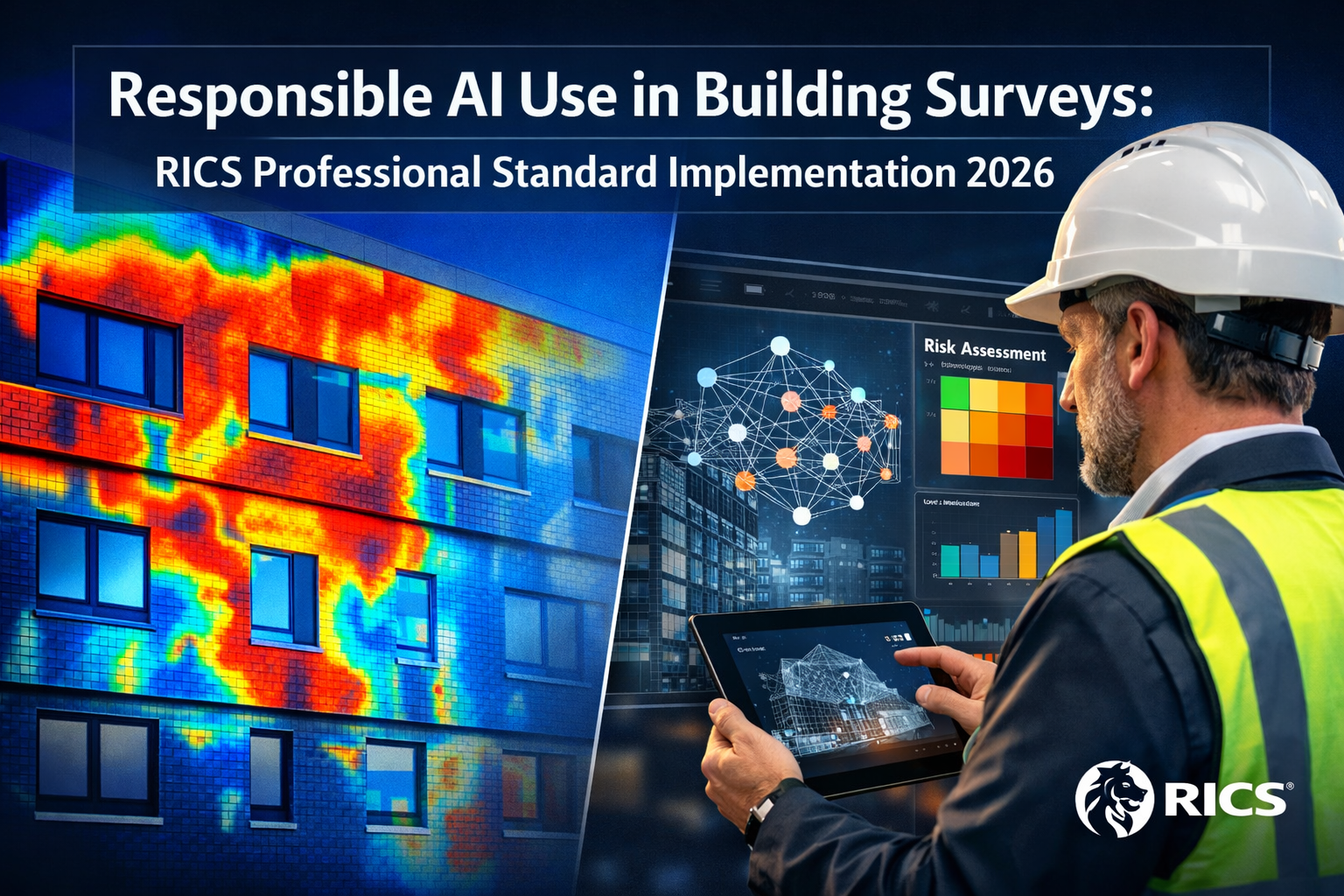

The Royal Institution of Chartered Surveyors (RICS) has drawn a line in the sand: as of March 9, 2026, every member and regulated firm using artificial intelligence with "material impact" on surveying services must comply with mandatory governance standards. This watershed moment transforms how building surveyors approach Responsible AI Use in Building Surveys: RICS Professional Standard Implementation for Defect Detection and Valuation Accuracy, making compliance not just best practice but a professional obligation backed by regulatory enforcement.
Building surveyors across the UK now face a critical challenge. AI tools promise unprecedented efficiency in identifying structural defects, automating valuation models, and generating comprehensive reports. Yet without proper governance frameworks, these same technologies introduce risks of algorithmic bias, erroneous outputs, and compromised professional accountability. The RICS standard addresses this tension head-on, establishing clear requirements for risk management, quality assurance, and human oversight.
Key Takeaways
- Mandatory compliance deadline: The RICS standard became enforceable on March 9, 2026, requiring all members and firms to implement governance frameworks for AI systems with material impact on service delivery
- Risk register requirement: Firms must maintain quarterly-reviewed written risk registers documenting inherent bias, erroneous outputs, and mitigation strategies for AI applications
- Human accountability remains central: Named appropriately-qualified surveyors must assess and document AI output reliability, with professional judgment superseding automated recommendations
- Transparency obligations: Clear client communication about AI involvement in surveys and valuations builds stakeholder confidence and meets regulatory standards
- Quality assurance protocols: Randomized dip-sampling and ongoing monitoring ensure AI systems produce accurate, reliable results in defect detection and valuation work
Understanding Material Impact in AI-Assisted Building Surveys
What Qualifies as Material Impact?
The RICS standard introduces a critical threshold concept: material impact. This determines which AI applications require full governance compliance. According to the standard, AI outputs qualify as having material impact when they influence service delivery in meaningful ways[2].
For building surveyors, material impact scenarios include:
- 🏗️ Summarizing documents for inclusion in survey reports or valuation assessments
- 📊 Composing portions of professional opinions or recommendations
- 🔍 Identifying building components requiring further investigation
- 💰 Generating valuation models based on comparable property data
- 📝 Automating defect categorization from inspection photographs
The RICS Regulatory Tribunal retains final authority to determine whether specific AI applications meet the material impact threshold[1]. This creates a dynamic standard where surveyors must exercise judgment about which tools require full compliance protocols.
Applications Below the Material Impact Threshold
Not every AI tool triggers mandatory compliance. Basic administrative applications typically fall outside the standard's scope:
- Spell-checking and grammar correction
- Calendar scheduling and appointment management
- Basic data entry automation
- Generic email composition without technical content
However, surveyors should document their reasoning when determining an application falls below the material impact threshold[2]. This documentation provides protection if regulatory questions arise later.
Core Requirements for Responsible AI Use in Building Surveys: RICS Professional Standard Implementation
The Risk Register Mandate
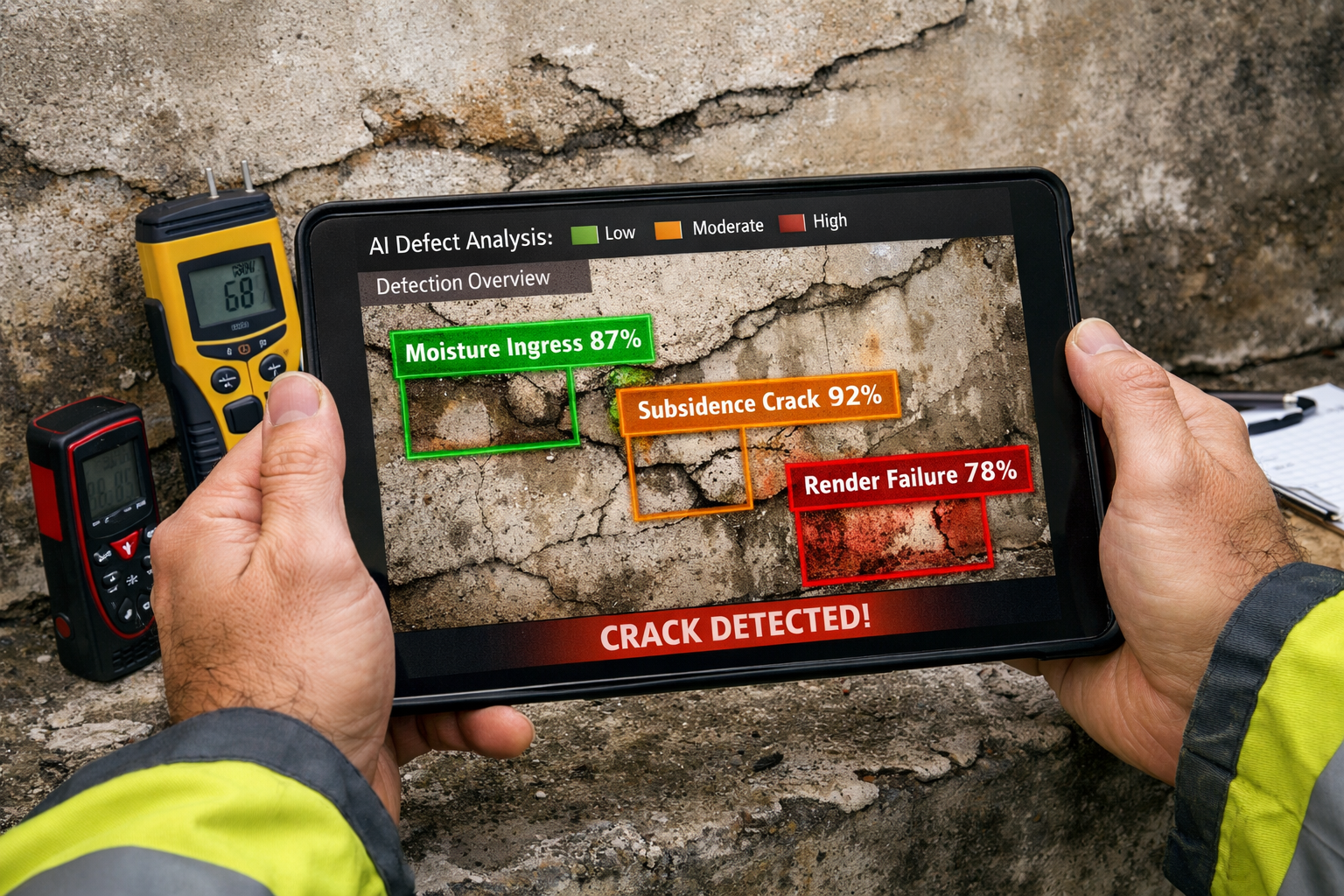
At the heart of Responsible AI Use in Building Surveys: RICS Professional Standard Implementation for Defect Detection and Valuation Accuracy lies a non-negotiable requirement: firms using AI with material impact must create and maintain a written risk register[3][4].
This register must be reviewed at least quarterly and document three critical elements:
1. Inherent Bias Identification
AI systems trained on historical building data may perpetuate biases. For example:
- Valuation algorithms might undervalue properties in certain postcodes based on historical discrimination patterns
- Defect detection models trained primarily on Victorian terraces may perform poorly on modern construction
- Image recognition systems might misidentify building materials common in specific cultural architectural styles
2. Erroneous Output Documentation
The risk register must track instances where AI systems produce incorrect or misleading results:
- False positives in defect detection that flag cosmetic issues as structural problems
- Valuation estimates that ignore recent market shifts or unique property features
- Automated report sections that contradict physical inspection findings
3. Mitigation Strategies
For each identified risk, firms must document specific mitigation approaches:
- Human verification protocols for high-stakes determinations
- Regular model retraining with diverse data sets
- Cross-referencing AI outputs against traditional surveying methods
- Clear escalation procedures when AI confidence scores fall below thresholds
Professional Judgment and Named Surveyor Accountability
The RICS standard places human professional judgment at the center of AI-assisted workflows[4]. This represents a crucial safeguard against over-reliance on automated systems.
Key requirements include:
Named Surveyor Designation: A specifically identified, appropriately-qualified surveyor must take responsibility for outputs with material impact[1]. This individual must be able to:
- Explain the reasoning behind AI-assisted conclusions
- Justify decisions if challenged by clients or regulators
- Override AI recommendations when professional judgment dictates
Written Reliability Assessments: Surveyors must assess and document in writing the reliability of AI outputs for each material application[4]. This documentation should address:
- The AI system's known accuracy rates for similar tasks
- Limitations of the training data or algorithms
- Circumstances where human judgment modified AI recommendations
- Quality assurance checks performed on outputs
When conducting building surveys, chartered surveyors cannot simply accept AI-generated defect lists without verification. Professional accountability requires physical inspection, contextual understanding, and expert interpretation.
Data Governance and Procurement Standards
Before deploying AI systems, firms must establish robust data governance policies[1][4]. These policies should address:
| Governance Area | Key Requirements |
|---|---|
| Data Quality | Ensure training data represents diverse building types, ages, locations, and conditions |
| Data Security | Protect client information and proprietary survey data from unauthorized access |
| Data Provenance | Document sources of training data and verify accuracy of historical records |
| Data Retention | Establish clear policies for storing AI inputs and outputs alongside traditional records |
When procuring third-party AI systems, firms must conduct written due diligence[4]. This assessment should evaluate:
- System design methodology and algorithmic approach
- Data sources used for model training
- Bias testing procedures and results
- Performance validation across diverse scenarios
- Vendor support for ongoing model updates and improvements
For chartered surveyors selecting AI tools for defect detection or valuation work, this due diligence prevents costly mistakes and regulatory violations.
Implementing Responsible AI Use in Building Surveys: RICS Professional Standard for Defect Detection
AI Applications in Defect Detection
Modern AI systems offer powerful capabilities for identifying building defects:
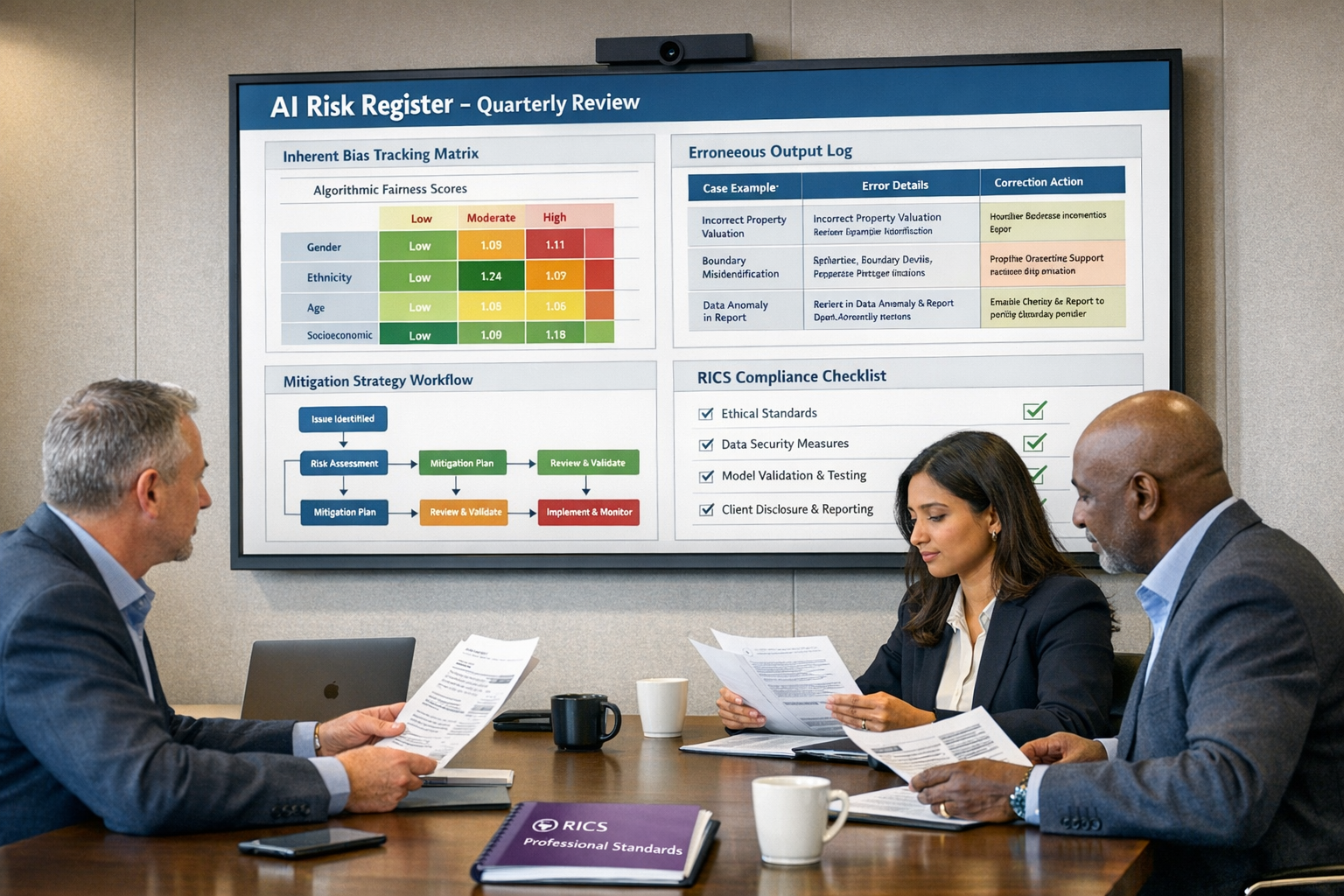
Computer Vision for Structural Issues: Machine learning models can analyze photographs to identify:
- Cracking patterns indicating subsidence or settlement
- Moisture staining suggesting water ingress
- Render deterioration requiring repair
- Roof tile displacement or damage
However, responsible implementation requires understanding these systems' limitations. AI trained primarily on external defects may miss internal structural problems. Models developed in one geographic region may not recognize construction methods common elsewhere.
When using AI for subsidence surveys or roof inspections, surveyors must verify AI findings through traditional investigation methods. The technology augments rather than replaces professional expertise.
Thermal Imaging and AI Analysis
Combining thermal imaging with AI interpretation represents a promising frontier for defect detection. AI algorithms can analyze thermal images to identify:
- Insulation gaps causing heat loss
- Hidden moisture behind wall surfaces
- Electrical faults generating excess heat
- Air leakage points compromising building performance
The RICS standard requires surveyors using these tools to document:
- The AI system's accuracy rates for thermal anomaly detection
- Environmental conditions affecting thermal imaging reliability
- Human verification procedures for flagged issues
- Alternative investigation methods considered
For drone roof surveys, AI-powered image analysis can process hundreds of photographs efficiently. Yet the named surveyor must review findings and apply professional judgment about which anomalies warrant further investigation.
Quality Assurance Protocols for Defect Detection
The standard mandates quality assurance through randomized dip-sampling[4]. For defect detection applications, this means:
Sampling Strategy: Regularly select random AI-analyzed surveys for complete human review:
- Compare AI-identified defects against manual inspection findings
- Document false positives and false negatives
- Track accuracy rates over time
- Adjust confidence thresholds based on performance data
Feedback Loops: Use quality assurance findings to improve AI performance:
- Report systematic errors to AI system vendors
- Retrain models with corrected data
- Update internal protocols when patterns emerge
- Share learnings across the surveying team
Documentation Requirements: Record quality assurance activities in writing[2][3]:
- Date and scope of each sampling review
- Discrepancies identified between AI and human assessment
- Actions taken to address performance issues
- Trends observed across multiple reviews
Responsible AI Use in Building Surveys: RICS Professional Standard Implementation for Valuation Accuracy
AI in Property Valuation Models
Artificial intelligence transforms property valuation through:
Automated Valuation Models (AVMs): These systems analyze comparable sales data, market trends, and property characteristics to generate value estimates. When properly implemented, AVMs can:
- Process vast datasets beyond human capacity
- Identify subtle market patterns and correlations
- Provide rapid preliminary valuations for portfolio work
- Flag properties requiring manual valuation due to unique features
However, Responsible AI Use in Building Surveys: RICS Professional Standard Implementation for Defect Detection and Valuation Accuracy demands critical oversight of these tools[1][4].
Risk Areas in AI Valuation:
⚠️ Data Currency: AVMs rely on historical transaction data that may not reflect current market conditions. Rapid market shifts following economic events can render AI valuations inaccurate.
⚠️ Unique Property Features: AI struggles with properties having unusual characteristics:
- Listed buildings with heritage restrictions
- Properties with significant renovation or extension work
- Homes with exceptional views or locations
- Buildings with specialized commercial uses
⚠️ Local Market Nuances: Algorithms may miss hyperlocal factors affecting value:
- Planned infrastructure developments
- School catchment area changes
- Neighborhood regeneration projects
- Local planning policy shifts
When conducting RICS valuations, professionals must document how AI outputs were verified and what adjustments professional judgment required.
Implementing Valuation Quality Controls
The RICS standard requires specific quality assurance for AI-assisted valuations:
Confidence Threshold Protocols: Establish clear rules for when AI valuations require human review:
- Properties where AI confidence scores fall below defined thresholds (e.g., 85%)
- Valuations showing significant variance from recent comparable sales
- Properties with incomplete or outdated data in AI training sets
- High-value properties where valuation accuracy critically impacts decisions
Comparable Sales Verification: Named surveyors must verify that AI-selected comparable properties genuinely reflect market conditions:
- Review actual transaction circumstances (e.g., distressed sales, family transfers)
- Confirm property condition similarity through inspection records
- Assess timing relevance of comparable sales
- Consider qualitative factors AI may overlook
Professional Override Documentation: When surveyors adjust AI-generated valuations, written documentation must explain[2]:
- Specific factors the AI system failed to consider
- Evidence supporting the professional adjustment
- Magnitude of the adjustment and its impact on final valuation
- Alternative approaches considered
For specialized work like matrimonial valuations or insurance reinstatement valuations, human expertise remains irreplaceable despite AI capabilities.
Client Communication and Transparency Requirements
Mandatory Disclosure Obligations
The RICS standard mandates transparent client communication about AI involvement in service delivery[1]. This builds confidence and ensures clients understand how technology influenced professional conclusions.
Disclosure Timing: Inform clients about AI use:
- During initial engagement discussions
- In terms of business documentation
- Within survey reports and valuation documents
- When responding to client questions about methodology
Disclosure Content: Explain clearly:
- Which aspects of the service involved AI assistance
- How professional judgment verified and supplemented AI outputs
- Limitations of the AI systems employed
- The named surveyor responsible for final conclusions
Example Disclosure Language:
"This building survey incorporated AI-assisted defect detection technology to analyze inspection photographs. All AI-identified issues were verified through physical inspection by our chartered surveyor, [Name], who takes full professional responsibility for the findings and recommendations in this report."
Building Stakeholder Confidence
Transparency about AI use strengthens rather than undermines professional credibility when properly communicated:
Emphasize Enhanced Capabilities: Frame AI as a tool that enables:
- More comprehensive analysis of complex data
- Identification of subtle patterns requiring investigation
- Efficient processing of large property portfolios
- Consistent application of technical standards
Highlight Human Oversight: Reassure clients that:
- Qualified professionals review all AI outputs
- Traditional surveying methods verify automated findings
- Professional judgment supersedes algorithmic recommendations
- Accountability remains with named chartered surveyors
Address Common Concerns: Proactively respond to client questions about:
- Data security and confidentiality protections
- AI system accuracy rates and validation procedures
- Circumstances where human judgment overrode AI recommendations
- Ongoing quality assurance and improvement processes
Training, Competency, and Knowledge Requirements
Baseline Knowledge Standards
The RICS standard establishes baseline knowledge requirements for surveyors using AI systems[3]. This enables profession-wide upskilling to minimize risks from inadequate technical understanding.
Core Competencies Required:
📚 AI Fundamentals: Understanding of:
- How machine learning algorithms function
- Difference between supervised and unsupervised learning
- Concept of training data and model accuracy
- Limitations of AI systems and common failure modes
📚 Risk Assessment: Ability to:
- Identify potential biases in AI systems
- Recognize scenarios where AI outputs may be unreliable
- Evaluate quality of training data and model validation
- Document risks and mitigation strategies effectively
📚 Quality Assurance: Skills in:
- Designing appropriate sampling and verification protocols
- Interpreting AI confidence scores and uncertainty measures
- Comparing AI outputs against traditional methods
- Implementing feedback loops for continuous improvement
📚 Ethical Considerations: Awareness of:
- Professional obligations under RICS standards
- Client confidentiality and data protection requirements
- Transparency and disclosure obligations
- Accountability frameworks and regulatory expectations
Ongoing Training Requirements
Firms must implement training programs covering[4]:
Initial Onboarding: Before surveyors use AI systems with material impact:
- System-specific training on functionality and limitations
- Review of firm's AI governance policies and procedures
- Practice exercises with supervised feedback
- Assessment of competency before independent use
Continuous Professional Development: Regular updates addressing:
- Emerging AI technologies and applications
- Lessons learned from quality assurance reviews
- Regulatory developments and guidance updates
- Industry best practices and case studies
Documentation: Maintain training records showing:
- Topics covered and duration of training sessions
- Attendance records for all relevant staff
- Competency assessments and results
- Refresher training schedules and completion
System Governance and Assessment Procedures
Pre-Implementation Assessment
Before deploying AI systems, the RICS standard requires firms to complete and record system governance assessment steps[2]. This written assessment must cover:
System Design Evaluation:
- Algorithm type and methodology employed
- Intended use cases and known limitations
- Development and validation procedures followed
- Update and maintenance protocols
Data Source Analysis:
- Origin and quality of training data
- Representativeness across property types and locations
- Data collection and labeling procedures
- Frequency of data updates and model retraining
Bias Testing Results:
- Testing procedures used to identify potential biases
- Results across different property types and demographics
- Mitigation measures implemented by developers
- Ongoing monitoring protocols for bias detection
Performance Validation:
- Accuracy rates on test datasets
- Performance across different scenarios and edge cases
- Comparison against human expert performance
- Limitations and known failure modes
For firms considering AI tools for dilapidation surveys or valuation work, this assessment prevents costly implementation mistakes.
Ongoing Monitoring and Review
System governance extends beyond initial implementation:
Performance Monitoring: Track key metrics continuously:
- Accuracy rates compared to human verification
- False positive and false negative rates for defect detection
- Valuation variance from final professional determinations
- Client feedback and complaint patterns
Quarterly Reviews: Conduct formal reviews examining[3][4]:
- Risk register updates with new issues identified
- Quality assurance findings and trends
- Training effectiveness and competency gaps
- System performance changes over time
Vendor Engagement: Maintain active relationships with AI system providers:
- Report systematic issues and performance concerns
- Request information about model updates and changes
- Participate in user groups and feedback forums
- Negotiate service level agreements covering accuracy and support
Regulatory Enforcement and Compliance Consequences
RICS Regulatory Tribunal Authority
The RICS Regulatory Tribunal holds significant enforcement powers regarding AI standard compliance[1]. The tribunal can:
- Investigate complaints about AI misuse in surveying services
- Determine whether specific applications had material impact
- Assess whether firms met governance requirements
- Impose sanctions for non-compliance
Potential Sanctions for standard violations include:
- Professional reprimands and warnings
- Mandatory additional training requirements
- Fines and financial penalties
- Practice restrictions or conditions
- In serious cases, removal from RICS membership
Building Compliance Programs
Firms should implement proactive compliance programs addressing:
Policy Development: Create comprehensive written policies covering:
- AI system procurement and approval procedures
- Risk register maintenance and review schedules
- Quality assurance protocols and sampling frequencies
- Client communication and disclosure requirements
- Training and competency standards
- Data governance and security measures
Internal Audits: Conduct regular compliance reviews:
- Verify risk registers are current and complete
- Check quality assurance documentation
- Review training records and competency assessments
- Test client communication and disclosure practices
- Assess data governance implementation
External Support: Consider engaging:
- Legal advisors for regulatory compliance guidance
- Technology consultants for AI system assessment
- Professional indemnity insurers for risk management advice
- Industry peer groups for best practice sharing
Practical Implementation Roadmap
Phase 1: Assessment and Planning (Months 1-2)
✅ Inventory Current AI Use: Document all AI systems currently used in surveying practice, categorizing by material impact potential
✅ Gap Analysis: Compare current practices against RICS standard requirements, identifying compliance gaps
✅ Resource Planning: Determine budget, personnel, and time requirements for compliance implementation
✅ Governance Structure: Establish oversight responsibilities and reporting lines for AI governance
Phase 2: Policy and Procedure Development (Months 2-4)
✅ Risk Register Creation: Develop comprehensive risk registers for all material impact AI applications
✅ Policy Documentation: Write formal policies addressing all standard requirements
✅ Procedure Development: Create step-by-step procedures for system assessment, quality assurance, and client communication
✅ Template Creation: Develop documentation templates for assessments, reviews, and disclosures
Phase 3: Training and Rollout (Months 4-6)
✅ Staff Training: Deliver comprehensive training to all surveyors using AI systems
✅ System Implementation: Deploy quality assurance protocols and monitoring procedures
✅ Client Communication: Update terms of business and report templates with required disclosures
✅ Monitoring Activation: Begin quarterly review cycles and quality assurance sampling
Phase 4: Review and Optimization (Ongoing)
✅ Performance Tracking: Monitor compliance metrics and system performance indicators
✅ Continuous Improvement: Refine procedures based on lessons learned and quality assurance findings
✅ Regulatory Monitoring: Stay informed about RICS guidance updates and industry developments
✅ Technology Evolution: Assess new AI capabilities and update governance frameworks accordingly
Conclusion
Responsible AI Use in Building Surveys: RICS Professional Standard Implementation for Defect Detection and Valuation Accuracy represents a fundamental shift in professional practice. The March 9, 2026 enforcement date marks the beginning of a new era where AI governance is not optional but mandatory for RICS members and regulated firms.
The standard strikes a careful balance between embracing technological innovation and maintaining professional accountability. By requiring risk registers, quality assurance protocols, human oversight, and transparent client communication, RICS ensures AI enhances rather than compromises surveying standards.
Building surveyors who implement robust governance frameworks position themselves for competitive advantage. Clients increasingly value transparency about AI use, and demonstrated compliance with professional standards builds trust and credibility. The firms that invest now in proper AI governance will lead the profession through the technological transformation ahead.
Actionable Next Steps
For Individual Surveyors:
- Review all AI tools you currently use and assess material impact
- Document your professional judgment process when using AI outputs
- Complete training on AI fundamentals and the RICS standard requirements
- Ensure you understand your firm's AI governance policies and procedures
For Surveying Firms:
- Conduct immediate compliance gap analysis against RICS standard requirements
- Establish or update risk registers for all material impact AI applications
- Implement quarterly review schedules and quality assurance protocols
- Update client communication materials with required AI disclosures
- Develop comprehensive training programs for all staff using AI systems
For Technology Selection:
- Complete written due diligence before procuring new AI systems
- Request bias testing results and performance validation data from vendors
- Negotiate service level agreements covering accuracy and ongoing support
- Establish clear data governance protocols for AI system integration
The surveying profession stands at a pivotal moment. Those who embrace responsible AI implementation while maintaining rigorous professional standards will define the future of building surveys and valuations. The RICS standard provides the roadmap—now comes the essential work of implementation.
For guidance on implementing AI governance in your surveying practice, consult with experienced chartered surveyors who understand both traditional methods and emerging technologies. Professional advice ensures compliance while maximizing the benefits AI offers for defect detection and valuation accuracy.
References
[1] Responsible Use Of Ai – https://www.rics.org/profession-standards/rics-standards-and-guidance/conduct-competence/responsible-use-of-ai
[2] Ai Responsible Use Standard – https://ww3.rics.org/uk/en/journals/construction-journal/ai-responsible-use-standard.html
[3] Responsible Use Of Artificial Intelligence In Surveying Practice September 2025 – https://www.rics.org/content/dam/ricsglobal/documents/standards/Responsible-use-of-artificial-intelligence-in-surveying-practice_September-2025.pdf
[4] Navigating The New Rics Ai Standard What It Means For Surveyors – https://www.artefact.com/blog/navigating-the-new-rics-ai-standard-what-it-means-for-surveyors/