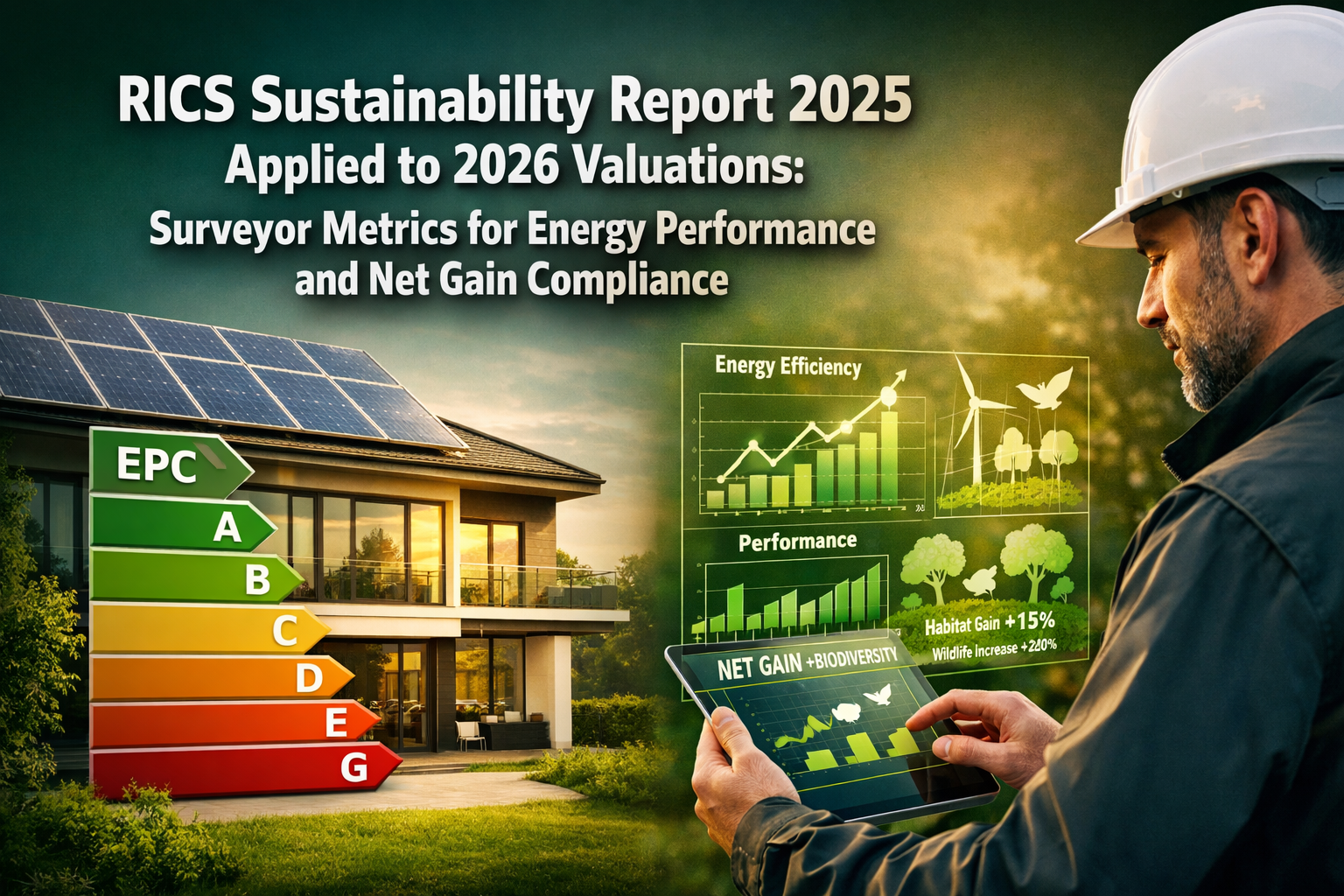

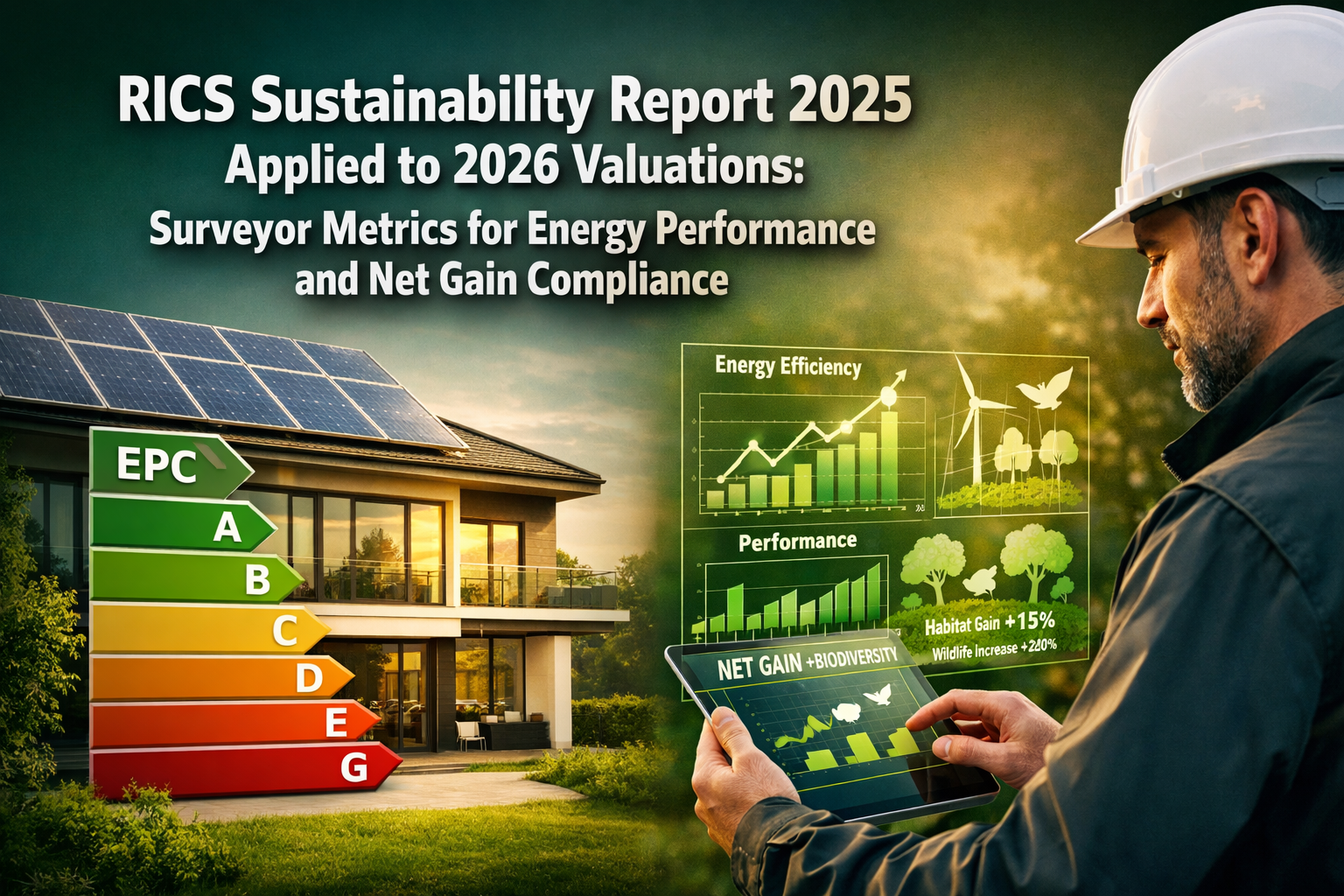
Property valuations in 2026 will exclude an estimated £47 billion worth of UK residential assets that fail to meet minimum Energy Performance Certificate (EPC) standards—a market correction that transforms sustainability from optional consideration to mandatory valuation factor. The RICS Sustainability Report 2025 Applied to 2026 Valuations: Surveyor Metrics for Energy Performance and Net Gain Compliance establishes the framework that chartered surveyors must now use to quantify environmental performance as a core component of property worth, not merely an advisory note.
The fourth edition of RICS's global professional standard on ESG and sustainability becomes effective April 30, 2026, representing a fundamental shift in how environmental, social, and governance factors are assessed in property valuations.[1] This isn't simply updated guidance—it's a regulatory transformation that requires surveyors to integrate energy performance metrics and biodiversity net gain calculations directly into valuation methodologies.
For property owners, developers, and investors, understanding how the RICS Sustainability Report 2025 Applied to 2026 Valuations: Surveyor Metrics for Energy Performance and Net Gain Compliance affects property values has become essential. The stakes are clear: properties with poor energy ratings face valuation penalties, while those demonstrating strong environmental credentials command premium pricing.
Key Takeaways
- April 30, 2026 marks the mandatory implementation date for the fourth edition of RICS ESG and sustainability standards in commercial property valuations globally[1]
- Energy Performance Certificate (EPC) ratings now directly impact property valuations, with upgrades from band D to B potentially increasing values by 8-12%
- Biodiversity Net Gain (BNG) compliance of 10% minimum is required for new developments and must be reflected in surveyor assessments
- Consolidated ESG Key Performance Indicators provide standardized metrics for measuring and comparing sustainability factors across properties[1]
- Jurisdiction-specific guidance for UK, EU, and Australia ensures compliance with regional regulatory frameworks[1]
Understanding the RICS Sustainability Report 2025 Framework
The RICS Sustainability Report 2025 examined sentiments from over 3,500 global professionals in commercial real estate and construction sectors to assess how climate considerations shape current practices.[5] The findings reveal a paradox: while the 2025 RICS Sustainable Building Index (SBI) remains positive, demand growth for green buildings has slowed, and the sector remains stagnant in adopting sustainable practices.[5]
Key Components of the Updated Standard
The fourth edition introduces several critical elements that surveyors must incorporate into their valuation methodologies:
🔍 Separation of Valuation from Strategic Advice
The revised standard clarifies that strategic ESG advice is typically a separate, additional service and should not be confused with valuation activities.[1] This distinction is crucial for property owners seeking professional valuation reports who need to understand which services address compliance versus market value assessment.
📊 Consolidated Global ESG KPI List
The updated standard includes a standardized list of typical ESG-related Key Performance Indicators to ensure consistent metric measurement across valuations.[1] These KPIs cover:
- Energy consumption per square meter
- Carbon emissions (operational and embodied)
- Water usage efficiency
- Waste management performance
- Biodiversity impact measurements
- Indoor air quality metrics
- Renewable energy generation capacity
⚖️ Proportionality and Professional Judgment
The fourth edition emphasizes proportionality, ensuring the standard works for different asset types, valuation risks, and varying levels of market maturity.[1] This flexibility allows surveyors to apply appropriate rigor based on property characteristics while maintaining consistency in methodology.
Regional Performance Variations
Interestingly, the Middle East and Africa (MEA) region has emerged as the strongest performer in sustainability adoption, with demand growth outpacing all other regions studied in the 2025 report.[5] This geographic variation demonstrates how local regulatory environments and market maturity influence sustainability integration in property valuations.
For UK-based properties, the standard now includes specific jurisdiction guidance reflecting established regulatory frameworks, including EPC requirements and emerging biodiversity net gain mandates.[1]
How Energy Performance Metrics Impact 2026 Property Valuations
Energy performance has transitioned from peripheral consideration to central valuation factor. The RICS Sustainability Report 2025 Applied to 2026 Valuations: Surveyor Metrics for Energy Performance and Net Gain Compliance provides the technical framework for quantifying this impact.
EPC Rating Valuation Adjustments
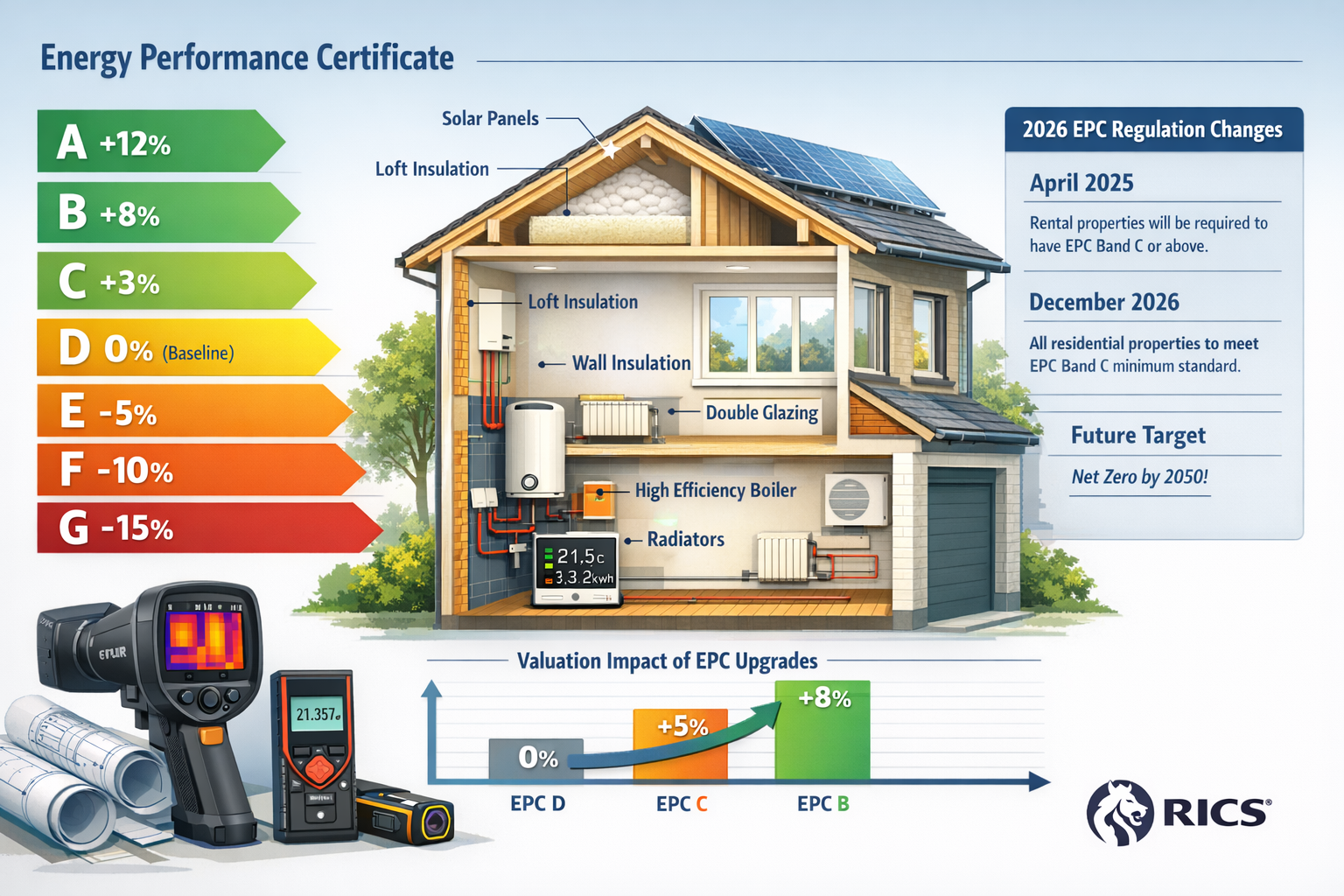
Current market data demonstrates clear valuation differentials based on EPC ratings:
| EPC Rating | Average Valuation Impact | Market Demand |
|---|---|---|
| A | +15% to +20% premium | Very High |
| B | +8% to +12% premium | High |
| C | Baseline to +5% | Moderate |
| D | -5% to -8% discount | Declining |
| E | -10% to -15% discount | Low |
| F-G | -20%+ discount | Very Low |
These adjustments reflect both regulatory compliance requirements and market preference for energy-efficient properties. Properties rated EPC D or below face increasing difficulty securing mortgage finance, directly impacting marketability and value.
Cost Assumptions Framework for Energy Upgrades
The revised standard provides practical guidance on cost assumptions in valuations, clarifying when and how capital and operational expenditure linked to ESG factors may be reflected in valuation.[1] This framework is essential when assessing properties requiring energy performance improvements.
Capital Expenditure Considerations:
- Insulation upgrades (wall, loft, floor): £4,000-£12,000 for typical residential properties
- Heating system replacement (heat pump installation): £8,000-£15,000
- Window replacement (double to triple glazing): £6,000-£10,000
- Solar PV installation: £5,000-£8,000 for 4kW system
- Smart energy management systems: £1,500-£3,000
When conducting RICS valuation assessments, surveyors must consider whether these improvement costs are reflected in current market value or represent future expenditure that impacts net valuation.
Operational Expenditure Impact
Beyond capital costs, the standard requires consideration of ongoing operational expenditure differences:
✅ Properties with EPC A-B ratings typically demonstrate:
- 40-60% lower annual energy costs
- Reduced maintenance requirements for modern systems
- Lower carbon tax exposure (as regulations tighten)
- Enhanced tenant/buyer appeal
❌ Properties with EPC D-G ratings face:
- Significantly higher utility bills
- Increased maintenance costs for aging systems
- Regulatory compliance risks
- Limited financing options
These operational factors directly influence investment value calculations and must be reflected in surveyor assessments under the 2026 standards.
Whole Life Carbon Assessments
Whole life carbon assessments have been mandatory for all RICS members globally conducting such assessments since July 1, 2024.[7] This earlier compliance requirement means that by 2026, surveyors must already be proficient in evaluating both operational carbon (from energy use) and embodied carbon (from construction materials and processes).
For residential properties, this involves:
- Operational carbon assessment over expected building lifespan
- Embodied carbon calculation for existing structure and proposed improvements
- Carbon reduction pathway showing compliance with net-zero targets
- Financial impact modeling of carbon-related costs and benefits
Biodiversity Net Gain Compliance in Surveyor Valuations
Biodiversity Net Gain (BNG) represents a newer but equally critical component of the RICS Sustainability Report 2025 Applied to 2026 Valuations: Surveyor Metrics for Energy Performance and Net Gain Compliance framework. Since November 2023, most new developments in England require a minimum 10% biodiversity net gain, fundamentally changing how development sites are valued.
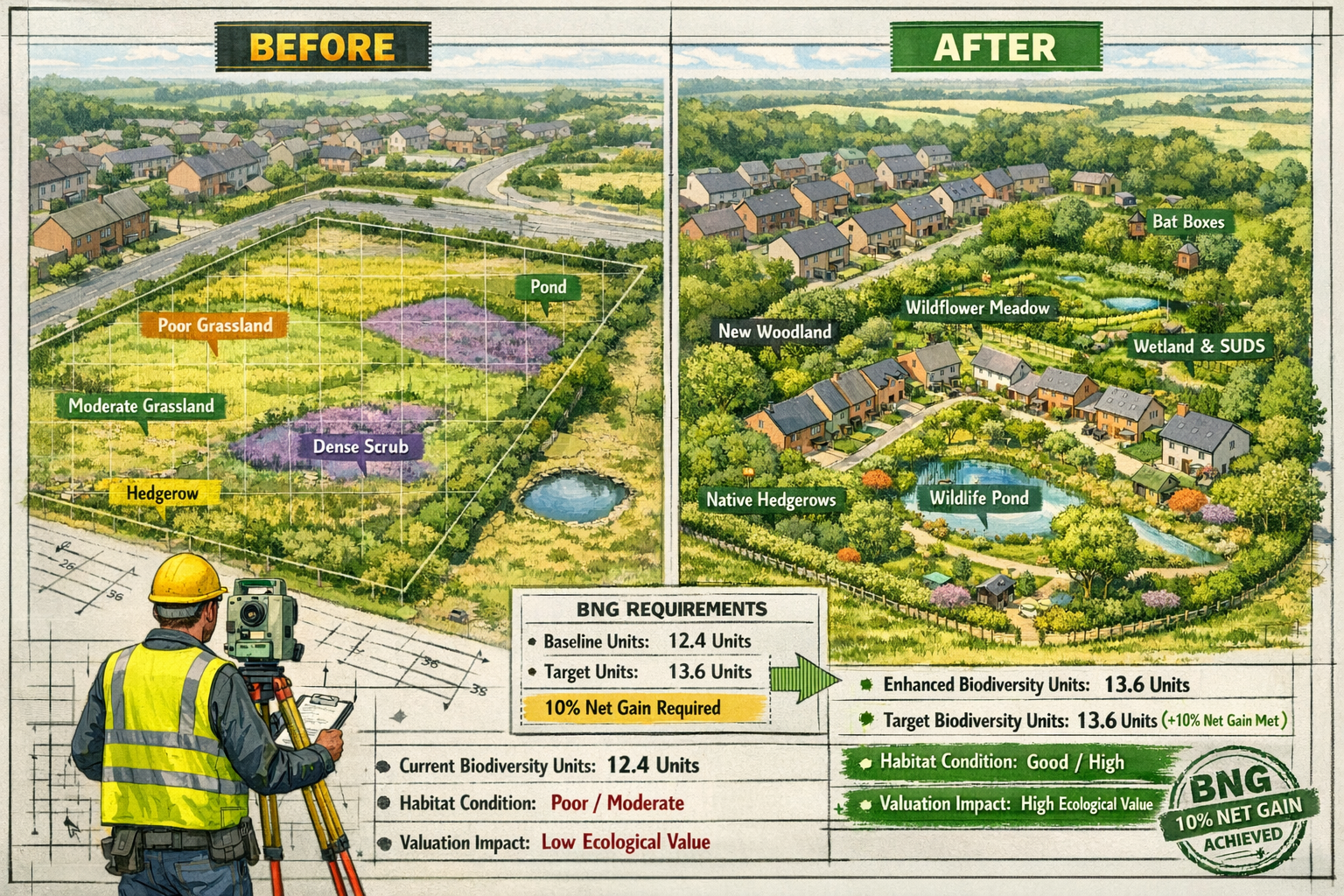
BNG Calculation Methodology for Surveyors
Surveyors must now incorporate biodiversity unit calculations into development site valuations. The methodology involves:
Step 1: Baseline Habitat Assessment
- Identify existing habitat types on site
- Assess habitat condition (poor, moderate, good)
- Calculate baseline biodiversity units using Defra metric
Step 2: Post-Development Habitat Prediction
- Map proposed habitat creation/enhancement
- Apply strategic significance multipliers
- Calculate post-development biodiversity units
Step 3: Net Gain Verification
- Confirm minimum 10% increase in biodiversity units
- Verify 30-year habitat management plan
- Document off-site compensation if required
Valuation Impact of BNG Requirements
BNG compliance affects property valuations through multiple channels:
Direct Costs:
- Habitat survey fees: £2,000-£5,000
- Biodiversity metric calculation: £1,500-£3,000
- Habitat creation/enhancement: £10,000-£50,000+ depending on site size
- 30-year management and monitoring: £15,000-£40,000
Indirect Value Impacts:
- Reduced developable area (if on-site provision required)
- Extended planning timeline (3-6 months additional)
- Enhanced market appeal for environmentally conscious buyers
- Potential premium for properties with established biodiversity features
For chartered surveyors conducting building assessments, understanding these cost implications is essential for accurate valuation of development sites and recently completed projects.
Off-Site BNG and Valuation Considerations
When on-site biodiversity provision isn't feasible, developers must purchase biodiversity units from off-site habitat banks or local authority schemes. This introduces additional valuation considerations:
- Unit pricing: Currently £15,000-£42,000 per biodiversity unit depending on habitat type and location
- Availability risk: Limited supply of biodiversity units in some regions
- Timing uncertainty: Potential delays if off-site provision requires additional approvals
Surveyors must assess whether development proposals have adequately budgeted for BNG compliance and reflect any shortfalls in their valuations.
Practical Application: Case Studies for Residential Properties
The theoretical framework becomes concrete when applied to real-world scenarios. These case studies demonstrate how the RICS Sustainability Report 2025 Applied to 2026 Valuations: Surveyor Metrics for Energy Performance and Net Gain Compliance affects residential property valuations in 2026.
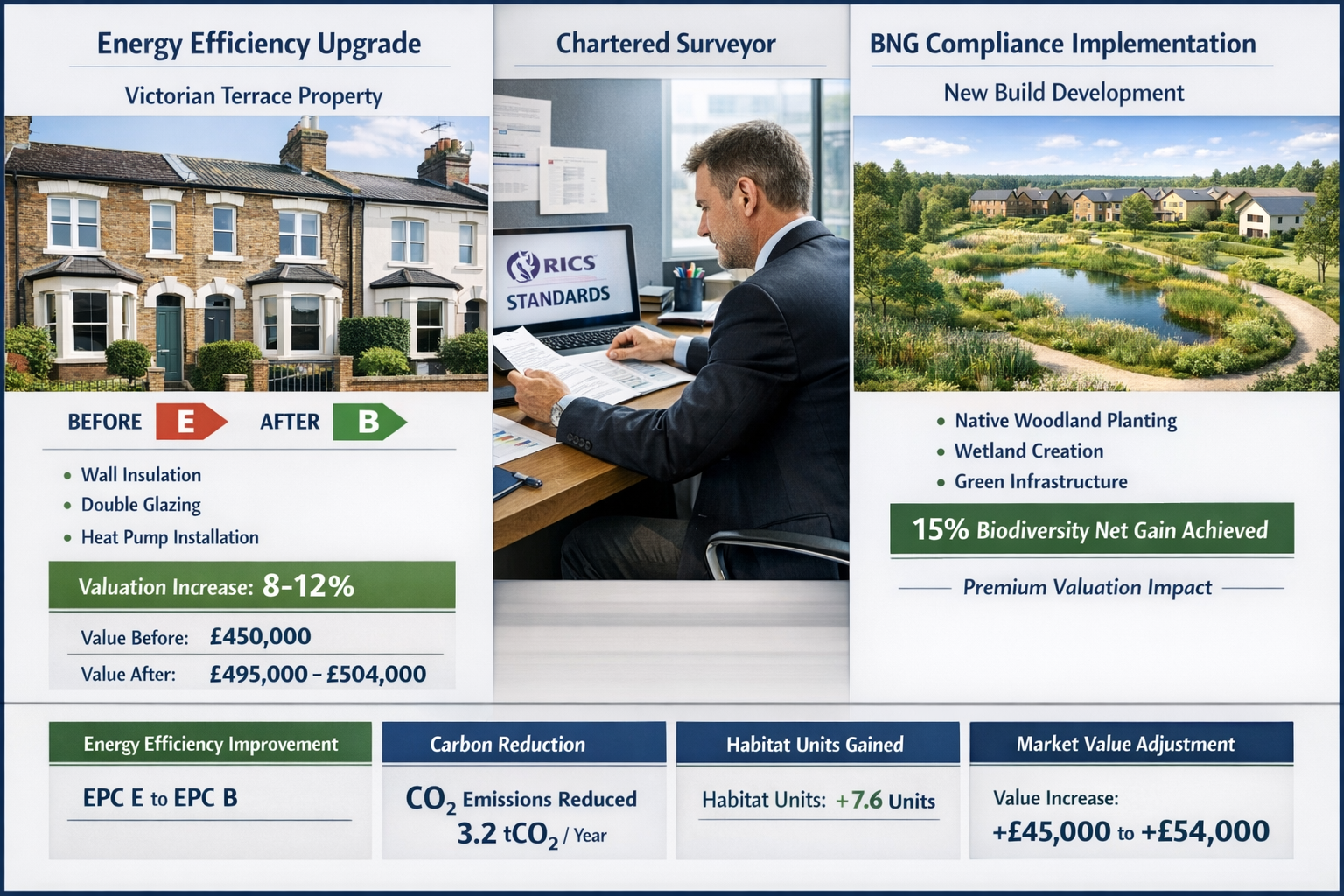
Case Study 1: Victorian Terrace EPC Upgrade
Property Profile:
- Location: South West London
- Type: Mid-terrace Victorian house (1890s)
- Size: 1,200 sq ft, 3 bedrooms
- Original EPC Rating: E (42 points)
Improvement Programme:
- External wall insulation: £8,500
- Loft insulation upgrade: £1,200
- Air source heat pump installation: £11,000
- Double glazing replacement: £7,500
- Solar PV (3.5kW): £6,000
- Total Investment: £34,200
Post-Improvement EPC Rating: B (83 points)
Valuation Impact:
- Pre-improvement market value: £650,000
- Post-improvement market value: £720,000
- Value increase: £70,000 (10.8%)
- Net gain after costs: £35,800
This case demonstrates how strategic energy performance improvements can generate substantial value uplift that exceeds investment costs. Surveyors in South West London increasingly encounter such scenarios where EPC upgrades are economically justified purely from a valuation perspective.
Surveyor Considerations:
- Verification of installation quality and certification
- Assessment of realistic energy cost savings (£1,800-£2,400 annually)
- Market evidence of EPC rating premiums in local area
- Consideration of alternative improvement pathways
Case Study 2: New Build Development with BNG Integration
Development Profile:
- Location: Surrey
- Type: Small residential development (8 houses)
- Site size: 0.8 hectares
- Planning approval: 2025
BNG Compliance Strategy:
- Baseline biodiversity units: 12.4 units
- Required post-development units: 13.64 units (10% gain)
- On-site provision: Native hedgerow planting, wildflower meadow, bat boxes, bird nesting sites
- Off-site provision: 2.1 units purchased from local habitat bank
BNG Costs:
- Habitat surveys and metric calculation: £4,200
- On-site habitat creation: £28,000
- Off-site unit purchase (2.1 units @ £18,000): £37,800
- 30-year management plan: £22,000
- Total BNG Cost: £92,000 (£11,500 per unit)
Valuation Impact:
- Development cost increase: £11,500 per house
- Market premium for "nature-positive" development: £15,000-£20,000 per house
- Net value impact: +£3,500 to +£8,500 per house
This case illustrates how BNG requirements add development costs but can generate market premiums when properly marketed. Surveyors in Surrey conducting development valuations must assess both cost implications and market positioning benefits.
Surveyor Considerations:
- Verification of biodiversity metric calculations
- Assessment of habitat management plan viability
- Market evidence for environmental premium pricing
- Risk assessment of off-site unit delivery
Case Study 3: Period Property with Combined EPC and Heritage Constraints
Property Profile:
- Location: Richmond
- Type: Grade II listed Georgian townhouse
- Size: 2,400 sq ft, 4 bedrooms
- Original EPC Rating: F (38 points)
Challenge: Balancing heritage conservation requirements with energy performance improvements.
Approved Improvement Programme:
- Internal wall insulation (breathable system): £15,000
- Secondary glazing (heritage-approved): £12,000
- Ground source heat pump (discreet installation): £18,000
- Loft insulation (non-invasive): £2,500
- Total Investment: £47,500
Post-Improvement EPC Rating: D (58 points)
Valuation Impact:
- Pre-improvement market value: £1,250,000
- Post-improvement market value: £1,295,000
- Value increase: £45,000 (3.6%)
- Net cost after value increase: £2,500
This case demonstrates the challenges of improving energy performance in heritage properties. While the EPC improvement is more modest (F to D rather than E to B), it addresses critical marketability concerns. Surveyors in Richmond must balance heritage considerations with sustainability requirements when valuing listed properties.
Surveyor Considerations:
- Heritage consent compliance verification
- Realistic EPC improvement potential given constraints
- Market penalty for sub-standard EPC in premium locations
- Alternative improvement technologies suitable for heritage properties
Surveyor Metrics and Reporting Requirements for 2026
The RICS Sustainability Report 2025 Applied to 2026 Valuations: Surveyor Metrics for Energy Performance and Net Gain Compliance establishes specific reporting requirements that surveyors must follow when sustainability factors materially affect property values.
Mandatory Reporting Elements
When conducting valuations under the 2026 standards, surveyors must include:
1. ESG Factor Identification
- Clear statement of which ESG factors are material to the valuation
- Explanation of how these factors influence market value
- Assessment of market maturity regarding ESG considerations
2. Energy Performance Documentation
- Current EPC rating and certificate details
- Energy consumption data (where available)
- Identification of potential improvement pathways
- Cost-benefit analysis of energy upgrades (where relevant)
3. Biodiversity Assessment (for development sites)
- Baseline biodiversity unit calculation
- BNG compliance status
- Associated costs or value impacts
- Off-site provision arrangements (if applicable)
4. Carbon Metrics
- Operational carbon assessment
- Embodied carbon considerations (for new build/major renovation)
- Alignment with net-zero pathways
- Carbon-related financial risks or opportunities
5. Cost Assumptions Transparency
- Clear statement of assumed capital expenditure for improvements
- Operational cost implications
- Basis for cost estimates (quotes, industry benchmarks, etc.)
- Sensitivity analysis where material uncertainty exists
Red Book Alignment
The revised standard aligns with mandatory requirements in RICS Valuation Global Standards (the "Red Book") and International Valuation Standards (IVS).[1] This alignment ensures that sustainability assessments are integrated into core valuation methodology rather than treated as supplementary information.
For surveyors conducting Red Book valuations, this means sustainability factors must be addressed within the main valuation report, not relegated to appendices or separate documents.
Professional Judgment and Proportionality
The fourth edition emphasizes that surveyors must apply professional judgment to determine the appropriate level of detail for sustainability assessment based on:
- Property type and value (higher-value properties warrant more detailed analysis)
- Transaction purpose (investment acquisitions require more rigorous assessment than basic market valuations)
- Market maturity (established markets with clear ESG pricing require detailed analysis)
- Data availability (comprehensive assessment possible only where data exists)
This proportionality principle prevents over-burdensome requirements for straightforward valuations while ensuring rigorous analysis where sustainability factors materially affect value.
Implementation Challenges and Solutions for Surveyors
As the April 30, 2026 implementation date approaches, surveyors face several practical challenges in applying the RICS Sustainability Report 2025 Applied to 2026 Valuations: Surveyor Metrics for Energy Performance and Net Gain Compliance.
Challenge 1: Data Availability and Quality
The Problem:
Many properties lack comprehensive energy performance data beyond basic EPC certificates. Biodiversity data is often non-existent for existing properties.
Solutions:
- Develop relationships with energy assessors for detailed performance data
- Utilize thermal imaging and energy audits for properties requiring detailed assessment
- Build databases of typical performance metrics for common property types
- Collaborate with ecologists for biodiversity assessments on development sites
Challenge 2: Valuing Improvement Costs vs. Market Value Impact
The Problem:
The cost of energy or biodiversity improvements doesn't always translate directly to equivalent value increase.
Solutions:
- Build comprehensive databases of market evidence showing ESG premium/discount
- Conduct sensitivity analysis showing value impact under different market scenarios
- Clearly separate improvement cost from value impact in reporting
- Consider payback periods and ROI calculations for improvement investments
Challenge 3: Regional Market Maturity Variations
The Problem:
ESG factors command significant premiums in some markets (e.g., central London) but minimal impact in others.
Solutions:
- Develop market-specific guidance for different geographic areas
- Monitor transaction evidence to track evolving ESG pricing
- Clearly state market maturity level in valuation reports
- Provide forward-looking assessment of likely ESG impact evolution
Challenge 4: Heritage and Technical Constraints
The Problem:
Listed buildings and properties with technical constraints face limited improvement options.
Solutions:
- Develop expertise in heritage-compatible sustainability solutions
- Build networks of specialist contractors and consultants
- Educate clients on realistic improvement potential given constraints
- Advocate for policy adjustments recognizing heritage property limitations
Challenge 5: Keeping Pace with Regulatory Change
The Problem:
Sustainability regulations continue evolving rapidly, making it difficult to maintain current knowledge.
Solutions:
- Establish continuous professional development programs focused on sustainability
- Subscribe to regulatory update services
- Participate in RICS working groups and industry forums
- Develop internal knowledge-sharing systems
Future Outlook: Beyond 2026
While the April 30, 2026 implementation date represents a significant milestone, sustainability integration in property valuations will continue evolving beyond this point.
Emerging Trends
🌡️ Climate Risk Assessment
Future standards will likely require more sophisticated climate risk assessment, including:
- Flood risk modeling under various climate scenarios
- Overheating risk assessment
- Resilience to extreme weather events
- Long-term climate adaptation costs
🔄 Circular Economy Metrics
Valuation standards may expand to include:
- Material reusability and recyclability
- Waste reduction performance
- Circular design principles
- End-of-life deconstruction costs
💚 Social Value Measurement
The "S" in ESG will likely receive greater attention:
- Community impact assessments
- Health and wellbeing metrics
- Accessibility and inclusivity features
- Social infrastructure provision
📱 Technology Integration
Digital tools will increasingly support sustainability assessment:
- AI-powered energy performance prediction
- Automated biodiversity metric calculation
- Real-time carbon monitoring systems
- Digital twin modeling for improvement scenario testing
Preparing for Continued Evolution
Surveyors can prepare for ongoing evolution by:
- Building foundational sustainability knowledge that extends beyond current regulatory requirements
- Investing in technology tools that support comprehensive ESG assessment
- Developing specialist expertise in particular property types or sustainability aspects
- Maintaining flexible methodologies that can adapt to new requirements
- Engaging with policy development to shape future standards
Conclusion
The RICS Sustainability Report 2025 Applied to 2026 Valuations: Surveyor Metrics for Energy Performance and Net Gain Compliance represents a fundamental transformation in how property values are assessed. Sustainability factors have moved from peripheral considerations to core valuation components, with direct financial implications for property owners, developers, and investors.
The April 30, 2026 implementation date for the fourth edition of RICS's global ESG and sustainability standard marks the point at which these requirements become mandatory for commercial property valuations globally, with significant implications for residential properties as well.[1] Energy Performance Certificate ratings now directly impact property values, with clear evidence showing 8-12% premiums for properties achieving EPC Band B compared to Band D properties. Biodiversity Net Gain requirements add complexity and cost to development projects but can also generate market premiums when properly implemented and marketed.
For property owners, the message is clear: investing in energy performance improvements and biodiversity enhancement is no longer optional from a value perspective. Properties that fail to meet evolving sustainability standards face increasing valuation penalties and marketability challenges.
For surveyors, the 2026 standards require enhanced technical knowledge, comprehensive data collection, and sophisticated analysis to properly reflect sustainability factors in valuations. The consolidated ESG KPI list, jurisdiction-specific guidance, and clear cost assumption frameworks provide the tools needed for consistent, professional assessment.[1]
Actionable Next Steps
For Property Owners:
- Obtain current EPC assessment and identify improvement opportunities
- Commission professional building surveys that include sustainability assessment
- Develop costed improvement plans with ROI calculations
- Implement high-value improvements before selling or refinancing
- Document sustainability features comprehensively for valuation purposes
For Developers:
- Integrate BNG planning into early-stage project design
- Budget appropriately for sustainability compliance costs
- Consider sustainability features as market differentiators
- Engage ecologists and energy consultants early in the process
- Develop marketing strategies highlighting environmental credentials
For Surveyors:
- Complete CPD training on the fourth edition RICS ESG standard before April 30, 2026
- Develop data collection systems for sustainability metrics
- Build networks of specialist consultants for detailed assessments
- Create standardized reporting templates that meet new requirements
- Monitor market evidence of ESG premiums/discounts in your operating areas
The integration of sustainability into property valuations reflects broader societal recognition that environmental performance has real financial consequences. As regulations tighten and market preferences evolve, the valuation gap between high-performing and poor-performing properties will likely widen further. Understanding and applying the RICS Sustainability Report 2025 Applied to 2026 Valuations: Surveyor Metrics for Energy Performance and Net Gain Compliance framework positions all stakeholders to navigate this transformation successfully.
References
[1] Rics Publishes Updated Global Standard Esg Sustainability Commercial Property Valuation – https://www.rics.org/news-insights/rics-publishes-updated-global-standard-esg-sustainability-commercial-property-valuation
[3] Rics Publish New Edition Of The Global Red Book – https://www.terracottaproperty.com/blog/rics-publish-new-edition-of-the-global-red-book
[5] Sustainability Report 2025 – https://www.rics.org/news-insights/current-topics-campaigns/sustainability/sustainability-report-2025
[7] Whole Life Carbon Assessments In 2026 Valuations Rics 2nd Edition Standards For Surveyors – https://nottinghillsurveyors.com/blog/whole-life-carbon-assessments-in-2026-valuations-rics-2nd-edition-standards-for-surveyors