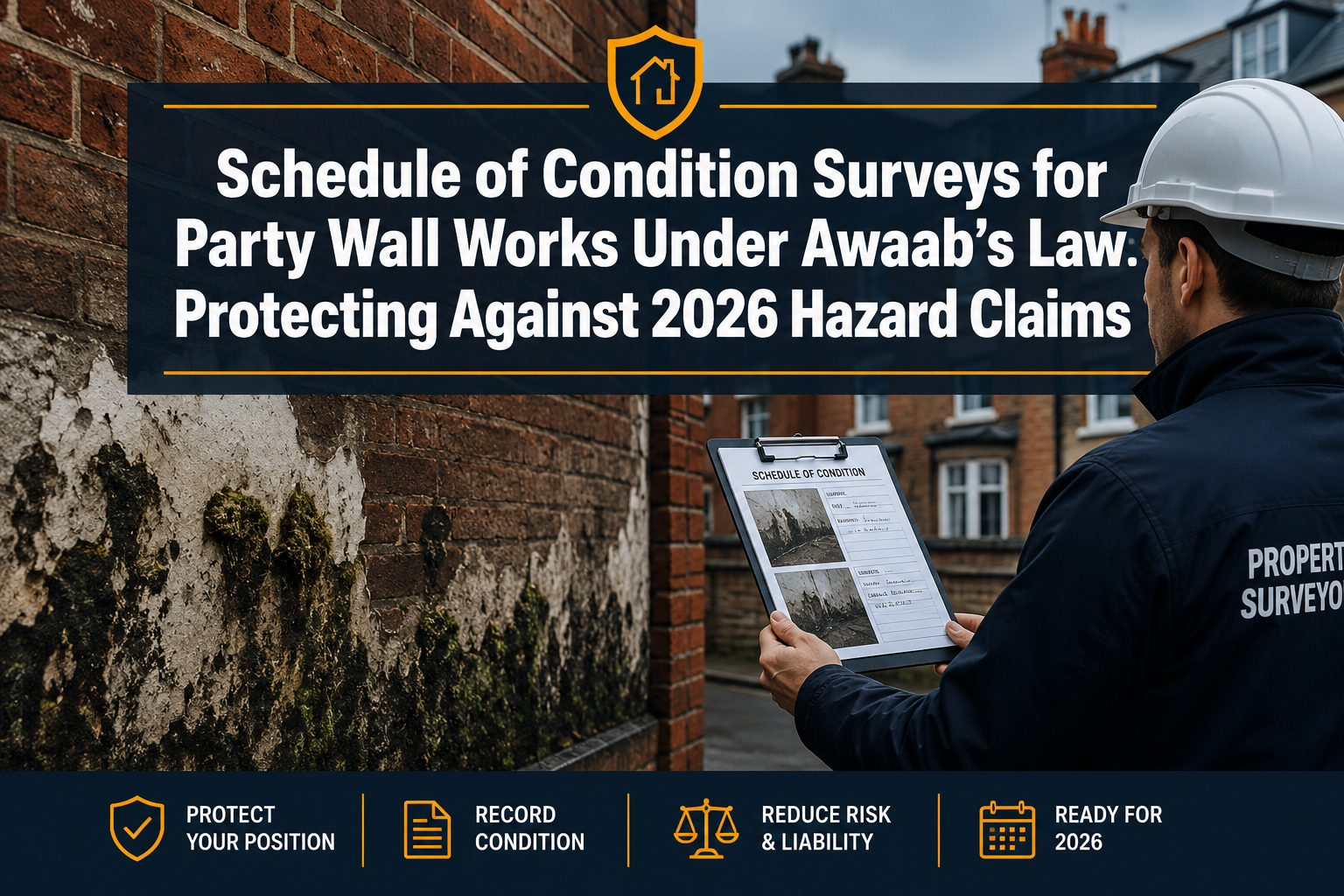

Damp and mould claims against landlords and building owners have risen sharply since Awaab's Law came into force in October 2025 — and the legal stakes climbed even higher when the legislation extended to private landlords on 1 May 2026. For anyone undertaking party wall works, this creates a specific and underappreciated risk: construction activity on or near a shared wall can trigger hazard complaints from adjoining owners or tenants, even when the damage pre-existed the works. The solution that experienced surveyors consistently recommend is a properly executed Schedule of Condition Survey — a detailed, dated, and photographic record of a property's state before any notifiable works begin.
Understanding how Schedule of Condition Surveys for Party Wall Works Under Awaab's Law: Protecting Against 2026 Hazard Claims interact is now essential knowledge for building owners, landlords, and their appointed surveyors alike.
Key Takeaways
- Awaab's Law now applies to private landlords as of May 2026, with strict response deadlines for hazards including damp, mould, excess cold, fire, and electrical faults.
- A Schedule of Condition Survey, completed before party wall works begin, is the primary defence against post-construction hazard claims.
- While not legally required under the Party Wall etc. Act 1996, a Schedule of Condition is universally regarded as best practice and can be decisive in dispute resolution.
- Phase 2 of Awaab's Law, expected later in 2026, will expand regulated hazards further — making pre-works surveys even more critical.
- Surveyors play a central role in preparing compliant, evidentially robust schedules that protect all parties.
What Awaab's Law Means for Party Wall Works in 2026
The Legislative Background
Awaab's Law takes its name from Awaab Ishak, a two-year-old child who died in 2020 as a direct result of prolonged exposure to mould in a social housing flat. The law was enacted in October 2025 as part of the Social Housing (Regulation) Act, initially targeting registered social landlords [1]. From 1 May 2026, the Renters' Rights Act 2025 extended the same obligations to the private rented sector, creating legally enforceable response timelines for housing hazards across virtually all tenures [3].
The mandatory response timescales are strict:
| Hazard Type | Investigation Deadline | Repair Commencement |
|---|---|---|
| Standard hazard (e.g. damp, mould) | 10 working days | 7 calendar days after investigation |
| Emergency hazard | 24 hours | Immediate action required |
Failure to meet these deadlines exposes landlords to civil penalties and compensation claims [2]. For landlords who also happen to share a party wall with a neighbour undertaking construction, the risk is compounded: works can disturb existing conditions, create new moisture pathways, or displace structural elements — all of which could trigger a hazard report under the Act.
How Party Wall Works Create Hazard Exposure
Party wall construction — including loft conversions, rear extensions, underpinning, and excavations near foundations — routinely affects adjoining properties. Vibration can open hairline cracks. Alterations to shared chimney breasts can disrupt thermal performance. Excavations can affect drainage runs. Any of these outcomes, if they result in damp penetration or excess cold in an adjoining let property, could constitute a reportable hazard under Awaab's Law.
Phase 2 of Awaab's Law, anticipated for later in 2026, will expand the regulated hazard list to include excess cold and heat, falls, structural collapse, fire, electrical hazards, and hygiene hazards [8]. This broader scope means that almost any construction-related defect affecting an adjoining tenanted property could fall within the legislation's reach.
The critical question in any resulting dispute will be: did the works cause the hazard, or did it pre-exist them? Without a Schedule of Condition, that question is almost impossible to answer objectively.
Schedule of Condition Surveys for Party Wall Works Under Awaab's Law: The Core Protective Mechanism
What a Schedule of Condition Is
A Schedule of Condition for party wall works is a detailed, pre-works record of an adjoining property's condition. It typically comprises:
- Written descriptions of every room and structural element adjacent to the proposed works
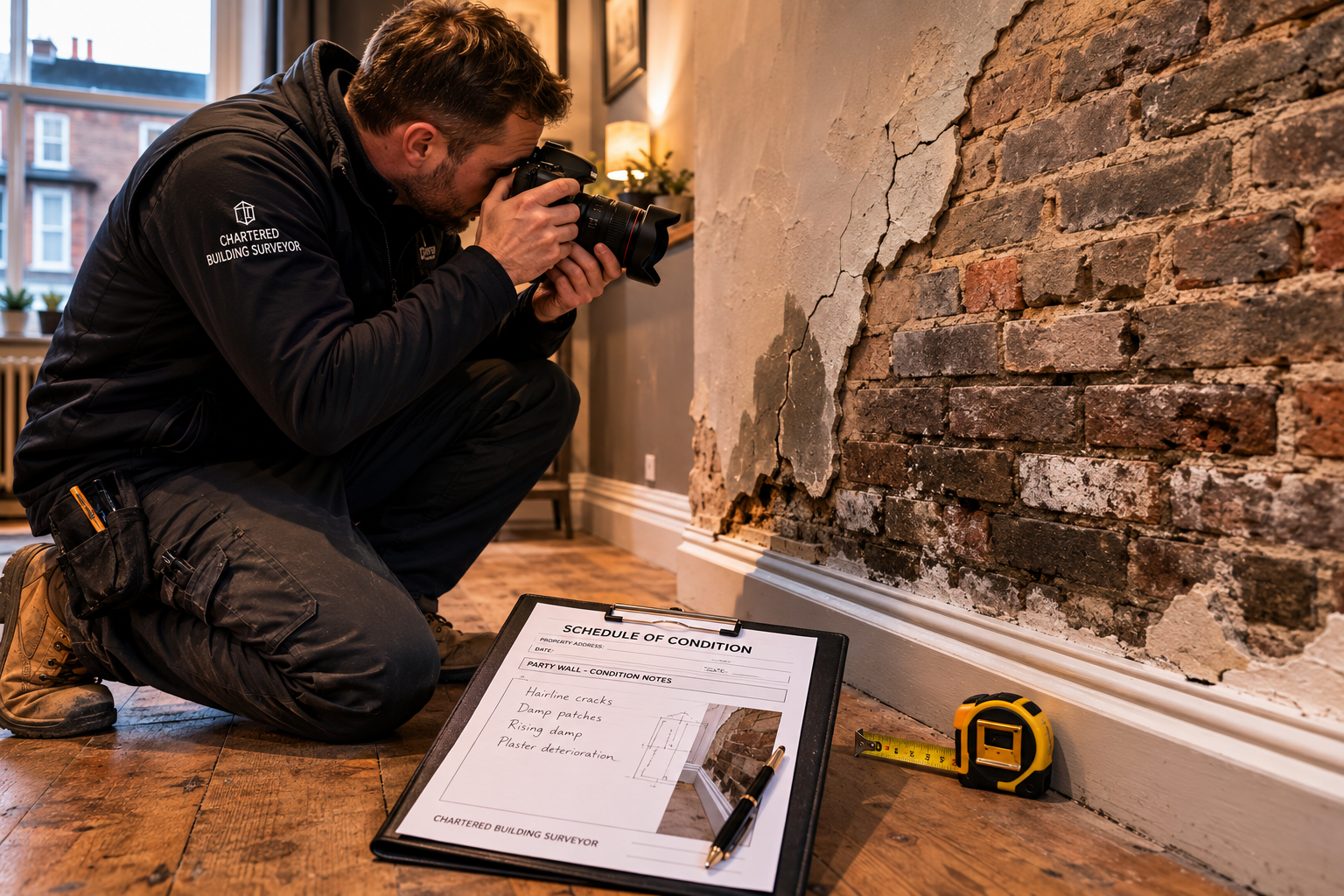
- Dated photographs of existing defects, including cracks, damp staining, mould patches, and surface deterioration
- Measurements of crack widths and locations, referenced to fixed points
- Notes on finishes, including the condition of tiled surfaces, plasterwork, and floor coverings near shared walls
Although the Party Wall etc. Act 1996 does not legally mandate a Schedule of Condition, it is universally treated as best practice by party wall surveyors and is frequently referenced in party wall awards as a baseline document [4].
"A Schedule of Condition is not a legal requirement, but its absence in a disputed claim is almost always to the detriment of the building owner."
The document is prepared before works commence and is agreed upon — or at least acknowledged — by all parties. It is then retained and compared against a post-works inspection to identify any new damage attributable to the construction.
Why Awaab's Law Makes This More Urgent Than Ever
Before Awaab's Law, the risk of a post-construction hazard claim was primarily a civil matter between neighbours. Now, if an adjoining property is tenanted, a landlord facing a damp or mould complaint triggered by nearby construction has just 10 working days to investigate and 7 calendar days to begin repairs [2]. If the landlord cannot demonstrate that the condition pre-existed the works, they face both the cost of remediation and potential enforcement action — even if the building owner next door is the actual cause.
A robust Schedule of Condition directly addresses this problem. It provides the adjoining landlord with documentary evidence to support a claim against the building owner, and it provides the building owner with evidence to contest any exaggerated or pre-existing claims.
For surveyors advising clients on party wall matters, this legislative shift means the Schedule of Condition has effectively moved from a recommended document to a near-essential one.
Specific Hazards to Document Before Works Begin
Given the expanded scope of Awaab's Law and its Phase 2 provisions, a 2026-compliant Schedule of Condition should specifically address the following hazard categories:
Damp and Mould
- Photograph all existing damp patches, tide marks, and mould growth
- Note surface moisture readings where possible
- Record the condition of any existing ventilation openings near the party wall
Excess Cold
- Document the condition of any shared chimney breast or flue that may be affected by works
- Note the presence and condition of insulation at party wall junctions
Falls Hazards
- Record the condition of tiled surfaces in bathrooms and kitchens adjacent to the party wall
- Note any existing loose or cracked tiles that could be disturbed by vibration [5]
Structural Condition
- Measure and photograph all existing cracks in walls, ceilings, and floors near the works zone
- Record the condition of lintels, window frames, and door frames adjacent to the shared wall
Fire and Electrical
- Note the position and condition of any electrical fittings near the party wall
- Record the condition of any fire-stopping elements at the party wall junction
Practical Templates and Protocols for Surveyors and Adjoining Owners
The Standard Schedule of Condition Template
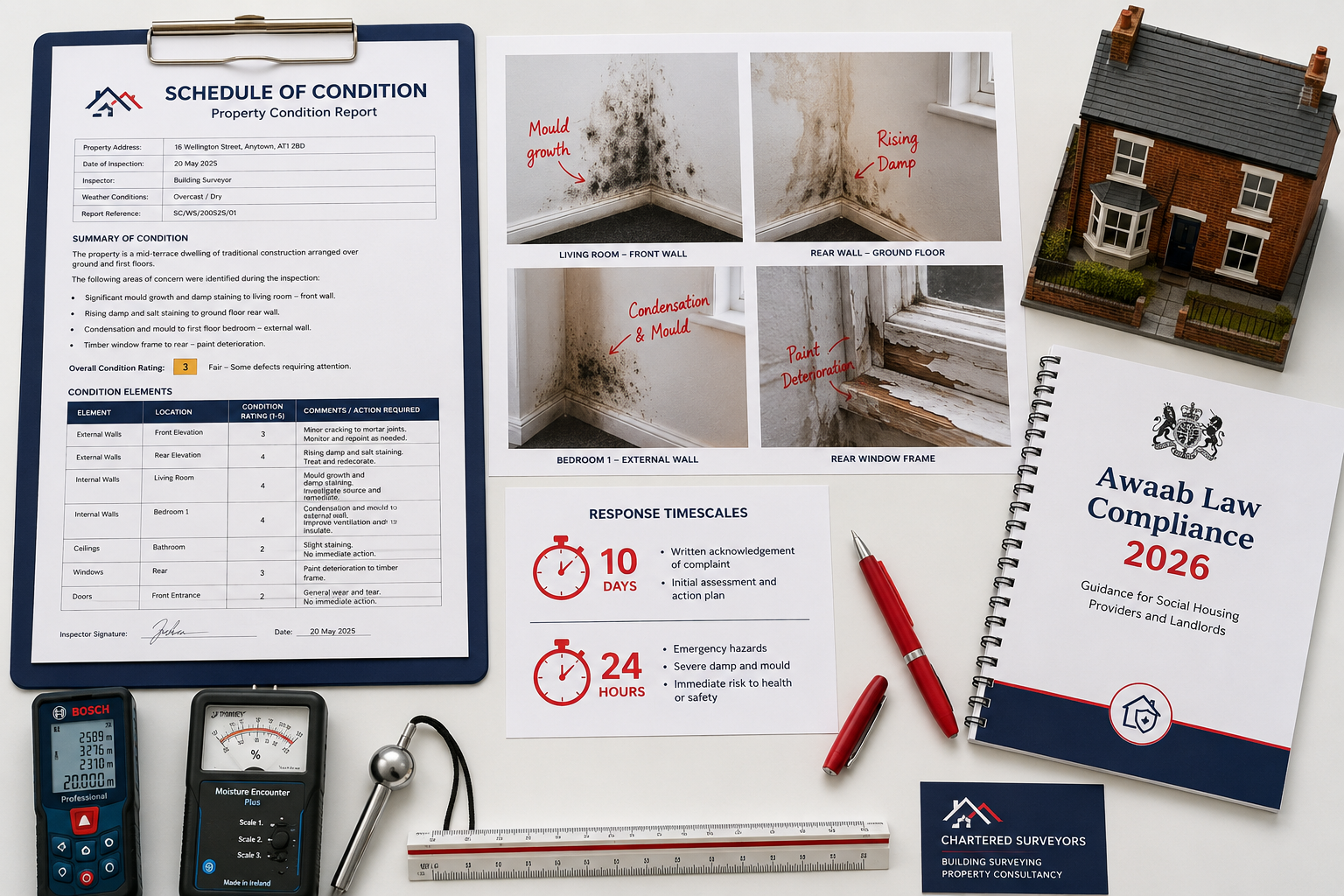
A well-structured Schedule of Condition for party wall works should follow a consistent format. The following template structure is recommended for 2026 compliance:
Section 1: Property Identification
- Address of the adjoining property
- Date of inspection
- Names of the building owner, adjoining owner, and appointed surveyors
- Reference to the relevant Party Wall Notice
Section 2: Scope of Works
- Brief description of the proposed works
- Identification of the areas of the adjoining property likely to be affected
Section 3: Room-by-Room Condition Record
For each affected room:
- General condition of walls, ceiling, and floor
- Specific defects noted (with photograph reference numbers)
- Crack schedule (location, orientation, width in millimetres)
- Damp readings where taken
Section 4: Photographic Schedule
- Numbered photographs cross-referenced to the written descriptions
- Photographs should be taken with a scale rule visible where defects are recorded
Section 5: Surveyor's Declaration
- Confirmation that the schedule accurately represents the condition observed
- Date and signature
For a broader understanding of what these reports contain and how they are used, the Schedule of Condition report guide provides useful context.
Who Commissions the Schedule?
Under standard party wall procedure, the Schedule of Condition is typically prepared by the adjoining owner's surveyor. However, where an agreed surveyor is appointed to act for both parties, that surveyor prepares the schedule as part of their overall duties.
The costs of preparing the Schedule of Condition are generally borne by the building owner, as they are the party proposing the works. This cost is usually included within the overall party wall surveyor's fees.
Post-Works Inspection Protocol
The Schedule of Condition is only half of the protection mechanism. After works are complete, a post-works inspection should be carried out to compare current conditions against the baseline record. The protocol should include:
- Re-inspection of all areas covered in the original schedule
- Comparison of crack widths against original measurements
- Moisture readings in areas where damp was noted or where new penetration is suspected
- Photographic record of any changes
- Written report identifying any new defects and their likely cause
If new defects are identified, the party wall award process provides a mechanism for the adjoining owner to seek compensation from the building owner. This is a separate process from any Awaab's Law enforcement action, but the two can run concurrently if the adjoining property is tenanted.
Legal Framework: Party Wall Act, Awaab's Law, and Dispute Resolution
How the Two Regimes Interact
The Party Wall etc. Act 1996 and Awaab's Law operate as parallel but distinct legal frameworks. The Party Wall Act governs the rights and obligations of building and adjoining owners during construction. Awaab's Law governs the obligations of landlords to their tenants regarding housing hazards. Where an adjoining property is tenanted, both regimes can apply simultaneously.
The key interaction points are:
- A building owner's party wall works create a hazard (e.g. new damp penetration) in an adjoining let property
- The tenant reports the hazard to their landlord (the adjoining owner)
- The landlord has 10 working days to investigate [2]
- If the investigation reveals the hazard was caused by the party wall works, the landlord has a claim against the building owner under the Party Wall Act
- The Schedule of Condition is the primary evidence in both the landlord's defence against the tenant's claim and the landlord's claim against the building owner
Without the Schedule of Condition, the landlord may be unable to prove causation — and may be held liable for a hazard they did not create.
For those facing an active party wall dispute, understanding this interaction is essential before any enforcement action is taken.
Case Law Considerations
While Awaab's Law is relatively new, the courts have consistently held that the burden of proof in damage claims following party wall works rests on the party alleging the damage. In the absence of a Schedule of Condition, courts have found it difficult to attribute damage to specific works, often resulting in claims being reduced or dismissed.
Conversely, where a detailed Schedule of Condition has been prepared and properly executed, courts have been willing to award compensation for new defects that clearly post-date the works. The photographic and written record provides the objective baseline that courts require.
Surveyors who are called upon to provide expert witness reports in party wall disputes consistently cite the Schedule of Condition as the most important document in the case file.
Enforcement and Penalties Under Awaab's Law
Landlords who fail to comply with Awaab's Law response timelines face:
- Civil penalties issued by local housing authorities
- Compensation claims from tenants through the courts or Housing Ombudsman
- Potential rent repayment orders
Private renters are now actively encouraged to report hazards promptly, and legal support services are increasingly available to assist with claims [7]. This means the likelihood of a formal claim following construction-related damage to an adjoining let property is significantly higher in 2026 than it was in previous years.
Proactive landlords — particularly those who share party walls with properties undergoing development — should ensure they are actively monitoring their properties and have robust hazard reporting systems in place [6].
Protecting Adjoining Owners: Practical Steps for 2026
Before Works Begin
- Appoint a party wall surveyor as soon as a Party Wall Notice is received. Do not wait until works start. See the legal requirements for party walls for guidance on the notice process.
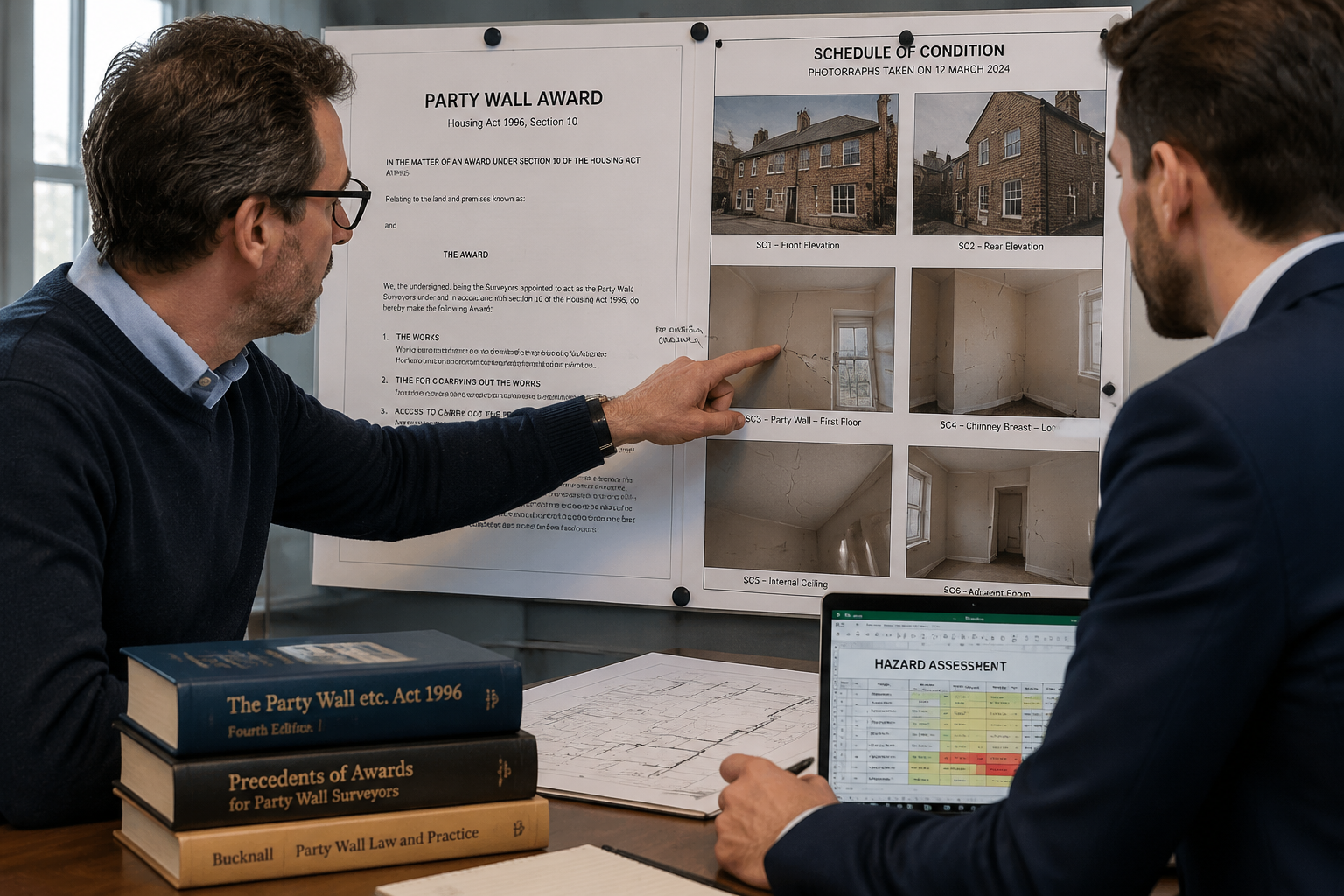
- Request a Schedule of Condition as part of the party wall award process. If the building owner's surveyor does not propose one, the adjoining owner's surveyor should insist upon it.
- Inspect the property yourself before the surveyor attends, and note any existing defects so they can be included in the schedule.
- If the property is tenanted, notify the tenant of the upcoming works and explain the Schedule of Condition process. Tenant cooperation in allowing access for the survey is essential.
During Works
- Keep a written log of any complaints from tenants regarding noise, dust, or apparent damage.
- If any new cracks or damp patches appear, photograph them immediately with a date-stamped image and notify the building owner's surveyor in writing.
- Do not carry out repairs to any new defects before they have been inspected and documented, as this could prejudice a later claim.
After Works Are Complete
- Request the post-works inspection promptly — do not allow months to pass before the comparison is made.
- If new hazards are identified that fall within the Awaab's Law categories, investigate them within the statutory 10-working-day period to protect against tenant enforcement action.
- If the hazards are attributable to the party wall works, pursue the building owner through the party wall award mechanism for compensation.
For properties with shared chimney structures, which are particularly vulnerable to disturbance during party wall works, the specific guidance on party wall shared chimneys is worth reviewing alongside the Schedule of Condition process.
Conclusion
The intersection of Schedule of Condition Surveys for Party Wall Works Under Awaab's Law: Protecting Against 2026 Hazard Claims represents one of the most practically significant developments in property law for building owners, landlords, and surveyors this year. The expanded scope of Awaab's Law — now covering private landlords and set to broaden further with Phase 2 — means that construction-related hazards in adjoining tenanted properties carry real legal and financial consequences.
A properly executed Schedule of Condition Survey is not a bureaucratic formality. It is the document that determines who bears responsibility when damp appears in a neighbour's bedroom wall six weeks after a loft conversion is completed. It protects building owners from exaggerated claims. It protects adjoining landlords from being held liable for hazards they did not cause. And it protects tenants by ensuring that genuine construction-related damage is identified, attributed, and remedied promptly.
Actionable next steps:
- If you have received a Party Wall Notice, appoint a qualified surveyor immediately and insist on a Schedule of Condition as part of the award.
- If you are a landlord with a tenanted property adjacent to planned construction, review your hazard reporting systems now to ensure compliance with Awaab's Law timelines.
- If you are a building owner planning works, budget for a Schedule of Condition as a non-negotiable part of your project costs — it is far cheaper than defending a hazard claim without one.
- Engage a chartered surveyor experienced in both party wall matters and residential compliance to ensure your documentation meets the standards that courts and housing authorities now expect.
The legal landscape has shifted. The Schedule of Condition Survey has shifted with it.
References
[1] Awaabs Law – https://www.chesterfield.gov.uk/housing/health-and-safety-at-home/awaabs-law/?utm_source=openai
[2] Awaabs Law Phase 2 October 2026 Hhsrs Hazards What Private Landlords And Surveyors Must Do Now – https://www.canterburysurveyors.com/blog/awaabs-law-phase-2-october-2026-hhsrs-hazards-what-private-landlords-and-surveyors-must-do-now/?utm_source=openai
[3] Awaabs Law Landlords 2026 – https://letsafeuk.co.uk/awaabs-law-landlords-2026?utm_source=openai
[4] Schedule Of Condition – https://echelonpartywall.co.uk/resources/guides/schedule-of-condition/?utm_source=openai
[5] Party Wall Implications For Stair And Bath Fall Hazard Retrofits Awaabs Law 2026 Survey Protocols – https://nottinghillsurveyors.com/blog/party-wall-implications-for-stair-and-bath-fall-hazard-retrofits-awaabs-law-2026-survey-protocols?utm_source=openai
[6] Awaabs Law 2026 Extensions Building Surveyors Guide To Assessing Excess Cold Fire And Electrical Hazards In Prs Properties – https://www.canterburysurveyors.com/blog/awaabs-law-2026-extensions-building-surveyors-guide-to-assessing-excess-cold-fire-and-electrical-hazards-in-prs-properties/?utm_source=openai
[7] Awaabs Law Private Rented Sector Claims – https://www.remedylegal.ai/blog/awaabs-law-private-rented-sector-claims?utm_source=openai
[8] What Is Awaabs Law – https://awaabslawguide.co.uk/guides/what-is-awaabs-law?utm_source=openai