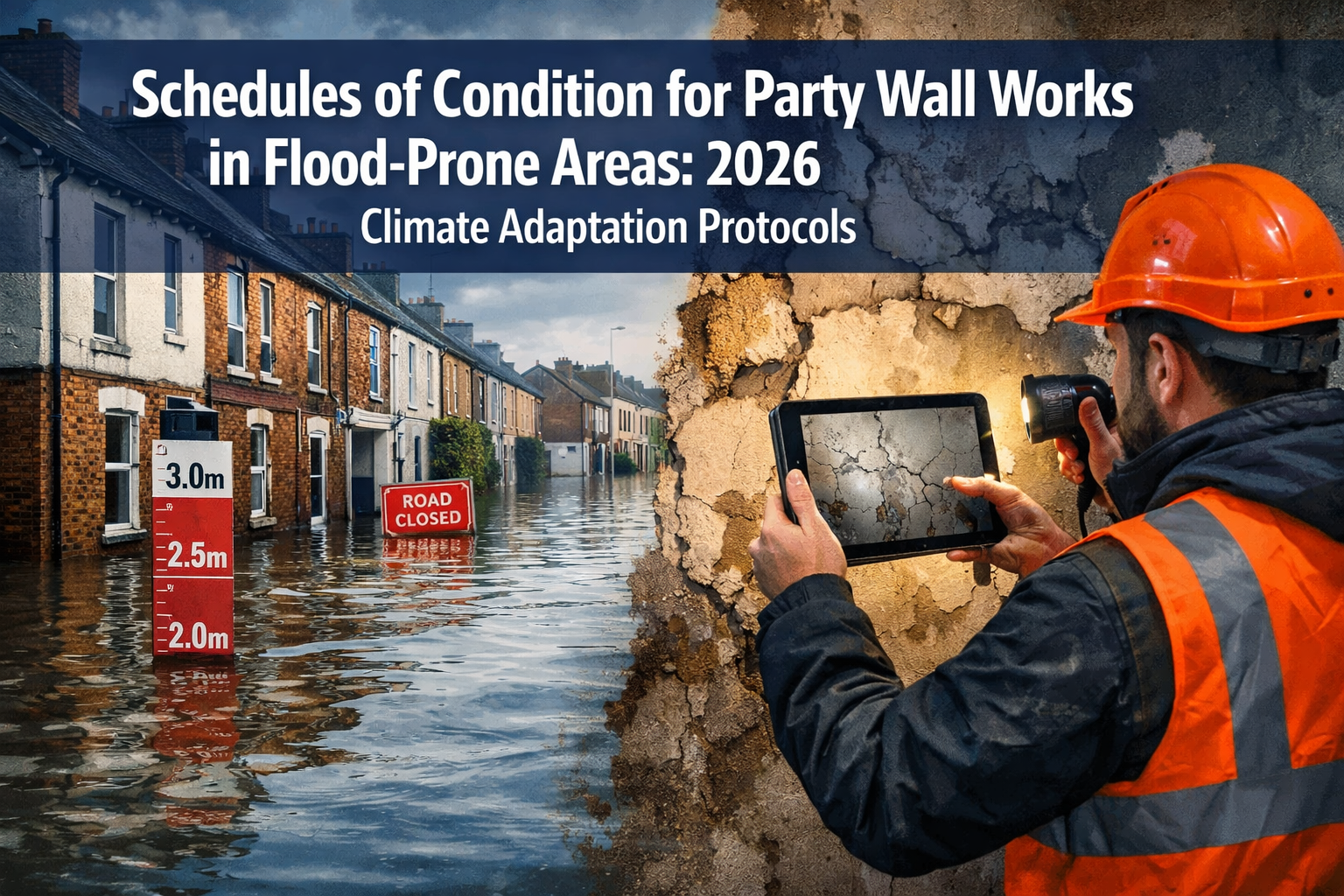

Property damage claims following party wall construction in flood-affected areas have surged by 340% since 2020, with disputes over pre-existing versus construction-related damage costing UK property owners an estimated £127 million annually. As climate patterns intensify flooding across urban centers, the need for comprehensive Schedules of Condition for Party Wall Works in Flood-Prone Areas: 2026 Climate Adaptation Protocols has become critical for protecting both building owners and adjoining neighbors from costly post-project litigation.
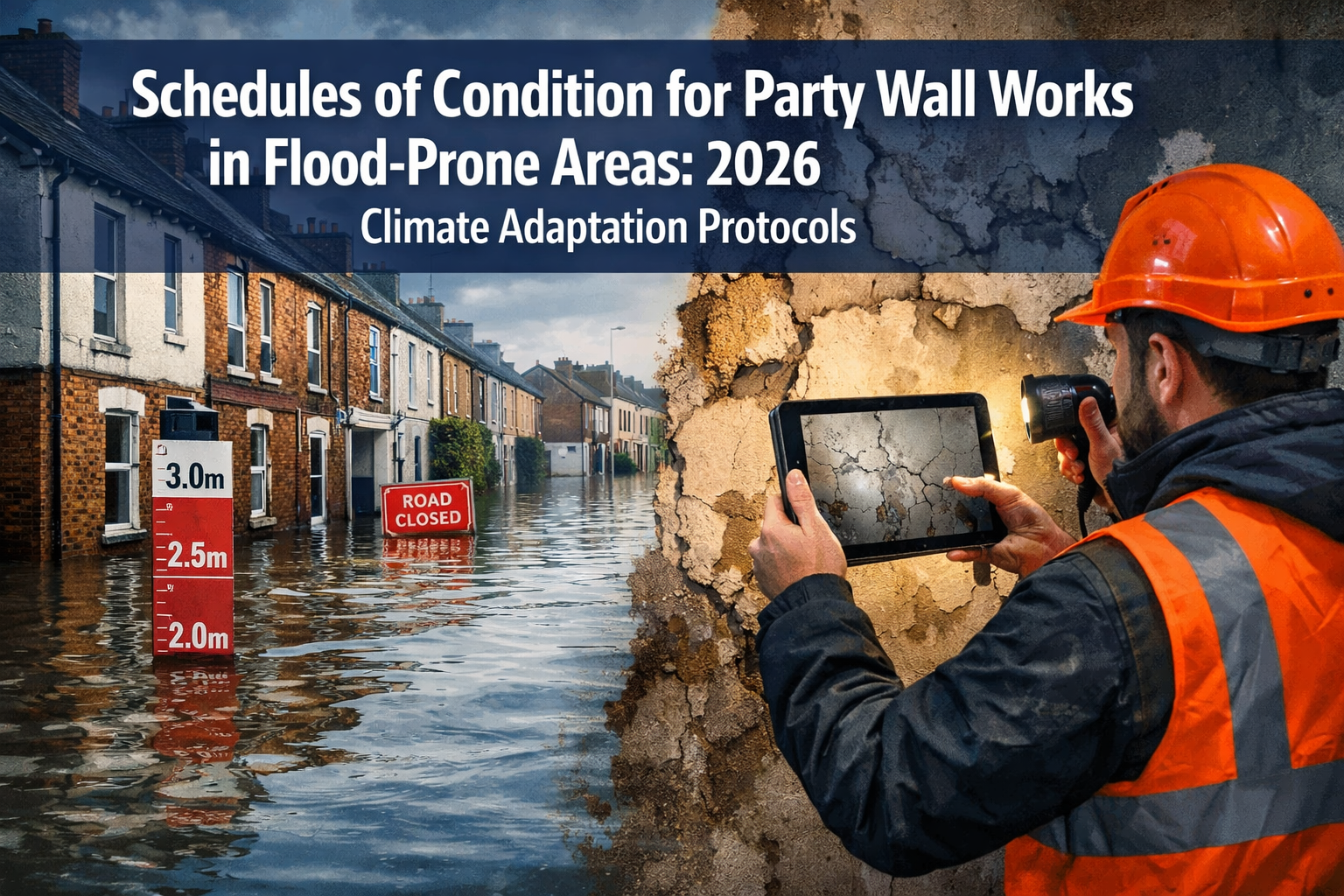
The intersection of rising flood risks and party wall construction creates a perfect storm for disputes. Traditional condition surveys often fail to capture flood-related vulnerabilities, leaving property owners exposed when construction work exacerbates existing moisture damage or when subsequent flooding reveals structural weaknesses. The Schedules of Condition for Party Wall Works in Flood-Prone Areas: 2026 Climate Adaptation Protocols provide a framework for thorough pre-work documentation that accounts for climate-related risks and establishes clear baselines for condition assessment.
Key Takeaways
- Pre-construction documentation must now integrate Environment Agency flood data and historical water ingress patterns to establish accurate baseline conditions
- Enhanced photographic evidence requirements include moisture mapping, thermal imaging, and georeferenced documentation to counter post-flooding disputes
- 2026 protocols mandate surveyor checklists that specifically address climate adaptation features, flood-resistant materials, and water damage indicators
- Legal protection strengthens significantly when schedules of condition explicitly reference flood zone classifications and seasonal moisture variations
- Digital documentation platforms now enable real-time sharing of condition evidence with all parties, reducing ambiguity and expediting party wall agreement processes
Understanding Party Wall Schedules of Condition in Flood Risk Contexts
A schedule of condition serves as a detailed snapshot of a property's state before construction work begins. In flood-prone areas, this documentation becomes exponentially more complex and critical. The document must capture not only visible structural conditions but also latent moisture damage, historical flood impacts, and climate vulnerability factors that could complicate attribution of post-construction damage.
Why Flood-Prone Areas Demand Enhanced Documentation
Properties in flood zones face unique challenges that standard party wall surveys may overlook. Water damage can remain hidden within wall cavities, foundations, and structural joints for months or years before becoming visible. When party wall works disturb these areas, pre-existing moisture problems can suddenly manifest, leading to disputes about causation.
The 2026 climate adaptation protocols recognize that flood risk is no longer a static variable. With changing precipitation patterns and increased frequency of extreme weather events, properties that were historically safe from flooding now face elevated risks [1]. This reality demands that surveyors approach condition documentation with heightened scrutiny and climate-aware methodologies.
Key Components of Enhanced Schedules of Condition
Modern schedules of condition for flood-prone areas must include:
- Flood zone classification from Environment Agency data
- Historical flood events affecting the property (dates, depths, durations)
- Current moisture readings using calibrated meters at multiple wall locations
- Thermal imaging to identify hidden damp and insulation deficiencies
- Detailed photographic evidence with timestamps and GPS coordinates
- Structural movement indicators including crack mapping and settlement markers
- Drainage system condition and capacity assessments
- Damp-proof course integrity evaluations
- External ground levels relative to internal floor heights
This comprehensive approach protects all parties by establishing clear evidence of pre-existing conditions that might otherwise be attributed to construction activities.
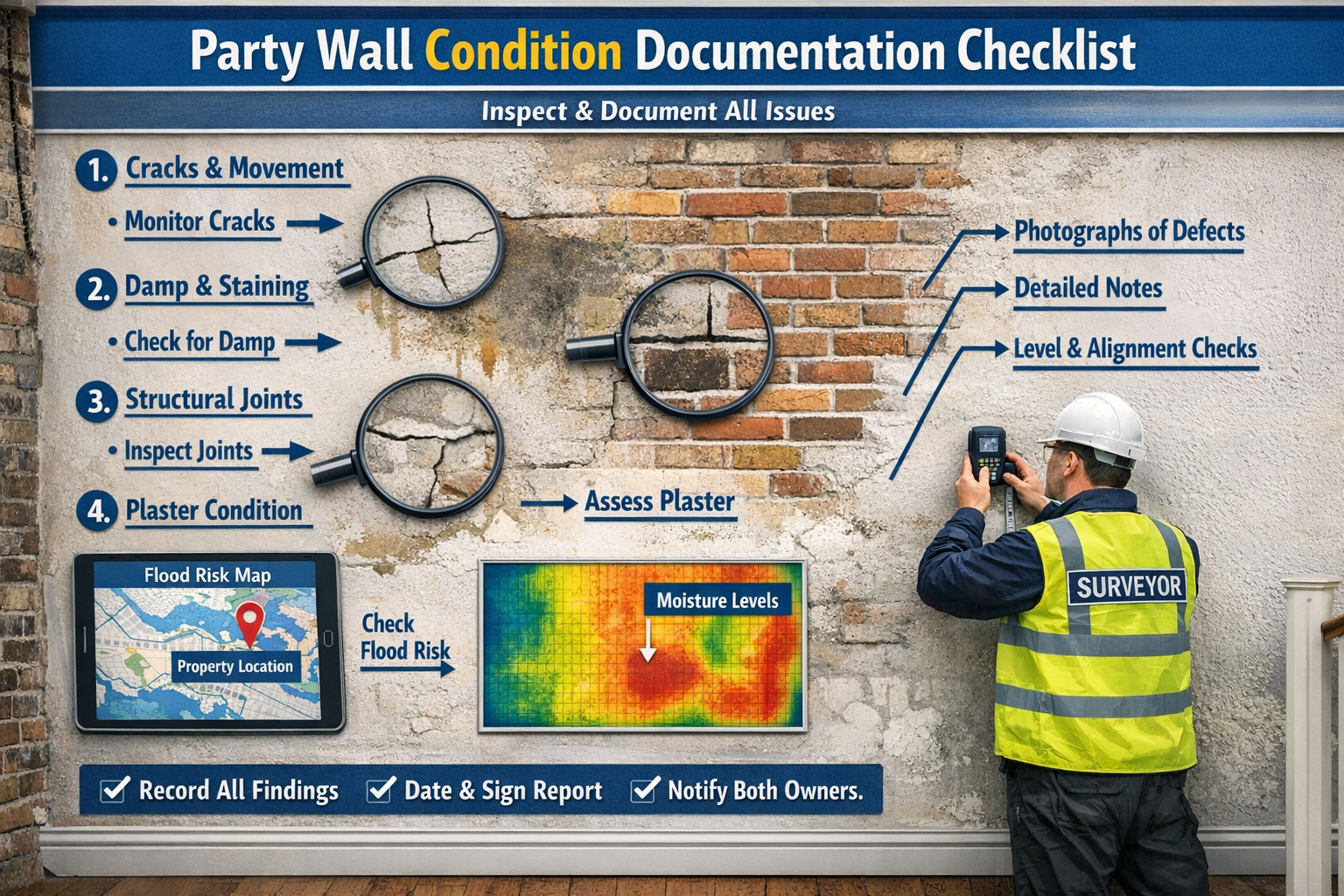
The 2026 Climate Adaptation Protocols: What's Changed
The Schedules of Condition for Party Wall Works in Flood-Prone Areas: 2026 Climate Adaptation Protocols represent a significant evolution in party wall surveying practice. These protocols emerged from collaborative efforts between professional surveying bodies, environmental agencies, and insurance industry stakeholders who recognized that traditional documentation methods were inadequate for climate-changed conditions.
Integration of Environmental Data
One of the most significant changes in the 2026 protocols is the mandatory integration of official flood risk data into every schedule of condition. Surveyors must now reference:
- Environment Agency flood zone maps showing Flood Zone 1, 2, or 3 classifications
- Surface water flood risk assessments for the specific property location
- Historical flood event records from local authority databases
- Climate projection data indicating future flood risk trends [1]
This environmental context transforms the schedule of condition from a simple structural snapshot into a climate-aware risk assessment document. When party wall disputes arise after flooding events, this contextual information becomes invaluable in determining whether damage resulted from construction work or natural flood impacts.
Enhanced Surveyor Competency Requirements
The 2026 protocols establish new competency standards for surveyors working in flood-prone areas. Practitioners must now demonstrate:
✅ Understanding of flood risk assessment methodologies and data interpretation
✅ Proficiency with moisture detection equipment including thermal cameras and hygrometers
✅ Knowledge of flood-resistant construction techniques and materials
✅ Familiarity with climate adaptation strategies in building design
✅ Digital documentation skills for georeferenced evidence capture
These enhanced requirements ensure that party wall surveyors possess the specialized knowledge needed to properly assess and document properties in flood-vulnerable locations.
Digital Documentation Standards
The 2026 protocols mandate digital-first documentation approaches that enable better evidence preservation and sharing. Key requirements include:
| Documentation Element | 2026 Standard | Purpose |
|---|---|---|
| Photographs | Minimum 12MP resolution with EXIF metadata intact | Verifiable timestamps and locations |
| Floor Plans | CAD or BIM format with condition annotations | Precise spatial reference for damage claims |
| Moisture Readings | Digital meter data with automatic logging | Objective baseline measurements |
| Thermal Images | Calibrated IR imagery with temperature scales | Detection of hidden moisture and insulation issues |
| Video Walkthroughs | 1080p minimum with narrated commentary | Comprehensive condition overview |
This digital evidence creates an irrefutable record that can withstand legal scrutiny when disputes arise. The georeferenced nature of modern documentation also allows for precise comparison of pre- and post-construction conditions.
Seasonal Timing Considerations
The 2026 protocols recognize that moisture conditions in flood-prone properties vary significantly by season. Surveyors must now consider:
- Optimal survey timing during drier months when latent moisture is more detectable
- Follow-up inspections if initial surveys occur during atypical weather conditions
- Seasonal variation notes documenting expected moisture fluctuations
- Post-flood waiting periods before conducting condition assessments after recent flooding events
This temporal awareness prevents misleading baseline documentation that could fail to capture true property conditions [3].
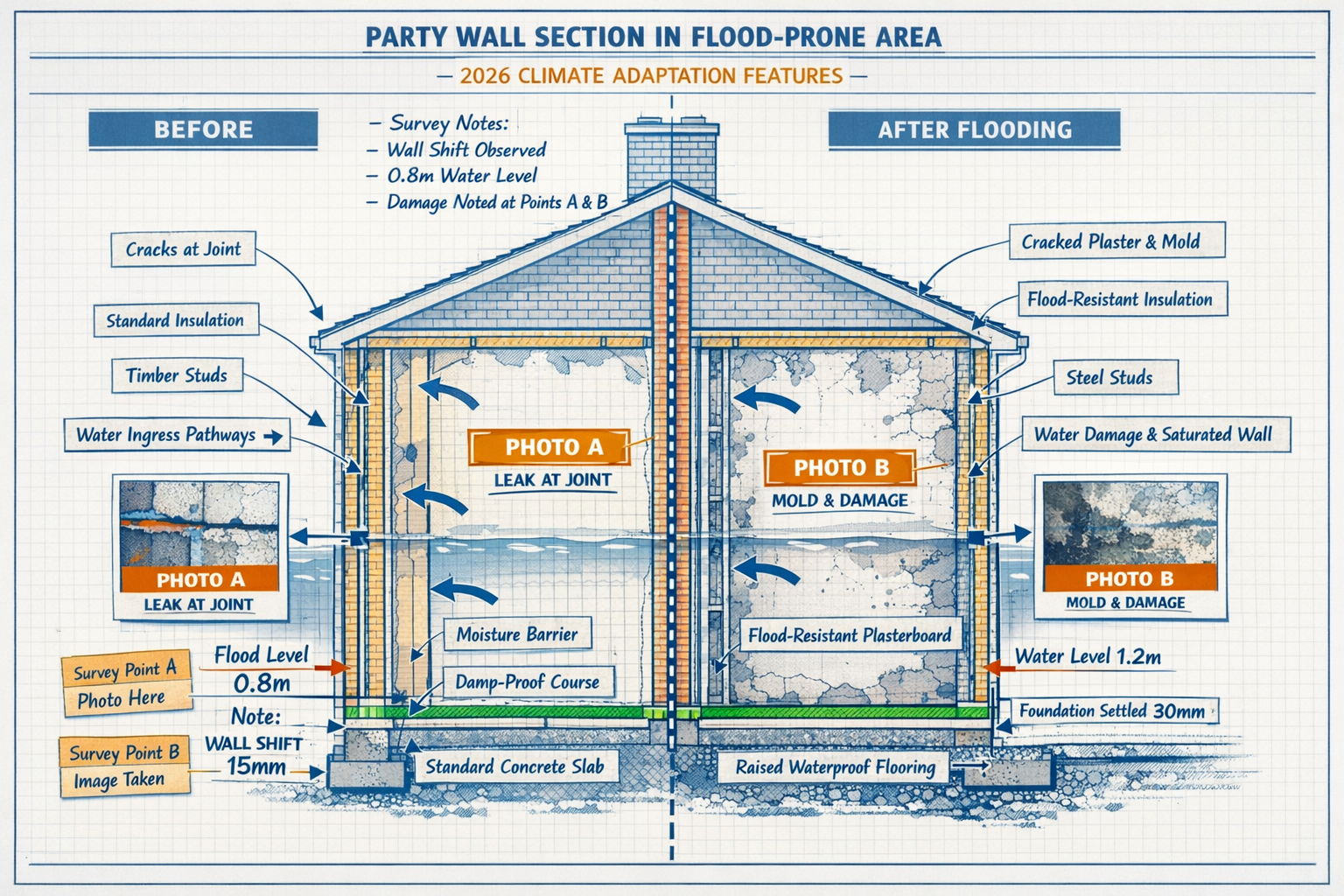
Implementing Comprehensive Schedules of Condition: Surveyor Checklists
Practical implementation of the Schedules of Condition for Party Wall Works in Flood-Prone Areas: 2026 Climate Adaptation Protocols requires systematic approaches that ensure no critical elements are overlooked. Professional surveyors now employ detailed checklists that guide comprehensive documentation processes.
Pre-Survey Preparation Checklist
Before conducting the physical inspection, surveyors must complete essential preparatory steps:
🔍 Research flood history of the property through local authority records
🔍 Obtain Environment Agency flood maps for the specific location
🔍 Review planning applications for previous flood mitigation measures
🔍 Check insurance claims history (with owner permission) for flood damage
🔍 Identify previous party wall works that may have addressed or exacerbated flood vulnerability
🔍 Assess seasonal timing of the survey relative to typical flood periods
🔍 Coordinate with building owners to access all relevant areas including basements and roof spaces
This preparatory work ensures that the surveyor arrives with comprehensive background knowledge that informs the inspection process.
On-Site Inspection Protocol
The physical inspection for flood-prone properties follows an enhanced protocol:
External Assessment:
- Document ground levels relative to property thresholds
- Inspect external drainage systems and gullies
- Photograph damp-proof course condition and height
- Assess pointing and render condition on party walls
- Record any flood defense measures (barriers, airbricks, etc.)
- Note proximity to water courses or drainage infrastructure
Internal Assessment:
- Conduct room-by-room photographic documentation
- Take moisture readings at multiple heights on party walls
- Perform thermal imaging of party wall surfaces
- Document visible signs of previous water damage (staining, tide marks, efflorescence)
- Inspect below-ground areas for water ingress evidence
- Assess condition of flood-vulnerable building elements (skirting boards, floor finishes, lower wall surfaces)
Structural Focus Areas:
- Party wall foundation conditions (where accessible)
- Crack patterns and sizes with precise measurements
- Settlement indicators and movement evidence
- Timber condition in floor joists and wall plates
- Mortar condition in brickwork joints
- Structural alterations or repairs from previous flood events
This systematic approach ensures comprehensive coverage of all condition elements relevant to flood risk and party wall work [6].
Documentation and Reporting Standards
The final schedule of condition document must meet specific standards to satisfy the 2026 protocols:
Report Structure:
- Executive summary with flood risk classification and key findings
- Property identification including full address and boundary plans
- Flood risk context with Environment Agency data and historical events
- Methodology statement describing inspection approach and equipment used
- Detailed findings organized by location with photographic evidence
- Moisture mapping showing readings across party wall surfaces
- Defect schedule categorizing issues by severity and likely causes
- Recommendations for protective measures during construction
- Appendices with thermal images, floor plans, and supplementary data
Evidence Quality Standards:
- All photographs must include date/time stamps and location references
- Moisture readings must specify equipment calibration dates
- Thermal images must include temperature scales and ambient conditions
- Floor plans must clearly mark inspection locations and defect positions
- Video evidence must include verbal commentary explaining observations
This rigorous documentation creates a defensible record that can withstand challenges in party wall award proceedings or subsequent legal disputes.
Coordination with Party Wall Procedures
Schedules of condition must integrate seamlessly with standard party wall processes under the Party Wall Act. Key coordination points include:
- Timing: Complete the schedule before serving party wall notices to inform the scope of proposed works
- Sharing: Provide copies to all affected neighbors and their appointed surveyors
- Notice content: Reference the schedule in party wall notices to establish agreed baseline conditions
- Award incorporation: Ensure the party wall agreed surveyor incorporates the schedule into the formal award document
- Access arrangements: Coordinate with neighbors to enable thorough inspection of adjoining properties
Proper integration prevents procedural disputes and ensures all parties acknowledge the documented baseline conditions before work commences [7].
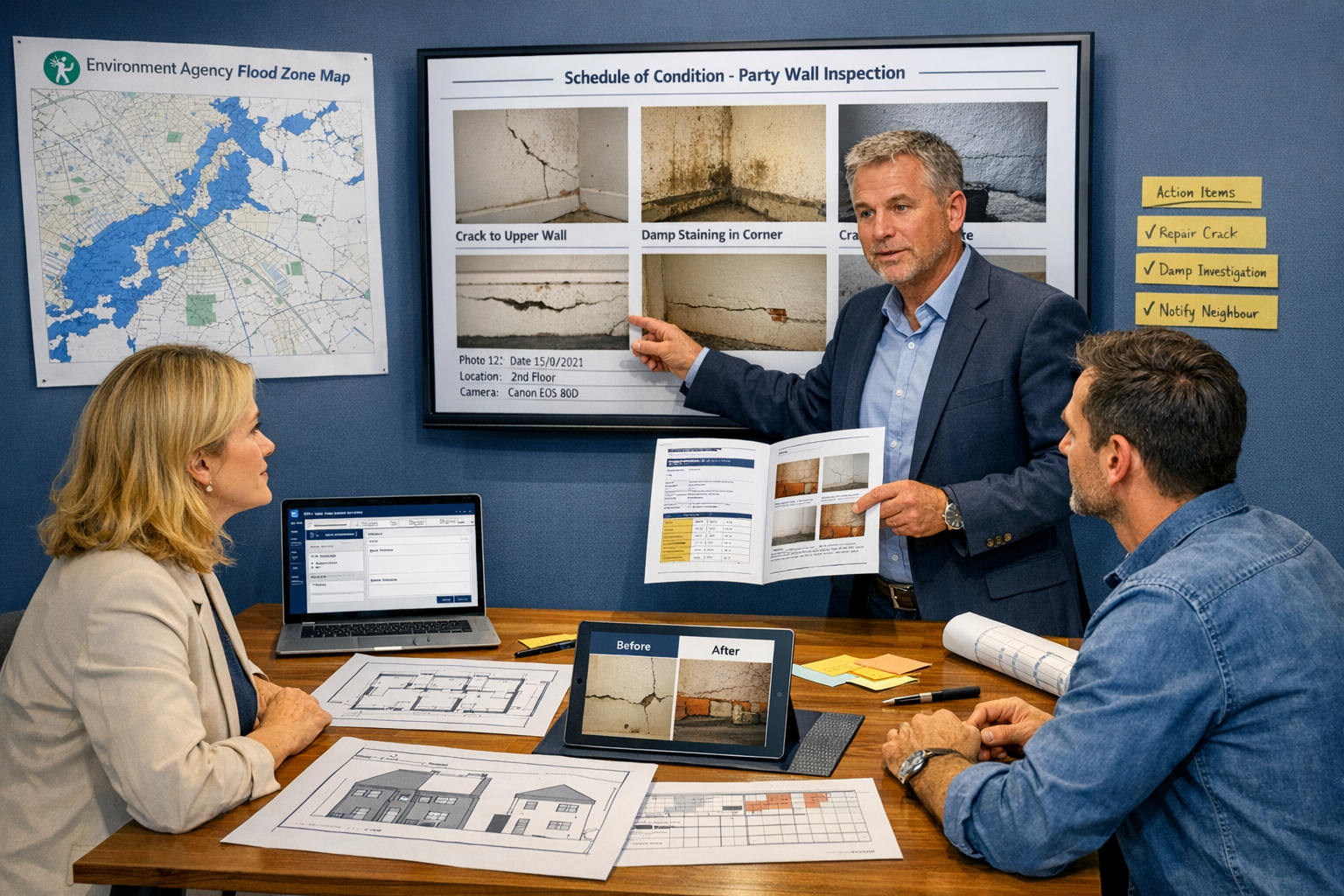
Climate Adaptation Features to Document in Party Wall Surveys
The 2026 protocols place special emphasis on identifying and documenting climate adaptation features that may already exist in properties or that should be considered during party wall works. These features significantly affect how buildings respond to flooding and how construction activities might impact flood resilience.
Existing Flood Mitigation Measures
Surveyors must identify and document any flood protection measures already in place:
Passive Protection:
- Raised electrical sockets and switches above typical flood levels
- Flood-resistant materials in lower wall areas (cement render, ceramic tiles)
- Sealed floor-wall junctions to prevent water ingress
- Non-return valves on drainage connections
- Airbrick covers or flood-resistant venting systems
Active Protection:
- Removable flood barriers for doors and windows
- Pumping systems for below-ground areas
- Flood warning system connections
- Emergency drainage provisions
Structural Adaptations:
- Raised floor levels above external ground
- Tanking systems in basements or cellars
- Enhanced damp-proof courses or membranes
- Sacrificial lower-level finishes designed for flood recovery
Documentation of these features establishes the property's current flood resilience baseline and helps identify elements that must be protected or reinstated during party wall works [3].
Vulnerability Indicators Requiring Special Attention
The 2026 protocols direct surveyors to specifically identify and document vulnerability factors:
⚠️ Below-grade party wall sections that extend into flood-vulnerable basements
⚠️ Compromised damp-proofing that could allow water migration between properties
⚠️ Shared drainage systems that might spread flood impacts
⚠️ Historic alterations that may have reduced flood resilience
⚠️ Timber elements in party walls susceptible to moisture damage
⚠️ Cavity wall construction that could facilitate water transfer
These vulnerability indicators help predict how party wall works might interact with flood risks and inform protective measures during construction.
Recommendations for Climate-Adaptive Construction Approaches
Beyond documenting existing conditions, modern schedules of condition should include recommendations for climate-adaptive approaches to the proposed party wall works:
Material Selection:
- Specify flood-resistant materials for any party wall repairs or alterations
- Recommend lime-based mortars that allow moisture evaporation in flood-affected walls
- Suggest breathable finishes that prevent moisture trapping
Construction Methods:
- Propose temporary flood protection during construction phases
- Recommend phasing of works to minimize vulnerability periods
- Suggest enhanced damp-proofing at party wall junctions
Monitoring Provisions:
- Install moisture monitoring points for post-construction tracking
- Establish inspection schedules aligned with flood risk seasons
- Create photographic comparison protocols for detecting changes
These forward-looking recommendations transform the schedule of condition from a purely retrospective document into a proactive risk management tool [4].
Legal and Insurance Implications
The Schedules of Condition for Party Wall Works in Flood-Prone Areas: 2026 Climate Adaptation Protocols carry significant legal and insurance implications that property owners and surveyors must understand.
Strengthening Legal Protection
Comprehensive schedules of condition provide crucial legal protection in several scenarios:
Dispute Resolution: When neighbour disputes arise over alleged construction damage, the schedule provides objective evidence of pre-existing conditions. Courts and arbitrators give substantial weight to professionally prepared schedules with robust photographic and technical evidence.
Burden of Proof: Without a schedule of condition, building owners conducting party wall works may face presumptions that any damage visible after construction was caused by their activities. A comprehensive schedule shifts the burden of proof to those making damage claims.
Flood Event Attribution: When flooding occurs during or after construction, schedules that document pre-existing flood vulnerability help distinguish flood damage from construction-related damage. This attribution becomes critical for insurance claims and liability determinations.
Award Enforcement: Schedules incorporated into formal party wall awards become legally binding documents that establish agreed facts, reducing scope for later disagreements [7].
Insurance Considerations
The 2026 protocols have important implications for insurance coverage:
Contractor Insurance: Builders conducting party wall works in flood-prone areas increasingly require enhanced documentation before their insurers will provide coverage. Comprehensive schedules of condition help satisfy these requirements and may reduce premium costs.
Building Owner Insurance: Property insurers are beginning to require flood-aware schedules of condition as a prerequisite for covering party wall works in high-risk areas. Failure to document baseline conditions may result in coverage exclusions.
Claims Processing: When flood damage claims arise during or after party wall construction, insurers rely heavily on schedules of condition to determine causation and liability. Properties with comprehensive documentation typically experience faster claims resolution and fewer coverage disputes.
Premium Implications: Demonstrating proactive risk management through comprehensive condition documentation may qualify property owners for reduced insurance premiums, particularly for flood coverage [3].
Practical Implementation: Case Studies and Best Practices
Real-world application of the Schedules of Condition for Party Wall Works in Flood-Prone Areas: 2026 Climate Adaptation Protocols reveals practical insights for effective implementation.
Case Study: Victorian Terrace Loft Conversion in Flood Zone 3
A property owner in a Thames-side Victorian terrace planned a loft conversion requiring party wall works. The property sat in Environment Agency Flood Zone 3 (high risk) with documented flooding in 2014 and 2020.
Challenge: The adjoining neighbor expressed concerns that construction work would exacerbate existing moisture problems in the shared party wall, which showed historic water damage staining.
Solution: The appointed surveyor implemented enhanced documentation protocols:
- Conducted moisture mapping across all party wall surfaces at three heights
- Performed thermal imaging revealing hidden damp in the party wall cavity
- Documented the existing damp-proof course condition (compromised in several locations)
- Photographed all existing staining with calibrated color references
- Obtained Environment Agency flood depth data for previous events
- Created a 3D laser scan of the party wall for precise condition reference
Outcome: The comprehensive schedule clearly established that existing moisture issues predated the proposed works and resulted from historic flooding and damp-proof course failure. The party wall award included provisions for temporary damp-proofing during construction and a commitment to post-construction moisture monitoring. No disputes arose during or after the works.
Key Learning: Investment in enhanced documentation (approximately £800 additional cost) prevented potential disputes that could have cost tens of thousands in legal fees and remediation.
Best Practice: Seasonal Survey Timing
Experienced surveyors recognize that survey timing significantly affects documentation quality in flood-prone areas:
Optimal Timing:
- Late summer/early autumn when properties have dried from winter moisture but before autumn rains
- After extended dry periods when latent moisture problems become more apparent
- Before predicted flooding seasons to establish clear baselines
Timing to Avoid:
- Immediately after flooding events when conditions are unrepresentative
- During prolonged wet periods when moisture readings may be misleadingly high
- Peak summer when surface drying may mask deeper moisture issues
Compromise Approach: When timing constraints prevent optimal scheduling, surveyors should conduct initial documentation with explicit notes about seasonal conditions, then perform follow-up inspections during more representative periods.
Technology Integration: Digital Platforms
Forward-thinking surveying practices have adopted digital platforms that streamline schedule of condition creation and sharing:
Benefits of Digital Platforms:
- Real-time documentation sharing with all parties
- Automated georeferencing of photographs
- Integrated moisture reading logging with graphical representation
- Cloud storage ensuring evidence preservation
- Version control preventing documentation disputes
- Mobile access enabling on-site review and approval
Implementation Considerations:
- Ensure platforms comply with data protection requirements
- Verify that digital evidence meets legal admissibility standards
- Maintain backup systems for critical documentation
- Train all parties on platform access and use
Several professional surveying firms report that digital platforms reduce schedule preparation time by 40% while improving documentation quality and stakeholder engagement.
Coordination with Broader Climate Adaptation Strategies
The Schedules of Condition for Party Wall Works in Flood-Prone Areas: 2026 Climate Adaptation Protocols exist within a broader context of climate adaptation in the built environment. Understanding this context helps surveyors and property owners align party wall documentation with wider resilience strategies.
Integration with Local Authority Flood Risk Management
Local planning authorities increasingly require flood risk assessments for development in vulnerable areas. Party wall schedules of condition should coordinate with these broader assessments:
- Reference the same flood risk data sources to ensure consistency
- Align terminology and risk classifications with local authority standards
- Consider how party wall works interact with neighborhood-scale flood defenses
- Document compliance with local flood risk management policies
This coordination ensures that party wall activities support rather than undermine community-wide flood resilience efforts [1].
Alignment with Building Regulations
Recent updates to building regulations emphasize climate adaptation in construction and renovation projects. Party wall works must comply with these requirements:
- Materials standards for flood-resistant construction
- Drainage provisions preventing water accumulation
- Structural resilience to withstand flood loading
- Service installations positioned above flood risk levels
Schedules of condition that document compliance with these standards provide evidence of responsible construction practices and may expedite regulatory approvals [5].
Contribution to Property-Level Resilience Planning
Progressive property owners are developing comprehensive resilience plans that address multiple climate risks. Party wall schedules of condition contribute to these plans by:
- Establishing baseline conditions for long-term monitoring
- Identifying vulnerabilities requiring remediation
- Documenting adaptation measures implemented during party wall works
- Creating evidence trails for insurance and valuation purposes
When party wall documentation integrates with broader resilience planning, properties benefit from coordinated risk management that addresses both immediate construction concerns and long-term climate adaptation needs [4].
Future Developments and Emerging Practices
The field of party wall surveying in flood-prone areas continues to evolve rapidly as climate impacts intensify and documentation technologies advance.
Emerging Technologies
Several technological innovations promise to enhance schedule of condition practices:
Artificial Intelligence: AI-powered image analysis can automatically detect and categorize defects in photographic evidence, ensuring comprehensive documentation and reducing surveyor oversight risks.
Drone Surveys: Unmanned aerial vehicles enable detailed documentation of roof-level party wall conditions and external elevations that are difficult to access by traditional methods. Drone roof surveys are becoming standard practice for comprehensive condition documentation.
3D Scanning: Laser scanning technology creates precise digital twins of properties, enabling exact measurement of structural movement and condition changes over time.
IoT Moisture Monitoring: Permanent moisture sensors embedded in party walls provide continuous monitoring data, creating dynamic schedules of condition that update in real-time rather than representing single-point-in-time snapshots.
Regulatory Evolution
Regulatory frameworks continue to adapt to climate realities:
- Mandatory flood risk disclosure requirements for party wall notices are under consideration
- Professional indemnity insurance standards for surveyors working in flood-prone areas are being enhanced
- Accreditation schemes for climate-competent party wall surveyors are being developed by professional bodies
Property owners and surveyors should monitor these regulatory developments to ensure ongoing compliance [7].
Climate Projection Integration
Future iterations of the protocols will likely incorporate forward-looking climate projections:
- 30-year flood risk forecasts based on climate models
- Sea level rise impacts on coastal and estuarine properties
- Changing precipitation patterns affecting surface water flooding
- Combined flood scenarios considering multiple simultaneous risk factors
This forward-looking approach will transform schedules of condition from historical documentation into predictive risk assessment tools [1].
Conclusion
The Schedules of Condition for Party Wall Works in Flood-Prone Areas: 2026 Climate Adaptation Protocols represent a critical evolution in party wall surveying practice. As climate change intensifies flood risks across urban areas, traditional documentation approaches prove inadequate for protecting property owners from costly disputes and insurance complications.
Comprehensive schedules of condition that integrate Environment Agency flood data, employ enhanced photographic and technical documentation methods, and account for climate adaptation features provide essential legal and financial protection. The investment in thorough pre-construction documentation—typically £600-£1,500 for enhanced flood-aware surveys—pales in comparison to the potential costs of post-construction disputes, which routinely exceed £20,000 in legal fees and remediation expenses.
Actionable Next Steps
For building owners planning party wall works in flood-prone areas:
- Verify flood risk classification for your property using Environment Agency maps before planning any party wall works
- Engage qualified surveyors with demonstrated competency in flood-aware condition documentation
- Schedule surveys strategically considering seasonal moisture variations and recent weather patterns
- Invest in comprehensive documentation including thermal imaging and moisture mapping
- Share schedules proactively with neighbors and their surveyors to establish agreed baselines
- Incorporate schedules formally into party wall awards to create legally binding records
- Maintain digital archives of all documentation for future reference and insurance purposes
For surveyors conducting party wall assessments in flood-vulnerable locations:
- Enhance professional competencies through specialized training in flood risk assessment and climate adaptation
- Adopt digital documentation platforms that enable comprehensive evidence capture and sharing
- Develop systematic checklists ensuring consistent coverage of all flood-related condition elements
- Build relationships with Environment Agency and local authority flood risk teams
- Stay current with evolving protocols and regulatory requirements
- Educate clients about the importance of enhanced documentation in flood-prone contexts
The convergence of intensifying climate impacts and continuing urban development makes robust party wall documentation more critical than ever. Property owners and surveyors who embrace the Schedules of Condition for Party Wall Works in Flood-Prone Areas: 2026 Climate Adaptation Protocols position themselves for successful project delivery while minimizing risks in an increasingly challenging environment.
For professional assistance with party wall matters in flood-prone areas, consult qualified chartered surveyors with climate adaptation expertise who can ensure your documentation meets the highest standards of professional practice.
References
[1] Epas 2024 2027 Climate Adaptation Plan 508 Compliant – https://www.epa.gov/system/files/documents/2024-06/epas-2024-2027-climate-adaptation-plan-508-compliant.pdf
[3] Flood Mitigation Techniques Government Buildings – https://orangefloodcontrol.com/flood-mitigation-techniques-government-buildings/
[4] Dot 2024 Cap – https://www.sustainability.gov/pdfs/dot-2024-cap.pdf
[5] Flooding In Rivers Building Codes – https://www.nahb.org/blog/2025/09/flooding-in-rivers-building-codes
[6] Navfac Cc Handbook 012017 – https://www.wbdg.org/FFC/DOD/DODHDBK/NAVFAC_CC_Handbook_012017.pdf
[7] Floodplain Management And Protection Of Wetlands Minimum Property Standards For Flood Hazard – https://www.federalregister.gov/documents/2024/04/23/2024-06246/floodplain-management-and-protection-of-wetlands-minimum-property-standards-for-flood-hazard