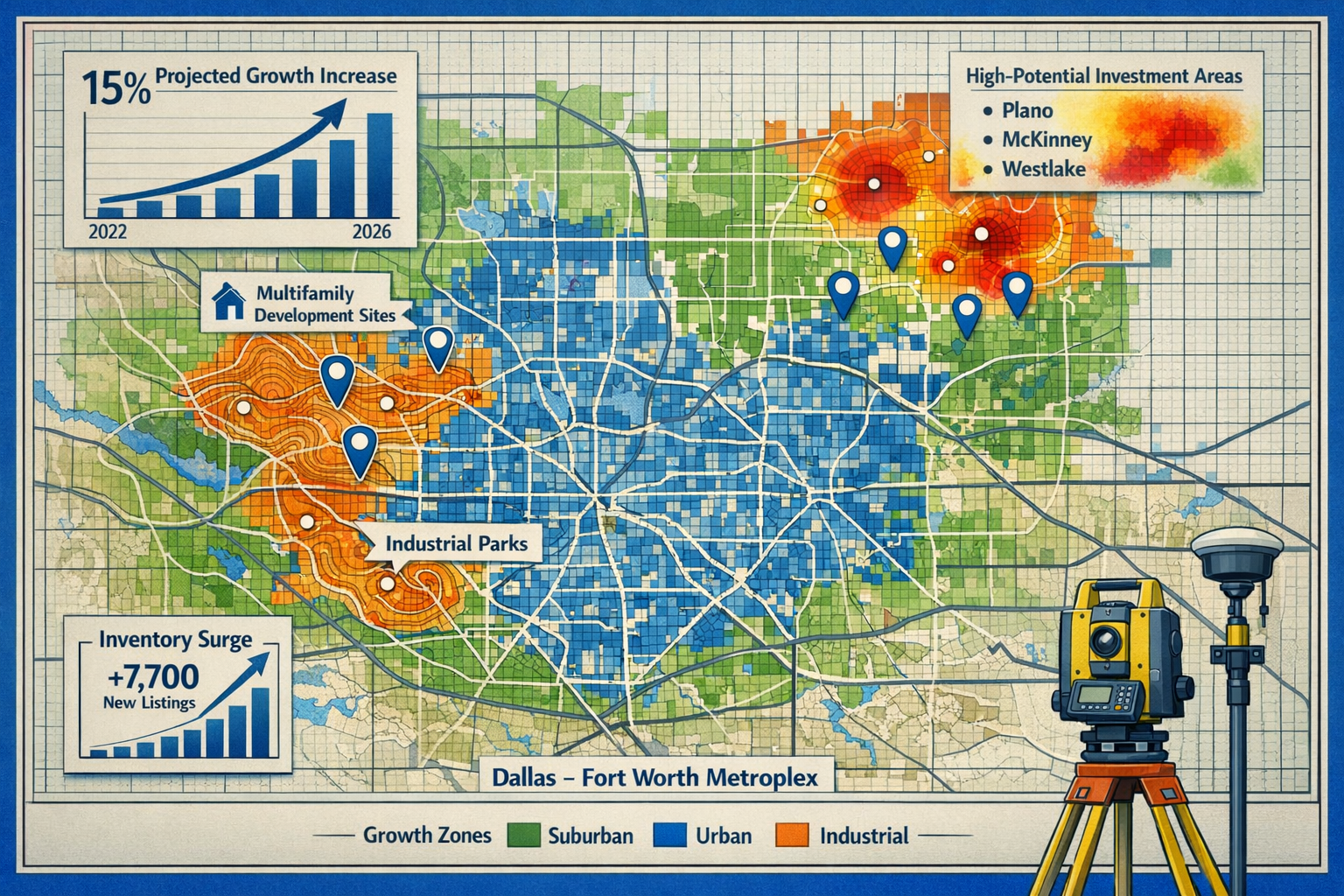
The Dallas-Fort Worth metroplex has claimed the top spot as the nation's most promising real estate market for 2026, according to PwC's prestigious rankings—but what does this mean for land professionals navigating rapid development? When surveying high-potential 2026 markets: Dallas-Fort Worth and beyond for land professionals, understanding the unique challenges of explosive growth becomes critical. With 7,700 new listings flooding the market in a single January week and closings projected to surge 15%, surveyors face unprecedented opportunities alongside complex technical demands.[2][5]
This comprehensive guide examines the market-specific surveying challenges and opportunities emerging from DFW's remarkable expansion, from topographic analysis for sprawling industrial parks to boundary work for high-density multifamily developments. Land professionals must adapt their strategies to serve a market experiencing both inventory relief and pricing recalibration across highly segmented neighborhoods.
Key Takeaways
- 📊 Dallas-Fort Worth ranks #1 nationally for real estate investment in 2026, with strong buy recommendations for retail and industrial properties requiring extensive surveying work[4]
- 📈 Closings projected to increase 15% in 2026, creating sustained demand for boundary surveys, topographic analysis, and site planning services[5]
- 🏘️ 7,700 new listings in one January week signal inventory relief but require rapid-response surveying capabilities to support accelerated transaction timelines[2]
- 💰 Median home price hovering around $355,000 with widespread price reductions (7,107 in one week) indicating market recalibration that demands accurate valuation support[1][2]
- 🎯 Segmented market dynamics mean ultra-desirable areas like south Plano and Westlake maintain competitive conditions while other neighborhoods experience inventory growth[2]
Understanding the 2026 Dallas-Fort Worth Market Landscape
National Recognition and Investment Rankings
The Dallas-Fort Worth metroplex has secured top national ranking as the #1 U.S. real estate market to watch for 2026, according to PwC's comprehensive market analysis.[4] This distinction places DFW at the forefront of the South Central region and positions it among the top 20 nationally for both commercial development and homebuilding prospects. For land professionals, this recognition translates directly into increased demand for surveying services across multiple property types.
Investors have provided strong net buy recommendations specifically for DFW retail and industrial property types—sectors that require extensive topographic surveys, boundary determinations, and site planning expertise.[4] The convergence of commercial and residential growth creates a unique environment where surveyors must maintain diverse skill sets to capitalize on varied opportunities.
Projected Growth and Market Fundamentals
Market analysts project that closings will increase 15% in 2026, representing a significant rebound after challenging market conditions in 2025.[5] This growth follows what NAR Chief Economist Lawrence Yun characterized as "another tough year for homebuyers" marked by record-high home prices and historically low sales volumes.[1] The 2026 turnaround signals renewed confidence in market fundamentals and creates sustained demand for professional surveying services.
The December 2025 turning point proved particularly significant, with home sales (after seasonal adjustment) reaching their strongest levels in nearly three years. Gains were broad-based across all four major U.S. regions, suggesting systemic market improvement rather than localized anomalies.[1] This widespread recovery pattern indicates that surveying professionals should prepare for sustained activity levels throughout 2026 and beyond.
Inventory Dynamics and Spring 2026 Predictions
January 2026 witnessed a significant inventory surge, with the week of January 12-18 alone bringing 7,700 new listings into the DFW market.[2] This substantial influx provides relief from the inventory pressure that characterized previous years and sets the stage for what industry experts predict will be a particularly active spring selling season.
Historical trend analysis suggests the DFW metroplex will see more homes listed for sale this spring than any year in the past five years (post-COVID era). In 2024, 16,278 new homes were listed during spring months, while 2025 saw a record 19,030 spring listings.[1] This upward trajectory creates compressed timelines for surveying work, as sellers and buyers alike seek to capitalize on favorable market conditions.
Market-Specific Surveying Challenges in Dallas-Fort Worth
Topographic Analysis for Industrial Park Development
The strong buy recommendations for industrial property types in DFW create specific demands for comprehensive topographic surveys.[4] Industrial parks require detailed elevation data, drainage analysis, and site grading plans that account for the region's unique geological characteristics. Land professionals must conduct thorough assessments that support large-scale development while addressing environmental considerations.
Industrial sites often span hundreds of acres, necessitating advanced surveying technologies including GPS-based systems, drone surveys, and 3D laser scanning. The accuracy requirements for industrial development exceed those of residential projects, as even minor elevation errors can result in costly drainage problems or foundation issues. Similar to how structural surveys provide comprehensive building assessments, industrial topographic surveys must deliver detailed site intelligence.
Key challenges for industrial surveying include:
- 🏭 Large-scale site coverage requiring efficient data collection methods
- 📐 High-precision elevation data for drainage and grading design
- 🚛 Access coordination with existing operations during survey work
- 🌳 Environmental impact assessments and wetland delineation
- ⚡ Utility mapping for complex infrastructure integration
Multifamily Development and High-Density Projects
The projected 15% increase in closings extends beyond single-family homes to include significant multifamily development activity.[5] High-density residential projects present unique surveying challenges, from boundary determinations for complex parcel assemblages to vertical construction surveys for multi-story buildings.
Multifamily developments often involve multiple property owners, easements, and access rights that require meticulous boundary research and documentation. Land professionals must navigate title complexities while providing survey products that satisfy lender requirements, municipal regulations, and developer specifications. The work shares similarities with specific defect reports in its focus on identifying and documenting critical issues.
Neighborhood-Level Market Segmentation
While overall active listings have climbed substantially, ultra-desirable pockets like south Plano, Westlake, and parts of McKinney remain highly competitive with limited inventory depth.[2] This segmentation creates variable demand patterns for surveying services across different submarkets within the metroplex.
High-end neighborhoods often require more sophisticated survey products, including detailed improvement location certificates, topographic surveys for custom home sites, and boundary surveys that address complex lot configurations. Land professionals must understand these micro-market dynamics to allocate resources effectively and provide appropriate service levels.
Segmented market considerations:
| Neighborhood Type | Inventory Status | Survey Demand Characteristics |
|---|---|---|
| Ultra-Desirable (Westlake, South Plano) | Limited, Competitive | Premium services, rapid turnaround, detailed documentation |
| Emerging Growth Areas | Increasing Supply | Volume work, standardized products, efficient workflows |
| Established Suburbs | Balanced Markets | Mixed residential/commercial, varied project types |
| Urban Core | Redevelopment Focus | Complex boundaries, vertical surveys, easement analysis |
Pricing Dynamics and Valuation Support Services
Widespread Price Reductions and Market Recalibration
The week of January 12-18, 2026 saw 7,107 price decreases recorded across the DFW market—nearly matching the volume of new listings entering during the same period.[2] This unprecedented level of price reduction activity suggests sellers are recalibrating expectations to align with buyer price sensitivity in a market transitioning from extreme scarcity to improved balance.
In stark contrast, only 853 price increases occurred during the same week, primarily from sellers who priced strategically at initial listing or in pockets where strong demand persists.[2] This asymmetry between price reductions and increases creates opportunities for surveyors to provide valuation support services that help stakeholders make informed pricing decisions.
Land professionals can expand their service offerings to include market analysis components within survey reports, helping clients understand how property characteristics impact value in the current environment. This approach aligns with comprehensive valuation reports that integrate physical property assessment with market positioning.
Median Price Trends and County-Level Variations
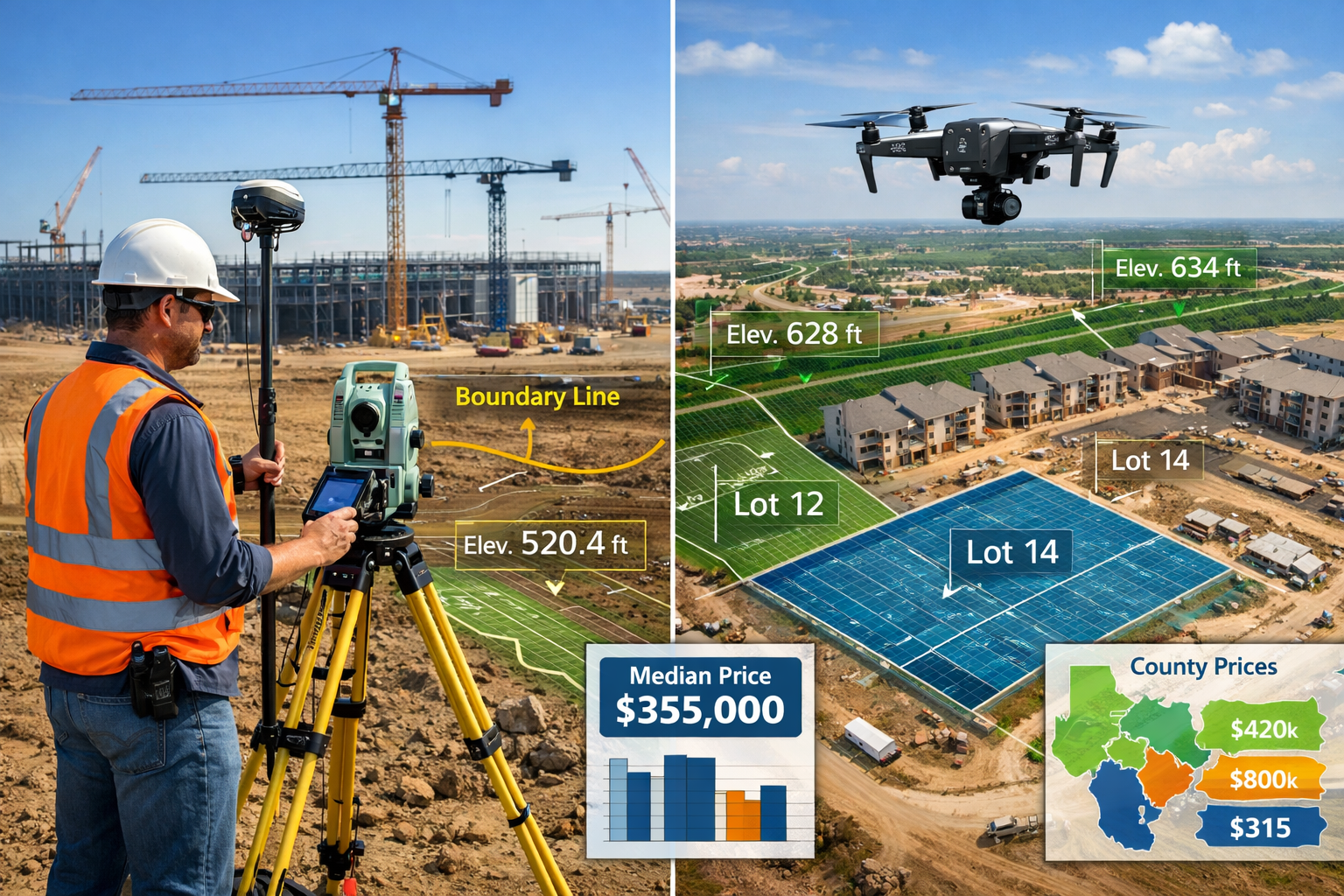
The median home sales price in the DFW metroplex hovers around $355,000 as of January 2026, with prices trending downward since the COVID-era peak.[1] This represents a positive indicator for buyers while creating adjustment challenges for sellers who purchased during the market's high-water mark.
County-level pricing reveals significant variations:[1]
- Rockwall County: $430,831 median price (-1.0% year-over-year)
- Denton County: $423,000 median price (-10.0% year-over-year)
- Collin County: $419,995 median price (-14.3% year-over-year)
These county-level differences reflect varying supply-demand dynamics, school district quality, employment center proximity, and infrastructure development patterns. Surveyors working across multiple counties must understand these pricing variations to provide context-appropriate services and advice.
The double-digit declines in Denton and Collin counties particularly impact land professionals conducting boundary surveys for refinance transactions or helping homeowners assess improvement investments. Accurate survey data becomes essential when property values approach or fall below outstanding mortgage balances, as lenders require precise improvement location information. Similar to help to buy valuations, these situations demand careful documentation.
Strategic Opportunities for Land Professionals in 2026
Capitalizing on Volume Growth Projections
The 15% projected increase in closings for 2026 represents substantial volume growth that land professionals can capture through strategic positioning.[5] This growth trajectory suggests sustained activity levels rather than a temporary spike, allowing surveyors to make confident investments in equipment, personnel, and technology infrastructure.
Volume growth creates opportunities to implement efficiency improvements that maintain quality while increasing throughput. Land professionals should consider:
✅ Technology investments in GPS equipment, drone systems, and data processing software
✅ Workflow optimization through standardized procedures and quality control checkpoints
✅ Strategic partnerships with title companies, real estate brokerages, and lending institutions
✅ Staff development to build capacity for handling increased project volumes
✅ Geographic expansion into emerging growth corridors within the metroplex
Diversification Across Property Types
The strong performance across retail, industrial, and residential sectors creates diversification opportunities that reduce reliance on any single property type.[4] Land professionals who develop expertise across multiple sectors position themselves to weather market fluctuations and capture opportunities as they emerge.
Commercial surveying work typically commands higher fees and involves longer-term client relationships compared to residential projects. However, residential volume provides steady cash flow and shorter project cycles. The optimal strategy often involves maintaining a balanced portfolio that leverages the strengths of each sector.
Surveyors should develop specialized capabilities for high-demand property types while maintaining core competencies across the full spectrum of land professional services. This approach mirrors the comprehensive service model used in chartered surveying practices that serve diverse client needs.
Technology Integration for Competitive Advantage
Advanced surveying technologies provide competitive advantages in a high-volume, fast-paced market environment. Drone-based aerial surveys dramatically reduce field time for large properties while providing comprehensive site documentation. Similarly, 3D laser scanning creates detailed as-built records for complex improvements and boundary features.
The integration of these technologies requires upfront capital investment but delivers long-term benefits through:
- 🚁 Reduced field time and lower labor costs per project
- 📊 Enhanced data quality and comprehensive site documentation
- ⚡ Faster turnaround times meeting compressed transaction schedules
- 🎯 Differentiated service offerings that command premium pricing
- 📱 Improved client communication through visual deliverables
Drone roof surveys demonstrate how aerial technology enhances traditional surveying capabilities, a principle that extends to broader land surveying applications.
Navigating Regulatory and Technical Considerations
Municipal Requirements Across DFW Jurisdictions
The Dallas-Fort Worth metroplex encompasses numerous municipalities, each with distinct surveying requirements, submittal procedures, and technical standards. Land professionals must maintain current knowledge of regulatory requirements across jurisdictions where they practice, as non-compliance can delay projects and expose clients to liability.
Key regulatory considerations include:
Survey Standards and Monumentation
Texas state law and local ordinances establish minimum standards for boundary surveys, including monumentation requirements, accuracy tolerances, and certification language. Land professionals must ensure their work products meet or exceed these standards while satisfying lender and title company requirements.
Platting and Subdivision Requirements
New development projects require compliance with municipal platting ordinances that govern lot dimensions, street dedications, utility easements, and public improvement requirements. Surveyors play a central role in plat preparation and must coordinate with planning departments, utility providers, and other stakeholders.
Floodplain and Environmental Regulations
Properties within FEMA-designated flood zones require elevation certificates and compliance documentation. Environmental regulations may also require wetland delineation, protected species habitat assessments, or historical resource surveys. These specialized services expand the scope of traditional land surveying work.
Title Research and Boundary Determination
Accurate boundary determination requires comprehensive title research that traces ownership history, identifies easements and encumbrances, and resolves conflicting deed descriptions. The complex land ownership patterns in rapidly developing areas like DFW often present challenging research scenarios.
Land professionals must develop strong relationships with title companies and maintain access to historical records, survey archives, and deed repositories. This research foundation supports defensible boundary determinations that withstand scrutiny during transaction closings and potential future disputes.
When boundary conflicts arise, surveyors may need to provide expert testimony or participate in resolution processes. Understanding the legal framework governing boundary disputes helps land professionals advise clients appropriately and document their work to support potential litigation. The principles mirror those used in party wall disputes, where technical expertise meets legal requirements.
Professional Liability and Risk Management
The high-value transactions and rapid pace of the 2026 DFW market create elevated professional liability exposure for land professionals. Errors in boundary determination, missed easements, or inaccurate elevation data can result in significant financial losses and professional liability claims.
Comprehensive risk management strategies include:
🛡️ Adequate professional liability insurance with coverage limits matching project exposure
📋 Thorough quality control procedures including independent review of critical work
📝 Clear engagement letters defining scope, limitations, and client responsibilities
🔍 Comprehensive field procedures ensuring complete data collection and documentation
⚖️ Continuing education maintaining current knowledge of standards and best practices
Beyond Dallas-Fort Worth: Regional Market Opportunities
Texas Statewide Growth Patterns
While Dallas-Fort Worth leads the state, other Texas markets also present significant opportunities for land professionals in 2026. The Texas Real Estate Research Center forecasts continued population growth and economic expansion across major metropolitan areas including Houston, Austin, and San Antonio.[6]
Each market presents unique characteristics:
Houston – Energy sector recovery drives commercial development and industrial expansion
Austin – Technology employment growth fuels residential construction and urban densification
San Antonio – Military installations and healthcare sectors support steady residential demand
Smaller Markets – College Station, Lubbock, and other secondary markets show selective strength
Land professionals with capacity to serve multiple Texas markets can diversify geographic risk while capturing growth across the state's dynamic real estate landscape.
South Central Region Leadership
Dallas-Fort Worth's position as the leading South Central region market reflects broader regional trends favoring business-friendly regulatory environments, affordable housing costs relative to coastal markets, and strong employment growth.[4] This regional context suggests sustained long-term opportunities beyond short-term market cycles.
The South Central region's competitive advantages include:
✨ No state income tax attracting businesses and residents
✨ Lower regulatory burdens compared to coastal states
✨ Available land for development at reasonable costs
✨ Strong transportation infrastructure supporting logistics
✨ Diverse economic base reducing recession vulnerability
National Market Context and Comparative Advantages
Understanding DFW's national market position helps land professionals appreciate the sustained nature of current opportunities. While coastal markets face affordability challenges and regulatory constraints, DFW offers a compelling combination of economic opportunity, reasonable housing costs, and available land for development.
The broad-based gains across all four major U.S. regions in December 2025 suggest improving national market fundamentals rather than isolated regional strength.[1] However, DFW's specific advantages position it to outperform national averages, creating above-average opportunities for land professionals serving the market.
Practical Implementation Strategies for Land Professionals

Building Strategic Partnerships
Success in surveying high-potential 2026 markets requires strategic partnerships with key transaction participants. Land professionals should cultivate relationships with:
Real Estate Brokerages
High-volume brokerages provide steady referral streams for residential boundary surveys and improvement location certificates. Establishing preferred vendor relationships ensures consistent workflow while providing brokers with reliable service for their clients.
Title Companies
Title companies require survey products that meet their underwriting standards and support smooth closings. Understanding title company requirements and maintaining responsive communication builds trust and generates repeat business.
Commercial Developers
Developers of retail, industrial, and multifamily projects need comprehensive surveying services from initial site analysis through final as-built documentation. Long-term relationships with active developers provide sustained revenue and project diversity.
Engineering Firms
Civil engineering firms frequently subcontract surveying work for infrastructure projects, site development, and municipal improvements. These partnerships provide access to large-scale projects and technical collaboration opportunities.
Service Differentiation and Value Propositions
In competitive markets, service differentiation separates successful land professionals from commodity providers competing solely on price. Effective differentiation strategies include:
📱 Technology-enhanced deliverables – Interactive maps, 3D visualizations, and digital data files
⚡ Guaranteed turnaround times – Committed schedules with penalty provisions for delays
🎓 Technical expertise – Specialized capabilities for complex projects or unique property types
💬 Superior communication – Proactive updates, accessible principals, and responsive service
🏆 Quality guarantees – Warranty provisions and professional liability backing
These differentiators justify premium pricing while building long-term client loyalty. The approach parallels comprehensive service models like building surveys versus homebuyer reports, where value justifies cost differences.
Marketing and Business Development
Effective marketing strategies help land professionals capture their share of projected market growth. Digital marketing approaches particularly effective for surveying services include:
Search Engine Optimization (SEO)
Local SEO strategies ensure visibility when potential clients search for surveying services in specific DFW submarkets. Optimized website content, Google Business Profile management, and local citations drive qualified leads.
Content Marketing
Educational content addressing common client questions establishes expertise and builds trust. Blog posts, videos, and downloadable resources attract prospects while supporting SEO objectives.
Professional Networking
Active participation in real estate, development, and construction industry associations provides visibility and relationship-building opportunities. Speaking engagements and committee participation demonstrate expertise.
Referral Programs
Structured referral programs incentivize past clients, partners, and professional contacts to recommend services. Tracking and rewarding referrals systematizes word-of-mouth marketing.
Operational Excellence and Scalability
Capturing growth opportunities requires operational systems that maintain quality while scaling volume. Key operational considerations include:
Standardized Workflows
Documented procedures for common project types ensure consistent quality and efficient training of new staff. Checklists, templates, and review protocols reduce errors and rework.
Technology Infrastructure
Integrated software systems connecting field data collection, office processing, and client deliverables streamline operations and reduce manual data handling. Cloud-based platforms enable remote collaboration and flexible work arrangements.
Quality Management
Formal quality control procedures including independent review, calibration protocols, and error tracking systems maintain high standards as volume increases. Quality metrics provide objective performance measurement.
Capacity Planning
Forecasting workload and strategically adding resources prevents bottlenecks while avoiding excess capacity during slower periods. Flexible staffing models using contract surveyors supplement core teams during peak demand.
Risk Factors and Market Headwinds
Interest Rate Sensitivity
While market fundamentals point to growth, interest rate fluctuations remain a significant risk factor for real estate transactions and surveying demand. Rising rates can quickly dampen buyer enthusiasm and reduce transaction volumes, while rate decreases typically stimulate activity.
Land professionals should monitor Federal Reserve policy decisions and economic indicators that influence interest rate trajectories. Diversification across property types and transaction purposes (purchase, refinance, development) provides some insulation from rate-driven demand fluctuations.
Economic Recession Risks
Broader economic conditions ultimately drive real estate market performance. Recession risks, employment disruptions, or financial market instability could derail projected growth despite current positive indicators. Land professionals should maintain conservative financial management and avoid overextending based on optimistic growth projections.
Building financial reserves during strong periods provides cushion during inevitable market downturns. Maintaining diverse client bases and service offerings reduces vulnerability to sector-specific disruptions.
Competitive Pressures
Market growth attracts new competitors and may intensify price competition as firms compete for market share. Land professionals must balance competitive pricing with sustainable margins that support quality service delivery and business reinvestment.
Differentiation strategies, operational efficiency, and strong client relationships provide defenses against pure price competition. Firms that compete solely on price typically struggle to maintain quality and eventually damage their reputations.
Technology Disruption
Emerging automation technologies and artificial intelligence applications may disrupt traditional surveying workflows and service models. While technology creates opportunities, it also threatens firms that fail to adapt to changing client expectations and competitive dynamics.
Proactive technology adoption and workforce development prepare land professionals for evolving industry standards. Viewing technology as an enabler rather than a threat positions firms to capture benefits while managing disruption risks.
Conclusion
Surveying high-potential 2026 markets: Dallas-Fort Worth and beyond for land professionals presents extraordinary opportunities grounded in strong market fundamentals, projected growth, and diverse property type demand. The metroplex's #1 national ranking, 15% projected increase in closings, and significant inventory relief create a favorable environment for surveyors positioned to deliver quality services efficiently.[4][5][2]
Success requires understanding market-specific challenges including topographic analysis for industrial development, multifamily project complexities, and neighborhood-level segmentation dynamics. The widespread price reductions and county-level pricing variations demand that land professionals provide valuation support alongside traditional surveying services.[1][2]
Strategic opportunities emerge from volume growth projections, property type diversification, and technology integration that provides competitive advantages. However, navigating regulatory requirements, managing professional liability, and building operational scalability remain essential foundations for sustainable growth.
Actionable Next Steps for Land Professionals
✅ Assess current capacity and identify bottlenecks that could limit ability to capture growth opportunities
✅ Evaluate technology investments in GPS systems, drones, and software that enhance efficiency and service quality
✅ Develop strategic partnerships with high-volume transaction participants including brokerages, title companies, and developers
✅ Implement marketing initiatives focused on local SEO, content creation, and professional networking
✅ Strengthen quality systems through documented procedures, independent review, and performance metrics
✅ Monitor market indicators including inventory levels, pricing trends, and transaction volumes across DFW submarkets
✅ Expand service offerings to include valuation support, specialized property types, and technology-enhanced deliverables
The Dallas-Fort Worth market's 2026 trajectory offers land professionals a rare combination of strong current demand and favorable long-term fundamentals. Those who act strategically to build capacity, enhance capabilities, and strengthen market position will capture disproportionate benefits from this high-potential market environment.
For land professionals seeking comprehensive approaches to property assessment and valuation, exploring what survey you need provides valuable context for matching services to client requirements across diverse transaction types.
References
[1] Dallas Fort Worth Real Estate Market Update January 2026 – https://chrisfoxrealestate.com/blog/dallas-fort-worth-real-estate-market-update-january-2026
[2] Dallas Fort Worth Real Estate Market Update Inventory Swells And Buyers Pivot In Early 2026 – https://bluefuserealty.com/blog/dallas-fort-worth-real-estate-market-update-inventory-swells-and-buyers-pivot-in-early-2026
[3] Watch – https://www.youtube.com/watch?v=aLqGhhNXAzk
[4] Markets To Watch – https://www.pwc.com/us/en/industries/financial-services/asset-wealth-management/real-estate/emerging-trends-in-real-estate-pwc-uli/markets-to-watch.html
[5] Dallas Fort Worth Housing 2026 – https://www.housingwire.com/articles/dallas-fort-worth-housing-2026/
[6] 2026 Texas Real Estate Forecast – https://trerc.tamu.edu/article/2026-texas-real-estate-forecast/
[7] Housing Market – https://www.redfin.com/city/30827/TX/Fort-Worth/housing-market
[8] Dallas Tx – https://www.zillow.com/home-values/38128/dallas-tx/