
The UK property market stands at a critical crossroads. With government homebuying reforms potentially making property condition assessments mandatory for all residential transactions, the surveying profession faces an unprecedented capacity crisis. Surveyor Talent Shortages in 2026: Building CPD Pathways to Meet Mandatory Assessment Demand has become more than an industry concern—it represents a fundamental challenge to the functioning of the UK housing market. As demand for qualified professionals surges, the sector must urgently address workforce development through enhanced Continuing Professional Development (CPD) frameworks and accelerated qualification pathways.
The numbers paint a stark picture. Global talent shortages have reached critical levels, with 32% of CEOs reporting they cannot find qualified workers [7]. The surveying sector, already experiencing demographic challenges with an aging workforce, now confronts the prospect of mandatory assessments that could triple demand for property surveys virtually overnight. This perfect storm demands immediate, strategic action.

Key Takeaways
⭐ Capacity Crisis Looming: Mandatory property assessments could increase survey demand by 200-300%, but the current workforce cannot meet this requirement without significant expansion.
⭐ CPD Transformation Required: Digital learning platforms and flexible qualification pathways are essential to accelerate surveyor training and maintain professional standards.
⭐ Skills Evolution: Modern surveyors need technical expertise, digital proficiency, and regulatory knowledge—requiring comprehensive CPD programs that address emerging technologies.
⭐ Strategic Recruitment: The profession must attract diverse talent through apprenticeships, graduate programs, and career-change pathways while retaining experienced professionals.
⭐ Industry Collaboration: Professional bodies, employers, and government must work together to create sustainable talent pipelines that can meet both current and future demand.
Understanding the Scale of Surveyor Talent Shortages in 2026
The surveying profession has long grappled with workforce challenges, but 2026 marks a tipping point. Recent global talent shortage surveys reveal that hiring challenges are growing as skills shortages widen across professional sectors [3]. For surveyors specifically, several converging factors create an acute crisis.
The Demographic Time Bomb
The surveying workforce skews significantly older than many professions. Approximately 40% of chartered surveyors are over 55 years old, with retirement waves expected to accelerate through 2030. Meanwhile, new entrants to the profession have not kept pace with departures, creating a widening gap between supply and demand.
This demographic challenge is compounded by:
- 📉 Declining university enrollment in surveying programs
- 🎓 Competition from other construction and property professions
- 💼 Limited awareness of surveying careers among young people
- 🌍 International mobility of qualified professionals seeking opportunities abroad
Mandatory Assessment Reforms: The Catalyst
Government proposals to introduce mandatory property condition assessments for residential transactions represent the most significant demand shock the profession has ever faced. Currently, only 20-30% of property purchases involve comprehensive surveys. If assessments become mandatory:
- Demand could increase by 200-300% almost immediately
- Current capacity would need to expand from approximately 400,000 annual surveys to potentially 1.2 million
- Chartered surveyors across London and major urban centers would face unprecedented workloads
- Rural and regional areas might struggle to access surveyor services entirely
The implications extend beyond simple numbers. Quality standards must be maintained, professional indemnity insurance costs may rise, and the risk of unqualified practitioners entering the market increases if legitimate pathways cannot accommodate demand.
Current Workforce Capacity
Present surveying capacity in the UK includes:
| Qualification Level | Approximate Numbers | Current Capacity |
|---|---|---|
| RICS Chartered Surveyors (Building) | ~15,000 | Core workforce |
| AssocRICS Professionals | ~3,000 | Growing segment |
| Graduate Trainees | ~1,500 annually | Future pipeline |
| Technical Surveyors | ~8,000 | Support roles |
Even with maximum utilization, this workforce cannot absorb a tripling of demand without significant expansion and efficiency improvements through technology and streamlined processes.
Building Effective CPD Pathways for Surveyor Development
Continuing Professional Development represents the most immediate solution to workforce expansion. The Royal Institution of Chartered Surveyors (RICS) and other professional bodies have recognized that traditional qualification pathways—typically requiring 3-5 years—cannot respond quickly enough to market demands.
Modernizing CPD Frameworks
Surveyor Talent Shortages in 2026: Building CPD Pathways to Meet Mandatory Assessment Demand requires fundamental rethinking of professional development approaches. Modern CPD frameworks must balance rigor with accessibility, maintaining professional standards while accelerating competency development.
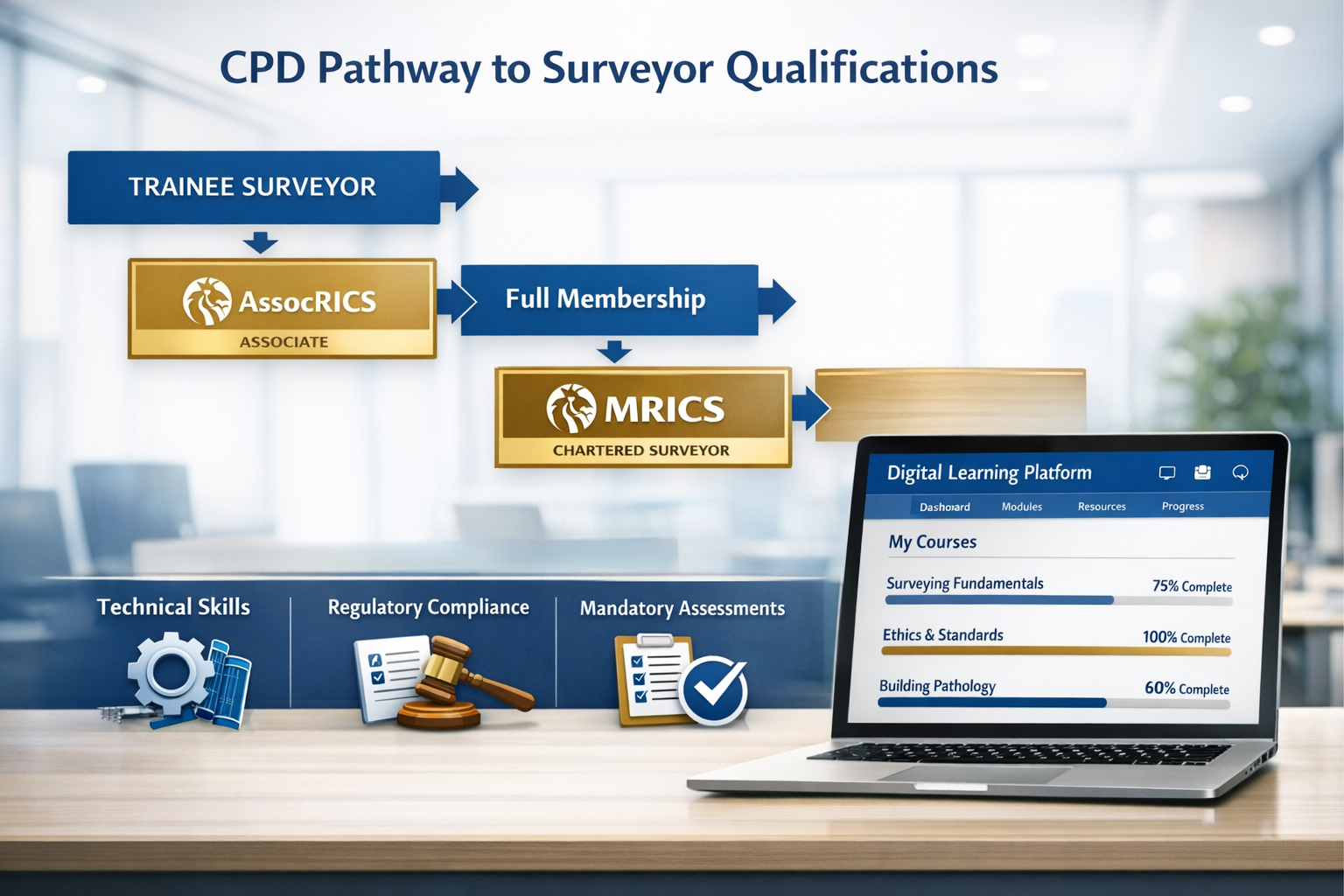
Digital Learning Platforms
Technology-enabled learning has transformed professional development across industries. For surveyors, digital CPD platforms offer:
✅ Flexible Learning: Professionals can complete modules around work commitments, accessing content 24/7 from any location
✅ Microlearning Modules: Bite-sized content focusing on specific competencies allows targeted skill development
✅ Interactive Assessments: Real-time testing and feedback accelerate learning and identify knowledge gaps
✅ Virtual Site Visits: 3D property models and virtual reality simulations provide training experiences without physical site access
✅ Peer Collaboration: Online forums and discussion groups facilitate knowledge sharing across geographic boundaries
Leading building surveyor services providers are already implementing these technologies, creating templates for industry-wide adoption.
Competency-Based Progression
Traditional time-based qualification pathways are giving way to competency-based models that recognize:
- Prior Learning: Professionals with construction, engineering, or property backgrounds can fast-track through relevant modules
- Practical Experience: On-the-job learning counts toward qualification requirements when properly documented and assessed
- Specialized Pathways: Focused qualification routes for specific survey types (e.g., homebuyer reports versus building surveys)
- Modular Certification: Professionals can achieve intermediate qualifications while working toward full chartered status
This approach allows capable individuals to enter productive work more quickly while maintaining professional standards through rigorous assessment.
Enhanced Assessment Mechanisms
To ensure quality while accelerating development, CPD pathways must incorporate robust assessment:
Portfolio-Based Evaluation: Candidates compile evidence of practical work, demonstrating competency across required areas through real project documentation.
Workplace Mentoring: Experienced surveyors provide structured guidance and assessment of trainees' developing skills, creating knowledge transfer while evaluating readiness.
Standardized Examinations: Updated technical assessments covering regulatory requirements, building pathology, construction technology, and professional ethics ensure consistent baseline knowledge.
Practical Demonstrations: Candidates conduct surveys under supervision, demonstrating technical proficiency and professional judgment in real-world conditions.
Addressing Mandatory Assessment Demand Through Strategic Workforce Development
Meeting the challenge of Surveyor Talent Shortages in 2026: Building CPD Pathways to Meet Mandatory Assessment Demand requires coordinated action across multiple fronts. Professional bodies, employers, educational institutions, and government must collaborate on comprehensive workforce strategies.
Recruitment and Attraction Initiatives
The profession must actively attract new talent through:
Apprenticeship Programs
Degree apprenticeships combine academic study with paid employment, removing financial barriers to entry. These programs:
- Provide earn-while-you-learn pathways into the profession
- Partner universities with surveying firms for integrated training
- Typically span 4-6 years, producing qualified professionals with both theoretical knowledge and practical experience
- Appeal to career-changers and school-leavers alike
Graduate Conversion Programs
Intensive programs allow graduates from related disciplines (architecture, engineering, construction management) to qualify as surveyors through accelerated 18-24 month pathways combining coursework with practical training.
Schools Engagement
Raising awareness of surveying careers among secondary school students through:
- 🏫 Career talks and site visits
- 📚 Curriculum materials showcasing the profession
- 🎯 Work experience placements
- 💡 STEM program partnerships highlighting surveying's technical aspects
Technology Integration and Efficiency
While workforce expansion is essential, technology can multiply existing capacity:
Digital Survey Tools: Laser scanning, photogrammetry, and thermal imaging accelerate data collection, allowing surveyors to complete more assessments without compromising quality.
AI-Assisted Analysis: Machine learning algorithms can identify potential defects in property images, flagging issues for surveyor review and reducing analysis time.
Automated Reporting: Template-based systems with intelligent content generation streamline report production, allowing surveyors to focus on technical judgment rather than administrative tasks.
Drone Technology: Aerial surveys provide comprehensive roof and elevation assessments without scaffolding or access equipment, as demonstrated by drone roof survey services now common across major cities.
These technologies don't replace professional judgment but enhance productivity, potentially increasing individual surveyor capacity by 30-50%.

Regional Capacity Building
Talent shortages affect regions differently. While chartered surveyors in London and major cities have better access to training resources, rural and smaller urban areas face acute shortages. Strategic approaches include:
Regional Training Hubs: Establishing CPD centers in underserved areas, providing local access to qualification pathways and reducing relocation requirements.
Remote Assessment Models: Video-supervised surveys and remote mentoring allow trainees in areas like Essex, Sussex, or Hertfordshire to access expert guidance without geographic constraints.
Mobile Training Units: Bringing practical training directly to regional locations, reducing barriers to skill development in areas with limited local infrastructure.
Incentive Programs: Financial support or enhanced CPD funding for professionals willing to practice in underserved regions, addressing geographic imbalances.
Retention and Career Development
Expanding the workforce means nothing if experienced professionals leave the sector. Retention strategies must include:
- 💰 Competitive Compensation: Salary structures reflecting the profession's value and market demand
- 📈 Career Progression: Clear pathways from technical roles through chartered status to senior positions
- 🔄 Work-Life Balance: Flexible working arrangements and reasonable workload management
- 🎓 Ongoing CPD Support: Employer-funded professional development maintaining skills and engagement
- 🏆 Professional Recognition: Industry awards and public acknowledgment of surveyor contributions
The Role of Professional Bodies in Addressing Talent Shortages
RICS and other professional institutions play pivotal roles in managing Surveyor Talent Shortages in 2026: Building CPD Pathways to Meet Mandatory Assessment Demand. Their responsibilities extend beyond standard-setting to active workforce development.
Qualification Pathway Innovation
Professional bodies are introducing:
Fast-Track Routes: Condensed pathways for experienced construction professionals demonstrating relevant competencies, reducing qualification time from 5 years to 2-3 years for suitable candidates.
Specialist Certifications: Focused qualifications for specific assessment types, allowing professionals to enter productive work in defined areas while pursuing broader chartered status.
International Recognition: Reciprocal agreements with overseas professional bodies, facilitating qualified surveyor migration to address UK shortages.
AssocRICS Expansion: Promoting Associate-level membership as a legitimate professional qualification, expanding the pool of qualified practitioners while maintaining appropriate scope limitations.
CPD Quality Assurance
As CPD delivery expands and diversifies, professional bodies must ensure quality through:
- ✓ Accreditation of training providers and digital platforms
- ✓ Regular audits of CPD content and delivery methods
- ✓ Standardized learning outcomes across different providers
- ✓ Feedback mechanisms capturing learner experiences and outcomes
- ✓ Continuous improvement based on emerging best practices
Industry Standards and Guidance
Clear standards help address capacity challenges by:
Proportionate Assessment Protocols: Guidance on appropriate survey levels for different property types and transaction values, ensuring resources focus where most needed.
Technology Standards: Frameworks for acceptable use of digital tools, drones, and AI assistance, providing confidence in modern methodologies.
Quality Benchmarks: Clear performance indicators helping firms and individuals maintain standards under pressure.
Ethical Guidelines: Protecting professional integrity when demand pressures might tempt shortcuts or overcommitment.
Government and Industry Collaboration
Solving Surveyor Talent Shortages in 2026: Building CPD Pathways to Meet Mandatory Assessment Demand requires partnership between public and private sectors.
Policy Coordination
If mandatory assessments become law, government must:
- 📅 Phase Implementation: Gradual rollout allowing workforce expansion to match demand increases
- 💵 Funding Support: Subsidies for CPD programs and apprenticeships, reducing barriers to entry
- 🎯 Targeted Incentives: Tax benefits or grants for firms investing in training and workforce development
- 📊 Workforce Monitoring: Regular capacity assessments informing policy adjustments
Educational Institution Partnerships
Universities and colleges must expand surveying programs through:
- Increased enrollment capacity in built environment courses
- Updated curricula reflecting modern practice and technology
- Industry placements integrated into degree programs
- Research partnerships advancing surveying methodologies
Industry Investment
Surveying firms and related businesses must commit to:
Training Budgets: Dedicating resources to apprenticeships and graduate development, viewing workforce investment as strategic necessity rather than discretionary expense.
Knowledge Sharing: Experienced practitioners dedicating time to mentoring and training, creating multiplier effects as knowledge transfers to new professionals.
Collaborative Initiatives: Industry consortiums pooling resources for training facilities, digital platforms, and regional capacity building where individual firms cannot act alone.
Future-Proofing the Surveying Profession
Beyond immediate crisis management, the profession must prepare for long-term sustainability. Global talent shortages show no signs of abating, with skills demands continuing to evolve [2]. The surveying sector must anticipate future challenges while addressing present shortages.
Emerging Skill Requirements
Tomorrow's surveyors need competencies beyond traditional building knowledge:
🔧 Digital Literacy: Proficiency with survey technology, data analytics, and digital reporting platforms
🌱 Sustainability Expertise: Understanding energy efficiency, retrofit requirements, and environmental impact assessment
⚖️ Regulatory Knowledge: Navigating complex and evolving building regulations, safety standards, and assessment requirements
💬 Client Communication: Translating technical findings into accessible guidance for diverse stakeholders
🔬 Continuous Learning: Adaptability and commitment to ongoing skill development as technology and standards evolve
CPD frameworks must anticipate these requirements, building future-ready professionals rather than merely addressing immediate gaps.
Professional Diversity and Inclusion
Expanding the talent pool requires attracting diverse candidates. The profession has historically been demographically homogeneous, limiting its appeal and missing valuable perspectives. Initiatives must include:
- 👥 Targeted outreach to underrepresented groups
- 🚪 Removing barriers to entry (financial, educational, social)
- 🤝 Mentorship programs supporting diverse professionals
- 📢 Visible role models demonstrating career possibilities
- 🏢 Inclusive workplace cultures retaining diverse talent
Research consistently shows diverse teams produce better outcomes—for surveying, this means more comprehensive assessments and innovative problem-solving.
Technology as Enabler, Not Replacement
While AI and automation will transform surveying practice, technology complements rather than replaces professional judgment. The most successful workforce strategies will:
- Embrace technology enhancing surveyor capabilities
- Maintain human expertise at the core of assessment processes
- Train professionals to leverage tools effectively
- Establish clear boundaries between automated assistance and professional responsibility
Services like structural surveys will always require expert interpretation that technology cannot replicate, ensuring the profession's continued relevance.
Practical Steps for Stakeholders
Different actors must take specific actions to address Surveyor Talent Shortages in 2026: Building CPD Pathways to Meet Mandatory Assessment Demand:
For Aspiring Surveyors
- 🎓 Research qualification pathways matching your background and circumstances
- 💼 Seek employers offering structured training and CPD support
- 🔗 Engage with professional networks and mentorship opportunities
- 📱 Utilize digital learning resources maximizing flexibility
- 🎯 Focus on emerging skills (technology, sustainability) alongside core competencies
For Surveying Firms
- 📊 Assess current capacity against projected demand scenarios
- 💰 Budget for training investments as strategic priority
- 🤝 Partner with educational institutions and professional bodies
- 🛠️ Implement technology enhancing team productivity
- 🌟 Create attractive career pathways retaining talent
For Professional Bodies
- ⚡ Accelerate qualification pathway reforms
- ✅ Ensure CPD quality while expanding access
- 📢 Promote the profession to diverse audiences
- 🤝 Facilitate industry collaboration on workforce challenges
- 📈 Monitor capacity and provide transparent data informing decisions
For Government
- 📅 Coordinate policy implementation with capacity realities
- 💵 Fund workforce development initiatives
- 🎓 Support educational institutions expanding programs
- 📊 Commission regular workforce assessments
- ⚖️ Ensure regulatory frameworks enable rather than hinder solutions
Conclusion
Surveyor Talent Shortages in 2026: Building CPD Pathways to Meet Mandatory Assessment Demand represents one of the most significant challenges facing the UK property sector. The convergence of demographic pressures, potential regulatory changes, and evolving skill requirements creates unprecedented urgency for workforce development.
However, this crisis also presents opportunity. By modernizing CPD frameworks, embracing technology, attracting diverse talent, and fostering collaboration across stakeholders, the surveying profession can emerge stronger and more capable. Digital learning platforms, competency-based qualification pathways, and strategic recruitment initiatives provide practical tools for expanding capacity while maintaining professional standards.
The path forward requires commitment from all stakeholders. Professional bodies must continue innovating qualification routes and CPD delivery. Employers must invest in training and create attractive career pathways. Government must coordinate policy with capacity realities and provide support for workforce development. Educational institutions must expand programs and update curricula. And aspiring surveyors must seize opportunities to enter a profession that offers meaningful, well-compensated work with strong future demand.
The surveying sector has weathered previous challenges through adaptation and professionalism. With strategic action today, it can meet tomorrow's demands while maintaining the high standards that protect property buyers and support the functioning of the housing market. Whether you're seeking chartered surveyors in Hertfordshire, Sussex, or anywhere across the UK, the profession's response to current challenges will determine service availability and quality for years to come.
The time for action is now. Stakeholders must collaborate urgently to build the talent pipelines, CPD pathways, and professional infrastructure that will sustain the surveying profession through 2026 and beyond. The alternative—inadequate capacity meeting mandatory assessment demand—risks undermining property market confidence and limiting homeownership opportunities. By contrast, successful workforce development will strengthen the profession, protect consumers, and ensure the UK housing market functions effectively for all participants.
References
[2] Manpowergroups 2026 Global Talent Shortage Survey – https://www.manpower.com.vn/en/insights/blogs/2026/02/manpowergroups-2026-global-talent-shortage-survey
[3] Survey Hiring Challenges Grow As Skills Shortage Widens – https://businessjournaldaily.com/survey-hiring-challenges-grow-as-skills-shortage-widens/
[7] Talent Shortage In 2026 32 Of Ceos Cannot Find Qualified Workers – https://www.merca20.com/talent-shortage-in-2026-32-of-ceos-cannot-find-qualified-workers/