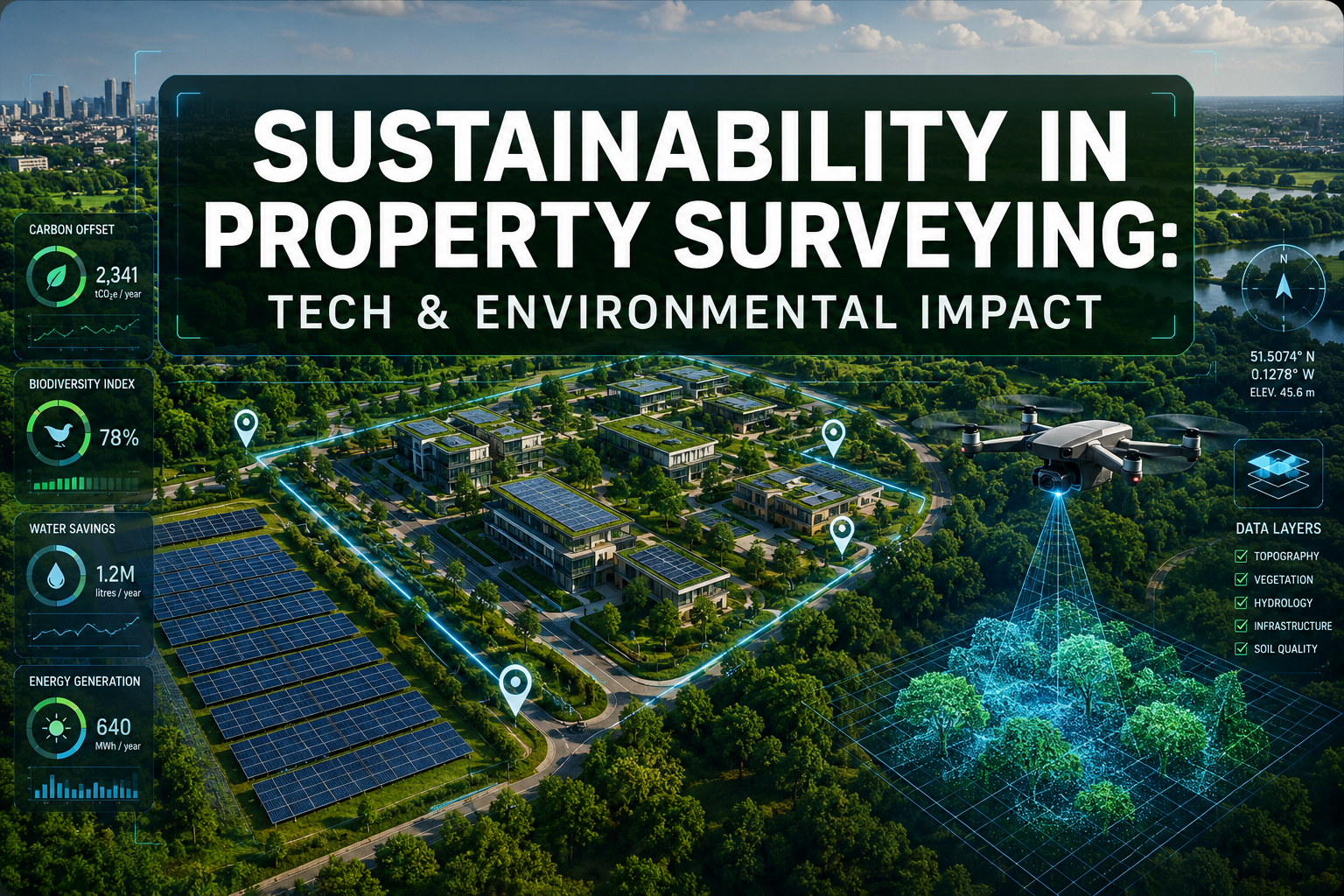

Over 40% of global carbon emissions come from the built environment — and a significant share of that footprint is locked in during the earliest decisions made before a single brick is laid [3]. That single statistic explains why sustainability in property surveying: using tech to assess environmental impacts pre-development has shifted from a niche specialism to a core professional requirement in 2026.
Regulators, investors, and communities are demanding more rigorous environmental scrutiny before development begins. Surveyors who can harness modern ecological data tools are not just meeting compliance requirements — they are actively shaping how land is used, how biodiversity is protected, and how carbon budgets are managed across entire project lifecycles.
Key Takeaways 📌
- Technology is now central to pre-development environmental assessment, with drones, AI, LiDAR, and BIM transforming how surveyors capture ecological data.
- Stricter 2026 regulations — including Biodiversity Net Gain (BNG) requirements and net-zero building standards — are making early environmental impact analysis non-negotiable.
- ESG pressures from investors and lenders are driving demand for surveyors with verifiable sustainability credentials and data-backed reporting.
- Ecological forecasting tools allow surveyors to model long-term environmental outcomes before development consent is even sought.
- Early-stage assessment reduces costly remediation, planning delays, and reputational risk for developers.
Why Sustainability in Property Surveying Is a 2026 Priority
The regulatory landscape has changed dramatically. In the UK, the Environment Act 2021 introduced mandatory Biodiversity Net Gain (BNG), requiring most new developments to deliver a measurable 10% improvement in biodiversity value. As of 2026, this is no longer aspirational — it is a planning condition [4].
Simultaneously, the RICS has made clear that evolving building standards and net-zero commitments now require surveyors to understand operational energy performance, embodied carbon, and ecological impact as part of their core competency [1]. The profession is not simply adapting to green trends; it is being reshaped by them.
💬 "Sustainability is no longer a bolt-on consideration — it is embedded in the valuation and surveying process from the very first site visit." — RICS Sustainability Guidance [1]
The BRE Group's 2026 outlook confirms that real estate professionals are under growing pressure to demonstrate measurable sustainability outcomes, with lenders increasingly tying financing conditions to environmental performance metrics [9]. This means surveyors who cannot produce credible, data-backed environmental assessments risk becoming commercially irrelevant.
For developers and property owners, the message is equally clear: engaging a surveyor with strong environmental tech capabilities early in the process is no longer optional. Whether you are commissioning a commercial property survey in London or assessing a residential site, environmental factors now directly influence value, planning consent, and long-term viability.
The ESG Investment Driver
Beyond regulation, ESG (Environmental, Social, and Governance) expectations from institutional investors are accelerating change. The IVSC ESG Sustainability Survey for 2025–26 found that environmental data quality and consistency remain the biggest challenge for valuers globally, with demand for standardised ecological metrics growing sharply [5].
Urban Land Institute's Emerging Trends in Europe report also identifies sustainability compliance as one of the top factors influencing real estate investment decisions across European markets [7]. Simply put: poor environmental data at the pre-development stage creates financial risk downstream.
The 2026 Tech Toolkit: Ecological Data Capture and Forecasting
The most significant shift in sustainability in property surveying: using tech to assess environmental impacts pre-development is the maturation of a powerful set of digital tools that can capture, model, and forecast ecological conditions with unprecedented accuracy.
🛸 Drone Technology and Remote Sensing
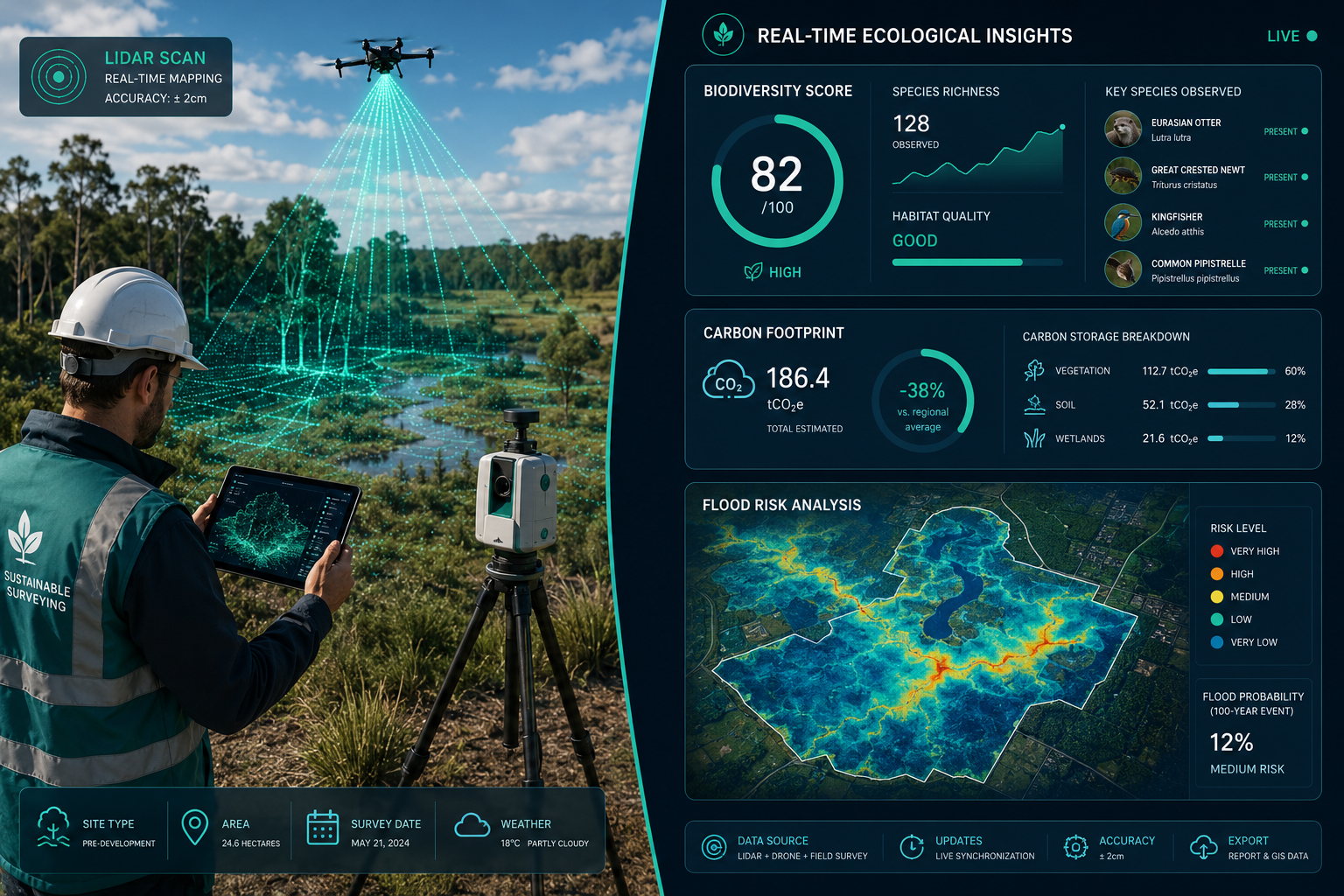
Drones have become indispensable for pre-development environmental surveys. Equipped with multispectral and thermal imaging sensors, they can map vegetation health, identify wetland boundaries, detect invasive species, and assess soil conditions across large sites in a fraction of the time traditional ground surveys require.
In 2026, drone-based surveys are being used to:
- Map habitat types for BNG baseline assessments
- Identify protected species corridors before planning applications
- Detect contamination hotspots through thermal and chemical sensors
- Monitor topographic changes that affect flood risk modelling
For roof-level and structural environmental assessments, drone roof surveys are also being used to evaluate green roof potential, solar panel suitability, and thermal performance — all factors that feed into a property's environmental credentials.
📡 LiDAR Scanning and 3D Terrain Modelling
Light Detection and Ranging (LiDAR) technology generates highly accurate three-dimensional models of land and structures. For pre-development surveying, this is transformative. LiDAR can:
| Application | Environmental Benefit |
|---|---|
| Flood plain mapping | Identifies drainage risk before design |
| Tree canopy assessment | Protects existing biodiversity assets |
| Soil volume modelling | Reduces unnecessary excavation and waste |
| Shadow and solar analysis | Optimises energy performance in design |
| Habitat connectivity mapping | Supports BNG baseline calculations |
When combined with Geographic Information Systems (GIS), LiDAR data allows surveyors to overlay environmental constraints — such as ancient woodland buffers, protected species zones, and air quality corridors — onto development proposals in real time.
🤖 AI-Powered Ecological Forecasting
Perhaps the most exciting development in 2026 is the use of artificial intelligence and machine learning to forecast ecological outcomes. Rather than simply recording what exists on a site today, AI-powered tools can model what will happen to biodiversity, carbon sequestration, and water quality under different development scenarios.
Specialist platforms are now being used to:
- Predict species population changes based on habitat loss or gain
- Model carbon payback periods for different construction approaches
- Simulate long-term flood risk under various climate scenarios
- Generate BNG metric calculations automatically from survey data
This capability is particularly valuable for surveyors working on complex sites where ecological forecasting tools for 2026 green development compliance are now expected as part of the planning evidence base [4].
🏗️ Building Information Modelling (BIM) Integration
BIM has long been used for construction planning, but its integration with environmental data is accelerating. In 2026, BIM models are being enriched with:
- Embodied carbon data for every material specification
- Operational energy performance modelling across seasonal cycles
- Whole-life carbon assessments aligned with RICS guidance [1]
- Ecological impact layers showing biodiversity value changes through construction phases
This integration means that a surveyor's environmental findings at the pre-development stage can be directly imported into the design process, creating a continuous data thread from first assessment through to post-construction monitoring.
Practical Application: What Surveyors Are Doing Differently in 2026
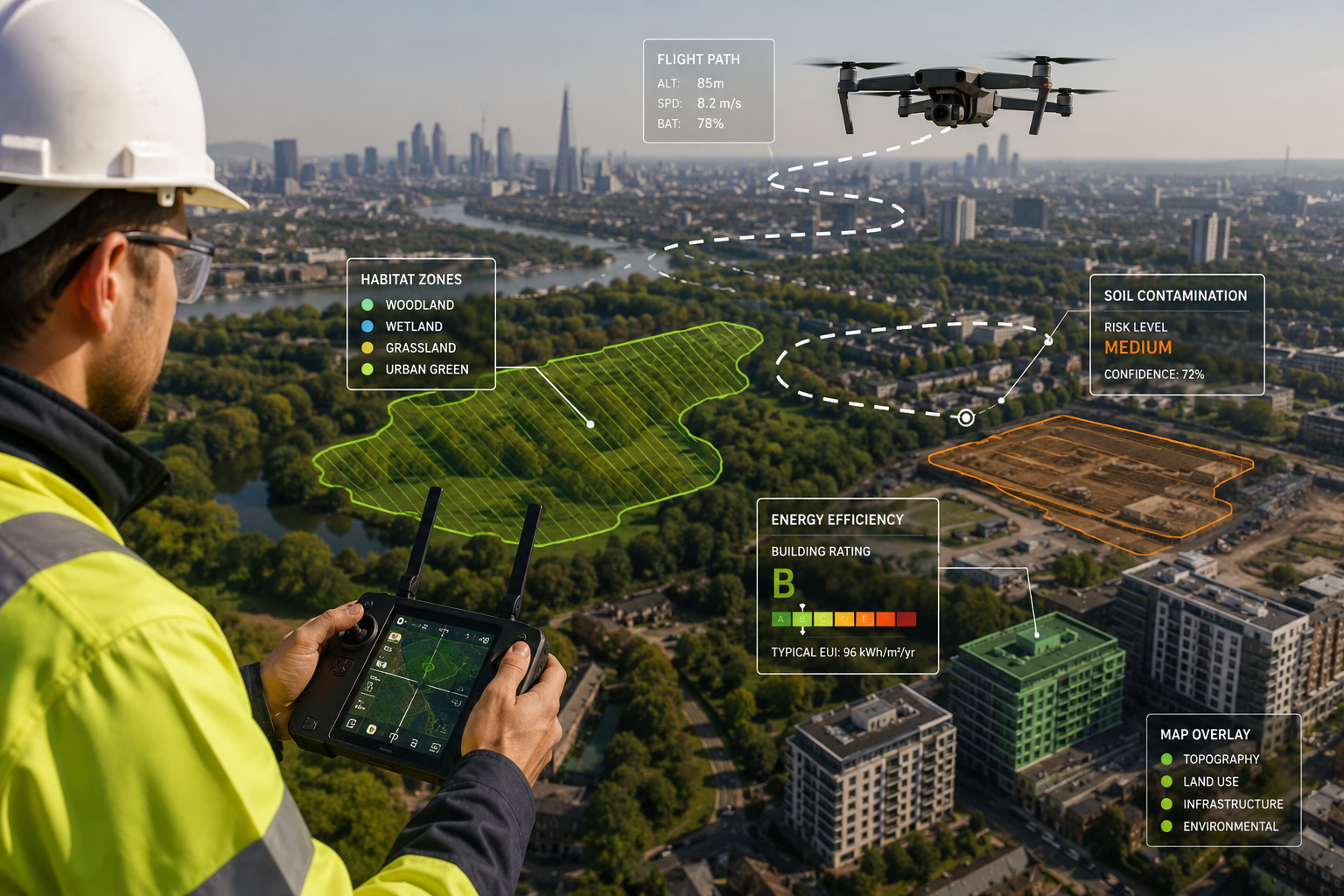
Understanding the tools is one thing. Seeing how they change the actual surveying workflow is another. Here is how sustainability in property surveying: using tech to assess environmental impacts pre-development plays out in practice across different project types.
Residential Development Sites
For a typical residential development site, a 2026 pre-development environmental survey might include:
- Drone-based habitat mapping to establish BNG baseline
- LiDAR terrain modelling for flood risk and drainage design
- AI ecological forecasting to model species impact under planning proposals
- Soil contamination screening using remote sensing data
- Energy performance modelling for orientation and massing decisions
The output feeds directly into planning applications, reducing the risk of objections and accelerating consent timelines. Surveyors who understand what survey is needed at each stage of a project can advise clients on sequencing these assessments efficiently.
Commercial and Mixed-Use Developments
Commercial projects face additional layers of environmental scrutiny. Commercial dilapidation surveys are increasingly incorporating environmental condition assessments, particularly where brownfield land is being repurposed.
Key considerations include:
- Legacy contamination from previous industrial use
- Air quality baselines for planning and occupier health
- Energy Performance Certificate (EPC) uplift requirements
- Scope 3 carbon emissions from construction supply chains [6]
The Sweep sustainability report for 2026 highlights that Scope 3 emissions — those embedded in supply chains and construction processes — are now under intense regulatory and investor scrutiny [6]. Surveyors who can quantify these at the pre-development stage provide significant value to developers navigating ESG reporting obligations.
Boundary and Party Wall Considerations
Environmental assessments at the pre-development stage also intersect with boundary and party wall matters. Tree root surveys, drainage assessments, and soil stability reports can all influence party wall damage claims and the conditions attached to party wall agreements.
Where development involves shared boundaries, early environmental data capture helps establish clear condition baselines — protecting both developers and neighbouring property owners from disputed claims later. Understanding boundary surveys in London as part of the pre-development process is increasingly important as urban development intensifies.
The Role of Schedule of Condition Reports
A Schedule of Condition Report is a foundational document in pre-development surveying. When combined with environmental data, it creates a powerful baseline record that documents not just structural condition but ecological and environmental status at a specific point in time.
This matters because planning authorities, lenders, and future occupiers may all require evidence of pre-development environmental conditions. A well-prepared Schedule of Condition that incorporates ecological data — vegetation surveys, drainage records, contamination screening results — provides robust legal and commercial protection.
Challenges and the Path Forward
Despite rapid progress, several challenges remain in mainstreaming sustainability in property surveying: using tech to assess environmental impacts pre-Development.
Skills and Training Gaps
The 2026 building surveying job market analysis identifies sustainability skills as the single biggest gap in the profession [8]. Many experienced surveyors have deep structural knowledge but limited training in ecological assessment, carbon accounting, or AI-powered forecasting tools. Bridging this gap requires investment in continuing professional development and, in many cases, collaboration with specialist ecologists and environmental consultants.
Data Standardisation
One of the persistent frustrations flagged in the IVSC ESG survey is the lack of standardised environmental data formats [5]. Different local planning authorities, lenders, and developers use different metrics, making it difficult to compare assessments or aggregate data at scale. Industry bodies including RICS and IVSC are working toward common frameworks, but full standardisation remains a 2026–2028 work in progress.
Cost and Accessibility
Advanced environmental tech — particularly AI forecasting platforms and LiDAR scanning — carries costs that can be prohibitive for smaller developers and residential clients. Land survey costs in 2026 have been influenced by technology investment, though competitive market dynamics are gradually bringing prices down [10]. The challenge is ensuring that sustainability assessment does not become a luxury available only to large-scale commercial projects.
Regulatory Complexity
The intersection of BNG requirements, net-zero building standards, EPC regulations, and planning policy creates a complex compliance landscape. Surveyors must navigate multiple overlapping frameworks simultaneously, and the regulatory environment continues to evolve. Staying current requires active engagement with RICS guidance, government consultations, and industry research [1][9].

Conclusion: Actionable Next Steps for Developers and Surveyors
The integration of technology into pre-development environmental assessment is not a future ambition — it is a 2026 reality. Sustainability in property surveying: using tech to assess environmental impacts pre-development is now a professional standard, a regulatory requirement, and a commercial differentiator.
Here are the key actions to take right now:
✅ Engage a surveyor early — before planning applications are submitted, not after. Early environmental data capture reduces risk and cost at every subsequent stage.
✅ Specify technology-enabled surveys — ask surveyors explicitly about their use of drone mapping, LiDAR, AI forecasting, and BIM integration for environmental assessment.
✅ Build BNG into project budgets from day one — mandatory Biodiversity Net Gain requirements mean ecological baseline surveys are a planning prerequisite, not an optional extra.
✅ Align with ESG reporting frameworks — if the project involves institutional finance, ensure environmental data is captured in formats compatible with lender and investor ESG requirements.
✅ Use Schedule of Condition Reports strategically — document pre-development environmental conditions comprehensively to protect against future disputes and compliance challenges.
✅ Invest in surveyor upskilling — for practices, prioritising CPD in sustainability, ecological assessment, and environmental tech is essential for remaining competitive in the 2026 market.
The built environment's contribution to climate change is too significant to leave environmental assessment as an afterthought. Surveyors equipped with the right technology, the right training, and the right regulatory knowledge are uniquely positioned to drive better outcomes — for clients, communities, and the planet.
References
[1] Navigating The Landscape Of Evolving Building Standards While Excelling In Sustainability – https://www.rics.org/news-insights/navigating-the-landscape-of-evolving-building-standards-while-excelling-in-sustainability
[2] Watch – https://www.youtube.com/watch?v=lf74pxIb9KQ
[3] How Green Building Is Shaping The Future Of Construction – https://www.nahb.org/blog/2024/11/how-green-building-is-shaping-the-future-of-construction
[4] Sustainability Driven Ecological Forecasting In Property Surveys Tools For 2026 Green Development Compliance – https://princesurveyors.co.uk/blog/sustainability-driven-ecological-forecasting-in-property-surveys-tools-for-2026-green-development-compliance/
[5] Esg Sustainability Survey 2025 26 – https://ivsc.org/esg-sustainability-survey-2025-26/
[6] The State Of Sustainability In 2026 Progress Pressure And The Path Forward – https://www.sweep.net/blog/the-state-of-sustainability-in-2026-progress-pressure-and-the-path-forward
[7] Emerging Trends – https://europe.uli.org/research/emerging-trends/
[8] 2026 Building Surveying Job Market Opportunities Chris Van Aurich E7xze – https://www.linkedin.com/pulse/2026-building-surveying-job-market-opportunities-chris-van-aurich-e7xze
[9] The State Of Sustainability And Real Estate 2025 Lessons And What S Next For 2026 – https://bregroup.com/news/the-state-of-sustainability-and-real-estate-2025-lessons-and-what-s-next-for-2026
[10] Land Survey Costs In 2026 Price Trends Technologys Impact And Budget Planning For Property Owners – https://wimbledonsurveyors.com/land-survey-costs-in-2026-price-trends-technologys-impact-and-budget-planning-for-property-owners/