

The property valuation landscape in 2026 faces a critical challenge that has nothing to do with data scarcity. Surveyors and lenders now have access to more property information than ever before, yet transaction delays and rework continue to plague the industry. The real issue lies in how well information is gathered and used at the very start of the valuation process [1]. As the market increasingly encounters high-rise blocks, non-standard construction, and adapted homes as part of everyday lending, the need for enhanced upfront assessment has never been more urgent. This is where Technology for Upfront Property Understanding in 2026 Valuations: GeoConnect and Data Tools for Complex Assets becomes essential—not as a replacement for professional judgment, but as a strategic tool for reducing transaction risks before they compound.
Key Takeaways
- Upfront data integration through platforms like GeoConnect reduces transaction delays by consolidating property-specific information from multiple sources at the point of instruction [1]
- AI-enhanced valuation tools deliver results in under 60 seconds with 94% accuracy compared to 85-90% for traditional methods, while processing over 300 market factors simultaneously [2]
- Complex asset assessment now requires evaluating construction type, environmental factors, market context, and long-term resilience criteria together rather than in isolation [1]
- Hybrid approaches combining algorithmic speed with human expertise for unique properties represent the industry's most successful strategy in 2026 [2]
- Forward-looking valuation criteria increasingly assess energy standards, maintenance requirements, and future adaptation potential alongside current market value [1]

Understanding the 2026 Valuation Challenge for Complex Properties
The Shift from Data Access to Data Application
The fundamental challenge facing property professionals in 2026 is not obtaining information—it's about strategic data utilization at the critical early stages of the valuation process. When professionals fail to gather comprehensive property understanding upfront, pressure builds exponentially as the transaction progresses [1]. This creates a cascade effect: incomplete initial assessments lead to follow-up queries, which trigger delays, which ultimately result in frustrated clients and increased costs.
For commercial property valuations and residential assessments alike, the stakes have risen considerably. The property market now regularly encounters:
- 🏢 High-rise residential blocks with complex cladding and fire safety considerations
- 🏗️ Non-standard construction types including timber frame, steel frame, and modern methods of construction
- ♿ Adapted properties with accessibility modifications that affect both value and marketability
- 🌱 Sustainability-enhanced buildings with varying levels of energy efficiency certification
- 🏛️ Heritage properties with listed building constraints and conservation area restrictions
Each of these property types requires nuanced upfront assessment that goes far beyond basic comparable analysis. The traditional approach of addressing complications mid-process simply doesn't work in 2026's fast-paced lending environment.
The Cost of Inadequate Upfront Assessment
When surveyors and lenders fail to build a comprehensive property picture before selecting a valuation route, the consequences ripple throughout the entire transaction. Research indicates that inadequate upfront understanding creates several specific problems:
| Issue | Traditional Approach | Impact on Transaction |
|---|---|---|
| Construction type identification | Discovered during site visit | Requires follow-up specialist reports |
| Environmental risk factors | Assessed separately from property characteristics | Delayed lending decisions |
| Market comparables selection | Based on limited initial data | Inaccurate valuation brackets |
| Regulatory compliance | Checked late in process | Last-minute transaction complications |
| Long-term resilience factors | Often overlooked entirely | Poor lending risk assessment |
This fragmented approach directly contradicts the 2026 opportunity that forward-thinking firms are seizing: reducing transaction delays and rework by improving property understanding at the outset rather than addressing issues mid-process [1]. Professional valuation reports in London increasingly reflect this shift toward comprehensive upfront assessment.
Technology for Upfront Property Understanding in 2026 Valuations: How GeoConnect Integrates Critical Data
GeoConnect's Core Functionality and Strategic Purpose
GeoConnect represents a fundamental shift in how property professionals approach the initial stages of valuation work. Rather than treating property data as something to be gathered piecemeal throughout the assessment process, this technology brings together property-specific information from multiple sources at the point of instruction [1].
The platform's design philosophy centers on a simple but powerful concept: enabling surveyors and lenders to build a clearer picture of properties before selecting a valuation route. This upfront clarity transforms decision-making from reactive problem-solving to proactive risk management.
GeoConnect's integration capabilities span several critical data domains:
🗺️ Environmental Data Integration
- Flood risk mapping from multiple authoritative sources
- Ground stability and subsidence history
- Contaminated land registers
- Radon exposure levels
- Coastal erosion risk zones
🏗️ Construction and Building Data
- Property age and construction type classification
- Building materials and methods identification
- Extension and alteration history
- Planning permission records
- Building control completion certificates
📊 Market Context Information
- Comparable sales with detailed filtering
- Local market trends and price movements
- Days on market analytics
- Area demand indicators
- Transaction volume patterns
📜 Historical Property Records
- Ownership history and title complications
- Previous valuation records
- Mortgage lending history
- Insurance claims data (where available)
- Planning application outcomes
This comprehensive data assembly allows professionals to examine construction type, form, location, history, and market context together, providing a more balanced view that supports more consistent lending decisions [1]. For RICS registered valuers in London, this integrated approach aligns perfectly with professional standards requiring thorough due diligence.
The Critical Role of Environmental Factors in Balanced Assessment
One of the most significant advantages of Technology for Upfront Property Understanding in 2026 Valuations: GeoConnect and Data Tools for Complex Assets is how it positions environmental factors within the broader property risk profile. Rather than treating flood risk, ground stability, or climate resilience as isolated concerns, the platform presents them as important but not isolated components of risk assessment [1].
This balanced approach prevents two common errors in property valuation:
- Over-weighting environmental risks to the exclusion of positive market factors and property characteristics
- Under-weighting environmental risks by treating them as secondary considerations addressed only after valuation completion
By presenting environmental data alongside construction quality, location advantages, market demand, and historical performance, GeoConnect enables more nuanced professional judgment rather than algorithmic decision-making. This is particularly valuable for properties in areas with known environmental challenges but strong market fundamentals.
Data Tools and AI Technology Transforming Complex Asset Valuations
Speed and Accuracy Metrics in Modern Valuation Technology
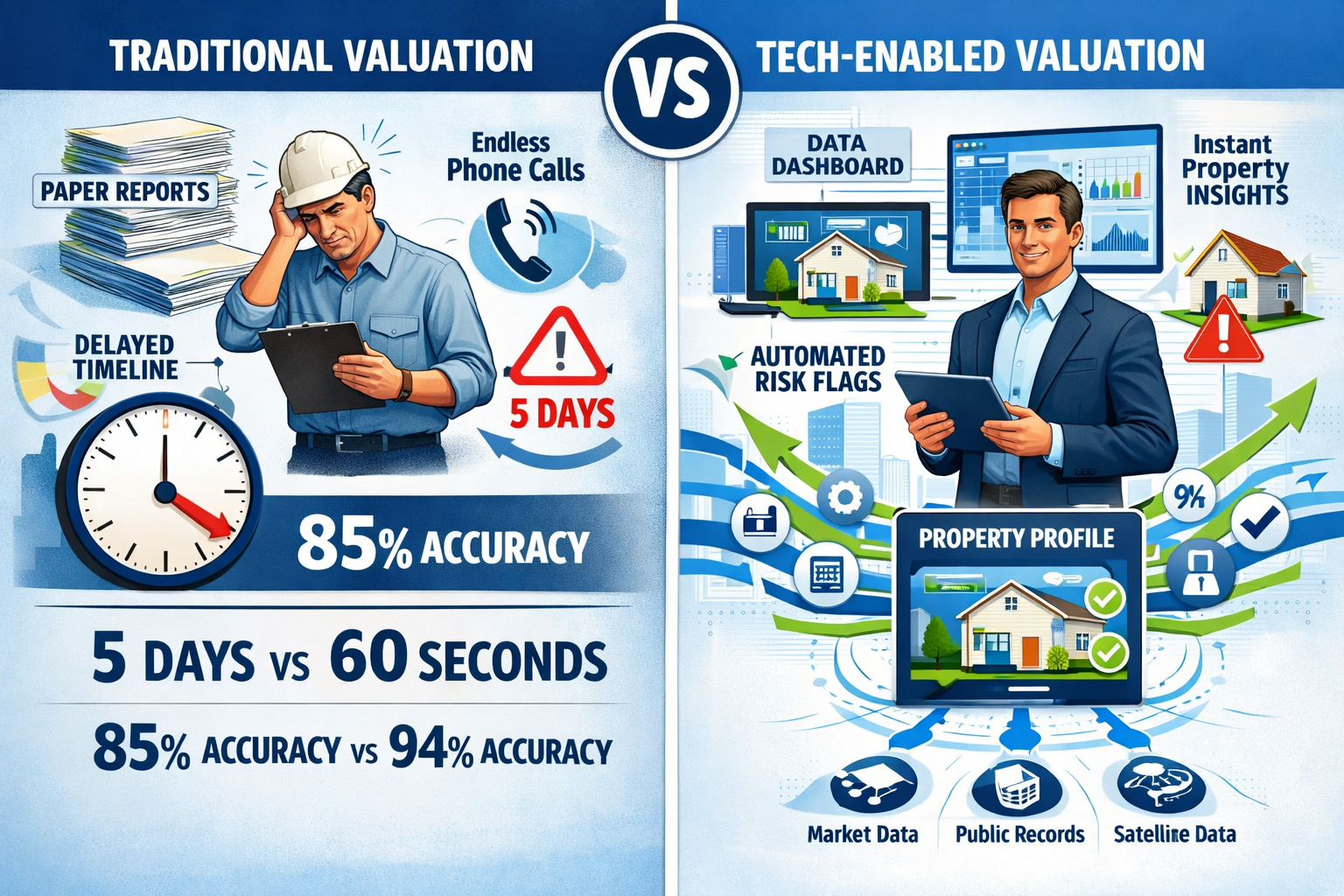
The performance capabilities of AI-enhanced property valuation tools in 2026 represent a quantum leap from traditional manual processes. Current systems deliver valuations in under 60 seconds compared to 3-5 days for traditional manual appraisals [2]. This speed advantage doesn't come at the expense of accuracy—in fact, the opposite is true.
AI valuation systems achieve 94% accuracy compared to 85-90% for traditional appraisals [2], with machine learning models handling complex, non-linear real estate data at high accuracy levels reaching up to 93% R² in recent studies. This improvement stems from the technology's ability to process vastly more variables simultaneously than human appraisers can manually consider.
The cost differential is equally striking: AI valuations cost $5-$15 versus $300-$500+ for manual professional appraisals [2]. However, this should not be interpreted as recommending full replacement of human expertise—particularly for complex or non-standard properties where professional judgment remains irreplaceable.
The Scale of Data Processing in Modern Valuation Systems
Modern AI systems analyze over 300 market factors including demographics, foot traffic, comparable sales, and real-time market conditions [2]. These algorithms are trained on historical sales data and property characteristics, creating models that identify patterns invisible to manual analysis.
The data categories processed include:
📍 Location Intelligence
- Proximity to transport links, schools, and amenities
- Neighborhood demographic trends
- Crime statistics and safety indicators
- Future infrastructure development plans
- Local employment and economic indicators
🏘️ Property Characteristics
- Detailed construction specifications
- Room configurations and spatial analysis
- Condition assessment indicators
- Energy performance metrics
- Unique features and modifications
💹 Market Dynamics
- Real-time comparable sales with adjustment factors
- Seasonal market variation patterns
- Supply and demand indicators
- Days on market by property type
- Price per square foot trends with granular segmentation
🔮 Predictive Analytics
- Value appreciation forecasting
- Market cycle positioning
- Risk probability modeling
- Investment return projections
- Future marketability assessment
Advanced platforms achieve 91% accuracy in 6-month value projections and 83% accuracy for 12-month projections [2], enabling identification of high-appreciation properties before market movements become obvious. For professionals conducting property valuations across London, these predictive capabilities add significant value to client advisory services.
The Hybrid Model: Combining Algorithmic Speed with Human Judgment
The industry consensus in 2026 indicates that the most successful approach combines algorithmic speed with human judgment for complex cases [2]. This hybrid model addresses the limitations of both pure automation and pure manual work:
Pure Automation Limitations:
- Struggles with truly unique properties without adequate comparables
- Cannot assess subjective quality factors like architectural merit
- Misses local market nuances not captured in data
- Fails to account for property-specific complications requiring site inspection
Pure Manual Work Limitations:
- Slow and expensive for straightforward properties
- Subject to individual appraiser bias and inconsistency
- Cannot process the volume of market data that influences value
- Lacks predictive analytics capabilities
The hybrid approach uses technology for initial screening, data assembly, and comparable analysis, while reserving human expertise for:
- Properties with non-standard construction requiring specialist knowledge
- Unique architectural or historical properties
- Properties with complex title or legal issues
- Cases requiring matrimonial valuation or divorce valuation where context matters significantly
- Situations involving retrospective valuation requiring historical market reconstruction
This division of labor maximizes efficiency while maintaining the professional judgment essential for complex cases. It's particularly valuable for firms handling diverse portfolios spanning standard residential properties through to complex commercial assets.
Forward-Looking Valuation: Assessing Long-Term Property Resilience
Expanding Valuation Criteria Beyond Current Market Value
In 2026, surveyors are increasingly expected to assess not just current property value but longer-term resilience [1]. This expanded scope reflects fundamental changes in how lenders, investors, and buyers think about property as an asset class. The question is no longer simply "What is this property worth today?" but rather "How will this property perform over the next 10-20 years?"
This shift makes early assessment and data analysis even more critical [1], as long-term resilience factors often require specialized data sources and analysis techniques beyond traditional comparable sales methodology.

Key Resilience Criteria in 2026 Valuations
🌡️ Energy Standards and Climate Adaptation
Properties are now assessed against both current and future energy performance requirements. The UK's trajectory toward net-zero emissions means that properties with poor energy efficiency face:
- Increased regulatory risk of rental restrictions or sale complications
- Higher ongoing costs reducing net value to owners
- Reduced buyer pool as mortgage lenders tighten criteria
- Potential mandatory upgrade requirements
Upfront data tools help identify properties requiring significant energy improvements before they become lending obstacles. This is particularly important for commercial building surveys in London where energy performance certificates significantly impact investment value.
🔧 Ongoing Maintenance Requirements
Technology-enhanced upfront assessment now includes predictive maintenance analysis based on:
- Building age and construction type
- Historical maintenance records
- Component lifecycle data
- Climate exposure factors
- Usage patterns and stress factors
Properties with high future maintenance burdens receive adjusted valuations reflecting the total cost of ownership rather than just acquisition price. This is especially relevant for reinstatement cost valuations where future replacement costs matter significantly.
🔄 Future Use Potential and Adaptability
Forward-looking valuations assess how easily properties can adapt to changing needs:
- Conversion potential for changing household structures
- Accessibility modification feasibility
- Home working space adequacy
- Technology infrastructure capability
- Planning permission likelihood for extensions or alterations
Properties with greater adaptability command premium valuations as they offer owners more options as circumstances change. Understanding valuation factors that influence long-term value helps professionals provide more comprehensive advice.
Integrating Resilience Assessment into Upfront Data Gathering
The challenge of assessing long-term resilience is that it requires synthesizing information from diverse sources that traditionally exist in separate silos. Energy performance data sits with certification bodies, flood risk projections come from environmental agencies, planning potential requires local authority records, and maintenance forecasts depend on construction databases.
Technology for Upfront Property Understanding in 2026 Valuations: GeoConnect and Data Tools for Complex Assets addresses this challenge by bringing these disparate data sources together at the initial instruction stage. This integration enables surveyors to:
- Identify resilience concerns before site visits, allowing proper preparation and specialist consultation where needed
- Provide clients with comprehensive risk profiles that go beyond simple market value figures
- Support lending decisions with forward-looking analysis that reduces long-term portfolio risk
- Deliver more valuable professional advice that positions surveyors as strategic advisors rather than just number providers
For properties requiring structural surveys in London, this forward-looking approach adds significant value by contextualizing structural findings within broader resilience considerations.
Practical Implementation: Making Technology Work for Complex Asset Valuations
Selecting the Right Technology Stack for Your Practice
Not all valuation technology solutions offer the same capabilities or suit every practice type. When evaluating data tools for upfront property understanding, consider these factors:
Integration Capabilities:
- Does the platform connect with your existing case management systems?
- Can it pull data from the specific sources most relevant to your market area?
- Does it support API connections for custom workflow automation?
Data Source Quality:
- Which authoritative databases does the platform access?
- How frequently is data updated?
- What verification processes ensure data accuracy?
Usability and Training Requirements:
- How steep is the learning curve for your team?
- What training and support does the vendor provide?
- Can the interface be customized to match your workflow?
Scalability and Cost Structure:
- Does pricing scale reasonably with usage volume?
- Are there hidden costs for additional data sources or users?
- What commitment period is required?
Workflow Integration for Maximum Efficiency
Successfully implementing Technology for Upfront Property Understanding in 2026 Valuations: GeoConnect and Data Tools for Complex Assets requires thoughtful workflow design. The goal is to enhance rather than disrupt existing professional processes.
Optimal Implementation Approach:
- Instruction Receipt Stage: Automatically trigger data gathering as soon as instruction details are entered
- Initial Assessment Stage: Review compiled data to identify complexity flags and risk factors
- Valuation Route Selection: Use data insights to determine whether desktop, drive-by, or full inspection is appropriate
- Pre-Visit Preparation: Brief surveyors on specific issues to investigate based on data findings
- Site Visit Efficiency: Focus inspection time on areas flagged by upfront data analysis
- Report Compilation: Integrate data findings with site observations for comprehensive reporting
- Client Communication: Present data-supported conclusions with visual aids and clear risk explanations
This structured approach ensures that technology enhances rather than replaces professional judgment, while maximizing efficiency gains.
Training and Professional Development Considerations
Adopting advanced valuation technology requires investment in team capabilities beyond just software licensing. Successful firms prioritize:
Technical Competency Development:
- Understanding how AI algorithms process property data
- Interpreting data visualization and risk indicators
- Recognizing when algorithmic outputs require human override
- Managing data quality issues and source limitations
Professional Judgment Enhancement:
- Using data insights to inform rather than replace site assessment
- Communicating technology-supported conclusions to clients
- Balancing algorithmic outputs with local market knowledge
- Maintaining RICS standards while leveraging technology efficiency
Client Communication Skills:
- Explaining how technology enhances valuation accuracy
- Presenting complex data findings in accessible formats
- Building client confidence in hybrid valuation approaches
- Managing expectations around speed versus complexity trade-offs
For practices offering specialized services like lease extension valuations in London or right to buy valuations, technology training should emphasize how data tools support these specific valuation types.
Conclusion: Embracing Technology for Better Property Understanding
The property valuation landscape in 2026 has reached a critical inflection point. The challenge is no longer accessing data—it's about strategically gathering and applying information at the very beginning of the valuation process to reduce transaction risks, eliminate costly rework, and deliver superior professional service. Technology for Upfront Property Understanding in 2026 Valuations: GeoConnect and Data Tools for Complex Assets represents not just an efficiency improvement but a fundamental evolution in how surveyors approach their professional responsibilities.
As high-rise blocks, non-standard construction, and adapted homes become everyday lending scenarios rather than exceptional cases, the ability to build comprehensive property understanding before selecting a valuation route becomes essential rather than optional [1]. The most successful practices in 2026 are those that embrace the hybrid model: using algorithmic speed and data processing power for initial assessment while reserving human expertise for the nuanced judgment that complex properties demand [2].
The forward-looking dimension of modern valuation—assessing energy standards, maintenance requirements, and future adaptation potential alongside current market value [1]—requires exactly the kind of multi-source data integration that platforms like GeoConnect provide. This isn't about replacing professional surveyors with algorithms; it's about equipping professionals with better tools to deliver more comprehensive, accurate, and valuable advice to clients navigating an increasingly complex property market.
Actionable Next Steps
For property professionals looking to enhance their valuation capabilities through technology:
- Audit your current data gathering process to identify where delays and rework typically occur
- Evaluate technology platforms based on integration capabilities, data source quality, and workflow compatibility
- Pilot technology with a subset of cases to understand practical benefits and implementation challenges
- Invest in team training that balances technical competency with professional judgment development
- Develop client communication approaches that explain how technology enhances rather than replaces professional expertise
- Monitor performance metrics including turnaround time, rework frequency, and client satisfaction
- Stay informed about evolving valuation criteria particularly around resilience, sustainability, and long-term property performance
The firms that thrive in 2026 and beyond will be those that recognize technology as an enabler of better professional service rather than a threat to professional expertise. By embracing upfront property understanding through integrated data tools, surveyors can focus their valuable time and expertise where it matters most: providing the nuanced judgment and strategic advice that clients truly value.
References
[1] 2026 Forecasts Technology And Surveying – https://mortgagesoup.co.uk/2026-forecasts-technology-and-surveying/
[2] Ai Property Valuation – https://www.growthfactor.ai/resources/blog/ai-property-valuation