Only 14% of homeowners who trigger the Party Wall etc. Act 1996 fully understand what a Party Wall Award actually contains — yet every clause within that document carries real legal weight that can protect or expose thousands of pounds. For anyone planning a loft conversion, rear extension, or basement dig in 2026, understanding the anatomy of a Party Wall Award is not optional. It is essential.
This guide — rooted in The Surveyor's Guide to Party Wall Awards: Key Clauses, Common Additions, and What Each One Protects — breaks down every standard and optional clause in plain English, explaining exactly what each one does and why it matters to both building owners and their neighbours.
Key Takeaways 📋
- A Party Wall Award is a legally binding document that governs how notifiable works are carried out — not just a formality.
- Every award contains core clauses covering access, working hours, damage liability, and schedule of condition references.
- Common additions such as security for expenses, ESG checkpoints, and special foundations clauses provide extra layers of protection.
- The RICS 8th Edition guidance (consulted through May 2026) has updated the draft award template, strengthening surveyor conduct and fee transparency rules. [1][2]
- Both building owners and adjoining owners have enforceable rights under the award — understanding each clause helps both parties exercise those rights confidently.
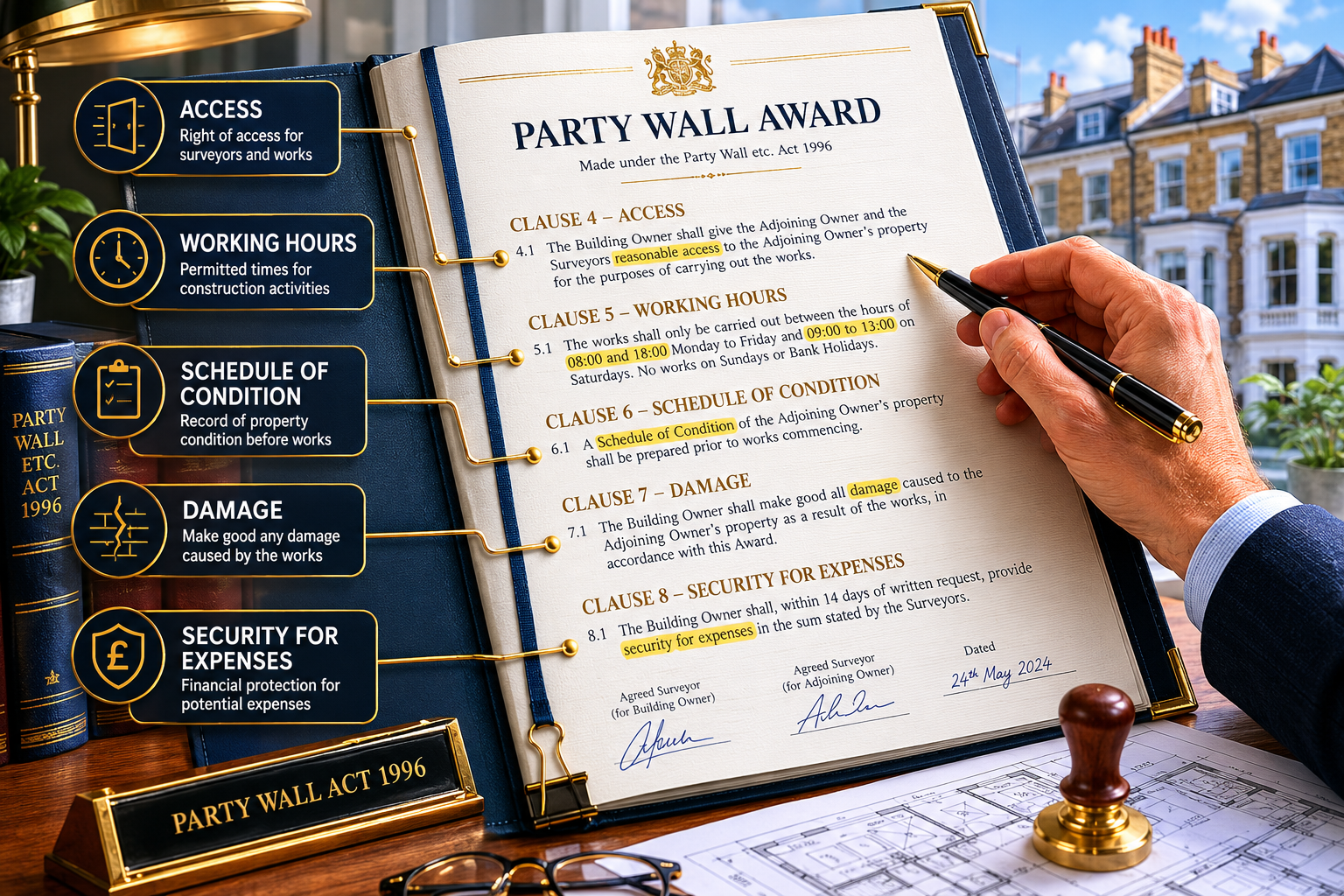
What Is a Party Wall Award and When Is One Needed?
Before diving into individual clauses, it helps to understand where a Party Wall Award sits in the overall process. A Party Wall Notice is the starting point — the formal written notification a building owner serves on neighbours before carrying out works covered by the Party Wall etc. Act 1996.
If the adjoining owner consents in writing within 14 days, no award is needed. The parties simply record the wall's condition and proceed. However, if the adjoining owner dissents, raises concerns, or simply does not respond, the dispute resolution mechanism kicks in and a surveyor (or surveyors) must prepare a Party Wall Award. [8]
💡 Pull Quote: "A Party Wall Award is not a punishment for disagreement — it is a structured legal framework that protects everyone involved in the build."
The award is drafted by either:
- An Agreed Surveyor appointed by both parties jointly, or
- Two Surveyors — one appointed by each party — who together draft the award
If those two surveyors cannot agree, a Third Surveyor (selected in advance) acts as referee. [6] Surveyor independence is a legal requirement, and the 2026 RICS guidance strengthens this rule explicitly. [6]
For a deeper look at how the agreed surveyor model works, see this guide to the party wall agreed surveyor role.
Core Clauses in Every Party Wall Award
The following clauses appear in virtually every Party Wall Award. Each serves a distinct protective function.
1. 🏗️ Description of the Works
What it is: A precise written description of the proposed works, often supported by drawings or specifications.
What it protects: Both parties. The building owner cannot deviate significantly from the described works without a supplementary award. The adjoining owner has a clear record of what was agreed, preventing scope creep.
Practical tip: Vague descriptions are a common source of disputes. Good surveyors insist on specific, measurable language — for example, "removal of 3.5 metres of party wall to a depth of 2.4 metres" rather than "some wall removal."
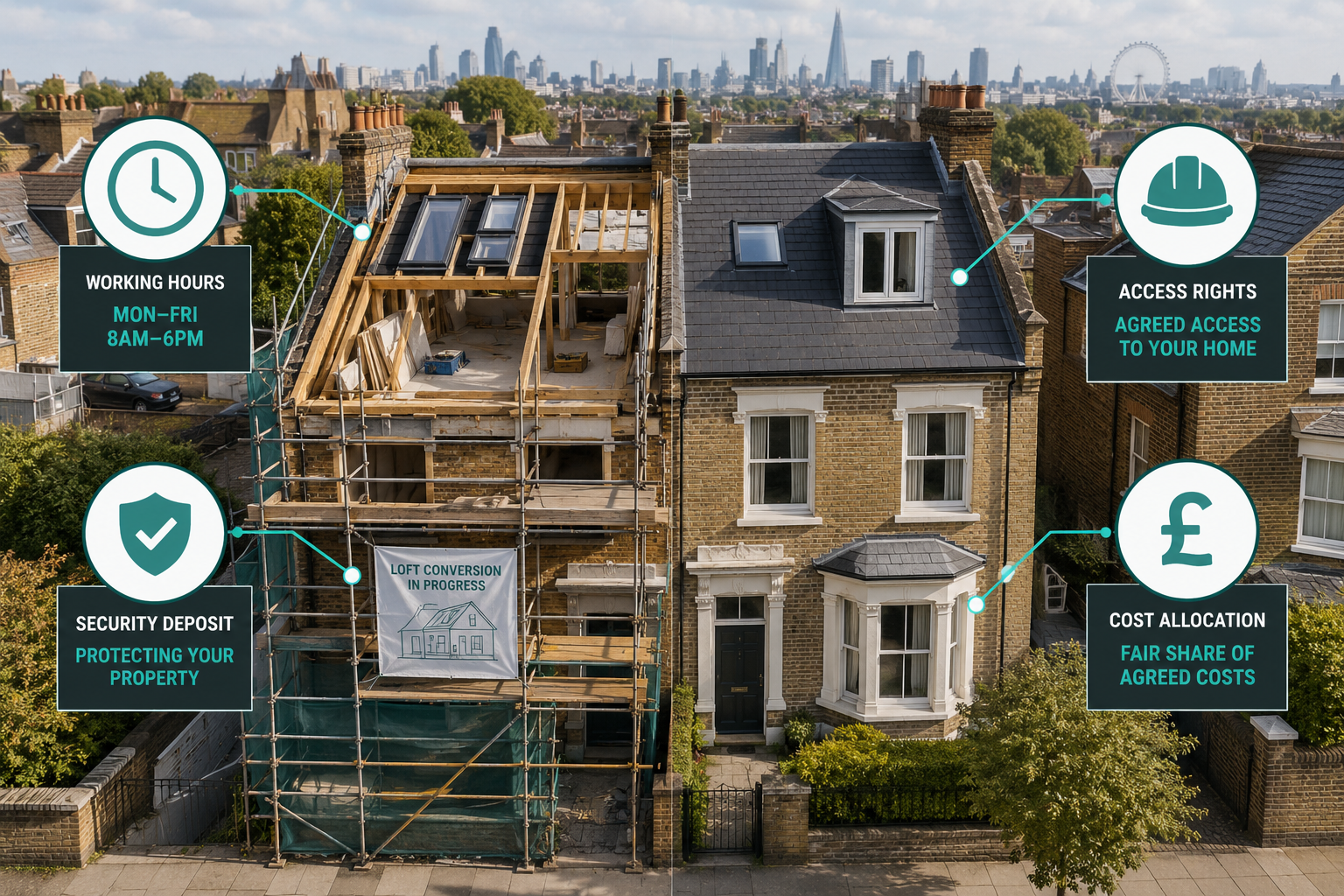
2. ⏰ Working Hours Restrictions
What it is: A clause specifying the times during which noisy or disruptive works may be carried out.
Standard provisions in 2026 awards typically read: [7]
| Day | Permitted Hours for Noisy Works |
|---|---|
| Monday – Friday | 8:00 am – 6:00 pm |
| Saturday | 8:00 am – 1:00 pm |
| Sunday | ❌ Prohibited |
| Bank Holidays | ❌ Prohibited |
What it protects: The adjoining owner from unreasonable disruption to their home life, sleep, and wellbeing. These restrictions are enforceable under the award's terms — a breach gives the adjoining owner grounds for legal action.
Common addition: Some awards include a prior notification clause, requiring the building owner to give 48 hours' written notice before commencing each phase of noisy works.
3. 🚪 Access Rights
What it is: A clause granting the building owner and their contractors the right to access the adjoining owner's property where necessary to carry out the works.
What it protects: The building owner's ability to complete the project lawfully. Without this clause, a contractor who steps onto a neighbour's land — even briefly — could face a trespass claim.
Key details typically included:
- Minimum notice period before access (usually 14 days for structural access)
- Requirement for the building owner to make good any damage caused during access
- Restriction of access to reasonable hours (aligned with the working hours clause)
⚠️ Important: Access rights under a Party Wall Award are separate from any general right of access under Section 8 of the Act. The award clause can be more specific and more protective than the statutory baseline.
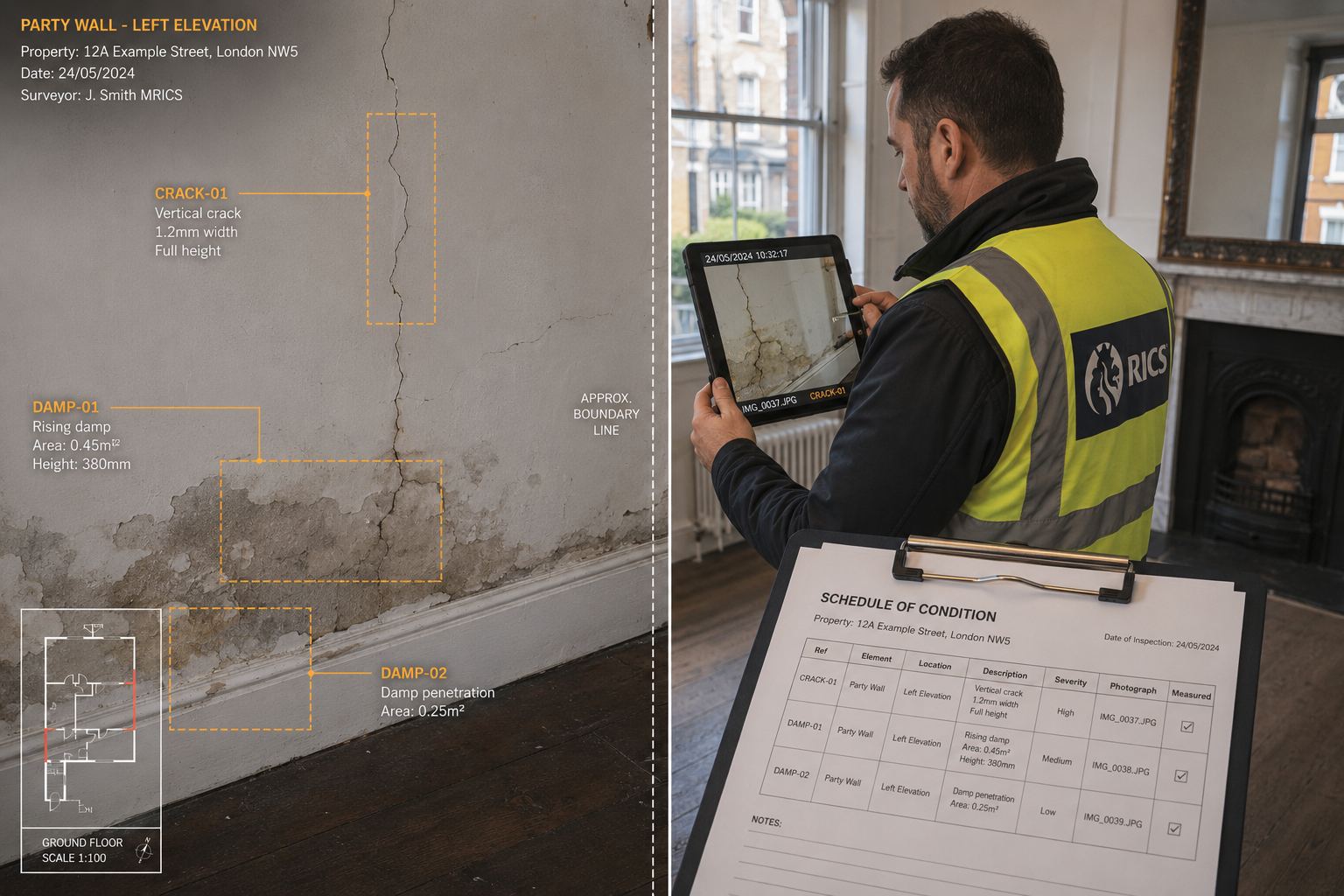
4. 📸 Schedule of Condition Reference
What it is: A clause incorporating a schedule of condition — a detailed photographic and written record of the adjoining property's existing condition before works begin.
What it protects: Both parties, but especially the adjoining owner. If cracks appear or damage occurs after works start, the schedule of condition is the baseline evidence used to determine whether the building owner is liable. [6]
A robust schedule should document:
- ✅ Existing cracks, settlement, or structural movement
- ✅ Condition of walls, ceilings, and floors
- ✅ External surfaces, garden walls, and outbuildings
- ✅ Photographic evidence with timestamps
Without this clause, proving causation in a damage claim becomes extremely difficult for either side.
5. 💷 Damage and Compensation
What it is: A clause establishing the building owner's liability to make good any damage caused to the adjoining property as a direct result of the notifiable works.
What it protects: The adjoining owner's right to have their property restored to its pre-works condition — at the building owner's expense. The clause typically specifies that repairs must be carried out in a like-for-like manner using materials of equivalent quality.
See the party wall damage guidance for more detail on how damage claims are handled in practice.
6. 💰 Costs and Fee Allocation
What it is: A clause confirming who pays for the party wall process.
The standard position under the Act: The building owner bears all reasonable party wall costs, including: [5]
- Their own surveyor's fees
- The adjoining owner's surveyor's fees
- Third Surveyor fees (if the dispute escalates)
What it protects: The adjoining owner from financial exposure simply for exercising their statutory rights. Fee reasonableness is legally protected — a building owner's surveyor can formally challenge excessive charges. [5]
2026 fee context: Surveyor fees have risen 8–12% since 2024, now ranging from £750 to £1,800 per surveyor per affected neighbour, with hourly rates of £90–£450 depending on project complexity. [5] For a full breakdown, see the party wall surveyor cost guide.
Common Additions to Party Wall Awards: What Each One Protects
Beyond the core clauses, surveyors regularly include additional provisions tailored to the specific project. These additions often provide the most targeted protection for both parties.
7. 🔒 Security for Expenses
What it is: A clause requiring the building owner to deposit a sum of money (or provide a bond) before works begin, held as security against potential damage or non-completion.
When it applies: Typically included where the adjoining owner has genuine concerns about the building owner's financial capacity to pay for repairs — for example, where the building owner is a developer rather than a long-term resident.
What it protects: The adjoining owner from being left with unrepaired damage if the building owner becomes insolvent or abandons the project mid-works.
Practical note: The amount is set by the surveyors and must reflect a realistic estimate of potential costs — not a punitive figure.
8. 🏛️ Special Foundations Clause
What it is: A clause addressing the use of reinforced concrete foundations or other special foundation types that extend into or affect the adjoining owner's land.
What it protects: The adjoining owner's consent rights. Under Section 7(4) of the Party Wall etc. Act 1996, special foundations cannot be placed on adjoining land without the adjoining owner's written consent. This clause records that consent (or its absence) explicitly.
Why it matters for loft conversions and extensions: Many party wall matters for loft conversions involve structural changes that affect foundations — making this clause increasingly common in residential awards.
9. 🌱 ESG Checkpoint Clauses (2026 Addition)
What it is: A newer addition recommended by the updated RICS guidance, incorporating Environmental, Social, and Governance (ESG) checkpoints into the award template. [3]
What it protects: Both parties from environmental liability and reputational risk. These clauses typically require:
- Dust and waste management plans
- Confirmation of compliance with environmental regulations during excavation
- Noise monitoring provisions beyond standard working hours restrictions
Surveyor compliance note: Surveyors are now advised to incorporate ESG checkpoint clauses into their standard award templates as part of aligning with the RICS 8th Edition guidance. [3]
10. 📋 Jurisdiction Verification Statement
What it is: A formal statement within the award confirming that the surveyors have verified their jurisdiction to act before accepting appointment.
What it protects: All parties from the legal and financial consequences of an award made without proper jurisdiction — which can render the entire award void. [4]
The RICS 8th Edition guidance explicitly reinforces jurisdiction verification as a non-negotiable first step, noting that acting outside jurisdiction exposes surveyors and parties alike to wasted costs and delays. [4]
11. 🔧 Structural Method Statement Reference
What it is: A clause incorporating or referencing a structural method statement prepared by the building owner's engineer, describing how the works will be carried out safely.
What it protects: The adjoining owner's structural integrity. By locking the method statement into the award, any deviation from the approved methodology triggers a breach — giving the adjoining owner a clear legal remedy.
Particularly relevant for: Basement excavations, underpinning, and party wall excavation works near the boundary.
12. 📞 Dispute Resolution and Third Surveyor Procedure
What it is: A clause setting out the procedure for resolving disagreements that arise during the works — including how and when the Third Surveyor can be called upon.
What it protects: Both parties from costly court proceedings. The Third Surveyor mechanism is designed to resolve disputes quickly and cost-effectively within the party wall framework, rather than through litigation. [6]
💡 Pull Quote: "The Third Surveyor is not an arbitrator — they are a specialist referee whose decision on the specific matter in dispute is binding on both appointed surveyors."
How the RICS 8th Edition Guidance Changes Award Drafting in 2026
The RICS consultation on the 8th Edition of its Party Wall Legislation and Procedure guidance concluded in May 2026. [1] The updated guidance introduces several changes that directly affect how awards are drafted and what clauses they must contain.
Key changes for surveyors and property owners to know:
| Change | Practical Impact |
|---|---|
| Updated draft award template | Standardises clause language, reducing ambiguity |
| Enhanced fee disclosure requirements | Building owners can better scrutinise fee reasonableness |
| Stronger jurisdiction verification guidance | Reduces risk of void awards |
| ESG checkpoint integration | New standard addition in complex projects |
| Revised letters of appointment | Clearer scope of surveyor authority from the outset |
[2][3]
Surveyors are advised to audit their existing templates against the 8th Edition requirements and update fee disclosure practices immediately. [3] For property owners, this means awards drafted in 2026 should be more transparent and more protective than those produced under earlier guidance.
For a broader understanding of how party wall disputes arise and are resolved, the party wall dispute guide provides useful context.
Quick Reference: Clause-by-Clause Protection Summary
| Clause | Protects Building Owner | Protects Adjoining Owner |
|---|---|---|
| Description of Works | ✅ Limits scope creep claims | ✅ Prevents unauthorised deviation |
| Working Hours | ✅ Defines permitted window | ✅ Limits disruption |
| Access Rights | ✅ Prevents trespass liability | ✅ Controls access timing |
| Schedule of Condition | ✅ Baseline for damage disputes | ✅ Evidence for damage claims |
| Damage & Compensation | ✅ Defines liability scope | ✅ Guarantees make-good rights |
| Cost Allocation | ✅ Caps unreasonable fee claims | ✅ Removes financial exposure |
| Security for Expenses | ❌ (cost to building owner) | ✅ Protects against non-payment |
| Special Foundations | ✅ Records consent obtained | ✅ Requires explicit consent |
| ESG Checkpoints | ✅ Reduces environmental liability | ✅ Environmental protection |
| Jurisdiction Statement | ✅ Validates award legality | ✅ Validates award legality |
| Method Statement | ✅ Defines approved methodology | ✅ Structural protection |
| Third Surveyor Procedure | ✅ Fast dispute resolution | ✅ Fast dispute resolution |
Conclusion: Actionable Next Steps for Building Owners and Adjoining Owners
The Surveyor's Guide to Party Wall Awards: Key Clauses, Common Additions, and What Each One Protects makes one thing clear: a Party Wall Award is far more than a bureaucratic hurdle. Every clause within it exists to protect a specific interest — and understanding those clauses puts both parties in a far stronger position.
If you are a building owner planning works in 2026:
- ✅ Serve your Party Wall Notice at the correct time — at least two months before structural works begin.
- ✅ Appoint a RICS-qualified surveyor familiar with the 8th Edition guidance.
- ✅ Review the draft award clause by clause before signing — particularly the working hours, access, and cost allocation provisions.
- ✅ Ensure a detailed schedule of condition is completed before works start.
If you are an adjoining owner:
- ✅ Do not ignore a Party Wall Notice — dissenting triggers the protective award process.
- ✅ Appoint your own independent surveyor; the building owner pays their reasonable fees.
- ✅ Request that security for expenses is included if you have concerns about the building owner's financial standing.
- ✅ Keep a copy of the award and the schedule of condition throughout the build.
For any questions about party wall procedures, the party wall Act FAQ resource is an excellent starting point — and speaking with a chartered surveyor in London early in the process remains the single most effective way to avoid costly disputes.
References
[1] Rics 8th Edition Party Wall Guidance 2026 Implementation Challenges And Surveyor Compliance Strategies – https://wimbledonsurveyors.com/rics-8th-edition-party-wall-guidance-2026-implementation-challenges-and-surveyor-compliance-strategies/?utm_source=openai
[2] Rics Opens Consultation On Party Wall Guidance Update – https://www.propertywire.com/news/uk/rics-opens-consultation-on-party-wall-guidance-update/?utm_source=openai
[3] Rics 8th Edition Party Wall Guidance Post Consultation Changes And Immediate 2026 Implementation For Surveyors – https://www.canterburysurveyors.com/blog/rics-8th-edition-party-wall-guidance-post-consultation-changes-and-immediate-2026-implementation-for-surveyors/?utm_source=openai
[4] Rics 8th Edition Party Wall Guidance 2026 Whats Changed And How Surveyors Must Adapt – https://wimbledonsurveyors.com/rics-8th-edition-party-wall-guidance-2026-whats-changed-and-how-surveyors-must-adapt/?utm_source=openai
[5] Party Wall Awards And Fee Structures In 2026 Navigating Increased Demand And Cost Pressures – https://wimbledonsurveyors.com/party-wall-awards-and-fee-structures-in-2026-navigating-increased-demand-and-cost-pressures/?utm_source=openai
[6] Party Wall Awards Explained Surveyor Roles Notice Periods And Dispute Resolution Under 2026 Rics Guidance – https://wimbledonsurveyors.com/party-wall-awards-explained-surveyor-roles-notice-periods-and-dispute-resolution-under-2026-rics-guidance/?utm_source=openai
[7] Party Wall Act 1996 Step By Step Guide To Notices Awards And Surveyor Models For 2026 Projects – https://wimbledonsurveyors.com/party-wall-act-1996-step-by-step-guide-to-notices-awards-and-surveyor-models-for-2026-projects/?utm_source=openai
[8] Difference Between Party Wall Notices And Awards – https://www.partywallslimited.com/blog/difference-between-party-wall-notices-and-awards?utm_source=openai