The UK property market stands at a critical juncture. As government consultations on homebuying reform progress through 2026, Upfront Condition Assessments in Reform Consultations: Expanding Building Survey Scopes for 2026 represents the most significant potential transformation in property transactions for decades. The Royal Institution of Chartered Surveyors (RICS) and industry stakeholders are actively preparing for a fundamental shift that could make pre-purchase property condition assessments mandatory, moving surveyor involvement to the earliest stages of the buying process rather than later in the transaction cycle.
This reform consultation proposes that sellers provide comprehensive property condition information upfront, fundamentally changing when and how building surveys are conducted. For surveyors, property professionals, and homebuyers alike, understanding these proposed changes is essential for navigating the evolving landscape of property transactions in 2026 and beyond.

Key Takeaways
- 🏛️ No confirmed implementation timeline yet: Government consultations closed in December 2025, but no definitive timeframe exists for mandatory upfront assessments, with RICS advocating for a minimum 24-month implementation period [3]
- 📋 Expanded survey scopes anticipated: Proposed reforms could require comprehensive Level 3 survey protocols earlier in transactions, including energy performance, electrical safety, drainage, and environmental assessments [1]
- 👷 Sector capacity challenges ahead: The surveying industry faces significant retraining requirements and talent pipeline development to meet anticipated increased survey volumes [5]
- 📈 Market momentum building: Even before reform implementation, the sector expects survey volume increases throughout 2026 driven by lending uplifts and buyer demand [5]
- ⚖️ Professional standards evolution: RICS is enhancing professional development pathways and digital tools to support practitioners adapting to new upfront assessment requirements [5]
Understanding the Current Reform Consultation Landscape
What Are Upfront Condition Assessments?
Upfront condition assessments represent a proposed requirement for sellers to commission and provide comprehensive property condition reports before marketing their properties. This contrasts sharply with current practice, where buyers typically arrange surveys after making offers, often weeks into the transaction process.
The consultation explores whether these assessments should become standard practice, potentially including:
- Structural condition evaluations examining foundations, walls, and load-bearing elements
- Building fabric assessments covering roofs, windows, doors, and external envelope
- Services inspections reviewing electrical, plumbing, heating, and drainage systems
- Environmental considerations including damp, timber defects, and contamination risks
- Energy performance documentation and sustainability features
- Legal and regulatory compliance information
For those wondering what survey you need, these reforms could standardize requirements across the market.
Current Status of Reform Consultations in 2026
As of 2026, the reform process remains in consultation and planning phases rather than confirmed implementation. The government completed its consultation on improving the home buying and selling process, with the feedback collection period ending in December 2025 [3]. However, several critical uncertainties remain:
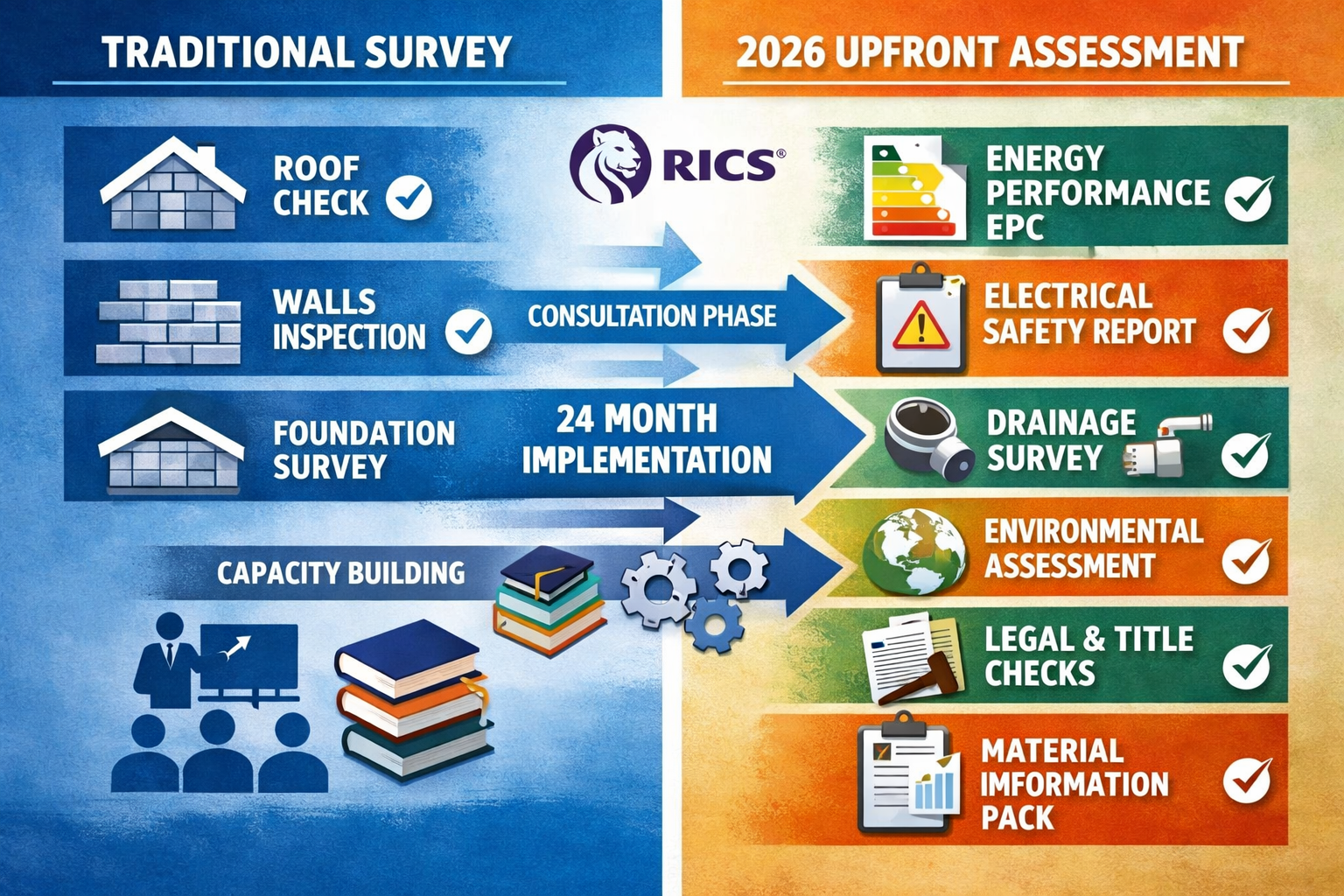
⏱️ Timeline Uncertainty: No definitive government timeframe has been established for when proposed reforms will be introduced [3]. RICS has emphasized that a minimum 24-month implementation period will be essential for building capacity, developing standards, and establishing clear guidance [3].
📜 Legislative Requirements: It remains unclear how many proposed reforms will require further consultation or primary legislation, indicating the reform process is still in early developmental stages [3].
🔍 Ongoing Research: RICS has offered to conduct further research to help the government understand industry capacity and resourcing requirements, while continuing to emphasize the importance of realistic timetables [3].
This consultation phase creates both challenges and opportunities for surveying professionals who must prepare for potential changes while managing current workloads.
Expanding Building Survey Scopes: What Changes Are Proposed?
From Reactive to Proactive: The Fundamental Shift
The proposed reforms in Upfront Condition Assessments in Reform Consultations: Expanding Building Survey Scopes for 2026 represent a fundamental shift from reactive to proactive property assessment. Currently, most surveys occur after offers are accepted, creating several problems:
- ❌ Transaction failures when surveys reveal unexpected defects
- ❌ Renegotiation delays causing frustration and additional costs
- ❌ Wasted survey fees when deals collapse
- ❌ Limited market transparency about property conditions
The upfront assessment model aims to address these issues by providing condition information before marketing begins, creating a more transparent and efficient transaction process.
Enhanced Survey Protocols for 2026
The surveying sector anticipates that upfront assessments will require expanded protocols beyond traditional homebuyer reports or building surveys. Industry analysts forecast these reforms could be transformative for the sector if implemented [5].
Comprehensive Assessment Components:
| Assessment Area | Traditional Survey Coverage | Proposed Upfront Requirements |
|---|---|---|
| Structural Elements | Visual inspection of accessible areas | Detailed examination including invasive testing where appropriate |
| Building Services | Basic functionality check | Comprehensive electrical, plumbing, heating certification |
| Roof Condition | External visual assessment | Detailed roof survey including thermal imaging |
| Drainage Systems | Limited visual inspection | CCTV drainage surveys and testing |
| Environmental Factors | Damp detection in visible areas | Comprehensive environmental assessment including contamination |
| Energy Performance | Optional EPC | Mandatory detailed energy assessment |
| Legal Documentation | Separate conveyancing process | Integrated material information pack |
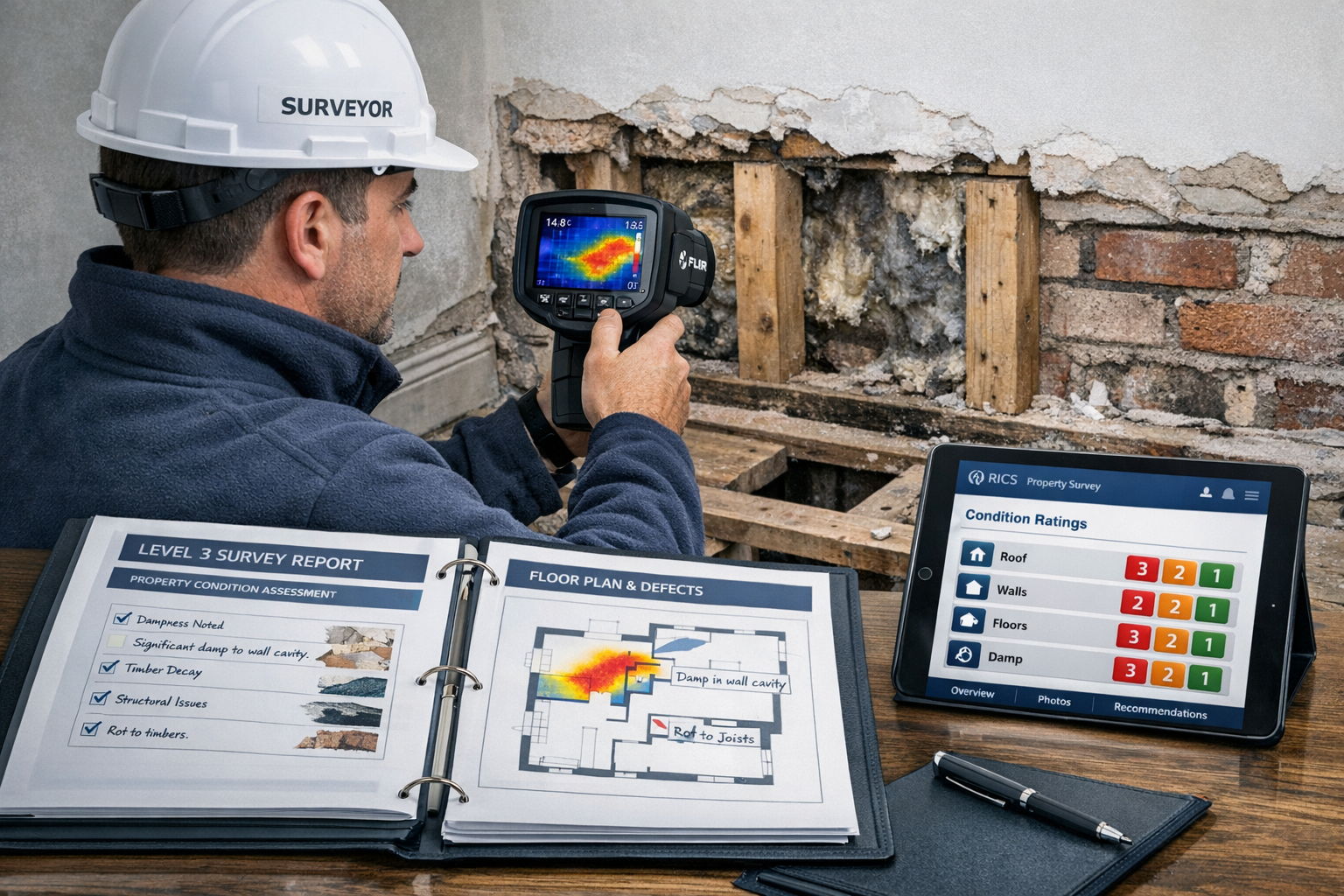
This expanded scope aligns more closely with Level 3 building surveys, requiring surveyors to provide comprehensive condition assessments rather than basic evaluations.
Material Information Requirements
The consultation specifically addresses "material information" that sellers must provide upfront. This includes not only physical condition assessments but also:
- 📄 Legal documentation (title deeds, planning permissions, building regulations certificates)
- 🏗️ Alteration history (extensions, conversions, structural modifications)
- ⚠️ Known defects (previous repairs, ongoing issues, insurance claims)
- 🌳 Environmental considerations (flooding history, ground conditions, tree preservation orders)
- 🔌 Services information (utilities connections, shared services, maintenance responsibilities)
For properties requiring commercial building surveys, these requirements become even more comprehensive, including lease obligations and tenant improvements.
Implications for Different Property Types
The expanded survey scopes will affect different property categories in varying ways:
Residential Properties: Standard upfront assessments covering structural condition, services, and energy performance will likely become the baseline requirement.
Period Properties: Older buildings may require specialized assessments addressing heritage considerations, traditional construction methods, and conservation requirements.
Leasehold Properties: Additional documentation regarding licence to alter requirements, service charges, and building insurance will be essential.
Commercial Properties: Comprehensive commercial dilapidation surveys and lease compliance assessments will become standard upfront requirements.
New Build Developments: Enhanced snagging report lists and developer warranty documentation will need to be provided before marketing.
Preparing the Surveying Sector for Increased Demand
Capacity and Resource Challenges
If reforms proceed as proposed, the surveying sector faces significant capacity challenges. The industry must ensure surveyors are retrained and ready to meet new demands while attracting the next generation of talent to facilitate increased activity levels [5].
Key Capacity Considerations:
🎓 Training and Qualification: Existing surveyors will need enhanced training in expanded assessment protocols, particularly in areas like energy performance, environmental assessment, and digital reporting systems.
👥 Workforce Expansion: The sector anticipates needing additional qualified professionals to handle increased survey volumes, requiring accelerated recruitment and qualification pathways.
🔧 Technology Investment: Firms must invest in digital survey platforms, thermal imaging equipment, drone technology for roof surveys, and automated reporting systems.
📊 Quality Assurance: Enhanced quality control mechanisms will be essential to maintain standards across increased volumes of upfront assessments.
RICS Professional Development Initiatives
RICS is actively working to support the sector's preparation for potential reforms. The organization is enhancing professional development pathways with clearer routes for graduates to gain qualifications and improving CPD platforms with enhanced digital tools and a new member app [5].
Professional Development Focus Areas:
- Enhanced technical training in expanded assessment protocols
- Digital competency development for new survey technologies and reporting platforms
- Regulatory compliance education covering updated standards and requirements
- Client communication skills for explaining comprehensive upfront assessments
- Risk management training addressing increased professional liability exposure
For those seeking qualified professionals, working with chartered surveyors who are actively engaging with these professional development initiatives will be increasingly important.
Anticipated Market Impacts in 2026
Even before formal reform implementation, the surveying sector is experiencing increased activity. Lenders are forecasting increased lending volumes with a strong start to 2026, creating an uplift in survey demand [5].
Market Trends Driving Current Demand:
📈 Lending Growth: Mortgage lenders anticipate higher transaction volumes throughout 2026, increasing survey requirements regardless of reform timelines.
🏠 Buyer Confidence: Growing awareness of upfront assessment proposals is encouraging buyers to commission comprehensive surveys earlier in their property searches.
💼 Professional Preparation: Forward-thinking sellers are voluntarily commissioning upfront condition reports to differentiate their properties and facilitate smoother transactions.
🔄 Transaction Efficiency: Market participants are recognizing that upfront information reduces transaction failures and accelerates completion times.
Technology and Innovation in Survey Delivery
The anticipated reforms are accelerating technological adoption across the surveying sector:
Digital Survey Platforms: Cloud-based systems enabling real-time reporting, photo documentation, and collaborative review processes are becoming standard practice.
Remote Assessment Technologies: Thermal imaging, drone surveys, and 3D modeling technologies are expanding assessment capabilities while improving efficiency.
Automated Reporting Systems: AI-assisted report generation tools are helping surveyors produce comprehensive documentation more quickly without compromising quality.
Data Integration: Platforms connecting survey data with property listings, legal documentation, and energy performance certificates are streamlining information sharing.
For specialized assessments like subsidence surveys or specific defect reports, these technologies enable more detailed analysis and clearer communication of findings.
Regional Considerations and Service Availability
Geographic Variations in Survey Demand
The implementation of upfront condition assessments will affect different regions variably, with capacity challenges potentially more acute in high-transaction areas.
High-Demand Metropolitan Areas: Regions like Central London, North London, and South East London will likely experience the most significant demand increases.
Affluent Suburban Markets: Areas including Chelsea, Hampstead, Richmond, and Barnes will require enhanced surveyor capacity for higher-value properties.
Regional Markets: Counties like Hertfordshire, Buckinghamshire, Oxfordshire, and Sussex will need distributed surveyor networks to serve diverse property types.
Ensuring Equitable Access to Survey Services
A critical consideration in reform implementation is ensuring that upfront assessment requirements don't create barriers to market entry for sellers in different economic circumstances or geographic locations.
Potential Challenges:
- 💰 Cost implications for sellers commissioning upfront assessments
- 📍 Surveyor availability in rural or lower-transaction areas
- ⏰ Timeline pressures for sellers needing to market properties quickly
- 🎯 Quality variations between different survey providers
RICS and government stakeholders are considering mechanisms to address these challenges, including standardized pricing frameworks, quality assurance protocols, and support programs for vulnerable sellers.
Legal and Professional Liability Considerations
Enhanced Professional Responsibility
The shift to upfront condition assessments creates new professional liability considerations for surveyors. When surveys are commissioned by sellers but relied upon by buyers, questions of duty of care, professional indemnity, and liability limitations become more complex.
Key Liability Issues:
⚖️ Dual Reliance: Surveys commissioned by sellers but relied upon by buyers create potential dual duty of care situations requiring clear terms of engagement.
📋 Scope Limitations: Comprehensive upfront assessments must clearly define inspection limitations, particularly for inaccessible areas or specialist systems.
🔍 Defect Discovery Timing: When previously undetected defects emerge after completion, determining surveyor responsibility becomes more complex with upfront assessments.
💼 Professional Indemnity: Insurance requirements may increase to reflect enhanced liability exposure from expanded survey scopes and broader reliance.
Expert Witness and Dispute Resolution
As upfront assessments become standard practice, disputes regarding survey accuracy, scope, and professional standards will likely increase, creating demand for expert witness services to defend survey evidence under new standards [2].
Surveyors must maintain meticulous documentation, follow rigorous protocols, and stay current with evolving professional standards to minimize liability exposure and effectively defend their work when challenged.
Cost Implications and Market Accessibility
Financial Impact on Sellers
Mandatory upfront condition assessments will shift survey costs from buyers to sellers, creating new financial considerations in property marketing:
Typical Cost Ranges (2026 Estimates):
- Basic Upfront Assessment: £400-£600 for standard properties
- Comprehensive Level 3 Survey: £800-£1,500 for larger or complex properties
- Specialist Assessments: £200-£500 each for drainage, electrical, or environmental surveys
- Total Upfront Package: £1,000-£3,000+ depending on property type and condition
These costs represent new upfront expenses for sellers, potentially affecting market accessibility and pricing strategies.
Value Proposition for Market Participants
Despite initial cost concerns, upfront assessments offer significant value:
For Sellers:
- ✅ Reduced transaction failures and renegotiation delays
- ✅ Enhanced property marketing with transparent condition information
- ✅ Faster sales processes with informed buyers
- ✅ Competitive advantage in crowded markets
For Buyers:
- ✅ Greater confidence in property condition before making offers
- ✅ Reduced survey duplication and wasted fees
- ✅ Faster transaction completion with upfront information
- ✅ Better-informed purchase decisions and negotiation positions
For the Market Overall:
- ✅ Increased transaction efficiency and reduced failure rates
- ✅ Enhanced market transparency and consumer protection
- ✅ Professional standards elevation across the sector
- ✅ Reduced overall transaction costs through efficiency gains
Practical Steps for Stakeholders
For Property Sellers Preparing for Reforms
Even before mandatory implementation, sellers can benefit from adopting upfront assessment practices:
- Commission Pre-Marketing Surveys: Consider obtaining comprehensive condition reports before listing properties to identify and address issues proactively
- Gather Documentation: Compile building regulations certificates, planning permissions, warranty documents, and maintenance records
- Address Known Defects: Undertake repairs for identified issues before marketing to maximize property value
- Prepare Material Information: Create comprehensive property information packs including legal documentation and service history
- Choose Qualified Surveyors: Work with experienced chartered surveyors familiar with upfront assessment protocols
For Buyers Navigating the Transition Period
Buyers should adapt their property search strategies to leverage available upfront information:
- Request Existing Surveys: Ask sellers whether condition assessments have been commissioned and request access to reports
- Verify Survey Quality: Ensure any provided surveys are conducted by qualified professionals following recognized standards
- Commission Additional Assessments: Consider supplementary specific defect reports for areas of concern
- Review Material Information: Carefully examine all upfront documentation before making offers
- Seek Professional Advice: Engage surveyors to review provided assessments and advise on property condition
For Surveying Professionals
Surveyors should actively prepare for anticipated reform implementation:
- Enhance Technical Skills: Pursue professional development in expanded assessment areas including energy performance and environmental evaluation
- Invest in Technology: Adopt digital survey platforms, thermal imaging equipment, and automated reporting systems
- Develop Standard Protocols: Create comprehensive upfront assessment templates and quality assurance procedures
- Review Insurance Coverage: Ensure professional indemnity insurance adequately covers expanded survey scopes and dual reliance scenarios
- Engage with RICS Guidance: Stay informed about evolving standards and participate in consultation processes
For Estate Agents and Conveyancers
Property professionals must adapt their processes to accommodate upfront assessments:
- Educate Clients: Explain the benefits and requirements of upfront condition assessments to sellers and buyers
- Coordinate Survey Commissioning: Facilitate early engagement between sellers and qualified surveyors
- Integrate Information Systems: Develop processes for sharing survey reports and material information with prospective buyers
- Adjust Marketing Strategies: Highlight available upfront information as a competitive advantage in property marketing
- Streamline Transaction Management: Adapt conveyancing workflows to leverage upfront information for faster completions
The Broader Context: Property Market Reform in 2026
Alignment with Other Reform Initiatives
Upfront condition assessments represent one component of broader property market reform efforts in 2026. These initiatives collectively aim to create a more transparent, efficient, and consumer-friendly transaction process.
Related Reform Areas:
🏢 Commercial Property Law: Parallel reforms affecting commercial property transactions are creating consistency across residential and commercial sectors [4].
📊 Digital Property Information: Government initiatives promoting digital property passports and centralized information repositories complement upfront assessment requirements.
⚖️ Consumer Protection: Enhanced disclosure requirements and professional standards strengthen buyer protections throughout the transaction process.
🌍 Environmental Standards: Increasing focus on energy performance and sustainability aligns with upfront assessment protocols incorporating environmental considerations.
International Comparisons and Best Practices
The UK's proposed reforms draw on international experiences with upfront property information requirements:
Australian Model: Vendor disclosure statements requiring comprehensive property information before marketing have been standard practice in several Australian states for years.
Scottish System: Scotland's Home Report requirement, introduced in 2008, mandates sellers commission surveys before marketing, providing valuable lessons for English reform implementation.
European Approaches: Various European jurisdictions require different levels of upfront property information, offering diverse models for consideration.
These international precedents demonstrate both the benefits and challenges of upfront assessment systems, informing UK reform development.
Conclusion
Upfront Condition Assessments in Reform Consultations: Expanding Building Survey Scopes for 2026 represents a pivotal moment for the UK property market. While no definitive implementation timeline has been established, the consultation process is advancing, and the surveying sector is actively preparing for transformative changes that could fundamentally reshape how property transactions occur.
The proposed shift from reactive to proactive condition assessments offers significant benefits: reduced transaction failures, enhanced market transparency, improved consumer protection, and greater efficiency throughout the buying and selling process. However, successful implementation requires careful attention to capacity building, professional development, quality assurance, and equitable market access.
Key Recommendations for Moving Forward
For all stakeholders navigating this transition period, several actions are essential:
Stay Informed: Monitor RICS guidance, government announcements, and industry developments as reform consultations progress toward potential implementation.
Prepare Proactively: Don't wait for mandatory requirements—consider adopting upfront assessment practices now to gain competitive advantages and operational experience.
Invest in Quality: Whether commissioning or conducting surveys, prioritize comprehensive assessments by qualified professionals following recognized standards.
Embrace Technology: Leverage digital tools, remote assessment technologies, and automated reporting systems to enhance efficiency and quality.
Engage Professionally: Participate in consultation processes, professional development initiatives, and industry discussions shaping reform implementation.
The minimum 24-month implementation period advocated by RICS provides time for the sector to build capacity, develop standards, and establish clear guidance [3]. This transition period is critical for ensuring reforms achieve their intended benefits without creating unintended barriers or disruptions.
As 2026 progresses, the property market will continue evolving toward greater transparency and efficiency. Whether through mandatory requirements or voluntary adoption, upfront condition assessments are becoming increasingly central to property transactions. Stakeholders who prepare now—understanding expanded survey scopes, investing in professional development, and adopting best practices—will be well-positioned to thrive in this transformed landscape.
The consultation phase may still be underway, but the direction of travel is clear: comprehensive property condition information provided upfront will become the standard expectation for property transactions in the years ahead. By preparing thoughtfully and engaging constructively with reform development, the property sector can ensure these changes deliver meaningful benefits for sellers, buyers, and professionals alike.
References
[1] Homebuying Reform Impacts On Building Surveys Preparing For Mandatory Upfront Condition Assessments In 2026 – https://nottinghillsurveyors.com/blog/homebuying-reform-impacts-on-building-surveys-preparing-for-mandatory-upfront-condition-assessments-in-2026
[2] Expert Witness Roles In 2026 Homebuying Reform Disputes Defending Survey Evidence Under New Upfront Standards – https://nottinghillsurveyors.com/blog/expert-witness-roles-in-2026-homebuying-reform-disputes-defending-survey-evidence-under-new-upfront-standards
[3] Home Buying And Selling Reform Hub – https://www.rics.org/news-insights/current-topics-campaigns/home-buying-and-selling-reform-hub
[4] What The 2026 Reform Cycle Means For Commercial Property Law – https://www.landmark.co.uk/news-insights/blog/what-the-2026-reform-cycle-means-for-commercial-property-law/
[5] Surveying In 2026 Reform Recovery And Renewed Demand – https://www.lrg.co.uk/news-and-insights/surveying-in-2026-reform-recovery-and-renewed-demand/