

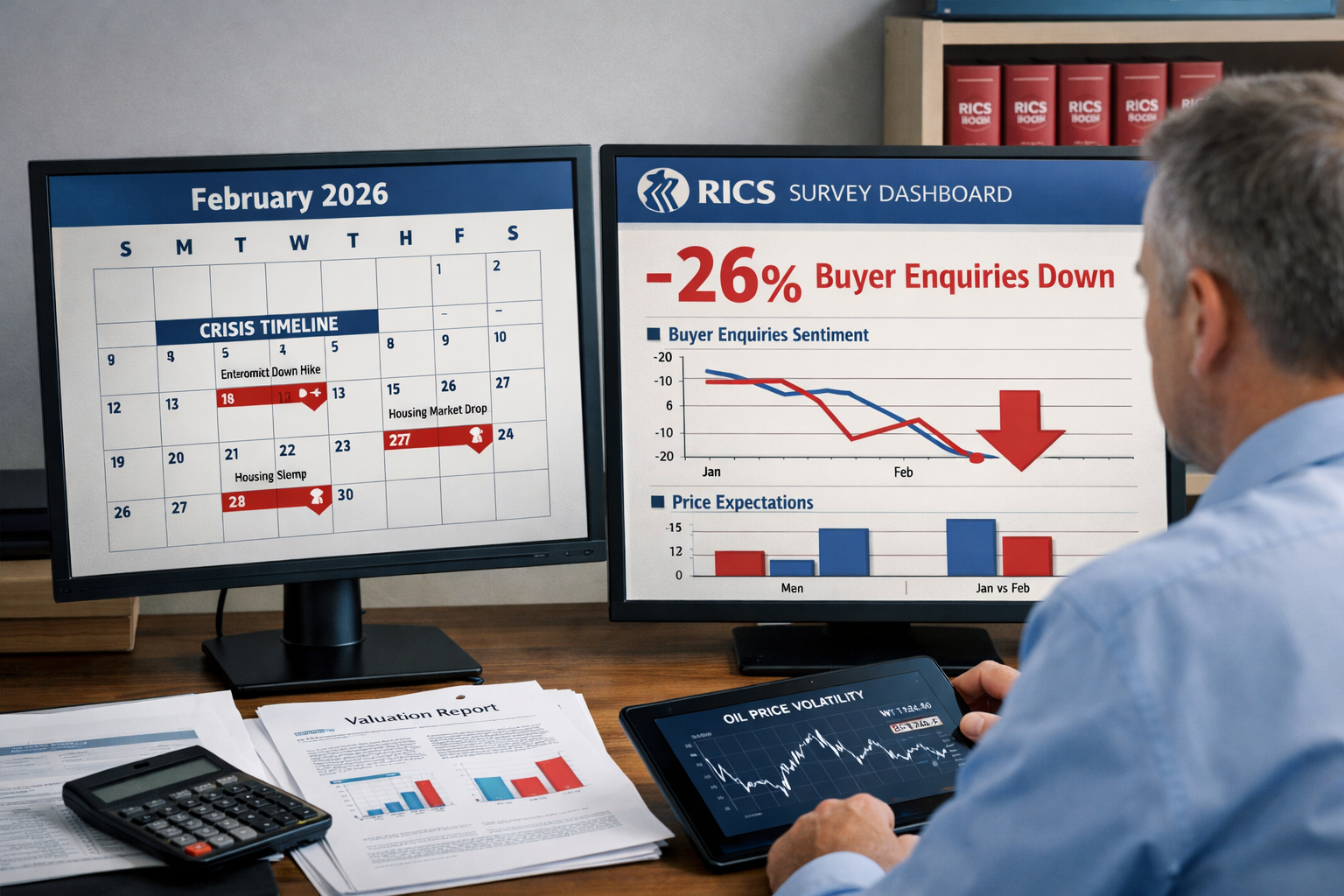
The February 2026 RICS Residential Market Survey delivered a stark warning: buyer demand collapsed to a net balance of -26%, plummeting from -15% in January as geopolitical shocks rippled through UK property markets. For surveyors navigating this turbulent landscape, the challenge extends beyond recording sentiment—it demands robust valuation adjustments for geopolitical risks and strategic frameworks to stress-test property values against oil price spikes, inflation surges, and prolonged global instability.
When international conflict escalates and economic uncertainty intensifies, surveyors face a critical question: How do you accurately value property when traditional market indicators diverge from sentiment data, and external shocks threaten to reshape financial fundamentals overnight? The answer lies in developing systematic approaches to incorporate geopolitical volatility into valuation methodologies.
Key Takeaways
- February 2026 saw dramatic sentiment decline: New buyer enquiries dropped to -26%, directly linked to geopolitical escalation, yet house prices continued rising 0.3% monthly and 1.3% annually[1][3]
- Surveyors must stress-test valuations: Incorporating oil price volatility, inflation scenarios, and interest rate sensitivity into discount rate adjustments and comparable analysis
- Recency bias affects market assessment: The sharp February decline demonstrates how surveyors can anchor expectations to recent dramatic events rather than underlying fundamentals[3]
- Long-term optimism persists: Despite near-term volatility, 17% net balance of surveyors expect sales activity increases over twelve months, suggesting recovery potential once instability stabilizes[1]
- Systematic risk frameworks are essential: Professional commercial property surveyors require documented methodologies for adjusting valuations based on quantifiable geopolitical risk factors
Understanding the February 2026 RICS Survey Volatility and Its Geopolitical Context
The February 2026 RICS survey captured a property market in flux, with geopolitical headwinds creating unprecedented challenges for valuation professionals. The survey period coincided with the U.S.-Israel war on Iran escalation in late February, triggering immediate market reactions that exposed the vulnerability of property sentiment to international events[3].
The Scale of Market Disruption
The numbers tell a compelling story of rapid deterioration:
| Metric | January 2026 | February 2026 | Change |
|---|---|---|---|
| New Buyer Enquiries | -15% | -26% | ⬇️ 11 points |
| Agreed Sales | N/A | -12% | Negative territory |
| Near-Term Transaction Expectations | N/A | -2% | Minimal momentum |
| 12-Month Sales Outlook | N/A | +17% | Optimistic long-term |
This disconnect between immediate sentiment and longer-term expectations creates a valuation dilemma. RICS Head of Market Research Tarrant Parsons explicitly stated that "the geopolitical backdrop has clearly weighed on confidence," with surveyors expressing concerns that prolonged conflict could delay Bank of England rate cuts and raise inflation[1][3].
The Sentiment-Price Paradox
Perhaps most striking was the divergence between sentiment and actual price performance. While survey respondents reported collapsing demand, Halifax reported average house prices rose 0.3% to £301,151 in February—a second consecutive monthly gain—with annual growth of 1.3% marking the strongest performance in four months[3].
This paradox highlights a critical challenge for surveyors: distinguishing between temporary sentiment shocks and fundamental value shifts. Professional RICS registered valuers must develop frameworks that account for both psychological market reactions and underlying economic realities.
Geopolitical Risk as a C-Suite Priority
The February volatility reflects broader concerns among business leaders. A recent emerging risks survey found that 26% of C-suite executives identified geopolitical risk as the most impactful threat to their organizations in 2026, with 34% citing economic risks overall, including greater-than-normal financial volatility (25%) as the single most frequent concern[4].
For property professionals, this means geopolitical risk assessment is no longer a peripheral consideration—it's a core competency that clients expect and professional standards increasingly demand.
Core Strategies for Valuation Adjustments for Geopolitical Risks in Property Assessment
Implementing valuation adjustments for geopolitical risks requires surveyors to move beyond traditional comparable analysis and incorporate systematic stress-testing methodologies. The following strategies provide a framework for navigating uncertainty while maintaining professional standards.
1. Discount Rate Sensitivity Analysis 📊
Geopolitical instability directly impacts discount rates through multiple channels:
- Interest rate uncertainty: Conflict-driven inflation concerns delay central bank rate cuts, affecting borrowing costs
- Risk premium adjustments: Market volatility increases required returns for property investments
- Currency fluctuations: International instability affects exchange rates and cross-border investment flows
Practical Implementation:
When conducting Red Book valuations, surveyors should model multiple discount rate scenarios:
- Base case: Current market rates (e.g., 5.0%)
- Moderate stress: +0.5-1.0% adjustment for sustained geopolitical tension
- Severe stress: +1.5-2.0% adjustment for major conflict escalation or supply chain disruption
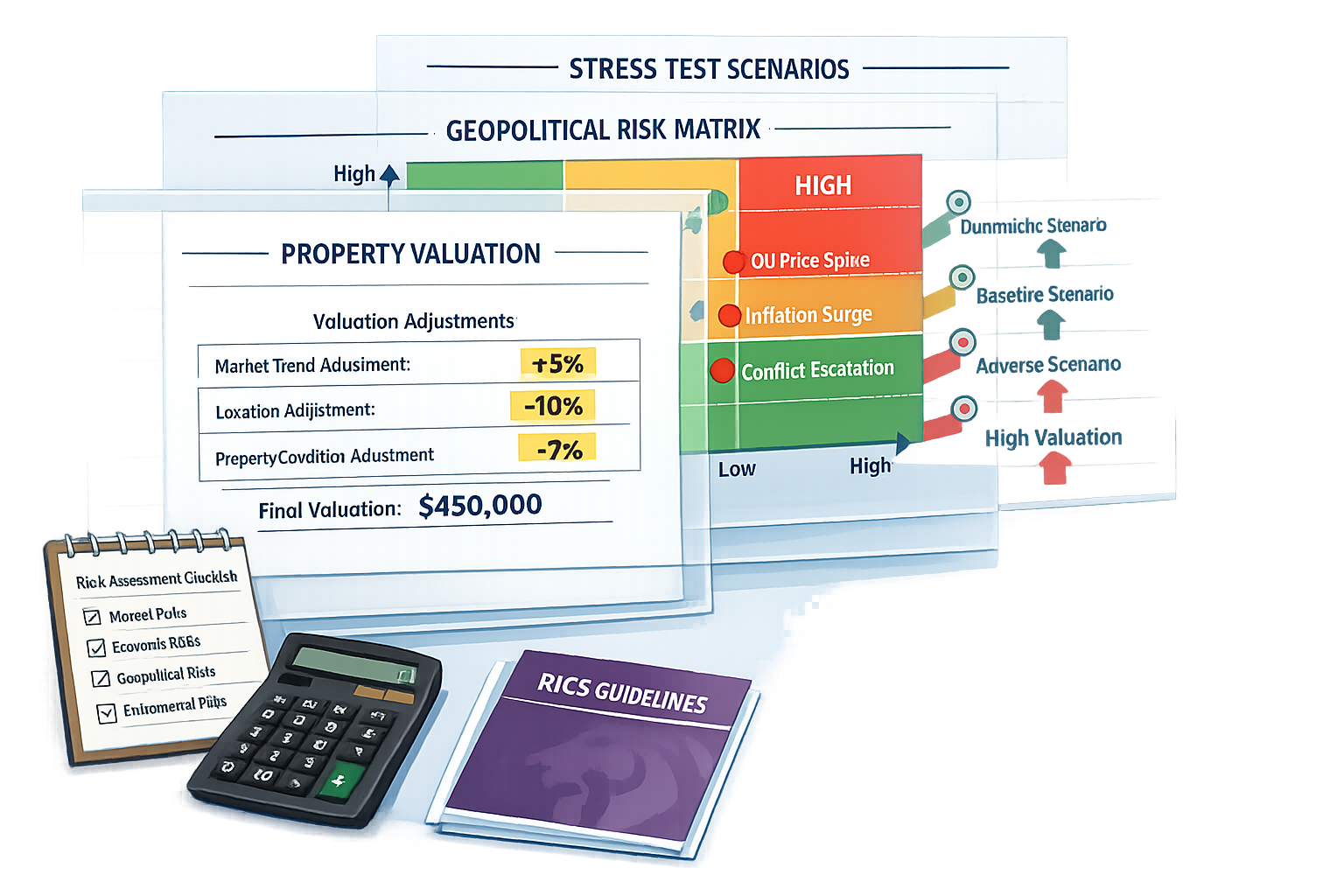
A property valued at £500,000 with a 5% discount rate might be worth £460,000 under a 6.5% stressed scenario—a £40,000 (8%) adjustment that clients need to understand.
2. Oil Price Impact Modeling 🛢️
Oil price volatility serves as a proxy for broader geopolitical instability and directly affects property markets through:
- Construction costs: Higher transportation and material expenses
- Consumer spending: Reduced disposable income for housing
- Inflation transmission: Energy price increases flowing through to general price levels
Surveyor Action Steps:
- Monitor Brent crude price movements relative to historical ranges
- Incorporate energy cost escalation clauses in commercial building surveys
- Adjust comparable evidence for timing differences during volatile periods
3. Scenario Planning Frameworks
Rather than single-point valuations, geopolitical uncertainty demands range-based assessments with clearly articulated assumptions:
Optimistic Scenario (30% probability):
- Geopolitical tensions ease by Q3 2026
- Bank of England proceeds with planned rate cuts
- Property market recovers to January 2026 sentiment levels
- Valuation: Full market value with minimal adjustment
Base Case Scenario (50% probability):
- Moderate instability continues through 2026
- Delayed but eventual rate normalization
- Gradual market recovery over 12-18 months
- Valuation: 3-5% downward adjustment for uncertainty
Pessimistic Scenario (20% probability):
- Prolonged conflict with economic sanctions
- Sustained high inflation and elevated rates
- Extended market stagnation
- Valuation: 8-12% downward adjustment for material uncertainty
4. Regional Variation Analysis 🗺️
The February RICS data showed that geopolitical impacts varied by region. Scottish surveyors reported slower homebuyer demand while maintaining optimism about the outlook[6], suggesting that geographic diversification affects risk exposure.
Chartered surveyors across London and surrounding areas including North London, Surrey, and Hertfordshire should consider:
- Urban vs. suburban resilience: Flight-to-safety patterns during uncertainty
- International buyer exposure: Areas dependent on foreign investment face higher volatility
- Economic base diversity: Regions with varied employment sectors show greater stability
5. Comparable Evidence Timing Adjustments ⏰
When geopolitical events cause rapid market shifts, comparable sales from even 3-6 months prior may not reflect current conditions. Surveyors must:
- Weight recent transactions more heavily during volatile periods
- Apply time adjustments that account for sentiment shifts, not just inflation
- Document the rationale for departing from older comparables
- Consider withdrawn listings and failed transactions as negative evidence
6. Material Uncertainty Clauses
RICS Valuation Standards allow for material uncertainty declarations when market evidence is insufficient or unreliable. The February 2026 volatility may warrant such declarations in specific contexts:
"The valuation is reported as being subject to 'material valuation uncertainty' as set out in VPS 3 and VPGA 10 of the RICS Valuation – Global Standards. Consequently, in respect of the valuation, less certainty – and a higher degree of caution – should be attached to the valuation than would normally be the case given the impact of geopolitical instability on market sentiment and transaction volumes."
This approach protects both surveyors and clients while maintaining transparency about valuation limitations.
Practical Implementation: Tools and Techniques for Surveyor Strategies Post-February 2026
Translating theoretical frameworks into daily practice requires surveyors to adopt specific tools, documentation standards, and client communication protocols that address valuation adjustments for geopolitical risks systematically.
Documentation and Reporting Standards 📋
Enhanced Assumptions Sections:
Modern valuation reports should include dedicated sections addressing:
- Geopolitical Risk Context: Brief summary of relevant international events during valuation period
- Market Sentiment Analysis: Reference to RICS survey data and local market intelligence
- Adjustment Methodology: Transparent explanation of any risk-based adjustments applied
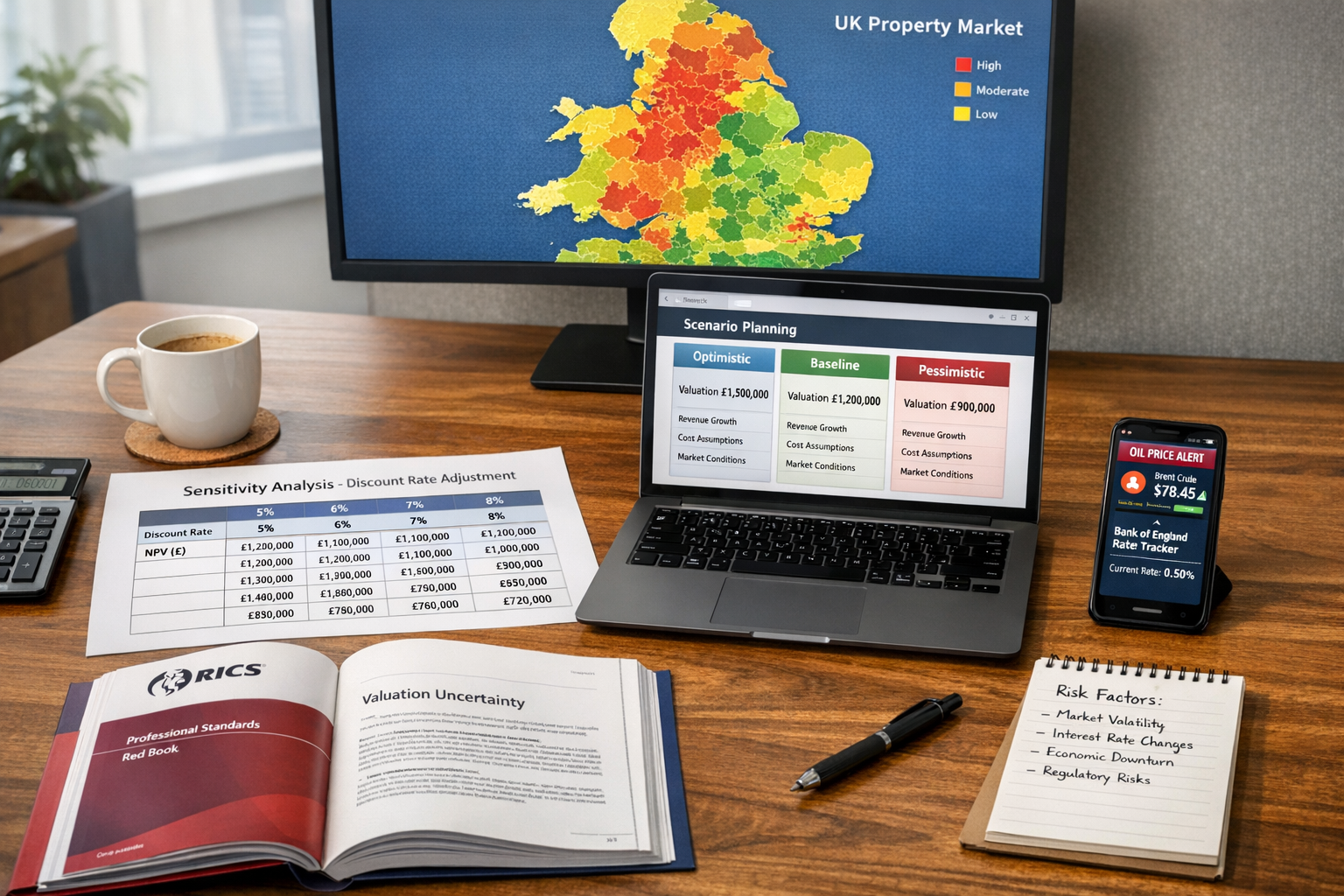
- Scenario Sensitivity: Range of values under different geopolitical outcomes
This approach aligns with professional standards for valuation factors and provides clients with actionable intelligence.
Client Communication Protocols 💬
Geopolitical volatility requires proactive client engagement:
Initial Instruction Stage:
- Discuss whether single-point or range-based valuation is appropriate
- Clarify the purpose of valuation and risk tolerance
- Establish update triggers if geopolitical conditions materially change
Report Delivery Stage:
- Present findings with clear context about market conditions
- Explain adjustment rationale in accessible language
- Provide guidance on monitoring indicators for revaluation needs
Ongoing Advisory:
- Offer periodic market updates for commercial dilapidation surveys and long-term projects
- Alert clients to significant geopolitical developments affecting property values
Technology and Data Integration 💻
Modern surveyors leverage technology to track geopolitical risk indicators:
Real-Time Monitoring Tools:
- Oil price alerts and commodity tracking platforms
- Central bank policy announcement calendars
- Geopolitical risk indices (e.g., Caldara-Iacoviello GPR Index)
- RICS survey release schedules
Data Analytics:
- Regression analysis linking geopolitical events to property price movements
- Volatility modeling for different property sectors
- Comparative market analysis across geopolitical risk profiles
Professional Development Priorities 📚
The February 2026 volatility highlights skill gaps that surveyors should address:
- Macroeconomic literacy: Understanding transmission mechanisms from geopolitical events to property markets
- Scenario planning: Techniques from strategic management applied to valuation
- Behavioral finance: Recognizing recency bias and other cognitive distortions in market assessment
- Risk quantification: Statistical methods for converting qualitative risks to valuation adjustments
Sector-Specific Considerations
Different property types require tailored approaches:
Residential Property:
- Consumer confidence more sensitive to news cycles
- Mortgage availability directly affected by interest rate uncertainty
- Regional variation based on employment sector exposure
Commercial Property:
- Tenant covenant strength varies with economic stability
- Lease terms may include inflation-protection mechanisms
- Investment yields more directly linked to geopolitical risk premiums
Specialized Valuations:
For matrimonial valuations, probate valuations, and capital gains tax valuations, surveyors must balance point-in-time accuracy with recognition of temporary volatility.
Building Resilient Valuation Practices
Long-term success in volatile markets requires institutional capabilities:
Knowledge Management:
- Maintain databases of geopolitical events and corresponding market reactions
- Document lessons learned from previous volatility episodes
- Share insights across surveying teams
Quality Assurance:
- Peer review of valuations during high-uncertainty periods
- Regular calibration of adjustment methodologies against actual outcomes
- Compliance checks for material uncertainty declarations
Client Relationship Management:
- Educate clients about geopolitical risk factors proactively
- Build trust through transparent communication during volatility
- Position surveying services as strategic advisory, not just compliance
The Recency Bias Challenge ⚠️
The February 2026 survey provides a textbook example of recency bias—the tendency to overweight recent dramatic events in forecasting. Surveyors anchored expectations to the late-February conflict escalation despite positive signals from January[3].
Mitigation Strategies:
- Use structured decision-making frameworks rather than intuitive judgments
- Reference historical precedents of geopolitical volatility and recovery
- Separate short-term sentiment from medium-term fundamentals
- Implement "pre-mortem" analysis: assume the valuation is wrong and identify why
This disciplined approach helps surveyors avoid both excessive pessimism during crises and complacency during calm periods.
Conclusion: Building Resilience in Property Valuation Practice
The valuation adjustments for geopolitical risks revealed by the February 2026 RICS survey volatility represent more than a temporary challenge—they signal a fundamental shift in how surveyors must approach property assessment in an increasingly interconnected and unstable world. When buyer enquiries collapse by 11 percentage points in a single month while house prices simultaneously rise, traditional valuation methodologies require enhancement with systematic risk frameworks.
The disconnect between sentiment and pricing that characterized February 2026 offers valuable lessons: markets are simultaneously rational and emotional, with short-term psychology often diverging from underlying fundamentals. Professional surveyors who develop robust stress-testing capabilities, incorporate scenario planning, and maintain transparent communication with clients will not only navigate current volatility but position themselves as trusted advisors for the uncertain decade ahead.
Actionable Next Steps for Surveyors
- Audit current valuation methodologies to identify gaps in geopolitical risk incorporation
- Develop standardized templates for scenario analysis and sensitivity testing
- Establish monitoring systems for key indicators: oil prices, RICS surveys, central bank communications
- Enhance client reporting with dedicated risk context sections and assumption transparency
- Invest in professional development focusing on macroeconomic analysis and behavioral finance
- Build peer networks for sharing insights during volatile periods
- Review insurance coverage and professional indemnity policies for material uncertainty scenarios
The 17% net balance of surveyors expecting sales growth over the next twelve months[1] demonstrates that optimism persists beneath the volatility. By implementing systematic approaches to valuation adjustments for geopolitical risks, surveyors can bridge the gap between current uncertainty and future opportunity, delivering valuations that are both professionally defensible and genuinely useful to clients navigating turbulent markets.
The property market will recover from February 2026's geopolitical shock—it always does. But the surveyors who thrive will be those who transformed crisis into capability, building valuation practices resilient enough to withstand whatever global instability emerges next.
References
[1] Latest Rics Survey Reveals Global Headwinds Are Weighing On Housing Market Confidence – https://www.buyassociationgroup.com/en-gb/news/latest-rics-survey-reveals-global-headwinds-are-weighing-on-housing-market-confidence/
[3] Uk Home Buyers Sentiment Freefall Geopolitical Fear Triggers Behavioral Overreaction 2603 – https://www.ainvest.com/news/uk-home-buyers-sentiment-freefall-geopolitical-fear-triggers-behavioral-overreaction-2603/
[4] Economic And Geopolitical Risks Top C Suite Concerns Emerging Risks Survey – https://www.casact.org/article/economic-and-geopolitical-risks-top-c-suite-concerns-emerging-risks-survey
[6] Scottish Surveyors Report Slower Homebuyer Demand But Remain Optimistic About Outlook – https://projectscot.com/2026/03/scottish-surveyors-report-slower-homebuyer-demand-but-remain-optimistic-about-outlook/