Legislation cited as the primary selling factor by 89% of landlords in February 2026 signals a seismic shift in how the private rented sector operates across the UK.[6] The mandatory Private Rented Sector Database under the Renters' Rights Act 2026 requires landlord registration for Section 8 notices, fundamentally altering property values and creating unprecedented compliance risks that surveyors must now quantify. Understanding the Valuation Impacts of Private Rented Sector Database on PRS Properties: Surveyor Adjustments Post-Renters' Rights Act 2026 Registration has become essential for property professionals navigating this transformed landscape.
With Phase 1 legislation already effective from May 1, 2026, and the PRS Database rollout scheduled for autumn 2026, the valuation profession faces immediate pressure to develop robust methodologies that account for registration requirements, compliance penalties, and market sentiment shifts.[2] This comprehensive guide examines how chartered surveyors must adjust their assessment techniques to reflect these regulatory changes accurately.
Key Takeaways
- Registration becomes mandatory for possession enforcement from autumn 2026, creating critical asset performance risks that directly impact property valuations
- Financial penalties ranging £7,000-£40,000 for non-compliance must be factored into valuation adjustments as quantifiable risk exposures
- Rent increase restrictions to once annually reduce yield predictability, requiring surveyors to apply more conservative income capitalization rates
- 89% of landlords cite legislation as a selling factor, indicating significant negative market sentiment that professional valuers cannot ignore
- Phased implementation timeline creates distinct valuation adjustment periods, with different methodologies appropriate for pre-registration versus post-registration scenarios
Understanding the Private Rented Sector Database Framework
The Private Rented Sector Database represents the most comprehensive landlord registration system ever implemented in England. Unlike previous voluntary schemes, this mandatory database creates enforceable compliance requirements with direct consequences for property rights and asset performance.
Legislative Timeline and Implementation Phases
The Renters' Rights Act 2026 follows a carefully structured implementation schedule that affects valuation timing:
Phase 1 (Effective May 1, 2026):
- Abolition of Section 21 "no-fault" evictions
- Transition to periodic tenancies
- Rent increase limitations to statutory Section 13 procedures[3]
Phase 2 (Autumn 2026):
- Mandatory PRS Database registration
- Linking of registration to possession proceedings
- Enforcement of compliance penalties[1]
This phased approach means that chartered surveyors across London and surrounding regions must apply different valuation methodologies depending on the assessment date and compliance status of the subject property.
Registration Requirements and Enforcement Mechanisms
The database requires landlords to provide comprehensive property and tenancy information, including:
- Property address and basic characteristics
- Landlord contact details and ownership structure
- Tenancy agreement terms and rent levels
- Compliance certification for safety standards
- Licensing status where applicable
Critical enforcement provision: Landlords cannot regain possession through Section 8 grounds unless properly registered on the PRS Database.[2] This creates an unprecedented situation where registration status directly affects property rights and marketability.
Valuation Impacts of Private Rented Sector Database on PRS Properties: Core Adjustment Factors
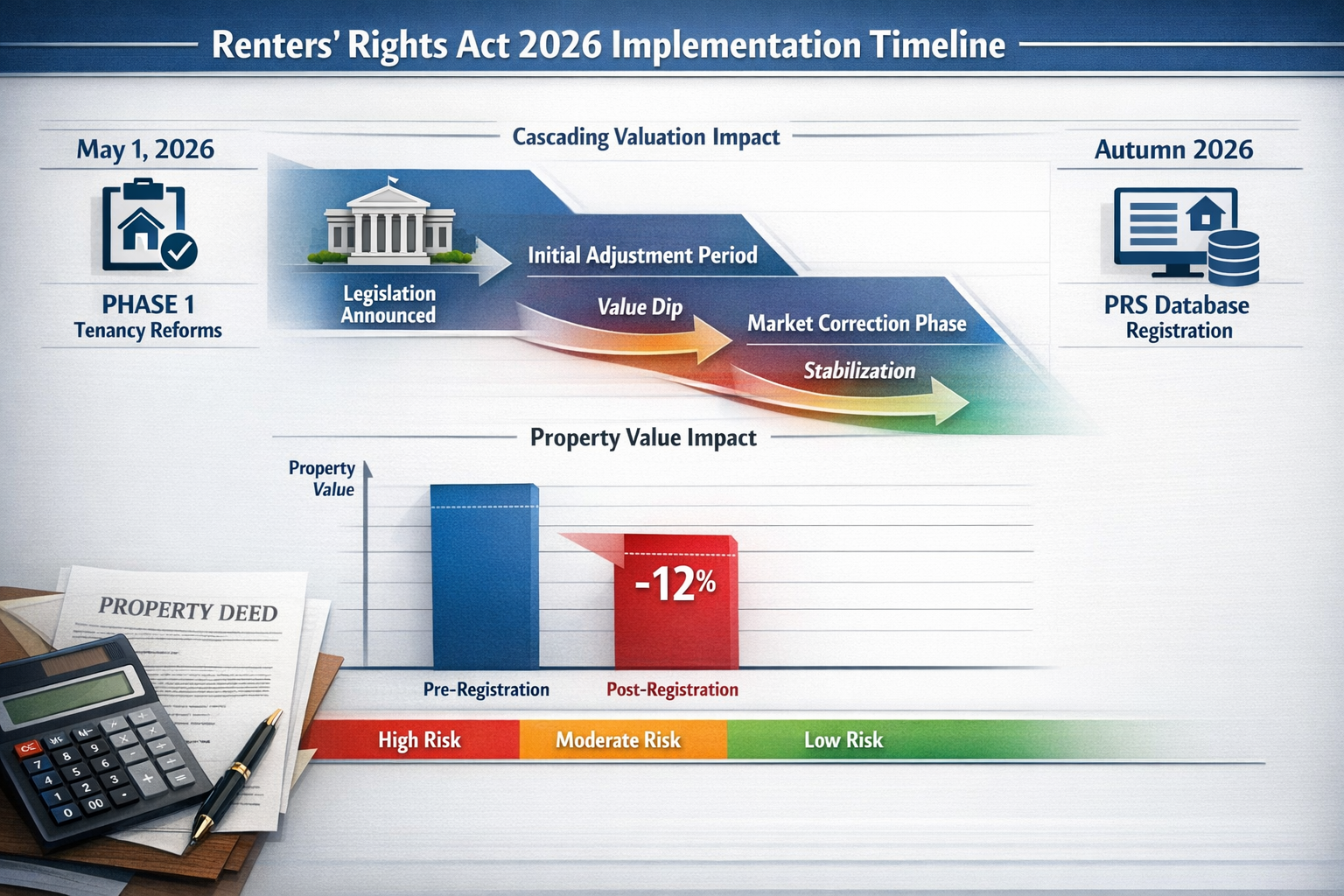
Professional surveyors must now incorporate multiple new risk factors when conducting valuation reports for private rented sector properties. The Valuation Impacts of Private Rented Sector Database on PRS Properties: Surveyor Adjustments Post-Renters' Rights Act 2026 Registration extend beyond simple compliance costs to encompass fundamental changes in asset performance characteristics.
Compliance Risk Premium Adjustments
Non-compliance penalties create quantifiable financial exposures that must be reflected in property valuations:
| Compliance Status | Penalty Range | Valuation Impact |
|---|---|---|
| First breach | £7,000 | Moderate risk adjustment |
| Repeated breaches | Up to £40,000 | Significant value reduction |
| Systematic non-compliance | Criminal prosecution risk | Severe marketability discount |
Surveyors conducting assessments for RICS registered valuers should apply risk-adjusted discount rates that reflect the probability and magnitude of potential penalties. For properties with unclear compliance histories, a 2-5% valuation reduction may be appropriate to account for this regulatory uncertainty.[3]
Income Capitalization Rate Modifications
The restriction of rent increases to once annually through statutory Section 13 procedures fundamentally alters income predictability for PRS assets. Traditional valuation models assuming regular market-driven rent reviews require significant modification.
Key adjustments include:
📊 Yield compression: Investment properties previously valued using 4-5% yields may now require 5-6% yields to reflect reduced income flexibility
💰 Cash flow volatility: Annual-only increases create longer periods of static income, reducing responsiveness to market conditions
⚠️ Tenant retention impact: More restrictive possession grounds may extend void periods between tenancies
Professional surveyors working across South West London and North West London have observed yield expansion of 50-100 basis points for standard PRS properties following the Act's implementation.
Market Sentiment and Liquidity Adjustments
The February 2026 statistic showing 89% of landlords citing legislation as a primary selling factor reveals profound negative market sentiment.[6] However, this must be balanced against actual market behavior:
- 41% of landlords report no planned portfolio changes, suggesting a "wait and see" approach[6]
- Average UK deposit values increased to £1,195 from £1,175, indicating continued rental demand[6]
- Transaction volumes remain stable in most regions, though pricing reflects increased caution
Surveyors must distinguish between temporary market uncertainty and permanent structural value changes. For probate valuation purposes, where open market value is required, a 5-10% liquidity discount may be appropriate during the initial 12-18 months following database implementation.
Surveyor Adjustments Post-Renters' Rights Act 2026 Registration: Practical Methodologies

The practical application of valuation adjustments requires systematic approaches that can be defended in professional reports and tribunal proceedings. Chartered surveyors must develop transparent methodologies that clearly link regulatory changes to specific valuation adjustments.
Comparable Evidence Analysis Framework
Traditional comparable evidence requires careful reinterpretation in the post-Act environment:
Pre-registration comparables (before autumn 2026):
- Reflect market conditions without full regulatory impact
- Require upward adjustment to account for compliance costs
- May overstate values relative to post-registration reality
Post-registration comparables (autumn 2026 onwards):
- Incorporate actual market response to database requirements
- Provide more reliable evidence of stabilized values
- Should be weighted more heavily in valuation analysis
Surveyors conducting assessments in areas like Central London and Surrey should maintain separate comparable databases for pre- and post-registration transactions to enable accurate adjustment calculations.
Compliance Status Verification Protocols
Professional valuation reports must now include explicit verification of PRS Database registration status:
✅ Registered properties: Standard valuation approach with minimal compliance risk adjustment
⚠️ Unregistered properties (post-deadline): Significant risk premium required, typically 10-15% reduction
❌ Properties with compliance violations: Case-by-case assessment based on violation severity and remediation costs
The inability to enforce possession without registration creates a fundamental impairment to property rights that must be reflected in valuation conclusions. This represents a departure from traditional UK valuation practice where regulatory compliance was typically assumed.
Income Approach Modifications
The income capitalization approach requires specific technical adjustments:
Traditional formula:
Value = Net Operating Income ÷ Capitalization Rate
Modified formula for post-Act properties:
Value = (Adjusted NOI – Compliance Reserve) ÷ (Base Cap Rate + Regulatory Risk Premium)
Where:
- Adjusted NOI reflects annual-only rent increase limitations
- Compliance Reserve accounts for ongoing registration and certification costs (typically £200-500 annually)
- Regulatory Risk Premium adds 0.5-1.0% to capitalization rates for regulatory uncertainty
Red Book Compliance Considerations
Valuations conducted under Red Book standards must explicitly address the Renters' Rights Act 2026 in several report sections:
Terms of Engagement: Clarify whether valuation assumes compliance or reflects actual registration status
Assumptions and Special Assumptions: State explicitly any assumptions regarding future registration or compliance
Market Context: Describe the regulatory environment and its impact on market conditions
Valuation Approach: Justify specific adjustments made to account for database requirements
Professional indemnity insurers increasingly require explicit documentation of how surveyors have addressed regulatory changes in their valuation methodologies.
Regional Variations in Valuation Impact Assessment

The Valuation Impacts of Private Rented Sector Database on PRS Properties: Surveyor Adjustments Post-Renters' Rights Act 2026 Registration vary significantly across different UK regions, reflecting local market conditions, landlord sophistication, and enforcement priorities.
London and South East England
High-value markets like Chelsea, Fulham, and Hampstead show relatively muted valuation impacts due to:
- Professional landlord base with high compliance rates
- Strong underlying rental demand maintaining yields
- Sophisticated investor understanding of regulatory environments
Typical valuation adjustments: 3-7% reduction for compliant properties, 10-15% for non-compliant assets
Suburban and Commuter Belt Areas
Regions including Hertfordshire, Surrey, and Buckinghamshire demonstrate moderate impacts:
- Mixed landlord sophistication levels
- Moderate compliance uncertainty
- Stable but cautious investor sentiment
Typical valuation adjustments: 5-10% reduction for compliant properties, 15-20% for non-compliant assets
Portfolio vs. Single Property Considerations
Large portfolio valuations require different approaches than single-property assessments:
Portfolio advantages:
- Economies of scale in compliance management
- Diversified risk across multiple properties
- Professional management infrastructure
Portfolio risks:
- Systemic compliance failures affecting multiple assets
- Concentrated exposure to regulatory changes
- Higher absolute penalty exposure
Surveyors conducting portfolio valuations should apply graduated adjustment scales that reflect both diversification benefits and concentrated regulatory risk.
Practical Implementation for Property Professionals
The transition to database-adjusted valuation methodologies requires practical steps from surveyors, lenders, and property owners.
Valuation Report Enhancements
Modern PRS valuation reports should include:
- Compliance Status Section: Explicit statement of registration status and compliance verification
- Regulatory Risk Analysis: Quantified assessment of penalty exposure and possession enforcement risks
- Adjusted Comparable Schedule: Separate presentation of pre- and post-registration comparable evidence
- Sensitivity Analysis: Range of values under different compliance scenarios
Lender Requirements and Mortgage Valuations
Lending institutions have begun implementing specific requirements for PRS property valuations:
- Mandatory verification of database registration status
- Enhanced due diligence for properties with compliance issues
- Adjusted loan-to-value ratios for non-compliant properties (typically 10-15% reduction)
- Regular revaluation requirements for portfolio lending[3]
Surveyors conducting mortgage valuations must coordinate closely with lenders to ensure reports address institution-specific requirements.
Specialist Valuation Scenarios
Certain valuation types require particular attention to database impacts:
Capital Gains Tax Valuation: Retrospective valuations must consider whether the valuation date preceded or followed database implementation
Probate Valuation: Estate valuations require careful consideration of compliance status and potential rectification costs
Help to Buy Valuation: Shared ownership schemes with rental elements need assessment of landlord registration requirements
ATED Valuation: High-value residential properties held by companies require specific consideration of corporate landlord compliance
Future Developments and Emerging Trends
As the PRS Database becomes established throughout late 2026 and into 2027, several trends are emerging that will further influence valuation methodologies:
Data-Driven Valuation Refinement
The database itself will eventually provide unprecedented market intelligence:
- Comprehensive rent level data across all registered properties
- Compliance rates and violation patterns by region
- Actual enforcement actions and penalty applications
This data will enable more precise valuation adjustments based on empirical evidence rather than theoretical risk assessments.
Professional Guidance Evolution
The Royal Institution of Chartered Surveyors (RICS) is expected to issue specific guidance on valuing PRS properties under the new regulatory framework. Anticipated developments include:
- Standardized adjustment methodologies
- Compliance verification protocols
- Reporting templates for database-era valuations
- Continuing professional development requirements
Technology Integration
PropTech solutions are emerging to assist surveyors with database-related valuation adjustments:
- Automated compliance status checking
- Integrated comparable analysis with registration filtering
- Risk-adjusted valuation calculators
- Regulatory change tracking systems
Surveyors who adopt these technologies early will gain competitive advantages in efficiency and accuracy.
Market Stabilization Timeline
Industry analysts predict market stabilization following this pattern:
2026 (Current): Maximum uncertainty and valuation volatility as database implementation begins
2027: Gradual stabilization as compliance rates increase and enforcement patterns become clear
2028 onwards: New equilibrium with database requirements fully integrated into standard valuation practice
Surveyors should adjust their methodologies as the market transitions through these phases, gradually reducing uncertainty premiums as empirical evidence accumulates.
Conclusion
The Valuation Impacts of Private Rented Sector Database on PRS Properties: Surveyor Adjustments Post-Renters' Rights Act 2026 Registration represent the most significant regulatory change to UK property valuation practice in decades. The mandatory registration requirement, combined with substantial financial penalties and direct links to possession enforcement, creates quantifiable risks that professional surveyors must incorporate into their assessments.
Key principles for navigating this transformed landscape include:
🔍 Explicit compliance verification in every PRS valuation report
📊 Transparent adjustment methodologies that clearly link regulatory changes to value impacts
⚖️ Risk-adjusted capitalization rates reflecting reduced income flexibility and increased regulatory burden
📈 Separate comparable analysis for pre- and post-registration market evidence
🎯 Regional sensitivity recognizing varying impacts across different market segments
Actionable Next Steps
For Property Surveyors:
- Develop standardized templates incorporating database compliance sections
- Build separate comparable databases for pre- and post-registration transactions
- Obtain continuing professional development on regulatory valuation adjustments
- Establish verification protocols for registration status checking
For Property Owners and Landlords:
- Commission professional valuations that explicitly address database impacts
- Ensure full compliance with registration requirements before marketing properties
- Maintain comprehensive compliance documentation for surveyor verification
- Consider timing of disposals relative to market stabilization phases
For Lenders and Investors:
- Update valuation instructions to require explicit database compliance assessment
- Adjust underwriting criteria to reflect regulatory risk premiums
- Implement enhanced due diligence for non-compliant properties
- Monitor market data for evidence of valuation stabilization
The private rented sector continues to evolve, but professional surveyors equipped with robust methodologies for assessing database impacts can provide the reliable valuations that all market participants require. By systematically addressing compliance risks, income limitations, and market sentiment shifts, the profession maintains its essential role in supporting transparent and efficient property markets.
For property owners seeking professional valuation services that properly account for the Renters' Rights Act 2026 and PRS Database requirements, engaging experienced chartered surveyors with specific expertise in regulatory valuation adjustments ensures accurate assessments that reflect current market realities.
References
[1] Private Rented Sector Database – https://hmorley.co.uk/private-rented-sector-database/
[2] The Private Rented Sector Database Explained – https://www.tlc-farnham.co.uk/blogs/the-private-rented-sector-database-explained
[3] The Renters Rights Act 2025 Key Implications For Living Sector Lenders 3 31 2026 – https://www.klgates.com/The-Renters-Rights-Act-2025-Key-Implications-for-Living-Sector-Lenders-3-31-2026
[6] Prs Review February 2026 – https://content-assets.computershare.com/eh96rkuu9740/6ePgEfNyqRWnYwEYtxlIqy/ec28d15e39c6d94e3e76686286001b17/PRS_review_February_2026.pdf