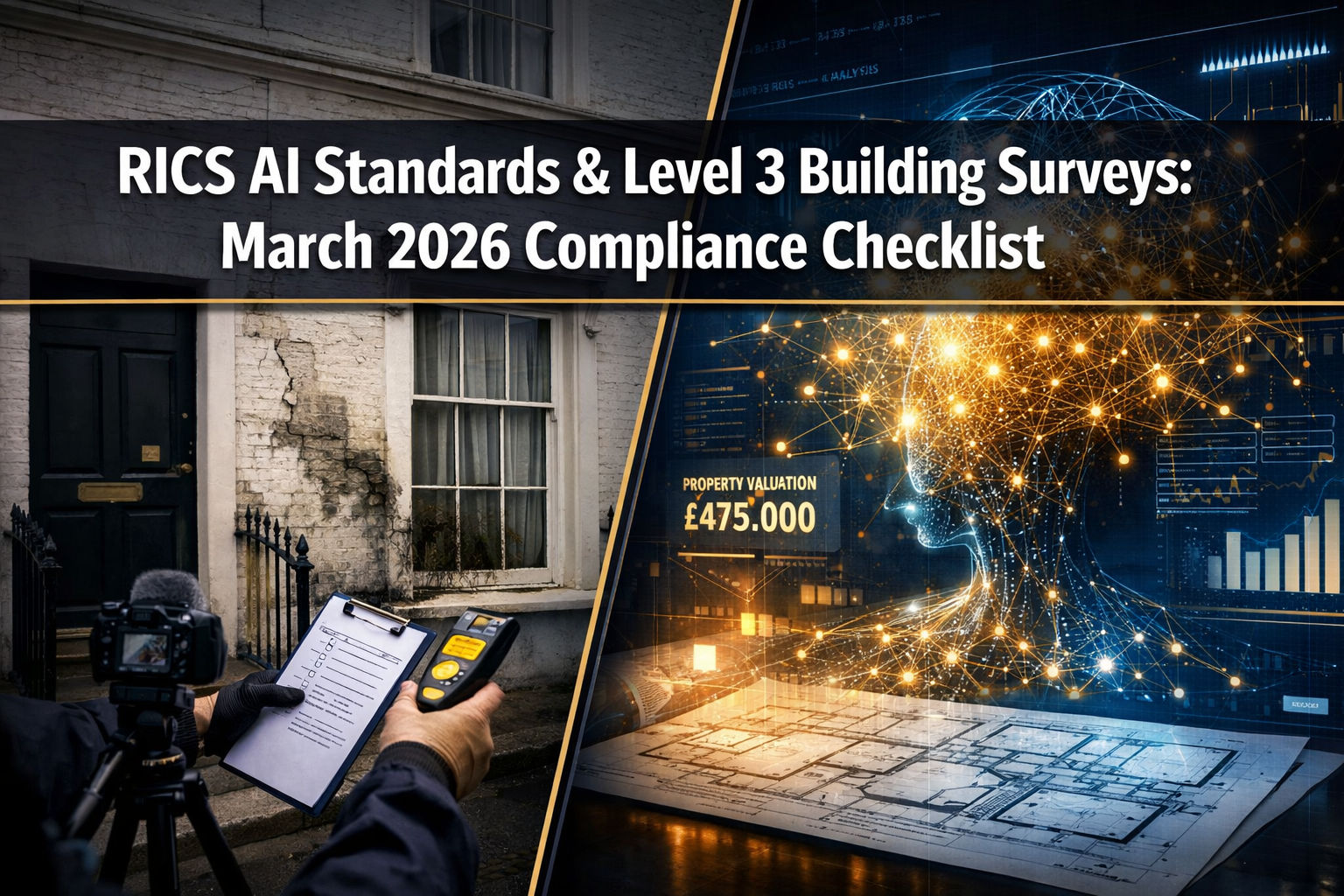

By 9 March 2026, every RICS-regulated surveying firm in the UK became legally obligated to comply with a landmark professional standard — one that fundamentally changes how artificial intelligence may be used in property assessment and valuation. For surveyors delivering Level 3 building surveys, this is not a background administrative update. It reshapes how defects are detected, documented, and priced, and it carries direct consequences for property valuations that buyers, lenders, and investors rely on.
The Valuation Impacts of RICS AI Standards on Level 3 Building Surveys: March 2026 Compliance Checklist is now a live operational concern for every firm conducting structural assessments. Understanding what changed, why it matters, and how to act on it is essential for maintaining professional credibility and client trust.
Key Takeaways
- 🏛️ The RICS "Responsible Use of Artificial Intelligence in Surveying Practice" standard became mandatory on 9 March 2026, affecting all RICS-regulated firms [2].
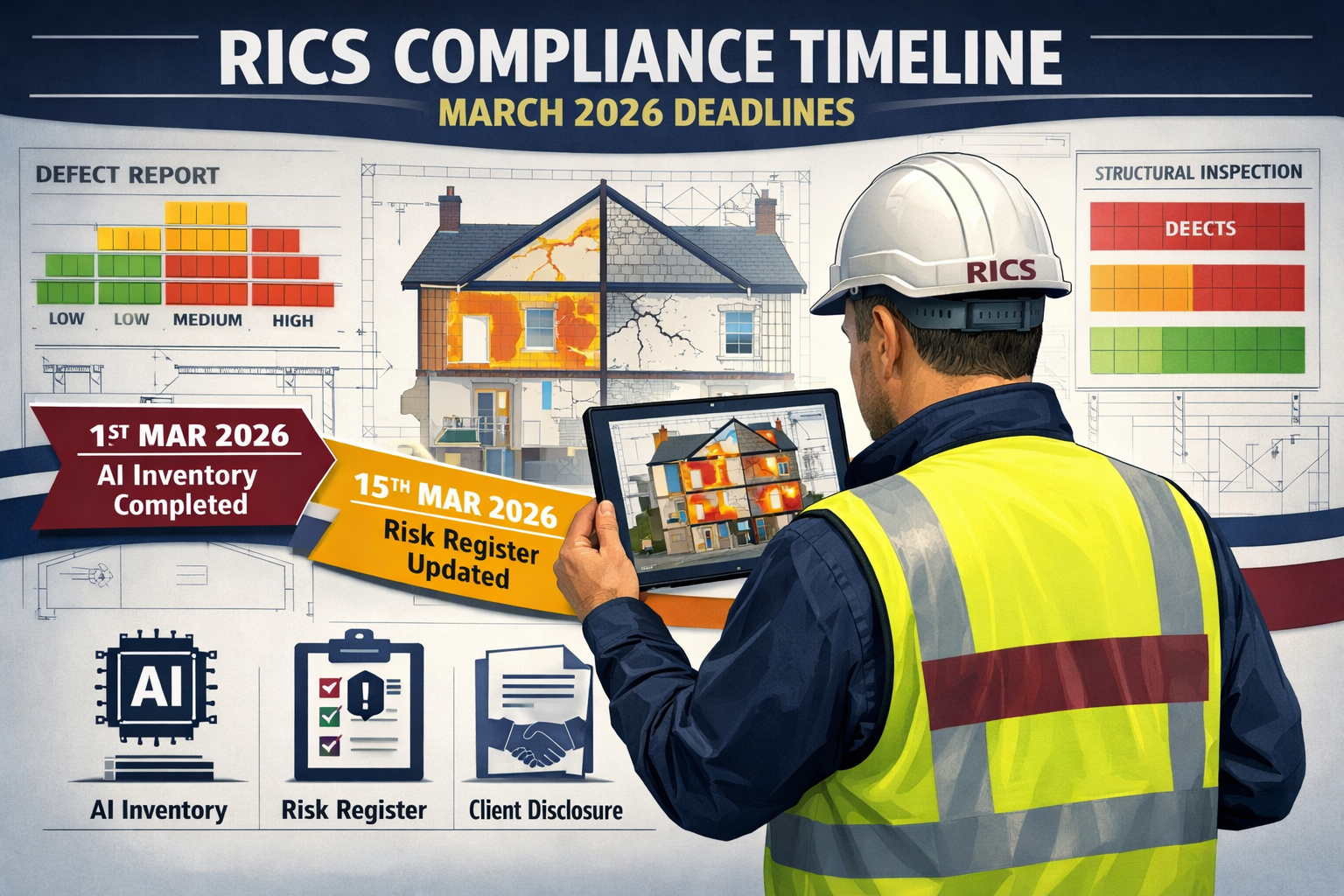
- 📋 Firms must maintain a written AI system inventory and a quarterly-reviewed risk register using RAG ratings [1].
- 🔍 Client disclosure of AI use must be made in writing, in advance, and embedded in terms of engagement [1].
- 💷 Level 3 surveys cost £700–£1,200 in 2026, and AI-driven defect findings can materially shift final valuations [3].
- ✅ AI system inventory completion is the single highest-priority compliance task — all other obligations depend on it [4].
What the March 2026 RICS AI Standard Actually Requires
The RICS "Responsible Use of Artificial Intelligence in Surveying Practice" professional standard was published in September 2025 and took mandatory effect on 9 March 2026 [2]. It applies to all RICS members and regulated firms, regardless of firm size. For Level 3 building survey practitioners, its requirements are especially consequential because AI tools are increasingly embedded in defect detection, thermal imaging analysis, drone data processing, and automated valuation modelling.
The standard covers five core domains [1][2]:
| Domain | Key Obligation |
|---|---|
| Knowledge Requirements | Surveyors must understand how AI systems they use actually work |
| Practice Management | Data governance, system governance, and risk management frameworks |
| AI Procurement & Due Diligence | Structured vendor assessment before adopting any AI tool |
| Output Reliability Assurance | Validation processes to catch erroneous or biased AI outputs |
| Client Communication | Written, advance disclosure of AI use in all engagements |
The AI System Inventory: Your First Compliance Priority
According to compliance analysis published in March 2026, completing the AI system inventory is the single most critical first step — because every other compliance obligation (risk assessments, monitoring reports, vendor reviews) depends on first knowing which AI systems are in scope [4].
The inventory must be a written register documenting:
- ✅ Every AI system with a material impact on surveying service delivery
- ✅ Known inherent bias risks within each system
- ✅ Documented potential for erroneous outputs
- ✅ The purpose and scope of each tool's use in client-facing work
For a firm conducting structural surveys in London, this might include AI-assisted crack analysis software, automated thermal imaging interpretation tools, or drone data processing platforms used in drone roof surveys.
💡 Pull Quote: "The inventory is not optional paperwork — it is the foundation upon which every other AI compliance obligation is built." — Digital Applied, March 2026 [4]
Risk Register Requirements
Once the inventory is complete, firms must establish and maintain a formal risk register for each AI system identified [1]. The register must:
- Use RAG (Red, Amber, Green) ratings to categorise risk severity
- Be reviewed at a minimum of quarterly
- Document mitigation plans for each identified risk
- Record the firm's stated risk appetite
This is a significant governance step. A surveyor using AI-assisted subsidence analysis software — for example, when conducting subsidence surveys — must now formally document what happens if that software produces a false negative, and what the firm's tolerance for that risk is.
Valuation Impacts of RICS AI Standards on Level 3 Building Surveys: March 2026 Compliance Checklist in Practice
Level 3 building surveys are the most detailed residential survey product available. In 2026, they typically cost between £700 and £1,200, and are particularly recommended for properties built before 1990 or those with significant extensions [3]. They provide a comprehensive structural assessment — covering everything from roof condition and damp penetration to foundation integrity and drainage systems.
The introduction of AI tools into this workflow creates both opportunities and risks for the final valuation figure.
How AI Affects Defect Detection and Valuation Adjustments
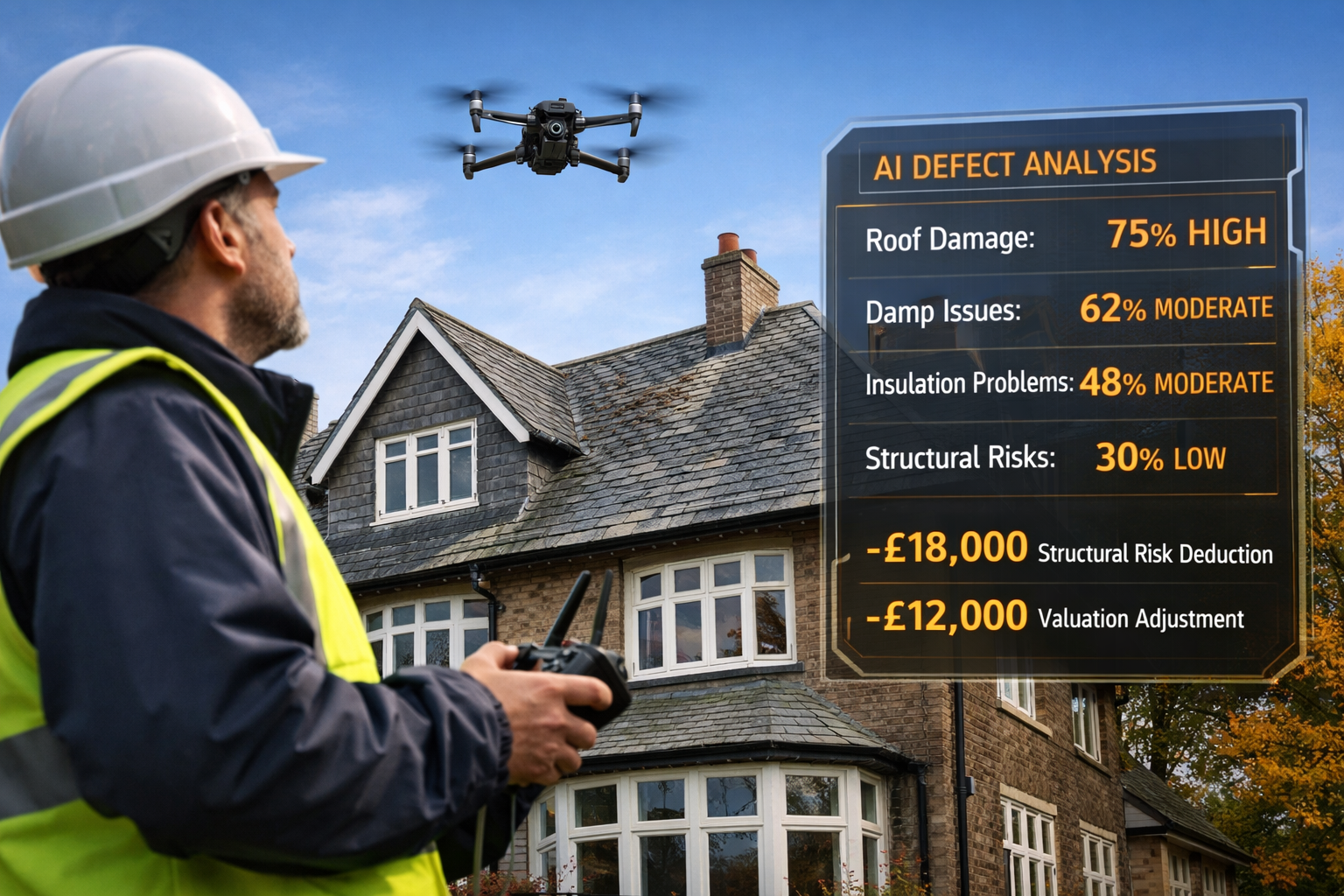
AI systems used in Level 3 surveys can accelerate and enhance defect detection. Drone-based roof scanning, for example, can identify missing tiles, cracked flashings, and blocked gutters with greater coverage than a manual inspection alone. Thermal imaging AI can flag hidden damp or insulation failure behind finished surfaces.
However, each AI-identified defect has a direct valuation consequence. A structural crack flagged by AI analysis may trigger a downward valuation adjustment of £10,000–£25,000 or more, depending on severity and location. If the AI system produces a false positive — flagging a defect that does not exist — the buyer may lose a transaction or negotiate an unnecessary price reduction.
This is precisely why the RICS standard requires output reliability assurance: a documented process for a qualified surveyor to validate AI outputs before they appear in a client report or valuation figure. For firms offering RICS registered valuer services, this validation step is now a mandatory compliance element, not a discretionary quality check.
The Client Transparency Mandate: What Must Be Disclosed
The standard is explicit on client communication [1]. RICS members and regulated firms must:
- Disclose in writing and in advance when AI systems will be used
- Specify the purpose of each AI tool within the engagement
- Include this disclosure in contractual documents and terms of engagement
This means that a standard Level 3 survey instruction letter must now contain a clear AI disclosure clause. Clients have a right to know if their roof assessment was partially conducted using drone AI software, or if their damp analysis was processed through an automated interpretation engine.
For firms offering valuation reports in London or Red Book valuations, this disclosure obligation applies equally to any AI tools used in the valuation process itself.
The March 2026 Compliance Checklist for Level 3 Survey Firms
The following checklist consolidates the core obligations from the RICS AI standard into an actionable framework for firms conducting Level 3 building surveys [1][2][4].
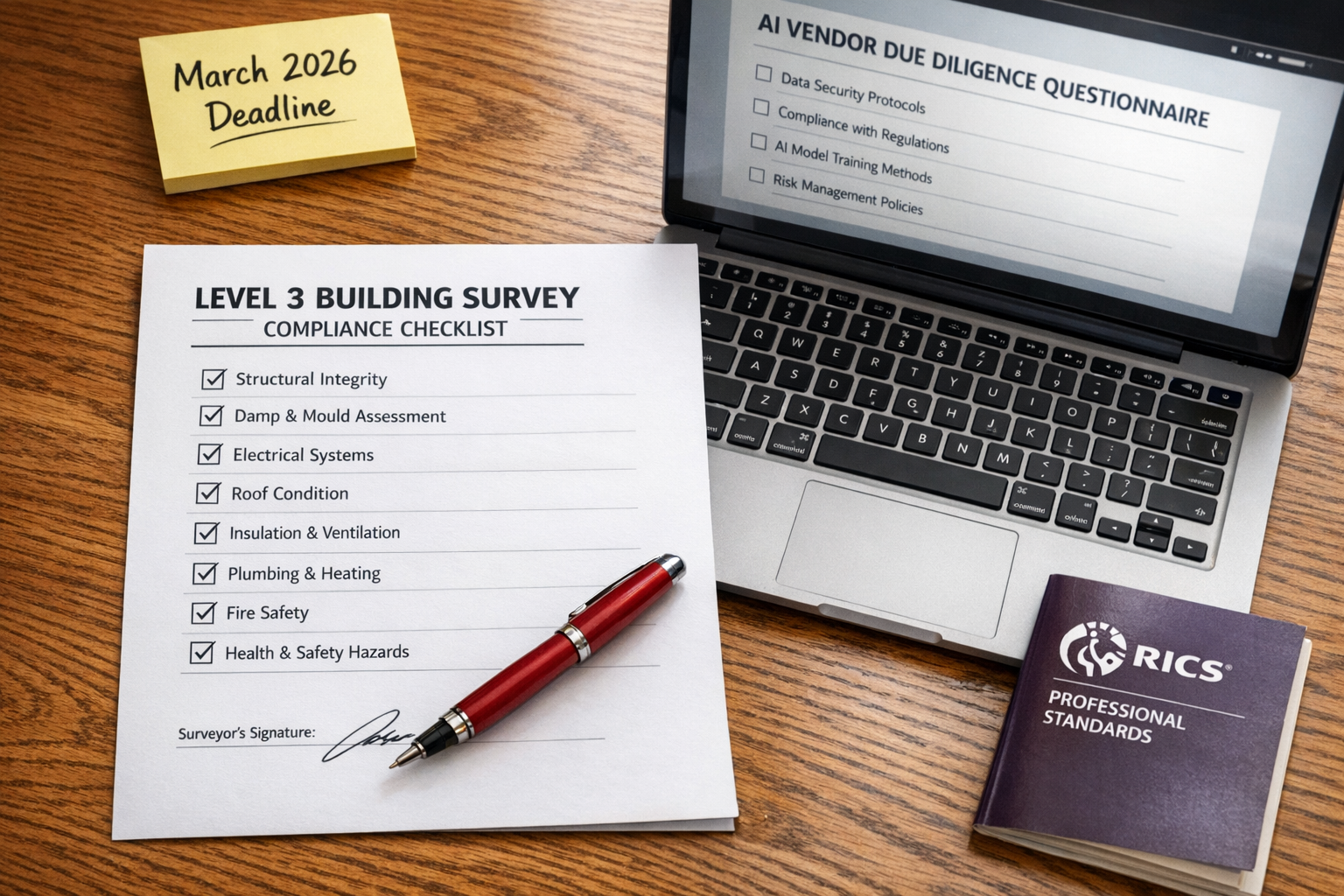
📋 Section 1: AI System Inventory (Complete First)
- Identify all AI tools currently used in survey delivery (defect detection, report generation, valuation modelling, drone data processing)
- Document each tool in a written register with system name, vendor, version, and purpose
- Record known bias risks and potential for erroneous outputs for each system
- Assign an internal owner responsible for each AI system
- Confirm which systems have material impact on service delivery outcomes
📋 Section 2: Risk Register
- Create a formal risk register for each AI system in scope
- Apply RAG ratings (Red/Amber/Green) to each identified risk
- Document mitigation plans for all Amber and Red risks
- Record the firm's risk appetite in writing
- Schedule quarterly review dates and assign responsibility
- Conduct the first quarterly review if not yet completed since 9 March 2026
📋 Section 3: AI Procurement and Vendor Due Diligence
- Establish a vendor assessment process for any new AI tool before adoption
- Request technical documentation from vendors covering bias testing and accuracy benchmarks
- Review vendor data handling and privacy policies for GDPR compatibility
- Document the procurement decision rationale in writing
📋 Section 4: Output Reliability Assurance
- Implement a mandatory human review step for all AI-generated outputs before inclusion in survey reports
- Document the validation methodology used by qualified surveyors
- Establish a process for logging and reviewing AI errors or anomalous outputs
- Ensure AI-assisted findings in specific defect reports are clearly attributed and validated
📋 Section 5: Client Communication and Disclosure
- Update terms of engagement to include a written AI disclosure clause
- Ensure disclosure specifies which AI tools will be used and for what purpose
- Confirm disclosure is provided before the survey commences
- Train fee earners on the disclosure obligation and how to explain it to clients
- Review and update standard instruction letters and proposal templates
📋 Section 6: Knowledge and Training
- Confirm all surveyors using AI tools have sufficient working knowledge of how those tools function
- Identify any knowledge gaps and schedule appropriate CPD
- Document training completion in personnel records
Valuation Impacts of RICS AI Standards on Level 3 Building Surveys: What This Means for Property Buyers and Lenders
The compliance requirements described above are not purely internal governance matters. They have tangible effects on the reliability and defensibility of property valuations — which matters enormously to buyers, mortgage lenders, and investors.
Increased Valuation Credibility
When a Level 3 survey report clearly discloses which AI tools were used, how their outputs were validated, and what risk controls were in place, the resulting valuation carries greater evidential weight. This is particularly important in contested situations — for example, when a buyer uses a survey finding to renegotiate a purchase price, or when a chartered surveyor is called upon to provide an expert witness report in a property dispute.
Reduced Risk of Negligence Claims
AI systems that produce erroneous outputs — and whose errors are not caught by a human validation step — create professional liability exposure. The RICS standard's output reliability requirements are, in part, a professional negligence risk management framework. Firms that follow the checklist above reduce their exposure significantly.
Alignment with Broader AI Governance Trends
The RICS standard does not exist in isolation. In March 2026, the National Institute of Standards and Technology (NIST) released version 1.1 of its AI Risk Management Framework, adding new MEASURE function guidance for organisations with federal contracts [4]. While this applies primarily to US federal contractors, it signals a global direction of travel: structured AI governance is becoming the baseline expectation across professional services.
For UK surveyors operating in international markets, or working with lenders who have global parent organisations, alignment with both RICS and NIST frameworks strengthens professional positioning.
Practical Considerations for Different Survey Contexts
The compliance obligations apply uniformly, but their practical expression varies by survey type and property context.
Pre-1990 properties — the primary target market for Level 3 surveys — often present the most complex defect profiles [3]. AI tools trained on modern construction datasets may have lower accuracy when assessing solid-wall construction, original timber frames, or pre-modern drainage systems. The risk register for such tools should explicitly flag this as an Amber or Red risk, with a mitigation plan requiring enhanced manual inspection.
Properties with extensions or conversions introduce additional complexity. AI systems may struggle to differentiate original fabric from later additions, potentially misclassifying defect severity. Surveyors conducting assessments in areas such as central London or Surrey — where period properties with complex alteration histories are common — should treat this as a standing risk register item.
Drone-assisted roof surveys are among the highest-value AI applications in Level 3 surveys, but also carry specific disclosure obligations. Clients must be told in advance that drone technology will be used, and the AI processing of drone imagery must be documented in the system inventory.
Conclusion: Actionable Next Steps for March 2026 Compliance
The Valuation Impacts of RICS AI Standards on Level 3 Building Surveys: March 2026 Compliance Checklist represents a genuine shift in how professional surveying practice is governed — not a bureaucratic burden, but a framework that protects surveyors, clients, and the integrity of property valuations alike.
Here are the immediate actions every Level 3 survey firm should take:
- Complete the AI system inventory this week. It is the prerequisite for everything else [4].
- Establish the risk register for each system identified, with RAG ratings and a first quarterly review date.
- Update all client-facing documentation — instruction letters, terms of engagement, proposal templates — to include compliant AI disclosure language.
- Audit your vendor relationships. Request technical documentation from AI tool providers and document your due diligence.
- Train your team. Ensure every surveyor using an AI tool can explain how it works and what its limitations are.
- Build the human validation step formally into your survey workflow, and document it.
Firms that treat this checklist as a genuine quality framework — rather than a compliance box-ticking exercise — will find that it strengthens their professional reputation, reduces liability exposure, and produces more defensible valuations. In a cautious property market, that credibility is a competitive advantage.
References
[1] Responsible Use Of Artificial Intelligence In Surveying Practice September 2025 – https://www.rics.org/content/dam/ricsglobal/documents/standards/Responsible-use-of-artificial-intelligence-in-surveying-practice_September-2025.pdf
[2] Responsible Use Of Ai – https://www.rics.org/profession-standards/rics-standards-and-guidance/conduct-competence/responsible-use-of-ai
[3] Building Survey Checklists For Bungalow Purchases 2026 Rics Guidance On Structural Risks And Costs – https://nottinghillsurveyors.com/blog/building-survey-checklists-for-bungalow-purchases-2026-rics-guidance-on-structural-risks-and-costs
[4] Ai Compliance Checklist March 2026 What Changed Month – https://www.digitalapplied.com/blog/ai-compliance-checklist-march-2026-what-changed-month
[5] Rics Ai Standard What It Means For Your Supplier – https://www.pfandco.co.uk/insights/rics-ai-standard-what-it-means-for-your-supplier
[6] Building Surveying Standards – https://www.rics.org/profession-standards/rics-standards-and-guidance/sector-standards/building-surveying-standards