
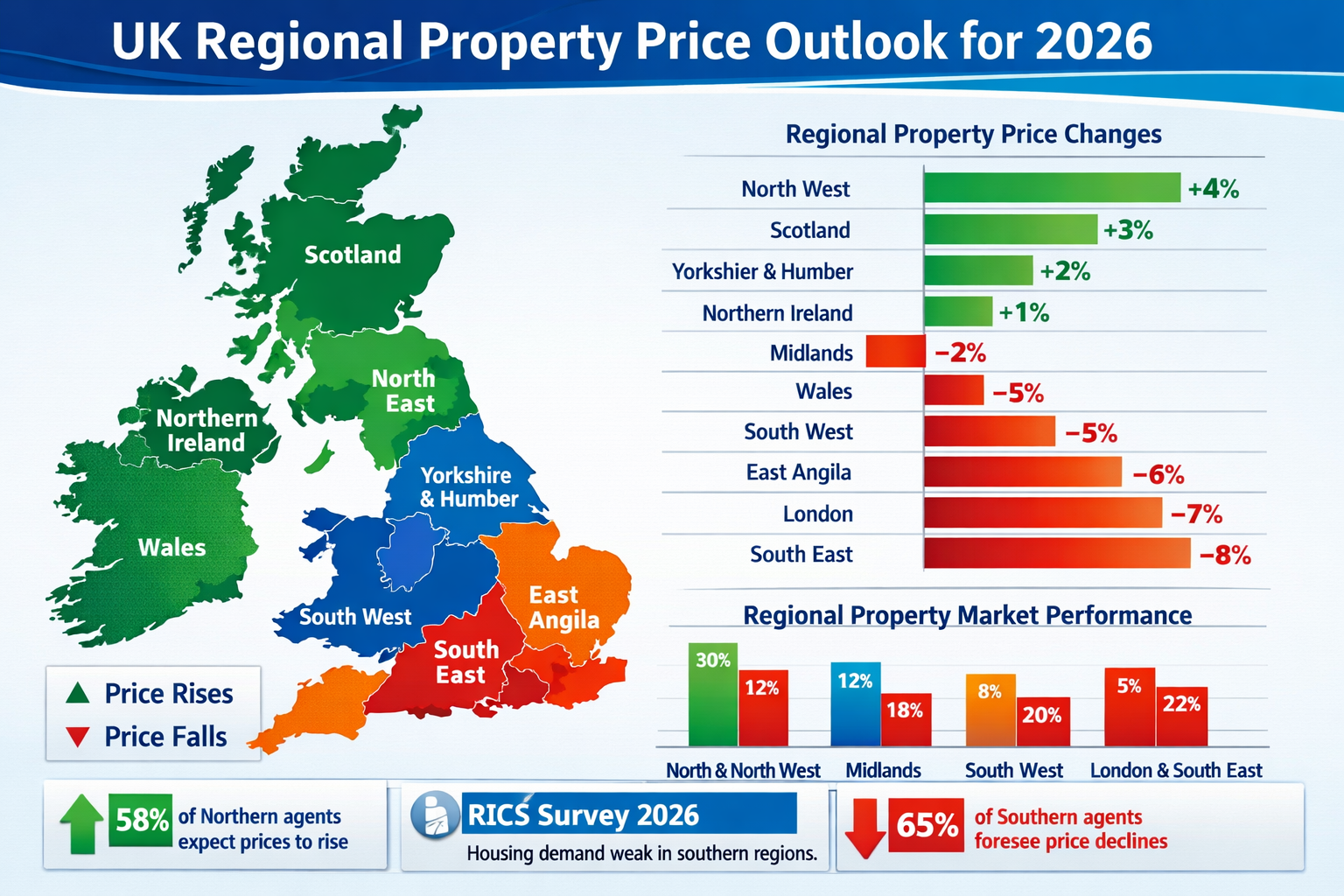
The UK property market in 2026 tells a tale of two nations. While northern regions experience robust price growth, the South East, South West, London, and East Anglia continue to struggle with persistent downward pressure. For property professionals conducting Valuation Surveys for Lagging Southern Markets: RICS Techniques Amid East Anglia and South East Price Pressures have become essential tools for navigating these challenging conditions. Understanding how to apply rigorous RICS methodologies in underperforming markets isn't just good practice—it's the difference between accurate valuations and costly miscalculations.
The January 2026 RICS UK Residential Market Survey reveals that these four southern regions maintained more negative net balances for price movements compared to the national average [2]. This regional divergence demands specialized valuation approaches that account for local market dynamics, affordability challenges, and emerging opportunities within seemingly stagnant markets.
Key Takeaways
- Regional divergence is intensifying: Southern markets including East Anglia and the South East show weaker performance than northern regions, requiring specialized valuation techniques
- RICS Red Book standards mandate multi-method validation: Professional valuers must justify their approach selection and cross-check findings, particularly in challenging markets
- Comparable method remains primary but requires careful adjustment: Market data from underperforming regions needs sophisticated analysis to ensure accuracy
- Affordability shifts are creating opportunities: Ex-rental stock and realistic pricing in areas like Essex are improving market conditions for specific segments
- Professional expertise is non-negotiable: Accurate valuations in lagging markets require RICS registered valuers who understand regional nuances
Understanding Regional Market Dynamics in 2026 Southern England
The Southern Market Underperformance Pattern
The current market landscape shows a clear geographical divide. The South East, South West, London, and East Anglia have consistently demonstrated weaker performance metrics throughout early 2026, though all regions showed marginal improvement from previous months [2]. This persistent underperformance creates unique challenges for property valuation professionals.
Key factors driving southern market pressures include:
- 🏠 Affordability constraints limiting buyer pools in traditionally expensive areas
- 📊 Interest rate sensitivity affecting mortgage accessibility
- 🏢 Changing work patterns reducing London commuter premium
- 💷 Price correction cycles following years of rapid appreciation
In contrast, the North and North West of England report prices on an upward trajectory, indicating significant regional divergence that valuers must acknowledge in their assessments [2]. This disparity means that national valuation models require substantial regional adjustment.
East Anglia Market Characteristics
East Anglia presents particular valuation challenges due to its mixed economic base and varying proximity to London. The region encompasses everything from affluent commuter towns to rural agricultural communities, each with distinct market dynamics.
Recent surveyor feedback from areas like Shenfield and Chelmsford in Essex noted a "drastic improvement" in January 2026, with more realistic seller expectations contributing to increased transaction activity [2]. This suggests that even within lagging markets, micro-regional variations exist that skilled valuers must identify and incorporate.
South East London and Surrounding Areas
The South East region, including South East London, faces unique pressures from:
- High baseline prices limiting further appreciation potential
- Competition from emerging regional centers offering better value
- Infrastructure uncertainties affecting long-term investment appeal
- Demographic shifts as younger buyers seek affordability elsewhere
For professionals conducting valuations in London and surrounding areas, understanding these localized factors is crucial for producing defensible valuation reports.
RICS Valuation Techniques for Challenging Market Conditions
The RICS Red Book Framework
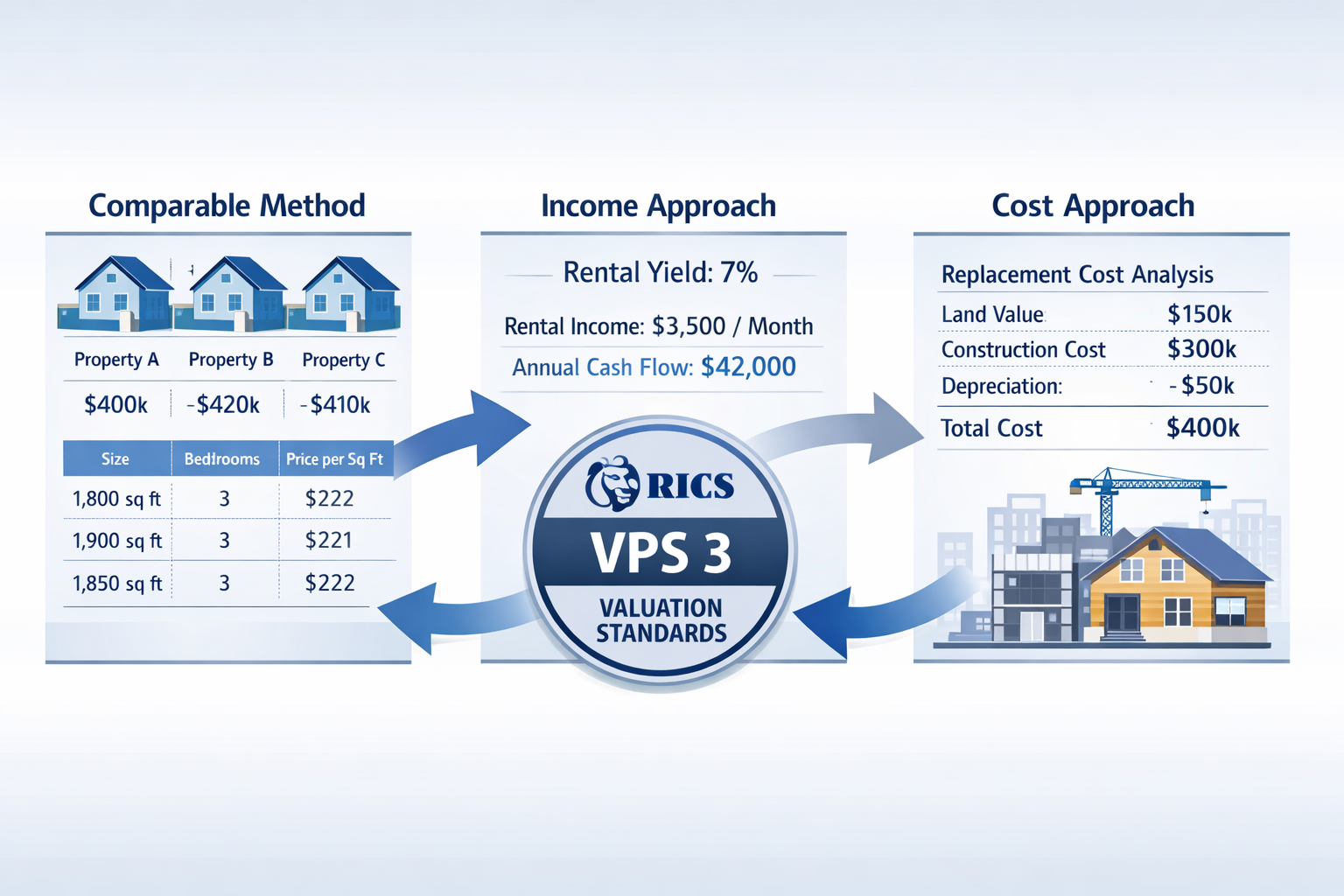
The RICS Valuation – Global Standards (commonly known as the Red Book) provides the professional framework that all chartered surveyors must follow. Under current standards, particularly VPS 3, valuers are required to adopt and document why they chose specific valuation approaches and methods [1].
This requirement becomes especially important when assessing properties in challenging regional markets where standard assumptions may not hold. The Red Book framework ensures consistency while allowing professional judgment to address local market peculiarities.
For those seeking Red Book valuations in London, understanding this framework helps clarify why professional valuers may take different approaches in lagging versus thriving markets.

The Comparable Method in Underperforming Markets
The comparable method remains the most widely used valuation technique for assessing market rent and value of both commercial and residential properties [1]. This approach involves analyzing recent sales of similar properties to establish a market value baseline.
However, applying comparables in lagging southern markets requires additional sophistication:
1. Time Adjustments
Market conditions change rapidly. A comparable sale from six months ago may reflect different market sentiment than today's conditions. Valuers must apply appropriate time adjustments to account for declining or stabilizing trends.
2. Location Micro-Adjustments
Within underperforming regions, significant value variations exist between streets, neighborhoods, and postcodes. Professional valuers must identify these micro-market differences and adjust comparables accordingly.
3. Condition and Quality Variations
In slower markets, property condition becomes more critical to value. Buyers have more choice and can afford to be selective. Comparables must be adjusted for differences in presentation, maintenance, and modernization.
4. Transaction Circumstance Analysis
Not all sales reflect true market value. Distressed sales, related-party transactions, or properties sold with special conditions must be identified and either excluded or carefully adjusted.
Multi-Method Validation Approach
RICS guidance emphasizes that valuers may use multiple approaches and methods to cross-check valuations and provide fully reasoned assessments [1]. This practice is particularly valuable when market data shows regional variations.
The three primary valuation approaches include:
| Approach | Best Application | Relevance to Southern Markets |
|---|---|---|
| Market Approach | Properties with active comparable sales | Primary method but requires careful adjustment for market trends |
| Income Approach | Investment properties and rental stock | Increasingly relevant as ex-rental properties enter market [2] |
| Cost Approach | Unique properties or new construction | Useful for specialized properties lacking comparables |
For comprehensive property assessments, professionals often combine these methods. For example, a valuation report might use comparables as the primary method while cross-checking with income capitalization for rental properties.
Adjusting for Affordability Improvements
The January 2026 RICS survey noted that East Lancashire experienced improved affordability through ex-rental stock entering the market, making lower and middle-priced properties more attainable [2]. This trend has implications for valuation methodology.
When former rental properties convert to owner-occupation in significant numbers, valuers must:
- ✅ Assess whether these properties represent true market comparables
- ✅ Evaluate any condition differences between rental and owner-occupied stock
- ✅ Consider the impact of increased supply on local pricing dynamics
- ✅ Identify whether this represents a temporary or structural market shift
Handling Realistic Pricing Expectations
Professional surveyors in Essex noted that accurate pricing became essential in early 2026, with higher-end stock taking longer to sell [2]. This observation provides valuable guidance for valuation professionals.
In markets where seller expectations are adjusting downward, valuers must:
- Distinguish between asking prices and achieved prices – listing data may not reflect true market value
- Weight recent transactions more heavily – older comparables may reflect outdated market sentiment
- Consider days-on-market data – extended marketing periods indicate pricing above market clearing levels
- Analyze price reduction patterns – properties requiring multiple reductions suggest initial overpricing
Practical Strategies for Valuation Surveys in Lagging Southern Markets
Comprehensive Data Collection
Accurate valuations in challenging markets begin with thorough data collection. Professional valuers should:
Expand the Comparable Search Radius
In slower markets with fewer transactions, expanding the geographical search area may be necessary. However, this must be balanced against maintaining location comparability.
Extend the Time Period
While recent sales are preferable, lagging markets may require examining transactions over a longer period, with appropriate time adjustments applied.
Incorporate Multiple Data Sources
- Land Registry data for completed transactions
- Estate agent listings for current market sentiment
- Rental market data for income approach validation
- Local authority planning data for area development trends
Understanding Valuation Factors Specific to Southern Markets
The valuation factors that influence property value vary by region. In underperforming southern markets, particular attention should be paid to:
Transport Connectivity
Proximity to London and major transport hubs remains a significant value driver, even in lagging markets. Properties with excellent connectivity typically maintain value better than isolated locations.
School Catchment Areas
Family-oriented buyers prioritize education, making school catchment areas a critical valuation factor that can create value pockets within otherwise underperforming regions.
Property Condition and Presentation
In markets with abundant choice, buyers can afford to be selective. Well-maintained properties command premiums, while those requiring work face steeper discounts than in faster markets.
Local Development Plans
Planned infrastructure improvements or major developments can support values even when broader regional trends are negative. Valuers should research and incorporate such factors.
Specialized Valuation Scenarios
Different valuation purposes require adapted approaches in lagging markets:
Probate Valuations
Probate valuations require particular care in declining markets, as HMRC expects realistic market values. Executors benefit from professional valuations that can withstand scrutiny.
Lease Extension Valuations
For lease extension valuations, regional market trends affect both the existing lease value and the marriage value calculation. Lagging markets may reduce marriage value premiums.
Right to Buy Valuations
Right to Buy valuations must reflect genuine market conditions. In underperforming areas, this ensures fair pricing for both purchasing tenants and local authorities.
Freehold Valuations
Freehold valuations in lagging markets require careful analysis of ground rent investment yields and reversion values, which may differ from national benchmarks.
Risk Assessment and Uncertainty Disclosure
Professional valuers operating in uncertain markets should clearly communicate confidence levels and material uncertainties. The RICS framework requires transparency about:
- Market evidence quality – whether sufficient comparable data exists
- Market volatility – the degree of price fluctuation observed
- Special assumptions – any departures from standard valuation assumptions
- Valuation uncertainty – appropriate ranges or caveats
This transparency protects both valuers and clients, ensuring that valuation reports are used appropriately for their intended purpose.
Emerging Opportunities in Stabilizing Markets
Signs of Market Stabilization
The RICS January 2026 survey suggests the market may be "turning a corner," with conditions beginning to stabilize despite regional variations [2]. For valuation professionals, this transitional period presents both challenges and opportunities.
Indicators of stabilization include:
- 📈 Improvement in net balance figures, even if still negative
- 🏘️ Increased transaction volumes as buyers and sellers find common ground
- 💡 More realistic pricing expectations from vendors
- 🔄 Reduced time-on-market for appropriately priced properties
Valuers who can identify these early stabilization signs provide valuable intelligence to clients making property decisions.
The Ex-Rental Property Opportunity
The influx of ex-rental properties into the sales market, particularly in areas like East Lancashire, creates a specific opportunity segment [2]. These properties often offer:
- Competitive pricing as landlords exit the market
- Renovation potential for buyers willing to improve condition
- Established locations in proven rental demand areas
- Value-add opportunities through refurbishment
For investors and first-time buyers, these properties represent affordability entry points. For valuers, they require careful assessment of current condition versus potential value after improvement.
Regional Variation as Strategic Advantage
The significant divergence between northern and southern markets means that location strategy becomes paramount. Savvy investors and homebuyers can leverage professional valuation advice to:
- Identify undervalued pockets within lagging regions
- Recognize areas poised for recovery ahead of the broader market
- Avoid overpaying in declining micro-markets
- Time purchases to maximize value in transitional markets
Professional chartered surveyors in the South East and East Anglia provide this localized expertise that generic valuation models cannot replicate.
Professional Standards and Continuing Development
The IVS Exposure Draft and Future Standards
The International Valuation Standards (IVS) Exposure Draft is currently open for public consultation until April 30, 2026 [1]. Proposed updates will impact RICS Global Valuation Standards going forward, potentially affecting how valuers approach regional market variations.
Professional valuers should:
- Stay informed about proposed standard changes
- Participate in consultation processes where appropriate
- Prepare for implementation of updated requirements
- Ensure continuing professional development addresses new standards
Importance of Local Market Knowledge
While professional standards provide the framework, local market knowledge remains irreplaceable. Valuers operating in East Anglia, the South East, and surrounding areas must:
- 🎯 Maintain active awareness of local transaction patterns
- 🤝 Build relationships with local estate agents and property professionals
- 📊 Track micro-market trends within their operating areas
- 🏘️ Understand neighborhood-specific value drivers and detractors
This combination of professional standards and local expertise distinguishes truly competent valuation professionals from those applying generic methodologies.
When to Engage Professional Valuation Services
Property owners, buyers, and professionals should engage qualified valuers when:
- Purchasing property in uncertain markets to avoid overpaying
- Selling property to establish realistic asking prices
- Refinancing to provide lenders with accurate security valuations
- Estate planning requiring probate valuations
- Tax purposes including ATED, capital gains, or inheritance tax
- Dispute resolution requiring independent expert opinion
- Investment analysis to assess acquisition or disposal decisions
The cost of professional valuation services represents a small fraction of potential losses from inaccurate property value assessments.
Conclusion
Valuation Surveys for Lagging Southern Markets: RICS Techniques Amid East Anglia and South East Price Pressures require a sophisticated blend of professional standards, local market knowledge, and analytical rigor. The regional divergence evident in 2026 UK property markets means that generic valuation approaches are insufficient for accurate property assessment.
The RICS Red Book framework provides the professional foundation, emphasizing the comparable method while encouraging multi-method validation. However, applying these techniques in underperforming markets demands additional considerations: careful time adjustments, micro-location analysis, condition assessments, and transaction circumstance evaluation.
The January 2026 RICS survey data reveals both challenges and opportunities. While southern regions continue to lag national performance, signs of stabilization are emerging. Realistic pricing expectations in areas like Essex, combined with improved affordability through ex-rental stock in other regions, suggest that the market is finding a new equilibrium.
Actionable Next Steps
For property professionals, investors, and homeowners navigating southern market conditions:
- Engage qualified RICS valuers with demonstrable local market expertise rather than relying on online estimates or generic models
- Request detailed valuation reports that explain methodology, comparable selection, and adjustments applied
- Consider multiple valuation methods to cross-check findings, particularly for significant transactions
- Stay informed about regional trends through RICS survey data and local market intelligence
- Time decisions strategically based on professional advice about market positioning and trajectory
- Recognize micro-market variations within broader regional trends that create pockets of opportunity
The complexity of lagging southern markets makes professional valuation expertise more valuable than ever. As the market continues its transition through 2026, those who invest in accurate, professionally conducted valuations will be best positioned to make informed property decisions that protect and enhance their financial interests.
Whether you're buying, selling, refinancing, or managing property assets in East Anglia, the South East, or surrounding regions, partnering with experienced RICS registered valuers ensures your decisions are grounded in rigorous analysis rather than speculation. In uncertain markets, this professional foundation is not optional—it's essential.
References
[1] APC: Valuation Approaches and Methods – https://ww3.rics.org/uk/en/journals/property-journal/apc-5-valuation-methods.html
[2] UK Residential Market Survey January 2026 – https://www.rics.org/content/dam/ricsglobal/documents/market-surveys/uk-residential-market-survey/UK-Residential-Market-Survey_January-2026.pdf