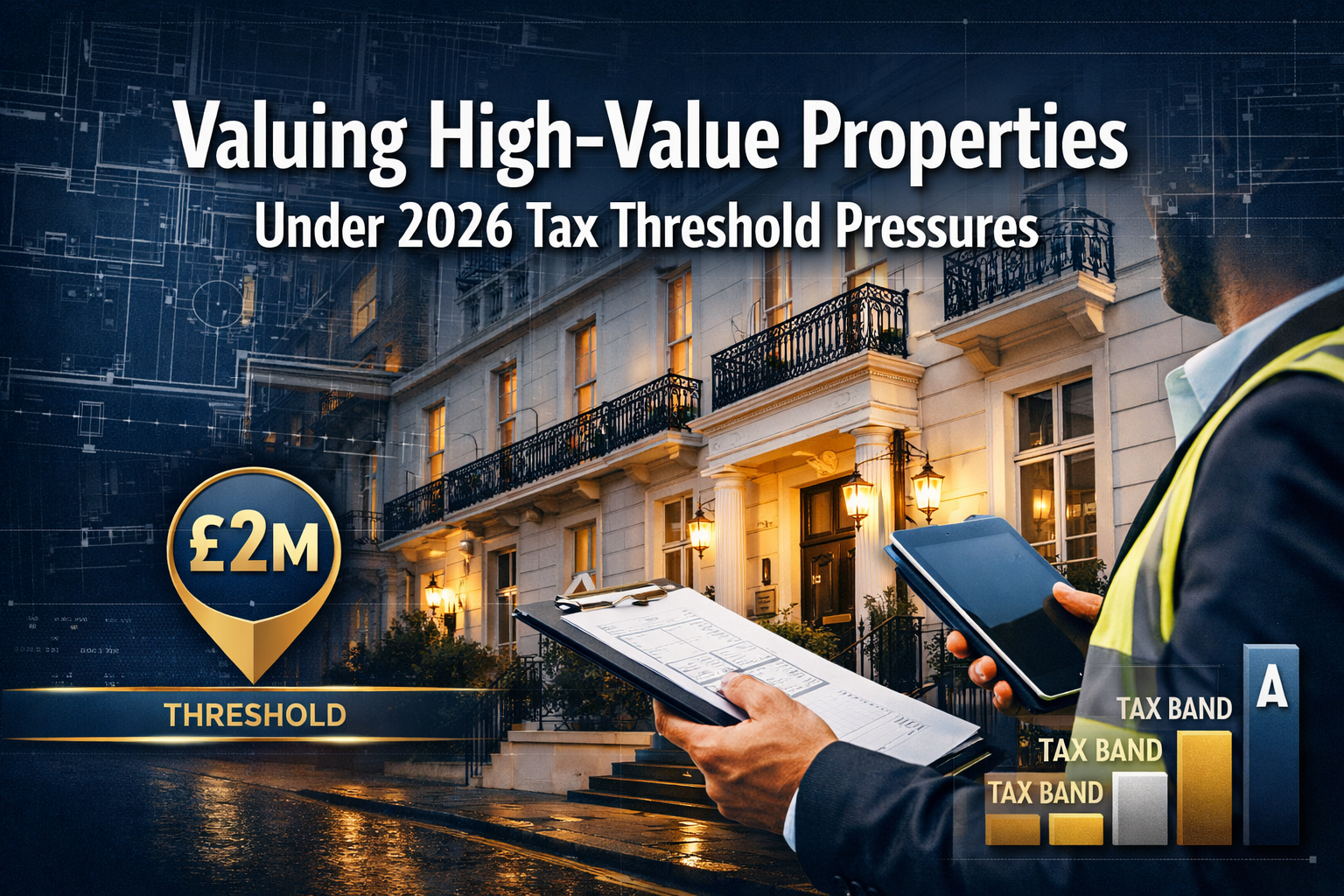
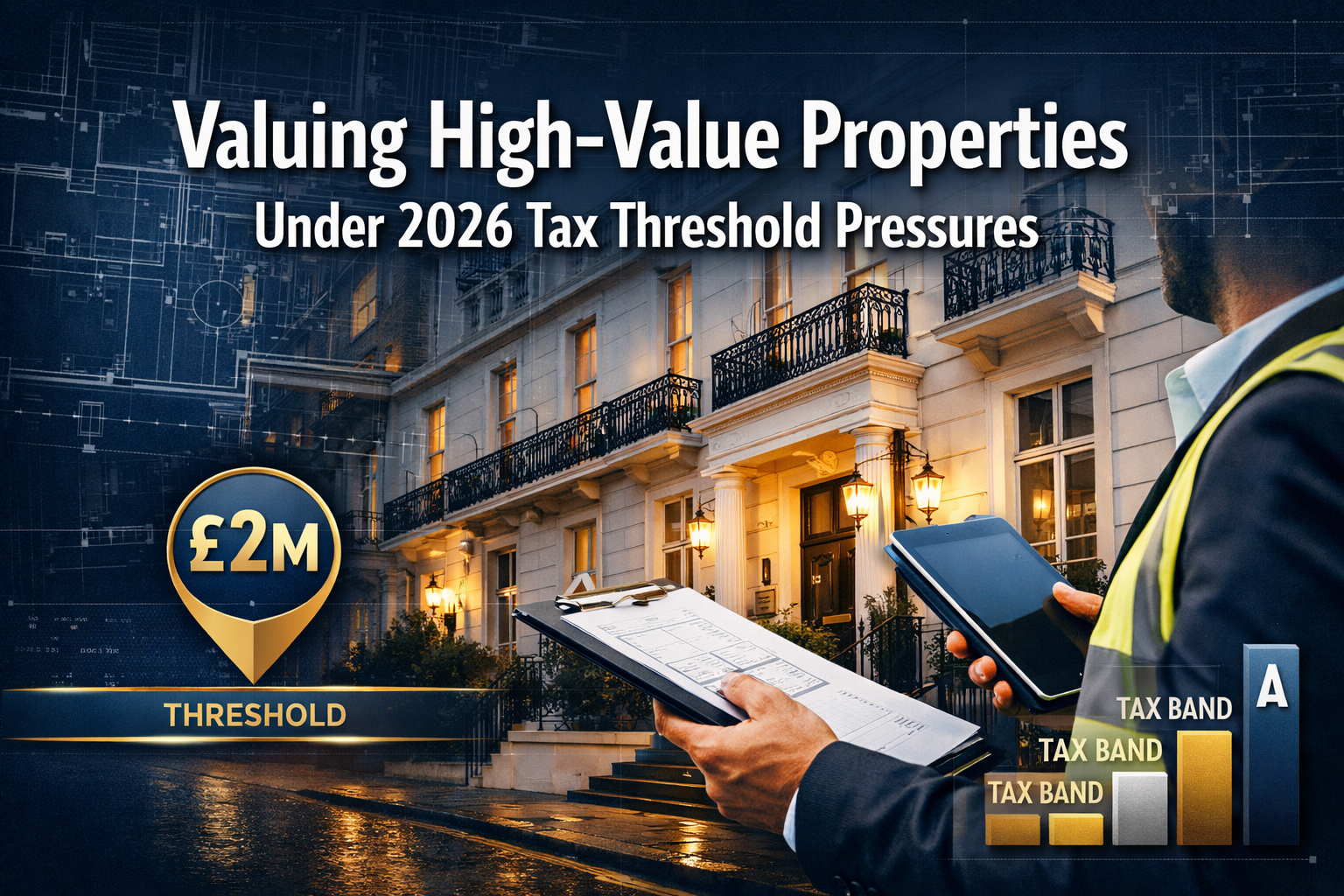
{"cover":"Professional landscape format (1536x1024) hero image featuring bold text overlay 'Valuing High-Value Properties Under 2026 Tax Threshold Pressures' in extra large 72pt white sans-serif font with subtle dark gradient shadow, centered in upper third. Background shows elegant London townhouse facade with surveyor holding clipboard and tablet in foreground, architectural blueprints overlay, £2M threshold marker graphic, tax band indicators. Color scheme: deep navy blue, gold accents, crisp white. High contrast, magazine cover quality, editorial financial property style with professional gravitas.","content":["Detailed landscape format (1536x1024) illustration showing price bunching phenomenon with vertical bar chart displaying property concentration just below £2 million threshold marker (highlighted in red), comparative bars at £1.95M, £1.98M, £1.99M showing clustering effect, downward arrows indicating market adjustment, percentage labels showing 2.5% value dampening, clean financial infographic aesthetic with blue and gold color scheme, tax band thresholds overlaid as horizontal lines, professional property valuation context.","Landscape format (1536x1024) detailed surveyor's checklist visual showing professional surveyor in hard hat examining luxury property interior with modern kitchen extension, tablet displaying digital valuation form with checkboxes, renovation impact assessment diagram, split-screen comparison showing pre and post-renovation values crossing £2M threshold, measurement tools, architectural drawings, RICS standards badge, warm interior lighting contrasting with professional documentation overlay, emphasis on capital improvements assessment.","Landscape format (1536x1024) regional risk heat map of Greater London and surrounding counties showing differential HVCTS exposure zones, color-coded areas from dark red (highest concentration above £2M) to light blue (lower exposure), specific borough labels for Chelsea, Kensington, Richmond, Surrey, Oxfordshire, property value gradient overlay, percentage statistics for each region, professional cartographic style with legend showing surcharge bands £2M-£5M+, clean data visualization aesthetic with property icons."]}
The luxury property market faces an unprecedented challenge in 2026. As the Valuation Office Agency conducts its targeted valuation exercise using April 2026 as the benchmark date, a phenomenon known as "price bunching" is reshaping how surveyors approach high-value property appraisals. With the High Value Council Tax Surcharge (HVCTS) set to take effect in April 2028, properties clustering just below the £2 million threshold are creating valuation complexities that demand precise, defensible methodologies. For chartered surveyors, understanding these threshold pressures and implementing robust checklists has never been more critical.
Key Takeaways
- 🏘️ Price bunching is concentrating property valuations just below the £2 million HVCTS threshold, requiring surveyors to adopt specialized valuation frameworks that account for market distortions
- 📊 The 2026 valuation benchmark will determine tax liability for five years, making accurate April 2026 assessments crucial for both buyers and sellers in the luxury segment
- 💰 Properties above £2 million face annual surcharges ranging from £2,500 to £7,500, potentially dampening high-end values by an average of 2.5%
- 📋 Comprehensive surveyor checklists must address renovation timing, regional risk factors, and buyer negotiation dynamics to deliver defensible appraisals
- ⚖️ Strategic valuation approaches can help property owners navigate threshold pressures while maintaining professional standards and RICS compliance
Understanding the 2026 Tax Threshold Landscape
The High Value Council Tax Surcharge Framework
The HVCTS represents the most significant change to UK property taxation in decades. Taking effect in April 2028, the surcharge applies exclusively to properties valued at £2 million or more, with homeowners—not tenants—bearing sole liability.[1] The framework establishes four distinct charging bands:
| Property Value Range | Annual Surcharge |
|---|---|
| £2.0m – £2.5m | £2,500 |
| £2.5m – £3.5m | £3,500 |
| £3.5m – £5.0m | £5,000 |
| £5.0m+ | £7,500 |
These charges come on top of existing Council Tax obligations, effectively doubling annual property tax bills for many high-value homeowners. For instance, a Kensington townhouse valued at £3.5 million would face combined annual liabilities of £7,000–£8,000 (existing Band H Council Tax plus the £5,000 surcharge).[2]
Why 2026 Is the Critical Valuation Year
The Valuation Office Agency is conducting a comprehensive valuation exercise throughout 2026, with April 2026 serving as the likely benchmark date.[2] These valuations will govern tax liability for the next five-year cycle, with subsequent revaluations occurring every five years thereafter. Charges will increase in line with CPI inflation from 2029-30 onwards.[1]
This timing creates immense pressure on property owners, developers, and RICS registered valuers in London to ensure accurate assessments. A property valued at £1.98 million in April 2026 avoids the surcharge entirely, while one assessed at £2.02 million triggers an immediate £2,500 annual liability—a difference of £12,500 over five years for just £40,000 in valuation variance.
The Price Bunching Phenomenon in Valuing High-Value Properties Under 2026 Tax Threshold Pressures
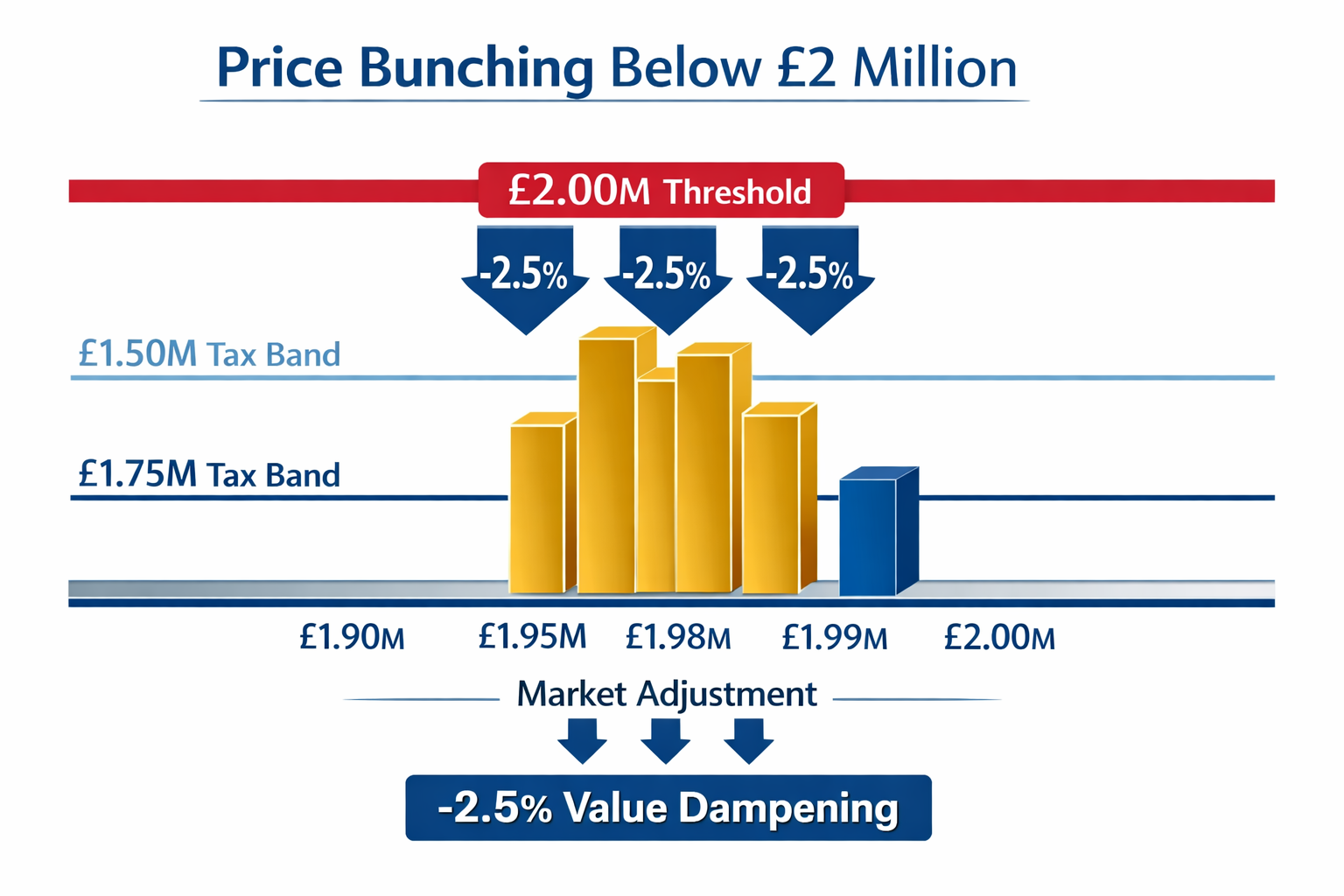
What Is Price Bunching?
Price bunching occurs when market participants strategically cluster property values just below tax thresholds to avoid higher liabilities. In the context of valuing high-value properties under 2026 tax threshold pressures, this manifests as:
- 📉 Artificial value compression near the £2 million mark
- 🤝 Negotiated pricing strategies between buyers and sellers
- 🏗️ Delayed or deferred renovations to avoid threshold breaches
- 📊 Market distortions affecting comparable sales analysis
Research suggests the HVCTS could dampen high-end property values by an average of 2.5% as purchasers "price in" the cumulative surcharge cost over their anticipated holding period.[2] This dampening effect is most pronounced in properties valued between £1.85 million and £2.15 million—the critical bunching zone.
Regional Variations in Threshold Pressure
Price bunching intensity varies significantly across regions. Areas with high concentrations of properties near the £2 million threshold face the most acute valuation challenges:
High-Pressure Zones:
- Central London boroughs (Chelsea, Hammersmith, Fulham)
- Affluent suburban areas (Richmond, Hampstead)
- Home Counties hotspots (Surrey, Oxfordshire)
Moderate-Pressure Zones:
Understanding these regional dynamics is essential when conducting structural surveys in London and surrounding areas.
The Renovation Timing Dilemma
One of the most complex aspects of valuing high-value properties under 2026 tax threshold pressures involves capital improvements. Significant renovations undertaken during 2026—such as high-specification kitchen extensions, loft conversions, or basement excavations—could inadvertently push a property into a higher surcharge band for the entire five-year period.[2]
Consider this scenario:
- January 2026: Property valued at £1.95 million (below threshold)
- March 2026: Owner completes £150,000 luxury kitchen extension
- April 2026: VOA assessment values property at £2.1 million
- Result: £12,500 in surcharges over five years that could have been avoided
This creates a strategic tension between maintaining property value and minimizing tax liability—a balance that requires careful surveyor guidance.
Comprehensive Surveyor Checklists for Valuing High-Value Properties Under 2026 Tax Threshold Pressures
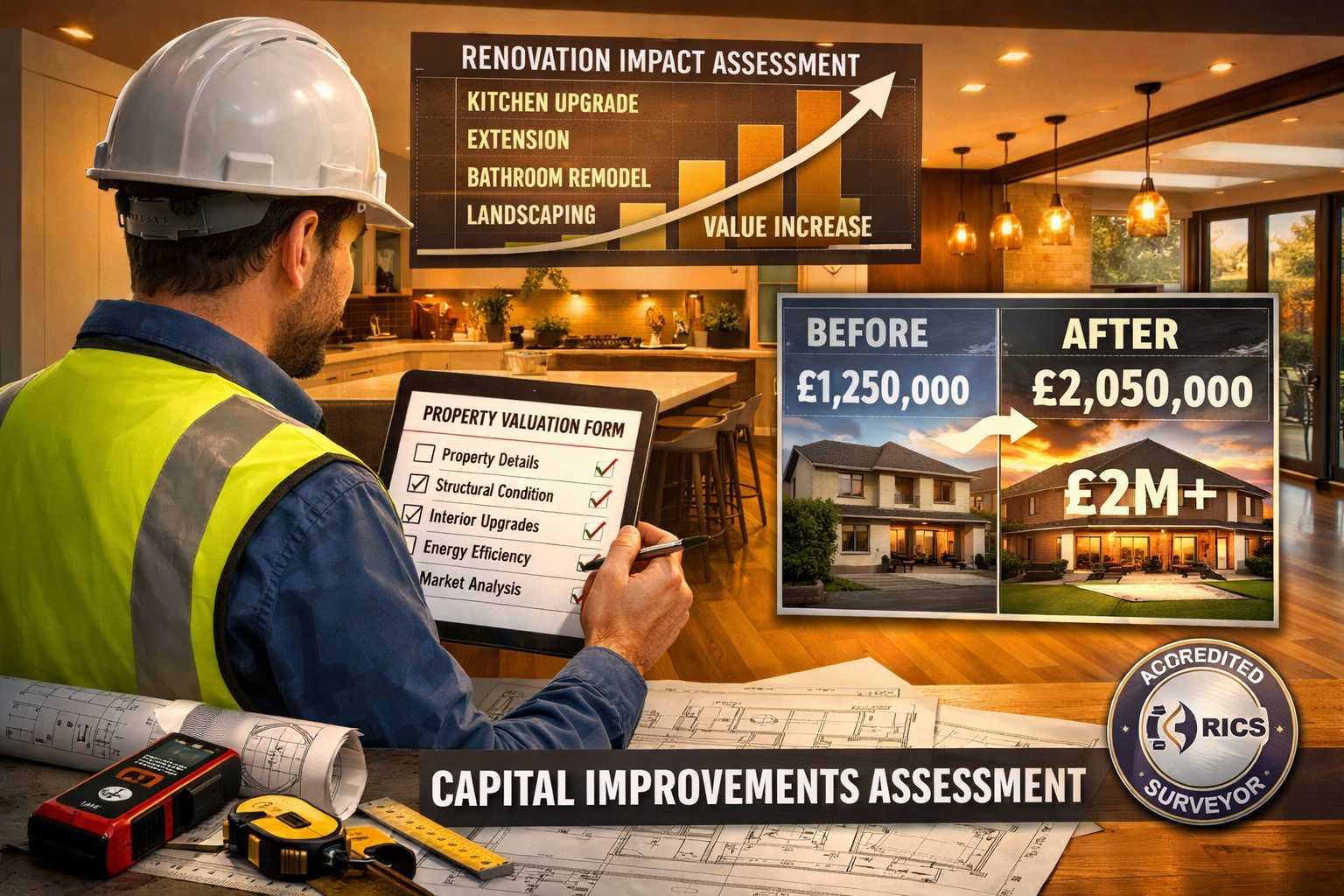
Pre-Valuation Assessment Checklist
Before conducting any formal valuation near threshold levels, surveyors should complete this foundational assessment:
✅ Property Classification Review
- Confirm property type (detached, semi-detached, terraced, flat)
- Identify leasehold vs. freehold status
- Document any mixed-use elements
- Review planning permissions and certificates
✅ Threshold Proximity Analysis
- Estimate preliminary value range
- Identify proximity to £2M, £2.5M, £3.5M, and £5M thresholds
- Calculate potential surcharge exposure
- Assess five-year cumulative tax impact
✅ Renovation and Improvement Documentation
- Catalog all improvements in last 5 years
- Document planned renovations for 2026
- Assess value-add from capital improvements
- Evaluate timing implications for threshold crossing
✅ Regional Market Context
- Analyze local comparable sales (last 12 months)
- Identify price bunching patterns in area
- Review market velocity near threshold levels
- Assess regional premium/discount factors
Detailed Valuation Methodology Checklist
When performing the actual valuation, this comprehensive checklist ensures defensible appraisals:
1. Comparable Sales Analysis
🔍 Selection Criteria:
- Prioritize sales within 0.5 miles and 6 months
- Exclude distressed or forced sales
- Identify threshold-influenced transactions
- Document any price bunching evidence
🔍 Adjustment Framework:
- Apply location adjustments (±5-15%)
- Account for property condition differentials
- Adjust for size variations (price per sq ft)
- Factor in specification and finish quality
2. Capital Improvements Assessment
🏗️ Value-Add Calculation:
- Kitchen renovations: 60-80% of cost
- Bathroom upgrades: 50-70% of cost
- Extensions: 70-90% of cost
- Loft conversions: 65-85% of cost
- Basement excavations: 50-75% of cost
🏗️ Timing Considerations:
- Pre-2026 improvements: Full value recognition
- In-progress 2026 work: Proportional valuation
- Planned but not commenced: Exclude from April 2026 valuation
- Quality of workmanship: ±10-20% adjustment
Understanding what survey you need helps determine the appropriate level of improvement assessment required.
3. Market Conditions Adjustment
📈 Threshold Pressure Factors:
- Apply 2-4% discount for properties £1.9M-£2.1M (bunching zone)
- Consider buyer negotiation leverage near thresholds
- Account for reduced liquidity above £2M
- Factor in anticipated market cooling (2026-2028)
📈 Regional Risk Weighting:
- High-pressure zones: 3-5% additional discount
- Moderate-pressure zones: 1-3% discount
- Low-pressure zones: Minimal adjustment
Post-Valuation Verification Checklist
After completing the valuation, verify accuracy and defensibility:
✔️ Internal Consistency Review
- Cross-check against multiple valuation methods
- Verify all adjustments are documented
- Ensure threshold proximity is clearly stated
- Confirm compliance with RICS Red Book standards
✔️ Client Communication Requirements
- Explain threshold implications clearly
- Provide surcharge liability projections
- Discuss renovation timing strategies
- Outline appeal rights and processes
✔️ Documentation Standards
- Maintain comprehensive working papers
- Photograph all key property features
- Retain comparable sales evidence
- Document all assumptions and limitations
For properties requiring specialized assessment, consider specific defect reports to address particular concerns that may affect valuation.
Strategic Approaches for Buyers and Sellers in Valuing High-Value Properties Under 2026 Tax Threshold Pressures
For Sellers: Maximizing Value While Managing Liability
Timing Strategies:
- Complete major renovations before Q1 2026 if possible
- Consider deferring non-essential improvements until after April 2026 assessment
- Strategically price properties to attract threshold-conscious buyers
- Obtain multiple independent valuations to establish defensible range
Presentation Tactics:
- Emphasize features that justify premium pricing without threshold breach
- Provide detailed improvement documentation to support valuation
- Consider offering buyer incentives rather than price reductions
- Engage chartered surveyors in Central London early in the sales process
For Buyers: Negotiating Threshold-Conscious Purchases
Due Diligence Priorities:
- Commission comprehensive pre-purchase valuations
- Assess likelihood of threshold breach in next revaluation cycle
- Calculate total cost of ownership including surcharge projections
- Evaluate renovation potential and threshold implications
Negotiation Leverage:
- Use threshold proximity as negotiation tool for properties £1.9M-£2.1M
- Request seller contributions toward future surcharge liability
- Structure offers to reflect five-year cumulative tax burden
- Consider timing of completion relative to VOA assessment period
Professional Support:
Engaging qualified professionals is essential. Consider obtaining a Red Book valuation in London to ensure RICS-compliant assessment that will withstand scrutiny.
Regional Risk Assessment for Valuing High-Value Properties Under 2026 Tax Threshold Pressures
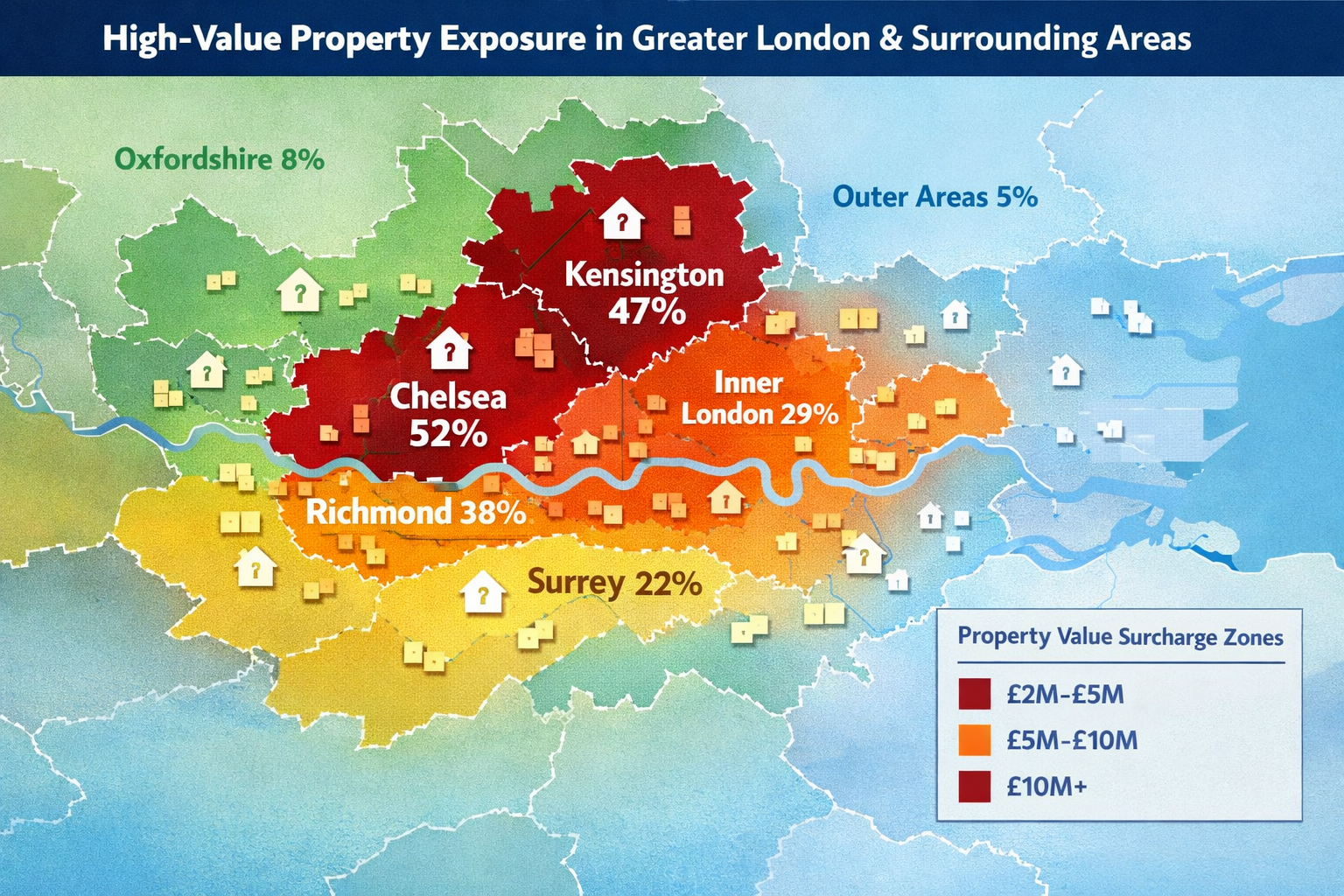
London-Specific Considerations
London's property market faces unique challenges due to the high concentration of properties near threshold levels. Key considerations include:
Inner London Boroughs:
- Highest concentration of £2M+ properties
- Most acute price bunching effects
- Greater buyer sophistication regarding tax implications
- Premium for properties definitively below thresholds
Areas like Battersea, Chiswick, and Putney represent transitional zones where price bunching is particularly evident.
Outer London Boroughs:
- Fewer properties at threshold levels
- Less market distortion
- Greater price stability
- Emerging opportunities for value-conscious buyers
Home Counties Market Dynamics
The Home Counties present different risk profiles:
High-Value Corridors (Surrey, Buckinghamshire, Hampshire):
- Significant commuter belt premium
- Growing threshold pressure as London buyers relocate
- Less sophisticated buyer awareness of HVCTS implications
- Opportunity for strategic positioning
Secondary Markets (Sussex):
- Lower concentration of threshold properties
- Minimal price bunching effects
- More traditional valuation approaches remain viable
- Long-term appreciation may bring more properties into scope
Professional Standards and Compliance in Threshold-Sensitive Valuations
RICS Red Book Requirements
All valuations near tax thresholds must comply with RICS Valuation – Global Standards (Red Book). Key requirements include:
📘 Basis of Value:
- Clearly state whether valuation is for market value, tax purposes, or other basis
- Disclose any special assumptions or departures
- Document threshold implications explicitly
- Provide appropriate caveats regarding market uncertainty
📘 Competence and Independence:
- Ensure valuer has appropriate local market knowledge
- Maintain independence from transaction outcome
- Disclose any conflicts of interest
- Document continuing professional development in tax-related valuation
📘 Reporting Standards:
- Provide comprehensive written reports
- Include detailed methodology explanation
- Document all comparable evidence
- Explain threshold-related adjustments transparently
For complex valuations, consider engaging specialists who provide RICS valuation services with appropriate expertise.
Ethical Considerations in Price Bunching Scenarios
Surveyors face ethical challenges when valuing properties under threshold pressures:
⚖️ Avoiding Manipulation:
- Never artificially suppress valuations to avoid thresholds
- Maintain professional objectivity regardless of client pressure
- Document genuine market evidence supporting valuations
- Report any suspected valuation fraud to appropriate authorities
⚖️ Client Education:
- Clearly explain limitations of valuation process
- Distinguish between strategic advice and valuation manipulation
- Provide realistic ranges rather than point estimates near thresholds
- Discuss appeal processes and rights
⚖️ Market Integrity:
- Contribute to transparent market functioning
- Share anonymized market intelligence with professional bodies
- Participate in consultation processes (early 2026 consultation)[1]
- Support development of best practice guidance
Practical Case Studies: Valuing High-Value Properties Under 2026 Tax Threshold Pressures
Case Study 1: The £1.95M Renovation Dilemma
Scenario: Semi-detached Victorian house in Hampstead, valued at £1.85M in January 2026. Owners planning £200K kitchen and bathroom renovation.
Surveyor Analysis:
- Pre-renovation value: £1.85M (below threshold)
- Post-renovation estimated value: £2.15M (above threshold)
- Five-year surcharge liability: £12,500
- Net value gain after tax: £187,500
Recommendation: Proceed with renovation but phase completion to occur after April 2026 VOA assessment, potentially saving £12,500 in surcharges while still capturing long-term value appreciation.
Case Study 2: The Threshold Negotiation
Scenario: Detached property in Surrey listed at £2.1M. Buyer commissioned independent valuation showing £1.98M market value.
Surveyor Findings:
- Comparable sales analysis: £1.95M-£2.05M range
- Price bunching evidence in local market
- Seller's improvements overstated by 15%
- Threshold-conscious buyer discount: 3%
Outcome: Negotiated purchase at £1.975M, saving buyer £125K on purchase price plus avoiding £12,500 in five-year surcharges.
Case Study 3: The Revaluation Risk Assessment
Scenario: Luxury flat in Chelsea valued at £2.45M in April 2026, placing it in the £2.0M-£2.5M surcharge band (£2,500 annually).
Surveyor Analysis:
- Current market trends suggest 2-3% annual appreciation
- By 2031 revaluation, property likely valued at £2.75M-£2.85M
- Would trigger move to £2.5M-£3.5M band (£3,500 annually)
- Total surcharge over 10 years: £30,000 (first 5 years) + £17,500 (second 5 years) = £47,500
Strategic Advice: Factor £47,500 cumulative tax burden into purchase decision and long-term financial planning.
Technology and Tools for Threshold-Sensitive Valuations
Digital Valuation Platforms
Modern surveyors leverage technology to enhance accuracy in threshold-sensitive scenarios:
🖥️ Automated Valuation Models (AVMs):
- Provide initial value estimates and ranges
- Identify comparable sales efficiently
- Flag threshold proximity automatically
- Must be supplemented with professional judgment
🖥️ Geographic Information Systems (GIS):
- Map price bunching patterns regionally
- Visualize threshold concentration zones
- Analyze spatial market trends
- Support regional risk assessment
🖥️ Renovation Impact Calculators:
- Model value-add from specific improvements
- Simulate threshold breach scenarios
- Calculate cumulative tax implications
- Support client decision-making
Data Sources and Market Intelligence
Reliable data is essential for defensible valuations:
📊 Official Sources:
- Land Registry price paid data
- VOA Council Tax banding information
- Planning authority records
- Building control approvals
📊 Commercial Databases:
- Rightmove and Zoopla market trends
- CoStar commercial property data
- EIG property intelligence
- Local agent market reports
📊 Professional Networks:
- RICS market surveys and guidance
- Local surveyor peer groups
- Professional indemnity insurer guidance
- Legal precedent databases
Preparing for the 2026 Public Consultation
The government has scheduled a formal public consultation on HVCTS details for early 2026.[1] Surveyors should prepare to contribute meaningfully:
Key Consultation Topics
🗣️ Valuation Methodology:
- Advocate for transparent VOA assessment processes
- Request clear guidance on improvement treatment
- Seek standardized adjustment frameworks
- Push for regular market data publication
🗣️ Appeal Mechanisms:
- Support robust appeal rights for property owners
- Request independent review processes
- Advocate for reasonable timelines
- Ensure access to professional representation
🗣️ Implementation Timing:
- Provide feedback on 2026 valuation timeline
- Highlight practical challenges for surveyors
- Suggest phased implementation approaches
- Address market disruption concerns
Professional Body Engagement
Surveyors should engage through professional channels:
- Participate in RICS consultation responses
- Contribute to local surveyor society discussions
- Share case studies and market intelligence
- Collaborate on best practice development
Conclusion
Valuing high-value properties under 2026 tax threshold pressures represents one of the most significant challenges facing chartered surveyors in recent decades. The phenomenon of price bunching near the £2 million HVCTS threshold is already reshaping market dynamics, creating valuation complexities that demand specialized expertise, robust methodologies, and unwavering professional standards.
The comprehensive surveyor checklists outlined in this guide provide a framework for delivering accurate, defensible valuations that account for threshold pressures while maintaining RICS compliance. By systematically addressing renovation timing, regional risk factors, comparable sales analysis, and buyer-seller negotiation dynamics, surveyors can navigate these challenges with confidence.
Actionable Next Steps
For property professionals preparing for the 2026 valuation benchmark:
-
Update Your Knowledge: Stay informed about HVCTS developments and participate in the early 2026 public consultation[1]
-
Enhance Your Toolkit: Implement comprehensive checklists and leverage technology to improve valuation accuracy near thresholds
-
Engage Specialists: For complex threshold-sensitive valuations, work with experienced chartered surveyors who understand regional market dynamics
-
Educate Clients: Provide clear, transparent guidance on threshold implications, cumulative tax burdens, and strategic timing considerations
-
Document Rigorously: Maintain comprehensive working papers that will withstand VOA scrutiny and support potential appeals
-
Monitor Market Trends: Track price bunching patterns in your region and adjust valuation methodologies accordingly
The stakes are high—a £40,000 valuation difference can trigger £12,500 in additional taxes over five years. By adopting the frameworks and checklists outlined in this guide, surveyors can deliver the precise, defensible appraisals that clients need to navigate the 2026 threshold pressures successfully.
As the April 2026 valuation benchmark approaches, professional excellence in threshold-sensitive valuations will distinguish leading practitioners from the rest. The time to prepare is now.
References
[1] High Value Council Tax Surcharge – https://www.gov.uk/government/publications/high-value-council-tax-surcharge/high-value-council-tax-surcharge
[2] Hvcts Guide – https://www.crownluxuryhomes.com/hvcts-guide/