

The buy-to-let market in 2026 presents unprecedented opportunities for institutional landlords. With property values forecasted to increase 22.2% over the next five years and rental income expected to climb 12% through the same period[2], professional investors are capitalizing on a perfect storm of rising tenant demand and constrained supply. However, success in Valuing Institutional Buy-to-Let Portfolios in 2026: Survey Protocols for Professional Landlord Expansion requires sophisticated assessment methodologies that go far beyond traditional residential valuations. As institutional allocations to real estate investment rise 15% year-over-year[1], the need for rigorous survey protocols has never been more critical.
The current market dynamics—characterized by RICS lettings data showing persistent supply constraints alongside robust tenant demand—create a compelling case for portfolio expansion. Yet higher investment property rates ranging from 6.6-7.5% in 2026[1] demand precision in valuation approaches. This comprehensive guide explores the risk-adjusted methodologies, survey protocols, and strategic frameworks that professional landlords must employ to make informed acquisition decisions in today's competitive landscape.

Key Takeaways
- Cap rate analysis remains fundamental for institutional portfolios, with multifamily properties showing lower rates (4.74%-5.38%) reflecting stronger performance and growth expectations compared to office properties (8.4%-9.02%)[1]
- Comprehensive survey protocols must integrate building condition assessments, rental yield projections, and market positioning analysis to support accurate portfolio valuations in 2026's recovering market
- Risk-adjusted valuation methods combining income capitalization, comparable sales analysis, and discounted cash flow modeling provide institutional investors with robust decision-making frameworks
- Strategic portfolio expansion requires professional surveyors who understand both property-specific defects and broader market dynamics affecting long-term investment returns
- Due diligence standards for institutional buy-to-let acquisitions must address regulatory compliance, tenant demand patterns, and supply constraints identified in current RICS data
Understanding Institutional Buy-to-Let Portfolio Valuation in 2026
The Shifting Landscape for Professional Landlords
The institutional buy-to-let sector has transformed dramatically as professional landlords recognize the stability and growth potential of multi-unit residential portfolios. Unlike individual property investors, institutional players operate at scale, requiring standardized valuation methodologies that can be applied consistently across diverse property types and geographic markets.
In 2026, the market presents unique characteristics that distinguish it from previous cycles. Global real estate investment is projected to rise 15% year-over-year, with institutional investors significantly increasing their allocations[1]. This influx of capital comes at a time when supply constraints—documented extensively in RICS lettings data—create favorable conditions for landlords who can accurately assess portfolio value and expansion opportunities.
The 1% rule continues to serve as a quick-assessment metric for rental portfolios: monthly rental income should equal at least 1% of the purchase price to ensure positive cash flow and acceptable returns[1]. However, sophisticated institutional investors recognize this as merely a starting point, not a comprehensive valuation framework.
Cap Rate Fundamentals for Multi-Unit Portfolios
Capitalization rates form the cornerstone of institutional property valuation. The cap rate calculation divides net operating income (NOI) by market value—for example, a £14 million property generating £600,000 NOI yields a 4.3% cap rate[1]. Understanding how cap rates vary across property classes provides critical context for portfolio decision-making.
Current market data reveals significant disparities:
| Property Class | Cap Rate Range | Market Positioning |
|---|---|---|
| Class A Multifamily | 4.74% | Premium properties, strong growth potential |
| Class B Multifamily | 4.92% | Mid-market stability, consistent performance |
| Class C Multifamily | 5.38% | Value-add opportunities, higher risk-return |
| Class A Office | 8.4% | Market challenges, higher risk profiles |
| Luxury Hotels | 6.48% | Moderate positioning, cyclical exposure |
These figures demonstrate that multifamily properties show lower cap rates reflecting stronger performance expectations[1]. For institutional landlords focused on buy-to-let portfolios, this data confirms the relative attractiveness of residential assets compared to commercial alternatives in 2026's market environment.
Why Survey Protocols Matter for Institutional Acquisitions
Professional survey protocols serve multiple critical functions in Valuing Institutional Buy-to-Let Portfolios in 2026: Survey Protocols for Professional Landlord Expansion. First, they identify property-specific defects that could impact long-term returns. A comprehensive specific defect report can uncover issues ranging from structural concerns to building services failures that might not be apparent during initial property viewings.
Second, survey protocols provide the factual foundation for accurate valuation modeling. When institutional investors deploy capital across multiple properties simultaneously, they require consistent assessment standards that enable portfolio-level analysis. This consistency allows for meaningful comparisons between potential acquisitions and supports data-driven investment decisions.
Third, professional surveys mitigate acquisition risk by identifying regulatory compliance issues, necessary capital expenditures, and maintenance liabilities. For institutional portfolios where properties must meet specific performance benchmarks, understanding the true condition and improvement requirements becomes essential for accurate financial modeling.
Working with experienced chartered surveyors in central London or other key markets ensures access to professionals who understand both local market dynamics and institutional investment requirements.
Survey Methodologies for Institutional Buy-to-Let Portfolio Assessment

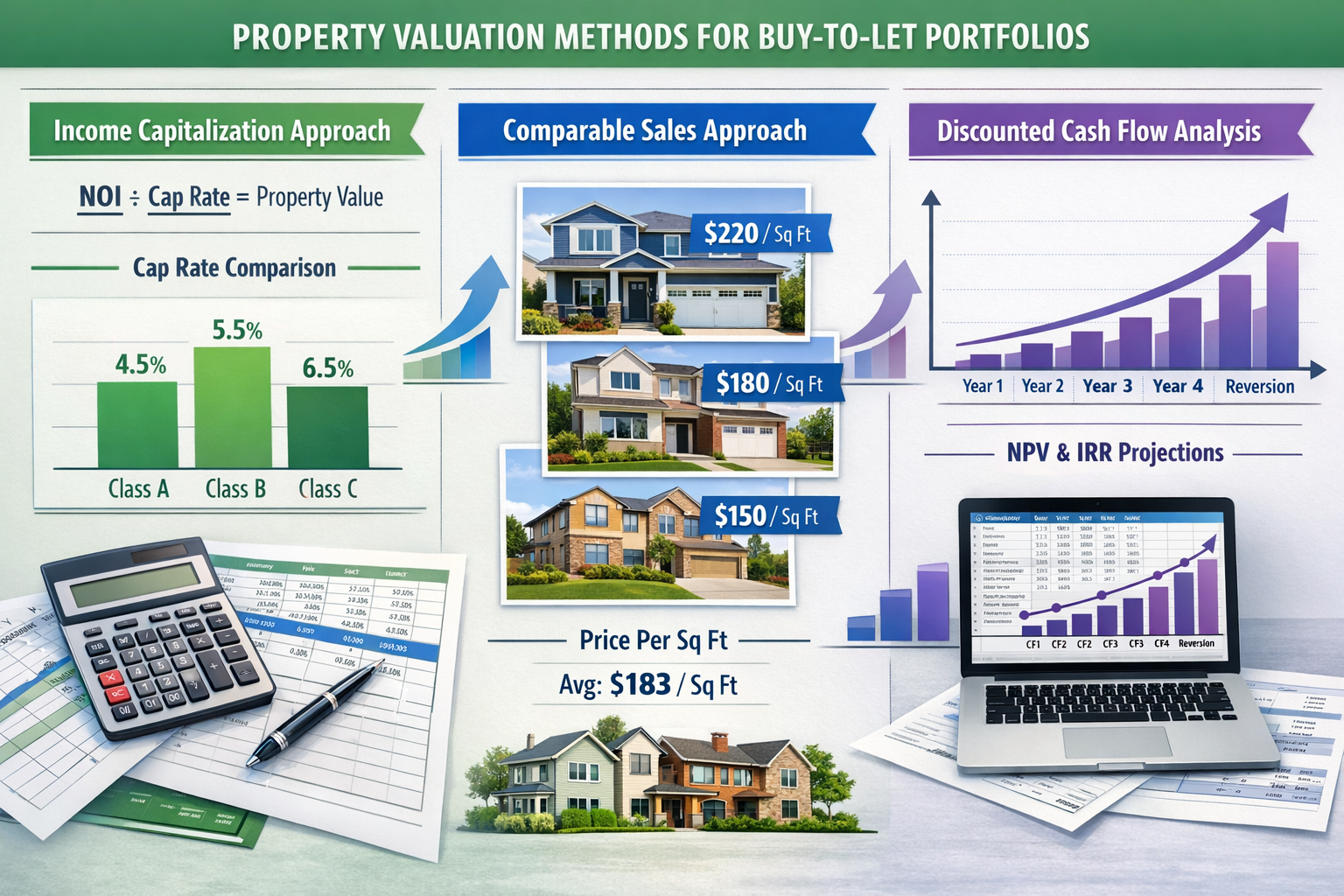
Income Capitalization Approach for Rental Portfolios
The income capitalization approach represents the most widely used valuation method for institutional buy-to-let portfolios. This methodology focuses on the property's ability to generate income, making it particularly relevant for rental assets where cash flow drives investment returns.
The fundamental formula divides annual net operating income by the capitalization rate:
Property Value = Net Operating Income ÷ Cap Rate
For example, if a portfolio generates £750,000 in annual NOI and comparable properties in the market trade at a 5% cap rate, the indicated value would be £15 million. However, institutional investors must refine this basic calculation by considering:
- Vacancy rates and tenant turnover patterns specific to each property class
- Operating expense ratios that reflect actual management costs at scale
- Capital expenditure reserves necessary to maintain property standards
- Market rent growth projections based on local supply-demand dynamics
The income approach aligns perfectly with institutional investment objectives because it directly connects property value to cash flow generation. When combined with professional survey data on property condition, this methodology provides a robust framework for portfolio expansion decisions.
U.S. REITs are forecasted to deliver 8.8% returns in 2026, with global REITs expected at 8.7%[3], demonstrating the continued appeal of income-producing real estate assets. These return expectations inform the cap rates that institutional investors apply when evaluating new acquisitions.
Comparable Sales Analysis for Portfolio Acquisitions
The sales comparison approach examines recent transactions of similar properties to establish market value benchmarks. For institutional buy-to-let portfolios, this methodology requires careful selection of comparable properties that match key characteristics:
✅ Property type and class (multifamily, student housing, professional rentals)
✅ Location and market dynamics (urban core, suburban, secondary markets)
✅ Unit mix and size (studio, one-bedroom, family units)
✅ Age and condition (new construction, renovated, original condition)
✅ Amenity packages (parking, communal spaces, security features)
Professional surveyors play a crucial role in comparable sales analysis by providing detailed property condition assessments that enable accurate adjustments. A property requiring significant capital improvements cannot be directly compared to a recently renovated asset without accounting for the cost differential.
When evaluating portfolios across multiple locations—such as properties spanning West London, Hertfordshire, and Berkshire—institutional investors must work with surveyors who understand regional market variations and can provide location-specific insights.
Discounted Cash Flow Modeling for Long-Term Holdings
Discounted cash flow (DCF) analysis provides the most sophisticated approach to Valuing Institutional Buy-to-Let Portfolios in 2026: Survey Protocols for Professional Landlord Expansion. This methodology projects future cash flows over a defined holding period and discounts them to present value using a risk-adjusted discount rate.
The DCF model incorporates multiple variables:
- Rental income projections based on current rents, market growth rates, and lease renewal assumptions
- Operating expense forecasts including property management, maintenance, insurance, and taxes
- Capital expenditure schedules for major building systems, unit renovations, and property improvements
- Terminal value calculations representing the expected sale price at the end of the holding period
- Discount rate selection reflecting the risk profile of the specific property and market
Survey protocols directly inform DCF modeling by identifying necessary capital expenditures and their timing. A building survey that reveals a roof requiring replacement within three years enables accurate cash flow projections that account for this major expense.
Industrial REITs have demonstrated 15-20% growth driven by e-commerce expansion, while healthcare REITs grew 18% in 2025[1]. These sector-specific performance trends illustrate how market dynamics influence discount rate selection and growth assumptions in DCF models.
Integrating Survey Data with Valuation Models
The true power of professional survey protocols emerges when survey findings integrate seamlessly with valuation models. This integration requires structured data collection that captures both qualitative assessments and quantitative metrics.
Key survey elements that inform institutional valuations include:
Building Condition Ratings 📊
Standardized condition scores for major building components (structure, roof, mechanical systems, exterior envelope) enable consistent portfolio-level analysis and capital planning.
Remaining Useful Life Assessments ⏰
Professional estimates of remaining service life for building systems inform capital expenditure forecasting and replacement reserve calculations.
Defect Cost Quantification 💷
Detailed cost estimates for identified defects support accurate adjustment of purchase prices and investment return calculations.
Regulatory Compliance Status ✅
Documentation of compliance with building regulations, fire safety standards, and energy performance requirements identifies potential liabilities and improvement costs.
Rental Optimization Opportunities 📈
Survey insights into potential unit improvements, amenity additions, or property repositioning strategies that could enhance rental income.
For complex properties or specialized assets, engaging commercial property surveyors with institutional experience ensures comprehensive assessment that addresses all value-influencing factors.
Strategic Implementation of Survey Protocols for Portfolio Expansion
Developing Standardized Assessment Frameworks
Institutional landlords expanding their buy-to-let portfolios require standardized assessment frameworks that enable consistent evaluation across multiple properties and markets. These frameworks establish clear protocols for survey scope, reporting formats, and decision criteria that support efficient portfolio management.
A robust assessment framework includes:
Pre-Acquisition Survey Standards 🔍
Defined survey levels appropriate to property type, transaction size, and risk profile. Large portfolio acquisitions may warrant comprehensive building surveys for all properties, while smaller add-on acquisitions might utilize targeted condition assessments.
Reporting Templates 📋
Standardized formats that capture essential data points in consistent structures, enabling portfolio-level analysis and comparison. Templates should accommodate property-specific details while maintaining data consistency.
Risk Rating Methodologies ⚠️
Clear criteria for categorizing properties by risk level based on condition, location, tenant profile, and market dynamics. Risk ratings inform investment decisions and portfolio allocation strategies.
Capital Planning Protocols 💰
Systematic approaches to identifying, prioritizing, and budgeting capital improvements across the portfolio based on survey findings and strategic objectives.
Professional surveyors familiar with institutional requirements can customize these frameworks to align with specific investment strategies and organizational processes. Whether focusing on properties in Essex or developments in Sussex, consistent protocols ensure quality control across diverse markets.
Risk-Adjusted Valuation in Constrained Supply Markets
The 2026 market environment—characterized by constrained supply documented in RICS lettings data—requires risk-adjusted valuation approaches that account for competitive dynamics and tenant demand strength. Properties in supply-constrained markets may command premium valuations due to limited alternatives and strong rental growth prospects.
Risk-adjusted valuation considers:
Market Supply Dynamics 📉
Analysis of new construction pipelines, planning permissions, and development constraints that limit future supply growth in specific markets.
Tenant Demand Indicators 📈
Assessment of employment growth, population trends, and demographic shifts driving rental demand in target markets.
Competitive Positioning 🎯
Evaluation of how specific properties compare to existing rental stock in terms of quality, location, amenities, and pricing.
Regulatory Environment 📜
Understanding of local planning policies, rent control measures, and landlord regulations that could impact future returns.
Long-term lease agreements hedge against interest rate volatility, while real estate's positive gearing to inflation provides robustness for multi-asset institutional portfolios[3]. These characteristics make buy-to-let portfolios particularly attractive in 2026's economic environment, but only when valuations accurately reflect risk-adjusted return expectations.
Due Diligence Protocols for Multi-Property Acquisitions
When acquiring multiple properties simultaneously—a common scenario in Valuing Institutional Buy-to-Let Portfolios in 2026: Survey Protocols for Professional Landlord Expansion—due diligence protocols must balance thoroughness with efficiency. Institutional investors cannot afford to conduct identical surveys on every property in a large portfolio acquisition, yet they must maintain adequate risk assessment standards.
Tiered due diligence approaches offer practical solutions:
Tier 1: Comprehensive Assessment (10-15% of portfolio)
Full building surveys on the highest-value properties, newest acquisitions, or assets with apparent condition concerns. These detailed assessments establish baseline standards and identify potential issues requiring broader investigation.
Tier 2: Targeted Condition Surveys (30-40% of portfolio)
Focused assessments examining specific building systems, known defect types, or areas of concern identified through preliminary reviews. These surveys provide cost-effective risk mitigation for mid-value properties.
Tier 3: Desktop Reviews and Sampling (remaining portfolio)
Analysis of existing documentation, previous survey reports, and maintenance records, supplemented by sample inspections of representative properties. This approach provides baseline assurance for lower-risk assets.
Professional guidance on what survey you need helps institutional investors select appropriate assessment levels for different property types and transaction scenarios.
Leveraging Technology in Portfolio Valuation
Modern survey protocols for institutional portfolios increasingly incorporate advanced technology that enhances accuracy, efficiency, and data management. These technological tools complement traditional surveying expertise with capabilities that support large-scale portfolio analysis.
Key technologies transforming institutional survey protocols include:
Drone Surveys 🚁
Aerial inspections provide safe, cost-effective assessment of roof conditions, building exteriors, and site layouts across multiple properties. Drone roof surveys enable rapid condition assessment without the time and expense of traditional access methods.
Thermal Imaging 🌡️
Infrared technology identifies insulation deficiencies, moisture intrusion, and building envelope failures that impact energy performance and maintenance costs.
3D Scanning and Modeling 📐
Laser scanning creates detailed digital models that support space planning, renovation design, and as-built documentation for portfolio properties.
Data Analytics Platforms 💻
Software systems that aggregate survey data, track condition trends, and generate portfolio-level insights supporting strategic decision-making.
Mobile Inspection Apps 📱
Field data collection tools that standardize survey protocols, ensure consistent reporting, and enable real-time communication between surveyors and investment teams.
These technologies enhance traditional survey methodologies rather than replacing professional expertise. The combination of experienced surveyors and modern tools delivers the comprehensive assessments institutional investors require.
Geographic Diversification and Local Market Expertise
Successful portfolio expansion often involves geographic diversification across multiple markets to reduce concentration risk and capture opportunities in different economic environments. However, this diversification strategy requires access to local market expertise and surveying professionals who understand regional characteristics.
Institutional landlords expanding across the UK benefit from working with surveying firms that maintain presence in key markets. Whether evaluating properties in Fulham, Richmond, Buckinghamshire, or Hampshire, local knowledge enhances survey quality and valuation accuracy.
Regional market factors that influence portfolio valuation include:
- Local construction standards and common building types that affect condition assessment approaches
- Climate and environmental conditions that impact building deterioration patterns and maintenance requirements
- Planning and regulatory frameworks that vary significantly across different councils and regions
- Market rental rates and tenant preferences that influence income projections and property positioning
- Economic and demographic trends specific to each geographic market
Data center and telecommunications REITs are projected to grow 8-10% annually through 2026, benefiting from AI infrastructure investment[1]. While these specialized property types differ from traditional buy-to-let assets, they illustrate how sector-specific and location-specific factors drive investment performance across real estate portfolios.
Building Long-Term Surveyor Relationships
Institutional portfolio management benefits significantly from long-term relationships with professional surveyors who develop deep understanding of the portfolio's characteristics, the investor's objectives, and the organization's decision-making processes. These ongoing relationships deliver value beyond individual transaction support.
Benefits of sustained surveyor partnerships include:
Portfolio Knowledge Continuity 📚
Surveyors who conduct regular assessments across the portfolio develop comprehensive understanding of property conditions, improvement histories, and emerging trends that inform strategic planning.
Efficient Communication 💬
Established relationships eliminate the learning curve associated with new service providers, enabling more efficient project execution and clearer communication of findings and recommendations.
Proactive Maintenance Planning 🔧
Ongoing surveyor involvement supports preventive maintenance strategies that reduce long-term costs and preserve property values across the portfolio.
Market Intelligence 🎓
Experienced surveyors provide valuable insights into market trends, construction cost movements, and emerging issues affecting property values and investment returns.
Customized Service Delivery ⚙️
Long-term partners can tailor their services to institutional clients' specific requirements, reporting preferences, and decision-making timelines.
For specialized needs such as subsidence surveys or expert witness reports, established relationships ensure rapid access to appropriate expertise when urgent issues arise.
Conclusion
Valuing Institutional Buy-to-Let Portfolios in 2026: Survey Protocols for Professional Landlord Expansion requires sophisticated methodologies that integrate professional survey protocols with advanced valuation techniques. As property values are forecasted to increase 22.2% and rental income expected to climb 12% over the next five years[2], institutional investors who master these assessment frameworks will be positioned to capitalize on exceptional growth opportunities.
The convergence of rising tenant demand, constrained supply documented in RICS data, and increasing institutional allocations to real estate creates a compelling environment for portfolio expansion. However, success depends on rigorous due diligence that accurately assesses property conditions, quantifies risks, and supports data-driven investment decisions.
Professional survey protocols serve as the foundation for this due diligence, providing the factual basis for valuation models, capital planning, and risk assessment. Whether applying income capitalization approaches, comparable sales analysis, or discounted cash flow modeling, institutional investors require comprehensive property intelligence that only experienced chartered surveyors can deliver.
Actionable Next Steps
For institutional landlords considering portfolio expansion in 2026:
- Establish standardized assessment frameworks that define survey protocols, reporting formats, and decision criteria aligned with your investment strategy
- Engage experienced chartered surveyors with institutional expertise and presence in your target markets to conduct comprehensive property assessments
- Implement risk-adjusted valuation methodologies that account for market supply constraints, tenant demand dynamics, and property-specific characteristics
- Leverage technology solutions including drone surveys, thermal imaging, and data analytics platforms to enhance survey efficiency and portfolio intelligence
- Develop long-term surveyor relationships that provide continuity, market insights, and proactive portfolio management support
The buy-to-let market in 2026 rewards professional landlords who combine strategic vision with rigorous analysis. By implementing comprehensive survey protocols and sophisticated valuation methodologies, institutional investors can identify opportunities, mitigate risks, and build portfolios positioned for sustained performance in an evolving market landscape.
References
[1] Building A Real Estate Investment Portfolio Your Complete Guide – https://www.amerisave.com/learn/building-a-real-estate-investment-portfolio-your-complete-guide
[2] Buy To Let Valuation Surge 2026 Survey Strategies For Institutional Investors In A Recovering Market – https://nottinghillsurveyors.com/blog/buy-to-let-valuation-surge-2026-survey-strategies-for-institutional-investors-in-a-recovering-market
[3] Ltcma Full Report – https://am.jpmorgan.com/content/dam/jpm-am-aem/americas/us/en/institutional/insights/portfolio-insights/ltcma-full-report.pdf