Japanese knotweed now affects approximately 5% of UK properties, costing homeowners an estimated £1.25 billion annually in treatment costs and property devaluation. This invasive species has transformed from a Victorian ornamental plant into one of the most significant challenges facing property valuers, mortgage lenders, and homeowners in 2026. Understanding Valuing Properties with Japanese Knotweed in 2026: RICS Guidance for Mortgage Lender Challenges has become essential for anyone involved in residential property transactions.
The Royal Institution of Chartered Surveyors (RICS) revolutionized its approach to Japanese knotweed in 2022, replacing outdated risk categories with practical management categories. This shift reflects growing scientific understanding that knotweed, while problematic, can be effectively controlled rather than requiring automatic property rejection or extensive excavation.

Key Takeaways
- RICS introduced four management categories (A-D) in 2022, replacing the previous risk-based system to emphasize control over eradication
- The 3-meter boundary rule now determines when knotweed on neighboring properties must be reported to mortgage lenders, replacing the outdated 7-meter threshold
- Mortgage lending is no longer automatically refused when knotweed is present; decisions depend on physical damage, amenity impact, and management plans
- Specialist remediation with insurance-backed warranties has become the standard requirement for properties in higher-risk categories
- Professional valuation by RICS registered valuers ensures accurate property assessments that reflect both knotweed impact and effective management strategies
Understanding the 2022 RICS Japanese Knotweed Guidance Framework
The RICS guidance update, which came into effect on March 23, 2022, represents a fundamental shift in how the property industry approaches Japanese knotweed. Prior to this revision, mortgage lenders often declined applications based solely on the mention of knotweed in survey reports, regardless of actual risk.[4]
The Four Management Categories Explained
The new framework replaces risk categories with management categories designed to provide clearer guidance for valuers and lenders.[1] This approach acknowledges that knotweed can be effectively managed rather than treating it as an insurmountable obstacle.
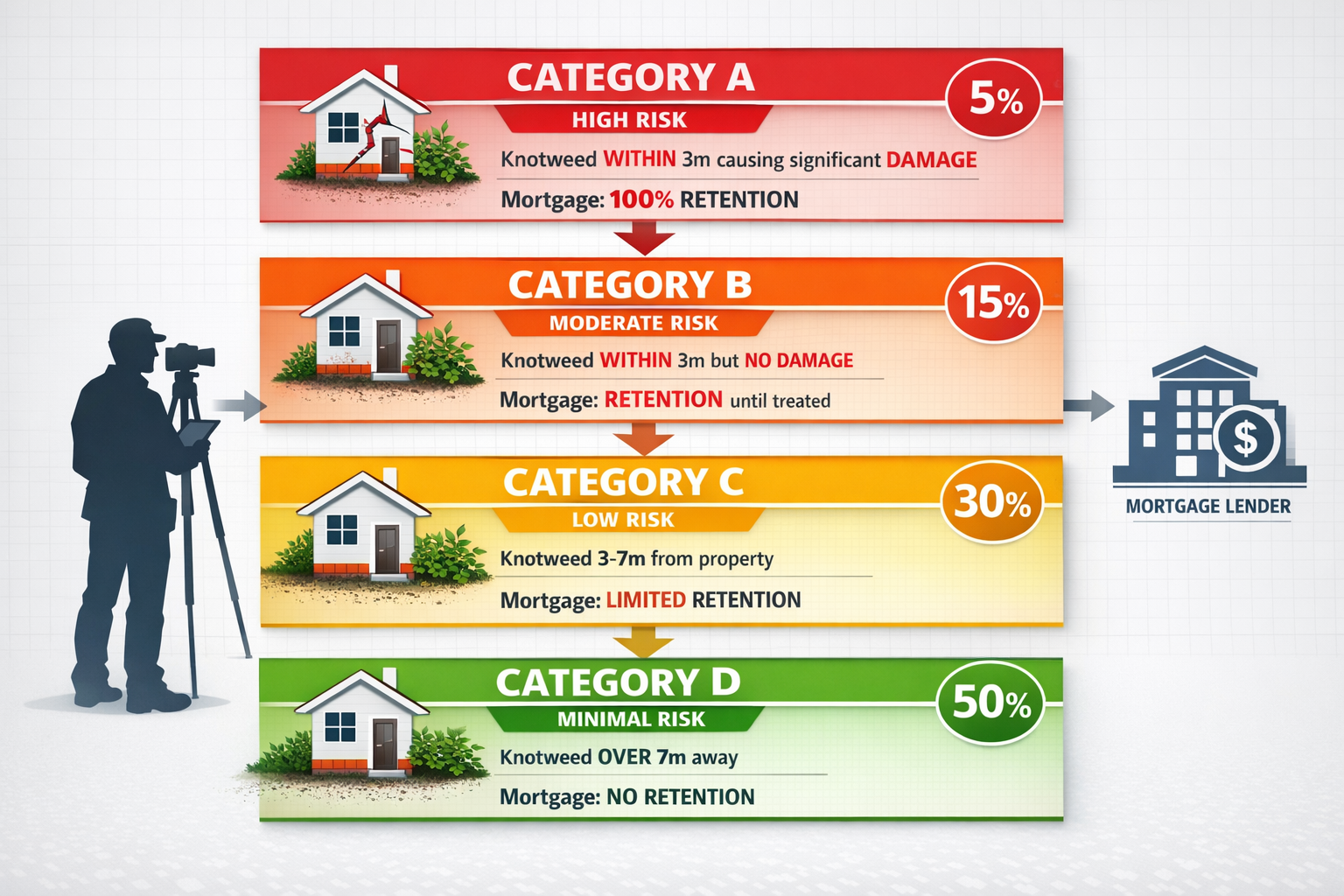
Management Category A 🔴 applies when Japanese knotweed is visible on-site and causing visible damage to a structure. This represents the highest concern level, where mortgage retention is advised pending specialist review. Visible damage might include:
- Cracked foundations or walls
- Disrupted paving or driveways
- Damaged drainage systems
- Compromised structural elements
Management Category B 🟠 is assigned when knotweed is visible but not causing visible damage, yet likely prevents use of or restricts access to amenity space. Surveyors recommend mortgage retention subject to specialist advice. This category recognizes that even without structural damage, knotweed can significantly impact property enjoyment and value.[1]
Management Category C 🟡 applies where knotweed is merely visible with no impact on structures or amenity. Considered "low impact," this category requires no mortgage retention recommendation, though clients should still seek specialist advice to prevent future escalation.[1]
Management Category D 🟢 addresses knotweed on neighboring properties. The key measurement is 3 meters from the property boundary as the threshold for reporting to lenders, replacing the outdated 7-meter rule.[2] Knotweed beyond 3 meters does not require reporting unless circumstances are exceptional.[7]
Why the Guidance Changed
The 2022 revision followed criticism from a 2019 House of Commons Science and Technology Committee report that described mortgage lenders' approach as "overly cautious."[4][6] The committee found that previous guidance created unnecessary barriers to property transactions and contributed to disproportionate property devaluation.
The updated guidance reflects improved scientific understanding of knotweed's actual risks. Research demonstrated that while Japanese knotweed can cause damage, its threat was often exaggerated compared to other structural issues like subsidence or tree root damage.
Within months of publication, the 2022 guidance document received over 2,000 unique downloads from the RICS website, indicating substantial market adoption.[5] This widespread uptake suggests the industry recognized the need for more nuanced assessment protocols.
Valuing Properties with Japanese Knotweed in 2026: RICS Guidance for Mortgage Lender Challenges in Practice
How Mortgage Lenders Assess Knotweed-Affected Properties
The presence of Japanese knotweed no longer automatically prevents mortgage lending. Lenders now assess based on three primary factors:
- Physical interaction with affected structures – Is the knotweed causing or likely to cause structural damage?
- Impact on amenity value – Does the infestation restrict property use or enjoyment?
- Existence of an appropriate management plan – Has professional remediation been implemented or planned?[2]
When knotweed is identified, mortgage lenders require clear risk categorization, a specialist report from a qualified remediation contractor, and evidence of a suitable remedial plan.[2] This represents a significant shift from blanket refusals to case-by-case assessment.
The Critical 3-Meter Boundary Rule
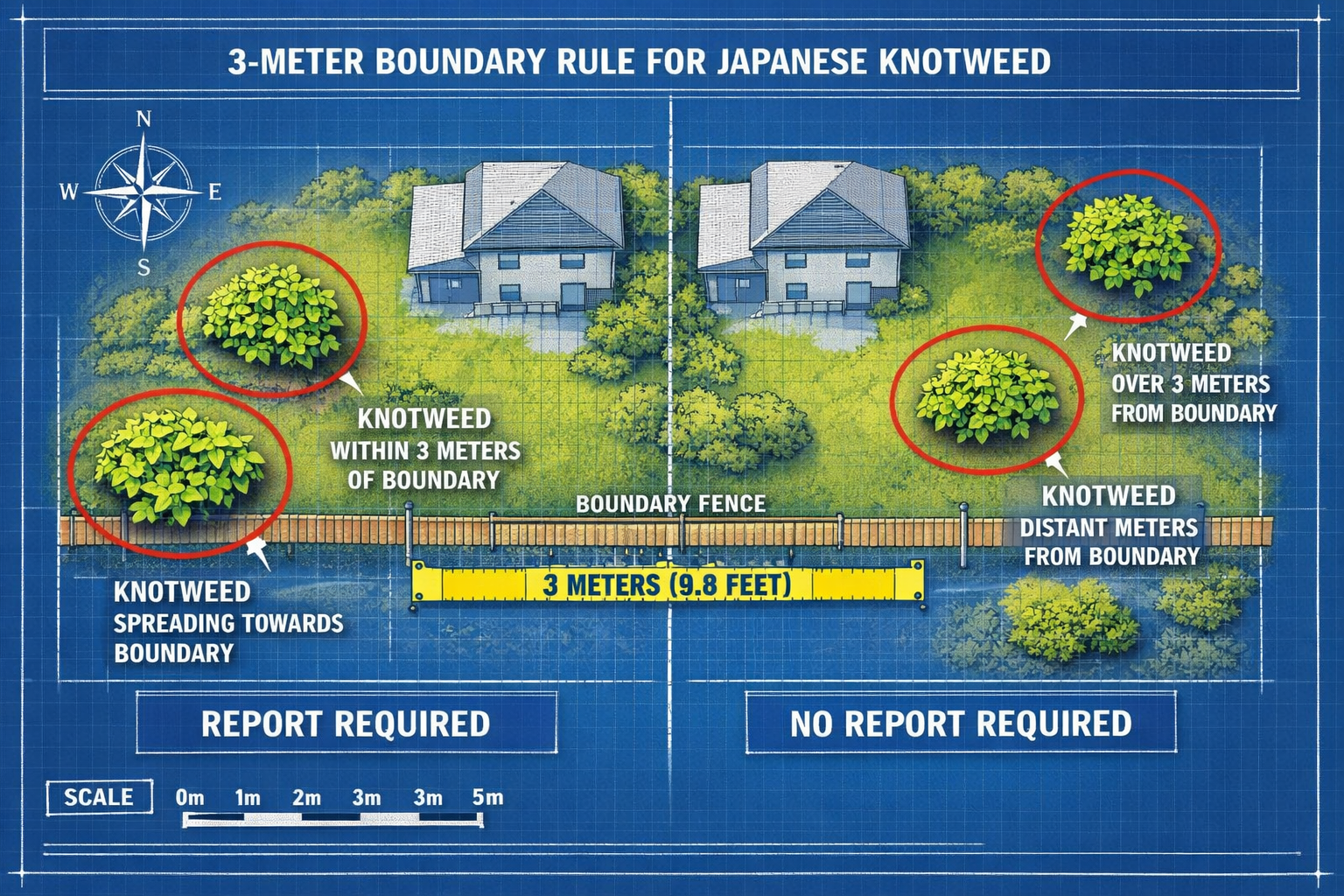
One of the most significant changes in the 2022 guidance concerns knotweed on neighboring properties. The 3-meter threshold from the property boundary determines whether surveyors must report the presence of knotweed to mortgage lenders.[2]
This replaces the previous 7-meter rule, which was based on outdated assumptions about knotweed's growth patterns. Scientific research demonstrated that knotweed rhizomes (underground stems) typically extend 3 meters from visible growth, though exceptional circumstances may warrant wider consideration.[7]
For property valuers, this means:
- ✅ Report required: Knotweed within 3 meters of the boundary
- ❌ No report needed: Knotweed beyond 3 meters (unless exceptional circumstances exist)
- 📋 Document thoroughly: Distance measurements and photographic evidence
Working with RICS registered valuers ensures accurate application of these distance thresholds and proper documentation for lender requirements.
Specialist Remediation Requirements
The RICS guidance requires specialist remediation work to be undertaken by properly qualified and externally audited professionals affiliated with industry trade bodies like the Property Care Association Invasive Weed Control Group (PCA IWCG).[3]
Specialist remediation may include:
- Herbicide treatment programs – Multi-year application schedules using approved chemicals
- Monitoring protocols – Regular site visits to track treatment effectiveness
- Formal management plans – Documented strategies with timelines and success criteria
- Insurance-backed warranties – Typically 10-year guarantees covering treatment failure
Importantly, excavation is not required by default under RICS guidance.[2] This represents a significant cost saving compared to previous approaches that often mandated complete removal of contaminated soil.
Impact on Property Valuation and Transaction Processes
Quantifying Knotweed's Effect on Property Values
The impact of Japanese knotweed on property values varies significantly based on management category and remediation status:
| Management Category | Typical Value Impact | Mortgage Availability |
|---|---|---|
| Category A | 5-15% reduction | Retention pending remediation |
| Category B | 3-10% reduction | Subject to specialist report |
| Category C | 0-5% reduction | Generally available with advice |
| Category D | Minimal impact | Normal lending criteria |
These percentages represent general market trends in 2026 and can vary based on property type, location, and extent of infestation. Properties with completed remediation and insurance-backed warranties often experience minimal long-term value impact.
Professional valuation reports from qualified surveyors provide the evidence mortgage lenders need to make informed decisions about knotweed-affected properties.
Insurance-Backed Warranties and Their Role
Insurance-backed warranties have become central to successful property transactions involving Japanese knotweed. These warranties typically provide:
- 10-year guarantee periods covering treatment effectiveness
- Property damage coverage if knotweed causes structural issues during the warranty period
- Transferability to subsequent property owners
- Independent insurance backing (not just contractor guarantees)
Mortgage lenders increasingly accept properties with Category A or B classifications when accompanied by appropriate insurance-backed warranties from PCA-registered specialists.[3] This has significantly improved market liquidity for affected properties.
The Surveyor's Role in Knotweed Assessment
Chartered surveyors play a crucial role in identifying and categorizing Japanese knotweed during property inspections. Their responsibilities include:
- Visual identification – Recognizing knotweed in various seasonal states
- Accurate categorization – Applying RICS management categories correctly
- Distance measurement – Determining proximity to structures and boundaries
- Damage assessment – Evaluating structural impact
- Recommendation provision – Advising on specialist referrals and remediation needs
Surveyors must distinguish Japanese knotweed from similar-looking plants like Russian vine, bindweed, or ornamental bamboo. Misidentification can lead to unnecessary remediation costs or, conversely, failure to address genuine problems.
For properties in areas with high knotweed prevalence, such as West London or Hertfordshire, surveyors maintain heightened vigilance during inspections.
Mortgage Lender Challenges and Solutions in 2026
Evolving Lender Policies
Mortgage lenders have adapted their policies significantly since the 2022 RICS guidance update. Major UK lenders now employ risk-based assessment frameworks rather than blanket refusals:
Progressive lender approaches include:
- Accepting Category C and D properties without additional requirements
- Approving Category B properties with specialist reports and management plans
- Considering Category A properties with completed remediation and warranties
- Employing in-house specialists to review knotweed cases
However, some lenders remain more conservative, particularly smaller building societies or specialist lenders. This creates a two-tier market where borrowers may need to shop around for suitable financing.
Due Diligence Requirements
Lenders conducting due diligence on knotweed-affected properties typically require:
- RICS-compliant survey report with clear management category assignment
- Specialist invasive species report from PCA-registered contractor
- Detailed remediation plan with timeline and methodology
- Insurance-backed warranty covering minimum 10-year period
- Photographic evidence documenting current infestation extent
- Treatment records if remediation has commenced
The cost of obtaining these documents typically ranges from £500-£2,000, depending on property size and infestation severity. This represents a significant transaction cost that buyers must factor into their budgets.
Understanding RICS valuation costs helps buyers budget appropriately for comprehensive assessments that include knotweed considerations.
Legal Considerations and Disclosure Obligations
Sellers face strict disclosure obligations regarding Japanese knotweed. The Law Society's TA6 Property Information Form specifically asks: "Is the property affected by Japanese knotweed?" Failure to disclose known infestations can result in:
- Misrepresentation claims from buyers
- Rescission of contracts if discovered before completion
- Damages claims for diminished property value
- Legal costs defending claims
Even if knotweed has been treated, sellers must disclose its historical presence and provide documentation of remediation efforts. Transparency has become essential for smooth transactions.
Buyers should also consider potential neighbour disputes if knotweed originates from adjacent properties. The Wildlife and Countryside Act 1981 makes it an offense to cause knotweed to grow in the wild, potentially creating liability for property owners who allow it to spread.
Treatment Protocols and PCA Standards
Herbicide Treatment Programs
The most common remediation approach involves multi-year herbicide application programs. These typically follow this protocol:
Year 1:
- Initial site survey and treatment plan development
- First herbicide application during growing season (May-September)
- Documentation of infestation extent and treatment areas
Years 2-3:
- Follow-up herbicide applications to target regrowth
- Quarterly monitoring visits to assess effectiveness
- Adjustment of treatment strategy based on plant response
Years 4-5:
- Reduced-frequency monitoring (bi-annual or annual)
- Targeted treatment of any remaining growth
- Final clearance assessment
Post-treatment:
- Ongoing monitoring during warranty period
- Rapid response if regrowth occurs
- Warranty claim processing if treatment fails
This approach typically costs £1,500-£4,000 for an average residential property, significantly less than excavation methods that can exceed £20,000.[9]
Alternative Remediation Methods
While herbicide treatment remains the standard, alternative methods include:
Excavation and removal – Complete removal of contaminated soil to certified depth (typically 3 meters). Most expensive option but provides immediate clearance. Costs: £20,000-£50,000+
Root barrier installation – Physical barriers preventing knotweed spread toward structures. Useful for boundary infestations. Costs: £3,000-£8,000
Burial on-site – Deep burial of knotweed material under specified conditions. Requires significant space and careful implementation. Costs: £10,000-£25,000
Combination approaches – Targeted excavation of high-risk areas combined with herbicide treatment elsewhere. Balances cost and effectiveness. Costs: £5,000-£15,000
The choice of method depends on property constraints, budget, transaction timelines, and lender requirements. Most mortgage lenders accept herbicide programs with insurance-backed warranties as sufficient.[3]
PCA Certification and Quality Assurance
The Property Care Association's Invasive Weed Control Group (PCA IWCG) provides industry standards for knotweed remediation. PCA-registered contractors must:
- Maintain professional indemnity insurance
- Follow Code of Practice guidelines
- Submit to regular external audits
- Provide standardized reporting
- Offer insurance-backed warranties through approved insurers
When selecting a remediation contractor, property owners should verify:
✅ Current PCA membership status
✅ Appropriate professional qualifications
✅ Insurance-backed warranty availability
✅ Track record and client references
✅ Detailed written quotations
Working with PCA-certified specialists ensures compliance with RICS guidance and lender requirements, facilitating smoother mortgage approval processes.
Regional Variations and Prevalence Patterns
Japanese knotweed distribution varies significantly across the UK. High-prevalence areas include:
Urban hotspots:
- South Wales valleys (particularly Swansea and Cardiff)
- West Midlands conurbation
- Greater Manchester
- London boroughs (especially along waterways)
Regional considerations:
- Surrey locations near rivers and railways
- Berkshire properties with historical Victorian gardens
- Sussex coastal areas with disturbed ground
Properties near railway lines, rivers, canals, and historical industrial sites face elevated risk due to knotweed's historical spread patterns. Victorian railway construction extensively used contaminated soil, creating linear distribution corridors that persist today.
Surveyors working in high-prevalence areas maintain heightened awareness during inspections, often recommending specialist surveys even when knotweed isn't immediately visible.
Future Developments and Emerging Solutions
Biological Control Research
Scientists continue researching biological control methods, including the Japanese knotweed psyllid (Aphalara itadori), a sap-sucking insect that feeds exclusively on knotweed. While released in the UK since 2010, biological control remains supplementary rather than primary treatment in 2026.
Current limitations include:
- Slow population establishment
- Variable effectiveness across sites
- Inability to provide rapid clearance for property transactions
- Lack of insurance-backed warranties for biological control alone
However, biological control may play an increasing role in long-term landscape management and reducing reinfestation pressure from neighboring land.
Technology-Enhanced Detection
Emerging technologies improving knotweed detection and monitoring include:
Thermal imaging – Detecting underground rhizome networks through temperature variations
DNA soil testing – Identifying knotweed presence from soil samples before visible growth appears
Drone surveys – Mapping infestation extent across large sites or inaccessible areas
AI image recognition – Automated identification from photographs reducing misidentification risk
These technologies increasingly feature in specialist surveys, providing more comprehensive assessments for high-value properties or complex sites.
Policy and Regulatory Evolution
The regulatory landscape continues evolving. Potential developments include:
- Mandatory knotweed registers maintained by local authorities
- Enhanced enforcement powers for controlling spread from public land
- Standardized treatment protocols across all UK regions
- Integration with broader invasive species management frameworks
Property professionals should monitor RICS guidance updates and industry publications for emerging best practices and regulatory changes.
Conclusion
Valuing Properties with Japanese Knotweed in 2026: RICS Guidance for Mortgage Lender Challenges represents a sophisticated, evidence-based approach that balances genuine risk management with practical property market needs. The shift from blanket refusals to nuanced assessment has improved market liquidity while maintaining appropriate safeguards.
The four management categories (A, B, C, D) provide clear frameworks for surveyors, valuers, and lenders. The 3-meter boundary rule offers practical guidance for neighboring property concerns. Insurance-backed warranties from PCA-certified specialists enable successful transactions even for affected properties.
Key Action Steps for Property Stakeholders
For buyers:
- Commission comprehensive surveys from qualified chartered surveyors
- Obtain specialist reports when knotweed is identified
- Verify PCA certification and warranty terms before accepting remediation proposals
- Budget for treatment costs and potential value impact
For sellers:
- Disclose knotweed presence honestly and completely
- Provide documentation of any historical or ongoing treatment
- Consider proactive remediation before marketing to expand buyer pool
- Obtain insurance-backed warranties to facilitate transactions
For mortgage lenders:
- Implement risk-based assessment frameworks aligned with RICS guidance
- Train valuation panels on current management categories
- Accept appropriate remediation plans with insurance backing
- Avoid unnecessarily conservative policies that restrict market access
For surveyors:
- Maintain current knowledge of RICS guidance and industry best practices
- Apply management categories consistently and accurately
- Provide clear, actionable recommendations in survey reports
- Distinguish knotweed from similar species to avoid misidentification
The Japanese knotweed challenge, while significant, is manageable with proper professional guidance. Properties affected by knotweed can be successfully valued, financed, and transacted when stakeholders follow established protocols and work with qualified specialists.
Understanding the 2022 RICS guidance framework and working with experienced professionals like Red Book valuation specialists ensures accurate property assessments that reflect both knotweed impact and effective management strategies. This balanced approach protects lender interests while maintaining fair property market access for buyers and sellers navigating knotweed challenges.
References
[1] Rics Japanese Knotweed Guidance – https://www.pba-solutions.com/japanese-knotweed-news/rics-japanese-knotweed-guidance/
[2] Rics Japanese Knotweed Guidelines – https://www.knotweedservices.co.uk/rics-japanese-knotweed-guidelines/
[3] Mortgages – https://www.phlorum.com/japanese-knotweed/mortgages/
[4] New Advice Helps Homeowners Trapped By Japanese Knotweed Rules – https://www.warrenanthony.co.uk/news/new-advice-helps-homeowners-trapped-by-japanese-knotweed-rules.html
[5] Japanese Knotweed New Guidance Comes Into Effect – https://ww3.rics.org/uk/en/journals/property-journal/japanese-knotweed—new-guidance-comes-into-effect.html
[6] Rics Updates Japanese Knotweed Guidance – https://www.gbhomesurveys.co.uk/rics-updates-japanese-knotweed-guidance/
[7] New 2022 Rics Guidance – https://tpknotweed.com/guidance/new-2022-rics-guidance/
[9] The Ultimate Guide To Japanese Knotweed And Mortgages – https://japaneseknotweed.co.uk/the-ultimate-guide-to-japanese-knotweed-and-mortgages/