

The Party Wall Act: Your Complete Guide to Property Rights and Responsibilities in 2025
Imagine planning your dream home extension, only to discover that a single shared wall with your neighbour could derail your entire project. For thousands of property owners across England and Wales each year, the party wall act transforms from obscure legislation into a critical concern that demands immediate attention. Whether you’re building a loft conversion, digging a basement, or simply repairing a shared boundary, understanding this essential piece of property law could save you from costly disputes, legal complications, and strained neighbour relations.
The Party Wall etc. Act 1996 exists to protect both building owners and their neighbours when construction work affects shared structures or boundaries. Despite being nearly three decades old, this legislation remains widely misunderstood, leading to unnecessary conflicts and expensive mistakes. This comprehensive guide will demystify the Act, explaining exactly when it applies, what your obligations are, and how to navigate the process smoothly.
Key Takeaways
- The Party Wall Act 1996 applies to all construction work affecting shared walls, boundaries, or excavations near neighbouring properties in England and Wales
- Property owners must serve formal notices to neighbours 2 months before starting work on party walls or 1 month for excavations, regardless of whether neighbours agree
- Three types of notices exist: party structure notices, line of junction notices, and excavation notices, each covering different types of construction work
- Appointing a party wall surveyor becomes necessary when neighbours dissent or fail to respond within 14 days of receiving notice
- Party wall awards are legally binding documents that protect both parties’ interests and provide a framework for resolving disputes during and after construction
Understanding the Party Wall Act: What It Is and Why It Matters
The party wall act represents one of the most important pieces of property legislation affecting homeowners, developers, and commercial property owners throughout England and Wales. Enacted in 1996, this law provides a framework for preventing and resolving disputes when construction work affects shared walls, structures, or boundaries between properties.
The Purpose Behind the Legislation
The primary purpose of the Party Wall Act is to balance the rights of property owners who wish to carry out building work with the rights of their neighbours whose properties might be affected. Before this legislation existed, disputes over shared walls frequently ended up in expensive court battles, creating animosity between neighbours and delaying essential construction projects.
The Act achieves this balance by:
✅ Establishing clear procedures for notifying neighbours about planned work
✅ Creating a framework for resolving disagreements without court intervention
✅ Protecting building owners’ rights to carry out necessary work
✅ Safeguarding neighbours’ properties from potential damage
✅ Providing independent dispute resolution through appointed surveyors
Geographic Coverage and Scope
The Party Wall Act 1996 applies exclusively to England and Wales. Scotland and Northern Ireland have different legal frameworks governing party wall matters. Property owners in London had been subject to similar legislation since the London Building Acts of the 19th century, but the 1996 Act extended these protections nationwide.
This legislation covers both residential and commercial properties, making it relevant whether you’re a homeowner planning a kitchen extension or a developer constructing a multi-storey commercial building. Understanding party wall matters is essential for anyone undertaking building work that might affect neighbouring properties.
What Constitutes a Party Wall?
Before diving into the procedural requirements, it’s crucial to understand exactly what qualifies as a “party wall” under the legislation. The term encompasses more than most people initially assume.
Types of Party Walls and Structures
The Party Wall Act defines several distinct categories of party structures:
1. Type (a) Party Wall 🏠
A wall that stands on the lands of two or more owners and forms part of a building. This is the most common type—the wall separating two semi-detached houses or terraced properties.
2. Type (b) Party Wall 🏢
A wall that stands on the lands of two or more owners but does not form part of a building, such as a garden wall built along the boundary line.
3. Party Fence Wall 🌳
A wall (not part of a building) that stands on the boundary between properties and is used to separate those properties. Unlike type (b) walls, party fence walls stand astride the boundary line.
4. Party Structure 🏗️
This includes party walls and also floors or other structures separating buildings or parts of buildings with different owners, such as the floor between flats in a converted house.
Common Misconceptions About Party Walls
Many property owners hold incorrect assumptions about party walls that can lead to compliance issues:
❌ Myth: “If the wall is entirely on my property, it’s not a party wall”
✅ Reality: A wall can be a party wall even if it stands entirely on one owner’s land, provided it’s used by both properties
❌ Myth: “Garden walls don’t count as party walls”
✅ Reality: Boundary walls and garden walls can absolutely be party structures under the Act
❌ Myth: “I don’t need to follow the Act if my neighbour agrees verbally”
✅ Reality: Formal written notice is legally required regardless of verbal agreements
Understanding these distinctions helps property owners identify when they need to comply with the Act’s requirements. Professional guidance from chartered surveyors in London can clarify whether your specific situation falls under the legislation.
When Does the Party Wall Act Apply?
The Party Wall Act doesn’t apply to every construction project—only those involving specific types of work. Understanding these triggers is essential for compliance.
Three Main Categories of Notifiable Work
Category 1: Work Directly to an Existing Party Wall 🔨
This includes:
- Cutting into a party wall to insert a damp-proof course
- Raising a party wall for any purpose
- Demolishing and rebuilding a party wall
- Underpinning a party wall
- Cutting away projecting foundations or chimney breasts
- Inserting beams or joists into a party wall
Category 2: Building a New Wall at the Boundary 🧱
When constructing a new wall along the boundary line between properties, you must serve notice if you plan to:
- Build the wall astride the boundary line (with neighbour’s consent)
- Build the wall entirely on your land but with foundations extending under your neighbour’s land
- Build the wall entirely on your land right up to the boundary
Category 3: Excavation Within Specified Distances ⛏️
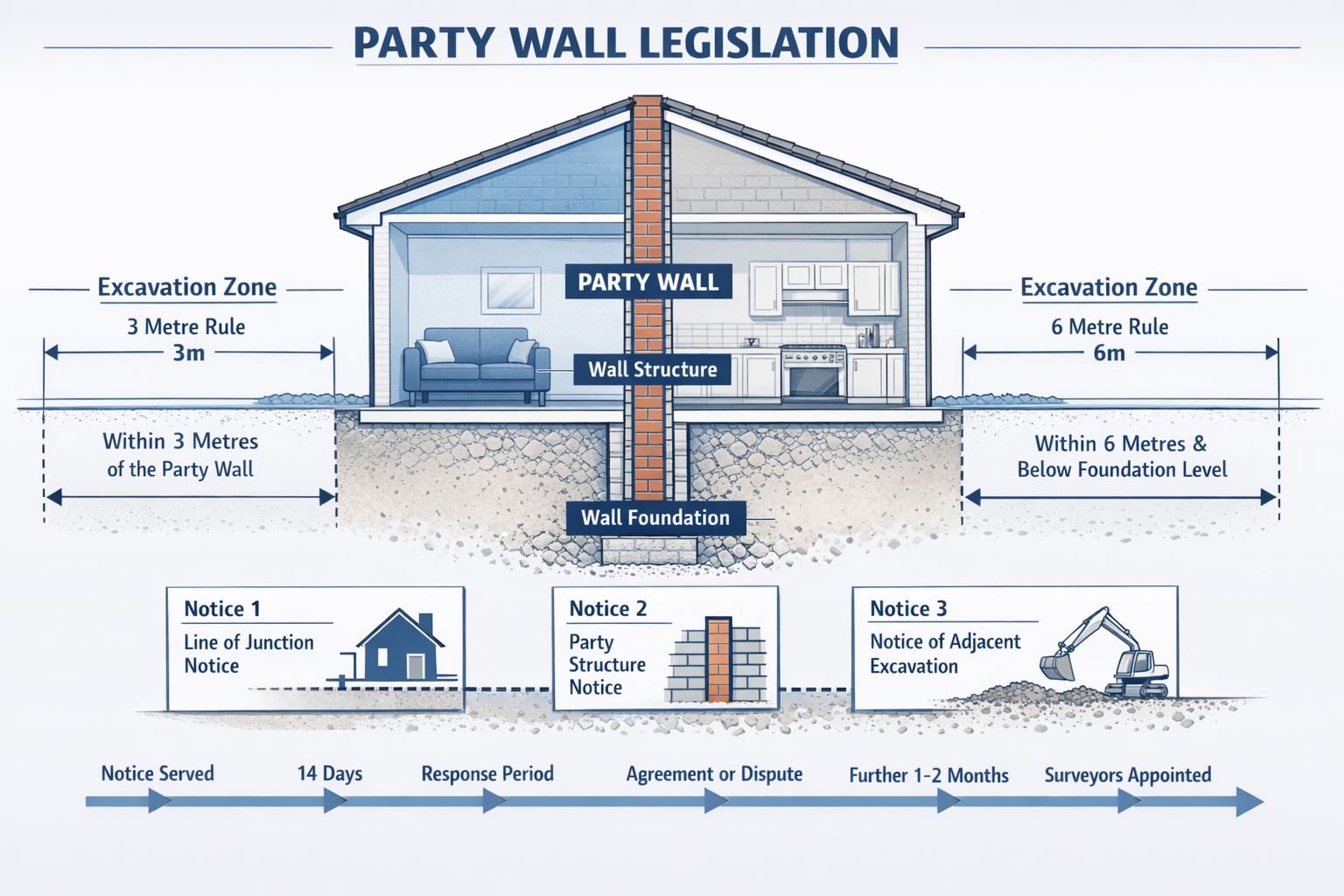
The Act requires notice for excavations within certain distances of neighbouring structures. This is where the party wall act 3 metre rule becomes relevant:
| Distance from Neighbour’s Structure | Depth Requirement |
|---|---|
| Within 3 metres | Excavation going deeper than neighbour’s foundations |
| Within 6 metres | Excavation going deeper than a line drawn at 45° from the bottom of neighbour’s foundations |
Common Projects Requiring Party Wall Notices
Understanding real-world applications helps clarify when the Act applies:
🏠 Loft Conversions: Usually require notices when raising party walls or inserting steel beams
🏠 Basement Excavations: Almost always trigger excavation notice requirements
🏠 Extensions: Require notices when building up to or along the boundary
🏠 Structural Alterations: May require notices when affecting party walls
🏠 Chimney Removal: Requires notice when removing chimney breasts from party walls
For specialized projects like party wall for loft conversions, professional advice ensures you meet all legal obligations.
Work Not Covered by the Act
Certain activities fall outside the Party Wall Act’s scope:
- Purely cosmetic work (painting, wallpapering)
- Minor repairs that don’t affect the wall’s structure
- Work entirely within your property that doesn’t approach boundaries
- Drilling to put up shelves or pictures
The Party Wall Notice Process: Step-by-Step Guide
Navigating the formal notice requirements represents the most critical aspect of Party Wall Act compliance. Getting this wrong can delay projects significantly and create legal complications.
Types of Party Wall Notices
The Party Wall Act establishes three distinct notice types, each serving different purposes:
1. Party Structure Notice 📋
Used for work directly affecting an existing party wall or structure. Must be served at least two months before work commences.
2. Line of Junction Notice 📋
Required when building a new wall on or astride the boundary line. Must be served at least one month before work starts.
3. Excavation Notice (Adjacent Excavation Notice) 📋
Necessary for excavations within the 3-metre or 6-metre zones. Must be served at least one month before excavation begins.
What Information Must Notices Contain?
Valid party wall notices must include specific information:
✏️ Building owner’s name and address
✏️ Address of the property where work will occur
✏️ Clear description of the proposed work
✏️ Date when work will commence (must allow proper notice period)
✏️ Drawings or plans showing the work (recommended though not always legally required)
✏️ Statement of the building owner’s rights under the Act
Serving Notices: Practical Considerations
Who Should Receive Notice?
Notices must be served on all “adjoining owners”—anyone with an interest in the neighbouring property. This includes:
- Freeholders
- Leaseholders with sufficient remaining lease term
- Tenants in certain circumstances
- Mortgagees (in some cases)
How to Serve Notice
Valid service methods include:
- Hand delivery to the person or property
- Recorded delivery post (recommended for proof)
- Leaving it at the property with a responsible person
Pro Tip: Always keep proof of service, including photographs of hand delivery or postal receipts. This documentation becomes crucial if disputes arise later.
The Neighbour’s Response Options
After receiving a party wall notice, the adjoining owner has 14 days to respond in one of three ways:
Option 1: Consent ✅
The neighbour can provide written party wall consent, allowing work to proceed as described. Even with consent, the building owner remains liable for any damage caused.
Option 2: Dissent ❌
The neighbour can formally dissent (disagree) with the proposed work. This doesn’t stop the work but triggers the dispute resolution process involving surveyors.
Option 3: No Response 🔇
If the neighbour doesn’t respond within 14 days, this is deemed a dissent, automatically triggering the surveyor appointment process.
Party Wall Surveyors: Roles and Responsibilities
When neighbours dissent or fail to respond to a party wall notice, the party wall act requires the appointment of surveyors to resolve the matter. This professional intervention protects both parties’ interests and provides an impartial framework for proceeding.
When Surveyors Become Necessary
Surveyor appointment becomes mandatory when:
- The adjoining owner formally dissents to the proposed work
- The adjoining owner fails to respond within the 14-day period
- Either party wants professional documentation of the property condition
- Complex technical issues require expert assessment
Even when neighbours initially agree, many building owners choose to involve surveyors proactively to create proper documentation and avoid future disputes.
Three Surveyor Appointment Options
The Act provides three distinct approaches to surveyor appointment:
Option 1: Agreed Surveyor 🤝
Both parties jointly appoint a single surveyor to act impartially for both sides. This is typically the most cost-effective approach, as fees are shared. Learn more about party wall agreed surveyors and their benefits.
Option 2: Two Surveyors 👥
Each party appoints their own surveyor. The two surveyors work together to produce the party wall award. If they cannot agree on any matter, they must appoint a third surveyor (called the “Third Surveyor”) to resolve the disagreement.
Option 3: Third Surveyor ⚖️
When the two appointed surveyors disagree on any aspect, they select a third surveyor whose decision on disputed matters is final.
What Do Party Wall Surveyors Do?
Professional party wall surveyors perform several critical functions:
Pre-Work Responsibilities:
- Inspect both properties and document existing conditions
- Review proposed work plans and specifications
- Assess potential risks to the adjoining property
- Determine necessary precautions and protective measures
- Prepare the party wall award document
During Construction:
- Monitor work to ensure compliance with the award
- Address concerns from either party
- Inspect if problems arise
- Mediate minor disputes
Post-Work Responsibilities:
- Conduct final inspections
- Assess any damage claims
- Determine appropriate remedies or compensation
- Resolve disputes about workmanship or damage
Surveyor Fees: Who Pays?
Understanding the cost implications is essential:
💰 General Rule: The building owner (person doing the work) pays all reasonable surveyor fees, including:
- Their own surveyor’s fees
- The adjoining owner’s surveyor’s fees
- The third surveyor’s fees (if appointed)
💰 Exceptions: The adjoining owner may be liable for fees if they:
- Cause unnecessary delays
- Make frivolous objections
- Refuse reasonable requests
Typical surveyor fees vary based on project complexity:
| Project Type | Typical Fee Range |
|---|---|
| Simple extension | £700 – £1,200 per surveyor |
| Loft conversion | £900 – £1,500 per surveyor |
| Basement excavation | £1,500 – £3,000+ per surveyor |
| Complex commercial work | £2,500 – £5,000+ per surveyor |
Professional chartered surveyors provide transparent fee structures and detailed cost estimates before beginning work.
The Party Wall Award: Your Legal Protection
The party wall award represents the culmination of the surveyor’s work—a legally binding document that governs how construction proceeds and protects all parties’ interests.
What Is a Party Wall Award?
A party wall award is a formal legal document prepared by the appointed surveyor(s) that sets out:
📄 Details of the proposed work and how it will be executed
📄 Condition of both properties before work begins
📄 Rights and responsibilities of both building and adjoining owners
📄 Protective measures required during construction
📄 Access arrangements for inspections and work
📄 Dispute resolution procedures if problems arise
📄 Time limits for completing the work
Key Components of a Party Wall Award
A comprehensive party wall award typically includes:
Section 1: Preamble
- Names and addresses of all parties
- Property descriptions
- Details of notices served
- Surveyor appointments
Section 2: Description of Works
- Detailed specifications of proposed work
- Drawings and technical plans
- Construction methodology
- Timeline for completion
Section 3: Condition Schedule
- Photographic evidence of existing conditions
- Detailed descriptions of both properties
- Record of any pre-existing damage or defects
- Baseline for assessing future damage claims
Section 4: Special Requirements
- Working hours restrictions
- Noise and dust control measures
- Access requirements and notice periods
- Insurance requirements
- Protective measures (shoring, temporary supports, etc.)
Section 5: Rights and Obligations
- Building owner’s rights to access
- Adjoining owner’s rights to compensation
- Procedures for addressing damage
- Dispute resolution mechanisms
Legal Status and Enforceability
Party wall awards carry significant legal weight:
⚖️ Legally Binding: Awards have the same force as a court order
⚖️ Enforceable: Breaches can be enforced through county court proceedings
⚖️ Appealable: Either party can appeal to the county court within 14 days
⚖️ Protective: Awards protect both parties from future disputes
What Happens If the Award Is Breached?
Violations of party wall awards can result in:
- Injunctions stopping work immediately
- Compensation claims for damages
- Orders to remedy non-compliant work
- Legal costs awarded against the breaching party
Common Party Wall Disputes and How to Resolve Them

Despite the Act’s protective framework, party wall disputes still arise. Understanding common issues and resolution strategies helps property owners navigate challenges effectively.
Typical Sources of Party Wall Disputes
1. Damage to Neighbouring Property 🏚️
The most common dispute involves alleged damage to property in party wall situations. This includes:
- Cracks in walls, ceilings, or floors
- Damage to decorations
- Structural movement or subsidence
- Water ingress or damp problems
- Damage to gardens or outbuildings
2. Excessive Noise and Disruption 🔊
Disputes often arise when:
- Work occurs outside agreed hours
- Noise levels exceed reasonable expectations
- Dust and debris affect neighbouring properties
- Access requirements become intrusive
3. Non-Compliance with the Award 📋
Problems occur when building owners:
- Deviate from approved plans
- Fail to implement required protective measures
- Refuse reasonable access for inspections
- Ignore working hour restrictions
4. Inadequate Notice or Process Failures ⚠️
Disputes can stem from:
- Failure to serve proper notices
- Starting work before notice periods expire
- Not appointing surveyors when required
- Incomplete or inaccurate information in notices
Resolution Strategies
Step 1: Direct Communication 💬
Many disputes resolve through simple dialogue:
- Discuss concerns promptly and calmly
- Document all communications in writing
- Seek to understand the other party’s perspective
- Propose reasonable compromises
Step 2: Surveyor Intervention 👨💼
When direct communication fails:
- Contact the appointed party wall surveyor(s)
- Request an inspection and assessment
- Allow surveyors to mediate the dispute
- Follow surveyor recommendations
Step 3: Third Surveyor Determination ⚖️
For disputes between appointed surveyors:
- The third surveyor reviews the disagreement
- Both sides present their positions
- The third surveyor makes a binding determination
- This decision becomes part of the award
Step 4: Court Appeal 🏛️
As a last resort:
- Either party can appeal to the county court within 14 days of the award
- Court reviews the surveyor’s decision
- Legal costs can be substantial
- Court decisions are final (subject to normal appeal processes)
Preventing Disputes: Best Practices
🛡️ Serve proper notices with complete, accurate information
🛡️ Communicate proactively with neighbours throughout the process
🛡️ Appoint experienced surveyors who understand local conditions
🛡️ Follow the award precisely without deviations
🛡️ Document everything with photos, emails, and written records
🛡️ Address concerns immediately rather than letting them escalate
🛡️ Maintain appropriate insurance to cover potential damage claims
Professional guidance from experienced boundary dispute party wall surveyors can prevent many common problems before they escalate.
Special Considerations and Complex Scenarios
While the basic Party Wall Act framework applies consistently, certain situations require additional consideration and specialist expertise.
Loft Conversions and the Party Wall Act
Loft conversions frequently trigger party wall requirements because they typically involve:
- Raising the party wall to accommodate increased ceiling height
- Inserting steel beams into party walls for structural support
- Removing chimney breasts that form part of the party structure
- Potential excavation for new staircases
Special Considerations for Lofts:
- Roof structure may be shared even if walls are not
- Weight distribution changes affect both properties
- Sound insulation requirements may exceed building regulations
- Access for construction can be particularly challenging
Basement Excavations and Deep Foundations
Basement projects present unique party wall challenges:
Excavation Notice Requirements:
Almost all basement excavations trigger the 3-metre or 6-metre rules, requiring party wall excavation notices.
Technical Complexities:
- Underpinning neighbouring foundations may be necessary
- Temporary shoring and support systems required
- Ground movement monitoring essential
- Water table considerations
- Risk of subsidence significantly higher
Extended Timelines:
Basement projects require longer notice periods and more extensive condition surveys due to higher risk profiles.
Commercial Properties and the Party Wall Act
Commercial property work adds layers of complexity:
Multiple Stakeholders:
- Freeholders, leaseholders, and tenants may all require notice
- Business interruption concerns
- Higher potential compensation claims
- More stringent insurance requirements
Specialized Surveyors:
Commercial projects benefit from commercial property surveyors who understand business implications.
Leasehold Properties
Leasehold situations require careful navigation:
Who Serves Notice?
- Typically the leaseholder if they’re undertaking the work
- Freeholder may need to be involved for major structural work
- Lease terms may impose additional restrictions
Who Receives Notice?
- Neighbouring leaseholders
- Freeholder (in many cases)
- Head leaseholders in complex ownership structures
Understanding leasehold matters helps clarify responsibilities.
Listed Buildings and Conservation Areas
Protected properties face additional requirements:
🏛️ Listed Building Consent may be required alongside party wall procedures
🏛️ Conservation Area Approval for external alterations
🏛️ Specialist surveyors with heritage experience
🏛️ Additional restrictions on materials and methods
🏛️ Extended timelines for approvals and work
Frequently Asked Questions About the Party Wall Act
Do I need to follow the Party Wall Act if my neighbour agrees to the work?
Yes, absolutely. Even with neighbour consent, you must serve formal written notice and follow the Act’s procedures. Verbal agreements or informal written consent don’t satisfy legal requirements. The notice period allows neighbours time to consider implications and protects both parties if circumstances change.
What happens if I start work without serving a party wall notice?
Starting work without proper notice constitutes a breach of the Act and can result in:
- Injunctions forcing you to stop work immediately
- Orders to reverse completed work
- Liability for neighbour’s legal costs
- Difficulty obtaining insurance for the project
- Potential civil action for damages
Can my neighbour stop my building project?
No. The party wall act doesn’t give neighbours the right to prevent lawful development. They can dissent to trigger the surveyor process, but they cannot stop work that complies with planning permission and building regulations. The Act only governs how work proceeds, not whether it can proceed.
How long does the party wall process take?
Typical timelines include:
- 2 months minimum for party structure notices (plus 14 days for response)
- 1 month minimum for line of junction and excavation notices (plus 14 days)
- 2-4 weeks for surveyor appointment and initial inspections
- 2-6 weeks for award preparation (simple to complex projects)
Total timeline: 3-5 months for straightforward projects, longer for complex work.
Who pays for damage caused during building work?
The building owner is strictly liable for all damage caused by the work, regardless of fault. This includes:
- Structural damage
- Cosmetic damage
- Consequential losses (within reason)
- Cost of repairs to pre-existing condition
This is why comprehensive insurance and detailed condition schedules are essential.
Can I do the party wall process myself without a surveyor?
Technically yes, if your neighbour consents in writing within 14 days. However, this is rarely advisable because:
- You lose the protection of a professional condition schedule
- Future damage claims become harder to defend
- You may miss technical issues that could cause problems
- Professional documentation provides legal protection
For any substantial project, professional surveyor involvement is strongly recommended.
What if my neighbour refuses to appoint a surveyor?
If your neighbour doesn’t appoint a surveyor within 10 days of dissenting (or being deemed to dissent), you can appoint a surveyor on their behalf. This surveyor must act impartially despite being appointed by you, and your neighbour can replace them with their own choice if they later decide to engage with the process.
Do I need party wall notices for permitted development?
Yes. Planning permission status is completely separate from Party Wall Act requirements. Even if your project qualifies as permitted development (not requiring planning permission), you must still comply with party wall legislation if the work falls within the Act’s scope.
For specific questions about your situation, consult experienced surveyors who can provide tailored advice.
Regional Variations: Party Wall Act Across England and Wales
While the party wall act applies uniformly across England and Wales, practical implementation can vary by region based on property types, local building practices, and regional surveyor availability.
London and Urban Areas
Dense urban environments like London present unique party wall challenges:
Higher Frequency:
- Terraced housing means almost all building work triggers the Act
- Multiple adjoining owners common in flats and conversions
- More complex ownership structures
Established Practices:
London had party wall legislation since the 1800s, so chartered surveyors in Central London have extensive experience with these matters.
Regional Considerations:
Different London boroughs may have varying approaches:
Suburban and Semi-Rural Areas
Areas like Surrey, Hertfordshire, and Buckinghamshire have different characteristics:
Property Types:
- More detached properties (fewer party wall situations)
- Larger plots with greater distances between buildings
- Garden walls and boundary structures more common
Regional Expertise:
Local surveyors understand regional building styles:
- Chartered surveyors in Surrey
- Chartered surveyors in Hertfordshire
- Chartered surveyors in Buckinghamshire
Wales
The Act applies identically in Wales, though:
- Welsh language notices may be appropriate in some areas
- Local building traditions may differ
- Surveyor availability may be more limited in rural areas
The Future of Party Wall Legislation
As we move through 2025, several trends and potential changes are shaping how the party wall act operates in practice.
Technological Advances
Modern technology is transforming party wall procedures:
Digital Documentation:
- 3D laser scanning for precise condition surveys
- Drone photography for roof and chimney inspections
- Digital platforms for serving notices and sharing documents
- Virtual meetings reducing delays and costs
Monitoring Technology:
- Vibration monitors detecting excessive movement
- Crack monitoring systems providing objective data
- Moisture meters identifying water ingress early
- Structural monitoring during high-risk work
Increasing Awareness
Property owners are becoming more informed about their rights and obligations:
- Online resources and guidance proliferating
- More proactive notice serving
- Earlier surveyor involvement
- Better understanding reducing disputes
Potential Legislative Updates
While no major reforms are currently proposed, discussions continue about:
- Clarifying certain ambiguous provisions
- Modernizing notice service methods
- Addressing digital communication
- Streamlining procedures for minor works
Climate Change Considerations
Environmental factors are influencing party wall matters:
- Subsidence risk increasing in some areas
- Flood risk affecting excavation work
- Sustainability requirements influencing construction methods
- Party wall insulation becoming more important for energy efficiency
Conclusion: Navigating the Party Wall Act Successfully
The party wall act may seem daunting initially, but understanding its requirements and following proper procedures protects everyone involved in building projects affecting shared structures. This legislation exists not to prevent development but to ensure it proceeds fairly, safely, and with proper consideration for all parties’ rights.
Key Success Factors
✨ Early Planning: Consider party wall requirements at the project planning stage, not as an afterthought
✨ Professional Guidance: Engage experienced party wall surveyors early to avoid costly mistakes
✨ Clear Communication: Maintain open, respectful dialogue with neighbours throughout the process
✨ Proper Documentation: Keep detailed records of all notices, responses, and communications
✨ Adequate Insurance: Ensure comprehensive coverage for potential damage claims
✨ Realistic Timelines: Build party wall notice periods and surveyor processes into project schedules
✨ Compliance Focus: Follow award conditions precisely to avoid disputes and legal complications
Your Next Steps
If you’re planning building work that might trigger party wall requirements:
1. Assess Your Situation 🔍
Determine whether your proposed work falls under the Act’s scope. Consider the type of work, proximity to boundaries, and impact on shared structures.
2. Consult Professionals 👨💼
Contact experienced party wall surveyors who can provide specific guidance for your project and location.
3. Serve Notices Promptly 📮
Don’t delay—serve proper notices with adequate time before your planned start date. Remember the minimum periods: 2 months for party structure work, 1 month for excavations.
4. Engage Constructively 🤝
Approach neighbours proactively, explain your plans clearly, and address their concerns respectfully. Most party wall matters resolve smoothly with good communication.
5. Follow the Process ✅
Whether your neighbour consents or dissents, follow the Act’s procedures completely. Cutting corners creates far more problems than it solves.
6. Document Everything 📸
Maintain comprehensive records including photographs, correspondence, and professional reports. This documentation protects you if disputes arise later.
Final Thoughts
The Party Wall Act 1996 represents sensible, balanced legislation that has prevented countless disputes and protected property owners’ interests for nearly three decades. While the procedures may seem bureaucratic, they exist for good reason—to ensure building work proceeds safely, fairly, and with proper consideration for everyone affected.
Whether you’re planning a modest extension or a major development, understanding and complying with party wall requirements isn’t just a legal obligation—it’s an investment in good neighbour relations, project success, and long-term peace of mind.
For comprehensive guidance tailored to your specific situation and location, professional party wall surveyors provide invaluable expertise that protects your interests and ensures full compliance with this important legislation. Don’t navigate these complex waters alone—expert support makes all the difference between smooth project completion and costly complications.