

{"cover":"Professional landscape format (1536×1024) hero image featuring bold text overlay 'Party Wall Essentials for Professional Landlord Extensions: Compliance in 2026's Bullish Buy-to-Let Expansion' in extra large 72pt white sans-serif font with dark shadow and semi-transparent navy overlay box, positioned in upper third center. Background shows modern terraced Victorian houses in London with construction scaffolding on side extension, architectural blueprints visible, professional surveyor with clipboard in foreground, split-screen showing shared party wall cross-section diagram. Color scheme: navy blue, white, gold accents. High contrast, magazine cover quality, editorial real estate professional aesthetic with subtle upward growth arrow graphics.","content":["Detailed landscape format (1536×1024) image showing professional party wall surveyor in hard hat and high-visibility vest conducting pre-construction inspection at terraced property boundary, measuring tape extended along shared wall, digital tablet displaying Party Wall Act 1996 documentation, close-up of brick party wall with annotation arrows pointing to key structural elements, construction site safety barriers visible, neighbor consultation meeting in background, split composition showing 'before' property state and planned extension overlay in transparent blue, professional lighting, documentary photography style with infographic elements overlaid.","Comprehensive landscape format (1536×1024) infographic-style image displaying timeline flowchart of party wall notice process from left to right, starting with 'Notice Served' document icon, progressing through '14-day response period' calendar graphic, branching paths showing 'Consent' green checkmark and 'Dissent' red X options, surveyor appointment icons, party wall award document at end, estimated costs £750-£1,800 displayed in bold typography, clock icons showing 2-4 month timeline, color-coded sections in professional blues and greens, clean modern business infographic aesthetic with property silhouettes in background, no repeated elements from previous images.","Striking landscape format (1536×1024) image showing aerial drone perspective of London buy-to-let property portfolio with multiple terraced houses undergoing simultaneous extension projects, construction cranes and scaffolding visible on rear and side extensions, architectural overlay showing loft conversion cross-sections, basement excavation depth markers with 3-6 metre measurement annotations, financial growth chart superimposed showing 2026 buy-to-let market expansion trend line ascending, golden hour lighting, professional real estate investment photography style, property value price tags floating above buildings showing extension cost ranges, modern sophisticated composition completely different from previous images."]"}

The buy-to-let market in 2026 is experiencing remarkable momentum, with institutional landlords and professional property investors expanding their portfolios at unprecedented rates. As this bullish expansion continues, one critical compliance area demands immediate attention: party wall agreements. Professional landlords undertaking extensions, conversions, and renovations must navigate the Party Wall Act 1996 with precision to avoid costly delays, legal disputes, and damaged neighbour relations. Understanding party wall essentials for professional landlord extensions: compliance in 2026's bullish buy-to-let expansion has become a non-negotiable competency for successful property investment strategies.
This comprehensive guide unpacks the legal requirements, procedural timelines, cost implications, and strategic approaches that professional landlords need to execute extension projects smoothly while maintaining full compliance with party wall legislation.
Key Takeaways
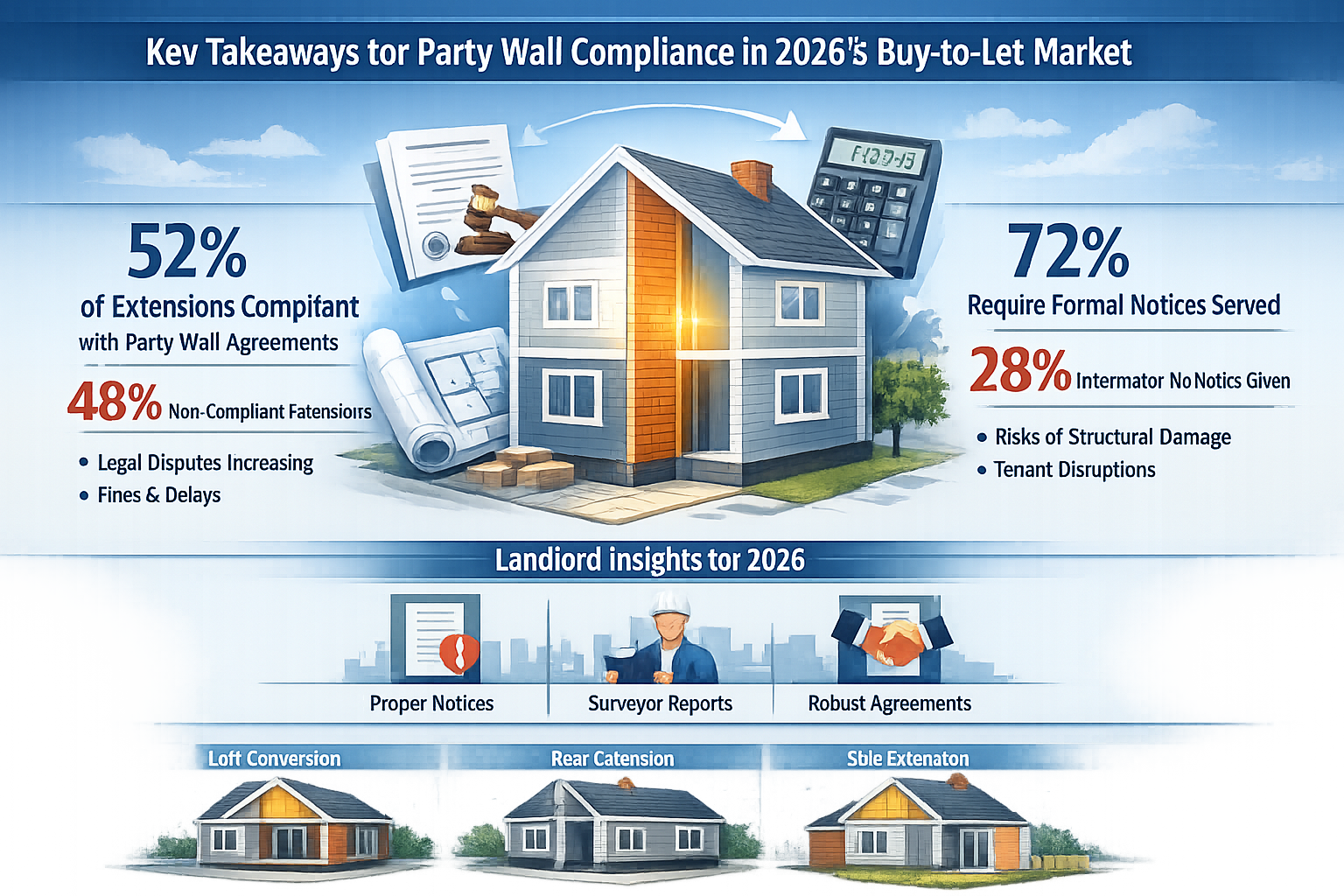
- 📋 Surveyor fees range from £750–£1,800 per neighbour, with party wall processes taking 2–4 months to complete in 2026
- 🏗️ Common extension types triggering party wall requirements include loft conversions, side extensions, rear extensions, and basement excavations within 3–6 metres of neighbouring properties
- ⚖️ The Party Wall Act 1996 applies only to England and Wales, requiring landlords to verify local regulations for properties in Scotland or Northern Ireland
- 💰 Extension costs in London range significantly: single storey rear extensions (£3,200–£3,800 per m²), two storey extensions (£3,400–£4,200 per m²), loft conversions (£2,200–£2,900 per m²), and basement conversions (£4,600–£6,200 per m²)
- ✅ Strategic notice serving and professional surveyor engagement prevent delays and protect landlord investments in 2026's competitive rental market
Understanding the Party Wall Act 1996: Foundation for Landlord Compliance
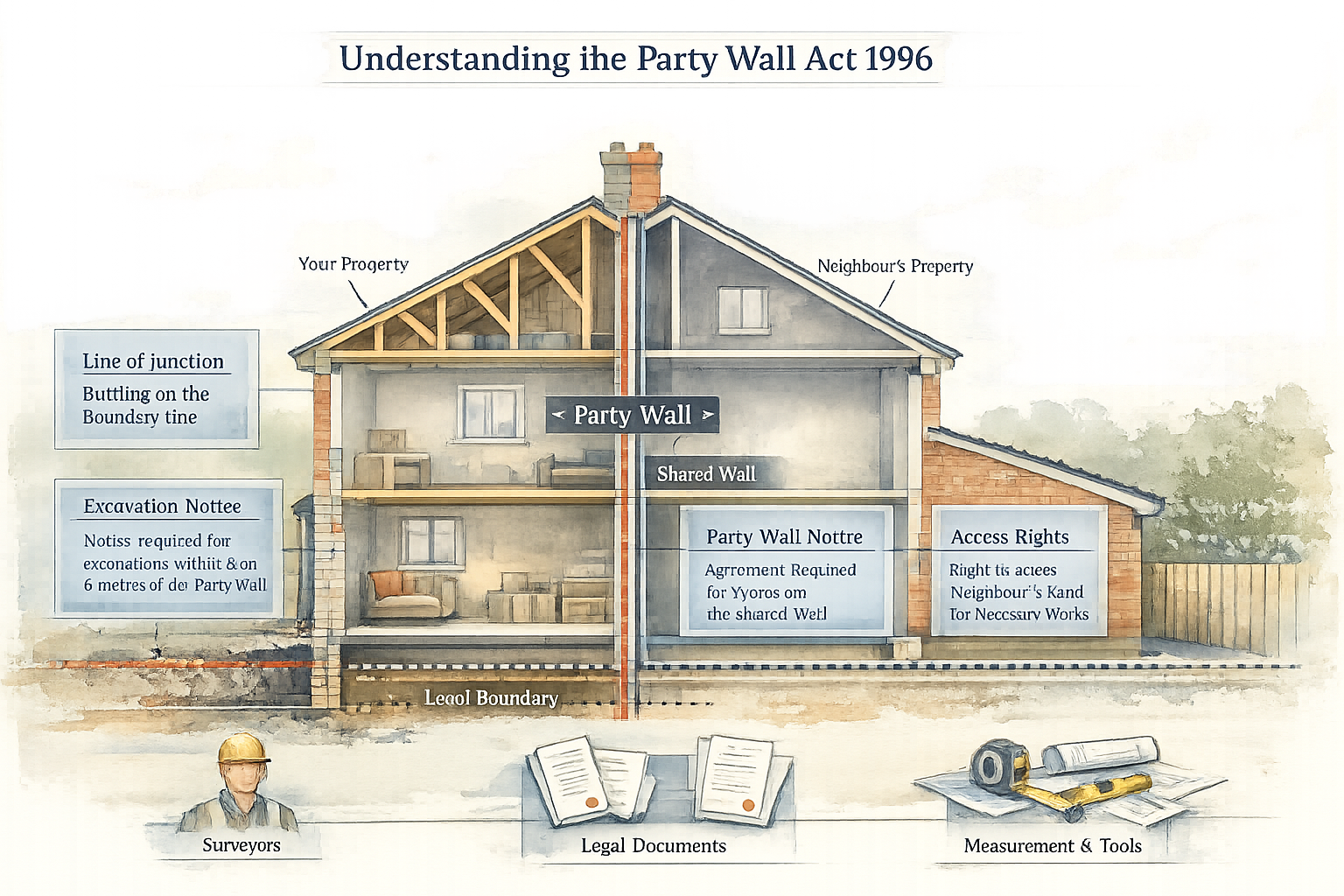
The Party Wall Act 1996 establishes the legal framework governing construction work on or near shared walls, boundaries, and structures between adjoining properties in England and Wales[2]. For professional landlords planning extensions in 2026, this legislation represents both a compliance obligation and a risk management tool.
Geographic Application and Jurisdictional Considerations
The Act applies exclusively to England and Wales—it does not extend to Scotland or Northern Ireland[2]. Landlords with multi-regional portfolios must verify local regulations for properties outside this jurisdiction. This geographic limitation means that party wall essentials for professional landlord extensions: compliance in 2026's bullish buy-to-let expansion requires location-specific due diligence.
Three Categories of Work Triggering the Act
The legislation identifies three distinct categories of construction work requiring formal party wall procedures[3]:
- Work directly to a party wall or party structure — modifications, repairs, or alterations affecting the shared wall itself
- New building on the boundary line — construction of new walls or structures precisely at the property boundary
- Excavations within specified distances — digging within 3 metres of neighbouring buildings if going deeper than their foundations, or within 6 metres if excavating below a 45-degree line from the bottom of neighbouring foundations[3]
Understanding these categories helps landlords identify which extension projects require formal party wall agreements and which fall outside the Act's scope.
Common Extension Types Requiring Party Wall Agreements
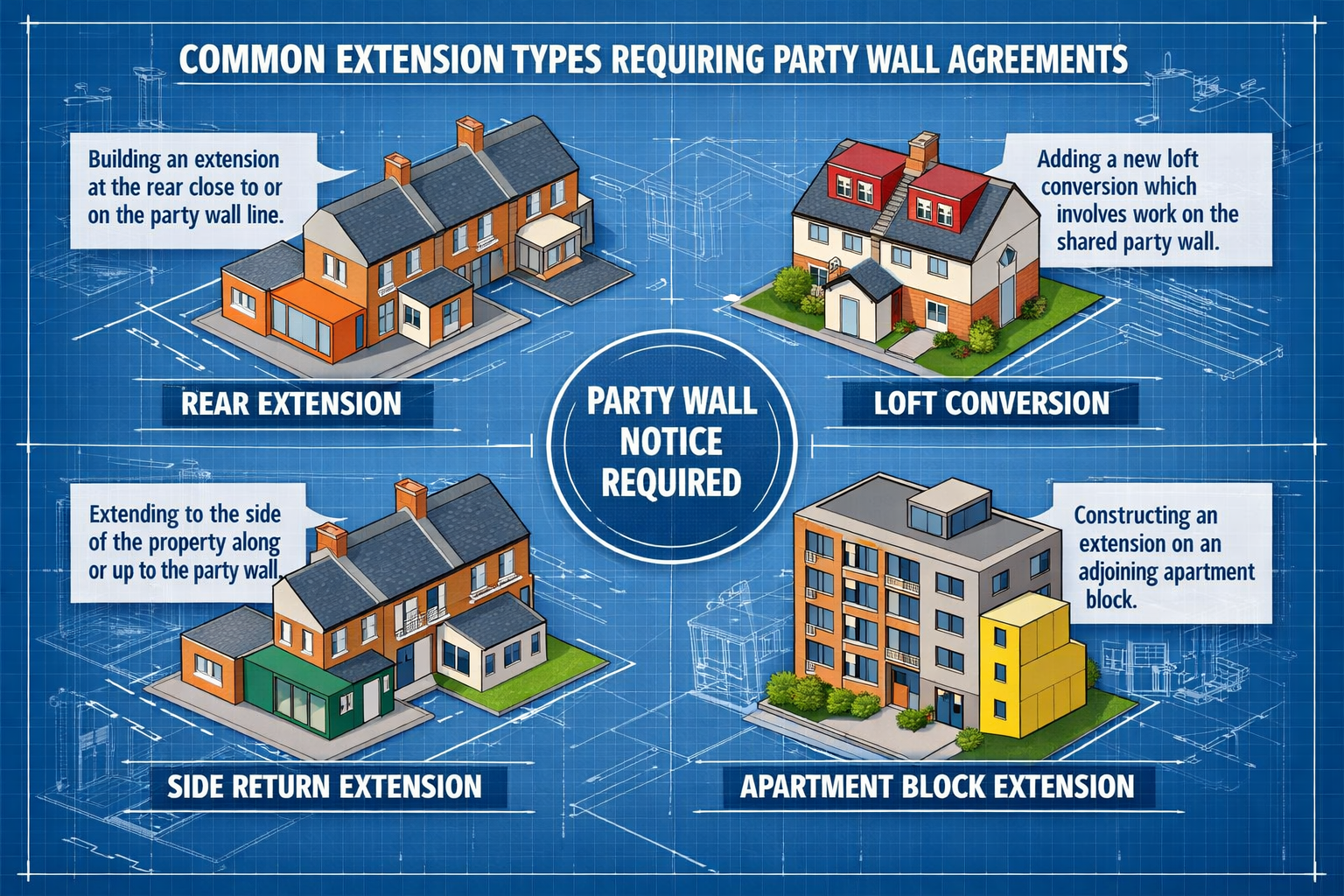
Professional landlords in 2026 are pursuing various extension strategies to maximize rental yields and property values. Each extension type carries specific party wall implications that must be addressed proactively.
Loft Conversions: Vertical Expansion Opportunities
Loft conversions represent one of the most cost-effective extension strategies, with London costs ranging from £2,200–£2,900 per m² (total project costs: £52,000–£100,000 for a typical 20m² conversion)[1]. These projects frequently trigger party wall requirements when:
- Structural beams are inserted into shared walls
- Party walls are raised to increase headroom
- Roof structures are modified affecting shared structural elements
For detailed guidance on navigating party wall requirements for loft projects, landlords should consult specialized resources on party wall considerations for loft conversions.
Rear and Side Extensions: Horizontal Expansion
Single storey rear extensions cost £3,200–£3,800 per m² in London (£60,000–£100,000 total for 20m²), while two storey rear extensions range from £3,400–£4,200 per m² (£140,000–£165,000 total)[1]. These extensions typically require party wall agreements when:
- New foundations are excavated within 3–6 metres of neighbouring properties
- Extension walls connect to or abut shared party walls
- Work involves cutting into party walls for structural support
Side extensions almost invariably trigger party wall requirements due to their proximity to boundary lines and shared structures[1][2].
Basement Conversions: Below-Ground Value Creation
Basement conversions represent the premium extension option at £4,600–£6,200 per m² in London (£155,000–£310,000 for 20m²)[1]. These projects consistently require party wall agreements because:
- Excavation depths exceed neighbouring foundation levels
- Underpinning work affects shared structural stability
- The 3-6 metre excavation proximity rule applies
Specific Works Requiring Formal Agreements
Beyond whole-extension projects, specific construction activities trigger party wall requirements[3]:
- ✂️ Cutting into party walls to insert beams or joists
- 🧱 Raising, lowering, or rebuilding party walls
- 🔥 Removing chimney breasts from party walls
- 🏗️ Underpinning party walls or adjacent foundations
- 🌡️ Installing party wall insulation systems
- 💧 Inserting damp proof courses affecting shared structures
The Party Wall Notice Process: Timeline and Procedures
Mastering the party wall notice process is essential for party wall essentials for professional landlord extensions: compliance in 2026's bullish buy-to-let expansion. The procedure follows a structured timeline that professional landlords must incorporate into project planning.
Serving the Party Wall Notice
Landlords (as "building owners") must serve formal written notice to adjoining property owners (the "adjoining owners") before commencing relevant works. The notice must include:
- Detailed description of proposed works with architectural drawings
- Anticipated start date for construction
- Contact information for the building owner and their representatives
- Rights and options available to the adjoining owner
Timing requirements vary by work type:
- Two months' notice for party wall works and new boundary buildings
- One month's notice for excavation works[2]
For comprehensive guidance on proper notice procedures, landlords should review resources on serving party wall notices correctly.
Neighbour Response Options
Upon receiving a party wall notice, adjoining owners have three formal options[3]:
| Response Option | Description | Implications |
|---|---|---|
| Consent ✅ | Agree to the works in writing | Project proceeds without surveyor involvement; fastest route |
| Dissent with Own Surveyor 📋 | Disagree and appoint independent surveyor | Two surveyors prepare joint party wall award; most common approach |
| Dissent with Agreed Surveyor 🤝 | Disagree but accept joint surveyor | Single surveyor acts impartially for both parties; cost-effective option |
If neighbours fail to respond within 14 days, they are deemed to have dissented, automatically triggering the surveyor appointment process[3].
The Party Wall Award
When surveyors are appointed, they prepare a party wall award—a legally binding document that:
- 📸 Records the pre-construction condition of neighbouring properties
- 🛡️ Establishes protective measures to prevent damage
- 📅 Sets out construction timelines and working hours
- 💷 Allocates responsibility for costs and fees
- ⚖️ Provides dispute resolution mechanisms
Understanding the party wall award process is crucial for London and Surrey landlords managing multiple extension projects.
Timeline Expectations for 2026
Professional landlords should budget 2–4 months for the complete party wall process in 2026[1]. This timeline includes:
- Notice period: 1–2 months
- Surveyor appointment: 1–2 weeks
- Award preparation: 2–6 weeks
- Finalization and agreement: 1–2 weeks
Strategic planning tip: Initiate party wall procedures immediately upon receiving planning permission to avoid construction delays.
Cost Implications: Budgeting for Party Wall Compliance in 2026
Financial planning for party wall compliance represents a critical component of extension project budgets. The 2026 pricing landscape reflects inflation adjustments and increased professional service costs.
Surveyor Fee Ranges
Party wall surveyor fees in 2026 range from £750–£1,800 per neighbour[1]. Factors influencing costs include:
- Project complexity: Simple single-storey extensions versus complex basement excavations
- Property location: London and Southeast premiums versus regional rates
- Number of adjoining properties: Terraced properties may involve multiple neighbours
- Dispute complexity: Contentious situations requiring additional negotiation
For detailed cost breakdowns, landlords can consult resources on party wall surveyor costs.
Who Pays Party Wall Costs?
Under the Party Wall Act 1996, the building owner (landlord) typically bears all reasonable costs associated with the party wall process, including:
- Their own surveyor's fees
- The adjoining owner's surveyor fees
- Award preparation and administration costs
- Pre-construction condition surveys
This cost allocation principle means that professional landlords should budget for surveyor fees multiplied by the number of affected neighbours.
2026 Pricing Trends
Party wall service costs have increased 3–4% from 2025 levels, reflecting general inflation in professional services and construction sectors[1]. Landlords should factor these increases into pro forma calculations when evaluating extension project viability.
Extension Cost Context
To contextualize party wall costs within overall extension budgets, consider these 2026 London price ranges[1]:
Extension Type Comparison Table
| Extension Type | Cost per m² | Total Cost (20m²) | Party Wall as % of Total |
|---|---|---|---|
| Single Storey Rear | £3,200–£3,800 | £60,000–£100,000 | 1.5–3.0% |
| Two Storey Rear | £3,400–£4,200 | £140,000–£165,000 | 1.0–1.3% |
| Loft Conversion | £2,200–£2,900 | £52,000–£100,000 | 1.5–3.5% |
| Basement Conversion | £4,600–£6,200 | £155,000–£310,000 | 0.5–1.2% |
Party wall costs represent a relatively small percentage of total extension investment, making compliance a prudent risk management expense rather than a prohibitive barrier.
Strategic Approaches for Professional Landlords in 2026's Market
As institutional landlords remain optimistic about buy-to-let expansion opportunities in 2026, implementing strategic party wall approaches becomes essential for portfolio-wide success.
Early Engagement Strategy
Proactive neighbour communication before formal notice serving can significantly smooth the party wall process. Professional landlords should:
- Inform neighbours informally about planned extensions before serving formal notices
- Share preliminary drawings to address concerns early
- Explain the party wall process to reduce anxiety and resistance
- Offer reassurance about protective measures and damage prevention
This relationship-building approach often results in consent rather than dissent, eliminating surveyor costs and accelerating timelines.
Agreed Surveyor Advantages
When neighbours dissent, proposing an agreed surveyor arrangement offers several benefits:
- 💰 Cost efficiency: Single surveyor fee instead of two separate appointments
- ⏱️ Faster process: Streamlined communication and decision-making
- 🤝 Reduced adversarial dynamics: Collaborative rather than confrontational approach
Landlords should identify experienced agreed surveyors with strong reputations for impartiality and efficiency.
Portfolio-Wide Systems
Professional landlords managing multiple properties should develop standardized party wall systems:
- Template notice documents customizable for specific projects
- Preferred surveyor relationships for consistent service quality
- Project management protocols integrating party wall timelines
- Financial tracking systems for accurate cost allocation
Risk Management Through Documentation
Comprehensive documentation protects landlords from future disputes:
- 📸 Photographic records of pre-construction conditions
- 📝 Written correspondence with all parties
- 📊 Condition survey reports by qualified professionals
- 🔍 Award compliance monitoring throughout construction
Understanding potential damage to property during party wall work helps landlords implement appropriate protective measures.
Dispute Prevention and Resolution
Despite best efforts, party wall disputes occasionally arise. Professional landlords should:
- Engage experienced surveyors with strong dispute resolution track records
- Maintain professional communication throughout disagreements
- Understand appeal mechanisms under the Act
- Consider mediation before formal legal proceedings
Resources on what constitutes a party wall dispute provide valuable guidance for navigating contentious situations.
Compliance Best Practices for 2026's Bullish Expansion
As party wall essentials for professional landlord extensions: compliance in 2026's bullish buy-to-let expansion becomes increasingly critical, adopting best practices ensures smooth project execution.
Pre-Acquisition Due Diligence
Before purchasing properties for extension-based value-add strategies, professional landlords should:
- Assess party wall complexity based on property configuration
- Research neighbour relationships through vendor disclosure
- Evaluate historical disputes via Land Registry searches
- Factor party wall costs into acquisition pro forma
Planning Permission Integration
Party wall procedures operate independently from planning permission, but coordinating both processes optimizes timelines:
- ✅ Secure planning permission first to demonstrate project viability
- ✅ Serve party wall notices immediately after planning approval
- ✅ Coordinate construction commencement with both approval timelines
- ✅ Communicate integrated timeline to all stakeholders
Contractor Coordination
Construction contractors must understand and respect party wall awards:
- Share party wall awards with contractors before work begins
- Brief site teams on protective measures and restrictions
- Monitor compliance with award conditions throughout construction
- Document adherence for potential future reference
Insurance Considerations
Professional landlords should verify that insurance policies adequately cover:
- 🏠 Structural damage to neighbouring properties during construction
- ⚖️ Legal costs associated with party wall disputes
- 👷 Contractor liability for party wall-related incidents
- 💼 Professional indemnity for surveyor negligence
Record Retention
Maintain comprehensive party wall records for the property's lifetime:
- Original notices and responses
- Party wall awards and amendments
- Condition survey reports and photographs
- Correspondence with neighbours and surveyors
- Completion certificates and final inspections
These records prove invaluable for future extensions, sales, or dispute resolution.
Common Questions and Misconceptions
Do I Need Party Wall Agreement for Internal Works?
Generally, purely internal works not affecting party walls or foundations do not require party wall agreements. However, removing chimney breasts from party walls or inserting beams into shared structures triggers the Act regardless of internal/external classification[3].
What If My Neighbour Refuses to Engage?
If neighbours ignore party wall notices or refuse to participate in the process, the Act provides mechanisms to proceed. After the 14-day response period, deemed dissent occurs, and landlords can appoint a surveyor on the neighbour's behalf to ensure the process continues[3].
Can I Start Work Before the Award Is Finalized?
No. Commencing construction before completing the party wall process constitutes a breach of the Act and exposes landlords to injunctions, damages claims, and project delays. The 2–4 month timeline must be respected[1].
Does the Act Apply to Commercial Properties?
Yes, the Party Wall Act 1996 applies to all building types in England and Wales, including commercial, residential, and mixed-use properties. Professional landlords with commercial portfolios face identical obligations.
How Do I Handle Multiple Neighbours?
For terraced properties or buildings with multiple adjoining owners, landlords must serve separate notices to each affected neighbour. Each may respond differently, potentially requiring multiple surveyor appointments and awards.
For additional clarity on common concerns, landlords can explore frequently asked party wall questions.
The 2026 Buy-to-Let Expansion Context
Understanding party wall essentials for professional landlord extensions: compliance in 2026's bullish buy-to-let expansion requires context about the broader market dynamics driving extension activity.
Institutional Optimism
Institutional landlords and professional investors maintain strong confidence in the buy-to-let sector throughout 2026, driven by:
- 📈 Sustained rental demand in major urban centers
- 🏘️ Housing supply constraints supporting rental yields
- 💰 Capital appreciation potential through strategic extensions
- 🔄 Portfolio optimization strategies maximizing per-unit returns
This optimism translates into increased extension activity as landlords seek to enhance property values and rental income through strategic improvements[4].
Regulatory Environment
The 2026 regulatory landscape emphasizes:
- Energy efficiency requirements driving loft and insulation projects
- Minimum space standards encouraging extensions for compliance
- Licensing scheme expansions requiring property improvements
- Safety regulations necessitating structural upgrades
These regulatory pressures create additional incentives for extension projects, making party wall compliance an increasingly frequent requirement.
Competitive Advantage Through Compliance Excellence
Professional landlords who master party wall procedures gain competitive advantages:
- ⚡ Faster project execution through efficient processes
- 💡 Reduced legal risk from proper compliance
- 🤝 Better neighbour relations supporting long-term operations
- 📊 Accurate financial modeling through cost predictability
In a bullish expansion market, these operational efficiencies compound across portfolio-wide extension programs.
Conclusion: Mastering Party Wall Essentials for Extension Success
Party wall essentials for professional landlord extensions: compliance in 2026's bullish buy-to-let expansion represents a critical competency for successful property investment strategies. As institutional landlords pursue aggressive extension programs to capitalize on favorable market conditions, understanding and implementing proper party wall procedures becomes non-negotiable.
Key success factors include:
- 🎯 Early planning: Initiating party wall processes immediately after securing planning permission
- 💼 Professional engagement: Appointing experienced surveyors with strong track records
- 🤝 Proactive communication: Building positive neighbour relationships before formal notices
- 📋 Comprehensive documentation: Maintaining detailed records throughout the process
- 💰 Realistic budgeting: Allocating £750–£1,800 per neighbour for surveyor fees
The 2–4 month timeline and relatively modest costs (1–3% of total extension budgets) make party wall compliance a manageable aspect of extension projects when approached strategically. Professional landlords who integrate these procedures into standardized portfolio management systems position themselves for efficient, compliant expansion throughout 2026 and beyond.
Actionable Next Steps
For professional landlords planning extension projects in 2026:
- Conduct portfolio audit: Identify properties requiring party wall agreements for planned extensions
- Establish surveyor relationships: Interview and select qualified party wall surveyors for ongoing projects
- Develop template systems: Create standardized notice documents and process workflows
- Budget accurately: Incorporate party wall costs into all extension pro forma analyses
- Educate project teams: Brief contractors, architects, and property managers on party wall requirements
- Initiate early: Serve notices immediately upon receiving planning permission to avoid delays
By mastering these party wall essentials, professional landlords can execute extension strategies confidently, maintaining compliance while capitalizing on 2026's bullish buy-to-let expansion opportunities.
References
[1] Party Wall Agreement London 2026 – https://www.mayfairstudio.co.uk/blog/party-wall-agreement-london-2026
[2] Party Wall Agreement – https://hoa.org.uk/advice/guides-for-homeowners/i-am-improving/party-wall-agreement/
[3] Party Wall Act And Joint Surveyor Agreements – https://charrettelaw.co.uk/party-wall-act-and-joint-surveyor-agreements/
[4] Party Wall Surveys For Institutional Buy To Let Expansions Compliance In 2026s Landlord Investment Surge – https://nottinghillsurveyors.com/blog/party-wall-surveys-for-institutional-buy-to-let-expansions-compliance-in-2026s-landlord-investment-surge