

The UK's ambitious net zero targets are driving an unprecedented surge in heat pump installations across densely populated urban areas in 2026. As homeowners rush to comply with new energy efficiency mandates and capitalise on government incentives, Party Wall Act Compliance for Heat Pump Installations: Survey Protocols in UK's 2026 Green Retrofit Boom has emerged as a critical concern for property owners, surveyors, and installers alike. With the Future Homes Standard requiring all new homes to be zero-carbon ready from 2025 onwards [1], and enhanced grants making retrofits more accessible [2], the installation of air source and ground source heat pumps in terraced housing and semi-detached properties presents unique challenges under the Party Wall etc. Act 1996.
The convergence of environmental legislation and property law means that thousands of homeowners are now discovering that their green energy ambitions require formal party wall procedures—particularly when excavation work, structural modifications, or installations within three metres of neighbouring properties are involved. Understanding the survey protocols and compliance requirements has never been more essential.
Key Takeaways
- 🏗️ Heat pump installations often trigger Party Wall Act requirements when involving excavation, structural work, or installations near shared boundaries in England and Wales
- 📋 Proper survey protocols include serving notices 2 months in advance, appointing qualified surveyors, and completing schedules of condition to protect all parties
- ⚖️ The 3-metre rule and excavation depths are critical considerations for ground source heat pumps and external unit foundations near party walls
- 💷 Non-compliance can lead to costly disputes, delays, and legal action, undermining the financial benefits of government heat pump grants
- 🌱 The 2026 green retrofit boom is creating unprecedented demand for party wall surveyors with expertise in renewable energy installations
Understanding the Party Wall Act in the Context of Heat Pump Installations
The Party Wall etc. Act 1996 remains the cornerstone legislation governing construction work on or near shared boundaries in England and Wales [6]. While originally designed to manage traditional building works like extensions and loft conversions, the Act's provisions are equally applicable to modern green retrofit projects.
What Triggers Party Wall Procedures for Heat Pumps?
Heat pump installations can trigger Party Wall Act requirements in several scenarios:
Ground Source Heat Pumps (GSHP):
- Excavation for horizontal ground loops extending within 3 metres of a neighbouring property
- Vertical borehole drilling that goes deeper than the foundations of an adjoining building
- Trenching for pipework that crosses or approaches party wall boundaries
Air Source Heat Pumps (ASHP):
- Mounting brackets requiring fixings into party walls or shared structures
- Ground works for external unit bases involving excavation near boundaries
- Structural modifications to shared walls for pipework penetrations
The critical factor is whether the work involves excavation, structural alteration, or work directly affecting a party wall or party structure. Many homeowners mistakenly believe that because heat pumps are environmentally beneficial, they're exempt from party wall requirements—this is categorically false.
"The green retrofit boom of 2026 has created a perfect storm where environmental compliance meets property law. Surveyors must navigate both building regulations and party wall legislation simultaneously." — Party Wall Surveyors Association
For comprehensive guidance on party wall procedures, consult our complete guide to party wall matters.
Survey Protocols for Party Wall Act Compliance in Heat Pump Projects
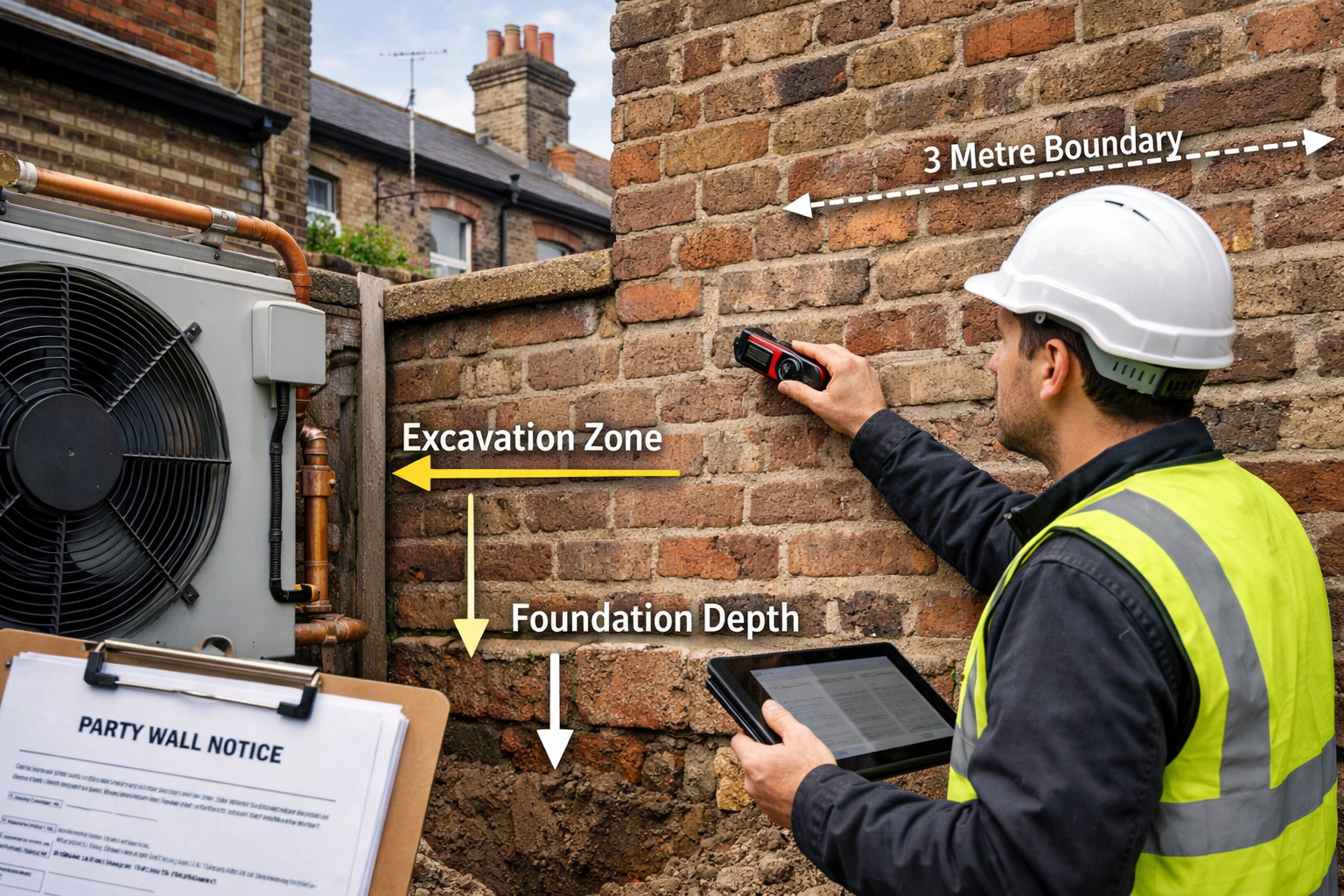
Proper survey protocols are essential to ensure Party Wall Act Compliance for Heat Pump Installations: Survey Protocols in UK's 2026 Green Retrofit Boom standards are met. The process involves several distinct stages, each with specific requirements and timelines.
Stage 1: Initial Assessment and Notice Requirements
Before any heat pump installation begins, property owners must determine whether party wall procedures apply:
Assessment Checklist:
- ✅ Distance from property boundary (is it within 3 metres?)
- ✅ Excavation depth compared to neighbouring foundations
- ✅ Structural impact on shared walls or structures
- ✅ Type of heat pump system (ground source vs. air source)
- ✅ Installation method and foundation requirements
If party wall procedures are required, the building owner must serve appropriate notices under the Act. For heat pump installations, this typically involves:
- Party Structure Notice (Section 2) – for work directly to a party wall
- Notice of Adjacent Excavation (Section 6) – for excavation within 3 metres of a neighbouring structure
These notices must be served at least two months before work commences for party structure notices, or at least one month for excavation notices. Understanding party wall notice requirements is crucial for timeline planning.
Stage 2: Surveyor Appointment and Party Wall Agreement
Once notices are served, the adjoining owner has three options:
- Consent in writing to the proposed works
- Dissent or fail to respond within 14 days
- Request modifications to the proposed works
If consent isn't provided, the matter becomes a "dispute" under the Act (even if amicable), requiring surveyor appointment. Both parties can either:
- Appoint separate surveyors who will then select a party wall agreed surveyor
- Jointly appoint a single agreed surveyor to act impartially
Key Survey Protocol Requirements:
| Survey Element | Purpose | Timeline |
|---|---|---|
| Schedule of Condition | Document pre-work property state | Before work starts |
| Site Inspection | Assess structural implications | Within 10 days of appointment |
| Technical Review | Evaluate installation plans | 2-3 weeks |
| Party Wall Award | Formal agreement document | Before work commences |
| Post-Work Inspection | Verify no damage occurred | After completion |
The party wall schedule of condition is particularly important for heat pump installations, as it provides photographic and written evidence of the neighbouring property's condition before any vibration, excavation, or structural work occurs.
Stage 3: Technical Survey Considerations Specific to Heat Pumps
Party wall surveyors must assess several technical factors unique to heat pump installations:
Foundation and Excavation Analysis:
- Depth of excavation for heat pump base or ground loops
- Proximity to neighbouring foundations
- Soil type and load-bearing capacity
- Potential for ground movement or subsidence
Structural Impact Assessment:
- Vibration during installation (particularly drilling for GSHP)
- Weight load of external units on shared structures
- Penetrations through party walls for pipework
- Acoustic transmission through shared walls
The 3-Metre Rule in Heat Pump Context:
The Party Wall Act 3-metre rule states that if you excavate within 3 metres of a neighbouring building and go deeper than its foundations, you must serve notice. For ground source heat pumps, this is particularly relevant:
- Horizontal ground loops typically require trenches 1-2 metres deep
- Vertical boreholes can extend 50-100 metres deep
- External unit foundations usually require 0.5-1 metre excavation
Surveyors must obtain detailed installation plans from heat pump contractors to accurately assess compliance requirements.
Stage 4: The Party Wall Award
The culmination of the survey process is the party wall award, a legally binding document that:
- Describes the proposed works in detail
- Sets out conditions for how work must be carried out
- Establishes working hours and access arrangements
- Addresses costs and who bears them
- Provides dispute resolution mechanisms
For heat pump installations, the award should specifically address:
- Maximum excavation depths and distances
- Vibration monitoring requirements during drilling
- Acoustic performance standards for the installed unit
- Reinstatement procedures if damage occurs
- Inspection schedules during and after installation
The building owner typically bears the cost of preparing the award, though this can be negotiated. For detailed information about expenses, see our guide on party wall surveyor costs.
The 2026 Green Retrofit Boom: Regulatory Drivers and Compliance Challenges
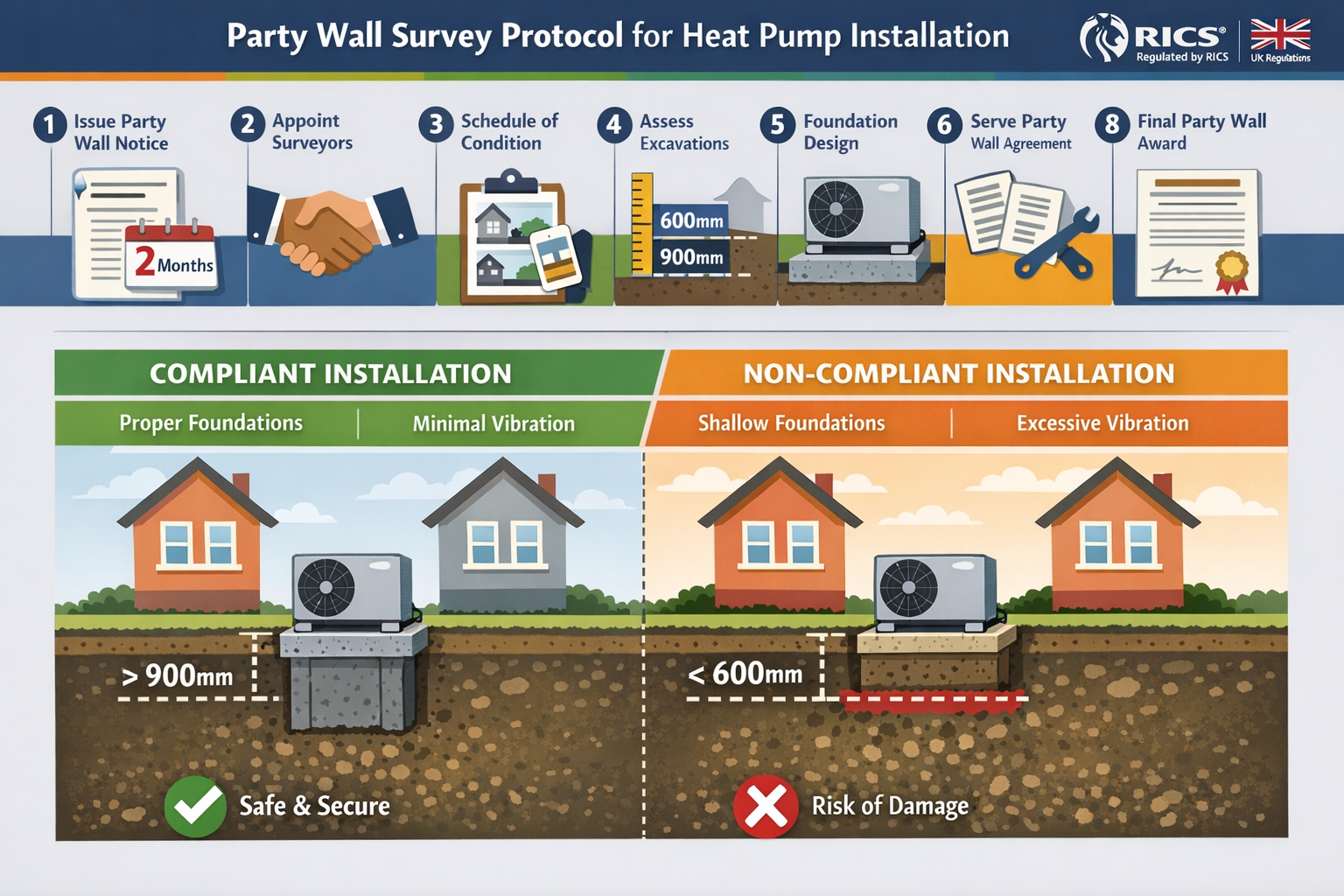
The surge in heat pump installations during 2026 is driven by multiple converging regulatory and financial factors, creating both opportunities and compliance challenges for property owners and surveyors.
Regulatory Drivers Behind the 2026 Heat Pump Surge
Future Homes Standard Implementation:
The Future Homes Standard, which came into effect for new builds in 2025, requires all new homes to produce 75-80% less carbon emissions than current building regulations allow [1]. While this directly affects new construction, it creates market pressure and consumer awareness that drives retrofit demand in existing housing stock.
Enhanced Grant Schemes:
The UK government has significantly expanded heat pump grant availability in 2026, with the Boiler Upgrade Scheme offering £7,500 grants for air source heat pumps and £7,500 for ground source systems [2]. This financial incentive has made heat pump installations economically viable for millions of homeowners.
Private Rental Sector Regulations:
New Energy Performance Certificate (EPC) requirements for rental properties are driving landlord investment in heat pumps. The government's response to the Private Rented Sector (PRS) energy performance consultation indicates strengthening standards that will require higher EPC ratings [3], with the Decent Homes Standard being reformed to include energy efficiency requirements [4].
EPC Band C Targets:
Proposals requiring private rented properties to achieve EPC Band C by 2030 [5] are creating urgency among landlords to upgrade heating systems now, contributing to the 2026 installation boom.
Compliance Challenges in Dense Urban Housing
The UK's housing stock presents unique challenges for Party Wall Act Compliance for Heat Pump Installations: Survey Protocols in UK's 2026 Green Retrofit Boom:
Terraced Housing Complications:
- Limited external space for ground source systems
- Shared party walls on both sides
- Restricted access for installation equipment
- Multiple neighbours requiring notification
Victorian and Edwardian Properties:
- Shallow foundations increasing 3-metre rule applicability
- Structural sensitivity to vibration
- Heritage considerations in conservation areas
- Complex ownership arrangements
Semi-Detached Properties:
- Shared chimney stacks potentially affected by vibration
- Party wall insulation concerns with heat pump installations
- Acoustic transmission through party structures
For properties with shared chimneys, additional considerations apply—see our guide on party wall shared chimneys.
Common Compliance Failures and How to Avoid Them
Failure 1: Not Serving Notices
Many homeowners proceed with heat pump installations without realising party wall procedures apply. This can result in:
- Injunctions stopping work mid-installation
- Retrospective party wall awards at higher cost
- Damaged neighbour relationships
- Legal liability for any resulting damage
Prevention: Always consult a qualified surveyor before commencing work, particularly for ground source systems or installations near boundaries.
Failure 2: Inadequate Schedule of Condition
Rushing or skipping the pre-work condition survey creates disputes when neighbours claim damage. Without comprehensive photographic evidence and written descriptions, proving causation becomes difficult.
Prevention: Ensure your surveyor conducts a thorough schedule of condition including:
- High-resolution photographs of all relevant areas
- Written descriptions of existing defects
- Measurements and crack monitoring where appropriate
- Internal and external documentation
Failure 3: Ignoring the 3-Metre Rule
Ground source heat pump trenches often extend within 3 metres of neighbouring properties. Failing to recognise this triggers party wall requirements, leading to non-compliance.
Prevention: Obtain detailed installation plans showing excavation depths and distances before serving notices. Use the excavation notice process appropriately.
Failure 4: Proceeding Without Party Wall Award
Some property owners mistakenly believe that serving notice is sufficient. However, if the neighbour dissents or doesn't respond, work cannot legally proceed without a party wall award in place.
Prevention: Allow sufficient time in project planning for the full party wall process—typically 3-4 months from initial notice to award completion.
Managing Party Wall Disputes During Heat Pump Installation
Despite best efforts, party wall disputes can arise during heat pump projects. Common dispute triggers include:
- Noise concerns about heat pump operation
- Visual impact objections to external units
- Property value concerns from neighbours
- Installation timing and working hours
- Access requirements across neighbouring land
When disputes occur, the party wall award provides the framework for resolution. Surveyors can mediate by:
- Clarifying misunderstandings about the work scope
- Proposing modifications to address legitimate concerns
- Setting clear conditions in the award
- Establishing monitoring protocols for sensitive properties
- Providing expert technical guidance on risk mitigation
For complex disputes, understanding what constitutes a party wall dispute and the resolution mechanisms available is essential.
Best Practices for Surveyors and Property Owners in 2026
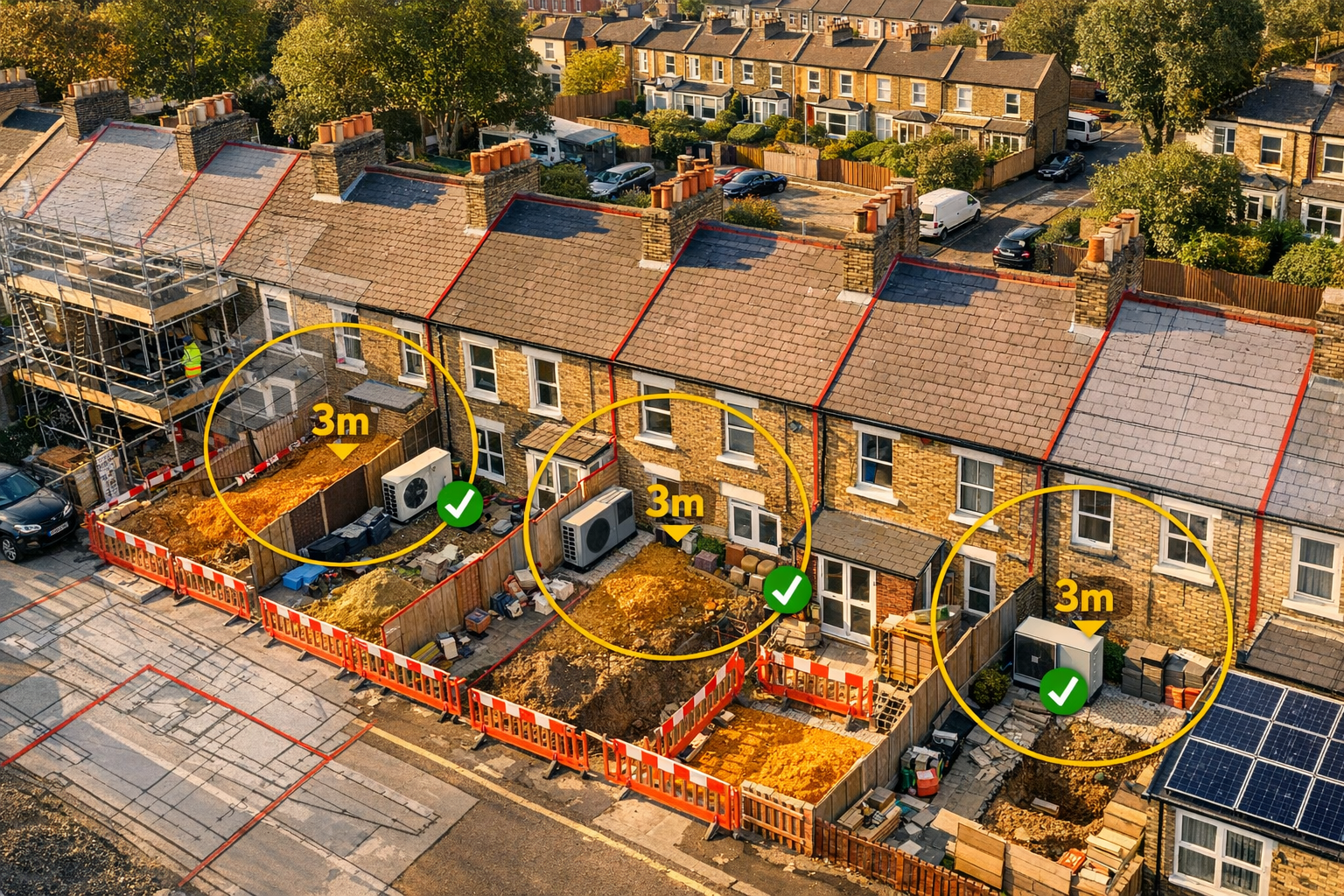
As the green retrofit boom continues throughout 2026, both surveyors and property owners must adapt their practices to meet the unique demands of heat pump installations under party wall legislation.
For Property Owners: Strategic Planning Checklist
6 Months Before Installation:
- ✅ Research heat pump options and obtain multiple quotes
- ✅ Determine if party wall procedures apply
- ✅ Budget for party wall surveyor costs (typically £700-£1,500 per party)
- ✅ Review property boundaries and identify all adjoining owners
3 Months Before Installation:
- ✅ Appoint a qualified party wall surveyor
- ✅ Obtain detailed installation plans from contractor
- ✅ Serve appropriate party wall notices
- ✅ Engage with neighbours early to explain the project
2 Months Before Installation:
- ✅ Respond to any neighbour concerns or questions
- ✅ Appoint surveyors if dispute arises
- ✅ Complete schedule of condition surveys
- ✅ Finalise party wall award
1 Month Before Installation:
- ✅ Confirm all party wall documentation is complete
- ✅ Provide contractor with copy of party wall award
- ✅ Establish communication channels with neighbours
- ✅ Schedule pre-work meeting with contractor and surveyor
During Installation:
- ✅ Ensure contractor complies with party wall award conditions
- ✅ Maintain open communication with neighbours
- ✅ Document the work with photographs
- ✅ Address any concerns immediately
Post-Installation:
- ✅ Arrange post-work inspection with surveyor
- ✅ Address any damage identified promptly
- ✅ Obtain final sign-off from party wall surveyor
- ✅ Retain all documentation for future reference
Understanding party wall consent requirements throughout this process is crucial for smooth project delivery.
For Surveyors: Professional Standards and Expertise
Party wall surveyors handling heat pump installations in 2026 must develop specialist knowledge spanning:
Technical Competencies:
- Heat pump technology and installation methods
- Building regulations Part L (conservation of fuel and power)
- Acoustic performance standards (MCS guidelines)
- Excavation techniques and foundation engineering
- Vibration monitoring and assessment
Regulatory Knowledge:
- Party Wall etc. Act 1996 (comprehensive understanding)
- Building Regulations 2010 (as amended)
- Future Homes Standard requirements
- Permitted Development rights for heat pumps
- Planning considerations in conservation areas
Survey Protocols:
- Enhanced schedule of condition documentation
- Thermal imaging for pre-existing defects
- Acoustic baseline measurements
- Foundation depth assessment techniques
- Post-installation verification procedures
Communication Skills:
- Explaining technical concepts to lay parties
- Mediating between neighbours with different priorities
- Liaising with heat pump installers and contractors
- Managing expectations about timelines and costs
Integrating Party Wall Compliance with Other Retrofit Considerations
Heat pump installations rarely occur in isolation. Property owners in 2026 are typically undertaking comprehensive retrofit packages that may include:
- Insulation upgrades (cavity wall, solid wall, loft)
- Window replacements (double or triple glazing)
- Solar panel installations (roof-mounted or ground-mounted)
- Electrical upgrades (for heat pump power requirements)
When multiple works are planned, party wall procedures can be consolidated. For example, if party wall insulation work is being undertaken simultaneously with heat pump installation, a single comprehensive party wall award can cover all works.
Similarly, if loft conversions are being completed alongside heat pump retrofits, coordinated party wall procedures can reduce overall costs and timelines.
Cost-Benefit Analysis: Party Wall Compliance vs. Non-Compliance
While party wall surveyor fees may seem like an unwelcome additional expense, the cost of non-compliance far exceeds proper procedure:
Compliance Costs:
- Party wall surveyor fees: £700-£1,500 per adjoining owner
- Schedule of condition: £300-£600
- Party wall award preparation: £800-£1,200
- Total typical cost: £1,800-£3,300
Non-Compliance Risks:
- Legal injunctions: £5,000-£15,000 in legal fees
- Project delays: Loss of grant funding, contractor rescheduling
- Retrospective awards: 50-100% premium on surveyor fees
- Damage claims: Potentially £10,000-£50,000+
- Relationship damage: Ongoing neighbour disputes
- Potential total cost: £20,000-£80,000+
The mathematics clearly favour compliance. Moreover, proper party wall procedures provide legal protection if damage does occur, as the award establishes the framework for assessment and remediation.
Future-Proofing: Party Wall Considerations for Emerging Heat Pump Technology
As heat pump technology evolves, surveyors must anticipate future party wall implications:
Hybrid Systems:
Combining heat pumps with existing boilers may require less extensive excavation but still trigger party wall procedures for external unit installation.
Shared Heat Networks:
Some developments are exploring shared ground source heat pump systems serving multiple properties. These require complex party wall agreements addressing:
- Shared infrastructure ownership
- Maintenance access rights
- Cost-sharing arrangements
- Decommissioning responsibilities
High-Temperature Heat Pumps:
New high-temperature models may have different installation requirements, potentially affecting party wall considerations.
Surveyors who develop expertise in these emerging technologies will be well-positioned to serve the market throughout the remainder of the decade.
Conclusion: Navigating Party Wall Act Compliance in the Green Retrofit Era
The intersection of net zero ambitions and property law has created unprecedented demand for specialist knowledge in Party Wall Act Compliance for Heat Pump Installations: Survey Protocols in UK's 2026 Green Retrofit Boom. As thousands of UK homeowners undertake heat pump retrofits to meet environmental targets and capitalise on government incentives, proper party wall procedures have become essential to project success.
The key principles for successful compliance are:
- Early planning – Begin party wall procedures 3-4 months before intended installation
- Professional guidance – Engage qualified surveyors with heat pump installation experience
- Comprehensive documentation – Ensure thorough schedules of condition protect all parties
- Open communication – Maintain positive neighbour relationships throughout the process
- Regulatory awareness – Understand how the 3-metre rule and excavation requirements apply to specific installations
For property owners, the modest investment in proper party wall compliance provides legal protection, preserves neighbour relationships, and ensures project completion without costly delays or disputes. For surveyors, developing specialist expertise in heat pump installations represents a significant professional opportunity in a rapidly growing market.
The 2026 green retrofit boom shows no signs of slowing, with government mandates, enhanced grants, and climate consciousness driving continued demand for heat pump installations. Those who master the party wall survey protocols specific to these installations will be best positioned to facilitate the UK's transition to net zero while protecting property rights and maintaining harmonious neighbourhoods.
Next Steps
For Property Owners Planning Heat Pump Installation:
- Consult a qualified party wall surveyor before proceeding
- Obtain detailed installation plans from your heat pump contractor
- Review our comprehensive party wall guidance
- Budget appropriately for party wall procedures
- Engage with neighbours early in the planning process
For Surveyors:
- Develop technical knowledge of heat pump installation methods
- Stay current with Building Regulations Part L updates
- Build relationships with reputable heat pump installers
- Consider specialist training in renewable energy installations
- Join professional forums discussing party wall retrofit challenges
The green retrofit revolution is transforming UK housing, and party wall compliance is the essential framework ensuring this transformation proceeds smoothly, legally, and harmoniously.
References
[1] Future Homes Standard Heat Pumps 2026 – https://www.altoenergy.co.uk/blog/future-homes-standard-heat-pumps-2026
[2] Uk Heat Pump Grants 2026 – https://www.yooparchitects.co.uk/eco-friendly-homes/uk-heat-pump-grants-2026/
[3] Prs Homes Energy Performance Government Response – https://assets.publishing.service.gov.uk/media/69722b193f2908a349040547/prs-homes-energy-performance-government-response.pdf
[4] The New Decent Homes Standard Policy Statement – https://www.gov.uk/government/consultations/consultation-on-a-reformed-decent-homes-standard-for-social-and-privately-rented-homes/outcome/the-new-decent-homes-standard-policy-statement
[5] New Epc Rules – https://theindependentlandlord.com/new-epc-rules/
[6] Party Wall Agreements In Data Centre Developments 2026 Compliance Amid Ai Driven Uk Demand – https://nottinghillsurveyors.com/blog/party-wall-agreements-in-data-centre-developments-2026-compliance-amid-ai-driven-uk-demand