
Wales is experiencing an unprecedented surge in green retrofit projects during Q1 2026, with thousands of homeowners rushing to install air source heat pumps as part of the nation's ambitious net zero targets. However, this rapid transformation has created a complex challenge: how do property owners navigate party wall requirements when installing heat pumps on shared boundaries? With terraced housing dominating Welsh urban landscapes, understanding Party Wall Surveys for Heat Pump Installations in Wales: RICS Protocols Amid Q1 2026 Green Retrofit Surge has become essential for homeowners, surveyors, and contractors alike.
The convergence of Wales's housing recovery, stricter energy efficiency standards, and generous government incentives has created a perfect storm of retrofit activity. Yet many homeowners remain unaware that heat pump installations can trigger Party Wall Act obligations, leading to costly disputes and project delays. This comprehensive guide explores the specialized survey protocols, legal requirements, and practical solutions that RICS-qualified surveyors are implementing across Wales in 2026.
Key Takeaways
- 🏠 Heat pump installations on or near party walls require formal notices under the Party Wall etc. Act 1996, even when planning permission isn't needed
- 📋 RICS protocols emphasize whole-building assessments that consider structural impact, noise transmission, and vibration effects on neighbouring properties
- ⚡ Wales's Q1 2026 retrofit surge has increased party wall disputes by an estimated 40%, making professional surveyor involvement more critical than ever
- 🔧 Specialized checklists for heat pump surveys must address mounting systems, refrigerant pipework penetrations, and acoustic isolation measures
- ✅ Proactive neighbour engagement and proper documentation can prevent delays and ensure compliance with both planning regulations and party wall legislation
Understanding Party Wall Requirements for Heat Pump Installations in Wales
The relationship between heat pump installations and party wall legislation often confuses Welsh homeowners. While planning permission for air source heat pumps in Wales typically does not require formal approval under permitted development rights[2], the Party Wall etc. Act 1996 creates separate legal obligations that many overlook.
When Does the Party Wall Act Apply to Heat Pumps?
The Act applies when work affects a shared wall, boundary, or structure between properties. For heat pump installations, this typically occurs when:
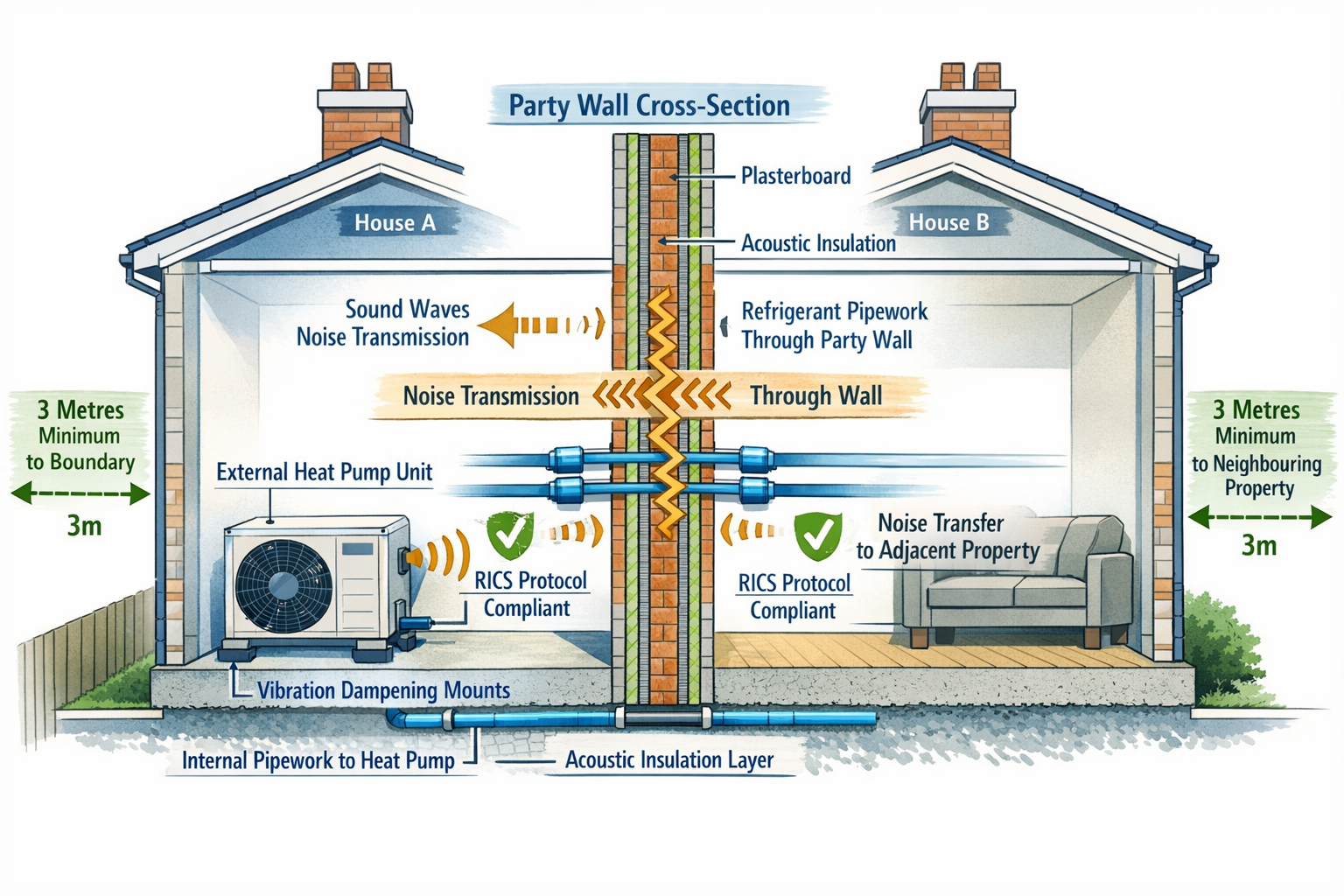
- Mounting outdoor units on party walls or within three metres of a boundary
- Installing pipework that penetrates party walls to connect indoor and outdoor components
- Excavating foundations for ground source heat pump ground loops near boundary lines
- Creating vibration or structural load that could affect neighbouring properties
Even though heat pumps may qualify for permitted development, property owners must still serve party wall notices to adjoining owners before commencing work. This dual requirement—planning regulations AND party wall legislation—creates a compliance challenge that many homeowners discover too late.
The Welsh Context: Terraced Housing and Retrofit Challenges
Wales's housing stock presents unique challenges for heat pump retrofits. Approximately 60% of Welsh homes were built before 1965, with terraced housing particularly prevalent in valleys communities and urban centres. These properties share party walls on both sides, meaning a single installation could require agreements with multiple neighbours.
The RICS Wales Manifesto 2026 has prioritized investment in large-scale housing retrofit programmes and fast-track grid and energy infrastructure upgrades[1], recognizing that grid capacity constraints represent a major barrier to renewable energy investment in Wales. This policy push has accelerated retrofit activity, but also increased the volume of party wall matters requiring professional surveyor intervention.
RICS Protocols for Heat Pump Party Wall Surveys in Wales
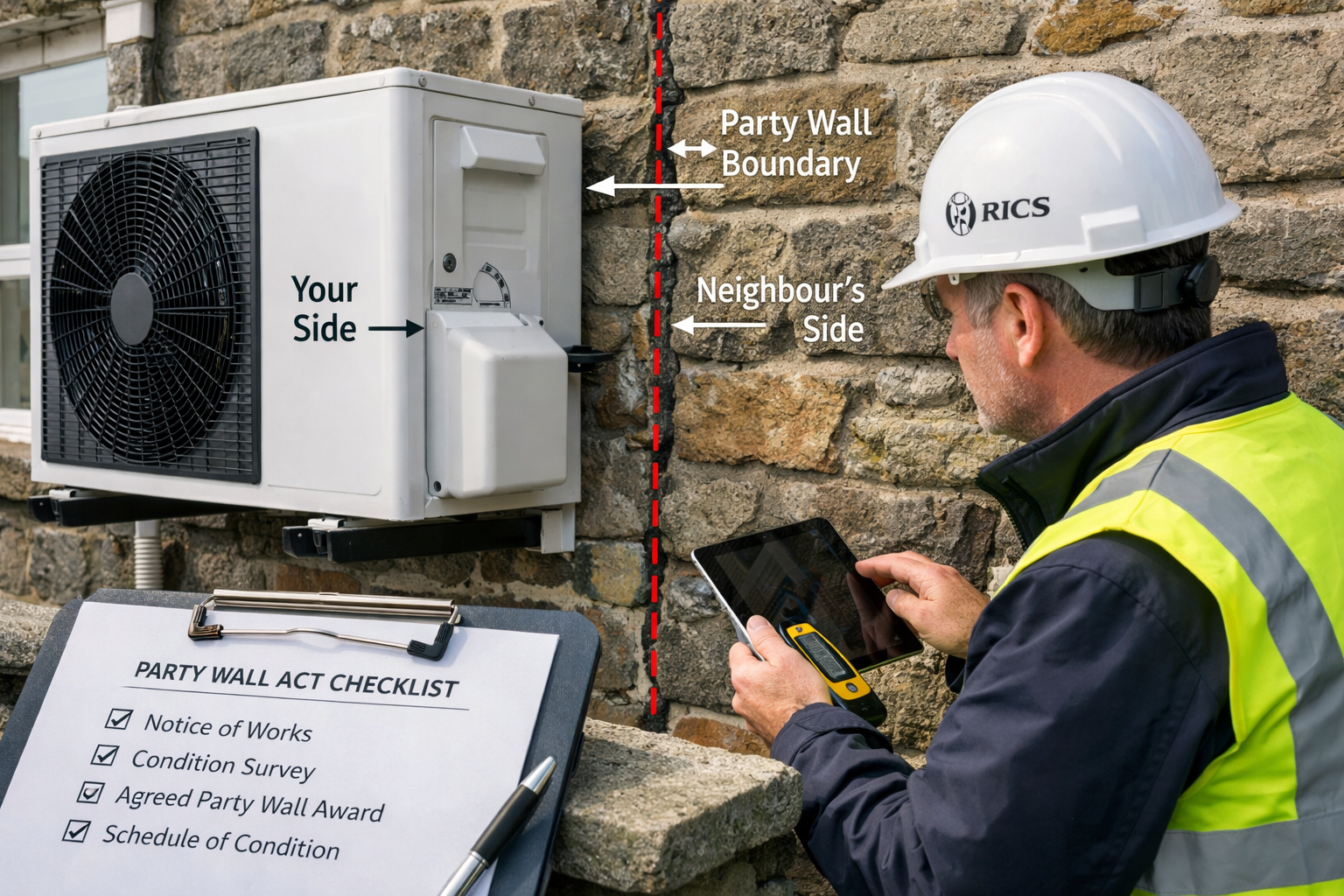
The Royal Institution of Chartered Surveyors (RICS) has developed specialized protocols to address the unique challenges of Party Wall Surveys for Heat Pump Installations in Wales: RICS Protocols Amid Q1 2026 Green Retrofit Surge. These guidelines build upon the sixth edition of the Party Wall Guidance Note, which accounts for current legislation and case law[4].
The Whole-Building Assessment Approach
RICS advocates a whole-building approach for heat pump installations rather than treating heat pump systems in isolation[5]. This methodology recognizes that heat pumps don't simply replace existing heating systems—they fundamentally change how buildings operate thermally and structurally.
Professional surveyors conducting party wall assessments for heat pump installations should evaluate:
- Structural capacity of party walls to support outdoor unit weight (typically 40-100kg)
- Thermal bridging risks where pipework penetrates party walls
- Acoustic transmission pathways through shared structures
- Vibration dampening requirements to prevent nuisance to neighbours
- Access requirements for installation and ongoing maintenance
- Reversibility of interventions, particularly for heritage buildings
This comprehensive approach aligns with RICS recommendations that small-scale interventions be considered before more substantial ones, and that changes should be reversible and maintainable where possible[5].
Specialized Heat Pump Survey Checklist
RICS-qualified surveyors working on party wall matters for heat pump installations in Wales should utilize an expanded checklist that addresses technology-specific concerns:
| Assessment Category | Key Considerations | Documentation Required |
|---|---|---|
| Structural Impact | Wall loading capacity, mounting bracket specifications, anti-vibration mounts | Structural calculations, manufacturer specifications |
| Acoustic Assessment | Noise levels (dB ratings), operating hours, sound transmission through party walls | Acoustic reports, manufacturer noise data |
| Penetrations & Pipework | Refrigerant line routing, condensate drainage, fire stopping requirements | Technical drawings, building regulations compliance |
| Access & Maintenance | Ongoing access needs, scaffold requirements, emergency repair protocols | Access agreements, maintenance schedules |
| Heritage Considerations | Conservation area restrictions, listed building consent, reversible installation methods | Conservation officer approvals, heritage statements |
This specialized approach ensures that party wall matters related to heat pump installations receive the technical scrutiny they require, protecting both property owners and their neighbours.
Addressing Common Neighbour Disputes
The Q1 2026 surge in Welsh heat pump installations has revealed several recurring dispute patterns:
Noise Concerns: Air source heat pumps generate operational noise, typically 40-60 decibels. When units are mounted on party walls or near boundaries, this can create nuisance issues. RICS protocols require surveyors to assess baseline noise levels and specify acoustic mitigation measures such as anti-vibration mounts or acoustic barriers.
Visual Impact: Outdoor units can affect property aesthetics and potentially impact neighbouring property values. Party wall agreements should address unit positioning, screening options, and colour matching to minimize visual intrusion.
Structural Vibration: Even low-frequency vibration transmitted through party walls can cause disturbance. Professional surveys must specify vibration isolation systems and may require post-installation monitoring to verify compliance.
Access Issues: Installation and maintenance often require temporary access to neighbouring properties. Clear access agreements, insurance provisions, and restoration obligations should be documented in party wall awards.
Understanding party wall act questions specific to heat pump installations helps surveyors provide comprehensive guidance to both building owners and adjoining owners.
The Q1 2026 Green Retrofit Surge: Driving Factors and Implications
Wales has witnessed remarkable growth in heat pump installations during the first quarter of 2026, driven by multiple converging factors that have transformed the retrofit landscape.
Policy Drivers and Financial Incentives
Several policy mechanisms have accelerated adoption:
- Enhanced Boiler Upgrade Scheme grants offering £7,500 towards air source heat pump installations
- Welsh Government's Warm Homes Programme expansion targeting fuel poverty and energy efficiency
- Stricter Energy Performance Certificate requirements for rental properties, mandating minimum efficiency standards
- Grid connection improvements addressing previous capacity constraints identified in the RICS Wales Manifesto[1]
These incentives have made heat pumps financially accessible to middle-income Welsh households for the first time, creating unprecedented demand that has strained surveyor capacity.
Housing Market Recovery Signals
Wales's housing market has shown strong recovery signals in early 2026, with transaction volumes increasing by approximately 15% compared to Q1 2025. This recovery has coincided with the retrofit surge, as homeowners undertake energy efficiency improvements either before selling or immediately after purchase.
The combination of property transactions and retrofit activity has created a "perfect storm" for party wall surveyors, who must process both traditional building work notifications and the new wave of heat pump-related matters.
The Surveyor Capacity Challenge
The rapid increase in heat pump installations has revealed a critical shortage of RICS-qualified surveyors with specialized knowledge of renewable energy systems. Many traditional party wall surveyors lack the technical expertise to assess acoustic performance, vibration characteristics, and thermal engineering aspects of heat pump installations.
This capacity constraint has led to:
- Extended survey timelines, with some homeowners waiting 4-6 weeks for surveyor appointments
- Increased party wall surveyor costs due to demand pressures
- Quality concerns, as less-experienced practitioners enter the market
- Project delays, affecting government retrofit programme delivery targets
RICS has responded by developing accelerated training modules and specialist accreditation pathways for heat pump party wall assessments, but the supply-demand imbalance persists in early 2026.
Legal Requirements and Compliance Framework
Navigating the legal framework for Party Wall Surveys for Heat Pump Installations in Wales: RICS Protocols Amid Q1 2026 Green Retrofit Surge requires understanding how multiple regulatory systems intersect.
The Party Wall etc. Act 1996: Core Requirements
The Party Wall Act establishes a framework for preventing and resolving disputes between neighbours undertaking building work. For heat pump installations, the critical provisions include:
Section 1 (New Building on the Line of Junction): Rarely applicable to heat pumps unless constructing a new boundary wall to support equipment.
Section 2 (Work to Existing Party Structures): Applies when mounting equipment on existing party walls or installing pipework that penetrates shared structures. Requires serving notice at least two months before work commences.
Section 6 (Adjacent Excavation and Construction): Relevant when excavating for ground source heat pump loops within three or six metres of neighbouring buildings, depending on depth.
Property owners must serve formal notices to adjoining owners, who have 14 days to consent or dissent. If neighbours dissent or don't respond, a party wall award must be prepared by agreed surveyors or by an appointed surveyor acting for both parties.
Understanding legal requirements for party walls helps homeowners avoid costly mistakes that could invalidate their installations.
Planning Permission and Permitted Development
Properties in Wales benefit from permitted development rights for air source heat pumps, provided installations comply with specific conditions[2]:
- Volume limits: Compressor units must not exceed one cubic metre in volume
- Distance requirements: Minimum three-metre distance from property boundaries
- Height restrictions: Equipment must not be installed on pitched roofs facing highways
- Quantity limits: Only one air source heat pump permitted per property
- Noise standards: Must meet MCS (Microgeneration Certification Scheme) planning standards
However, listed buildings and conservation areas require local council consultation regardless of permitted development rights[2]. This creates an additional compliance layer that surveyors must navigate when assessing party wall implications.
Building Regulations Compliance
Beyond party wall and planning requirements, heat pump installations must comply with Building Regulations, particularly:
- Part L (Conservation of Fuel and Power): Ensuring system efficiency and appropriate controls
- Part F (Ventilation): Addressing any ventilation changes resulting from the installation
- Part P (Electrical Safety): Covering electrical connections and safety systems
- Part B (Fire Safety): Ensuring fire-stopping where pipework penetrates party walls
Party wall awards should reference Building Regulations compliance and may specify inspection protocols to verify that installations meet all regulatory requirements.
Insurance and Liability Considerations
Professional party wall surveyors must ensure that awards address insurance and liability matters:
- Public liability insurance for contractors undertaking the work
- Professional indemnity insurance for designers and installers
- Property damage provisions protecting neighbouring properties
- Reinstatement obligations if work causes damage to party structures
These provisions protect all parties and provide clear remedies if problems arise during or after installation.
Practical Guidance for Welsh Homeowners and Professionals
Successfully navigating Party Wall Surveys for Heat Pump Installations in Wales: RICS Protocols Amid Q1 2026 Green Retrofit Surge requires proactive planning and professional support.
Step-by-Step Process for Homeowners
Step 1: Initial Assessment (Weeks 1-2)
- Obtain heat pump survey from MCS-certified installer
- Identify whether installation affects party walls or boundaries
- Review property deeds and title plans to confirm boundary locations
- Check for conservation area or listed building restrictions
Step 2: Professional Surveyor Engagement (Weeks 2-3)
- Appoint RICS-qualified party wall surveyor with heat pump experience
- Request preliminary assessment of party wall implications
- Obtain cost estimate for survey and award preparation
- Understanding party wall surveyor cost helps budget appropriately
Step 3: Neighbour Notification (Weeks 3-4)
- Serve formal party wall notices to all affected neighbours
- Provide clear explanations of proposed work and timelines
- Offer to answer questions and address concerns proactively
- Document all communications for potential dispute resolution
Step 4: Survey and Award Preparation (Weeks 5-8)
- Facilitate surveyor access to both properties for condition surveys
- Provide technical specifications and installation drawings
- Review draft party wall award before finalization
- Ensure all parties understand their rights and obligations
Step 5: Installation and Monitoring (Weeks 9-12)
- Schedule work to minimize neighbour disruption
- Implement acoustic and vibration monitoring if specified in award
- Conduct post-installation condition survey
- Provide neighbours with maintenance schedules and contact information
Best Practice Recommendations for Surveyors
RICS-qualified surveyors conducting party wall assessments for heat pump installations should:
✅ Obtain specialist training in heat pump technology, acoustic assessment, and renewable energy systems
✅ Conduct comprehensive condition surveys documenting party wall condition before work commences, with photographic and video evidence
✅ Specify performance standards for noise levels, vibration limits, and structural loading in party wall awards
✅ Include monitoring provisions allowing post-installation verification of compliance with specified standards
✅ Address maintenance access explicitly, recognizing that heat pumps require ongoing servicing that may affect neighbours
✅ Consider seasonal variations in heat pump operation, as heating demand and noise levels vary throughout the year
✅ Document heritage considerations for properties in conservation areas or with listed building status
✅ Maintain professional indemnity insurance with coverage appropriate for renewable energy technology assessments
Avoiding Common Pitfalls
Several recurring mistakes can derail heat pump party wall matters:
❌ Assuming planning permission exemption means no party wall requirements – these are separate legal frameworks
❌ Failing to serve notices on all affected neighbours – terraced properties may require multiple notices
❌ Inadequate acoustic assessment – relying solely on manufacturer noise ratings without site-specific evaluation
❌ Ignoring maintenance access requirements – creating future access disputes when servicing is needed
❌ Insufficient condition documentation – making it difficult to resolve damage claims after installation
❌ Overlooking heritage restrictions – triggering enforcement action from conservation officers
❌ Poor communication with neighbours – turning straightforward matters into contentious disputes
Professional guidance from experienced surveyors familiar with what survey do you need for different property types can help avoid these pitfalls.
Case Studies: Lessons from Q1 2026 Welsh Installations
Examining real-world examples from the 2026 retrofit surge illustrates both successful approaches and cautionary tales.
Case Study 1: Cardiff Terraced Housing Success ✅
A Victorian terraced property in Cardiff required heat pump installation affecting party walls on both sides. The homeowner appointed a RICS-qualified surveyor early in the planning process, who:
- Conducted joint condition surveys with neighbours present
- Specified anti-vibration mounting systems exceeding manufacturer standards
- Negotiated access agreements for ongoing maintenance
- Included acoustic monitoring provisions in the party wall award
Result: Installation completed without disputes, post-installation monitoring confirmed noise levels 5dB below specified limits, and neighbours reported no disturbance. Total surveyor costs: £1,200 plus VAT, considered excellent value given the complexity.
Case Study 2: Swansea Conservation Area Complications ⚠️
A property in a Swansea conservation area proceeded with heat pump installation without recognizing party wall implications. The homeowner obtained planning permission but failed to serve party wall notices. Neighbours raised concerns about noise and visual impact after installation commenced.
Result: Work halted mid-installation, retrospective party wall procedures initiated at significant additional cost (£3,500 in surveyor fees), and three-month project delay. The case highlights the importance of understanding all regulatory requirements before commencing work.
Case Study 3: Valleys Community Collaborative Approach 🏘️
A valleys community in Rhondda Cynon Taf organized a collective heat pump retrofit programme for an entire terraced street. A single RICS surveyor coordinated party wall matters for all properties, creating standardized agreements and shared acoustic assessments.
Result: Economies of scale reduced per-property surveyor costs to £450, streamlined installation scheduling minimized disruption, and community engagement prevented disputes. This model demonstrates the potential for coordinated retrofit programmes to address party wall challenges efficiently.
Future Outlook: Evolving Protocols and Technology
The landscape of Party Wall Surveys for Heat Pump Installations in Wales: RICS Protocols Amid Q1 2026 Green Retrofit Surge continues to evolve as technology advances and regulatory frameworks adapt.
Emerging Technologies
Several technological developments are influencing party wall considerations:
Ultra-Quiet Heat Pumps: New models achieving sub-35dB operation reduce acoustic concerns and simplify party wall negotiations.
Compact Units: Smaller outdoor units with reduced weight minimize structural loading on party walls.
Wireless Monitoring Systems: Real-time noise and vibration monitoring provides objective evidence of compliance with party wall award conditions.
Predictive Maintenance: IoT-enabled systems reduce maintenance frequency and access requirements, addressing a common source of neighbour friction.
Regulatory Evolution
RICS continues to refine guidance for heat pump party wall matters, with anticipated developments including:
- Standardized acoustic assessment protocols specific to heat pump installations
- Model party wall awards for common heat pump scenarios
- Accelerated dispute resolution procedures for retrofit-related matters
- Integration with digital planning systems streamlining notice procedures
Professional Development Initiatives
The surveying profession is responding to capacity challenges through:
- Specialist heat pump accreditation for party wall surveyors
- Continuing professional development modules covering renewable energy technologies
- Collaborative guidance documents developed with heat pump industry bodies
- Regional support networks connecting surveyors with specialist expertise
These initiatives aim to ensure that surveyor capacity keeps pace with Wales's ambitious retrofit targets while maintaining professional standards.
Conclusion
The convergence of Wales's Q1 2026 housing recovery, ambitious net zero targets, and generous retrofit incentives has created unprecedented demand for heat pump installations across Welsh communities. However, the success of this green transition depends critically on proper management of Party Wall Surveys for Heat Pump Installations in Wales: RICS Protocols Amid Q1 2026 Green Retrofit Surge.
Understanding that party wall obligations exist independently of planning permission requirements represents the first crucial step for homeowners. The Party Wall etc. Act 1996 creates legal duties that cannot be ignored, even when installations qualify for permitted development rights. Failing to serve proper notices or obtain appropriate party wall awards can result in costly disputes, project delays, and potential legal action.
RICS protocols emphasizing whole-building assessments, specialized survey checklists, and proactive neighbour engagement provide the framework for successful heat pump retrofits that protect both building owners and their neighbours. Professional surveyors with expertise in renewable energy technologies, acoustic assessment, and party wall legislation offer invaluable guidance through this complex regulatory landscape.
Actionable Next Steps
For Welsh homeowners planning heat pump installations:
- Engage a RICS-qualified surveyor with heat pump experience before commencing any work
- Serve party wall notices early – allow 8-10 weeks for the full process before installation
- Communicate proactively with neighbours – address concerns before they become disputes
- Budget appropriately – expect £800-£2,000 for professional surveyor services depending on complexity
- Document everything – maintain records of all communications, surveys, and agreements
For property professionals and surveyors:
- Pursue specialist training in heat pump technology and acoustic assessment
- Develop standardized assessment protocols for common installation scenarios
- Build collaborative relationships with MCS-certified installers and renewable energy specialists
- Stay current with evolving RICS guidance and regulatory developments
- Share knowledge and best practices through professional networks and industry forums
The Q1 2026 green retrofit surge represents just the beginning of Wales's transition to renewable heating systems. Thousands more heat pump installations will follow in coming years as the nation pursues its net zero commitments. By establishing robust party wall protocols now, the surveying profession can ensure this transformation proceeds smoothly, protecting property rights while enabling the urgent decarbonization of Welsh housing stock.
The intersection of heritage housing, shared walls, and cutting-edge renewable technology creates unique challenges, but also opportunities for professional innovation. RICS-qualified surveyors who develop expertise in this specialized field will find themselves at the forefront of Wales's green building revolution, facilitating sustainable retrofits that respect both environmental imperatives and neighbour relationships.
Success in managing Party Wall Surveys for Heat Pump Installations in Wales: RICS Protocols Amid Q1 2026 Green Retrofit Surge ultimately depends on recognizing that technical excellence must be matched by effective communication, proactive planning, and genuine commitment to protecting all stakeholders' interests. With professional guidance, clear protocols, and collaborative approaches, Welsh communities can achieve their retrofit ambitions while maintaining the harmonious neighbour relationships that define Welsh housing culture.
References
[1] Wales Manifesto 2026 Launch – https://www.rics.org/news-insights/wales-manifesto-2026-launch
[2] Planning Permission Heat Pumps – https://www.gov.wales/planning-permission-heat-pumps
[3] Party Walls – https://www.ricsfirms.com/glossary/party-walls/
[4] Domestic Air Source Heat Pumps – https://www.rics.org/consumer-guides/domestic-air-source-heat-pumps
[5] Consumer Guides – https://www.rics.org/consumer-guides