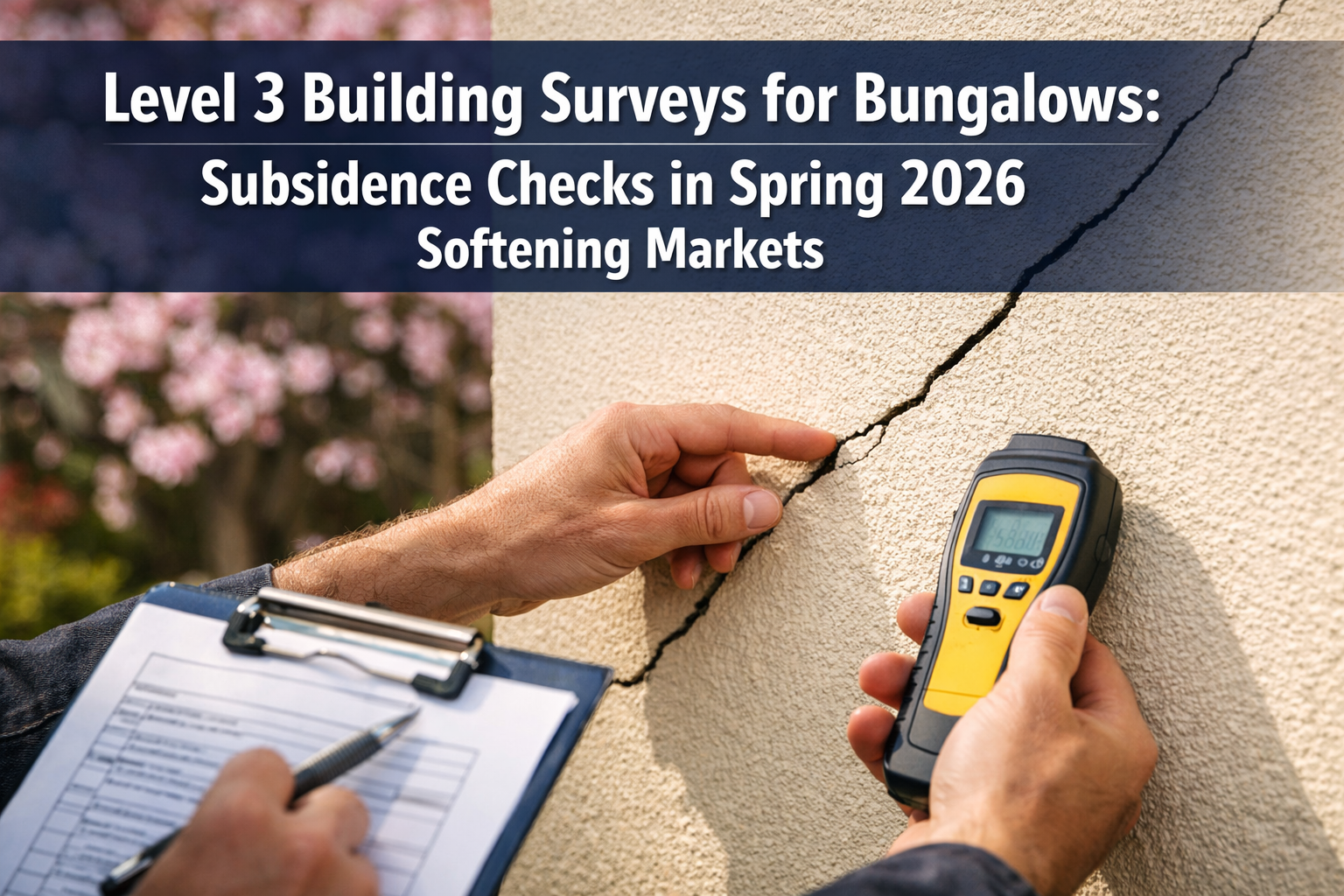

Buyer enquiries have plummeted by 26% across UK property markets in spring 2026, creating an environment where cautious purchasers demand comprehensive structural assessments before committing to bungalow purchases. This dramatic decline in market activity means that Level 3 Building Surveys for Bungalows Under Spring 2026 Weak Enquiries: Subsidence Checks in Softening Markets have become essential tools for risk-averse buyers navigating uncertain conditions. With many bungalows situated on clay soils prone to seasonal movement, thorough subsidence checks are no longer optional extras but critical components of due diligence.
The combination of softening market conditions and the unique structural vulnerabilities of single-storey properties has elevated the importance of detailed professional inspections. Buyers who skip comprehensive surveys in 2026 risk inheriting costly structural problems that sellers may be increasingly motivated to conceal as properties languish on the market.
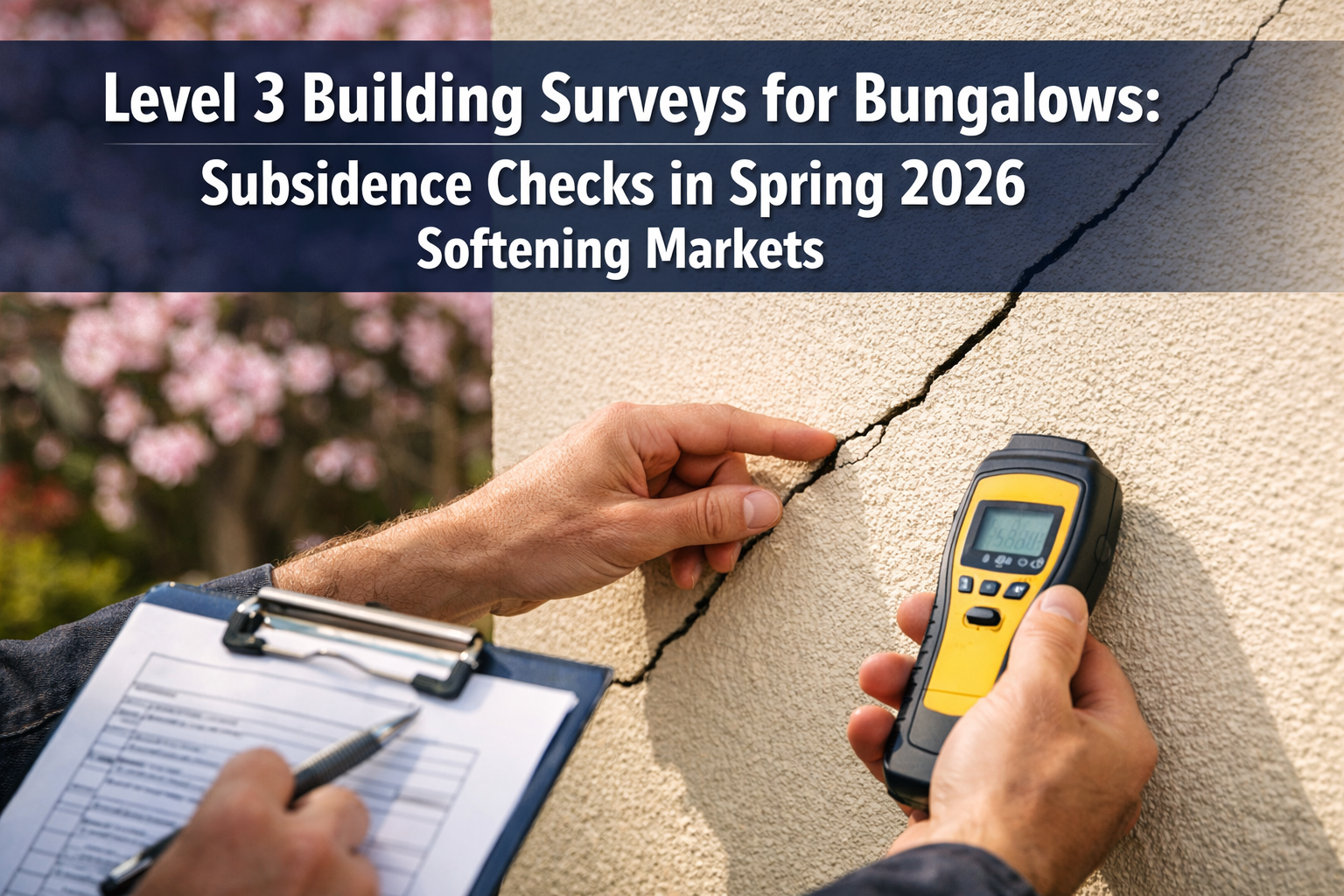
Key Takeaways
- Level 3 surveys cost £700-£1,200 in 2026 and provide the most comprehensive residential inspection available, essential for bungalows with structural risks [2]
- Subsidence checks are included as standard in Level 3 surveys, with detailed examination of crack patterns, foundation movement, and drainage issues [1]
- Spring 2026's 26% decline in buyer enquiries creates a buyer's market where thorough surveys provide negotiating leverage and protect against hidden defects
- Bungalows built before 1990 or with extensions should always receive Level 3 surveys due to higher structural risk profiles [2]
- Specialist follow-up reports cost £500-£1,500 if initial surveys identify significant subsidence, roof spread, or moisture problems requiring detailed investigation [1]
Understanding Level 3 Building Surveys for Bungalows Under Spring 2026 Weak Enquiries: Subsidence Checks in Softening Markets
What Makes Level 3 Surveys Essential for Bungalows
Level 3 surveys represent the most thorough residential property inspection available in the UK market. Unlike basic valuations or mid-level homebuyer reports, these comprehensive assessments provide detailed analysis of structural condition, building materials, significant defects, and remedial recommendations [4]. For bungalows specifically, this depth of inspection proves invaluable due to several architectural characteristics that increase vulnerability.
Single-storey construction means that roof structures span greater distances without intermediate support, making bungalows particularly susceptible to roof spread where walls gradually bow outward under the weight of the roof. Additionally, many bungalows were constructed during the 1960s-1980s building boom using materials and techniques that have aged poorly, including cavity wall ties prone to corrosion and inadequate foundation depths.
The spring 2026 market downturn has fundamentally altered the risk-reward calculation for property purchases. With fewer competing buyers and properties remaining unsold for longer periods, purchasers can afford to be selective and demand comprehensive information before proceeding. A Level 3 survey provides the detailed intelligence needed to negotiate price reductions or request repairs as conditions of sale.
Subsidence Risk Factors Specific to Bungalows
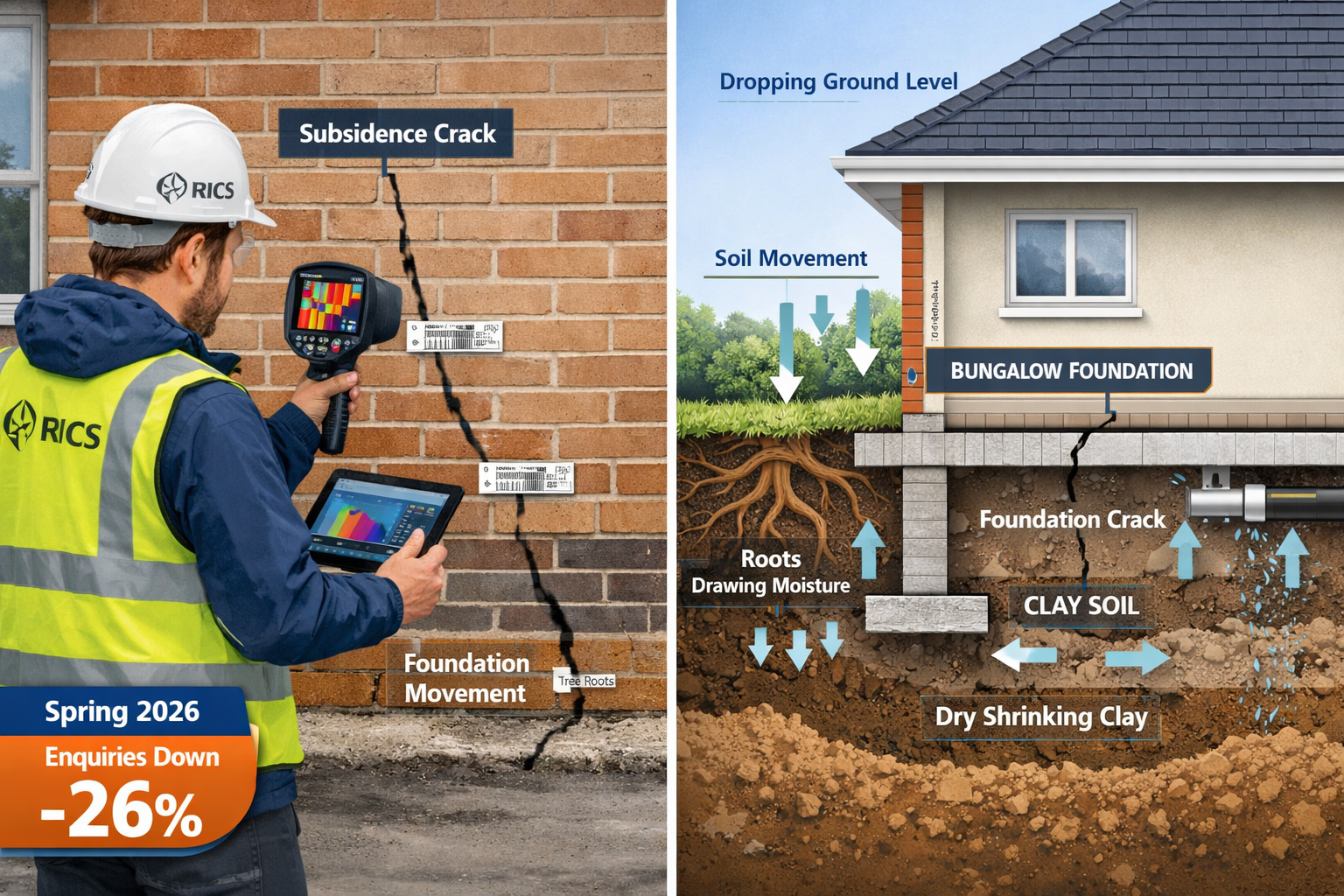
Bungalows face unique subsidence challenges that make thorough foundation assessments critical. Their typically shallow foundation depths (often just 600-900mm compared to 1000mm+ for two-storey properties) provide less resistance to ground movement. This becomes particularly problematic on clay soils, which expand when wet and contract during dry periods, creating cyclical stress on foundations.
Common subsidence indicators that Level 3 surveyors examine include:
- Diagonal cracks wider than 3mm extending from corners of windows and doors
- Stepped cracking in brickwork following mortar joints in a staircase pattern
- Doors and windows that stick or show gaps around frames
- Visible gaps between walls and ceilings or between walls and floors
- Rippling or distortion in brickwork indicating foundation settlement
The geographical distribution of subsidence risk varies significantly across the UK. Properties in the South East, East Anglia, and parts of the Midlands face elevated risk due to extensive clay soil deposits. London clay, in particular, creates challenging conditions for older bungalows that may have been built without adequate foundation engineering.
Tree proximity represents another critical factor. Mature trees within 20 meters of a bungalow can extract substantial moisture from clay soils during growing seasons, causing ground contraction and differential settlement. Species like oak, willow, poplar, and elm pose the highest risk due to their extensive root systems and high water demands.
The Spring 2026 Market Context
The 26% decline in buyer enquiries during spring 2026 reflects broader economic uncertainties, including interest rate pressures and affordability constraints. This softening market creates a paradoxical situation where buyers have increased negotiating power but face potentially greater risks from sellers who may defer maintenance or attempt to conceal defects while waiting for market conditions to improve.
For bungalow buyers specifically, this environment makes comprehensive surveys even more valuable. Properties that have been on the market for extended periods may have developed or worsened structural issues during the listing period. Sellers facing financial pressure may be less forthcoming about known problems, making independent professional assessment essential.
The reduced competition also means buyers can take time to commission proper surveys without fear of losing properties to rival bidders. This represents a significant shift from the frenzied markets of 2020-2022, where survey contingencies were sometimes waived to secure purchases. In 2026, there's no excuse for proceeding without thorough due diligence.
Comprehensive Subsidence Checks: What Level 3 Surveys Include
Foundation and Structural Movement Assessment
Level 3 surveys include systematic examination of foundations and structural elements to identify signs of movement or settlement. Surveyors assess crack patterns, widths, and orientations to determine whether observed defects indicate active subsidence, historic settlement, or benign thermal movement [1].
The inspection process includes:
External examination: Surveyors walk the entire perimeter of the property, examining all elevations for crack patterns, bulging walls, leaning chimneys, and other movement indicators. Binoculars are used to inspect high-level features like eaves, fascias, and roof lines for distortion.
Internal assessment: All accessible rooms are inspected for cracks in plasterwork, uneven floors, sticking doors, and gaps around joinery. Spirit levels may be used to check floor and ceiling planes for deviation from horizontal.
Drainage inspection: Level 3 surveys include lifting inspection chamber covers to observe drain operation and check for blockages, root intrusion, or structural defects that might contribute to ground instability [4]. Poor drainage can saturate clay soils, triggering heave (upward ground movement) that's equally damaging as subsidence.
Monitoring recommendations: If cracks or movement are identified but their activity status is unclear, surveyors may recommend installing monitoring strips or tell-tales across cracks to track any progression over 6-12 months before purchase completion.
For properties showing clear signs of subsidence, surveyors will recommend specialist subsidence surveys that may include trial pit excavations to expose foundation depths, ground investigation boreholes to assess soil conditions, and structural engineering calculations to design remedial works.
Roof Structure and Roof Spread Evaluation
Bungalows commonly experience roof spread, a structural defect where the weight of the roof pushes external walls outward at eaves level. This occurs when roof structures lack adequate horizontal restraint (collar ties, purlins, or ceiling joists) or when these elements have failed through timber decay or inadequate connections.
Level 3 surveys specifically include entry into roof spaces to visually inspect roof structure and identify deterioration-prone areas [4]. Surveyors examine:
- Timber condition: Checking for rot, woodworm infestation, or structural damage to rafters, purlins, ridge boards, and ceiling joists
- Structural adequacy: Assessing whether the roof structure has appropriate bracing and whether spanning timbers are adequately sized for their loads
- Wall plate connections: Examining how roof timbers connect to supporting walls and whether these connections show signs of movement
- Insulation assessment: Thermal insulation is partially lifted to assess thickness and type, which also allows inspection of ceiling joists and detection of any condensation-related timber decay [4]
Roof spread typically manifests as horizontal cracks at eaves level where walls meet the roof structure. In severe cases, walls may lean outward visibly, and the roof ridge may sag. These defects require structural intervention, often involving installation of steel tie rods or reinforced collar ties to restrain outward wall movement.
A comprehensive roof survey may be recommended as a follow-up if significant concerns are identified during the Level 3 inspection. For properties where roof access is difficult or hazardous, drone roof surveys provide detailed visual assessment without physical access requirements.
Moisture, Damp, and Drainage Issues
Moisture problems in bungalows often connect directly to subsidence risk, as water infiltration can destabilize foundations and accelerate structural deterioration. Level 3 surveys include systematic assessment of:
Rising damp: Caused by failed or absent damp-proof courses, this allows ground moisture to wick upward through masonry. Surveyors use moisture meters to measure wall dampness levels and assess damp-proof course integrity.
Penetrating damp: Results from defective external walls, failed pointing, cracked render, or inadequate weatherproofing. Particularly common in bungalows with low-pitched roofs where water can penetrate at eaves level.
Condensation: Single-storey properties with limited ventilation often experience condensation problems, especially in bathrooms and kitchens. While not directly structural, chronic condensation can cause timber decay and mold growth.
Drainage defects: As noted earlier, Level 3 surveys include lifting drainage inspection covers to observe system operation [4]. Surveyors check for:
- Adequate fall on drainage pipes
- Signs of blockages or slow drainage
- Cracked or displaced drainage components
- Root intrusion from nearby vegetation
- Adequate surface water drainage away from foundations
Properties showing significant moisture problems may require specialist investigations including CCTV drainage surveys, invasive damp investigations, or thermal imaging surveys to identify hidden moisture pathways.
Cost-Benefit Analysis: Level 3 Surveys in Softening Markets
Survey Costs vs. Risk Exposure
Level 3 surveys typically cost £700-£1,200 in 2026, with pricing varying based on property size, location, and complexity [2]. For a typical three-bedroom bungalow, buyers should budget toward the upper end of this range, particularly if the property is older or shows visible defects.
This investment must be weighed against potential risk exposure:
| Risk Category | Typical Repair Cost | Detection Probability |
|---|---|---|
| Minor subsidence (crack repair) | £3,000-£8,000 | High ✅ |
| Moderate subsidence (underpinning) | £15,000-£30,000 | High ✅ |
| Severe subsidence (extensive underpinning) | £30,000-£60,000+ | High ✅ |
| Roof spread repair | £5,000-£15,000 | High ✅ |
| Re-roofing (full replacement) | £8,000-£18,000 | Medium ⚠️ |
| Drainage system replacement | £4,000-£12,000 | Medium ⚠️ |
| Damp-proofing and replastering | £3,000-£8,000 | High ✅ |
A £900 survey that identifies £25,000 worth of subsidence repairs provides exceptional return on investment. Even if the survey identifies no significant defects, the peace of mind and negotiating confidence justify the expense in uncertain market conditions.
Negotiating Leverage in Weak Markets
The spring 2026 market downturn fundamentally shifts negotiating dynamics. With properties taking longer to sell and fewer competing buyers, comprehensive survey findings provide substantial leverage for price reductions or repair requirements.
Strategic approaches include:
Price reduction negotiation: Survey findings documenting structural defects provide objective justification for reduced offers. In soft markets, sellers facing carrying costs (mortgage payments, maintenance, insurance) may accept significant reductions rather than returning to an uncertain market.
Retention agreements: Buyers can negotiate for funds to be retained from the sale proceeds in escrow until specified repairs are completed. This protects buyers while allowing transactions to proceed.
Seller-funded repairs: In competitive situations (even in soft markets), buyers may require sellers to complete identified repairs before completion as a condition of purchase.
Insurance implications: Survey findings help buyers assess whether properties will be insurable at reasonable premiums. Subsidence history or active movement can significantly increase insurance costs or make coverage unavailable, affecting long-term ownership economics.
Understanding what survey you need helps buyers match inspection scope to their specific risk tolerance and property characteristics.
When to Commission Specialist Follow-Up Reports
Level 3 surveys sometimes identify issues requiring specialist investigation beyond the surveyor's scope. Follow-up reports typically cost £500-£1,500 depending on complexity [1].
Common specialist investigations include:
Structural engineer reports: Required when significant structural movement, inadequate foundations, or major alterations are identified. Engineers provide calculations and remedial design specifications.
Drainage CCTV surveys: When drainage defects are suspected but not fully visible during standard inspection. Cameras inserted into drainage pipes provide detailed condition assessment.
Timber and damp specialists: For properties with extensive moisture problems or suspected timber decay beyond accessible areas. May include invasive investigations and laboratory testing.
Electrical condition reports: While not strictly structural, older bungalows often have outdated wiring requiring comprehensive electrical testing beyond visual inspection.
Arboricultural surveys: When large trees near the property pose potential subsidence risk. Tree surgeons assess species, condition, and root zones, providing management recommendations.
These specialist reports should be commissioned promptly after receiving the Level 3 survey to avoid transaction delays. In soft markets, sellers may be willing to contribute toward specialist report costs to maintain buyer interest.

Essential Checklists for Bungalow Buyers in Spring 2026
Pre-Survey Preparation Checklist
Maximize survey value by preparing thoroughly before the inspection:
✅ Research property history: Check planning records for extensions, conversions, or structural alterations that may affect survey scope
✅ Review seller's documentation: Examine any existing surveys, guarantees for previous work, or insurance claims history
✅ Identify concerns: Note any visible defects or concerns to specifically raise with the surveyor
✅ Check local geology: Research soil types and subsidence history in the area using British Geological Survey resources
✅ Arrange access: Ensure surveyor has access to all areas including roof spaces, outbuildings, and drainage inspection points
✅ Request previous surveys: Ask sellers for any surveys they commissioned, even if from previous transactions
✅ Verify surveyor qualifications: Confirm your surveyor is RICS-registered and experienced with bungalow properties and subsidence issues
✅ Discuss scope: Brief the surveyor on any specific concerns or areas requiring particular attention
Working with experienced chartered surveyors ensures professional standards and appropriate insurance coverage for the advice provided.
Post-Survey Action Checklist
After receiving your Level 3 survey report:
✅ Review thoroughly: Read the entire report carefully, noting all identified defects and their severity ratings
✅ Prioritize issues: Distinguish between critical structural concerns, significant defects, and minor maintenance items
✅ Request clarification: Contact the surveyor to discuss any unclear findings or technical terminology
✅ Obtain repair quotations: Commission estimates for identified repairs to inform negotiation strategies
✅ Assess insurance implications: Contact insurance providers to confirm coverage availability and premium implications
✅ Commission specialist reports: Arrange any recommended follow-up investigations promptly
✅ Develop negotiation strategy: Determine whether to seek price reduction, seller-funded repairs, or transaction withdrawal
✅ Consult legal advisor: Discuss survey findings with your conveyancing solicitor regarding contractual protections
✅ Consider long-term costs: Factor ongoing maintenance requirements and potential future repairs into affordability calculations
✅ Document everything: Maintain comprehensive records of all survey findings, quotations, and correspondence for future reference
Red Flags Requiring Immediate Attention
Certain survey findings should trigger serious reconsideration of the purchase:
🚩 Active progressive subsidence: Widening cracks or recent movement indicating ongoing foundation problems
🚩 Extensive underpinning required: Properties requiring underpinning to multiple elevations face costs exceeding £40,000-£60,000
🚩 Uninsurable defects: Issues that make the property uninsurable or only insurable with prohibitive premiums
🚩 Structural alterations without approval: Unauthorized removal of load-bearing walls or other major alterations lacking building control certification
🚩 Extensive timber decay: Widespread rot or insect infestation affecting structural timbers
🚩 Failed or absent damp-proofing: Particularly when combined with structural movement or foundation concerns
🚩 Inadequate foundations: Properties built without proper foundations or on made ground without appropriate engineering
🚩 Major drainage defects: Collapsed or severely damaged drainage requiring complete system replacement
🚩 Asbestos-containing materials: Particularly when requiring removal as part of planned renovations
🚩 Japanese knotweed or other invasive species: Can affect property value and mortgage availability
In softening markets, buyers should be prepared to walk away from properties with serious structural issues rather than inheriting expensive problems. The reduced competition means alternative properties are available without the same risk profiles.
Working with Professional Surveyors: Maximizing Value
Choosing the Right Surveyor for Bungalow Properties
Not all surveyors possess equal expertise with bungalow-specific issues. Select professionals with:
RICS membership: Ensures adherence to professional standards and appropriate insurance coverage. All surveyors should be Registered Valuers with the Royal Institution of Chartered Surveyors.
Bungalow experience: Ask specifically about experience surveying single-storey properties and familiarity with common bungalow defects like roof spread.
Local knowledge: Surveyors familiar with local geology, construction methods, and subsidence history provide more contextually relevant advice.
Subsidence expertise: For properties in high-risk areas or showing visible movement, prioritize surveyors with specific subsidence investigation experience.
Clear communication: Choose professionals who explain technical issues in accessible language and remain available for follow-up questions.
Comprehensive reporting: Review sample reports to assess thoroughness, clarity, and usefulness of recommendations provided.
Firms offering structural surveys with subsidence expertise provide the specialized knowledge essential for high-risk bungalow purchases.
Understanding Survey Report Terminology
Level 3 survey reports use specific terminology to categorize defect severity:
Condition Rating 1: No repair currently needed. Normal maintenance required.
Condition Rating 2: Defects requiring future repair or replacement, but not urgent. Routine maintenance items.
Condition Rating 3: Defects requiring urgent repair or significant expense. Serious problems affecting structural integrity, safety, or habitability.
Further investigation required: Issues where the surveyor cannot fully assess severity without specialist investigation. Common for suspected subsidence, concealed structural alterations, or drainage defects.
Understanding these classifications helps prioritize remedial actions and inform negotiation strategies. Condition Rating 3 items warrant immediate attention and typically justify price reductions or repair requirements.
Integrating Survey Findings with Purchase Decisions
Survey reports should inform but not solely determine purchase decisions. Consider:
Total cost of ownership: Add identified repair costs to purchase price and compare against alternative properties
Renovation intentions: If planning significant renovations, some survey-identified issues may be addressed as part of planned works
Risk tolerance: Assess personal comfort with uncertainty around issues requiring further investigation
Market alternatives: In soft markets with ample inventory, compare the surveyed property against alternatives without significant defects
Emotional factors: Balance objective survey findings against subjective property preferences and location priorities
Future marketability: Consider how identified defects might affect resale prospects and property value
The spring 2026 market environment favors patient buyers willing to wait for properties without significant structural concerns rather than compromising on fundamental building integrity.
Conclusion
Level 3 Building Surveys for Bungalows Under Spring 2026 Weak Enquiries: Subsidence Checks in Softening Markets represent essential due diligence tools in an uncertain property landscape. The 26% decline in buyer enquiries has created market conditions where comprehensive structural assessments provide both protection against costly defects and substantial negotiating leverage.
Bungalows' unique vulnerability to subsidence, roof spread, and moisture problems makes thorough professional inspection non-negotiable, particularly for properties built before 1990 or situated on clay soils. The £700-£1,200 investment in a Level 3 survey pales against potential repair costs ranging from thousands to tens of thousands of pounds for structural defects.
Immediate action steps for bungalow buyers in spring 2026:
- Commission Level 3 surveys for all bungalow purchases, regardless of apparent condition
- Prioritize surveyors with specific bungalow and subsidence expertise to ensure thorough assessment
- Budget for potential specialist follow-up reports if initial surveys identify areas requiring detailed investigation
- Use survey findings strategically to negotiate price reductions or repair requirements in the softening market
- Maintain realistic expectations about older bungalow condition while remaining prepared to walk away from properties with serious structural issues
- Consider long-term ownership costs including ongoing maintenance and potential future repairs when evaluating affordability
The current market environment rewards patient, well-informed buyers who invest in comprehensive due diligence. With reduced competition and motivated sellers, there's no justification for compromising on thorough structural assessment. Properties that pass rigorous Level 3 surveys with only minor defects represent sound investments, while those with significant structural concerns should be approached with extreme caution or avoided entirely.
Spring 2026's challenging market conditions will eventually stabilize, but the structural integrity of your purchased property will affect your financial security for decades. Comprehensive surveys provide the foundation for confident decision-making in uncertain times.
References
[1] Survey For Bungalows 2025 – https://surveymatch.co.uk/survey-for-bungalows-2025/
[2] Building Survey Checklists For Bungalow Purchases 2026 Rics Guidance On Structural Risks And Costs – https://nottinghillsurveyors.com/blog/building-survey-checklists-for-bungalow-purchases-2026-rics-guidance-on-structural-risks-and-costs
[3] House Survey Checklist – https://www.comparemymove.com/guides/surveying/house-survey-checklist
[4] Scope Of Inspection Home Survey Level Three – https://www.rics.org/profession-standards/rics-standards-and-guidance/sector-standards/building-surveying-standards/home-surveys/scope-of-inspection-home-survey-level-three
SEO Meta Title: Level 3 Bungalow Surveys: Subsidence Checks Spring 2026