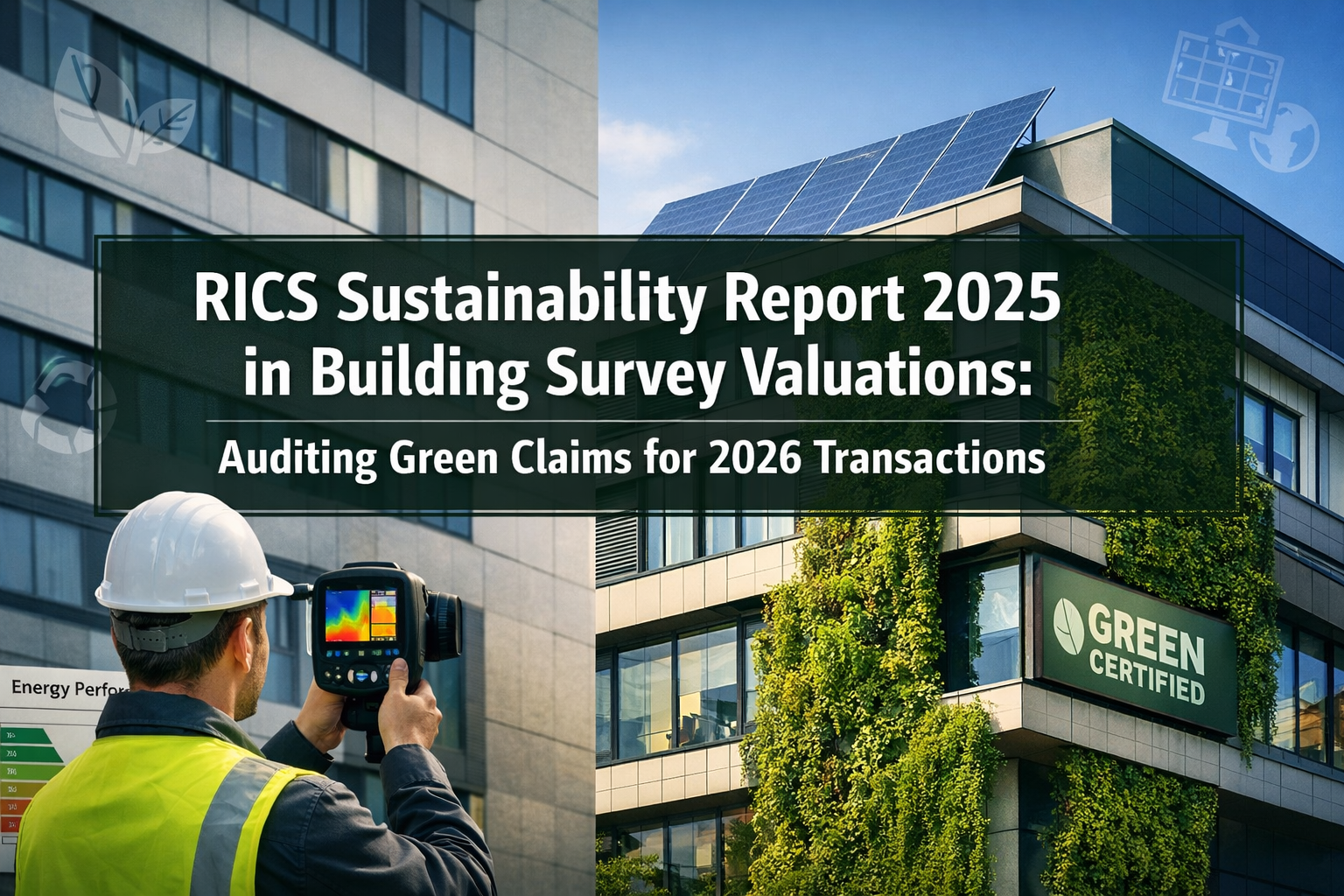

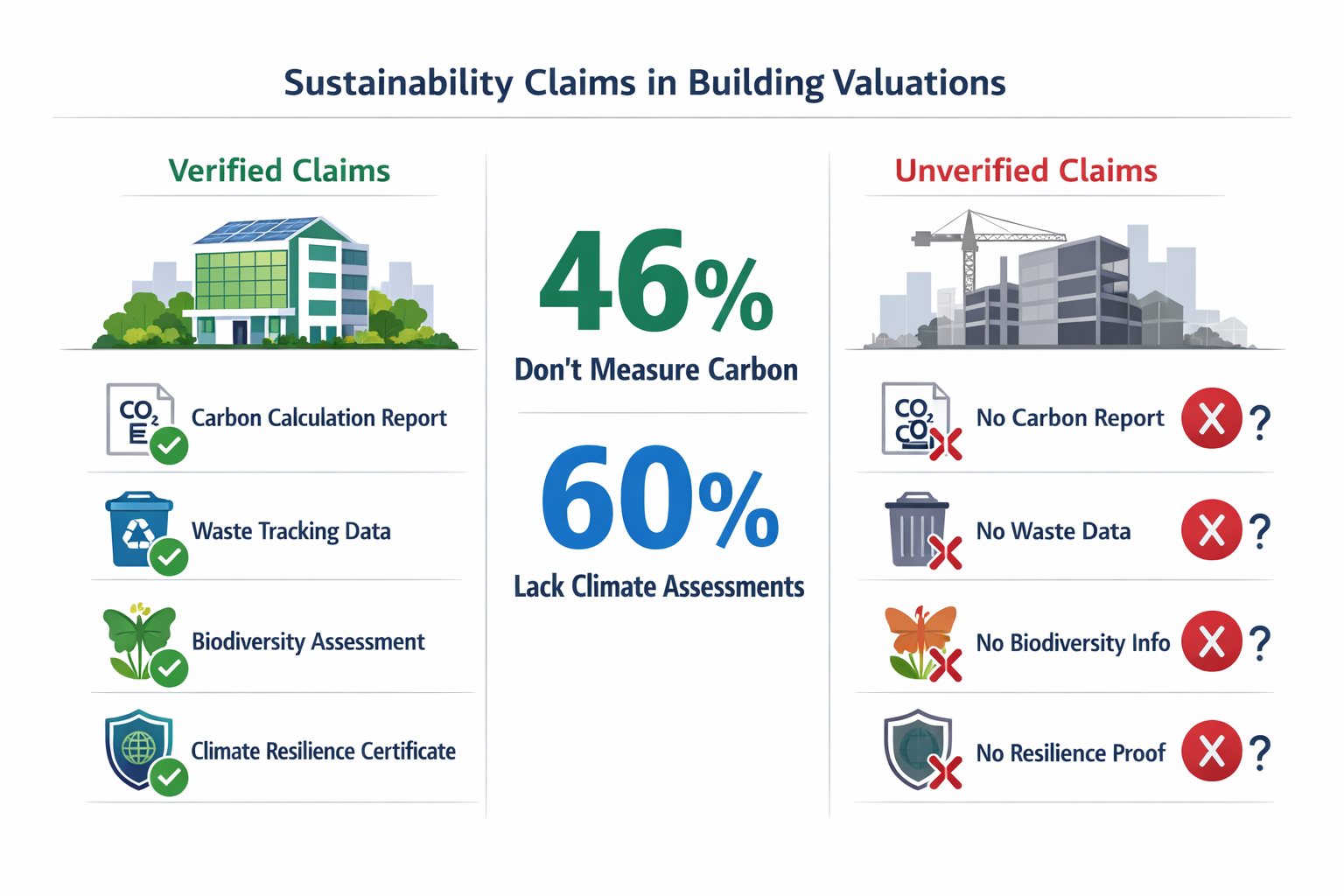
The built environment accounts for 40% of global carbon emissions, yet 46% of construction professionals don't measure carbon across their projects—a figure that has risen alarmingly from 34% in just one year[1][3]. This widening measurement gap creates a critical challenge for property professionals in 2026: how can surveyors accurately verify sustainability claims when nearly half the industry lacks basic carbon data? The RICS Sustainability Report 2025 in Building Survey Valuations: Auditing Green Claims for 2026 Transactions provides essential guidance for navigating this verification crisis as the market recovers.
As property transactions accelerate in 2026, the demand for credible sustainability assessments has never been higher. Yet the RICS Sustainability Report 2025 reveals a troubling disconnect: while 86% of respondents identify green building certification as important for investors, 60% report conducting carbon calculations and climate resilience assessments in less than half of projects—or not at all[1][3]. For surveyors conducting building valuations, this means many "green" properties entering the market lack substantiation for their claimed environmental benefits.
Key Takeaways
- Carbon measurement crisis: 46% of construction professionals don't measure carbon emissions, creating significant verification challenges for building survey valuations in 2026 transactions[1][3]
- Regional demand variation: Green building demand shows dramatic regional differences, with MEA at +52, UK at +43, but Americas slowing to just +11—critical data for assessing sustainability premiums[1][3]
- Documentation gaps widespread: 60% of projects lack proper carbon calculations and climate resilience assessments, requiring enhanced due diligence when auditing green claims[1][3]
- Certification remains paramount: 86% of investors prioritize green building certifications, making third-party verification essential for accurate valuations[3]
- Skills deficit threatens accuracy: 30% of professionals lack sufficient knowledge to assess embodied carbon emissions, highlighting the need for specialized surveyor training[1][3]
Understanding the RICS Sustainability Report 2025 Framework for Building Valuations
The RICS Sustainability Report 2025 in Building Survey Valuations: Auditing Green Claims for 2026 Transactions establishes a comprehensive framework for property professionals navigating the sustainability verification landscape. The report's Sustainable Building Index (SBI) remains in positive territory, indicating continued market momentum for green buildings, though growth has notably slowed in most regions except the Middle East and Africa[1].
Regional Market Dynamics and Valuation Implications
Understanding regional variations in sustainability demand proves essential for accurate building survey valuations. The 2025 data reveals striking geographical differences:
| Region | SBI Score | Market Implications |
|---|---|---|
| Middle East & Africa | +52 | Strongest green premium potential |
| United Kingdom | +43 | Robust demand, mature certification market |
| Europe | +39 | Steady growth, regulatory drivers |
| Asia Pacific | +27 | Moderate expansion, emerging standards |
| Americas | +11 | Slowest growth, potential overvaluation risk |
These regional variations directly impact how surveyors should approach sustainability premiums in property valuations. A green-certified building in London may command a significantly different premium than a comparable property in New York, based purely on market demand dynamics rather than intrinsic environmental performance[1][3].
The Certification Priority Hierarchy
The report confirms that 86% of respondents identify green building certification as important for investors, establishing third-party verification as the gold standard for sustainability claims[3]. However, not all certifications carry equal weight in valuation assessments. Surveyors must understand the hierarchy:
Tier 1 Certifications (highest valuation impact):
- BREEAM Outstanding/Excellent
- LEED Platinum/Gold
- WELL Building Standard Platinum/Gold
- Passive House certification
Tier 2 Certifications (moderate valuation impact):
- Energy Performance Certificate (EPC) A or B ratings
- NABERS ratings (Australia/UK)
- Green Star ratings
- Local authority sustainability awards
Tier 3 Claims (minimal valuation impact without verification):
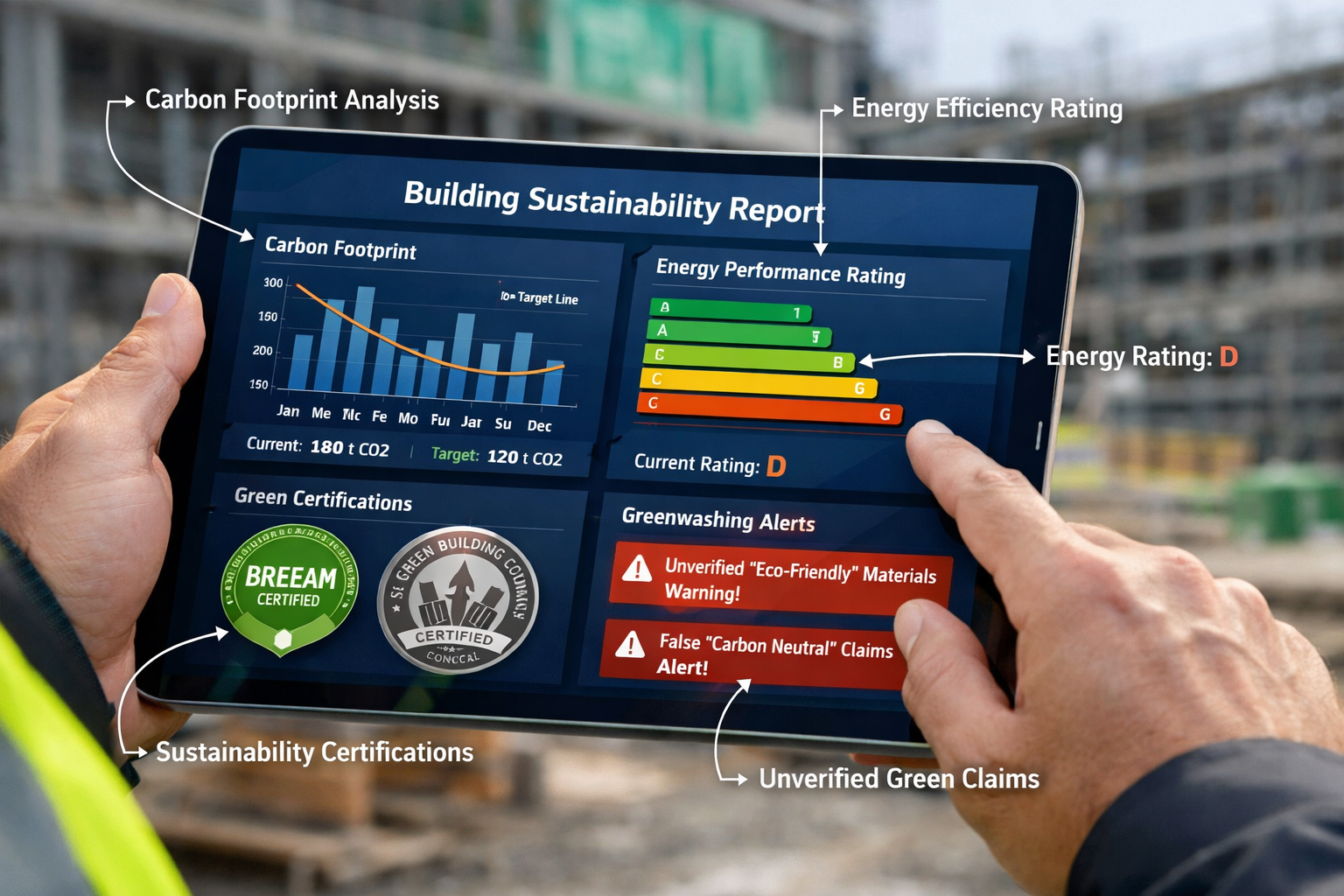
- Self-assessed "eco-friendly" features
- Unverified carbon neutrality claims
- Generic "sustainable building" marketing
- Uncertified renewable energy installations
For comprehensive property assessments, surveyors should integrate sustainability verification into standard structural survey protocols to ensure thorough documentation.
Critical Gaps in Current Sustainability Practice Affecting 2026 Valuations
The RICS Sustainability Report 2025 in Building Survey Valuations: Auditing Green Claims for 2026 Transactions exposes several critical deficiencies that directly impact valuation accuracy and transaction risk assessment.
The Carbon Measurement Crisis
Perhaps most concerning, 46% of construction professionals don't measure carbon across projects—an increase from 34% in 2024[1][3]. This deterioration in measurement practices creates a fundamental problem for surveyors: how can green claims be verified without baseline data?
The implications for building survey valuations are profound:
🚨 Red Flag Indicators for Surveyors:
- Properties claiming "low carbon" or "net zero" status without documented carbon assessments
- Developers unable to provide embodied carbon calculations for materials and construction
- Operational carbon projections lacking verified baseline measurements
- Retrofit projects claiming carbon savings without pre- and post-intervention data
When conducting commercial property surveys, this documentation gap requires enhanced scrutiny and potentially adjusted valuation assumptions.
Indoor Environmental Quality: The Overlooked Valuation Factor
While carbon dominates sustainability discussions, the report reveals that 94% of respondents report occupiers prioritize indoor environmental quality (IEQ)[3]. This presents a significant opportunity for surveyors to differentiate their valuation assessments by incorporating IEQ metrics that directly affect occupant wellbeing and, consequently, rental premiums and capital values.
Key IEQ Factors for Building Survey Integration:
✅ Air Quality Metrics
- Ventilation rates and fresh air provision
- VOC (Volatile Organic Compound) levels in materials
- Particulate matter filtration systems
- CO₂ monitoring and control systems
✅ Thermal Comfort Assessment
- Temperature control granularity
- Radiant heating/cooling systems
- Thermal bridging and cold spots
- Overheating risk in summer months
✅ Acoustic Performance
- Sound insulation between spaces
- External noise intrusion levels
- HVAC system noise ratings
- Acoustic treatment in common areas
✅ Natural Light and Views
- Glazing ratios and daylight factors
- Glare control measures
- Connection to outdoor environments
- Circadian lighting systems
Properties demonstrating superior IEQ performance through verified measurements may justify premium valuations even when other sustainability metrics prove average. This factor becomes particularly relevant for residential structural assessments where occupant comfort directly influences marketability.
The Skills and Knowledge Deficit
The report identifies that 30% of professionals point to insufficient knowledge and skills to reduce embodied carbon emissions[1][3]. This skills gap extends beyond construction professionals to affect surveyors themselves, creating potential liability when sustainability claims go unquestioned or improperly assessed.
Competency Requirements for Sustainability Auditing:
📚 Technical Knowledge Areas:
- Embodied carbon calculation methodologies (RICS Whole Life Carbon Assessment)
- Operational energy modeling and verification
- Green building certification standards and requirements
- Climate resilience and adaptation assessment frameworks
- Biodiversity net gain measurement and verification
📚 Practical Assessment Skills:
- Identifying greenwashing in marketing materials
- Verifying renewable energy system performance claims
- Assessing retrofit quality and thermal performance
- Evaluating water efficiency systems and monitoring
- Documenting waste reduction and circular economy features
Surveyors lacking these competencies should consider specialist consultation or additional training before providing definitive opinions on sustainability valuations, particularly for expert witness reports where technical accuracy proves paramount.
Practical Implementation: Integrating RICS Sustainability Report 2025 into Building Survey Valuations
The RICS Sustainability Report 2025 in Building Survey Valuations: Auditing Green Claims for 2026 Transactions provides actionable frameworks for surveyors conducting property assessments in the current market. Implementation requires systematic integration of sustainability verification into existing survey protocols.
Enhanced Due Diligence Checklist for Green Claims
When encountering sustainability claims during building surveys, surveyors should deploy a structured verification approach:
Phase 1: Documentation Review 📋
- Request all green building certifications and supporting documentation
- Obtain Energy Performance Certificates and assessment reports
- Review carbon calculation reports (embodied and operational)
- Examine waste management and tracking records
- Collect biodiversity impact assessments and net gain evidence
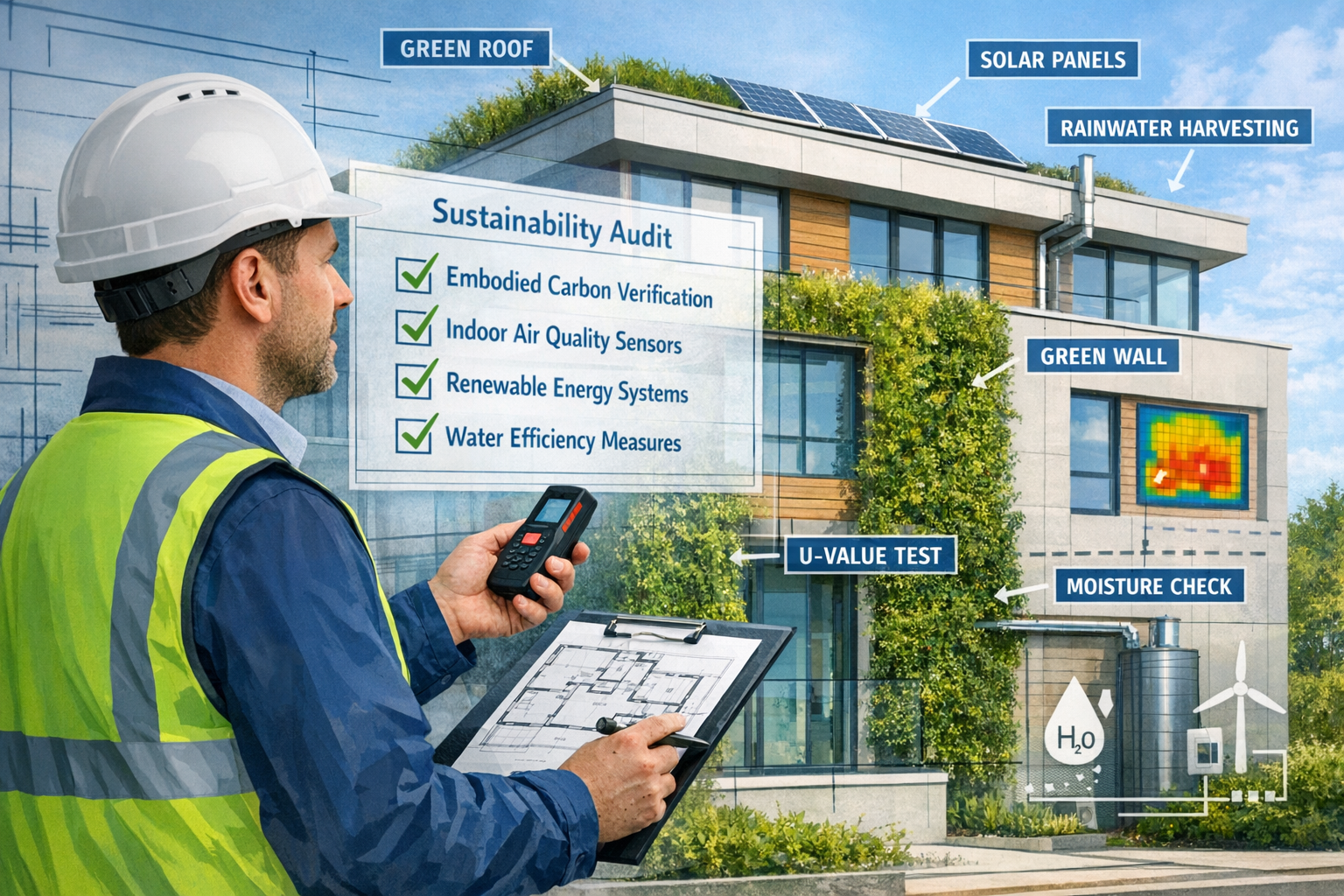
Phase 2: Physical Verification 🔍
- Inspect renewable energy installations and verify capacity claims
- Assess insulation quality and thermal envelope performance
- Evaluate water efficiency fixtures and monitoring systems
- Examine sustainable material specifications against documentation
- Test indoor environmental quality monitoring systems
Phase 3: Performance Validation 📊
- Compare claimed energy performance against actual utility data
- Verify renewable energy generation against system specifications
- Assess maintenance records for sustainable systems
- Review occupant satisfaction surveys regarding IEQ
- Analyze post-occupancy evaluation data where available
This systematic approach aligns with comprehensive building survey methodologies while adding essential sustainability verification layers.
Addressing the Investment Barrier Triad
The RICS report identifies three primary obstacles blocking sustainable investment: (1) initial costs, (2) lack of ROI evidence, and (3) lack of investor awareness or client demand[1][3]. These barriers directly affect valuation methodologies and require explicit consideration in survey reports.
Valuation Adjustment Framework:
For Properties with Verified Sustainability Features:
- Apply positive adjustment for certified green credentials (typically 5-15% premium depending on certification level and regional demand)
- Factor in reduced operational costs through lower energy consumption
- Consider enhanced marketability and reduced void periods
- Account for future-proofing against regulatory tightening
- Recognize potential for preferential financing terms
For Properties with Unverified Green Claims:
- Apply neutral to negative adjustment for unsubstantiated claims
- Flag potential remediation costs to achieve claimed performance
- Note reputational risk from greenwashing exposure
- Consider regulatory compliance risk if claims prove false
- Document verification costs for future transactions
When conducting Red Book valuations, these adjustments must be clearly documented and justified with reference to market evidence and the RICS Sustainability Report 2025 data.
Climate Resilience as an Emerging Valuation Factor
The report confirms that green building certification and high adaptability/resilience are reported as the most important features of sustainable buildings for investors[1]. This shifts the focus beyond carbon reduction alone to encompass adaptation and long-term viability.
Climate Resilience Assessment Components:
🌡️ Thermal Resilience
- Overheating risk assessment under future climate scenarios
- Passive cooling capabilities and thermal mass
- HVAC system capacity for increased cooling demand
- Shading and solar control measures
💧 Water Security and Flood Risk
- Flood resilience measures and property elevation
- Sustainable drainage systems (SuDS) implementation
- Water harvesting and storage capacity
- Greywater recycling and water efficiency systems
🌪️ Extreme Weather Preparedness
- Structural resilience to high winds and storms
- Roof and facade durability under extreme conditions
- Emergency power and water backup systems
- Building envelope weather-tightness and durability
🌱 Biodiversity and Ecosystem Services
- Green infrastructure and urban cooling effects
- Biodiversity net gain contributions
- Natural flood management features
- Air quality improvement through vegetation
More than 60% of respondents agree the construction sector needs to make protecting biodiversity a critical issue[3], signaling this will increasingly feature in sustainability valuations. Surveyors should begin documenting biodiversity features and ecosystem services as part of comprehensive property assessments.
Integrating Sustainability into Level 3 Building Surveys
For detailed Level 3 building surveys, sustainability assessment should be integrated throughout the inspection process rather than treated as a separate section:
Structural Elements:
- Document sustainable materials and assess embodied carbon implications
- Evaluate thermal bridging and insulation continuity
- Assess moisture management and breathability of construction
- Examine durability and lifecycle performance of materials
Building Services:
- Verify efficiency ratings of heating, cooling, and ventilation systems
- Assess renewable energy installations and integration quality
- Evaluate water heating efficiency and distribution losses
- Examine lighting systems and control strategies
Building Envelope:
- Test air-tightness and identify thermal performance gaps
- Assess window and door performance against claimed specifications
- Evaluate roof insulation and ventilation adequacy
- Examine external wall construction and thermal performance
Site and External Works:
- Document sustainable drainage and water management
- Assess biodiversity features and ecological value
- Evaluate external lighting efficiency and controls
- Examine accessibility and sustainable transport provisions
This integrated approach ensures sustainability considerations inform the overall property assessment rather than appearing as an afterthought.
The 2026 Transaction Landscape: Practical Considerations
As the property market continues its recovery in 2026, the RICS Sustainability Report 2025 in Building Survey Valuations: Auditing Green Claims for 2026 Transactions provides crucial context for transaction risk assessment.
The Greenwashing Detection Framework
With only 40% of professionals tracking waste reduction and data-sharing regularly[1][3], many sustainability claims lack comprehensive lifecycle documentation. Surveyors must develop keen detection skills for potential greenwashing:
Common Greenwashing Indicators:
⚠️ Vague or Unquantified Claims
- "Eco-friendly" without specific metrics
- "Sustainable" without certification or verification
- "Green" without documented environmental benefits
- "Carbon neutral" without offsetting documentation
⚠️ Cherry-Picked Metrics
- Highlighting single positive features while ignoring overall performance
- Emphasizing operational efficiency while concealing high embodied carbon
- Promoting renewable energy without addressing energy demand
- Focusing on recycled content while ignoring overall sustainability
⚠️ Misleading Imagery and Marketing
- Green imagery disconnected from actual building performance
- Certification logos without valid accreditation
- Future commitments presented as current achievements
- Selective disclosure of sustainability data
⚠️ Lack of Third-Party Verification
- Self-assessed environmental performance
- Uncertified energy modeling claims
- Unverified carbon calculations
- Missing post-occupancy performance data
When these indicators appear, surveyors should flag them in reports and recommend additional verification before transaction completion. This becomes particularly important for commercial dilapidation surveys where sustainability obligations may form part of lease agreements.
Regulatory Compliance and Future-Proofing
The 2026 transaction landscape increasingly features regulatory requirements around building performance and sustainability disclosure. Surveyors must consider:
Current and Emerging Regulatory Factors:
📜 Energy Performance Requirements
- Minimum EPC ratings for rental properties
- Trajectory toward net zero carbon by 2050
- Potential for stranded assets failing to meet future standards
- Retrofit costs to achieve compliance
📜 Climate Risk Disclosure
- Task Force on Climate-related Financial Disclosures (TCFD) requirements
- Physical climate risk assessments
- Transition risk from carbon pricing and regulation
- Mandatory sustainability reporting for larger buildings
📜 Biodiversity and Ecosystem Requirements
- Biodiversity net gain obligations
- Tree preservation and protection orders
- Sustainable drainage requirements
- Green space and urban cooling mandates
Properties lacking clear pathways to regulatory compliance may face significant value impairment as 2026 progresses and requirements tighten. RICS valuation protocols increasingly require explicit consideration of these regulatory risks.
Market Segmentation and Sustainability Premiums
The RICS report's regional data reveals significant market segmentation in sustainability demand. Surveyors must calibrate their premium assessments accordingly:
High-Premium Markets (UK, MEA, Europe):
- Strong investor demand for certified green buildings
- Robust tenant willingness to pay for sustainability features
- Competitive advantage from superior environmental performance
- Regulatory drivers supporting premium maintenance
Moderate-Premium Markets (Asia Pacific):
- Growing but inconsistent sustainability demand
- Premium dependent on specific location and building class
- Certification value varies by city and investor type
- Emerging regulatory frameworks creating uncertainty
Low-Premium Markets (Americas):
- Slowing green building demand growth
- Risk of overvaluation based on sustainability claims
- Premium highly dependent on specific tenant requirements
- Market skepticism regarding ROI of green features
This segmentation requires surveyors to carefully research comparable evidence and avoid assuming universal sustainability premiums across all markets.
Conclusion
The RICS Sustainability Report 2025 in Building Survey Valuations: Auditing Green Claims for 2026 Transactions reveals a property market at a critical juncture. While 86% of investors prioritize green building certification, the widening gap in carbon measurement—now affecting 46% of projects—creates significant verification challenges for surveyors conducting building valuations[1][3].
The report's findings demand a fundamental shift in how property professionals approach sustainability assessment. With 60% of projects lacking proper carbon calculations and climate resilience assessments, surveyors can no longer accept green claims at face value. Instead, systematic verification protocols must become standard practice, integrating sustainability auditing into every building survey and valuation.
Key priorities for surveyors in 2026:
✅ Enhance technical competency in carbon assessment, climate resilience evaluation, and green building certification standards to address the 30% skills deficit identified in the report[1][3]
✅ Implement structured verification frameworks that systematically audit sustainability claims through documentation review, physical inspection, and performance validation
✅ Recognize regional market dynamics when assessing sustainability premiums, acknowledging the dramatic variation from MEA's +52 to Americas' +11 in green building demand[1][3]
✅ Prioritize indoor environmental quality alongside carbon metrics, reflecting the 94% of occupiers who prioritize IEQ in their property decisions[3]
✅ Develop greenwashing detection skills to protect clients from overvalued properties with unsubstantiated sustainability claims
✅ Consider climate resilience as a core valuation factor, not an optional add-on, recognizing investors' focus on adaptability and long-term viability[1]
The transition to credible sustainability valuation requires investment in training, enhanced survey protocols, and willingness to challenge unverified claims. However, surveyors who master these competencies will provide essential value to clients navigating the complex 2026 transaction landscape, protecting against overvaluation while identifying genuine sustainability premiums.
As the built environment's 40% contribution to global carbon emissions comes under increasing scrutiny, the surveying profession must lead in establishing verification standards that separate genuine environmental performance from marketing rhetoric. The RICS Sustainability Report 2025 provides the roadmap—implementation now rests with individual practitioners committed to professional excellence and client protection.
Next Steps:
- Review the complete RICS Sustainability Report 2025 and associated technical guidance
- Assess current competency gaps and develop a professional development plan addressing carbon assessment and climate resilience evaluation
- Update building survey templates and checklists to incorporate systematic sustainability verification protocols
- Establish relationships with specialist consultants for complex sustainability assessments beyond core surveying expertise
- Begin documenting sustainability features and verification status in all property reports to build market evidence and comparable databases
The 2026 property market demands surveyors who can confidently audit green claims and provide clients with accurate, evidence-based sustainability valuations. The RICS Sustainability Report 2025 framework provides the foundation—professional commitment to implementation will determine success.
References
[1] Sustainability Report 2025 – https://www.rics.org/news-insights/current-topics-campaigns/sustainability/sustainability-report-2025
[2] Rics Apc Hot Topics 2025 Questions Answers – https://resources.apcguide.com/rics-apc-hot-topics-2025-questions-answers/
[3] Sustainability Report 2025 Infographic – https://www.rics.org/content/dam/ricsglobal/documents/reports/Sustainability-Report-2025-Infographic.pdf
[4] Esg Sustainability Survey 2025 26 – https://ivsc.org/esg-sustainability-survey-2025-26/
[5] Sustainability Report 2025 – https://www.rics.org/content/dam/ricsglobal/documents/reports/Sustainability-report-2025.pdf