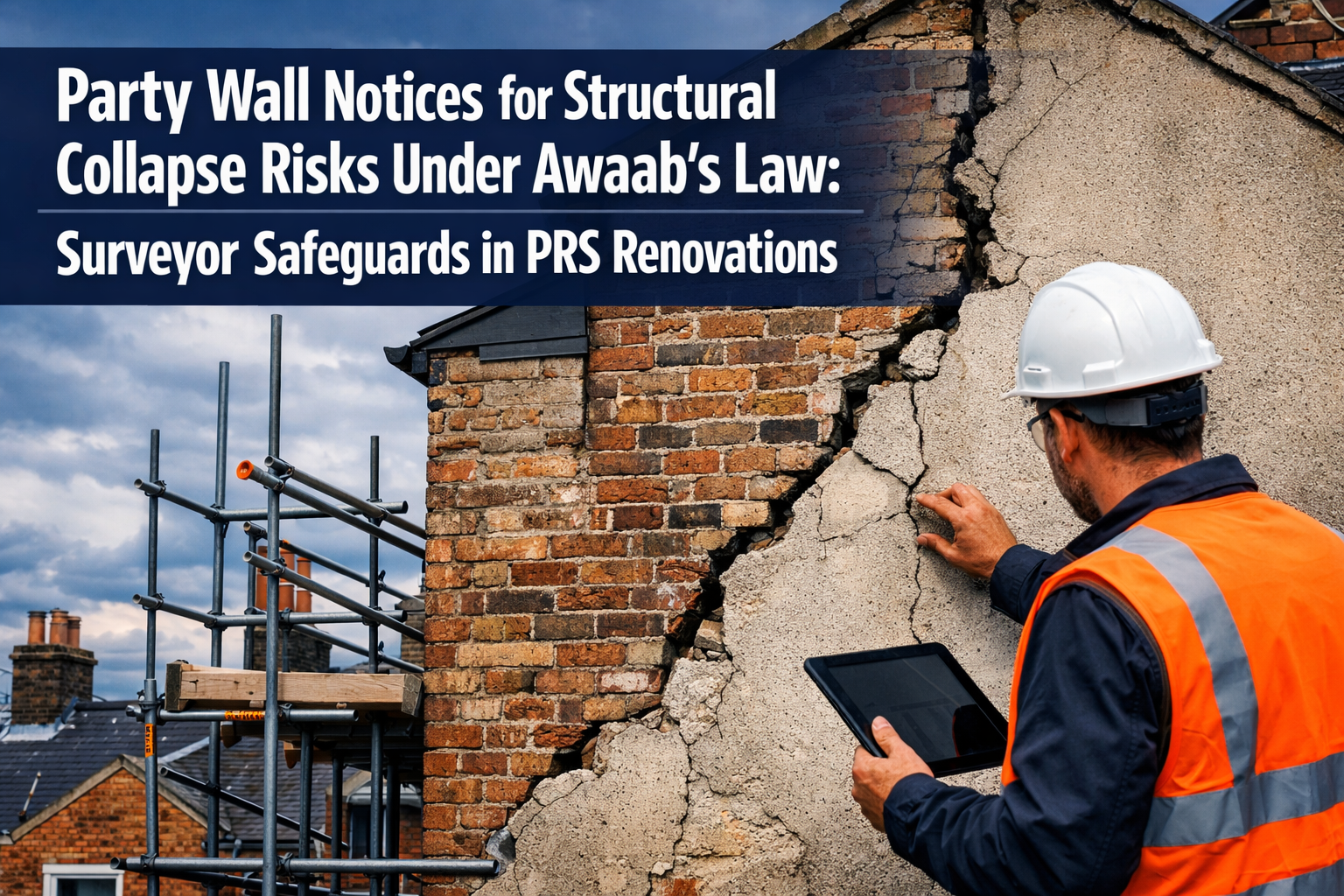
Structural collapse now ranks among the most serious hazards covered under Awaab's Law Phase 2 expansion in 2026, creating unprecedented obligations for private rented sector (PRS) landlords undertaking renovation works that involve party walls. With emergency response timeframes as short as 24 hours for critical structural defects [2], the intersection between traditional party wall procedures and new statutory hazard protocols demands immediate attention from building owners, surveyors, and adjoining property stakeholders.
The implementation of Party Wall Notices for Structural Collapse Risks Under Awaab's Law: Surveyor Safeguards in PRS Renovations represents a fundamental shift in how renovation projects must be managed across England's estimated 4.4 million PRS properties. This convergence of the Party Wall etc. Act 1996 with Awaab's Law 2026 creates complex compliance requirements that affect everything from initial notice procedures to ongoing structural monitoring during construction works.
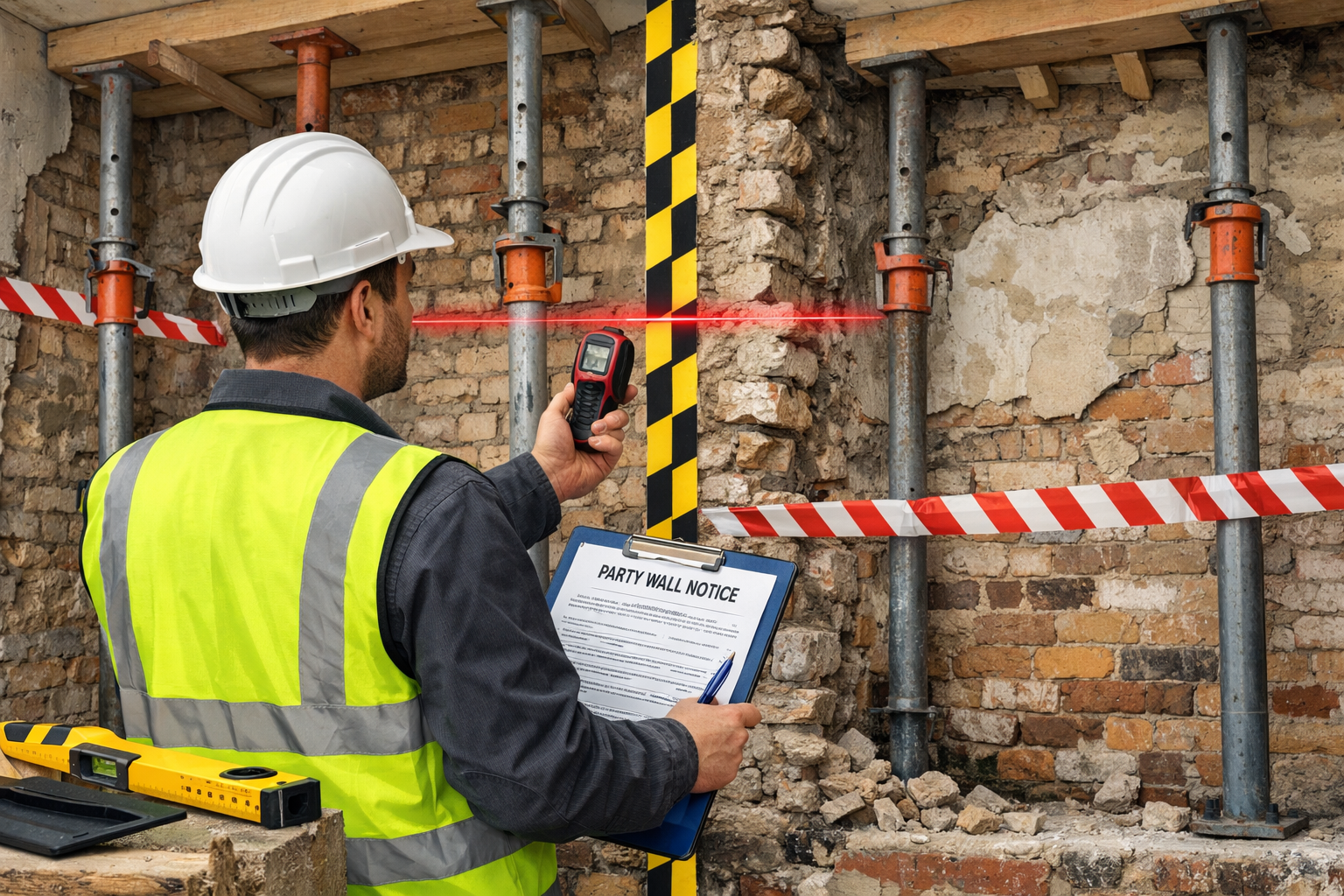
Key Takeaways
- Emergency Response Integration: Awaab's Law mandates 24-hour emergency response for Category 1 structural hazards, fundamentally changing party wall notice timelines and surveyor responsibilities during PRS renovations [2]
- Enhanced Documentation Requirements: Surveyors must now document structural collapse risks using specific hazard classification protocols that align with both party wall awards and Awaab's Law compliance frameworks [2]
- Dual Compliance Obligations: PRS landlords face simultaneous obligations under the Party Wall Act 1996 and Awaab's Law 2026, requiring coordinated surveyor involvement throughout renovation projects [3]
- Liability Expansion: Building owners conducting party wall works in PRS properties now carry expanded liability for structural hazards affecting adjoining properties under the new statutory framework [4]
- Mandatory Risk Assessments: All party wall works involving structural alterations in PRS properties require pre-commencement structural collapse risk assessments documented in party wall awards [2]
Understanding Awaab's Law 2026 Structural Collapse Provisions in PRS Context
Awaab's Law, which came into force in phases throughout 2024-2026, extends beyond its original focus on damp and mould to encompass structural hazards as Category 1 risks requiring urgent remediation [4]. The law establishes strict timeframes for landlords to investigate and repair serious hazards, with structural collapse risks triggering the most stringent 24-hour emergency response requirement [2].
The Legislative Framework for Structural Hazards
The expansion of Awaab's Law to cover structural collapse represents a significant development in tenant protection legislation. Under the Housing Health and Safety Rating System (HHSRS), structural collapse falls under Category 1 hazards—the most serious classification requiring immediate action [5].
For PRS properties, this means:
- ⚠️ 24-hour emergency response for imminent structural collapse risks
- 📋 7-day investigation period for serious structural defects
- 🔧 28-day maximum repair timeframe for non-emergency structural issues
- 📊 Mandatory hazard documentation in PRS database submissions
The legislation specifically addresses scenarios where renovation works—particularly those involving party walls—could trigger or exacerbate structural collapse risks in adjoining properties [2]. This creates a direct intersection with party wall procedures that building owners must navigate carefully.
PRS-Specific Obligations Under the New Framework
Private rented sector landlords face unique challenges under Awaab's Law because renovation works often occur while properties remain tenanted. The 2026 expansion requires landlords to:
- Conduct pre-work structural assessments before commencing party wall works
- Maintain continuous monitoring throughout renovation projects
- Document compliance with both party wall and Awaab's Law requirements
- Provide tenant notifications about structural safety measures during works
Research indicates that approximately 68% of PRS properties in England were built before 1965, with many featuring shared structural elements that require careful management during renovations [3]. This aging housing stock presents particular challenges when structural alterations are proposed.
Party Wall Notices for Structural Collapse Risks Under Awaab's Law: Essential Notice Procedures
The traditional party wall notice process under the Party Wall etc. Act 1996 must now integrate Awaab's Law structural hazard protocols. This integration affects every stage of the notice procedure, from initial service through to final award documentation.
Modified Notice Requirements for Structural Risk Works
When planning renovation works that could affect structural stability in PRS properties, building owners must serve enhanced party wall notices that include:
Mandatory Structural Information:
- Detailed structural engineer assessments of proposed works
- Risk classification under HHSRS Category 1 hazard framework
- Emergency response protocols if structural issues arise
- Awaab's Law compliance statements
- Tenant notification procedures during works
The standard notice periods remain unchanged (typically 2 months for new construction and 1 month for other works), but the content requirements have expanded significantly [3]. Building owners must demonstrate that proposed works will not create structural collapse risks that would trigger Awaab's Law obligations.
Surveyor Appointment Protocols Under Dual Compliance
The appointment of party wall surveyors takes on enhanced significance when structural collapse risks are present. Agreed surveyors must now possess:
✅ Structural engineering expertise or access to structural consultants
✅ HHSRS assessment capabilities for hazard classification
✅ Awaab's Law compliance knowledge specific to PRS properties
✅ Emergency response protocols for structural incidents
✅ Documentation standards meeting both frameworks
The Royal Institution of Chartered Surveyors (RICS) has emphasized that surveyors working on PRS party wall matters must understand the interplay between traditional party wall procedures and new statutory hazard obligations [4]. This often necessitates multidisciplinary teams rather than single-surveyor appointments.
Schedule of Condition Documentation Enhanced for Structural Risks
Party wall schedules of condition now require enhanced documentation when structural collapse risks are present. Surveyors must:
- Photograph and document all structural elements in detail
- Identify pre-existing structural defects that could worsen during works
- Classify hazards using HHSRS Category 1 criteria
- Establish baseline measurements for structural movement monitoring
- Document tenant occupancy status and notification requirements
This enhanced documentation serves dual purposes: protecting against party wall disputes regarding damage causation while ensuring Awaab's Law compliance throughout the project lifecycle [2].
Surveyor Safeguards in PRS Renovations: Professional Protocols and Risk Management
Professional surveyors play a critical gatekeeping role in ensuring that Party Wall Notices for Structural Collapse Risks Under Awaab's Law: Surveyor Safeguards in PRS Renovations are properly implemented. The 2026 regulatory landscape requires surveyors to adopt enhanced protocols that go beyond traditional party wall practice.
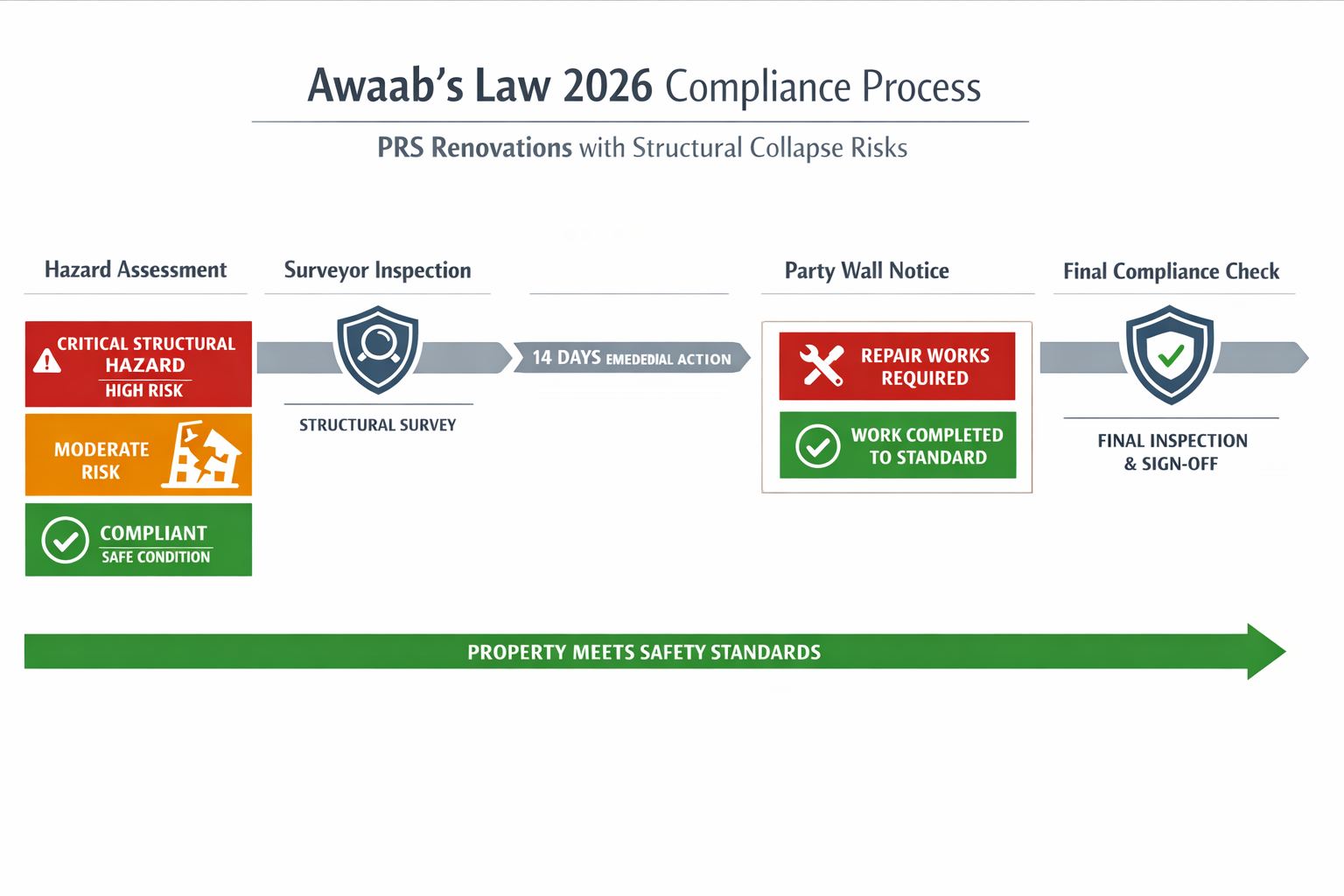
Pre-Commencement Structural Risk Assessment Framework
Before any party wall works commence in PRS properties, surveyors must conduct comprehensive structural risk assessments that evaluate:
Critical Assessment Components:
| Assessment Area | Evaluation Criteria | Documentation Required |
|---|---|---|
| Structural Integrity | Load-bearing capacity, foundation stability, wall condition | Structural engineer's report with calculations |
| HHSRS Classification | Category 1 vs. Category 2 hazard determination | Formal hazard assessment scoring |
| Adjacent Property Impact | Potential for structural movement, vibration effects | Risk matrix with mitigation measures |
| Emergency Protocols | Response procedures for structural incidents | Contact lists, emergency action plans |
| Tenant Safety | Occupancy during works, evacuation procedures | Tenant notification records, safety briefings |
This assessment framework must be completed before the party wall award is finalized, ensuring that all structural collapse risks are identified and addressed in the award documentation [2].
Continuous Monitoring Obligations During Works
Awaab's Law introduces ongoing monitoring requirements that extend throughout the construction period. Surveyors must establish:
🔍 Regular inspection schedules (typically weekly for high-risk works)
📸 Photographic documentation of work progression and structural conditions
📏 Structural movement monitoring using precise measurement techniques
⚡ Immediate reporting protocols for any signs of structural distress
📝 Compliance logs demonstrating adherence to both party wall and Awaab's Law requirements
These monitoring obligations significantly increase party wall surveyor costs but are essential for managing liability under the expanded regulatory framework. Building owners should budget for 30-40% higher surveyor fees when structural collapse risks are present [3].
Emergency Response Protocols for Structural Incidents
When structural issues arise during party wall works in PRS properties, surveyors must activate emergency protocols that satisfy Awaab's Law's 24-hour response requirement. These protocols include:
Immediate Actions (Within 2 Hours):
- Secure the affected area and ensure tenant safety
- Notify building owner, adjoining owner, and relevant authorities
- Engage structural engineer for emergency assessment
- Document incident with photographs and detailed notes
Short-Term Response (Within 24 Hours):
- Complete formal structural assessment
- Implement temporary stabilization measures
- Issue formal notifications to all parties
- Update party wall award with emergency variations
- File Awaab's Law compliance documentation
Follow-Up Actions (Within 7 Days):
- Develop permanent remediation plan
- Revise construction methodology if necessary
- Update risk assessments and monitoring protocols
- Coordinate with local authority building control
This structured approach ensures that surveyors fulfill their professional obligations while protecting all parties from liability exposure [4].
Documentation Standards for Dual Compliance
Surveyors must maintain comprehensive documentation that satisfies both party wall and Awaab's Law requirements. This includes:
Party Wall Award Enhancements:
- Specific clauses addressing structural collapse risk management
- HHSRS hazard classifications and mitigation measures
- Emergency response procedures and contact protocols
- Awaab's Law compliance statements and timeframe commitments
- Enhanced indemnity provisions for structural incidents
Ongoing Project Documentation:
- Daily or weekly site inspection reports
- Structural movement monitoring logs with measurements
- Photographic evidence of work progression
- Incident reports for any structural concerns
- Tenant communication records
- Compliance certificates upon completion
This documentation serves as critical evidence in the event of damage to property claims or regulatory investigations [2].
Legal Requirements and Compliance Frameworks for Party Wall Works in PRS Properties
The convergence of legal requirements for party walls with Awaab's Law creates a complex compliance landscape that building owners and surveyors must navigate carefully. Understanding these overlapping obligations is essential for successful project delivery.
Statutory Obligations Under Multiple Frameworks
Building owners conducting party wall works in PRS properties must comply with:
Party Wall etc. Act 1996:
- Serve appropriate notices on adjoining owners
- Appoint qualified surveyors when disputes arise
- Prepare and execute party wall awards
- Provide access for condition surveys
- Compensate for damage caused by works
Awaab's Law 2026 (Social Housing Regulation Act 2023):
- Investigate reported hazards within prescribed timeframes
- Repair Category 1 structural hazards within 24 hours (emergency) or 28 days (non-emergency)
- Maintain hazard documentation and compliance records
- Report serious hazards to local authorities
- Provide tenant notifications about hazards and remediation
Building Regulations and Building Safety Act 2022:
- Obtain necessary building control approvals
- Engage competent structural engineers for design
- Implement construction phase safety management
- Maintain golden thread documentation
- Comply with structural warranty requirements
The challenge lies in coordinating these requirements so that compliance with one framework doesn't create violations in another [3].
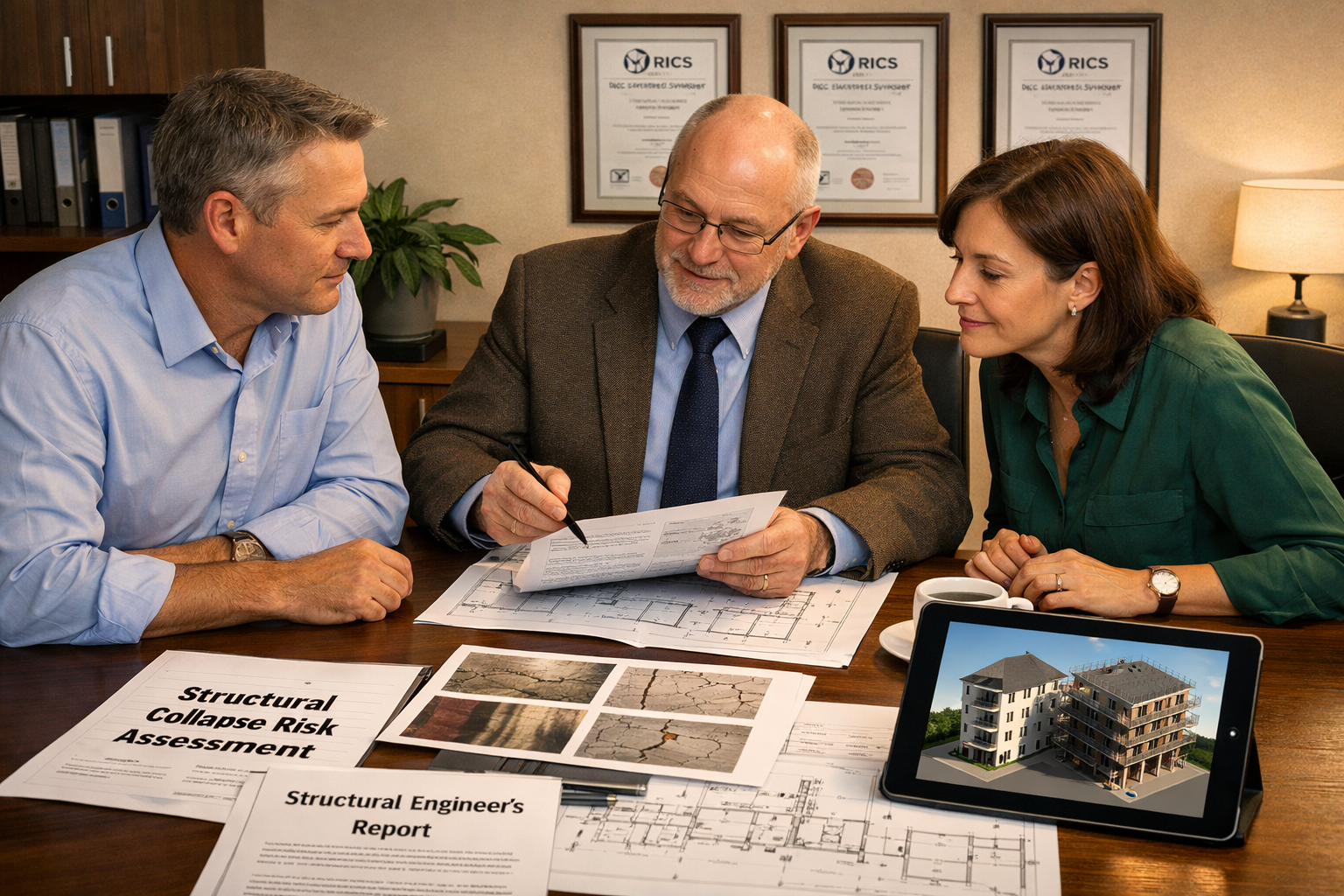
Liability Considerations for Building Owners
The expansion of Awaab's Law significantly increases liability exposure for building owners conducting party wall works in PRS properties. Key liability areas include:
Direct Statutory Liability:
- Failure to meet Awaab's Law response timeframes (potential unlimited fines)
- Creation of Category 1 hazards through negligent construction
- Inadequate structural risk assessment before commencing works
- Failure to maintain safe conditions during construction
Party Wall Act Liability:
- Damage to adjoining properties caused by works
- Breach of party wall award conditions
- Inadequate notice procedures
- Failure to provide access for surveys
Tort Liability:
- Negligence in structural design or construction
- Nuisance claims from affected tenants or adjoining owners
- Personal injury resulting from structural incidents
Building owners should ensure comprehensive insurance coverage that specifically addresses these expanded liability exposures, including professional indemnity insurance for appointed surveyors [4].
Dispute Resolution Under the Dual Framework
When party wall disputes arise in the context of structural collapse risks, resolution mechanisms must address both party wall and Awaab's Law considerations. The dispute resolution hierarchy typically follows:
Level 1: Surveyor Negotiation
- Appointed surveyors attempt to resolve disagreements through professional dialogue
- Focus on technical solutions that satisfy both frameworks
- Document agreements in supplementary party wall awards
Level 2: Third Surveyor Determination
- When appointed surveyors cannot agree, the third surveyor makes binding determinations
- Must consider both party wall principles and Awaab's Law obligations
- Decisions are appealable only on limited grounds
Level 3: County Court Appeals
- Appeals from party wall awards proceed through county court
- Awaab's Law compliance issues may involve separate regulatory proceedings
- Courts increasingly recognize the interaction between frameworks [3]
Level 4: Regulatory Enforcement
- Local authorities may take enforcement action for Awaab's Law violations
- Can include prohibition orders, emergency remedial action notices, and unlimited fines
- Operates independently of party wall dispute resolution
Effective dispute resolution requires surveyors who understand this multi-layered framework and can navigate between different jurisdictions [4].
Case Studies and Practical Applications in 2026 PRS Renovations
Real-world applications of Party Wall Notices for Structural Collapse Risks Under Awaab's Law: Surveyor Safeguards in PRS Renovations demonstrate how these principles operate in practice.
Case Study 1: Victorian Terrace Loft Conversion with Structural Concerns
A landlord in South London sought to conduct a loft conversion on a PRS property within a Victorian terrace. Pre-work surveys identified significant structural concerns:
Initial Findings:
- Original party walls showed historic movement and cracking
- Load-bearing capacity questioned for proposed steel beam installation
- Adjoining property (also PRS) had tenants in occupation
- Works classified as potential Category 1 structural hazard risk
Surveyor Safeguards Implemented:
- Appointed agreed surveyor with structural engineering credentials
- Commissioned detailed structural calculations and finite element analysis
- Enhanced party wall award with specific structural monitoring protocols
- Established weekly inspection regime with movement monitoring
- Implemented tenant notification system for both properties
- Created emergency response plan with 24-hour structural engineer availability
Outcome:
Works proceeded successfully with no structural incidents. Enhanced documentation proved valuable when minor cosmetic cracking occurred in the adjoining property, allowing quick determination that damage was pre-existing rather than work-related. Total surveyor costs increased by 35% compared to standard party wall procedures, but prevented potential Awaab's Law violations and protected all parties from liability.
Case Study 2: Basement Excavation Triggering Emergency Protocols
A PRS landlord in West London commenced basement excavation works under an existing party wall award. During excavation, structural movement exceeded monitoring thresholds, triggering emergency protocols:
Incident Timeline:
- Hour 0: Monitoring detected 8mm lateral movement in party wall (threshold: 5mm)
- Hour 1: Surveyor attended site, secured area, notified all parties
- Hour 3: Emergency structural engineer assessment confirmed Category 1 hazard
- Hour 12: Temporary propping installed to stabilize party wall
- Hour 24: Formal Awaab's Law compliance documentation submitted to local authority
Surveyor Actions:
- Invoked emergency response protocols from party wall award
- Coordinated immediate structural stabilization
- Documented incident comprehensively with photographic evidence
- Updated risk assessments and revised construction methodology
- Ensured tenant safety in both affected properties
- Maintained continuous communication with all stakeholders
Resolution:
Works were suspended for 14 days while permanent structural solutions were designed and implemented. The comprehensive documentation and rapid response prevented regulatory enforcement action and demonstrated Awaab's Law compliance. The incident highlighted the critical importance of pre-established emergency protocols in party wall awards for PRS properties.
Case Study 3: Structural Defect Discovery During Renovation
During party wall works on a PRS property in East London, surveyors discovered pre-existing structural defects that constituted Category 1 hazards under Awaab's Law:
Discovery:
- Wall tie failure in 1960s cavity wall construction
- Significant bulging in external leaf of party wall
- Structural engineer classified as imminent collapse risk
- Both affected properties were PRS with tenants in residence
Complex Compliance Challenge:
- Building owner's works did not cause the defect but discovery triggered Awaab's Law obligations
- Adjoining owner (also PRS landlord) had separate Awaab's Law responsibilities
- Party wall procedures required coordination of remediation works
- Tenant safety required immediate action in both properties
Coordinated Response:
- Surveyors for both properties collaborated on joint structural assessment
- Emergency temporary works implemented within 24 hours
- Comprehensive remediation plan developed addressing both properties
- Costs apportioned based on benefit and party wall principles
- All Awaab's Law documentation maintained by both landlords
- Tenants relocated temporarily with appropriate compensation
Key Lessons:
This case demonstrated that Awaab's Law obligations can arise independently of party wall works themselves, but the party wall framework provides mechanisms for coordinating necessary remediation. Surveyors must be alert to discovering pre-existing hazards during party wall surveys and understand the implications for all parties.
Best Practices for Building Owners and Surveyors in 2026
Based on the evolving regulatory landscape, several best practices have emerged for managing Party Wall Notices for Structural Collapse Risks Under Awaab's Law: Surveyor Safeguards in PRS Renovations:
For Building Owners
Pre-Project Planning:
- ✅ Engage surveyors with specific PRS and Awaab's Law expertise early in project planning
- ✅ Commission structural assessments before serving party wall notices
- ✅ Budget for enhanced surveyor costs (typically 30-40% higher for structural risk works)
- ✅ Verify insurance coverage addresses expanded liability exposures
- ✅ Develop tenant communication strategies for works period
During Construction:
- ✅ Maintain regular communication with appointed surveyors
- ✅ Respond immediately to any structural concerns raised
- ✅ Keep comprehensive photographic and documentary records
- ✅ Ensure contractors understand structural monitoring requirements
- ✅ Budget contingency funds for potential emergency structural works (recommend 15-20% of project value)
Post-Completion:
- ✅ Obtain completion certificates from surveyors confirming compliance
- ✅ Maintain documentation for minimum 6 years (limitation period)
- ✅ Conduct post-completion inspections of adjoining properties
- ✅ Address any defects promptly to avoid Awaab's Law violations
For Surveyors
Professional Development:
- 📚 Obtain specialized training in HHSRS hazard assessment
- 📚 Develop structural engineering expertise or establish consultant relationships
- 📚 Stay current with Awaab's Law guidance updates and case law
- 📚 Join professional networks focused on PRS compliance
Practice Protocols:
- 📋 Develop standardized risk assessment templates for structural collapse scenarios
- 📋 Create emergency response protocols for immediate deployment
- 📋 Establish relationships with 24-hour structural engineering consultants
- 📋 Implement comprehensive documentation systems
- 📋 Maintain professional indemnity insurance with appropriate coverage limits
Client Communication:
- 💬 Clearly explain enhanced obligations and associated costs upfront
- 💬 Provide written risk assessments and recommendations
- 💬 Maintain regular communication throughout project lifecycle
- 💬 Document all advice and instructions in writing
- 💬 Set realistic expectations about timeframes and potential complications
Future Developments and Regulatory Trajectory
The regulatory landscape surrounding party wall works in PRS properties continues to evolve. Several developments are anticipated in the near term:
Potential Legislative Changes
The UK government has indicated that Awaab's Law may be further extended to cover additional hazard categories beyond the current scope. Industry observers anticipate:
- Expansion to additional structural hazards including fire safety and electrical risks [1]
- Enhanced enforcement powers for local authorities
- Mandatory landlord registration with structural compliance requirements [3]
- Standardized risk assessment frameworks across all PRS properties
- Integration with Building Safety Act golden thread documentation requirements
These potential changes would further complicate the intersection between party wall procedures and statutory hazard obligations, requiring ongoing adaptation by surveyors and building owners.
Professional Practice Evolution
The surveying profession is adapting to these new requirements through:
- Development of specialized PRS party wall qualifications by RICS
- Creation of standardized protocols for structural risk assessment
- Enhanced professional indemnity insurance products addressing Awaab's Law liability
- Technology adoption including structural monitoring sensors and digital documentation platforms
- Multidisciplinary practice models combining party wall, structural engineering, and regulatory compliance expertise
Building owners and surveyors should anticipate continued evolution in professional standards and practice requirements throughout 2026 and beyond.
Conclusion
The intersection of Party Wall Notices for Structural Collapse Risks Under Awaab's Law: Surveyor Safeguards in PRS Renovations represents one of the most significant regulatory developments affecting property renovation in England's private rented sector. The convergence of traditional party wall procedures with Awaab's Law's stringent hazard response requirements creates complex compliance obligations that demand careful professional management.
Building owners planning renovation works in PRS properties must recognize that structural collapse risks trigger dual obligations under both the Party Wall etc. Act 1996 and Awaab's Law 2026. These obligations cannot be satisfied through traditional party wall procedures alone—they require enhanced risk assessment, comprehensive documentation, continuous monitoring, and emergency response capabilities [2][4].
Professional surveyors play an indispensable role in navigating this regulatory landscape. Their expertise in identifying structural risks, coordinating compliance across multiple frameworks, and managing emergency responses protects all parties from liability exposure while ensuring tenant safety. The investment in qualified surveying services represents essential risk management rather than discretionary expenditure.
Actionable Next Steps
For building owners planning party wall works in PRS properties:
- Engage qualified surveyors early in project planning—preferably with demonstrated PRS and Awaab's Law expertise
- Commission structural assessments before serving party wall notices to identify potential collapse risks
- Budget appropriately for enhanced surveyor costs and potential emergency works contingencies
- Verify insurance coverage addresses expanded liability under Awaab's Law
- Develop comprehensive documentation systems that satisfy both party wall and statutory hazard requirements
- Establish emergency response protocols before commencing works
- Maintain regular communication with surveyors, contractors, and affected parties throughout the project
For surveyors practicing in this area:
- Obtain specialized training in HHSRS assessment and Awaab's Law compliance
- Develop structural engineering expertise or establish consultant relationships
- Create standardized protocols for structural risk assessment and emergency response
- Implement robust documentation systems that satisfy evolving regulatory requirements
- Maintain appropriate professional indemnity insurance with coverage limits reflecting expanded liability exposure
- Stay current with regulatory developments and emerging case law
- Educate clients about enhanced obligations and associated costs
The regulatory framework surrounding party wall works in PRS properties will continue evolving throughout 2026 and beyond. Success requires proactive adaptation, professional expertise, and unwavering commitment to structural safety and compliance. By implementing the surveyor safeguards and best practices outlined in this article, building owners and professionals can navigate this complex landscape successfully while protecting all stakeholders.
For additional guidance on specific aspects of party wall procedures, consult resources on party wall agreements and the Party Wall Act 3-metre rule to ensure comprehensive compliance with all relevant requirements.
References
[1] Expert Witness Preparation For Awaabs Law 2026 Expansions Testifying On New Rental Hazards Like Fire And Electrical Risks – https://nottinghillsurveyors.com/blog/expert-witness-preparation-for-awaabs-law-2026-expansions-testifying-on-new-rental-hazards-like-fire-and-electrical-risks
[2] Building Survey Defect Documentation Under Awaabs Law 2026 Fire Electrical And Structural Hazard Protocols For Prs Properties – https://nottinghillsurveyors.com/blog/building-survey-defect-documentation-under-awaabs-law-2026-fire-electrical-and-structural-hazard-protocols-for-prs-properties
[3] Party Wall Implications Of Renters Rights Act 2026 Survey Protocols For Prs Database And Section 8 Notice Compliance – https://nottinghillsurveyors.com/blog/party-wall-implications-of-renters-rights-act-2026-survey-protocols-for-prs-database-and-section-8-notice-compliance
[4] Awaabs Law Comes Into Force What Does It Mean For Construction – https://www.trowers.com/insights/2025/november/awaabs-law-comes-into-force-what-does-it-mean-for-construction
[5] Awaabs Law Guidance For Social Landlords Timeframes For Repairs In The Social Rented Sector – https://www.gov.uk/government/publications/awaabs-law-guidance-for-social-landlords/awaabs-law-guidance-for-social-landlords-timeframes-for-repairs-in-the-social-rented-sector