
The RICS consultation window for the draft 8th edition of Party Wall Legislation and Procedure runs for just eight weeks — and as of late April 2026, that window is already closing fast. For surveyors who work daily with party wall matters, this is one of the most significant opportunities in years to shape the guidance that governs professional practice across England and Wales. Responding to RICS Party Wall Consultation: Surveyor Strategies for Draft 8th Edition Feedback is not just a professional courtesy — it is a direct investment in the quality and clarity of the framework every practitioner relies on.
This article breaks down what the draft 8th edition contains, which areas deserve the sharpest scrutiny, and how surveyors can submit structured, effective responses before the deadline passes. [1]
Key Takeaways 📋
- The consultation closes in late May 2026 — surveyors must register on the RICS consultations portal to submit feedback. [5]
- Priority areas include notice service procedures, fee practices, Third Surveyor conduct, and updated award templates. [2]
- The draft includes new appendices, revised letters of appointment, and a refreshed draft award template. [1]
- Structured, evidence-based responses carry more weight than general comments — cite specific clause numbers where possible.
- All surveyors, legal professionals, and dispute resolution practitioners working in England and Wales are invited to contribute. [1]
What the Draft 8th Edition Actually Changes
Before crafting a response, every surveyor needs a clear picture of what the draft 8th edition modifies compared to its predecessor. The updates are both structural and substantive.
Structural Changes: Appendices, Templates, and Appointment Letters
The draft introduces enhanced appendices that provide more detailed procedural guidance. Alongside these, RICS has revised the letters of appointment and associated terms — documents that surveyors use at the very start of every party wall engagement. An updated draft award template is also included, reflecting how awards are structured and presented in practice today. [1]
These structural changes matter because they affect the paperwork surveyors produce on every job. Any ambiguity in an award template, for example, can become the seed of a party wall dispute months or years down the line.
Substantive Changes: Conduct, Fees, and the Third Surveyor
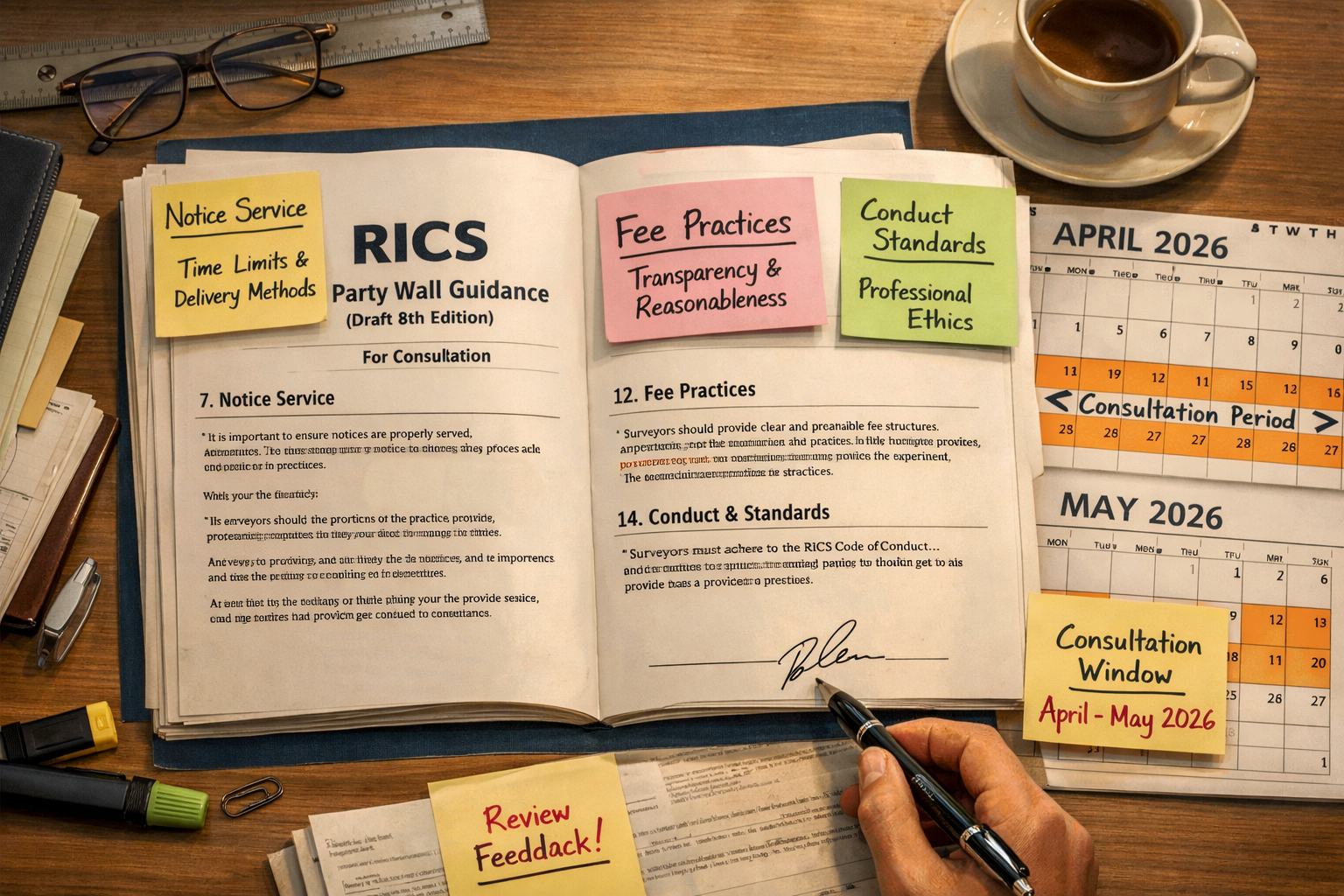
On the substantive side, the draft strengthens guidance in four key areas: [2]
| Area | What Has Changed |
|---|---|
| Fee practices | Clearer standards for how surveyors charge and disclose fees |
| Third Surveyor use | Enhanced guidance on when and how the Third Surveyor is engaged |
| Service of notices | Updated procedures for valid notice service |
| Public engagement | Improved guidance on communicating with building and adjoining owners |
Each of these areas has generated real-world friction in practice. Surveyors who have dealt with contested party wall notices or fee disputes will immediately recognise why RICS has chosen to tighten guidance here.
💬 "The strength of professional guidance lies not in its length, but in its precision. Vague clauses invite disputes; clear standards prevent them."
Responding to RICS Party Wall Consultation: Priority Areas for Surveyor Feedback
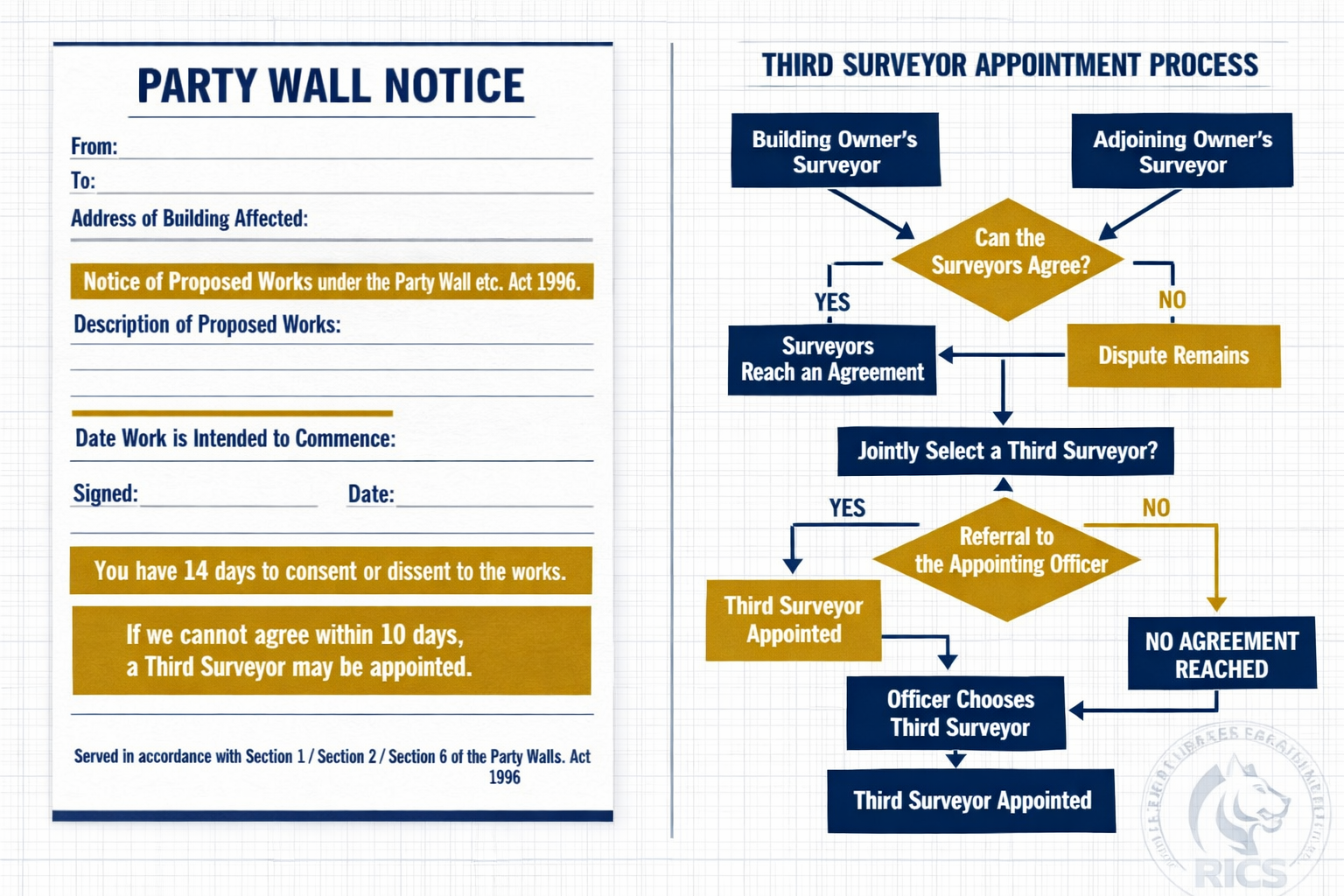
Not all sections of the draft carry equal weight for day-to-day practice. The following areas represent the highest-priority topics for substantive surveyor feedback.
1. Service of Notices: Getting the Procedure Right
Notice service is the foundation of every party wall matter. An invalid notice can unravel an entire project, expose surveyors to professional liability, and leave building owners in a difficult legal position. The draft 8th edition updates procedures in this area, but surveyors should scrutinise whether the revised guidance:
- Clearly defines what constitutes valid service (post, hand delivery, electronic means)
- Addresses service on absent or unresponsive adjoining owners
- Aligns with current case law on notice validity
Surveyors handling party wall excavation notices under Section 6 of the Party Wall etc. Act 1996 will know that the 3-metre and 6-metre rules create specific notice obligations — any ambiguity in the draft guidance around these scenarios is worth flagging explicitly in a response.
2. Fee Practices and Transparency
Fee disputes between surveyors and owners are a persistent source of tension. The draft's enhanced guidance on fee practices is a welcome development, but surveyors should assess whether the new language:
- Requires upfront fee estimates in appointment letters
- Addresses proportionality of fees relative to project value
- Clarifies the position where an agreed surveyor is appointed (see what you need to know about the party wall agreed surveyor)
Understanding party wall surveyor costs from the client's perspective helps surveyors frame feedback that is practical and defensible.
3. Third Surveyor Appointment and Conduct
The Third Surveyor is a crucial safeguard in the party wall process, yet the circumstances that trigger their involvement are often misunderstood by owners and, occasionally, by less experienced surveyors. The draft guidance reportedly strengthens this area — but feedback should probe whether the revised text: [2]
- Clearly distinguishes the Third Surveyor's role from that of an arbitrator
- Sets out the process for referral in plain, unambiguous language
- Addresses situations where a Third Surveyor declines to act or is unavailable
4. The Updated Award Template
The party wall award is the central document in any formal dispute resolution process. A well-drafted award protects all parties and reduces the risk of future litigation. Surveyors reviewing the draft template should consider:
- Whether the template adequately covers damage provisions (relevant to damage to property in party wall matters)
- Whether conditions relating to working hours, noise, and access are sufficiently detailed
- Whether the template is flexible enough to accommodate complex projects such as loft conversions or works involving shared chimneys
5. Public Engagement and Plain Language
The draft includes updated guidance on communicating with building owners and adjoining owners. This is particularly important given that most people involved in a party wall matter are not property professionals. Surveyors should assess whether the guidance:
- Encourages the use of plain English in correspondence
- Sets expectations for response times and communication frequency
- Addresses the use of digital communication tools
How to Submit an Effective Response: A Step-by-Step Strategy
Responding to RICS Party Wall Consultation: Surveyor Strategies for Draft 8th Edition Feedback requires more than simply agreeing or disagreeing with proposed changes. RICS gives greater weight to responses that are structured, specific, and evidence-based.
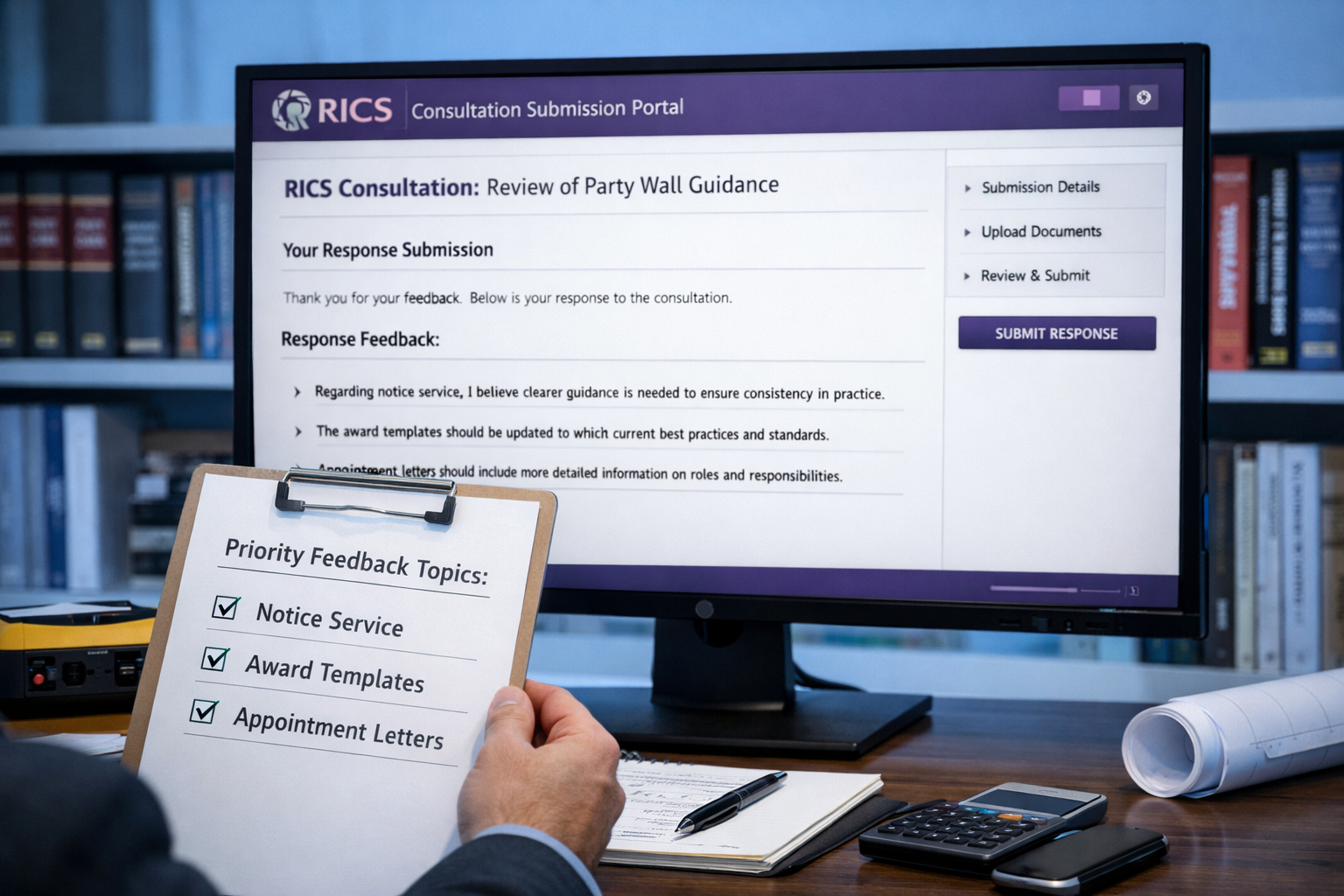
Step 1: Register on the RICS Consultations Portal
Responses must be submitted through the RICS consultations portal, which requires registration or login. [5] Do this early — last-minute registration can cause delays, particularly if email verification is required.
Step 2: Read the Draft in Full Before Commenting
It sounds obvious, but many consultation responses focus only on headline changes. Read every clause, including the appendices and template documents. The most impactful feedback often addresses wording in supporting materials rather than the main body text.
Step 3: Structure Responses by Clause or Section
RICS consultation forms typically ask for feedback on specific sections. Use this structure to your advantage:
✅ Do:
- Reference specific clause numbers
- Explain why a clause is unclear or problematic
- Suggest alternative wording where possible
- Draw on real case examples (anonymised)
❌ Avoid:
- General statements without specific references
- Repeating the same point across multiple sections
- Submitting feedback that is purely self-interested without broader professional justification
Step 4: Prioritise Quality Over Quantity
A response that addresses three issues in depth is far more useful to RICS than one that skims across twenty points. Focus on the areas where professional experience provides genuine insight — notice service, fee transparency, and award drafting are natural territories for practising surveyors.
Step 5: Coordinate with Professional Networks
Individual responses carry weight, but coordinated responses from professional groups, regional surveyor associations, or specialist party wall networks carry more. Consider sharing draft responses with colleagues for peer review before submission.
Why This Consultation Matters for Long-Term Practice
The 8th edition of Party Wall Legislation and Procedure will become the reference standard for practitioners, courts, and tribunals for years to come. The current guidance has served the profession well, but the built environment has changed significantly since the last edition. Issues such as:
- The rise of basement excavations in urban areas
- More complex mixed-use developments
- Greater use of digital communication in notice service
- Increased public awareness of party wall rights
…all demand that the guidance keeps pace. Surveyors who engage with the consultation are helping to ensure that the 8th edition reflects the reality of modern practice rather than an idealised version of it.
For those working across London and the South East — areas where party wall matters are particularly frequent given the density of terraced and semi-detached housing — the stakes are especially high. Whether advising on party wall agreements in London or handling complex boundary matters, the quality of RICS guidance directly affects the quality of professional service surveyors can deliver.
Common Mistakes to Avoid When Submitting Consultation Responses
Even experienced surveyors can fall into traps when responding to professional consultations. The following are the most common pitfalls:
| Mistake | Why It Weakens Your Response |
|---|---|
| Vague language | "This section is unclear" without explanation gives RICS nothing to act on |
| Missing the deadline | Late responses are typically not considered |
| Ignoring the appendices | Supporting documents often contain the most practically significant changes |
| Focusing only on negatives | Acknowledging what works well adds credibility to criticism |
| Not saving a copy | Always retain a copy of your submitted response for professional records |
Conclusion: Act Before the Window Closes
The eight-week consultation period for the RICS draft 8th edition of Party Wall Legislation and Procedure represents a rare and direct channel for practising surveyors to influence the guidance that governs their work. With the deadline falling in late May 2026, the time to act is now — not next week.
Actionable Next Steps 🎯
- Register on the RICS consultations portal today if not already done. [5]
- Download and read the full draft — including all appendices and template documents.
- Identify two or three priority areas from your own practice experience where the draft guidance could be strengthened.
- Draft your response using specific clause references and, where possible, real-world examples.
- Share your draft with a colleague for peer review before final submission.
- Submit before the deadline and retain a copy for your professional records.
The party wall framework exists to protect all parties in what can be a stressful and high-stakes process. Every surveyor who takes the time to engage with responding to RICS Party Wall Consultation: Surveyor Strategies for Draft 8th Edition Feedback contributes to a stronger, clearer, and more effective professional standard — one that benefits practitioners and property owners alike.
References
[1] RICS Launches Consultation on Updated Party Wall Practice Guidance – https://www.rics.org/news-insights/rics-launches-consultation-on-updated-party-wall-practice-guidance
[2] RICS Launches Consultation on Party Wall Guidance – https://thenegotiator.co.uk/news/regulation-law-news/rics-launches-consultation-on-party-wall-guidance/
[3] RICS Consults on Updated Party Wall Practice Guidance – https://www.lexisnexis.co.uk/legal/news/rics-consults-on-updated-party-wall-practice-guidance
[5] Consultations – https://www.rics.org/profession-standards/consultations