
Over 90% of party wall disputes in England and Wales involve procedural errors that could have been avoided with clearer professional guidance — and the RICS 8th Edition Party Wall Guidance: Key Updates and Practical Implications for Surveyors in 2026 is designed to close exactly that gap. Launched for public consultation across April and May 2026, this draft update to the RICS professional practice guidance represents the most significant overhaul of party wall standards in recent years, replacing the previous 7th edition with sharper templates, stronger conduct rules, and clearer statutory procedures [1][2].
For surveyors, developers, and homeowners alike, understanding what has changed — and why — is not optional. It is essential.
Key Takeaways 📌
- The RICS 8th Edition replaces the 7th edition and is currently in an eight-week public consultation running April–May 2026 [1][3].
- Revised award templates and updated letters of appointment are among the most practical documentation changes [2].
- The guidance strengthens rules around fee practices, Third Surveyor use, notice service, and surveyor independence [1][2].
- A party wall surveyor's appointment is confirmed as personal and statutory — not subject to client override [2].
- Surveyors should begin aligning their practices now, before the final edition is published.
What Is the RICS 8th Edition and Why Does It Matter?
The Royal Institution of Chartered Surveyors (RICS) periodically updates its professional practice guidance to reflect evolving legal interpretations, industry best practices, and feedback from practitioners. The 8th edition of the party wall guidance is the latest iteration of this ongoing effort, directly supporting RICS members who accept instructions under the Party Wall etc. Act 1996 in England and Wales [1][3].
The guidance is not legislation itself. Rather, it is a best-practice framework that explains:
- When the Act is engaged
- The procedures that follow engagement
- The professional standards expected of RICS members operating as party wall surveyors [1]
According to James Kavanagh, RICS Head of Professional Practice (Land & Development), the consultation represents a meaningful opportunity to help professionals navigate the statutory process with greater clarity and confidence [1][2][3].
💬 "The consultation is an opportunity to help professionals better navigate the statutory process under the Party Wall etc. Act 1996." — James Kavanagh, RICS [1]
The timing is deliberate. RICS has noted that clarity and professional standards are particularly important in the current property sector climate, where urban densification and increased renovation activity are generating more party wall interactions than ever before [2].
For those managing party wall matters across London and the wider South East, the stakes are especially high.
The Consultation Process: Who Is Involved and What Happens Next?
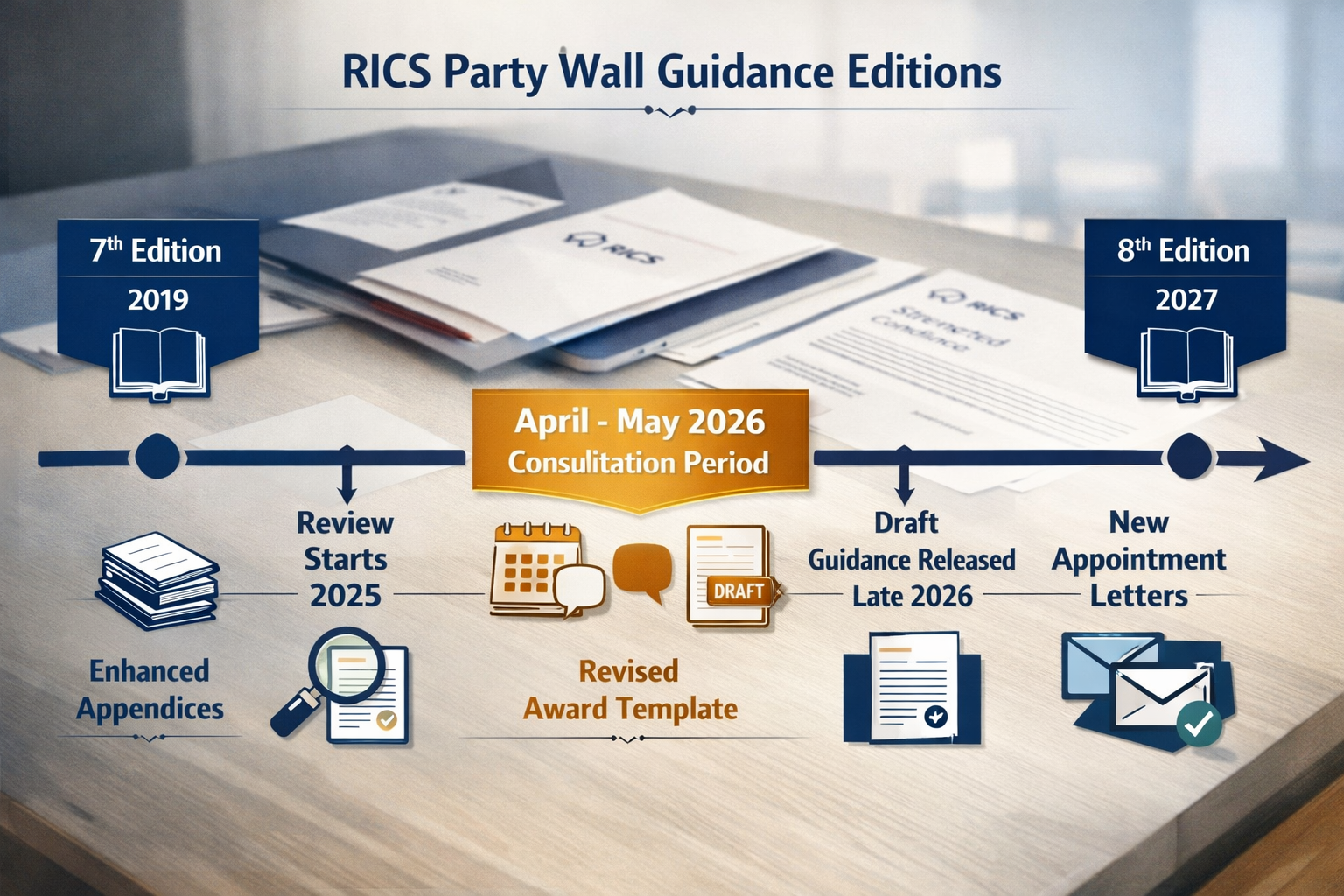
The eight-week consultation period runs across April and May 2026, inviting structured feedback from a broad range of stakeholders [1][2][3]:
| Stakeholder Group | Why They Are Consulted |
|---|---|
| Chartered Surveyors | Primary practitioners under the Act |
| Legal Professionals | Advise on disputes and statutory interpretation |
| Dispute Resolution Practitioners | Handle escalated party wall conflicts |
| Property Developers | Frequently trigger party wall procedures |
| Homeowners | Affected by adjoining works and notices |
The consultation draft is publicly available through RICS, and responses are being collected to shape the final published edition. Practitioners are strongly encouraged to review the draft and submit feedback before the consultation closes [1][3][4].
Once the consultation period ends, RICS will review responses and publish the final 8th edition guidance. Until then, the 7th edition remains operative — but surveyors should be preparing their practices for the transition now.
Key Updates in the RICS 8th Edition Party Wall Guidance: Key Updates and Practical Implications for Surveyors in 2026
This section breaks down the most significant changes in the draft 8th edition, organised by theme.
1. 📄 Revised Documentation Templates
One of the most immediately practical changes is the introduction of updated documentation templates, including:
- Revised letters of appointment with clearer terms for both building owners and adjoining owners
- Updated draft award templates that replace previous versions [1][2][3]
These revisions aim to reduce ambiguity in the award-making process and provide a more consistent baseline for practitioners. For surveyors who have developed their own bespoke templates over the years, this is a prompt to review and align with the new RICS standard.
Understanding how a party wall award is structured and what it must contain is now more clearly defined under the draft guidance.
2. 📋 Enhanced Appendices
The consultation draft features significantly enhanced appendices, providing clearer step-by-step guidance for practitioners working through the party wall process [1][2]. These appendices are intended to serve as practical reference tools — particularly useful for less experienced surveyors or those dealing with unusual or complex scenarios.
The appendices cover procedural pathways, notice requirements, and escalation routes, making it easier to identify the correct course of action at each stage.
3. ⚖️ Strengthened Regulatory and Conduct Standards
Perhaps the most substantive change in the 8th edition is the strengthened coverage of regulatory and conduct matters [1][2][3]. This includes explicit guidance on:
- Fee practices — addressing transparency, reasonableness, and the risks of fee-gouging in disputed matters
- Use of the Third Surveyor — clarifying when referral is appropriate and how the Third Surveyor should operate
- Service of notices — confirming correct procedures for issuing valid party wall notices
- Public engagement — setting expectations for how surveyors communicate with adjoining owners and building owners
These updates reflect ongoing concerns within the profession about inconsistent conduct, particularly in high-volume urban markets where party wall work is frequently contentious.
4. 🏛️ Personal and Statutory Independence of the Surveyor
A particularly important clarification in the draft 8th edition is the explicit confirmation that a party wall surveyor's appointment is personal and statutory — meaning it is independent of client instruction [2].
This has significant implications. It means:
- A surveyor cannot be directed by their appointing owner to act in ways that compromise their statutory duties
- The surveyor's obligations run to the process and the Act, not solely to the party who appointed them
- Attempts by clients to exert undue influence over a surveyor's decisions may constitute a conduct issue
This principle is not new in law, but its reinforcement in the guidance provides a clearer professional framework for surveyors who face pressure from clients during contentious disputes. Understanding the full scope of party wall disputes and the surveyor's independent role within them is essential reading for practitioners in 2026.
5. 🎯 Three Core Professional Objectives
The draft 8th edition is structured around three core objectives for practitioners [1][2][3]:
- Competence — Ensuring surveyors have the knowledge and skills to navigate the statutory process
- Conduct — Setting clear expectations for professional behaviour and ethical practice
- Consistency — Reducing variation in how the Act is applied across different practitioners and regions
These objectives underpin every section of the guidance and provide a useful lens through which surveyors can evaluate their own practice.
Practical Implications for Surveyors in 2026: RICS 8th Edition Party Wall Guidance Key Updates

The RICS 8th Edition Party Wall Guidance: Key Updates and Practical Implications for Surveyors in 2026 will affect day-to-day practice across several areas. Here is what surveyors need to consider now.
Impact on Project Timelines and Costs
Professional guidance updates of this nature can influence how disputes are managed and resolved, with downstream effects on project timelines and costs for both developers and homeowners [2]. Surveyors who are not aligned with the new guidance risk:
- Delays caused by procedurally defective awards
- Challenges to their independence or conduct
- Reputational damage in a competitive market
For projects in densely built urban areas — where the 3-metre rule under the Party Wall Act frequently comes into play — the stakes are particularly high.
Impact on Adjoining Owner Representation
The updated guidance reinforces that adjoining owners have a right to expect competent, independent representation from their appointed surveyor. Surveyors acting for adjoining owners should review their appointment letters and ensure they reflect the revised RICS templates.
Homeowners who discover that neighbouring party wall work is underway without proper notice or procedure should be aware that the 8th edition strengthens the framework for challenging such situations.
Impact on Schedule of Condition Practices
The guidance's emphasis on documentation quality extends to schedules of condition, which form a critical part of the party wall process. A thorough party wall schedule of condition protects both parties and reduces the risk of post-works disputes about damage to property.
Surveyors should ensure their schedule of condition methodology is robust, well-documented, and consistent with the enhanced standards implied by the 8th edition.
Surveyor Action Checklist: Preparing for the 8th Edition 📋
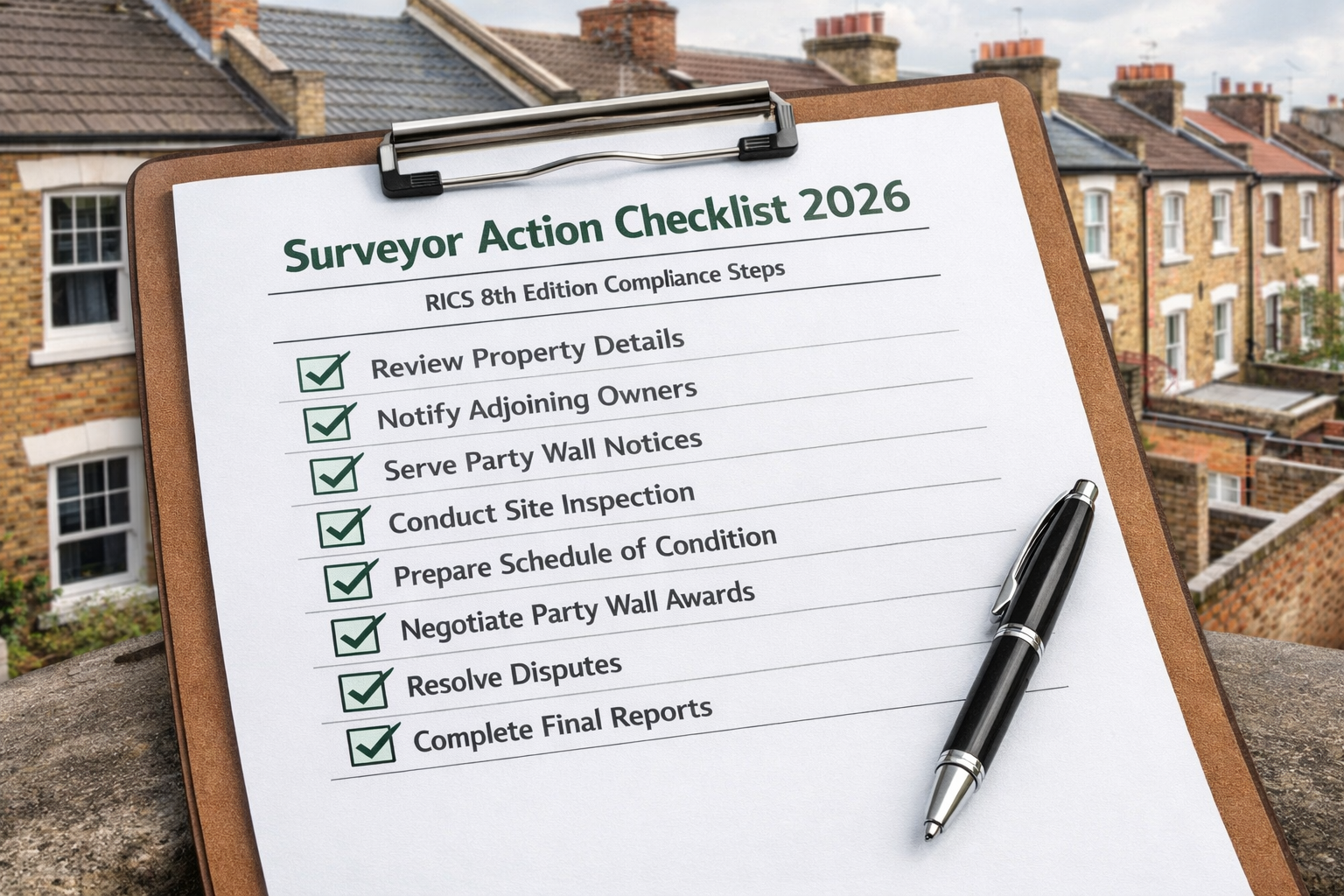
Before the final 8th edition is published, surveyors should work through the following preparation steps:
Documentation Review
- Review and update all letters of appointment against the draft RICS templates
- Audit existing award templates for compliance with the revised draft award format
- Ensure all notice templates reflect current procedural requirements
Conduct and Independence
- Review internal policies on client communication to reinforce surveyor independence
- Establish clear protocols for when and how to refer matters to the Third Surveyor
- Document fee structures transparently and ensure they meet reasonableness standards
Procedural Alignment
- Confirm notice service procedures are legally valid and consistently applied
- Review schedule of condition processes for documentation quality
- Update CPD records to reflect engagement with the 8th edition consultation material
Stakeholder Engagement
- Submit a response to the RICS consultation before it closes in May 2026
- Brief colleagues and junior surveyors on the key changes
- Review client-facing materials to ensure public engagement standards are met
Who Is Most Affected by the Updated Guidance?
The RICS 8th edition will have the broadest impact on the following groups [2]:
🏗️ Property Developers
Developers undertaking projects in urban areas with shared boundaries will need to ensure their appointed surveyors are working to the new standard. Procedural failures at the notice stage can cause costly delays.
🏠 Homeowners Undertaking Extensions or Renovations
Residential property owners planning works that trigger the Party Wall etc. Act 1996 — such as loft conversions, rear extensions, or basement excavations — should verify that their surveyor is familiar with the 8th edition requirements. Reviewing common party wall agreement questions before instructing a surveyor is a sensible first step.
📐 Chartered Surveyors
The guidance directly governs RICS members' professional conduct. Surveyors who fail to align with the published guidance risk disciplinary action and reputational harm.
⚖️ Legal Professionals
Solicitors and barristers advising on party wall disputes will need to be aware of the updated conduct standards, particularly around Third Surveyor referrals and surveyor independence.
Conclusion: Act Now, Not Later
The RICS 8th Edition Party Wall Guidance: Key Updates and Practical Implications for Surveyors in 2026 is more than a document update — it is a signal that the profession is raising its standards across competence, conduct, and consistency [1][3]. With the consultation running through May 2026 and the final edition expected to follow, surveyors have a limited window to engage with the process and align their practices proactively.
Actionable next steps for surveyors:
- Download and read the draft 8th edition consultation document from the RICS website
- Submit a consultation response before the May 2026 deadline
- Audit your documentation templates against the revised letters of appointment and award template
- Review your conduct policies — particularly around fee transparency, Third Surveyor use, and client independence
- Update your CPD log to reflect engagement with the new guidance
- Brief your team so that all surveyors in your practice are prepared for the transition
The party wall process exists to protect all parties involved in construction near shared boundaries. The 8th edition guidance strengthens the framework that makes that protection real. Surveyors who engage early will be better positioned to deliver the high standards their clients — and the profession — deserve.
References
[1] RICS Launches Consultation On Updated Party Wall Practice Guidance – https://www.rics.org/news-insights/rics-launches-consultation-on-updated-party-wall-practice-guidance
[2] RICS Opens Consultation On Party Wall Guidance Update – https://www.propertywire.com/news/uk/rics-opens-consultation-on-party-wall-guidance-update/
[3] RICS Launches Consultation On Party Wall Guidance – https://thenegotiator.co.uk/news/regulation-law-news/rics-launches-consultation-on-party-wall-guidance/
[4] RICS Consults On Updated Party Wall Practice Guidance – https://www.lexisnexis.co.uk/legal/news/rics-consults-on-updated-party-wall-practice-guidance