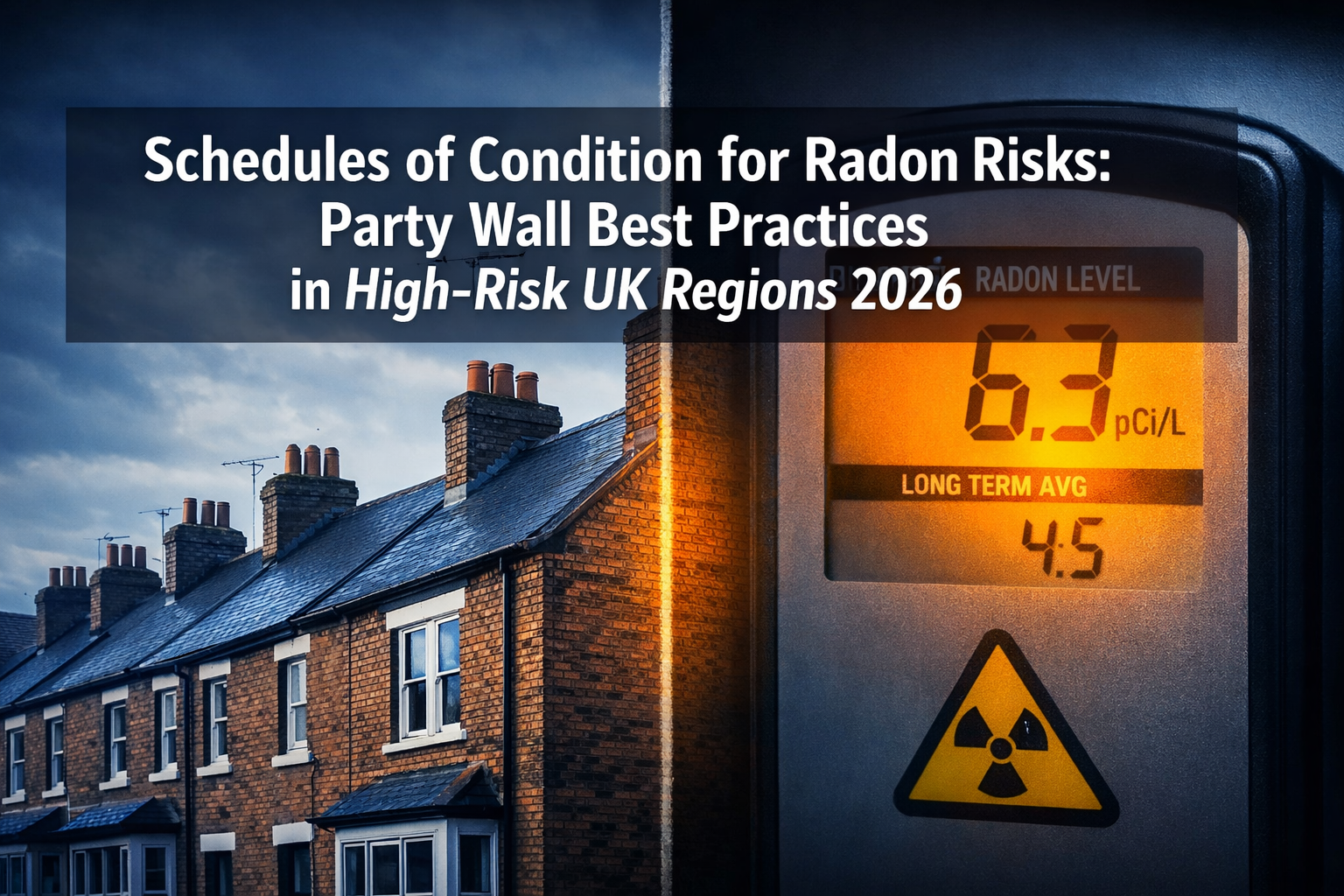

Radon gas causes an estimated 1,100 lung cancer deaths in the UK every year — yet the majority of party wall awards issued in high-risk regions still contain no radon baseline data whatsoever. That gap is no longer just a professional oversight; in 2026, it carries real legal and financial consequences for building owners, surveyors, and adjoining neighbours alike.
Schedules of Condition for Radon Risks: Party Wall Best Practices in High-Risk UK Regions 2026 sits at the intersection of two regulatory worlds that have historically operated in isolation: the Party Wall etc. Act 1996 and the UK's evolving radon safety framework. As construction activity accelerates across radon-affected areas (RAAs) — particularly in the South West, East Midlands, and parts of Wales — the need for integrated, RICS-aligned documentation has never been more urgent [1][7].
This guide provides practical templates, testing strategies, and procedural frameworks to help surveyors, building owners, and their neighbours navigate this increasingly complex compliance landscape.
Key Takeaways 📋
- Radon action level is 200 Bq/m³: Any reading at or above this threshold triggers mandatory mitigation under UK guidance [1][3][4].
- Baseline testing must precede notifiable works: A schedule of condition without pre-works radon data is incomplete in any RAA.
- 90-day minimum testing periods are required for statistically reliable radon measurements [3].
- Landlords must disclose known high radon levels in writing to tenants; vendors should provide test results to buyers [2][6].
- Party wall awards can — and should — include radon clauses to protect all parties from post-works disputes in high-risk regions.
Understanding the UK Radon Landscape in 2026
What Is Radon and Why Does It Matter for Party Wall Works?
Radon is a naturally occurring radioactive gas produced by the decay of uranium in rocks and soil. It seeps upward through the ground and can accumulate to dangerous concentrations inside buildings, particularly in basements, ground floors, and areas with poor ventilation [8]. Because it is colourless and odourless, it is entirely undetectable without specialist equipment.
For party wall purposes, the relevance is direct: excavation works, underpinning, basement conversions, and foundation alterations — all notifiable under the Party Wall etc. Act 1996 — can disturb soil strata, alter pressure differentials, and fundamentally change how radon enters a building. A party wall excavation notice served in a radon-affected area without any corresponding radon risk assessment is, in 2026, an incomplete document.
UK Radon-Affected Areas: Where the Risk Is Highest
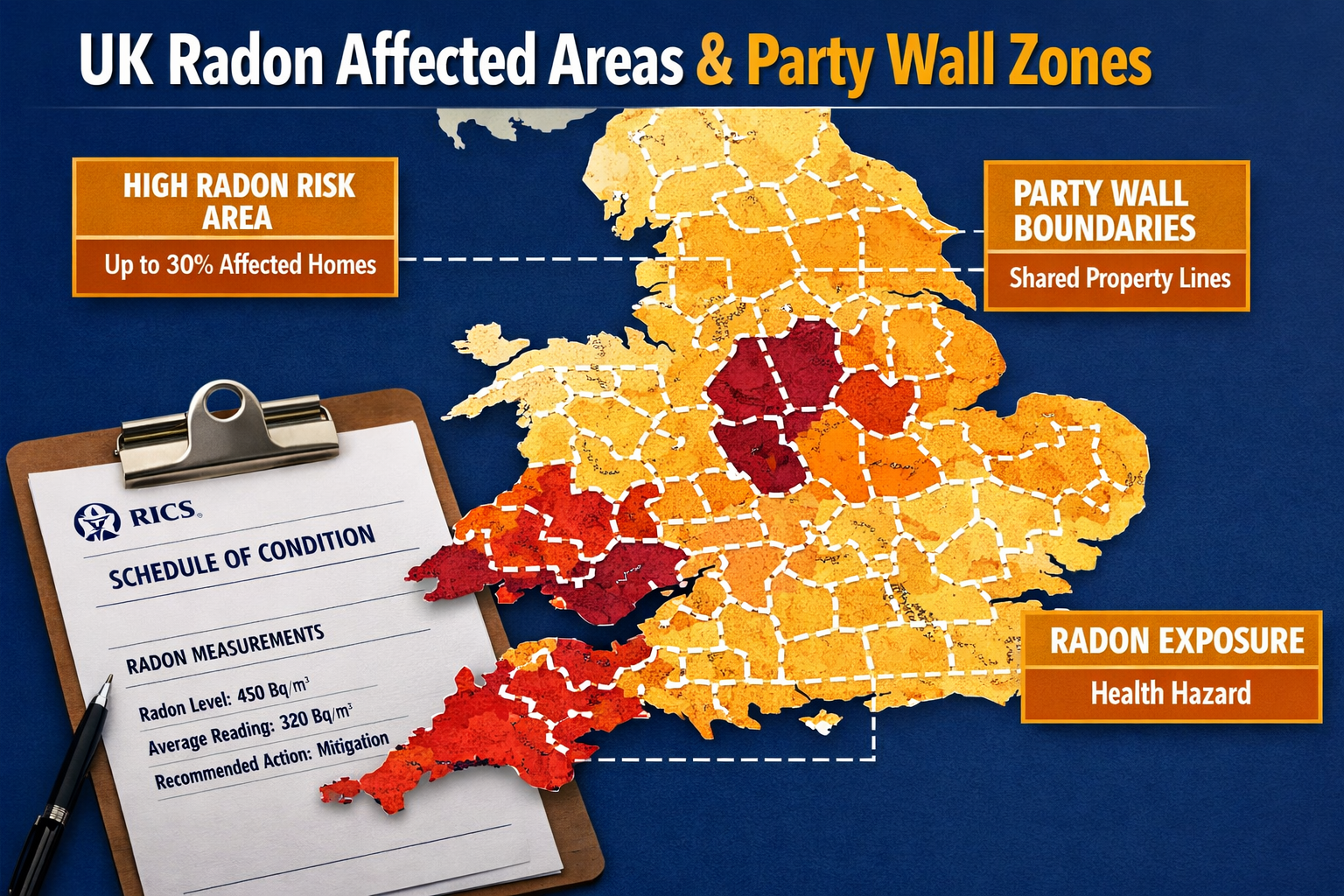
The UK Health Security Agency (UKHSA) designates radon-affected areas as those where 1% or more of homes are estimated to exceed the action level of 200 Bq/m³ [4]. The highest-risk regions include:
| Region | Risk Level | Notable RAA Designations |
|---|---|---|
| Cornwall & Devon | 🔴 Very High | Widespread granite geology |
| Derbyshire & Nottinghamshire | 🔴 High | Limestone and shale formations |
| Northamptonshire | 🟠 Elevated | Jurassic limestone belt |
| Parts of Wales | 🟠 Elevated | Slate and igneous rock areas |
| Somerset & Wiltshire | 🟡 Moderate-High | Mixed geology zones |
| Parts of Oxfordshire | 🟡 Moderate | Limestone outcrops |
💡 Pull Quote: "In high-risk regions, a schedule of condition without radon baseline data is like a structural survey without photographs — it simply does not provide adequate protection."
Even outside these primary zones, radon levels can vary dramatically between adjacent properties due to local geology, building construction, and ventilation patterns [2]. This is why testing rather than assumption is the professional standard.
Regulatory Context: Radon as a Workplace and Housing Obligation
Radon assessment is a formal workplace health and safety requirement under the Ionising Radiations Regulations 2017 [1]. Employers in RAAs must measure radon levels and take action if readings exceed 300 Bq/m³ in the workplace (the workplace action level differs slightly from the domestic threshold) [4].
For residential properties, the action level remains 200 Bq/m³ [1][3][4]. Landlords who are aware of high radon concentrations must disclose this information to tenants in writing [6]. Meanwhile, property vendors are increasingly expected — and in some cases legally obliged — to share radon test results with buyers [2][5].
In 2026, surveyors who ignore these obligations when preparing party wall documentation in RAAs face potential professional liability claims, particularly if post-works radon levels are found to have increased significantly.
Schedules of Condition for Radon Risks: Party Wall Best Practices in High-Risk UK Regions 2026 — The RICS-Aligned Framework
What a Standard Schedule of Condition Covers
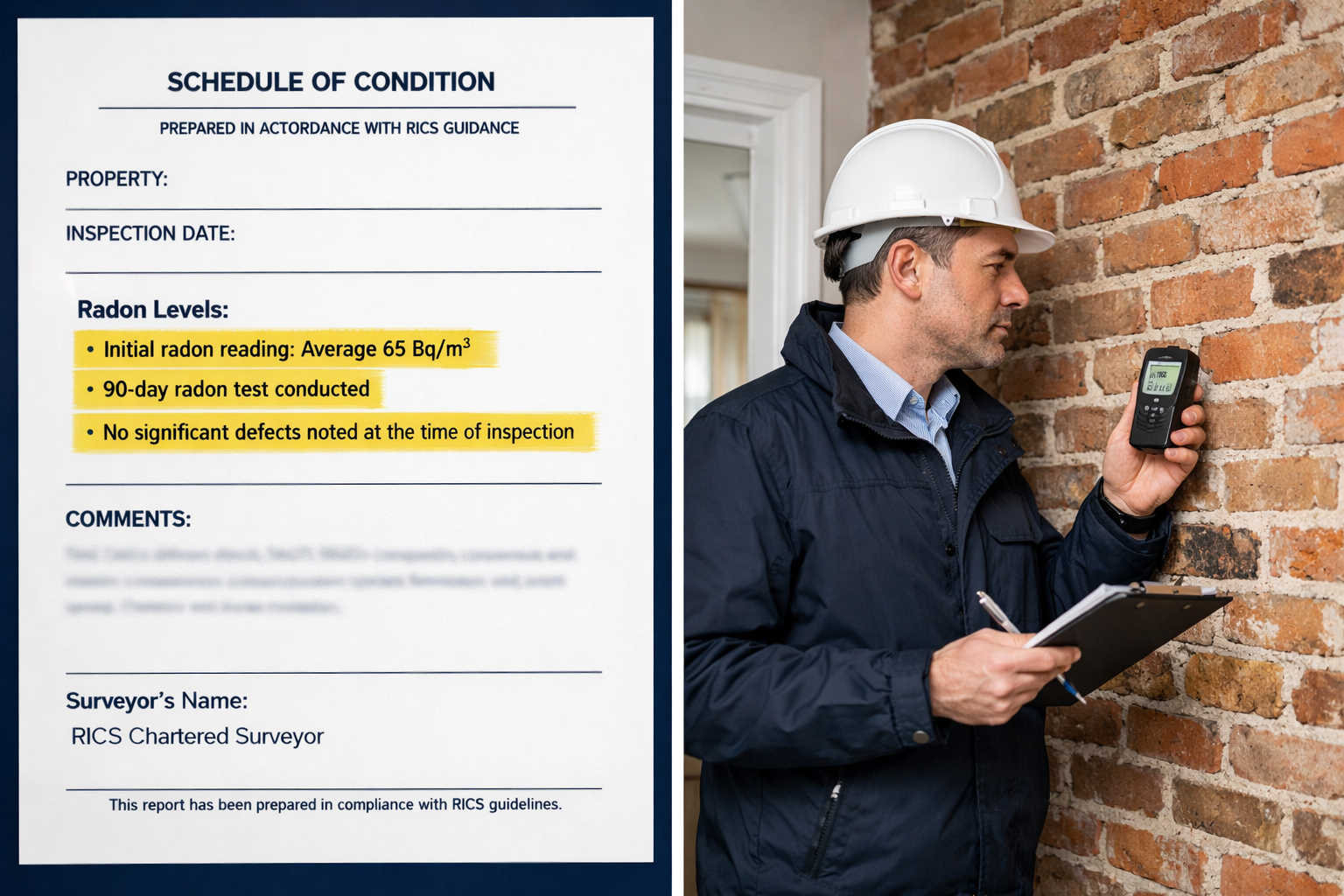
A schedule of condition report is a detailed, photographic record of a property's condition at a specific point in time — typically prepared before notifiable building works begin. Its primary purpose is to establish a baseline against which any damage caused by the works can be measured and attributed.
Standard schedules record:
- Structural cracks and their dimensions
- Damp patches and moisture readings
- Condition of floors, walls, ceilings, and external elements
- Existing defects that pre-date the proposed works
What most schedules in RAAs still fail to record: pre-works radon concentrations.
Integrating Radon Baseline Data into Party Wall Schedules
For surveyors operating in high-risk UK regions in 2026, the following additions to a standard schedule of condition are considered best practice:
1. Pre-Works Radon Testing Protocol
Testing must be conducted before notifiable works begin, using UKAS-accredited detectors placed in the lowest habitable floor of both the building owner's and adjoining owner's property. Key parameters:
- Minimum testing period: 90 days [3]
- Detector placement: Ground floor or basement; away from draughts and direct sunlight
- Accreditation: Use only UKAS-accredited laboratories for analysis
- Seasonal adjustment: Winter measurements tend to be higher; note the season in the schedule
2. Radon Risk Classification Clause
The schedule should include a formal radon risk classification for the property, referencing the UKHSA's Indicative Atlas of Radon in England and Wales. This provides documentary evidence that the risk was assessed, regardless of the outcome.
3. Post-Works Verification Requirement
The party wall award should specify that post-works radon testing will be carried out within 6 months of practical completion, using the same methodology as the baseline test. If readings have increased above the action level of 200 Bq/m³, the building owner's works are presumed to have contributed, and remediation costs become a matter for the award [3][4].
Template Radon Clause for Party Wall Awards
The following clause structure is suitable for inclusion in a party wall award in an RAA:
Radon Risk Clause (Template)
"The Building Owner shall, prior to commencement of the notifiable works, arrange for radon concentration testing to be carried out at [property address] and [adjoining property address] in accordance with UKHSA guidance, using UKAS-accredited detectors deployed for a minimum period of 90 days. Results shall be appended to this Award as Schedule [X]. Should post-works testing, conducted within 6 months of practical completion, reveal radon concentrations at the Adjoining Owner's property in excess of 200 Bq/m³ where pre-works levels were below this threshold, the Building Owner shall bear the reasonable costs of radon mitigation works as agreed between the parties or, failing agreement, as determined by the appointed surveyor(s)."
This clause aligns with both the Party Wall etc. Act 1996's compensation provisions and the UK's current radon action framework [1][4]. Surveyors can adapt the language to suit specific circumstances, but the core elements — baseline testing, accredited methodology, post-works verification, and a clear liability trigger — should remain intact.
When Both Parties Need Separate Surveyors
In contentious cases involving radon risk — particularly where one party disputes the pre-works baseline or the attribution of post-works increases — it is strongly advisable for each party to appoint their own surveyor rather than relying on an agreed surveyor. Separate representation provides clearer accountability and a more robust dispute resolution pathway if radon-related claims arise later.
For guidance on the full range of party wall matters and how surveyors are appointed, the process is well-established under the Act — but radon adds a layer of technical complexity that demands specialist input.
Schedules of Condition for Radon Risks: Party Wall Best Practices in High-Risk UK Regions 2026 — Regional Considerations and Practical Guidance
Region-Specific Considerations
Cornwall and Devon
These counties sit on granite bedrock — one of the most prolific natural sources of radon in the UK [8]. Any party wall works involving excavation, basement construction, or underpinning in these areas should be treated as high-priority for radon documentation, regardless of whether the specific postcode falls within a formally designated RAA.
For properties in these regions, surveyors should consider recommending radon testing even where the works are above ground, as disturbance to adjoining foundations can alter air pathways.
East Midlands (Derbyshire, Nottinghamshire, Northamptonshire)
Limestone and shale geology creates significant radon variability across short distances. Two semi-detached properties sharing a party wall can have meaningfully different radon profiles. This makes individual property testing — rather than reliance on area-wide risk estimates — essential for any schedule of condition in these regions.
Parts of Wales and Northern England
Slate quarrying regions and areas with igneous rock geology carry elevated radon risk. Local planning authorities in some Welsh counties now encourage radon-protective construction measures for new builds and extensions, which party wall surveyors should factor into their award recommendations.
Practical Steps for Building Owners in RAAs
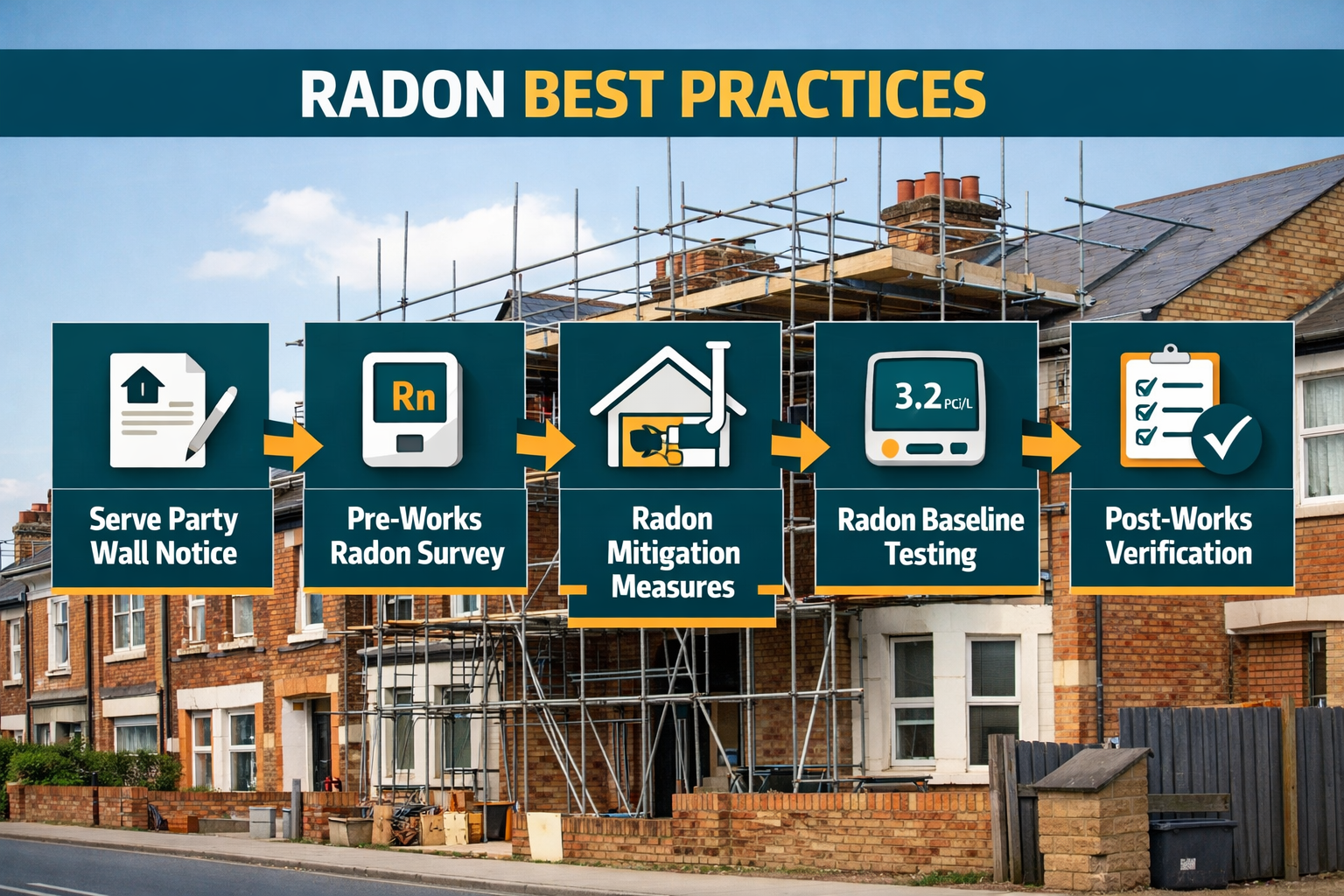
If planning notifiable works in a radon-affected area in 2026, the following sequence is recommended:
- ✅ Serve the correct party wall notice — use a party wall notice at least 2 months before works begin for structural works, or 1 month for line of junction works.
- ✅ Commission pre-works radon testing immediately after notice is served — the 90-day testing window means delays are costly [3].
- ✅ Appoint a surveyor experienced in RAA documentation — not all party wall surveyors have radon expertise; ask specifically about their experience with radon clauses.
- ✅ Ensure the schedule of condition captures radon baseline data — this is the single most important protective step for both parties.
- ✅ Include post-works testing obligations in the award — this closes the liability loop and protects the building owner from speculative claims.
What Adjoining Owners Should Request
Adjoining owners in RAAs have every right to request that radon testing forms part of the party wall process. If a building owner's surveyor has not included radon provisions in a proposed award, the adjoining owner's surveyor should raise this as a formal objection before the award is sealed.
Adjoining owners should also:
- Request copies of any existing radon test results from the building owner [2][5]
- Consider independent testing of their own property before works begin
- Ensure the award specifies who bears the cost of post-works testing
For properties where party wall disputes have already arisen, radon data can become a critical piece of evidence — particularly if works have already begun without a proper schedule in place.
Radon Mitigation: What Happens When Levels Exceed 200 Bq/m³?
If post-works testing reveals concentrations above the 200 Bq/m³ action level [1][3][4], mitigation options include:
| Mitigation Method | Typical Application | Effectiveness |
|---|---|---|
| Positive pressurisation | Whole-house systems | High |
| Sump and fan extraction | Sub-floor radon sumps | Very High |
| Improved underfloor ventilation | Suspended timber floors | Moderate-High |
| Sealing entry points | Cracks, service penetrations | Moderate |
| Radon membrane installation | New builds / major works | Very High |
The costs of these interventions vary from approximately £500 for basic sealing works to £2,500+ for full sump-and-fan systems. Where the party wall award includes a radon clause, the attribution of these costs is governed by the award's terms — making the pre-works baseline data absolutely critical.
Conclusion: Protecting All Parties Through Proactive Radon Documentation
The integration of radon risk assessment into schedules of condition is no longer a niche concern for specialist surveyors — it is a professional standard that all practitioners operating in high-risk UK regions should adopt in 2026. The consequences of omission are significant: post-works radon increases that cannot be attributed (or defended against) because no baseline exists, disputes that escalate into costly litigation, and landlords or vendors who face legal exposure for non-disclosure [2][5][6].
Schedules of Condition for Radon Risks: Party Wall Best Practices in High-Risk UK Regions 2026 represents a convergence of property law, public health regulation, and professional surveying standards. The good news is that the framework for compliance is clear, the testing methodology is well-established, and the template clauses are adaptable to most party wall scenarios.
Actionable Next Steps
- 🔍 Check whether your property falls within a radon-affected area using the UKHSA's online postcode checker before serving or responding to any party wall notice.
- 📋 Commission a schedule of condition report that explicitly includes radon baseline testing as a documented component.
- ⚖️ Ensure your party wall award includes a radon clause with clear pre- and post-works testing obligations and a defined liability trigger at 200 Bq/m³.
- 🏗️ If works have already begun without radon documentation, commission testing immediately and seek legal advice on how to establish a retrospective baseline.
- 👥 Consult a chartered surveyor with specific experience in RAA party wall matters — the intersection of radon science and property law requires both technical and legal literacy.
For any questions about the party wall process, common Party Wall Act questions are a useful starting point, and professional surveying support is available across London, Surrey, and the wider South East.
References
[1] Radon In 2026 – https://properteco.co.uk/radon-in-2026/
[2] Information For House Buyers And Sellers – https://radonassociation.co.uk/guide-to-radon/information-for-house-buyers-and-sellers/
[3] Radon Policy 2024 Version2 – https://www.believehousing.co.uk/wp-content/uploads/2026/01/Radon-Policy-2024-Version2.pdf
[4] Chapter 32 Radiation Safety Arrangements For Protection Against Radon – https://assets.publishing.service.gov.uk/media/67d9552c69606cdea9e08756/Chapter_32_-_radiation_safety_arrangements_for_protection_against_radon.pdf
[5] Housesales – https://www.ukradon.org/information/housesales
[6] 2026 Radon Awareness And Safety Guide – https://resphealth.org/2026-radon-awareness-and-safety-guide/
[7] Party Wall Surveys And Neighbour Disputes During 2026s Construction Uptick Rics Compliance Framework – https://nottinghillsurveyors.com/blog/party-wall-surveys-and-neighbour-disputes-during-2026s-construction-uptick-rics-compliance-framework
[8] Radon – https://www.gov.uk/government/collections/radon