By 2026, over 1 million new EV charging points are projected to be required across UK residential and commercial properties — yet a significant proportion of these installations will involve shared walls, boundaries, and access rights that trigger the Party Wall etc. Act 1996. For homeowners, developers, and surveyors alike, understanding how Party Wall Surveys for EV Charging Point Installations: RICS Protocols Amid 2026 Net Zero Mandates intersect with existing property law is no longer optional — it is essential.
The rush to decarbonise transport has collided head-on with the UK's densely packed housing stock. Terraced homes, semi-detached properties, and shared-access driveways dominate the residential landscape, meaning that installing an EV charger is rarely as simple as drilling a hole and plugging in a cable. When that cable or mounting bracket touches — or comes close to — a party wall or shared boundary structure, the legal and surveying obligations multiply fast.
This article breaks down the RICS protocols that govern these installations, the party wall implications that property owners must navigate, and the practical steps that prevent costly disputes.
Key Takeaways 📋
- EV charger installations near shared walls can trigger the Party Wall etc. Act 1996, requiring formal notices and potentially a full party wall agreement.
- RICS guidance emphasises proactive risk assessment, including vibration analysis and structural integrity checks, before any drilling or cable routing begins.
- Cost allocation and dispute prevention are central concerns — RICS protocols provide a framework for apportioning responsibility fairly between adjoining owners.
- 2026 net zero mandates are accelerating installation timelines, increasing the risk of procedural shortcuts that lead to neighbour disputes and legal liability.
- A schedule of condition report before work begins is strongly recommended to protect all parties from unfounded damage claims.
Why EV Charging Installations Are Triggering Party Wall Obligations in 2026
The UK government's commitment to net zero by 2050 — with interim targets driving significant infrastructure change by 2026 — has placed enormous pressure on residential and commercial property owners to install EV charging infrastructure quickly [6]. Commercial property managers are already preparing for mandatory compliance, with best practices now recommending early-stage structural assessments as part of any EV readiness programme [2].
However, speed and legal compliance rarely coexist comfortably. The Party Wall etc. Act 1996 is triggered when a building owner proposes to carry out work that:
- Cuts into, exposes, or otherwise affects a party wall or party structure
- Involves excavation within 3 or 6 metres of an adjoining owner's building (depending on depth)
- Affects the structural integrity of a shared boundary wall
EV charger installations frequently involve all three scenarios. A wall-mounted charger on a shared flank wall, cable conduit buried beneath a shared driveway, or a ground anchor for a bollard-style charger near a boundary — each of these can engage the Act's provisions.
💡 Pull Quote: "The intersection of green energy mandates and party wall law is creating a new frontier for RICS surveyors — one where technical expertise and legal knowledge must work in tandem."
For a comprehensive overview of how the Act applies to different types of work, the Party Wall Act 3-metre rule is particularly relevant when cable trenches or ground-mounted charger foundations are involved.
What Counts as "Notifiable Work" for EV Charger Installations?
Not every EV charger installation will trigger the Act. The key questions are:
| Installation Type | Party Wall Act Triggered? | Notice Required? |
|---|---|---|
| Internal garage wall charger (no shared wall) | ❌ No | No |
| Wall-mounted charger on shared flank wall | ✅ Yes | Party Structure Notice |
| Cable conduit through party wall | ✅ Yes | Party Structure Notice |
| Ground-mounted charger with foundation near boundary | ⚠️ Possibly | Excavation Notice |
| Shared driveway cable trench | ⚠️ Possibly | Depends on depth/proximity |
When in doubt, serving a party wall notice is always the safer course of action. Failure to do so can expose the building owner to injunctions, forced removal of works, and liability for any resulting damage.
RICS Protocols for Party Wall Surveys for EV Charging Point Installations: RICS Protocols Amid 2026 Net Zero Mandates
RICS (the Royal Institution of Chartered Surveyors) has been actively developing guidance to help surveyors navigate the intersection of sustainability retrofits and party wall obligations [4]. The core RICS protocol for EV charging installations near party walls follows a structured sequence:
Step 1: Pre-Installation Assessment
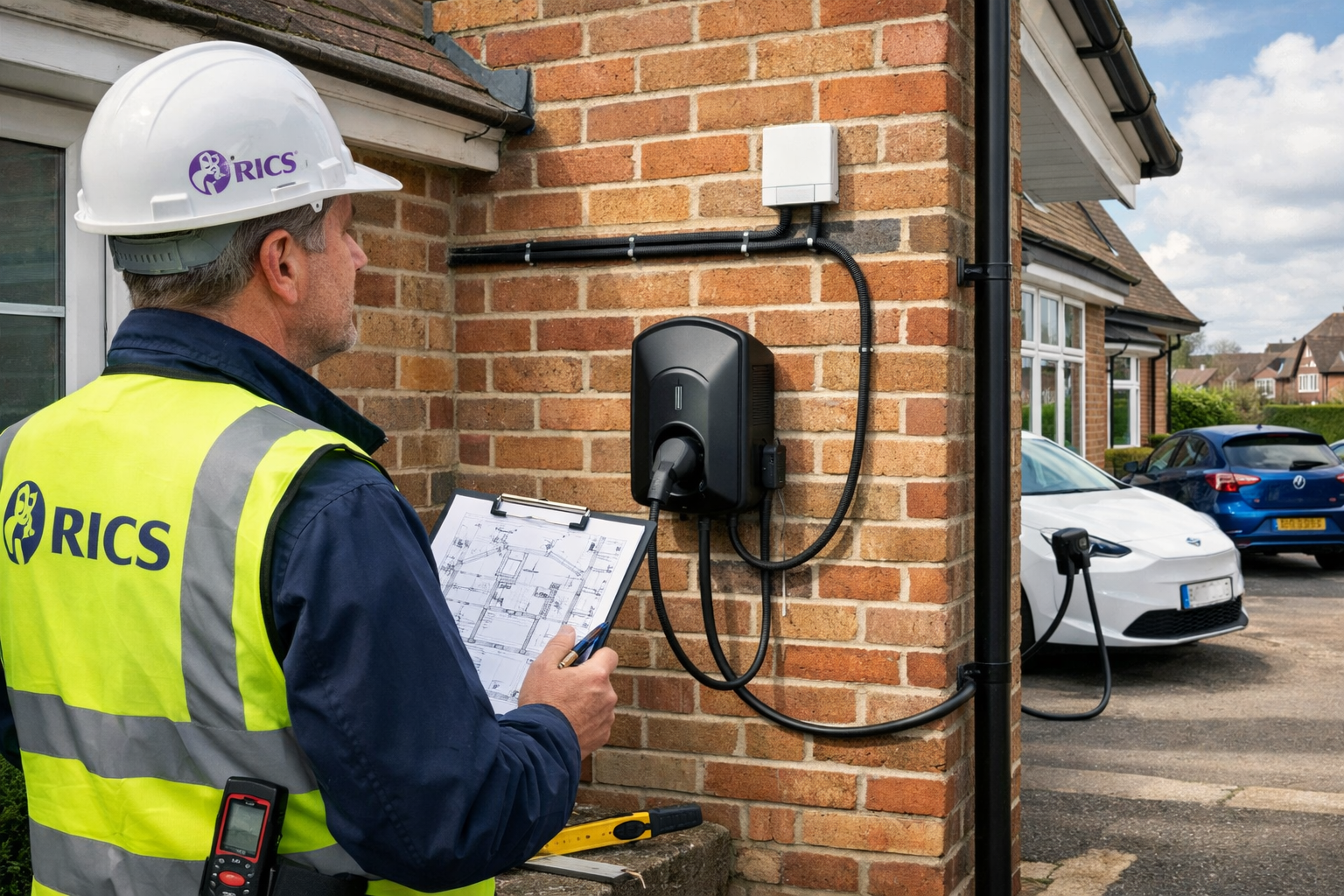
Before any notice is served, a qualified surveyor should conduct a pre-installation structural assessment of the party wall or boundary structure. This involves:
- Visual inspection of the wall's condition, existing cracks, and any previous repairs
- Vibration risk analysis — drilling into masonry near a party wall generates vibrations that can cause or worsen existing damage
- Cable routing assessment — identifying the least invasive path for electrical conduit
- Access rights review — establishing whether the installation requires access to the adjoining owner's land
This aligns with RICS's broader emphasis on retrofitting existing buildings sustainably, which stresses that green energy upgrades must not compromise structural integrity or neighbour relations [4].
Step 2: Serving the Correct Notice
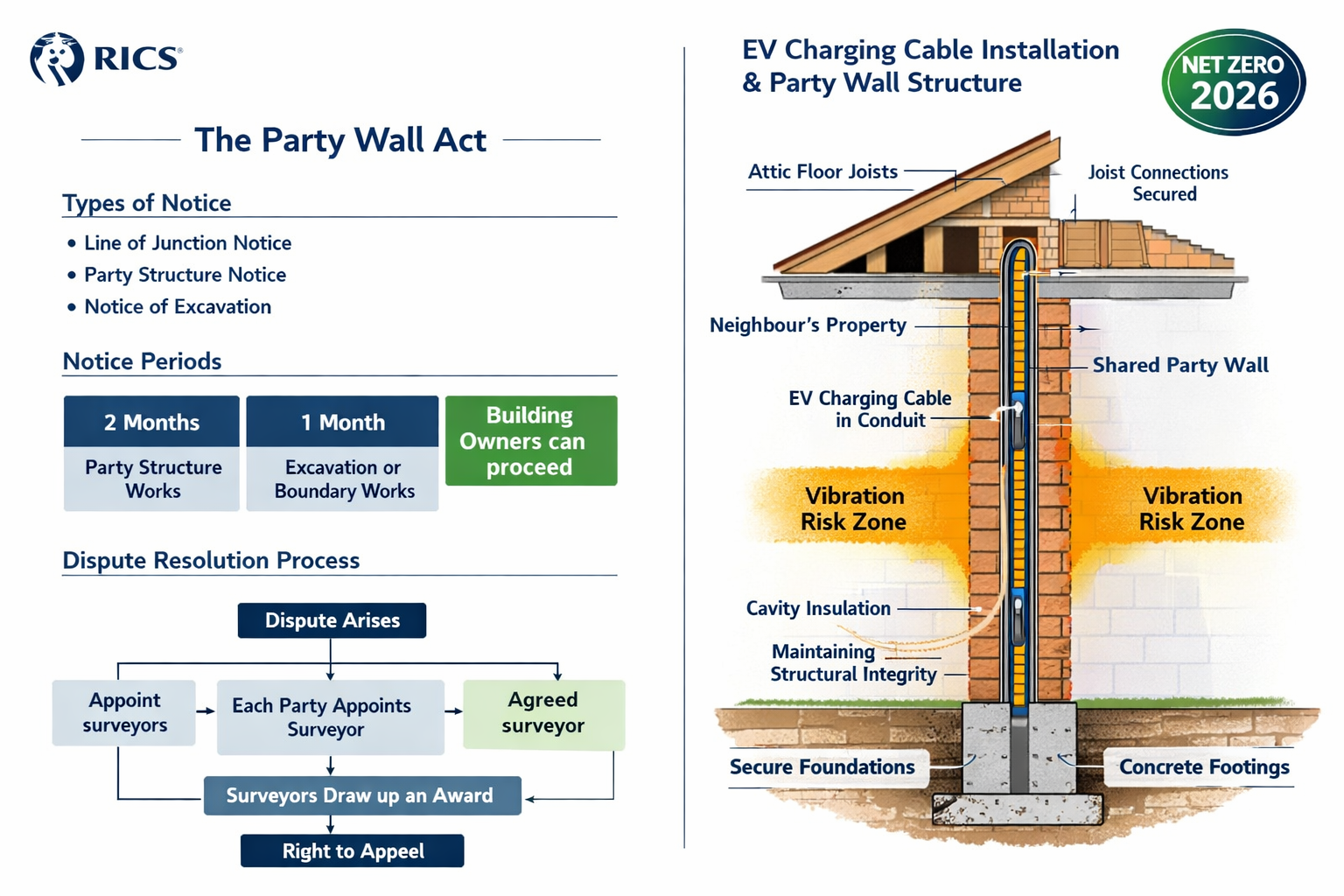
Once the scope of work is defined, the building owner must serve the appropriate notice. For most EV charger installations affecting a party wall, this will be a Party Structure Notice, giving the adjoining owner 2 months to respond.
If the installation involves excavation near the boundary, a separate party wall excavation notice must be served, typically providing 1 month's notice.
Step 3: Schedule of Condition Report
This is arguably the most protective step for both parties. A schedule of condition report documents the existing state of the party wall and adjoining property before any work begins. In the context of EV charger installations, this is critical because:
- Drilling and cable routing can cause hairline cracks in plaster or masonry
- Vibration from installation tools can loosen existing pointing or render
- Without a pre-work record, disputes about who caused what damage become almost impossible to resolve fairly
⚠️ Important: A schedule of condition is not legally mandatory, but RICS strongly recommends it as standard practice for any notifiable works.
Step 4: Agreeing or Appointing a Surveyor
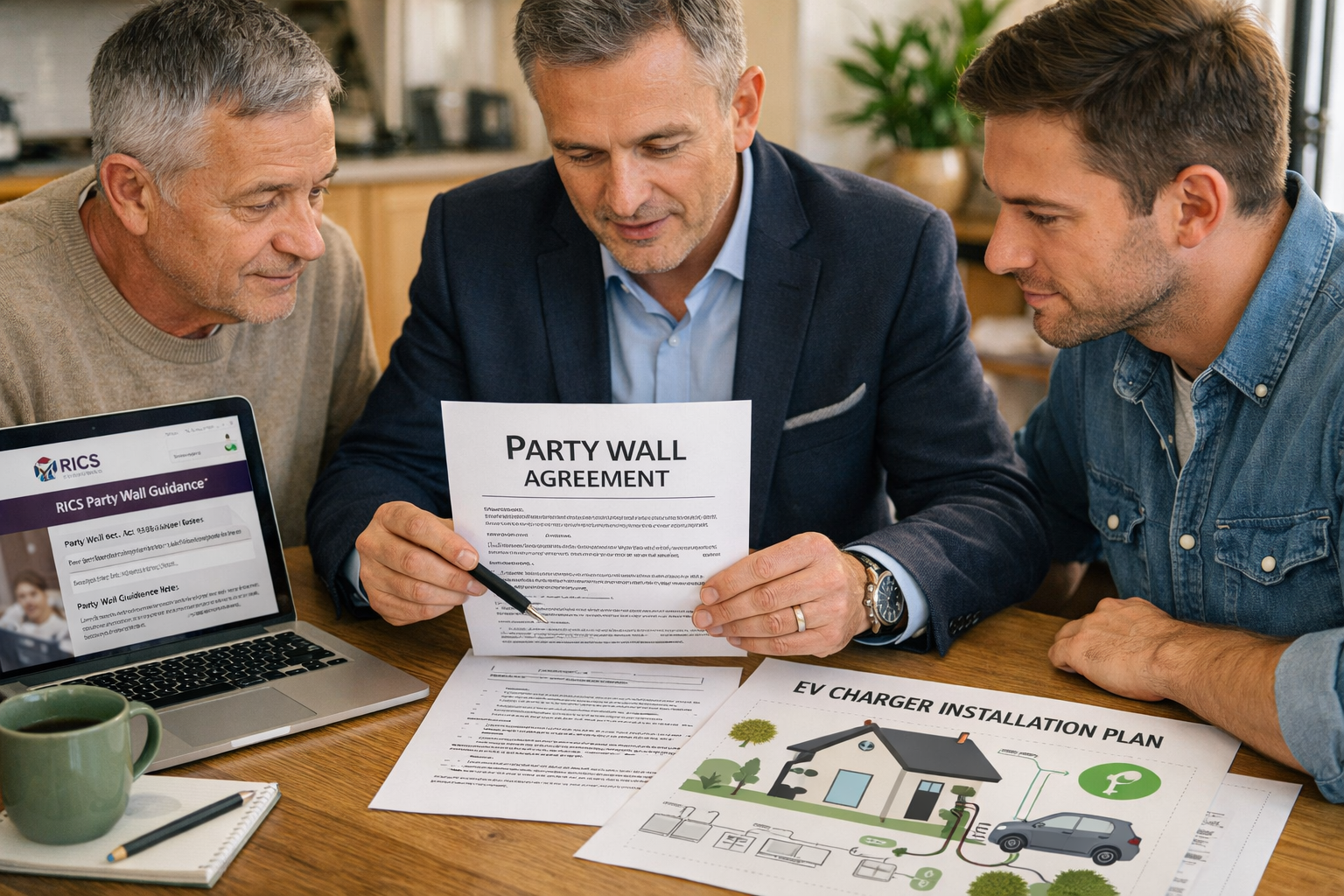
If the adjoining owner consents to the work, a party wall agreement can be drawn up relatively quickly. If they dissent — or fail to respond within the notice period — both parties must appoint surveyors. They may agree to use a single agreed surveyor to reduce costs, or each appoint their own, with a third surveyor available to resolve any disagreements.
Vibration Risks, Structural Concerns, and Cost Allocation
The Vibration Problem
One aspect of EV charger installations that is frequently underestimated is vibration risk. Percussion drilling into a party wall — particularly in older Victorian or Edwardian terraced properties — can cause:
- Cracking of internal plaster on the adjoining owner's side
- Loosening of decorative cornices or ceiling roses
- Damage to existing electrical or plumbing runs within the wall cavity
RICS protocols require surveyors to specify drilling methods within the party wall award where vibration risk is identified. Rotary drilling rather than hammer action, or the use of diamond-tipped core drills, may be stipulated to minimise impact.
For properties where existing structural concerns are present, a structural survey prior to installation can identify vulnerabilities that should inform the party wall award's conditions.
Damage to Property: Who Pays?
The Party Wall etc. Act 1996 is clear: the building owner carrying out the work is liable for any damage caused to the adjoining owner's property as a direct result of those works. This principle applies fully to EV charger installations.
Understanding damage to property in party wall scenarios is essential for both surveyors and property owners. The award drawn up by the surveyor(s) should include:
- Specific conditions on how the installation must be carried out
- Remediation obligations if damage occurs
- Timelines for completing the work
- Access provisions if the installer needs to reach the adjoining owner's side
Cost Allocation Under RICS Guidance
A common source of confusion — and dispute — is who bears the cost of the party wall process itself. The general principle is:
- The building owner pays for the surveyor's fees, the schedule of condition, and any remedial works
- The adjoining owner's surveyor fees are also typically borne by the building owner, provided those fees are reasonable
- Shared infrastructure costs (e.g., a charger serving both properties) may be apportioned by agreement
Understanding party wall surveyor costs upfront helps building owners budget accurately and avoids unpleasant surprises mid-project. In 2026, with installation demand at record levels, surveyor availability is tighter — early engagement is strongly advised [2].
Preventing Disputes: Best Practice for the 2026 EV Charging Rollout
The scale of EV infrastructure deployment planned for 2026 means that party wall disputes related to EV charger installations are almost certain to increase. Proactive dispute prevention is far less costly — financially and relationally — than reactive resolution.
The Most Common Dispute Triggers
Based on RICS guidance and emerging case patterns, the most frequent causes of neighbour disputes over EV charger installations include:
- 🔴 Failure to serve notice — the most serious procedural failure
- 🟠 Inadequate schedule of condition — leaving damage claims unresolvable
- 🟡 Poor communication — neighbours feeling blindsided by sudden installation activity
- 🟡 Disputed access rights — particularly for shared driveways or rear access lanes
- 🟢 Disagreement over cable routing aesthetics — visible conduit on shared walls
Practical Dispute Prevention Strategies
Early neighbour engagement is the single most effective tool. Many disputes arise not from legal technicalities but from a neighbour feeling ignored or disrespected. A simple conversation before serving formal notices can transform a potential dispute into a cooperative arrangement.
Use a single agreed surveyor where possible. This reduces costs for both parties and streamlines the award process. It works best when both parties have a broadly cooperative relationship and the works are straightforward.
Commission a thorough schedule of condition. This protects both the building owner (against inflated damage claims) and the adjoining owner (against genuine damage being dismissed). For a detailed explanation of what this involves, see what is a schedule of condition report.
Specify installation methods in the award. Vague awards create disputes. The surveyor should specify drilling methods, working hours, dust and noise management, and cable routing in sufficient detail to leave no room for ambiguity.
💡 Pull Quote: "In 2026, the best party wall surveyor is one who understands not just the law, but the technology — knowing how an EV charger is installed is as important as knowing the Act."
The Broader Net Zero Context: RICS and the Sustainability Imperative
The 2026 net zero mandates are not just a policy backdrop — they are actively reshaping how RICS surveyors approach their work. RICS has identified several reasons why surveyors are well-placed to support the net zero transition, including their expertise in assessing existing building stock and mediating between competing interests [6].
For EV charging specifically, the scale of the challenge is significant. Charging infrastructure in commercial buildings requires careful planning around structural capacity, electrical load, and access [7]. In residential settings, the party wall dimension adds another layer of complexity that purely electrical or planning-focused professionals may overlook.
The commercial sector faces its own set of pressures, with Charge Point Operators (CPOs) scaling infrastructure at pace [3]. Where commercial properties share walls with residential neighbours, or where multi-occupancy buildings are involved, the party wall implications can be substantial and require specialist RICS expertise.
RICS's work on retrofitting historic buildings sustainably is directly relevant here [4]. Many of the UK's most densely packed terraced streets — the very areas where shared-wall EV charger installations are most common — consist of listed or conservation-area properties where additional planning constraints apply alongside party wall obligations.
Conclusion: Actionable Next Steps for Property Owners and Surveyors
Party Wall Surveys for EV Charging Point Installations: RICS Protocols Amid 2026 Net Zero Mandates represent a genuinely new challenge at the intersection of green energy policy and established property law. The good news is that the legal framework is clear, the RICS guidance is robust, and the process — when followed correctly — protects everyone involved.
Actionable Next Steps ✅
-
Assess your installation plans early. Before engaging an electrician, determine whether your proposed EV charger location is near a party wall or boundary. If in doubt, consult a RICS-accredited party wall surveyor.
-
Serve the correct notice in good time. Party Structure Notices require 2 months; excavation notices require 1 month. Factor this into your project timeline — especially given 2026 installation demand.
-
Commission a schedule of condition report before any work begins. This is the single most effective protection against post-installation disputes.
-
Engage your neighbour early and openly. A brief, friendly conversation before formal notices arrive can prevent months of dispute.
-
Appoint a RICS-accredited surveyor with specific experience in both party wall matters and sustainable retrofit projects. The combination of skills matters.
-
Budget for the full process. Include surveyor fees, schedule of condition costs, and a contingency for remedial works in your project budget.
The UK's net zero journey depends on millions of individual property decisions being made correctly. Getting the party wall process right for EV charger installations is a small but important part of that larger picture — and in 2026, there is no excuse for getting it wrong.
For further guidance on all aspects of party wall matters, explore the comprehensive resources available at Kingston Surveyors' party wall matters hub.
References
[1] Out Of Charge Key Issues To Successfully Monetize Public Ev Charging In 2026 – https://www.morganlewis.com/blogs/powerandpipes/2026/01/out-of-charge-key-issues-to-successfully-monetize-public-ev-charging-in-2026
[2] Planning Ev Charger Installations For 2026 What Commercial Properties Should Prepare Now – https://amtekconstruction.com/planning-ev-charger-installations-for-2026-what-commercial-properties-should-prepare-now/
[3] What It Takes For Cpos To Scale Ev Charging In 2026 – https://driivz.com/blog/what-it-takes-for-cpos-to-scale-ev-charging-in-2026/
[4] Retrofitting Historic Buildings Sustainably – https://ww3.rics.org/uk/en/journals/built-environment-journal/retrofitting-historic-buildings-sustainably.html
[6] Pathways Net Zero Surveyors Five Reasons Cheerful – https://www.rics.org/news-insights/wbef/pathways-net-zero-surveyors-five-reasons-cheerful
[7] altenergymag – https://www.altenergymag.com/news/2026/01/28/ev-charging-infrastructure-in-commercial-buildings-best-practices-and-future-readiness/46705/
[8] Driving The Ambition Loop – https://www.arup.com/globalassets/downloads/insights/d/driving-the-ambition-loop/driving-the-ambition-loop.pdf