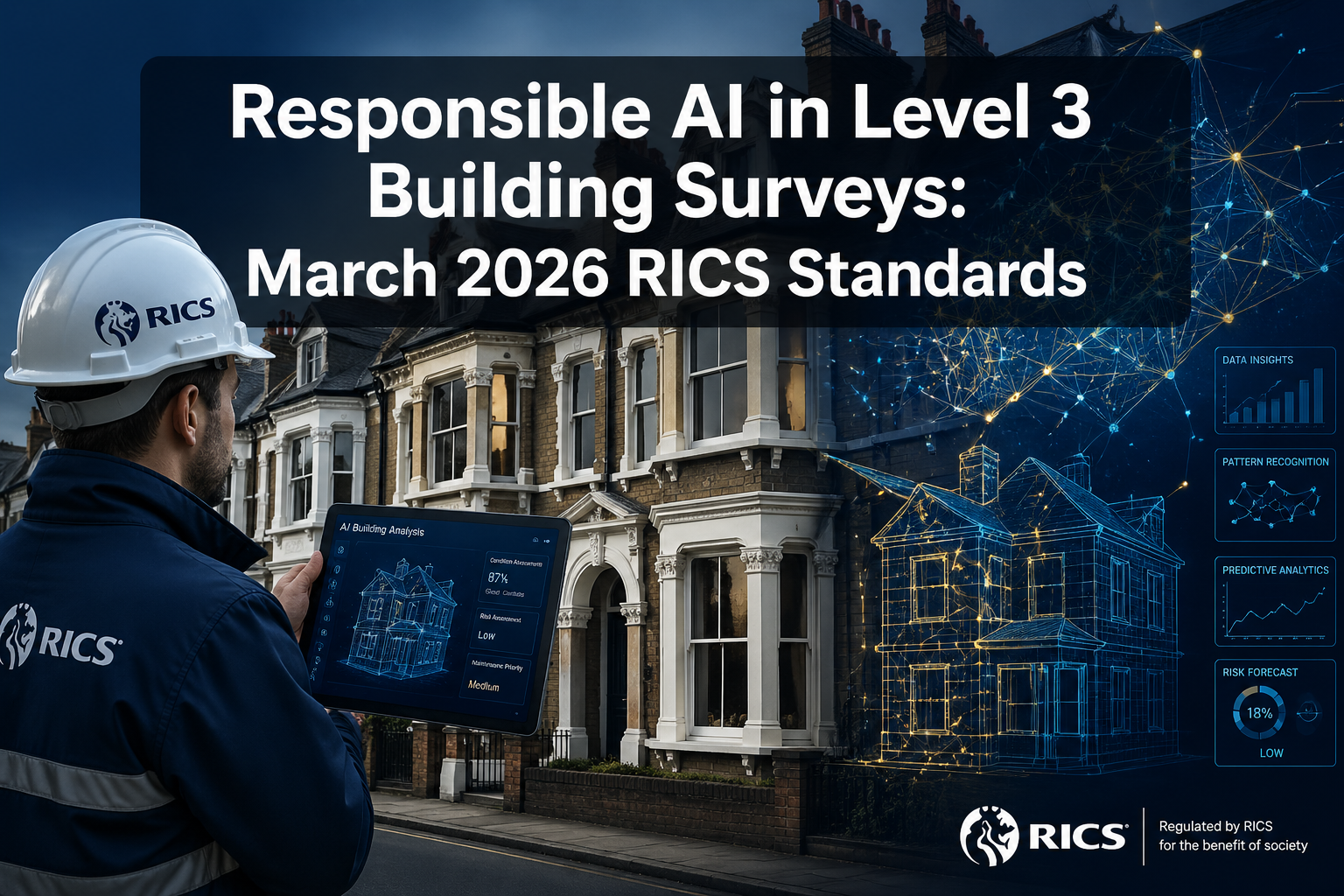
Fewer than 12% of surveying firms had a formal AI governance policy in place when RICS published its landmark standard in September 2025 — a figure that makes the mandatory March 2026 compliance deadline all the more significant for the profession. [3]
Responsible AI Integration in Level 3 Building Surveys: March 2026 RICS Standards and Practical Tools is no longer a future-facing discussion. It is the operational reality facing every RICS-regulated firm today. The new Professional Standard, which came into full effect in March 2026 following a six-month implementation window, applies globally to all RICS members and regulated firms — with no opt-out provisions for regulated practitioners. [3] For those conducting Level 3 Building Surveys (formerly known as Full Structural Surveys), the implications are direct, detailed, and demanding.
This article unpacks what the standard requires, how AI tools are being applied in practice during Level 3 inspections, and what surveyors must do to remain compliant while leveraging technology responsibly.
Key Takeaways 📋
- ✅ The RICS AI standard is mandatory for all regulated firms globally as of March 2026 — no exemptions exist
- ✅ Only AI tools with a material impact on service delivery require formal compliance documentation
- ✅ Firms must produce a written determination, a risk register, and a responsible AI use policy
- ✅ Client transparency is non-negotiable — written notification of AI use is required, including opt-out options
- ✅ Human professional judgment must always oversee AI-generated outputs in Level 3 survey reports
What the March 2026 RICS AI Standard Actually Requires
The RICS Professional Standard on responsible AI use was formally published in September 2025 and became enforceable in March 2026. [5] It is the first global AI standard specifically designed for the surveying profession, covering valuation, construction, infrastructure, and land services — including Level 3 Building Surveys. [3]
The Material Impact Threshold
Not every use of AI triggers full compliance obligations. The standard draws a critical distinction: only AI tools that have a material impact on the delivery of surveying services must be formally assessed and documented. [4] For Level 3 surveys, this threshold is likely crossed when AI is used to:
- Identify structural defects or anomalies from inspection images
- Generate condition ratings or risk scores for report sections
- Summarise inspection findings or draft report language
- Analyse drone or thermal imaging data for roof or structural assessments
Routine administrative uses — such as AI-assisted scheduling or email drafting — generally fall below this threshold.
The Written Determination Requirement
Every RICS-regulated firm must create and maintain a written record documenting:
- Whether AI use has a material impact on their services
- The reasoning behind that determination
- How that determination will be reviewed over time [2]
This is not a one-time exercise. As AI tools evolve and firm practices change, the written determination must be revisited and updated accordingly.
Mandatory Knowledge for All Members
Before deploying AI in surveying services, members must demonstrate a basic working understanding of: [2]
| Knowledge Area | Why It Matters for Level 3 Surveys |
|---|---|
| Types of AI systems | Knowing whether a tool uses machine learning, LLMs, or computer vision |
| Hallucination risks | AI may generate plausible but incorrect defect descriptions |
| Bias risks | Training data may under-represent certain property types or construction eras |
| Failure modes | Understanding when AI tools produce unreliable outputs |
| Data usage risks | Client property data may be used to train external AI models |
💬 "Members must maintain basic understanding of different AI types, their limitations, failure modes, hallucinations, bias risks, and data usage risks before deploying AI in surveying services." [2]
This is particularly relevant for surveyors working on older or non-standard properties — areas where AI training data is often thinner and error rates higher.
Responsible AI Integration in Level 3 Building Surveys: Practical Tools and Anomaly Detection
Level 3 Building Surveys are the most comprehensive residential survey product available. They are typically commissioned for older properties, unusual constructions, or buildings in poor condition — precisely the environments where AI anomaly detection tools offer the greatest potential value, and where their limitations are most exposed.
AI Tools Currently Used in Level 3 Inspections
Responsible AI integration in Level 3 building surveys is already happening across several practical applications:
🔍 Computer Vision for Defect Detection
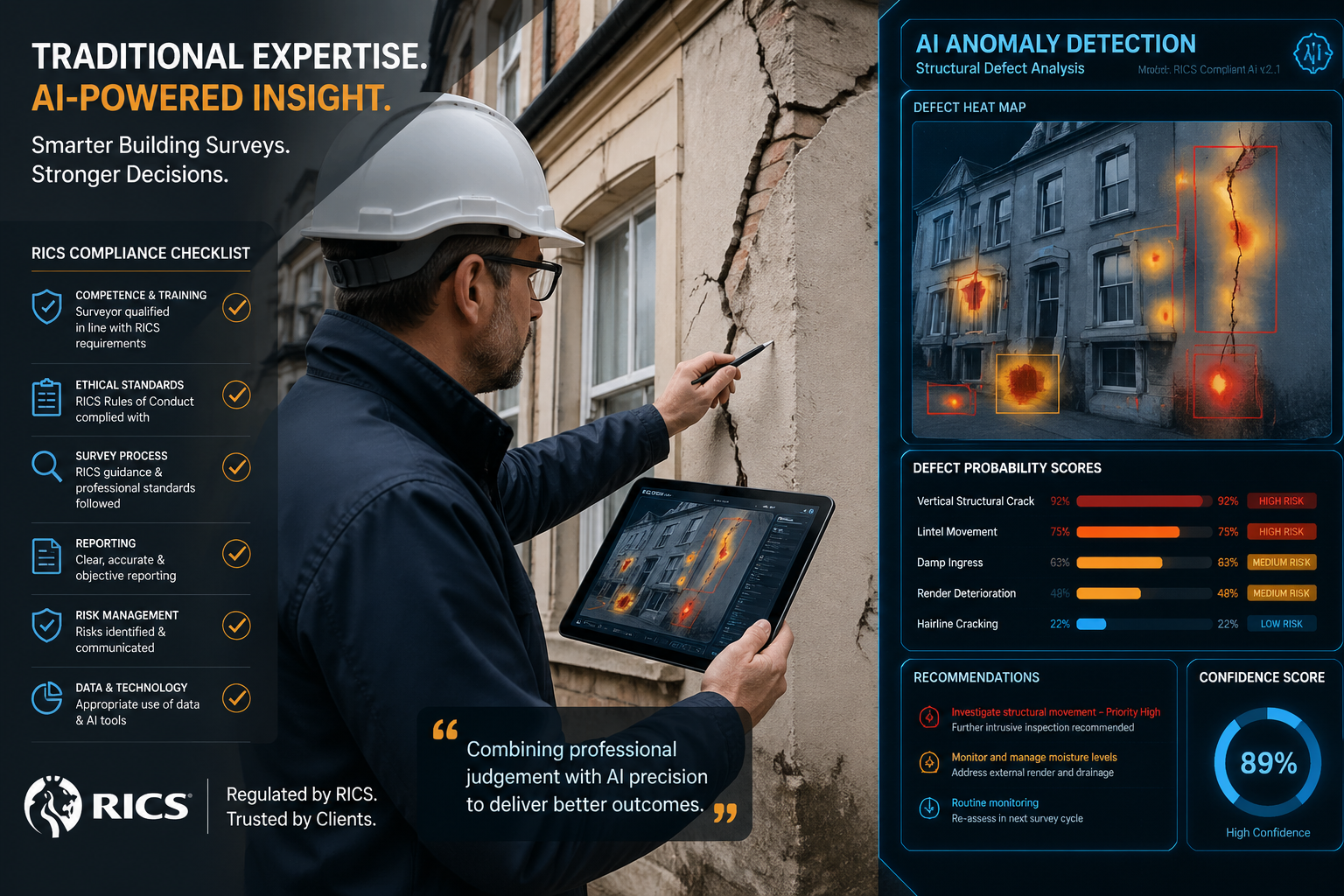
AI-powered image analysis tools can flag potential cracks, damp patches, spalling brickwork, and roof deterioration from photographs taken during inspection. These tools work by comparing surveyor images against large datasets of labelled defect photographs. When used correctly, they act as a second-pass review — catching anomalies a surveyor may have photographed but not yet formally assessed.
🚁 Drone-Assisted Roof Analysis
Drone roof surveys generate high-resolution imagery that AI tools can analyse for missing tiles, ridge deterioration, flashing failures, and moss accumulation. The AI flags areas of concern for the surveyor to assess professionally — it does not replace the surveyor's judgment.
📊 Thermal Imaging Pattern Recognition
AI can process thermal imaging data to identify cold bridges, moisture ingress patterns, and insulation failures that may not be visible to the naked eye. This is particularly valuable in Level 3 surveys of period properties with complex fabric.
📝 Report Drafting Assistance
Large language model (LLM) tools are increasingly used to draft condition descriptions and recommendations. This is where hallucination risk is highest — AI may generate technically plausible but factually incorrect statements about defect causes or remediation costs.
Case Study: Anomaly Detection in a Victorian Terrace
Consider a Level 3 survey of a late-Victorian terraced property in North London. The surveyor uses a computer vision tool to review 340 site photographs. The AI flags 23 images as potentially showing defect anomalies — including a subtle crack pattern in the rear return wall that the surveyor had photographed but not yet formally assessed.
On review, the surveyor identifies the crack pattern as consistent with differential settlement — a significant finding that influences the report's structural section and the client's negotiating position.
The AI did not diagnose the defect. The surveyor did. The AI's role was to ensure the photograph was not overlooked in a large image set. This is the model the RICS standard envisions: AI as a tool that supports professional judgment, never replaces it. [2][4]
For complex structural assessments, working alongside residential structural engineers remains essential — AI tools do not substitute for specialist structural expertise.
Specific Defect Reporting and AI Outputs
When AI outputs feed into a specific defect report, the surveyor must be able to independently verify and professionally validate every finding. The standard is explicit: AI-generated summaries, opinions, and inspection recommendations must remain under human professional control. [2]
Building a Compliant AI Governance Framework: What Firms Must Do Now
The Five Pillars of RICS AI Compliance
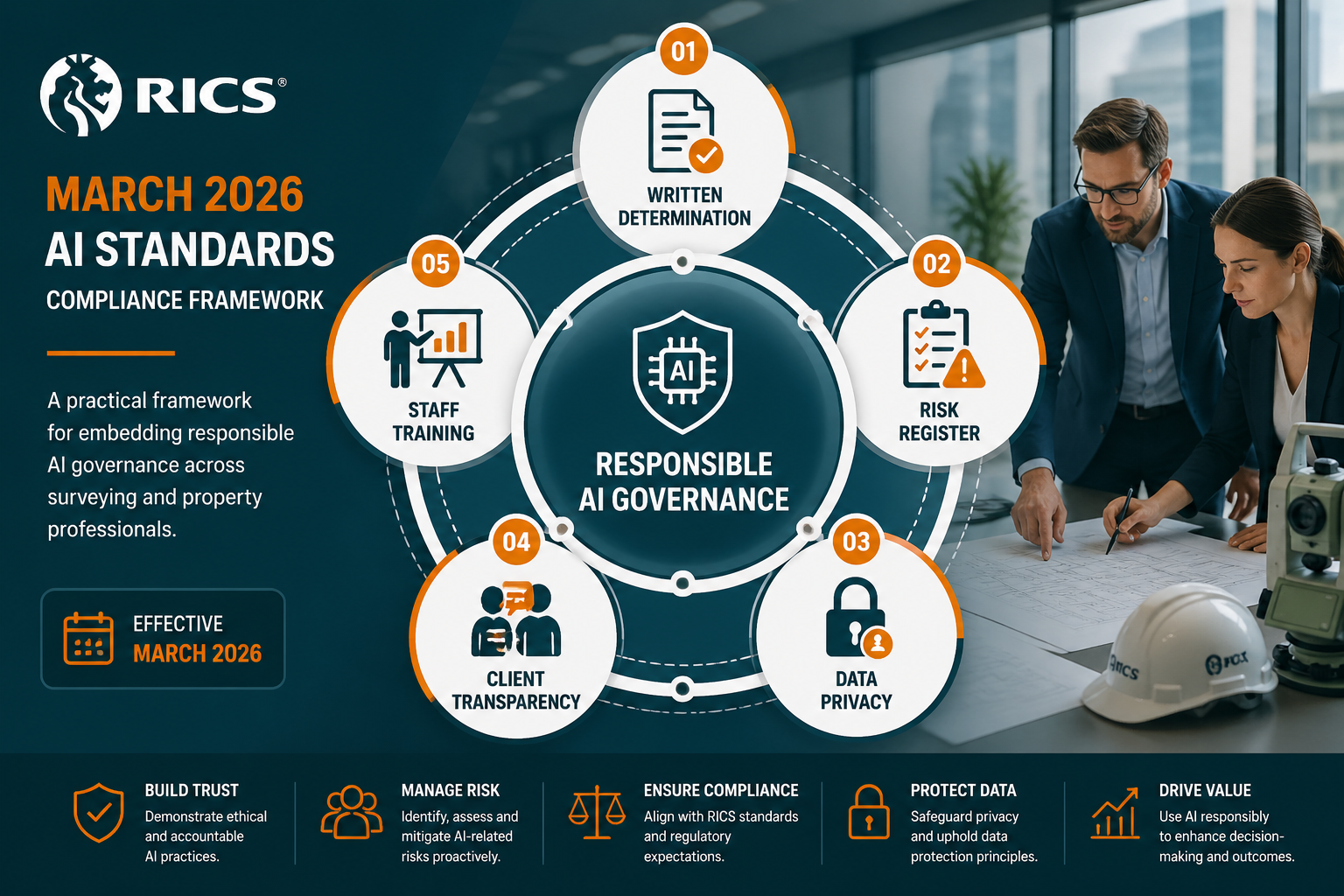
Responsible AI integration in Level 3 building surveys requires firms to build governance structures across five interconnected areas: [2][3]
1. 📋 Responsible AI Use Policy
All RICS-regulated firms using or intending to use AI must develop and implement a formal responsible AI use policy. This policy must be informed by a risk register that identifies the specific AI tools in use, their applications, and the risks they introduce.
2. 🔒 Data Privacy Governance
Firms must implement written requirements covering: [2]
- Secure storage of confidential client data
- Restriction of data access to authorised personnel only
- Prohibition on uploading private client data to external AI systems without express written client consent
This last point is critical for Level 3 surveys, where property photographs, structural reports, and client financial information may all be processed through AI tools. Before using any cloud-based AI service, firms must confirm whether client data is used to train the AI model — and obtain consent if it is.
3. 📣 Client Transparency
Members must notify clients in writing where AI is used in service delivery. Clients must also be informed whether they have the option to opt out. [3] This notification should form part of the terms of engagement — not an afterthought buried in small print.
4. 🖥️ System Governance Assessment
Before deploying any AI tool, firms must complete a system governance assessment covering: [2][4]
- Procurement due diligence (who built the tool, how was it trained?)
- Reliability protocols (how is accuracy monitored?)
- Written records of the assessment process
5. 🎓 Staff Training
Firms must provide regular training for all staff with access to AI systems. [2] This training must equip staff to manage the additional risks AI introduces — including recognising hallucinated outputs and understanding when to escalate concerns to senior surveyors.
Practical Compliance Checklist ✅
| Compliance Requirement | Action Required | Priority |
|---|---|---|
| Written determination on material impact | Document and date | 🔴 Immediate |
| Responsible AI use policy | Draft and adopt | 🔴 Immediate |
| Risk register for AI tools | Create and maintain | 🔴 Immediate |
| Client notification language | Update engagement terms | 🔴 Immediate |
| Data privacy written requirements | Review all AI tools used | 🔴 Immediate |
| System governance assessments | Complete for each AI tool | 🟠 High priority |
| Staff training programme | Schedule and deliver | 🟠 High priority |
| Review cycle for written determination | Set calendar reminders | 🟡 Ongoing |
Professional Oversight: The Non-Negotiable Principle
The RICS standard is unambiguous on one point: adequate professional oversight of AI outputs is mandatory where those outputs have material impact on service delivery. [2][4] For Level 3 surveys, this means:
- Every AI-flagged defect must be independently assessed by the surveyor
- No AI-generated condition rating may appear in a report without surveyor verification
- Report language drafted by AI must be reviewed, edited, and approved by the responsible surveyor
- The surveyor signing the report bears full professional responsibility for its contents
This principle protects clients, protects the profession, and — critically — protects surveyors from liability exposure if an AI tool produces an erroneous output.
Firms conducting commercial building surveys face identical obligations, with the added complexity of larger, more varied building stock and more sophisticated AI tools potentially in use.
Surveyor Accountability and the Human-AI Partnership
Why Accountability Cannot Be Delegated to AI
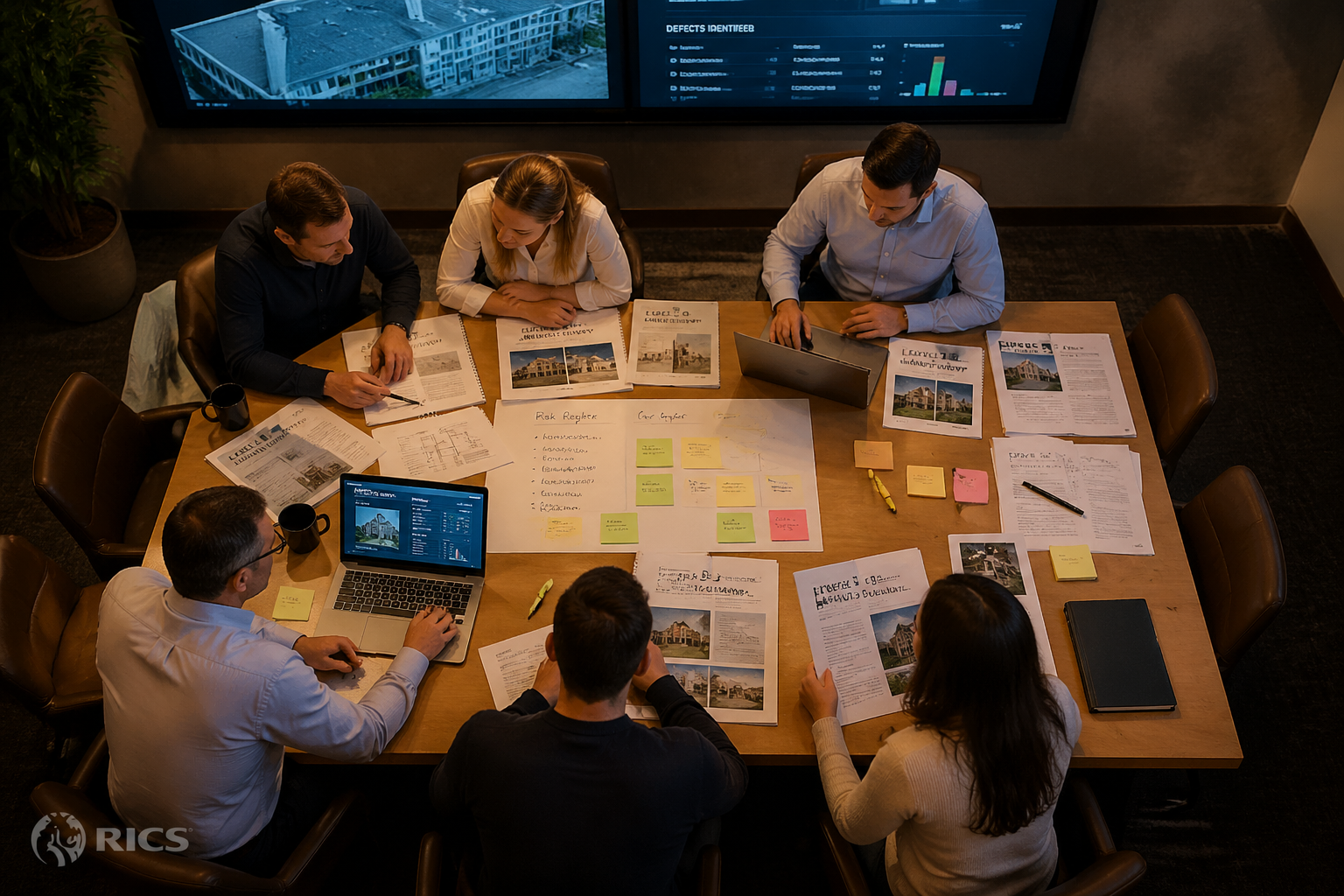
The RICS standard reflects a broader professional truth: accountability cannot be outsourced to an algorithm. A surveyor who relies on an AI tool to identify defects, and then fails to apply independent professional judgment, is not compliant — regardless of how sophisticated the tool is.
This matters particularly for chartered surveyors operating in competitive markets where time pressure may tempt over-reliance on AI outputs. The standard exists precisely to prevent this drift.
Dilapidations and Schedule of Condition Reports
AI tools are also being applied in schedule of condition reports and dilapidation surveys, where photographic evidence and condition descriptions are central to the document's legal value. In these contexts, AI-assisted image analysis can improve consistency and reduce the risk of missed items — but the same governance requirements apply. Any AI tool with material impact on the delivery of these services must be assessed, documented, and overseen.
Expert Witness Implications
Where Level 3 survey findings are used in litigation or dispute resolution, the use of AI in producing those findings becomes a matter of legal scrutiny. Expert witness reports must be capable of withstanding cross-examination — including questions about the reliability of any AI tools used in the underlying survey. Surveyors must be able to explain what AI tools were used, how their outputs were validated, and why the professional judgment applied remains sound.
Keeping Up With a Fast-Moving Standard
The RICS standard acknowledges that AI technology is evolving rapidly. [5] Firms should not treat March 2026 compliance as a one-time exercise. The written determination, risk register, and AI use policy must all be reviewed regularly — and updated whenever new AI tools are adopted or existing tools are materially updated.
Conclusion: Actionable Next Steps for Surveyors in 2026
The March 2026 RICS AI standard marks a genuine turning point for the surveying profession. Responsible AI integration in Level 3 building surveys is no longer optional, experimental, or aspirational — it is a regulated professional obligation with real enforcement consequences.
The good news is that the standard is proportionate. It focuses compliance obligations on AI tools that genuinely affect service delivery, rather than imposing blanket restrictions on all technology use. Firms that approach this thoughtfully — building proper governance structures, training their teams, and maintaining rigorous human oversight — will find that AI genuinely enhances the quality and consistency of their Level 3 surveys.
Immediate Actions for Firms 🚀
- Audit current AI tool usage — identify every AI application in use and assess whether it has material impact on service delivery
- Produce the written determination — document the assessment and reasoning in writing today
- Draft or update the responsible AI use policy — informed by a risk register specific to your firm's tools
- Review client engagement terms — ensure written AI notification and opt-out language is included
- Audit data privacy practices — confirm no client data is being uploaded to external AI systems without consent
- Schedule staff training — ensure all team members with AI access understand the risks and their responsibilities
- Establish a review cycle — set a regular date to revisit the written determination and risk register
The profession has always balanced technical expertise with professional judgment. The RICS AI standard simply extends that balance into the digital age — ensuring that as tools become more powerful, the humans who use them remain firmly accountable.
References
[1] Rics Ai Standards In Building Surveys 2026 Practical Protocols For Level 3 Assessments And Risk Detection – https://nottinghillsurveyors.com/blog/rics-ai-standards-in-building-surveys-2026-practical-protocols-for-level-3-assessments-and-risk-detection
[2] Ai Responsible Use Standard – https://ww3.rics.org/uk/en/journals/construction-journal/ai-responsible-use-standard.html
[3] Rics Brings First Global Ai Standard For Surveyors Into Effect – https://www.associationexecutives.org/resource/rics-brings-first-global-ai-standard-for-surveyors-into-effect.html
[4] Responsible Use Of Ai – https://www.rics.org/profession-standards/rics-standards-and-guidance/conduct-competence/responsible-use-of-ai
[5] Rics First Ever Standard On Responsible Ai Use Now In Effect – https://www.rics.org/news-insights/rics-first-ever-standard-on-responsible-ai-use-now-in-effect