

93% of UK construction employers report difficulty recruiting qualified staff — and Quantity Surveyors sit at the very top of that hiring crisis. [2] For building surveyors working across residential developments, commercial refurbishments, and mixed-use schemes, this is not a distant industry statistic. It is a live operational pressure reshaping how projects are planned, priced, and delivered right now.
Addressing Quantity Surveyor Shortages in UK Property Projects: Strategies for Building Surveyors to Mitigate Risks in 2026 requires more than awareness of the problem. It demands practical, field-tested tactics that building surveyors can deploy immediately — from restructuring procurement timelines to leveraging technology and expanding their own cost-management competencies. This article examines the depth of the crisis, its direct impact on property projects across the UK, and the most effective risk mitigation strategies available in 2026.
Key Takeaways 📌
- The QS shortage is structural, not cyclical — the CITB projects a need for nearly 48,000 new workers annually through 2029, with QS roles among the hardest to fill. [3]
- Building surveyors are increasingly absorbing cost-management duties as QS capacity tightens, making cross-disciplinary skills essential.
- Early procurement and retained relationships with QS professionals significantly reduce project delay risk.
- Technology tools — including BIM, digital takeoff software, and cost-management platforms — can partially offset QS capacity constraints.
- London and the South East face the most acute shortages, with salary premiums making independent QS access harder for smaller developers and private clients. [3]
Understanding the Scale of Quantity Surveyor Shortages in UK Property Projects
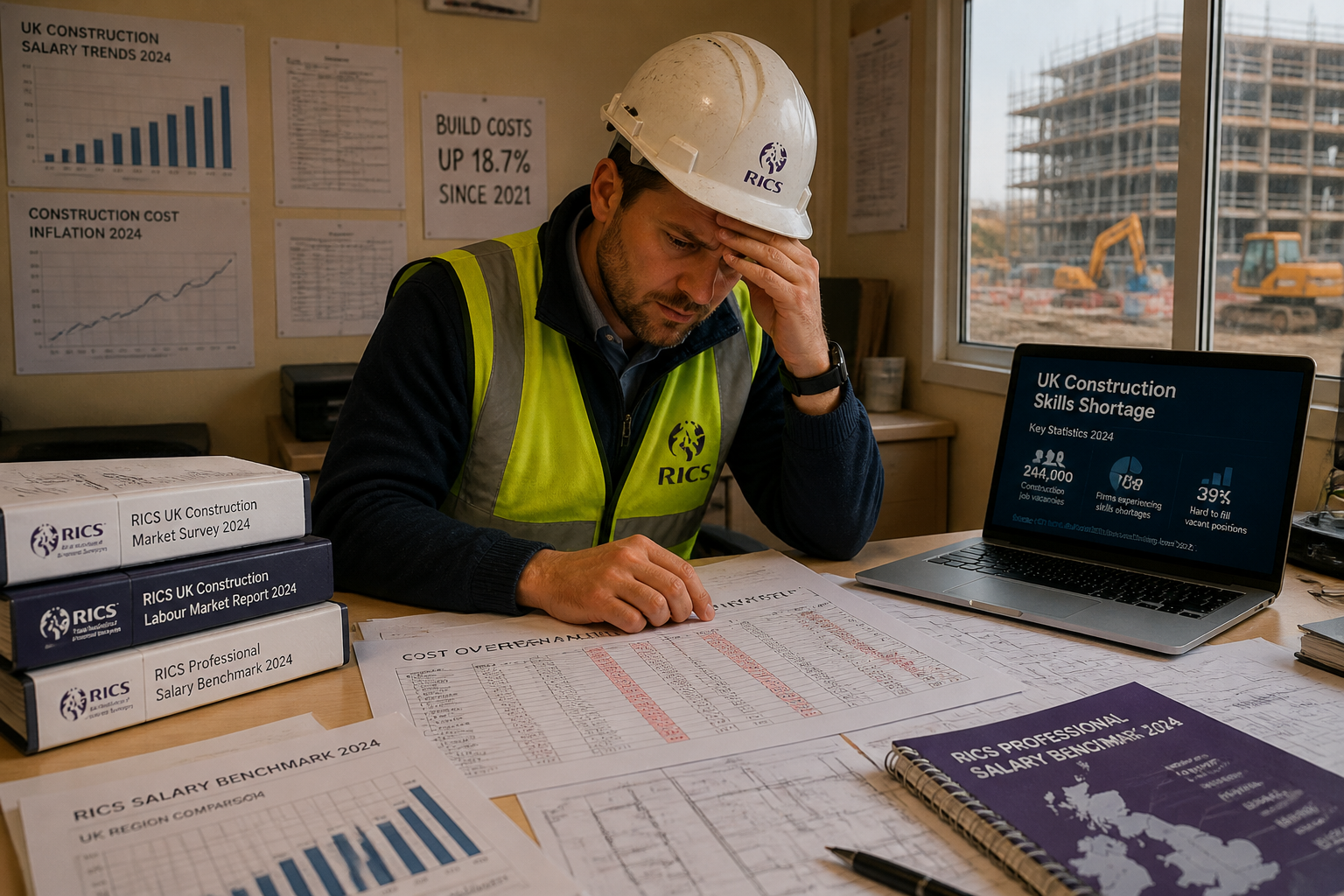
The Numbers Behind the Crisis
The data paints a stark picture. The Construction Skills Network estimates that over 225,000 additional workers will be needed by 2027 to meet UK construction sector demands. [4] Within that broader gap, three roles are consistently identified as the most difficult to recruit: Construction Project Managers, Quantity Surveyors, and Construction Planners. [2] These are precisely the professionals who sit at the heart of cost control and project delivery.
The Construction Industry Training Board (CITB) projects a need for nearly 48,000 new workers annually through 2029, with the structural nature of this shortage driving persistent wage inflation across the sector. [3] Meanwhile, RICS data confirms that QS shortages are already impacting productivity, cost control, innovation, and delivery across construction — this is an operational constraint, not merely a recruitment metric. [1]
💬 "The widening skills gap threatens profitability for QS firms, as limited capacity constrains their ability to accept new work, while the tight labour market forces compensation packages upward." [6]
Salary Inflation as a Symptom
The candidate-driven market has produced significant salary escalation. Current 2025–2026 market data shows the following ranges [3]:
| QS Level | Salary Range (UK) | London/SE Premium |
|---|---|---|
| Graduate QS | £25,000 – £40,000 | +10–15% |
| Assistant QS | £30,000 – £45,000 | +10–15% |
| Quantity Surveyor | £42,000 – £65,000 | +15–20% |
| Senior QS | £56,000 – £90,000 | +20–25% |
Employers are increasingly forced to offer wage premiums to attract "job-ready" Senior QS professionals who can immediately manage commercial risks without significant oversight. [3] For private developers and building surveyors operating in high-demand residential markets, this creates a direct cost pressure that feeds into project viability assessments.
Sector Concentration Making Things Worse
Demand is not evenly distributed. Infrastructure, Utilities (including Water/AMP8), and Renewable Energy sectors are absorbing a disproportionate share of experienced QS talent, particularly those with NEC contract expertise. [3] This pulls capacity away from private residential and commercial sectors. New-build private residential housing faces additional headwinds from interest rate impacts, while private commercial fit-out and refurbishment show more stable demand. [3]
The revenue picture for the QS industry itself reflects these pressures: industry revenue declined at a 0.4% compound annual rate to £1.9 billion over the five years through 2025–26, impacted by project delays, elevated interest rates, and a 16% collapse in new work orders recorded in 2023. [6]
For building surveyors working across chartered surveyor services in London and the wider South East, these macro conditions translate directly into project-level risk.
How QS Shortages Create Risk for Building Surveyors in 2026

The Knock-On Effects on Property Projects
When a Quantity Surveyor is unavailable, delayed in appointment, or stretched across too many projects, the consequences ripple outward quickly. Building surveyors operating across residential developments in London, Surrey, and the wider South East are encountering several recurring risk categories in 2026:
⚠️ Cost Overruns
Without timely QS input, preliminary cost estimates go unchallenged. Tender returns arrive without proper analysis. Variations accumulate without robust change control. The result is budget erosion that often only becomes visible late in a project lifecycle.
⚠️ Programme Delays
QS involvement is critical at procurement stage — defining contract terms, preparing bills of quantities, and managing tender processes. When this expertise is delayed or absent, procurement timelines extend, pushing back start dates and creating knock-on delays across the entire programme.
⚠️ Valuation Inaccuracies
Interim valuations, final account settlements, and insurance reinstatement calculations all depend on accurate cost data. Building surveyors asked to provide insurance reinstatement valuations or RICS Red Book valuations without current QS cost intelligence face increased professional risk.
⚠️ Contractual Exposure
Shortage of QS oversight increases the likelihood of poorly drafted or mismanaged contracts. Disputes over variations, defects liability, and final accounts become more common — and more expensive to resolve.
⚠️ Regulatory and Compliance Gaps
The Building Safety Act 2022 and its ongoing implementation have added new cost and compliance layers to higher-risk residential buildings. Without QS expertise, building surveyors may underestimate the cost implications of compliance requirements.
The London and South East Pressure Point
Shortage of general labour was identified as one of the top factors limiting construction activity by the most recent RICS UK Construction Monitor, with a direct impact on the government's target of 1.5 million new homes. [4] In London and the South East — where development density is highest and project complexity greatest — the combination of high QS salary premiums and constrained supply creates a particularly acute challenge.
Building surveyors working across areas such as South West London, Surrey, and North London are reporting longer lead times to secure QS appointments, with some residential projects experiencing delays of four to eight weeks at procurement stage alone.
Strategies for Building Surveyors to Mitigate Risks in 2026

1. 🔑 Appoint QS Professionals Early — Before You Need Them
The single most effective mitigation strategy is early procurement. In a candidate-short market, waiting until a project reaches RIBA Stage 3 or 4 before engaging a QS is a significant risk. Building surveyors should advise clients to appoint QS professionals at Stage 1 or 2, even in a limited capacity, to secure availability and establish cost benchmarks from the outset.
Practical steps:
- Build a retained panel of QS contacts across different project sizes and specialisms
- Establish preferred supplier relationships with QS firms before projects are confirmed
- Include QS appointment as a gateway condition in project initiation checklists
2. 📊 Expand Cost-Management Competencies Within Your Practice
The shortage environment is accelerating a convergence of roles. Building surveyors who develop working knowledge of elemental cost planning, preliminary cost estimating, and basic bill preparation are better positioned to bridge gaps when QS input is delayed.
This does not mean replacing QS expertise — it means being able to hold the line on cost intelligence while QS capacity is secured. Key areas for building surveyors to develop include:
- Understanding NRM1 and NRM2 (RICS New Rules of Measurement)
- Familiarity with BCIS cost data for residential and commercial benchmarking
- Competency in reading and challenging contractor valuations
For building surveyors already providing commercial building surveys or schedule of dilapidations services, these cost-management skills represent a natural extension of existing technical capabilities.
3. 💻 Leverage Technology to Offset Capacity Constraints
Digital tools cannot replace a qualified QS, but they can meaningfully reduce the time burden on QS professionals — effectively stretching limited capacity further. Building surveyors should be familiar with and advocate for the use of:
| Tool Category | Examples | Benefit |
|---|---|---|
| Digital Takeoff Software | Bluebeam, PlanSwift, CostX | Faster measurement from drawings |
| BIM Cost Integration | Autodesk Revit + QTO | Automated quantity extraction |
| Cost Management Platforms | Procore, Causeway | Real-time budget tracking |
| Benchmarking Databases | BCIS, Spon's | Rapid cost validation |
When QS time is scarce, having pre-measured quantities and structured cost data ready for review dramatically reduces the hours a QS needs to invest at critical project stages.
4. 📋 Strengthen Contract and Risk Management Protocols
In the absence of full QS oversight, building surveyors must ensure that contractual risk is properly allocated and documented. This means:
- Using standard form contracts (JCT, NEC) rather than bespoke arrangements that require more intensive commercial management
- Implementing robust change control procedures from day one, with no variations instructed without written cost assessment
- Ensuring provisional sums and contingency allowances are explicitly defined and ring-fenced in project budgets
- Commissioning a specific defect report early in the project lifecycle to identify cost risks before they become contractual disputes
5. 🤝 Collaborate With Specialist Consultants for High-Risk Elements
For complex or high-value project elements — structural works, M&E installations, external envelope systems — building surveyors should proactively recommend specialist cost consultants even where a generalist QS is already appointed. This distributes the cost intelligence burden and reduces the risk of undercosting complex packages.
This is particularly relevant for projects involving:
- Cladding remediation under Building Safety Act requirements
- Heritage and listed building works where specification uncertainty is high
- Infrastructure-heavy residential schemes with significant groundworks
6. 📅 Build Realistic Programme Contingencies
One of the most practical adjustments building surveyors can make in 2026 is to recalibrate programme expectations to reflect QS market realities. Advising clients that procurement stages will take longer — and building this into project programmes from the outset — reduces the pressure that leads to poor procurement decisions.
Recommended programme adjustments in 2026:
- Add 4–6 weeks to pre-tender QS appointment lead times
- Allow 2–3 weeks additional time for tender analysis and recommendation
- Build in a 10–15% cost contingency at early stages to absorb QS-identified risks
7. 🏛️ Engage With RICS and Industry Bodies for Pipeline Intelligence
RICS, CIOB, and CITB publish regular data on skills pipeline, salary trends, and regional demand. Building surveyors who stay connected to this intelligence — through membership, CPD events, and industry publications — are better positioned to anticipate shortages and advise clients accordingly. [4]
The RICS President's column published in February 2025 highlighted the urgency of addressing the construction skills gap as a strategic priority for the profession. [4] Building surveyors have a role to play in advocating for better pipeline development, including supporting apprenticeship programmes and graduate pathways into the QS profession.
For building surveyors working across commercial property in London or providing expert witness reports in construction disputes, staying current with RICS guidance is not optional — it is a professional obligation.
Regional Considerations: Where Shortages Bite Hardest
The QS shortage is a national issue, but its intensity varies significantly by region. London and the South East consistently experience the most acute pressures due to:
- Higher project complexity and specification standards
- Greater competition from infrastructure and commercial sectors for QS talent
- Cost of living pressures driving QS professionals toward higher-paying sectors
Building surveyors operating across East London, North West London, and Central London should factor regional QS availability into their project risk assessments and client advice. Engaging local QS practices with established regional networks — rather than relying on national firms with stretched capacity — can improve appointment lead times and project continuity.
Conclusion: Proactive Risk Management Is the Only Viable Response
Quantity Surveyor Shortages in UK Property Projects: Strategies for Building Surveyors to Mitigate Risks in 2026 is not a problem that will resolve itself in the near term. With the CITB projecting structural workforce gaps through 2029 [3], and RICS confirming that shortages are already constraining productivity and cost control across the sector [1], building surveyors must treat QS availability as a standing project risk — not an occasional inconvenience.
The most resilient building surveyors in 2026 will be those who:
✅ Appoint QS professionals early and maintain retained relationships with trusted practitioners
✅ Develop their own cost-management competencies to bridge gaps intelligently
✅ Deploy technology to maximise the productivity of scarce QS time
✅ Strengthen contractual and change control protocols to reduce commercial exposure
✅ Build realistic programme contingencies that reflect current market realities
✅ Stay connected to RICS and industry intelligence to anticipate and respond to shifting conditions
The shortage is real, the risks are material, and the strategies are available. The building surveyors who act on them now will protect their clients, their projects, and their professional reputations through what remains a deeply challenging market environment.
References
[1] Watch – https://www.youtube.com/watch?v=U8oCnx7DKqo
[2] The UK Construction Skills Shortage In 2026 – https://www.v7recruitment.com/the-uk-construction-skills-shortage-in-2026
[3] UK Quantity Surveyor Salary Market Report 2025 2026 – https://www.maximrecruitment.com/news/post/uk-quantity-surveyor-salary-market-report-2025-2026/
[4] President Column Justin Sullivan February 2025 – https://ww3.rics.org/uk/en/modus/business-and-skills/surveying-stories/president-column-justin-sullivan-february-2025.html
[5] Quantity Surveyor Jobs In The UK (2026 Guide) | Roles, Skills & Career Outlook – https://www.constructionjobboard.co.uk/blog/188/quantity-surveyor-jobs-in-the-uk-(2026-guide)-%7C-roles,-skills-&-career-outlook/
[6] IBISWorld – https://www.ibisworld.com/united-kingdom/industry/quantity-surveyors/14665/
[7] UK Construction Recruitment In 2026 Lessons From Company Collapses And Talent Demand Pressures – https://www.mostonrecruit.co.uk/blogs/uk-construction-recruitment-in-2026-lessons-from-company-collapses-and-talent-demand-pressures