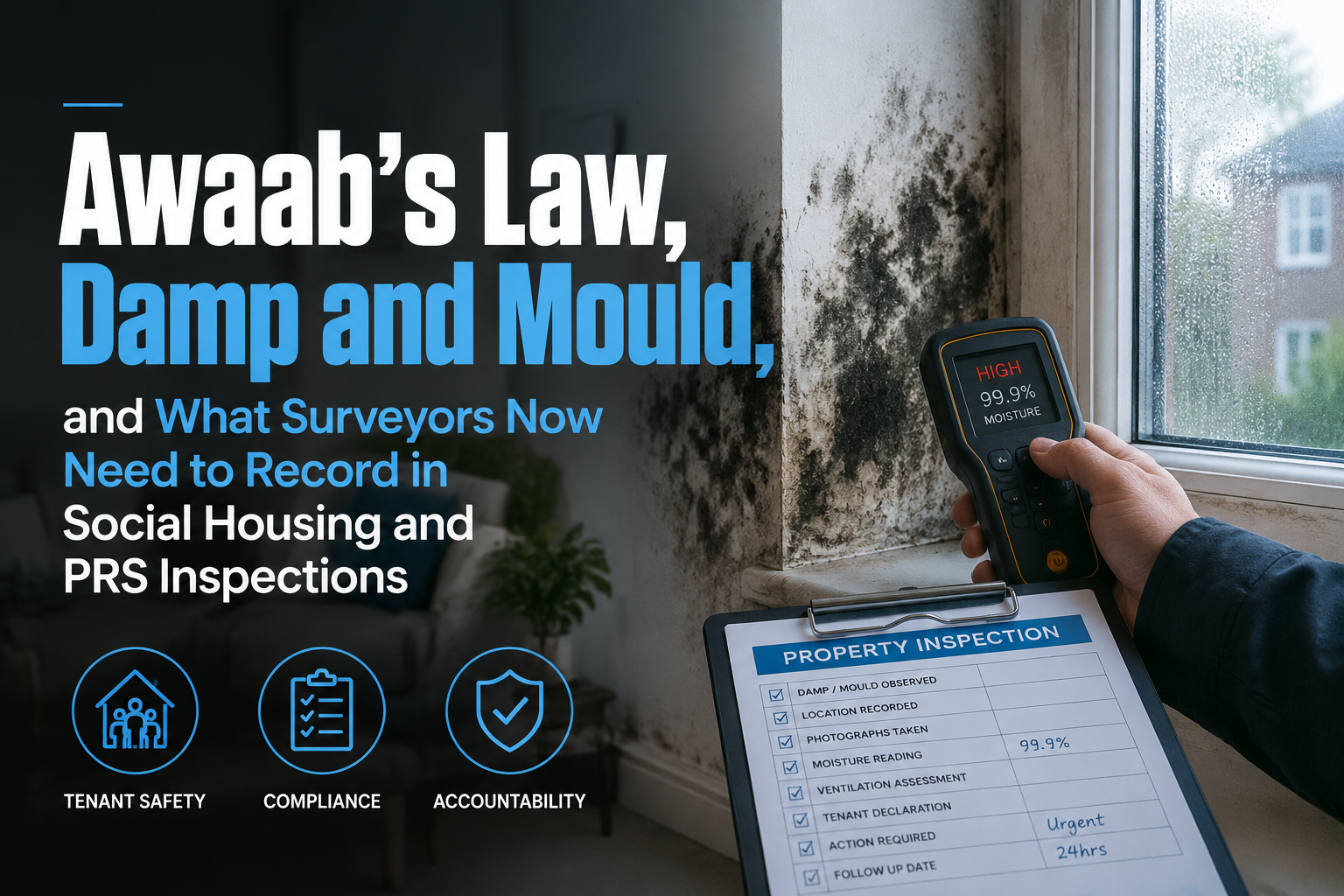

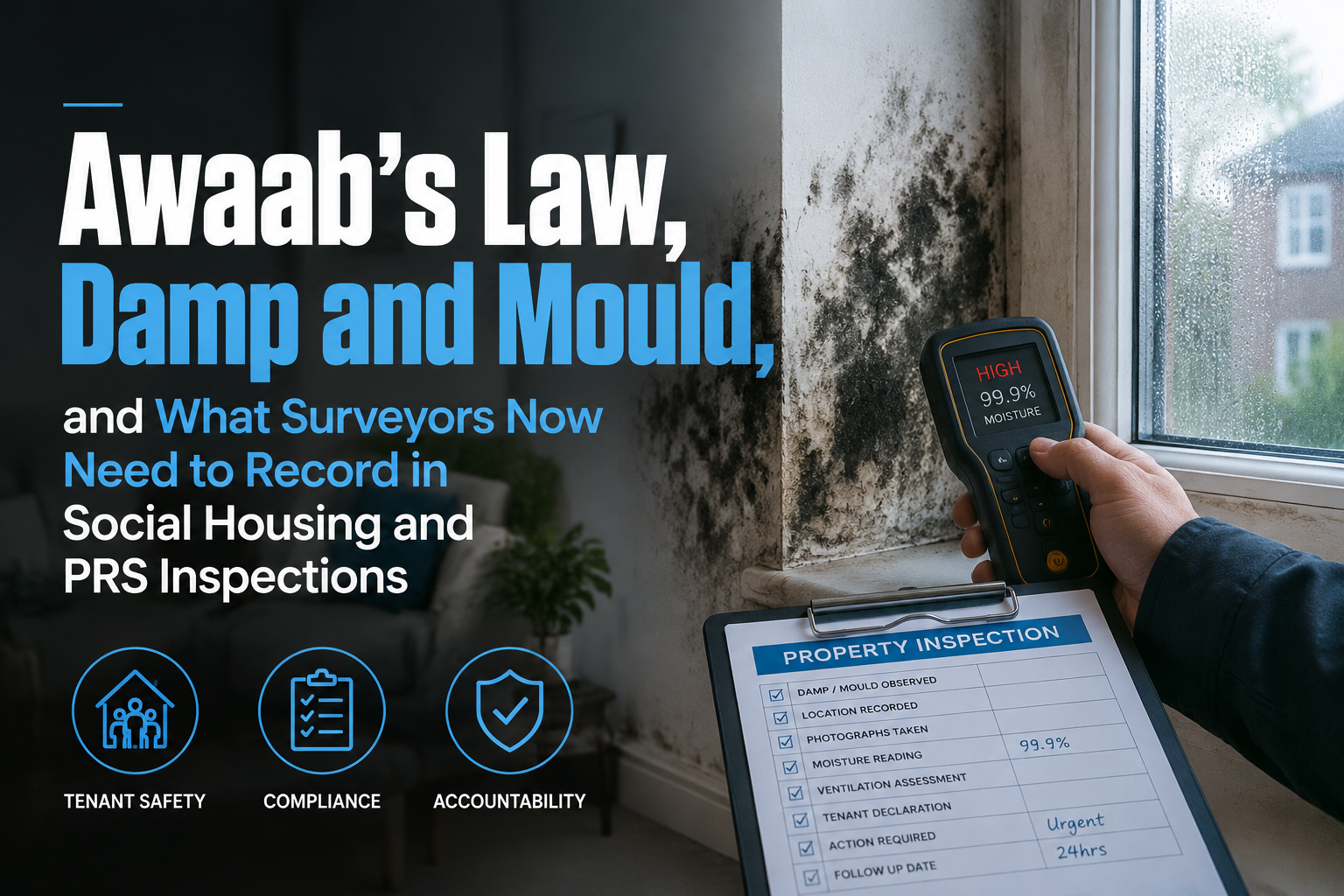
{"cover":"Professional landscape format (1536×1024) hero image with bold text overlay: 'Awaab's Law, Damp & Mould: What Surveyors Must Record Now' in extra large 70pt white bold sans-serif font with dark semi-transparent overlay box, centered upper third. Background shows a chartered surveyor in hi-vis vest using a moisture meter on a damp, mould-stained social housing wall, dramatic documentary lighting, dark teal and white color scheme, editorial magazine quality, high contrast, photorealistic.","content":["Landscape format (1536×1024) editorial image showing a close-up split-scene: left side displays a damp-stained social housing interior wall with visible black mould patches and condensation, right side shows a professional surveyor's clipboard with a structured inspection checklist, moisture readings, timestamped photographs pinned to it, and a red-circled statutory deadline calendar showing '14 days'. Teal and charcoal color palette, documentary photography style, sharp focus on inspection documentation details.","Landscape format (1536×1024) infographic-style editorial image showing a vertical timeline flowchart on a dark navy background: '24 Hours – Emergency Hazard Response', '14 Days – Damp & Mould Investigation', '48 Hours – Written Summary', '7 Days – Repair Completion', each node with a clock icon and color-coded urgency indicator (red, amber, green). A surveyor's hand points to the timeline with a pen. Bold white sans-serif typography, clean data-visualization aesthetic, professional and authoritative.","Landscape format (1536×1024) wide-angle editorial photograph showing a professional surveyor using a digital tablet with inspection software in a social housing flat, photographing a ventilation grille and overheating thermometer reading with a thermal imaging camera. A Phase 2 HHSRS hazard checklist is visible on the tablet screen. Warm interior lighting contrasts with clinical inspection equipment. Color palette: slate grey, amber, white. Photorealistic, documentary quality, depth of field focus on the digital tools."]
Over 3 million people in England live in homes with serious damp or mould — yet before October 2025, social landlords faced no statutory clock on when they had to act. That changed permanently when Awaab's Law came into force. For surveyors working in social housing and the private rented sector (PRS), the practical implications are significant: inspection reports are no longer just advisory documents. They are now potential legal evidence.
This guide focuses on the practical inspection and reporting requirements that Awaab's Law, damp and mould, and what surveyors now need to record in social housing and PRS inspections demand in 2026 — covering what to photograph, measure, escalate, and document to protect both landlords and tenants.
Key Takeaways
- ✅ Awaab's Law (Phase 1) came into force on 27 October 2025 for social housing in England, imposing strict statutory deadlines for investigating and repairing damp, mould, and emergency hazards.
- ✅ Surveyors' inspection reports — including dates, photographs, moisture readings, and risk classifications — are now primary legal evidence for compliance.
- ✅ Core deadlines: 14 days to investigate damp/mould, 48 hours for a written summary, 7 days to complete repairs where a significant health risk exists, and 24 hours for emergencies. [8]
- ✅ Phase 2 (from October 2026) extends the law beyond damp and mould to a wider range of HHSRS hazards, including overheating and ventilation failures. [1]
- ✅ PRS landlords are not yet subject to Awaab's Law but face growing regulatory pressure and should adopt equivalent standards now.
Understanding Awaab's Law: The Legal Framework Surveyors Must Know
What Is Awaab's Law and Why Does It Matter?
Awaab's Law is named after Awaab Ishak, a two-year-old boy who died in 2020 as a direct result of prolonged exposure to mould in a Rochdale social housing flat. The coroner's findings triggered a national reckoning with housing standards.
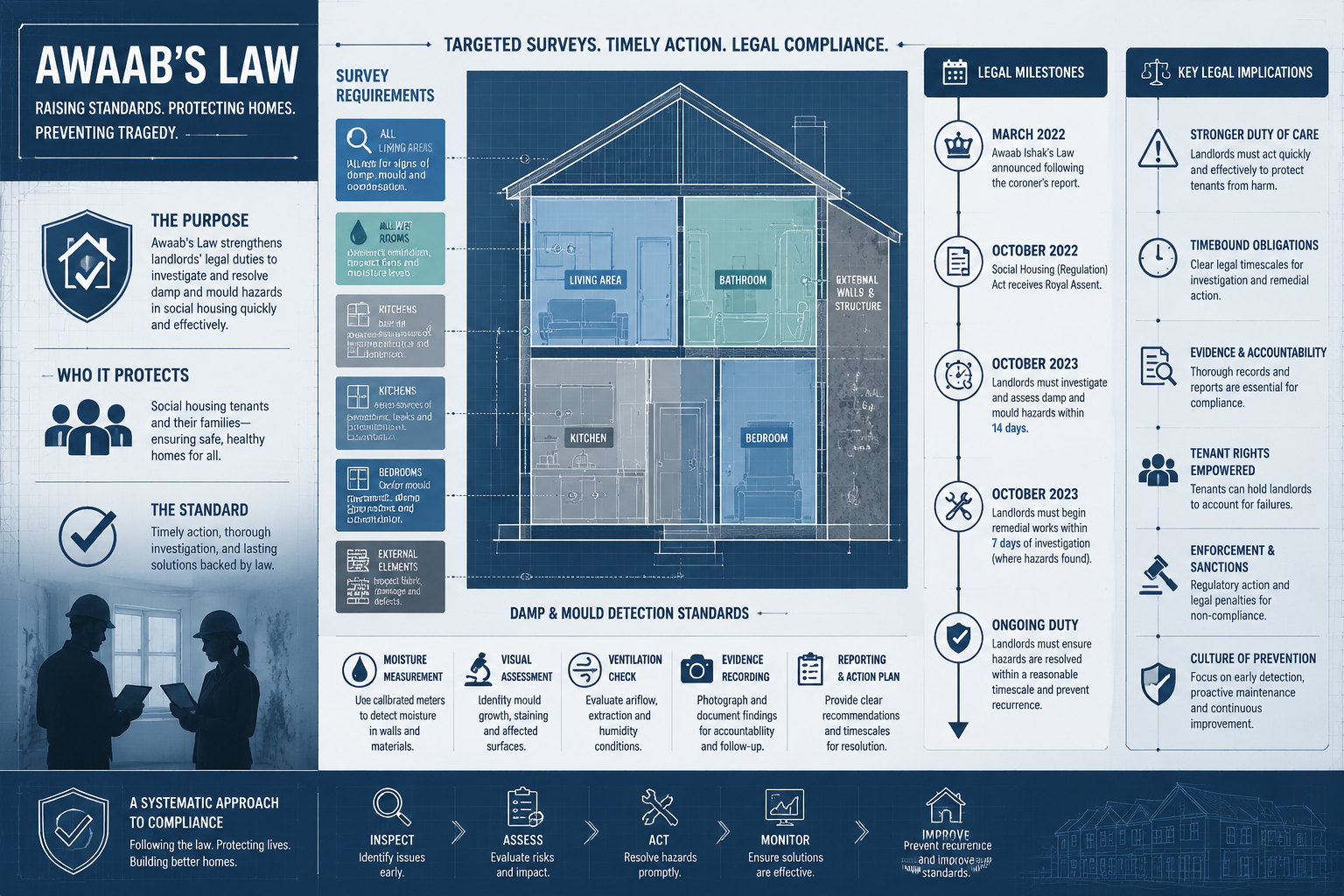
The law is implemented through section 42 of the Social Housing (Regulation) Act 2023 and the Hazards in Social Housing (Prescribed Requirements) (England) Regulations 2025. It places binding obligations on registered social landlords (RSLs) — housing associations and local authority landlords — to respond to reported hazards within defined timeframes. [8]
💬 "Awaab's Law transforms what was once best practice into a legal obligation — and surveyors' inspection records are the paper trail that proves compliance."
Who Is Currently Covered?
As of 2026, Phase 1 applies exclusively to social housing in England. Private rented sector landlords are not yet legally bound by Awaab's Law, though the Renters' Rights Bill and proposed Decent Homes Standard for the PRS signal that this is coming. [9]
Phase 1 covers:
- Damp and mould hazards
- Emergency hazards (e.g., critical gas or electrical failures)
Phase 2, expected from October 2026, will extend obligations to a broader range of hazards under the Housing Health and Safety Rating System (HHSRS), including overheating, excess cold, and ventilation failures. [1] [3]
The Statutory Deadlines: What Surveyors Are Working Against
Understanding the legal timeframes is essential for structuring inspection reports correctly. These are not targets — they are statutory minimums. [8]
| Hazard Type | Investigate By | Written Summary | Repair Deadline |
|---|---|---|---|
| Damp & Mould | 14 calendar days | 48 hours after investigation | 7 days if significant health risk |
| Emergency Hazard | 24 hours | N/A | Immediate action required |
| Phase 2 Hazards (from Oct 2026) | TBC per hazard | TBC | TBC |
Breaking Down Each Deadline
🕐 14-Day Investigation Window (Damp & Mould)
From the moment a tenant reports damp or mould, the social landlord has 14 calendar days to carry out a proper investigation. This is where a qualified surveyor's involvement is critical. The investigation must be substantive — not a cursory visual check — and the surveyor's report must be timestamped and detailed enough to withstand scrutiny. [8]
📄 48-Hour Written Summary
Within 48 hours of completing the investigation, the landlord must provide the tenant with a written summary of findings. A well-structured surveyor's report — covering cause, extent, risk level, and recommended actions — feeds directly into this requirement. [4]
🔧 7-Day Repair Deadline
Where the investigation finds a significant risk to health or safety, repairs must begin and be completed within 7 days. If that is not reasonably practicable, the landlord must take mitigating action, such as offering alternative accommodation. Surveyors must therefore clearly classify risk level in their reports. [8]
🚨 24-Hour Emergency Response
For emergency hazards — including dangerous electrical faults, gas leaks, or structural failures — the landlord must attend within 24 hours. Surveyors called to emergency inspections must produce rapid, clear reports that support immediate decision-making. [5]
Awaab's Law, Damp and Mould, and What Surveyors Now Need to Record: The Inspection Checklist
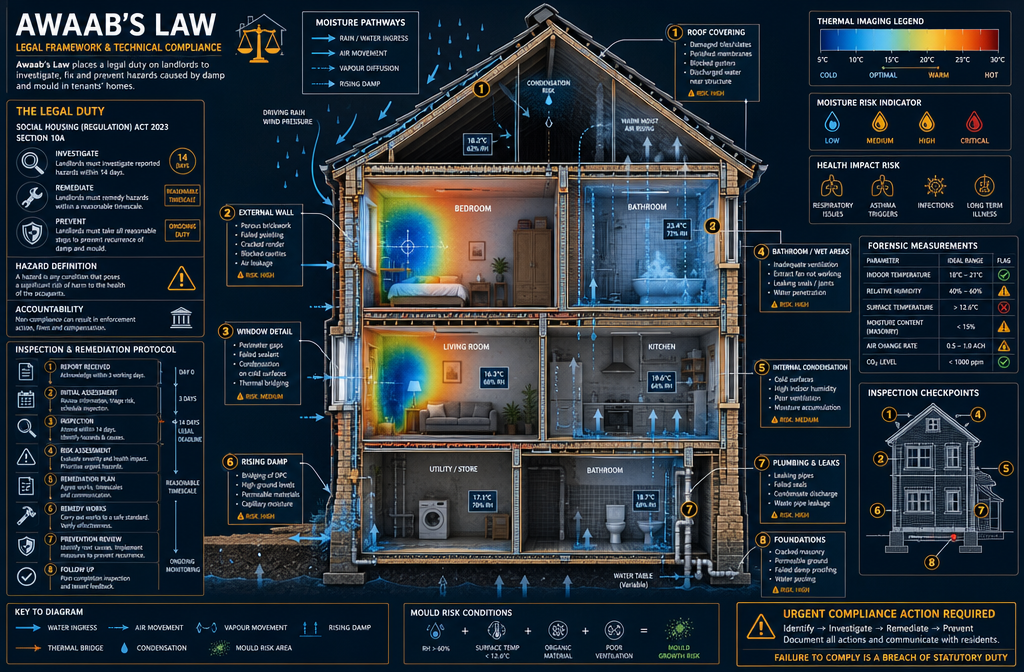
This is the core of the article. The following section outlines precisely what surveyors must capture during damp, mould, and hazard inspections to produce legally robust reports.
1. 📸 Photographic Evidence — Systematic and Timestamped
Photography is no longer optional. Every inspection should include:
- Wide-angle shots of each affected room, showing overall extent
- Close-up shots of mould patches, staining, peeling paint, and efflorescence
- Ventilation points — grilles, extractor fans, trickle vents — showing condition and blockage
- Window reveals and sills — common condensation points
- Behind furniture — mould often hides in corners and on cold external walls
⚠️ All photographs must be automatically timestamped. Many surveyors now use digital tools that embed GPS coordinates and timestamps into image metadata, which provides an auditable record of when and where the inspection took place. [6]
2. 📏 Moisture Readings — Quantify, Don't Just Qualify
Visual assessment alone is insufficient. Surveyors must take and record:
- Surface moisture readings using a calibrated moisture meter (expressed as a percentage)
- Relative humidity (RH) readings in each room — above 70% RH is a significant risk indicator
- Dew point calculations where condensation risk is suspected
- Wall temperature readings using a thermal probe or infrared thermometer, particularly on external walls
Record readings in a room-by-room matrix within the report. This allows landlords to demonstrate that risk was quantitatively assessed, not just observed. [2]
3. 🗂️ Cause Classification — Penetrating, Rising, or Condensation?
One of the most important distinctions in any damp report is identifying the root cause. Misidentification leads to ineffective repairs and repeat complaints. Surveyors should record:
- Penetrating damp: Evidence of water ingress through walls, roofs, or windows. Note the likely entry point and any visible external defects.
- Rising damp: Check for a failed or absent damp-proof course (DPC). Record floor-level moisture gradient readings.
- Condensation: The most common cause of mould in social housing. Record ventilation adequacy, thermal bridging, and occupancy patterns where relevant.
A structural survey can provide the depth of investigation needed when the cause is unclear or when multiple defect types are suspected simultaneously.
4. 🌡️ Ventilation and Overheating Assessments
With Phase 2 extending Awaab's Law to HVAC and ventilation hazards from October 2026, surveyors should begin incorporating these checks now. [1] [2]
Record:
- Presence and condition of mechanical extract ventilation (MEV) in kitchens and bathrooms
- Airflow rates where measurable
- Condition of trickle vents in window frames
- Evidence of overheating — particularly in top-floor flats and south-facing rooms
- Any thermal bridging at junctions (lintels, window reveals, floor-wall junctions)
5. 📋 Risk Classification — The Most Critical Output
Under Awaab's Law, the surveyor's risk classification directly triggers the landlord's legal obligations. A report that fails to clearly classify risk leaves the landlord unable to determine which statutory deadline applies.
Use a clear, consistent framework:
| Risk Level | Definition | Recommended Action |
|---|---|---|
| Category 1 (Emergency) | Immediate threat to life or safety | Report within hours; 24-hour landlord response |
| Significant Health Risk | Likely to cause harm if not addressed | 7-day repair deadline triggered |
| Moderate Risk | Defect present; not immediately dangerous | Planned repair programme |
| Low Risk / Advisory | Minor defect; monitor | Maintenance note |
For context on how these risk levels align with broader HHSRS methodology, a specific defect report can provide the granular analysis needed for complex cases.
6. 🕒 Timestamps and Inspection Chronology
Every report must record:
- Date and time of instruction received
- Date and time of inspection
- Date and time of report issued
This chronology is the landlord's proof of compliance with the 14-day investigation window. A report without clear timestamps is not compliant evidence. [4] [8]
7. 📝 Recommended Actions with Completion Timeframes
Surveyors must move beyond describing defects and explicitly recommend:
- What work is needed (e.g., install MVHR unit, repoint external brickwork, replace failed DPC)
- Who should carry it out (specialist contractor, general maintenance)
- By when — aligned with the statutory deadlines above
This bridges the gap between inspection and compliance, giving landlords an actionable roadmap. [6]
Awaab's Law, Damp and Mould, and What Surveyors Now Need to Record: The PRS Dimension
While Awaab's Law currently applies only to social housing, private rented sector landlords face significant parallel pressures in 2026. The Renters' Rights Bill, currently progressing through Parliament, proposes to extend a Decent Homes Standard to the PRS — and the expectation is that Awaab's Law-style obligations will follow. [9]
For PRS surveyors and landlords, the practical advice is clear: adopt social housing standards now.
What PRS Surveyors Should Do Differently in 2026
- Use the same inspection checklist as for social housing — moisture readings, photographs, cause classification, risk rating
- Document response timelines even where not legally required — this creates a defensible record if a dispute arises
- Reference HHSRS in reports — private tenants can still request local authority inspections under the Housing Act 2004, and HHSRS Category 1 hazards carry enforcement powers
- Consider a schedule of condition report at the start of a tenancy to establish a baseline, making it far easier to identify and attribute deterioration later
For landlords managing properties across London and the South East, chartered surveyors in London with specific experience in damp and mould inspections can provide reports structured to meet both current and anticipated regulatory requirements.
Digital Tools and Record-Keeping: Raising the Bar for Compliance
The Housing Ombudsman has made clear that poor record-keeping is one of the most common reasons landlords fail compliance assessments. [5] In 2026, the expectation is that inspection records are:
- Digitally stored with audit trails
- Searchable by property and date
- Integrated with repair management systems so that inspection findings automatically trigger work orders
Platforms designed for social landlords now allow surveyors to upload reports directly into compliance dashboards, with automated alerts when statutory deadlines are approaching. [6] Surveyors who can work within these digital ecosystems — or who produce reports in compatible formats — are significantly more valuable to housing association clients.
A dilapidations survey approach — which systematically catalogues condition across a property — provides a useful structural model for the kind of comprehensive, room-by-room documentation that Awaab's Law demands.
Phase 2 and Beyond: What Surveyors Should Prepare For
Phase 2 of Awaab's Law, expected from October 2026, will extend statutory obligations to a wider range of HHSRS hazards. [1] Based on current government guidance and sector commentary, this is likely to include:
- Excess cold — inadequate heating systems or insulation
- Overheating — particularly relevant in urban flats and top-floor properties
- Falls — unsafe stairs, balconies, or flooring
- Fire hazards — inadequate fire doors, escape routes, or detection
- Ventilation failures — poor air quality linked to respiratory illness [3]
Surveyors should begin expanding their inspection templates now to capture data across these hazard categories, even where Phase 2 is not yet in force. This positions both surveyors and their landlord clients ahead of the compliance curve.
For properties where roof condition may contribute to damp ingress or thermal performance issues, a roof survey should be considered as part of a holistic inspection strategy.
Common Mistakes Surveyors Must Avoid
❌ Vague language — "some damp noted" is not compliant. Quantify with readings.
❌ No timestamps — A report without inspection date/time cannot prove the 14-day deadline was met.
❌ Missing cause analysis — Describing mould without identifying its root cause leads to ineffective repairs and repeat complaints.
❌ No risk classification — Without a clear risk level, landlords cannot determine which statutory deadline applies.
❌ Ignoring ventilation — Many mould cases are primarily ventilation failures, not structural defects. Surveyors who miss this produce incomplete reports.
❌ Failing to recommend timescales — Recommendations without deadlines leave landlords exposed to non-compliance claims. [4] [5]
Conclusion: Actionable Next Steps for Surveyors in 2026
Awaab's Law, damp and mould, and what surveyors now need to record in social housing and PRS inspections represent a fundamental shift in the profession's responsibilities. Inspection reports are no longer just professional opinions — they are compliance documents with direct legal consequences.
Here is what to do now:
- Audit your current report templates — do they capture timestamps, moisture readings, cause classification, risk levels, and recommended timescales? If not, update them immediately.
- Invest in calibrated equipment — moisture meters, hygrometers, and infrared thermometers are now essential tools, not optional extras.
- Train on HHSRS methodology — understanding the full hazard rating system prepares surveyors for Phase 2 obligations from October 2026.
- Build digital workflows — work with clients to integrate inspection reports into their compliance management systems.
- Stay ahead on PRS changes — adopt social housing inspection standards for private rented sector clients now, before legislation forces the change.
- Expand inspection scope — begin capturing ventilation, overheating, and excess cold data in every inspection, not just damp and mould cases.
For landlords and property managers seeking expert damp and mould inspections that meet Awaab's Law requirements, working with chartered surveyors who understand the full regulatory landscape is no longer a luxury — it is a legal necessity.
Not sure which type of survey is right for your property or situation? Our guide on what survey you need can help you identify the most appropriate inspection for your specific circumstances.
References
[1] Awaabs Law Phase 2 Is Coming What Social Landlords Need To Know About Additional Hazard Compliance In 2026 – https://www.mobysoft.com/resources/blogs/awaabs-law-phase-2-is-coming-what-social-landlords-need-to-know-about-additional-hazard-compliance-in-2026/
[2] Awaabs Law Technical Compliance Hvac Ventilation – https://www.arm-environments.com/resources/awaabs-law-technical-compliance-hvac-ventilation
[3] Part 2 Awaabs Law 2026 Landlords Must Act Wider Health Duncan 19xue – https://www.linkedin.com/pulse/part-2-awaabs-law-2026-landlords-must-act-wider-health-duncan-19xue
[4] How Awaabs Law Will Be Stress Tested In 2026 – https://theintermediary.co.uk/2026/02/how-awaabs-law-will-be-stress-tested-in-2026/
[5] Awaabs Law – https://www.housing-ombudsman.org.uk/centre-for-learning/key-topics/awaabs-law/
[6] How Digital Tools Help Social Landlords Meet Awaabs Law – https://www.trimble.com/blog/construction/en-US/article/how-digital-tools-help-social-landlords-meet-awaabs-law
[7] Awaabs Law 2026 Social Landlords Housing Associations – https://www.villageheating.co.uk/awaabs-law-2026-social-landlords-housing-associations/
[8] Awaabs Law Guidance For Social Landlords Timeframes For Repairs In The Social Rented Sector – https://www.gov.uk/government/publications/awaabs-law-guidance-for-social-landlords/awaabs-law-guidance-for-social-landlords-timeframes-for-repairs-in-the-social-rented-sector
[9] Awaabs Law Decent Homes Private Landlords – https://slaterandbrandley.co.uk/blog/awaabs-law-decent-homes-private-landlords/
[10] Awaabs Law Six Months On – https://soha.co.uk/2026/04/24/awaabs-law-six-months-on/