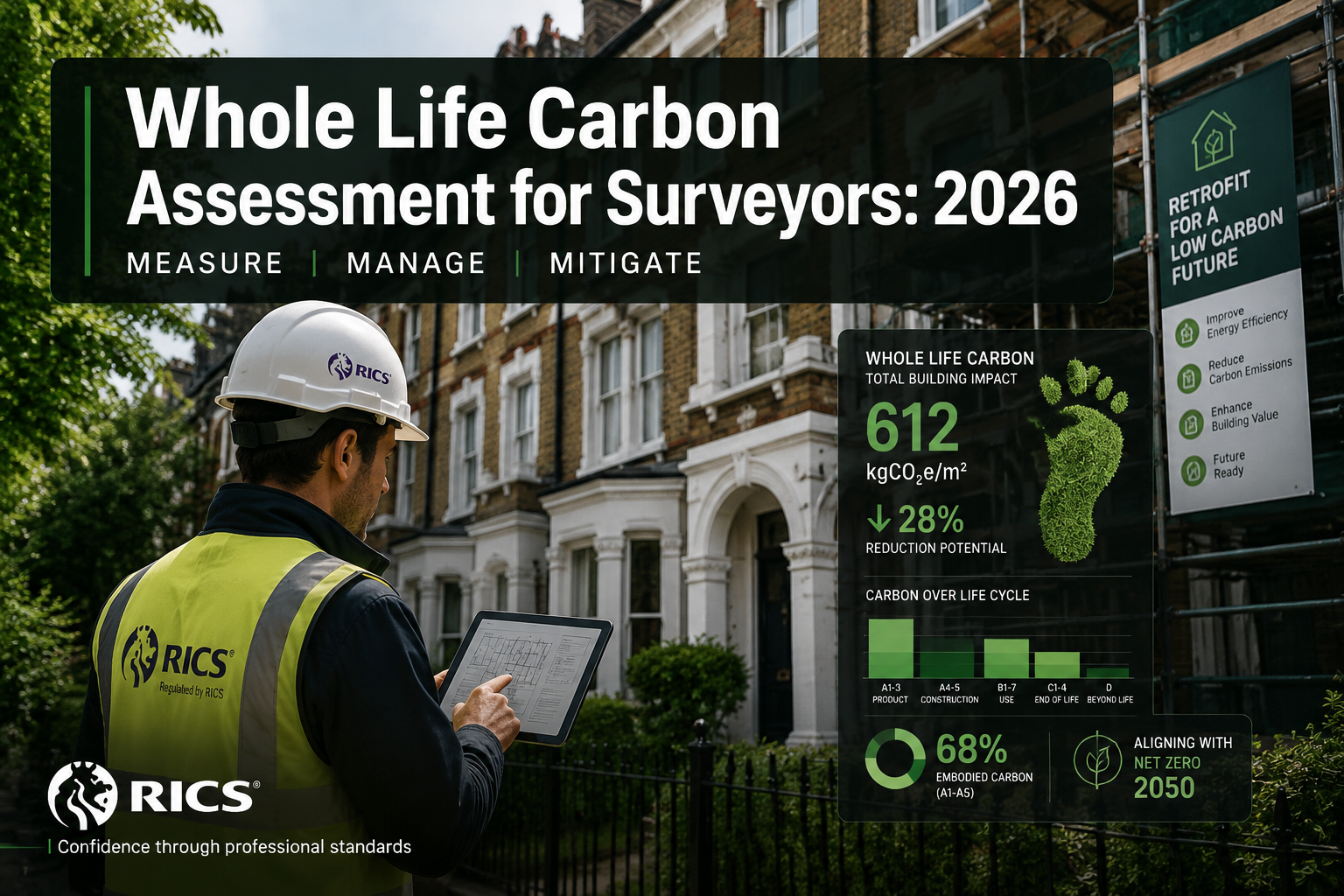
The UK built environment accounts for roughly 40% of the country's total carbon emissions — yet until very recently, most building survey and valuation reports said almost nothing about it. That silence is ending fast. Whole Life Carbon Assessment for Surveyors: How UK Valuation and Building Survey Reports Are Changing in 2026 is no longer a niche sustainability topic debated at green-building conferences. It is rapidly becoming a core professional competency that every chartered surveyor in the UK needs to understand, communicate, and — increasingly — report on.
This shift is not just about environmental conscience. It is being driven by lender expectations, evolving RICS guidance, planning policy, and a growing body of evidence that carbon risk is financial risk. Surveyors who treat whole life carbon as someone else's problem are likely to find their reports falling short of client expectations — and potentially of professional standards — before the decade is out.
Key Takeaways 📋
- Carbon reporting is entering mainstream surveying — it is no longer confined to specialist sustainability consultants.
- Embodied carbon (the carbon locked into building materials) is now as important as operational carbon in whole life assessments.
- Lenders and valuers are beginning to price carbon risk into mortgage decisions and Red Book valuations.
- Retrofit trade-offs are complex: reducing operational carbon can sometimes increase embodied carbon, and surveyors must communicate this honestly.
- Precision is not the goal — surveyors must learn to communicate carbon risk clearly without overclaiming accuracy they do not have.
Why Carbon Has Moved from Specialist Advice into Mainstream Surveying
For most of the past decade, whole life carbon assessment was the domain of specialist sustainability consultants and environmental engineers. A building surveyor's job was to identify defects, assess condition, and advise on value. Carbon was, at best, a footnote.
Three forces are changing that picture in 2026.
1. Regulatory and Policy Pressure
The UK government's legally binding commitment to reach net zero by 2050 — with interim targets along the way — has pushed carbon into planning policy, building regulations, and professional standards. The Future Homes Standard, expected to tighten further, is already reshaping how new buildings are assessed. Meanwhile, local planning authorities in London and other major cities are increasingly requiring whole life carbon assessments as part of planning submissions for larger developments.
RICS has updated its guidance to reflect this reality. The RICS Whole Life Carbon Assessment Professional Statement sets out expectations for how carbon should be measured and reported across a building's full lifecycle — from extraction of raw materials through to demolition and disposal. While the statement currently focuses primarily on new developments and major refurbishments, its influence is filtering into how all building professionals think about carbon.
2. Lender and Investor Expectations
Green mortgages and sustainability-linked lending are no longer fringe products. Major UK lenders are increasingly factoring Energy Performance Certificate (EPC) ratings into lending decisions, and some are beginning to look beyond EPC ratings toward broader carbon risk profiles. A property with a poor EPC rating — or one that would be extremely costly to retrofit — represents a stranded asset risk that lenders are starting to price in.
For surveyors producing Red Book valuations, this creates a direct professional obligation. If carbon risk is material to value — and in many cases it now is — it needs to be acknowledged in the valuation report. Ignoring it is not a neutral act; it is an omission.
3. Client Demand
Buyers, landlords, and occupiers are asking better questions. Commercial tenants with their own net zero commitments want to know the carbon profile of the buildings they occupy. Residential buyers are increasingly aware that a poorly insulated Victorian terrace could cost tens of thousands of pounds to retrofit. Surveyors who can speak confidently about whole life carbon — even at a high level — are adding genuine value.
Understanding Embodied Carbon: The Missing Half of the Equation
When most people think about a building's carbon footprint, they think about energy use — the gas burned for heating, the electricity consumed by lighting and appliances. This is operational carbon, and it has been the focus of building regulations and EPC ratings for years.
But there is another half of the equation that has been largely invisible: embodied carbon.
💡 "Embodied carbon refers to the greenhouse gas emissions associated with the materials and construction processes throughout the whole lifecycle of a building — including extraction, manufacturing, transport, installation, maintenance, and end-of-life disposal."
For a typical new-build home, embodied carbon can account for 50–70% of the building's total lifetime carbon footprint, particularly as operational carbon falls thanks to better insulation and low-carbon energy. For refurbishment projects, the balance shifts — but embodied carbon remains significant.
What This Means for Building Surveys
A structural survey or building condition report that identifies the need for significant remedial work is, in carbon terms, also identifying a future embodied carbon liability. Replacing a roof covering, re-rendering a façade, or underpinning foundations all involve the extraction, manufacture, and transport of new materials — each with its own carbon cost.
Surveyors do not need to calculate precise carbon figures for every repair recommendation. But they do need to understand the concept well enough to:
- Flag when proposed works have significant embodied carbon implications
- Advise clients on the carbon trade-offs between repair and replacement
- Avoid inadvertently recommending high-carbon solutions when lower-carbon alternatives exist
The Retrofit Trade-Off Problem ⚖️
This is where whole life carbon assessment gets genuinely complex — and where surveyors need to be especially careful about overclaiming precision.
Consider a common scenario: a 1930s semi-detached house with solid walls. The obvious recommendation to improve its EPC rating is external wall insulation (EWI). This will reduce operational carbon significantly over time. But EWI involves substantial quantities of insulation material, render, fixings, and associated works — all with embodied carbon costs. The carbon payback period (the time it takes for the operational savings to offset the embodied carbon of the intervention) can be 10–25 years depending on the materials used and the energy mix.
| Retrofit Measure | Operational Carbon Saving | Embodied Carbon Cost | Approx. Payback Period |
|---|---|---|---|
| Loft insulation (mineral wool) | High | Low | 1–3 years |
| External wall insulation | High | Medium–High | 10–25 years |
| Triple glazing (replacing double) | Low–Medium | Medium | 20–40 years |
| Heat pump (replacing gas boiler) | High | Medium | 5–15 years |
| Solar PV panels | Medium | Low–Medium | 3–7 years |
Note: Figures are indicative ranges; actual payback periods depend on specific materials, installation methods, and local energy grid carbon intensity.
Surveyors advising on retrofit — whether in a commercial building survey or a residential condition report — should be able to flag these trade-offs without necessarily quantifying them to the nearest kilogram of CO₂e. The goal is informed decision-making, not false precision.
How Valuation and Building Survey Reports Are Changing in 2026
The practical question for most surveyors is: what does this actually mean for the reports they write and the advice they give?
Changes to Valuation Reports
The connection between carbon risk and property value is becoming harder to ignore. Properties with poor EPC ratings already attract lower offers in many markets — research consistently shows a "green premium" (or conversely, a "brown discount") in residential and commercial property values. As minimum EPC requirements for rented properties tighten, the financial risk of owning a low-rated property increases.
For surveyors producing property valuations — whether for mortgage purposes, probate, or commercial transactions — the key questions are:
- Does the EPC rating materially affect value or marketability?
- Are there regulatory compliance risks (e.g., minimum EPC requirements for lettings) that affect the asset's income potential?
- Would the cost of retrofit to achieve compliance be disproportionate to the property's value?
These are not questions that require a full whole life carbon assessment. But they do require surveyors to be carbon-literate enough to identify when carbon risk is a material valuation factor.
Changes to Building Survey Reports
Building survey reports — particularly RICS Level 3 Home Surveys and commercial condition reports — are beginning to include dedicated sections on energy performance and carbon risk. This goes beyond simply noting the EPC rating. It involves:
🔍 Identifying carbon-relevant defects: Poor insulation, single glazing, inefficient heating systems, and air leakage paths are not just comfort issues — they are carbon issues. Describing them in those terms helps clients understand the full implications.
📊 Flagging retrofit feasibility: Not all properties are equally easy to retrofit. A listed building with solid stone walls faces very different constraints from a 1990s cavity-wall house. Surveyors are well-placed to flag these constraints early.
⚠️ Communicating uncertainty honestly: Whole life carbon assessment involves significant uncertainty — in material carbon factors, future energy grid intensity, occupant behaviour, and building performance in use. Surveyors must resist the temptation to present carbon figures with false precision.
💰 Linking carbon to cost: The most effective way to communicate carbon risk to most clients is to translate it into financial terms — retrofit costs, potential value impact, and regulatory compliance risk.
For those unsure which level of survey is appropriate for a given property, it is worth reviewing what survey you need before commissioning any report.
The Language of Carbon Risk
One of the most important skills surveyors need to develop is the ability to communicate carbon risk clearly, proportionately, and without overclaiming. This means:
- Using qualitative descriptors (high, medium, low carbon risk) rather than spuriously precise figures
- Being explicit about the limitations of available data (EPC ratings are modelled, not measured)
- Distinguishing between current performance and potential with retrofit
- Avoiding alarmism while still conveying genuine material risks
💬 "The surveyor's job is not to be a carbon accountant. It is to be a trusted adviser who can identify when carbon matters, explain why, and help clients make better decisions."
Practical Steps for Surveyors Adapting to Carbon Reporting Requirements
The transition to carbon-aware surveying does not happen overnight. Here is a practical framework for surveyors looking to develop their competency in this area.
Step 1: Build Carbon Literacy
Surveyors do not need to become carbon specialists, but they do need a working knowledge of:
- The difference between embodied and operational carbon
- How EPC ratings are calculated and their limitations
- The RICS Whole Life Carbon Assessment Professional Statement
- Common retrofit measures and their carbon trade-offs
- How to read a basic lifecycle assessment (LCA) report
RICS CPD resources, the UK Green Building Council's guidance, and CIBSE publications are all useful starting points.
Step 2: Update Report Templates
Most surveying firms are already reviewing their standard report templates to include carbon-relevant sections. Key additions include:
- An energy and carbon summary section noting EPC rating, key energy-related defects, and retrofit feasibility
- A carbon risk flag in the executive summary for properties where carbon is a material issue
- Standard caveats on data limitations to avoid overclaiming precision
Step 3: Engage with Lender Requirements
Surveyors working on mortgage valuations should stay current with lender-specific requirements around EPC ratings and green mortgage products. Some lenders are now requesting additional commentary on retrofit potential as part of the valuation instruction.
For commercial property surveyors, engagement with institutional investors' ESG reporting requirements is increasingly important. Large commercial landlords are under significant pressure to report on the carbon performance of their portfolios, and the surveyors they instruct need to understand this context.
Step 4: Know When to Refer
Whole life carbon assessment for complex projects — large mixed-use developments, major refurbishments, or heritage buildings — genuinely requires specialist expertise. Surveyors should know where their competency ends and when to recommend a specialist carbon assessor or sustainability consultant. This is not a weakness; it is good professional practice.
For heritage and listed buildings, the carbon calculus is particularly complex. Retaining existing fabric — even imperfect fabric — is almost always lower-carbon than demolition and rebuild. Surveyors with experience in historic buildings are well-placed to make this case.
Regional Considerations: Carbon Risk Across the UK Property Market
Carbon risk is not uniformly distributed across the UK property market. Older housing stock — concentrated in cities like London, Manchester, and Bristol — faces greater retrofit challenges than newer suburban developments. Properties in conservation areas face planning constraints that limit retrofit options.
For surveyors working across London and the South East — areas with a high concentration of Victorian and Edwardian housing stock — carbon literacy is particularly important. Whether working in South West London, North London, or Surrey, the challenges of advising on solid-wall properties, listed buildings, and properties in conservation areas are a daily reality.
The good news is that surveyors with deep local knowledge are well-positioned to give genuinely useful carbon advice — because they understand the local planning context, the typical construction methods of the area, and the realistic retrofit options available.
Conclusion: Actionable Next Steps for Surveyors in 2026
Whole Life Carbon Assessment for Surveyors: How UK Valuation and Building Survey Reports Are Changing in 2026 represents one of the most significant shifts in professional practice in a generation. The transition from carbon-blind to carbon-aware surveying is not optional — it is the direction of travel for the profession, driven by regulation, lender expectations, and client demand.
The key is not to be paralysed by the complexity, but to start building competency now. Here are the most important actions to take:
✅ Complete RICS-accredited CPD on whole life carbon assessment and energy performance
✅ Review and update standard report templates to include carbon-relevant sections
✅ Develop a referral network of specialist carbon assessors for complex projects
✅ Engage with lender guidance on EPC requirements and green mortgage products
✅ Practice communicating carbon risk in plain language — qualitative, honest, and proportionate
✅ Stay current with evolving RICS professional statements and government policy
Carbon literacy is not about becoming a sustainability specialist. It is about being a better, more complete surveyor — one who can give clients the full picture of the assets they are buying, selling, or managing. In 2026, that picture must include carbon.