
Roughly 4.98 million leasehold dwellings exist in England alone — the vast majority of them flats — and for decades their owners have faced escalating ground rents, costly lease extensions, and a fundamental lack of control over the buildings they call home. That is now set to change. The draft Commonhold and Leasehold Reform Bill, published in January 2026 and signalled prominently in the May 2026 King's Speech, proposes the most sweeping overhaul of residential tenure law since the Leasehold Reform Act 1967. For flat owners and surveyors in Kingston upon Thames and across SW London, understanding the Commonhold and Leasehold Reform Bill 2026 implications for flat owners and surveyors is no longer optional — it is essential.
⚠️ Important note: All bill provisions described in this article are draft or proposed measures. Nothing has yet received Royal Assent. Commencement dates and final figures remain subject to Parliamentary scrutiny and amendment.
Key Takeaways 📌
- The draft Bill proposes commonhold as the default tenure for all new-build flats, effectively banning the grant of new long residential leases on flats.
- Ground rents on existing leases would be capped at £250 per annum, then reduced to a peppercorn over a proposed 40-year transition period.
- Lease extension rights and enfranchisement procedures are proposed to become cheaper, simpler, and faster for existing leaseholders.
- Surveyors face significant valuation challenges as the reform reshapes how leasehold and freehold interests are priced.
- Buyers of existing leasehold flats in 2026 should seek specialist surveyor advice before exchanging contracts.
Table of Contents
- What Is the Draft Commonhold and Leasehold Reform Bill 2026?
- Commonhold as the New Default Tenure
- The Proposed Ban on New Long Leases for Flats
- Ground Rent Reforms: Caps, Transitions, and Timelines
- Implications for Existing Short-Lease Flats and Lease Extensions
- Valuation Impact: What Changes for Surveyors?
- What Surveyors Should Advise Prospective Buyers of Leasehold Flats
- FAQ
- Conclusion
What Is the Draft Commonhold and Leasehold Reform Bill 2026? {#what-is-the-draft-bill}

The draft Commonhold and Leasehold Reform Bill was published by the Ministry of Housing, Communities and Local Government in January 2026 following years of consultation and a series of incremental reforms under the Leasehold Reform (Ground Rent) Act 2022. The May 2026 King's Speech confirmed the Government's intention to bring a version of this legislation before Parliament, with Housing Today and Mortgage Solutions both reporting it as a flagship housing reform commitment for this Parliament.
The Property Institute, which represents managing agents and residential property managers, welcomed the draft Bill's ambition while calling for careful transition provisions to protect existing management structures.
The Bill has three broad pillars:
| Pillar | Summary |
|---|---|
| Commonhold reform | Establishes commonhold as the default tenure for new-build flats |
| Leasehold restriction | Bans the grant of new long residential leases on flats |
| Ground rent reform | Caps and phases out ground rents on existing leases |
For flat owners and chartered surveyors in South West London, each pillar carries distinct practical consequences.
Commonhold as the New Default Tenure {#commonhold-default-tenure}
What Is Commonhold?
Commonhold is a form of freehold ownership for individual units within a multi-unit building. Each flat owner holds the freehold of their own unit and is automatically a member of the Commonhold Association — a company limited by guarantee that collectively owns and manages the common parts. There is no landlord, no lease running down, and no ground rent.
Introduced by the Commonhold and Leasehold Reform Act 2002, commonhold has been available for over two decades but has been adopted for fewer than 20 developments in England and Wales. The 2026 draft Bill proposes to change that fundamentally.
The Proposed Shift
Under the draft Bill's proposals:
- New-build flats would be required to be sold as commonhold units rather than as long leaseholds.
- Developers would no longer be permitted to create a leasehold structure for new residential flat buildings.
- A Commonhold Council framework would provide standardised constitutional documents to reduce complexity for developers and lenders.
🏗️ Why does this matter for SW London? Kingston upon Thames, Battersea, Richmond, and Putney are all experiencing significant flat development activity. If the Bill is enacted in its current form, any new-build flat scheme commencing after the relevant commencement date would need to be structured as commonhold from the outset.
For buyers of new-build flats, our chartered surveyors in Battersea are already fielding questions about what this means for snagging inspections, service charge structures, and building warranties under a commonhold model.
The Proposed Ban on New Long Leases for Flats {#ban-on-new-long-leases}
The draft Bill proposes that no new long residential lease (typically defined as a lease exceeding 21 years) should be granted on a flat after the relevant commencement date. This is arguably the most structurally significant provision in the entire Bill.
What This Does NOT Cover
It is critical to understand what the proposed ban would not affect:
- ✅ Existing leases already granted before commencement remain valid and enforceable.
- ✅ Commercial leases are unaffected.
- ✅ Houses sold on long leases (already restricted under the Leasehold Reform (Ground Rent) Act 2022 for new builds) have separate treatment.
- ✅ Lease extensions on existing leases are not banned — they remain possible and are separately addressed.
Developer and Lender Readiness
The Property Institute has flagged that mortgage lenders, conveyancers, and developers will need significant lead time to adapt systems, standard documentation, and lending criteria for commonhold. Mortgage Solutions reported in early 2026 that several major lenders are reviewing their commonhold lending policies in anticipation of the Bill's progress.
For buyers considering a new-build flat in areas like Richmond or Putney, the tenure structure of any purchase will be a key due diligence point until commencement dates are confirmed.
Ground Rent Reforms: Caps, Transitions, and Timelines {#ground-rent-reforms}
The Current Problem
Ground rents have been one of the most contentious aspects of leasehold tenure. Some leaseholders have faced ground rents that double every 10 or 25 years, rendering their flats unmortgageable and unsaleable. The 2022 Act banned ground rents on new residential long leases, but millions of existing leaseholders remain subject to historic ground rent obligations.
What the Draft Bill Proposes
The draft Commonhold and Leasehold Reform Bill 2026 proposes a two-stage approach to existing ground rents:
- Stage 1 — Cap: Ground rents on existing residential long leases would be capped at £250 per annum (or the current rent if lower).
- Stage 2 — Phase-out: Over a proposed 40-year transition period, ground rents would reduce progressively to a peppercorn (effectively zero).
💬 "The proposed 40-year transition is designed to balance leaseholder relief against freeholder property rights — but the detail of how that reduction is calculated year by year will be critical."
⚠️ These figures and timelines are as published in the draft Bill text and remain subject to amendment. Surveyors should not treat them as final until the Bill receives Royal Assent and commencement regulations are made.
Impact on Freehold Investment Values
Freeholders and ground rent investors face significant capital value erosion if these proposals are enacted. A freehold interest deriving income from a ground rent roll of £500 per annum per flat, multiplied across a 100-unit block, could see that income stream capped and then extinguished entirely. For those requiring a freehold valuation in London, the uncertainty created by the draft Bill is already influencing how RICS valuers approach freehold investment appraisals.
Implications for Existing Short-Lease Flats and Lease Extensions {#short-lease-implications}
The Short-Lease Problem Persists
The draft Bill does not eliminate the short-lease problem overnight. Millions of existing leasehold flats — particularly in older mansion blocks and converted Victorian terraces across SW London — have leases with fewer than 80 years remaining. A lease below 80 years triggers the marriage value premium in lease extension calculations, making extensions significantly more expensive.
The draft Bill proposes to:
- Abolish marriage value as a component of the premium payable for lease extensions.
- Standardise the capitalisation and deferment rates used in lease extension valuations, removing the current uncertainty caused by competing expert evidence.
- Allow leaseholders to extend leases to a 990-year term at a peppercorn ground rent.
For flat owners in Kingston upon Thames or across SW London sitting on a short lease, these proposals — if enacted — could substantially reduce the cost of extending. However, acting before commencement may still be advisable depending on individual circumstances, and specialist advice from a lease extension valuation surveyor in London is essential.
Collective Enfranchisement
The draft Bill also proposes reforms to collective enfranchisement (the right of leaseholders to collectively purchase the freehold of their building). Proposed changes include:
- Lowering the participation threshold required to trigger a collective claim.
- Simplifying the valuation methodology to reduce disputes and professional costs.
- Extending rights to a broader range of mixed-use buildings.
Valuation Impact: What Changes for Surveyors? {#valuation-impact}
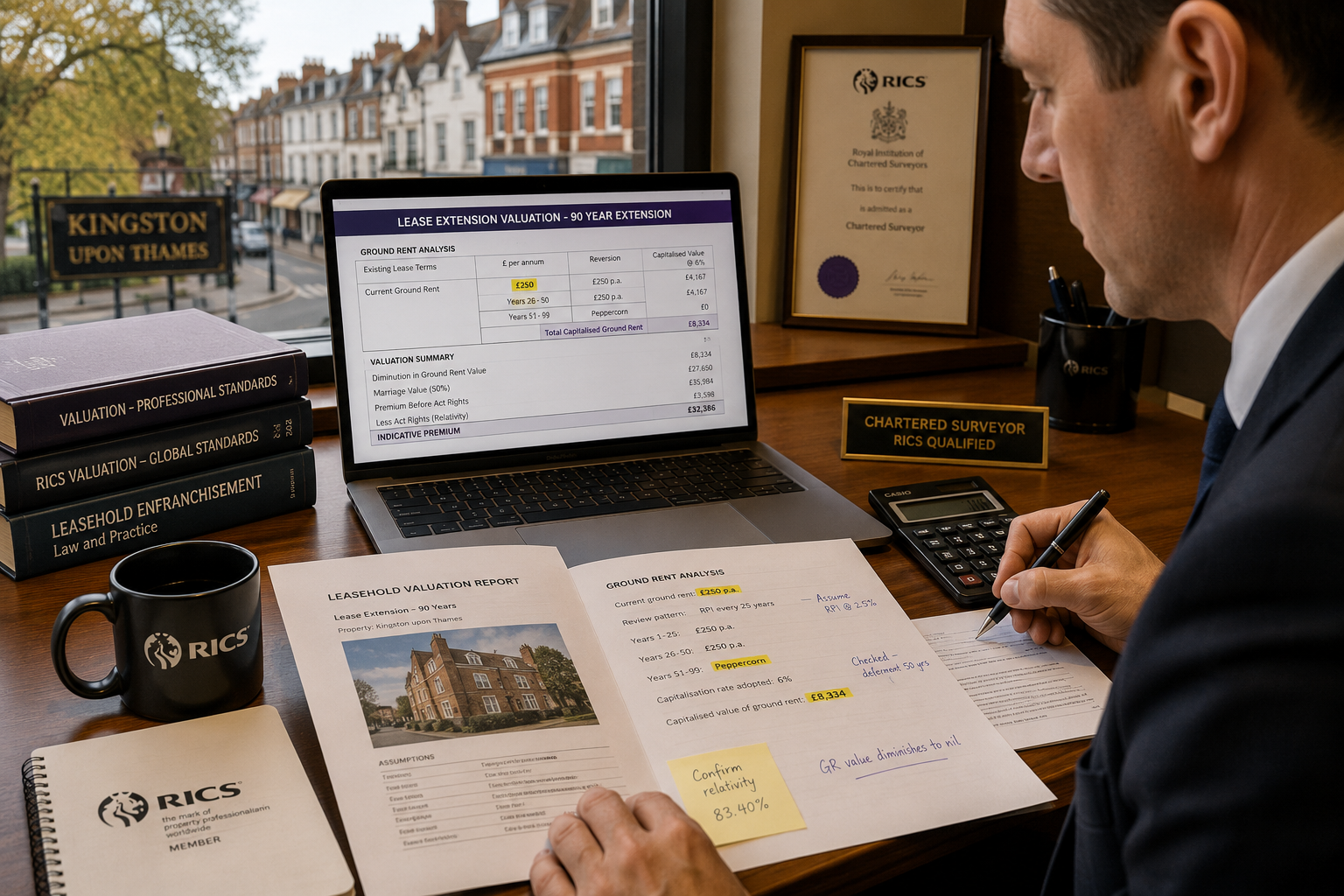
The Commonhold and Leasehold Reform Bill 2026 implications for flat owners and surveyors are perhaps most acute in the field of valuation. The draft Bill, if enacted, would reshape several established valuation methodologies.
Key Valuation Changes Proposed
| Valuation Area | Current Position | Proposed Change |
|---|---|---|
| Lease extension premium | Includes marriage value if lease < 80 years | Marriage value abolished |
| Capitalisation rate | Negotiated/disputed between parties | Prescribed by regulation |
| Deferment rate | Commonly 5% (Sportelli) but disputed | Prescribed by regulation |
| Ground rent income | Capitalised at investment yield | Capped then phased to peppercorn |
| Freehold investment value | Reflects ground rent income stream | Substantially reduced |
For RICS-registered valuers, the transition period will be technically demanding. Valuations instructed before commencement must apply current law; those instructed after must apply the new statutory framework. There will inevitably be a period of uncertainty where both regimes are relevant to different instructions.
Our team of RICS registered valuers in London is monitoring the Bill's progress closely to ensure our valuation reports remain compliant and defensible throughout the transition.
Retrospective Valuations
Where a lease extension or enfranchisement claim was initiated before commencement but completes after, transitional provisions will determine which valuation basis applies. This is a complex area where retrospective property valuation in London expertise will be particularly valuable for clients navigating overlapping legal regimes.
What Surveyors Should Advise Prospective Buyers of Leasehold Flats {#surveyor-advice}
The Commonhold and Leasehold Reform Bill 2026 implications for flat owners and surveyors create a clear advisory duty. Any surveyor acting for a buyer of a leasehold flat in 2026 should address the following points in their advice:
🔍 Pre-Purchase Checklist for Leasehold Flats
1. Check the unexpired lease term
- Is it above or below 80 years?
- Below 80 years triggers marriage value under current law — extension costs could be significant before the Bill is enacted.
2. Review the ground rent provisions
- Is the ground rent fixed, reviewable, or doubling?
- Does it exceed the proposed £250 cap?
- Doubling ground rents may still affect mortgageability even before the Bill is enacted.
3. Assess the service charge history
- Review at least three years of service charge accounts.
- Check for major works reserve fund adequacy.
4. Identify the freeholder and managing agent
- Is the freeholder an institutional investor with a large ground rent portfolio?
- How might the draft Bill affect their willingness to engage on lease extensions?
5. Consider timing of any lease extension
- If the lease is below 90 years, the buyer should understand the cost of extending under current law versus waiting for the proposed reforms.
- Waiting carries risk: the Bill may be amended, delayed, or its commencement deferred.
6. Structural and building condition
- A structural survey in London remains essential regardless of tenure reform — the physical condition of the building is independent of the legal framework.
💬 "Tenure reform does not fix a leaking roof or a failing concrete frame. A thorough building survey is non-negotiable for any flat purchase."
For buyers across SW London, our chartered surveyors in Kingston can provide both RICS HomeBuyer Reports and full building surveys tailored to leasehold flat purchases, with specific commentary on lease terms and the implications of the proposed reforms.
FAQ {#faq}
❓ When will the Commonhold and Leasehold Reform Bill become law?
The draft Bill was published in January 2026 and featured in the May 2026 King's Speech as a Government priority. However, it has not yet received Royal Assent. Parliamentary timetables are subject to change, and commencement dates for individual provisions will be set by separate regulations. Do not assume any provision is in force until confirmed by your solicitor or surveyor.
❓ Should I wait for the Bill to pass before extending my lease?
Not necessarily. If your lease has fewer than 80 years remaining, every year of delay increases the marriage value premium payable under current law. The proposed abolition of marriage value is not yet enacted. Waiting could cost you significantly more than acting now. Take specialist advice from a lease extension valuation surveyor to model both scenarios.
❓ Will my existing leasehold flat automatically convert to commonhold?
No. The draft Bill does not propose automatic conversion of existing leases to commonhold. Conversion of existing leasehold buildings to commonhold would require a separate process, and the draft Bill proposes a voluntary conversion mechanism requiring the agreement of leaseholders and the freeholder.
❓ How does the proposed ground rent cap affect my flat's value?
If your flat carries a high or escalating ground rent, the proposed cap at £250 and eventual reduction to a peppercorn could increase the marketability and mortgageability of your flat. However, until the Bill is enacted, lenders and buyers may still apply caution to problematic ground rent clauses.
❓ Do these reforms affect houses as well as flats?
The draft Bill's commonhold provisions and the ban on new long leases are primarily aimed at flats. Houses have been subject to separate restrictions since the Leasehold Reform (Ground Rent) Act 2022, which already banned ground rents on new-build house leases. The ground rent cap proposals in the 2026 draft Bill would apply to both houses and flats with existing long leases.
❓ What should I do if I am buying a new-build flat right now?
Check whether the development is being sold as leasehold or commonhold. If leasehold, understand that this is still lawful under current law but may be subject to future reform. Instruct a chartered surveyor in London to review the lease terms, ground rent provisions, and service charge structure before exchange.
Conclusion {#conclusion}
The draft Commonhold and Leasehold Reform Bill 2026 represents a genuine generational shift in how residential flats in England and Wales will be owned, managed, and valued. For flat owners in Kingston upon Thames and across SW London, the proposed reforms offer real hope: the prospect of owning a freehold interest in your home through commonhold, freedom from escalating ground rents, and cheaper, simpler lease extensions. For surveyors, the Bill demands careful attention to transitional valuation methodology, updated client advice protocols, and a clear understanding of what is proposed versus what is currently law.
✅ Actionable Next Steps
- Flat owners with short leases: Do not wait passively — model the cost of extending now versus post-enactment with a specialist surveyor.
- Prospective buyers: Instruct a RICS-qualified surveyor to review lease terms as part of every leasehold flat purchase.
- Investors in freehold ground rent portfolios: Commission updated valuations that stress-test the impact of the proposed cap and phase-out.
- Developers: Begin engaging with solicitors and lenders now on commonhold documentation and lending criteria.
- All parties: Monitor gov.uk and the Property Institute for updates on Parliamentary progress and commencement dates.
The reform landscape is moving quickly. Whether you are a first-time buyer in Battersea, a long-standing leaseholder in Richmond, or a surveyor advising clients across SW London, staying informed and taking proactive advice is the single most important step you can take in 2026.
For expert surveyor advice on leasehold flat purchases, lease extension valuations, or freehold appraisals across Kingston upon Thames and SW London, contact our team at Kingston Surveyors.