The RICS Residential Market Survey for January 2026 recorded a positive national price balance for the fourth consecutive month — yet London and the South East continue to lag behind the broader recovery, with buyer enquiries still subdued and affordability pressures keeping many would-be purchasers on the sidelines. For cautious buyers navigating this tentative turnaround, a Level 3 Building Survey is not a luxury — it is a financial shield.
This guide unpacks the London price stabilisation signals in RICS Jan 2026, explains why Level 3 Building Survey protocols are especially critical for southern buyers right now, and delivers a practical checklist framework to help buyers move forward with genuine confidence.
Key Takeaways 📋
- RICS January 2026 data shows national price stabilisation, but London and the South East are recovering more slowly due to persistent affordability constraints.
- A Level 3 Building Survey (formerly the Full Structural Survey) is the most thorough inspection available and is strongly recommended for older, larger, or non-standard London properties.
- Hidden defects — damp, subsidence, roof failure, and drainage problems — are disproportionately common in London's Victorian and Edwardian housing stock.
- In a stabilising market, buyers have more negotiating leverage; a detailed survey report is a powerful tool for price renegotiation.
- Choosing a RICS-registered chartered surveyor in London ensures the survey meets the highest professional standards.
Understanding the RICS January 2026 Market Signals for London
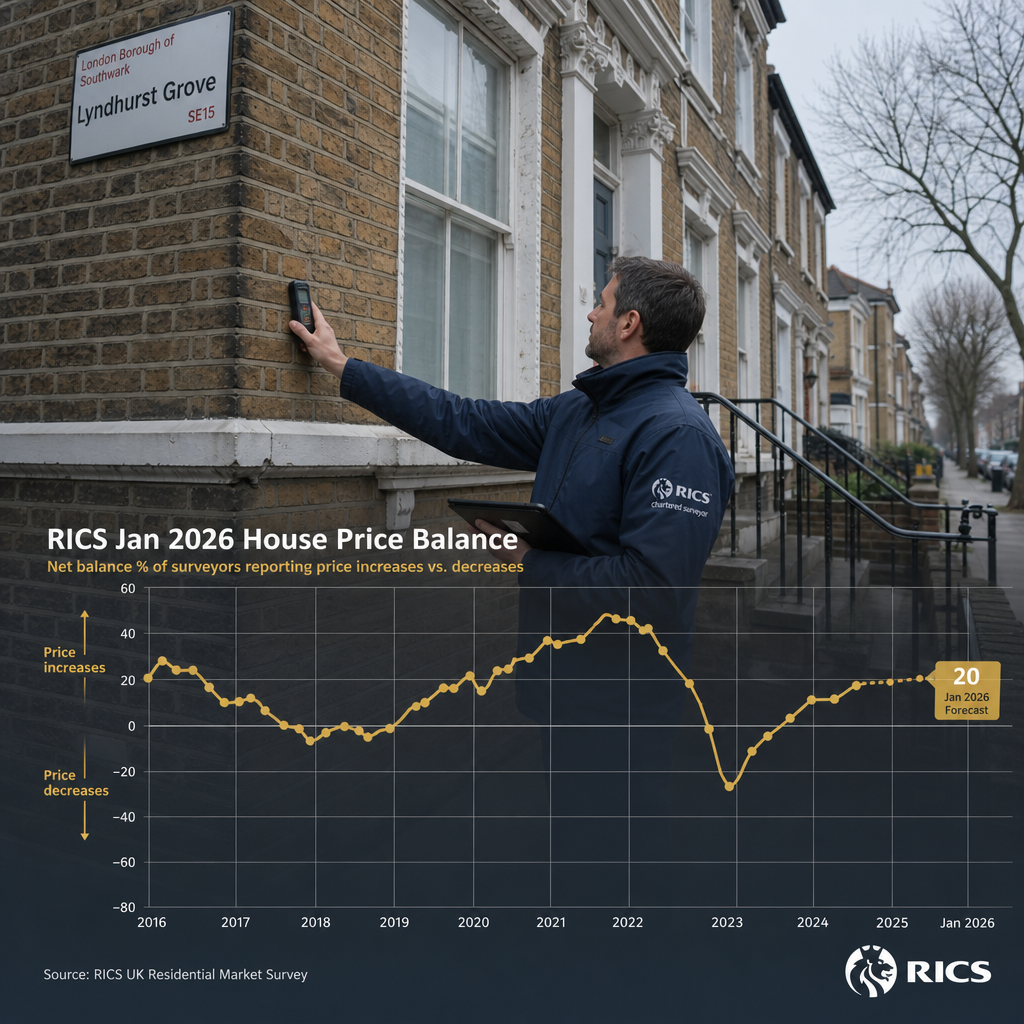
The RICS UK Residential Market Survey is one of the most closely watched barometers of property market sentiment. Its January 2026 edition painted a nuanced picture: nationally, the price balance moved into positive territory, suggesting more surveyors are seeing prices rise than fall. However, regional breakdowns reveal a more complex story for southern England.
Why London and the South East Are Lagging
Several structural factors explain why London price stabilisation signals in RICS Jan 2026 are more cautious than the national headline:
- 💷 Affordability ceiling: Average London house prices remain at multiples of local earnings that far exceed the national average, limiting the pool of active buyers.
- 📈 Mortgage rate sensitivity: Southern buyers, who typically borrow larger absolute sums, feel interest rate movements more acutely than buyers in lower-priced regions.
- 🏗️ Supply overhang: New-build completions in outer London boroughs and commuter belt towns have added stock to a market where demand is still recovering.
- 🏦 Stamp duty recalibration: The March 2025 stamp duty threshold changes reduced the relief available to first-time buyers in higher-value markets, disproportionately affecting London.
"A stabilising market is not the same as a rising market. For southern buyers, the window of negotiating leverage may be narrow — and a thorough survey is the best way to use it."
What Stabilisation Means for Buyer Strategy
In practical terms, price stabilisation means that panic buying is off the table, but so is waiting indefinitely for prices to fall. Buyers who act in 2026 with proper due diligence — particularly a Level 3 Building Survey — are well-positioned to secure fair value while the market remains balanced.
For a broader understanding of how to assess value in the current climate, the best London property valuation guide provides essential context on how surveyors determine market value in conditions like these.
Level 3 Building Survey Protocols: What Cautious Southern Buyers Need to Know
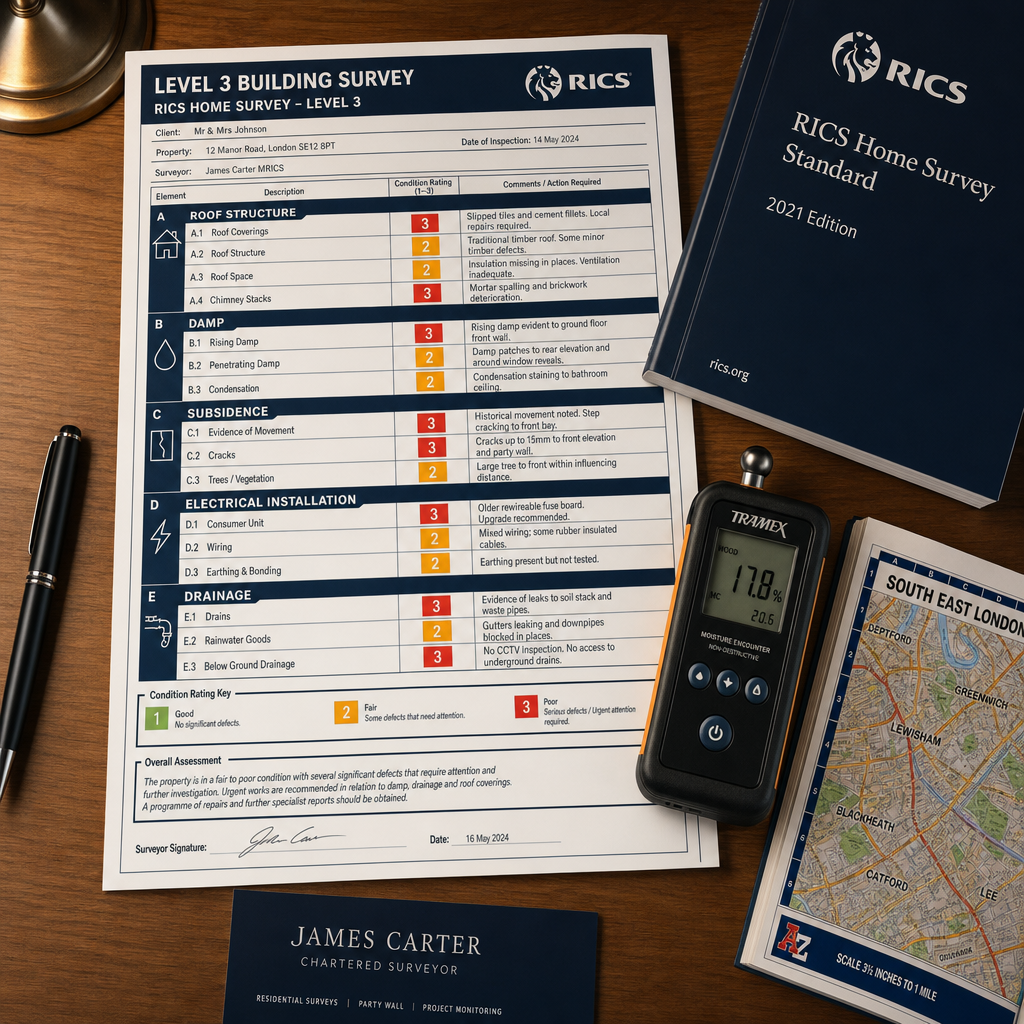
A Level 3 Building Survey — also known as a Full Building Survey — is the most comprehensive residential survey available under the RICS Home Survey Standard. It is distinct from a Level 2 HomeBuyer Report, which provides a more limited condition assessment. Understanding the difference is critical before committing to any London property purchase.
For a clear breakdown of the options, see this detailed comparison of a HomeBuyer Report vs Building Survey.
What a Level 3 Survey Covers
| Inspection Area | Level 2 HomeBuyer Report | Level 3 Building Survey |
|---|---|---|
| Roof structure & covering | Visual only | Full accessible inspection |
| Damp & moisture | Surface readings | Intrusive investigation where possible |
| Structural movement | Noted if visible | Detailed crack analysis & monitoring advice |
| Drainage | Basic observation | Camera survey recommended |
| Timber defects (rot, beetle) | Flagged if visible | Probing & moisture profiling |
| Services (electrics, gas, plumbing) | General comment | Condition assessment with specialist referral |
| Legal & planning issues | Not included | Highlighted for solicitor attention |
The London-Specific Defect Landscape
London's housing stock is dominated by Victorian and Edwardian terraces, many of which are over 100 years old. These properties carry a specific set of structural risks that make a Level 3 protocol essential:
🔴 High-Priority Defects in London Properties:
- Subsidence and heave — London clay is notorious for seasonal shrinkage and swelling. A specialist subsidence survey may be warranted where cracking patterns suggest movement.
- Roof deterioration — Original slate or clay tile roofs on period properties frequently require significant investment. A professional roof survey can quantify repair costs before exchange.
- Rising and penetrating damp — Solid-wall Victorian construction lacks modern cavity wall insulation, making damp ingress a persistent issue.
- Timber decay — Original floor joists, roof timbers, and window frames are vulnerable to wet rot and dry rot in poorly ventilated properties.
- Drainage failures — Shared or combined drainage systems in terraced properties can be expensive to repair and are a common source of post-purchase disputes.
RICS Level 3 Protocol: The Inspection Framework
Under RICS Home Survey Standard guidelines, a Level 3 survey must follow a systematic inspection protocol. Key elements include:
- Pre-inspection desk research: Checking planning history, building regulations applications, and flood risk data.
- External inspection: Roof, chimneys, gutters, downpipes, walls, windows, doors, and drainage.
- Internal inspection: All accessible rooms, roof void (where safely accessible), sub-floor void (where accessible), and services.
- Condition ratings: Each element is rated C1 (no action needed), C2 (repairs/replacement required), or C3 (urgent action required).
- Post-inspection report: A detailed written report with photographic evidence, repair recommendations, and specialist referral advice.
For buyers who are uncertain which survey level is right for their specific property, this guide on what survey you need provides clear guidance based on property age, type, and condition.
Building Buyer Confidence: Strategies for the RICS Jan 2026 Southern Market

The London price stabilisation signals in RICS Jan 2026 create a unique psychological challenge for buyers: the market is neither clearly rising nor clearly falling, which can trigger decision paralysis. The following strategies help buyers move forward with confidence.
Strategy 1: Use the Survey as a Negotiation Tool
In a stabilising market, sellers are less likely to receive competing offers. A Level 3 Building Survey that identifies C2 or C3 defects provides documented, professional evidence to support a price reduction request. This is one of the most effective uses of survey findings in the current climate.
Example negotiation scenario:
- Agreed purchase price: £650,000
- Level 3 survey identifies: roof covering replacement (£18,000), damp treatment (£6,500), drainage repair (£4,200)
- Total identified remedial cost: £28,700
- Realistic price renegotiation: £15,000–£22,000 reduction (sellers typically accept a partial reduction)
Strategy 2: Commission Specialist Reports Early
Where a Level 3 survey flags potential issues, commissioning specialist reports before exchange — rather than after — gives buyers full cost certainty. Key specialists to consider:
- Structural engineer: For significant cracking, movement, or subsidence concerns. A residential structural engineer report provides definitive assessment.
- Drainage contractor: CCTV drain survey to identify root intrusion, collapsed sections, or shared drain liabilities.
- Electrical contractor: Full EICR (Electrical Installation Condition Report) for properties with original wiring.
- Timber and damp specialist: Invasive investigation of suspected rot or beetle infestation.
Strategy 3: Understand the Party Wall Implications
Many London purchases involve properties with shared walls, and planned renovation work — extensions, loft conversions, or basement excavations — triggers obligations under the Party Wall etc. Act 1996. Buyers should factor party wall costs into their budget from the outset. The party wall award process in London and Surrey is a key resource for understanding these obligations.
Strategy 4: Match Survey Depth to Property Risk
Not every London property requires the same level of scrutiny. Use this risk matrix to calibrate survey investment:
| Property Type | Age | Recommended Survey Level |
|---|---|---|
| Modern flat (post-2000) | <25 years | Level 2 + snagging report |
| Converted Victorian flat | 80–130 years | Level 3 essential |
| Terraced Victorian/Edwardian house | 80–130 years | Level 3 essential |
| Interwar semi-detached | 80–100 years | Level 3 recommended |
| 1960s–1980s estate property | 40–65 years | Level 2 or Level 3 |
| Listed building or unusual construction | Any | Level 3 + specialist reports |
Strategy 5: Choose the Right Surveyor for the Right Area
London's property market is hyperlocal. A surveyor with deep knowledge of a specific borough will understand the typical defect profiles, planning history patterns, and local market conditions far better than a generalist. For buyers targeting specific areas, specialist local surveyors are available across the capital:
- Chartered surveyors in South East London for buyers in Lewisham, Greenwich, and Southwark
- Chartered surveyors in North London for Islington, Haringey, and Camden
- Chartered surveyors in Surrey for commuter belt buyers in Epsom, Guildford, and Weybridge
Strategy 6: Factor in Valuation Alongside the Survey
A Level 3 Building Survey assesses condition, not value. In a stabilising market, buyers also need an independent RICS valuation to confirm that the agreed price reflects current market conditions. The RICS registered valuers in London service provides this assurance separately from the structural survey.
Common Questions About Level 3 Surveys in the Current London Market
❓ How much does a Level 3 Building Survey cost in London?
Costs typically range from £800 to £2,000+ depending on property size, age, and complexity. Given that the average London property transaction involves hundreds of thousands of pounds, this represents exceptional value for money.
❓ How long does a Level 3 survey take?
A thorough inspection of a typical three-bedroom Victorian terrace takes 3–5 hours on-site, with the written report delivered within 3–7 working days.
❓ Can a Level 3 survey be used to pull out of a purchase?
Yes. If the survey reveals defects that materially change the buyer's assessment of the property, they can withdraw before exchange of contracts without legal penalty (though conveyancing costs already incurred will not be recoverable).
❓ Should buyers get a survey on a new-build property?
New-build properties have different risk profiles. A snagging report is typically more appropriate than a Level 3 survey for recently completed properties.
❓ What if only one specific defect is a concern?
Where a buyer has a targeted concern — a suspicious crack, a damp patch, or a questionable chimney — a specific defect report can provide focused professional assessment without the cost of a full Level 3 survey.
Conclusion: Acting Wisely in a Stabilising London Market 🏠
The London price stabilisation signals in RICS Jan 2026 represent a genuine, if cautious, turning point for the capital's property market. For buyers who have been waiting on the sidelines, 2026 offers a window of relative balance — prices are not surging, competition is not frenzied, and sellers are more willing to negotiate.
But stabilisation does not mean risk-free. London's ageing housing stock, clay-soil geology, and complex leasehold landscape mean that hidden defects remain a very real financial threat. The Level 3 Building Survey protocols outlined in this guide exist precisely to protect buyers from those risks.
Actionable Next Steps for Cautious Southern Buyers:
- ✅ Instruct a Level 3 Building Survey before exchanging contracts on any pre-1980 London or South East property.
- ✅ Use survey findings to renegotiate the purchase price where C2 or C3 defects are identified.
- ✅ Commission specialist reports (structural engineer, drainage, electrical) for any flagged high-risk areas before exchange.
- ✅ Obtain an independent RICS valuation to confirm the agreed price reflects current stabilised market conditions.
- ✅ Choose a locally experienced RICS-registered surveyor who understands the specific defect profiles and market dynamics of the target area.
- ✅ Budget for party wall obligations if any post-purchase renovation work is planned.
The combination of informed market awareness and rigorous Level 3 survey protocols is the most reliable path to a sound property purchase in London's tentatively recovering market.