

Nearly one in three party wall disputes escalates into a formal disagreement about whether damage existed before construction began — a conflict that a properly prepared schedule of condition could have prevented entirely. Understanding Schedules of Condition for Party Wall Works: What to Record Before Works Start and Why It Matters is not just a procedural formality. It is one of the most powerful protective tools available to both building owners and adjoining owners when construction work is planned near a shared boundary.
This guide breaks down exactly what a schedule of condition should contain, how it is prepared, and why skipping this step can cost thousands of pounds in unresolved disputes.
Key Takeaways 📋
- A schedule of condition is a formal, photographic and written record of a neighbouring property's condition before party wall works begin.
- It protects both parties — the building owner from false damage claims, and the adjoining owner from uncompensated genuine damage.
- The schedule should include photography, crack mapping, floor-by-floor notes, access records, and structural observations.
- It is typically prepared by a party wall surveyor and forms part of the Party Wall Award.
- Without a schedule, proving the pre-existing state of a property becomes extremely difficult — and expensive.
What Is a Schedule of Condition in Party Wall Works?
A schedule of condition is a detailed, timestamped record of the physical state of an adjoining property at a specific point in time — namely, before any notifiable party wall works commence. It is prepared under the framework of the Party Wall etc. Act 1996, which governs construction works that affect shared walls, boundary structures, and excavations near neighbouring properties.
The document typically combines:
- 📷 Dated photographs of every relevant surface
- ✏️ Written descriptions of existing defects
- 📐 Crack maps and measurements
- 🗺️ Floor plans or room-by-room annotations
- 📝 Access notes and surveyor observations
"A schedule of condition is not about blame — it is about establishing a baseline of truth before work begins."
The schedule is usually appended to the Party Wall Award, making it a legally referenced document. If damage is later claimed, both parties can refer back to this baseline record to determine whether the damage is new or pre-existing.
To understand the broader legal framework, it helps to first be clear on what a party wall dispute involves and how the Act applies to different types of work.
Why Schedules of Condition for Party Wall Works Matter: The Legal and Practical Case
The Risk of Skipping the Schedule
When no schedule of condition exists, any damage claim after works are completed becomes a matter of word against word. The adjoining owner insists a crack is new; the building owner insists it was always there. Without documented evidence, resolution often requires expensive expert reports, independent surveyors, and sometimes litigation.
Consider these common scenarios where a schedule proves essential:
| Scenario | Without Schedule | With Schedule |
|---|---|---|
| Hairline crack appears post-works | Disputed — no baseline | Clearly pre-existing or new |
| Plaster bulging near party wall | Impossible to date | Documented if pre-existing |
| Ceiling staining near excavation | Ambiguous liability | Liability clearly assigned |
| Loose tiles or brickwork | No reference point | Condition confirmed in advance |
Legal Standing Under the Party Wall Act
The Party Wall etc. Act 1996 does not explicitly mandate a schedule of condition in every case, but it is strongly implied and widely considered best practice by RICS-accredited surveyors. When a Party Wall Notice is served and an Award is made, the schedule forms a critical annex to that Award.
If the adjoining owner dissents to the notice, appointed surveyors will almost always prepare a schedule as part of their duties. Even where party wall consent is given, commissioning a schedule independently remains strongly advisable.
Schedules of Condition for Party Wall Works: What to Record Before Works Start and Why It Matters — A Room-by-Room Guide
A thorough schedule is not a quick walk-around with a phone camera. It is a systematic, methodical inspection carried out by a qualified surveyor, following a structured format. Here is what a proper schedule must capture.
1. 📷 Photography — The Foundation of Any Schedule
Photography is the single most important element. Every photograph must be:
- Timestamped and geotagged where possible
- Taken with consistent lighting to reveal surface conditions accurately
- Supplemented by scale references (a ruler or coin placed next to defects)
- Organised by room, elevation, and floor level
What to photograph:
- All walls adjacent to or near the party wall
- Ceilings directly below or beside the works area
- Floors, particularly timber floors near the boundary
- External brickwork, pointing, and render
- Windows and door frames (for signs of distortion)
- Chimneys if relevant — particularly important for party wall works involving shared chimneys
- Roof slopes visible from accessible areas
A professional surveyor will typically take 50 to 150 photographs for a standard terraced house, far more than most homeowners would consider necessary.
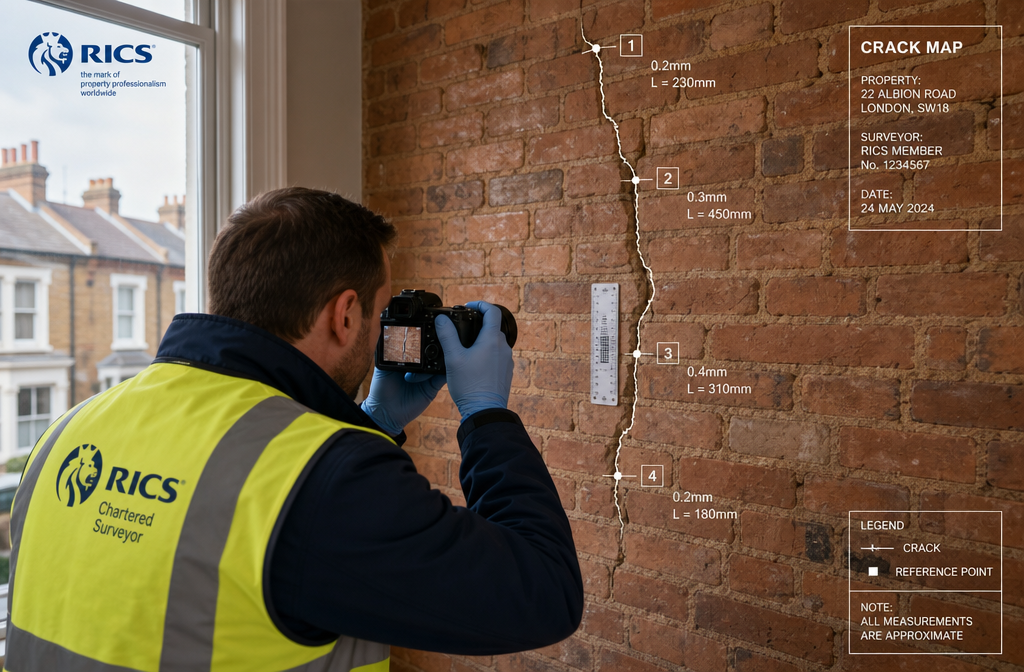
2. ✏️ Crack Mapping — Recording Every Existing Defect
Crack mapping is the process of identifying, measuring, and classifying every crack visible in the property at the time of inspection. This is arguably the most technically demanding part of the schedule.
Crack classification (based on BRE Digest 251 guidance):
| Category | Width | Description |
|---|---|---|
| 0 | < 0.1mm | Hairline, negligible |
| 1 | 0.1–1mm | Fine, easily filled |
| 2 | 1–5mm | Slight, noticeable |
| 3 | 5–15mm | Moderate, requires attention |
| 4 | 15–25mm | Severe, structural concern |
| 5 | > 25mm | Very severe, urgent action needed |
Each crack should be numbered on a floor plan, with its location, orientation (horizontal, vertical, diagonal), width, and length recorded. This creates a crack map — a visual reference that makes it immediately clear whether any post-works damage matches the pre-existing pattern or represents something entirely new.
3. 🗺️ Floor Plans and Room-by-Room Written Notes
Photographs alone are not sufficient. Written notes provide context, narrative, and legal clarity that images cannot always convey. A good schedule includes:
- Room-by-room condition descriptions covering walls, ceilings, floors, and joinery
- Floor plan sketches showing the location of defects relative to the party wall
- Notes on damp, staining, settlement, or previous repairs that are visible
- Observations about structural elements such as lintels, beams, and joist directions
- Comments on finishes — whether plasterwork is original, recently repainted, or patched
This written record ensures that even if photographs are unclear or disputed, there is a contemporaneous professional opinion on record.
4. 🏗️ External Inspection — Don't Forget the Outside
Works that affect party walls often impact external fabric as well. The external inspection should cover:
- Brickwork and mortar joints — noting any spalling, loose bricks, or open joints
- Render and cladding — existing cracks or delamination
- Boundary walls and fences — condition and any pre-existing lean or damage
- Drainage channels and gullies near the works area
- Garden structures adjacent to the boundary
For loft conversions and extensions, the external condition of the roof at the party wall junction is particularly important. Learn more about the specific considerations for party wall works in loft conversions.
5. 📝 Access Notes and Surveyor Observations
Every schedule must clearly record:
- Date and time of inspection
- Who was present (surveyor, building owner representative, adjoining owner)
- Areas that could not be accessed and why
- Any limitations on the inspection (furniture blocking walls, locked rooms, etc.)
- The surveyor's professional observations on the overall structural condition
Access limitations are particularly important. If a room was not inspected because the adjoining owner refused access or it was inaccessible, this must be explicitly noted. Otherwise, a later claim for damage in that area becomes ambiguous.
Who Prepares the Schedule — and Who Pays?
The Surveyor's Role
A schedule of condition should be prepared by a qualified, RICS-accredited surveyor with experience in party wall matters. This is not a task for a general contractor or a DIY effort. The surveyor must be:
- Independent and impartial
- Experienced in the Party Wall etc. Act 1996
- Capable of producing a legally defensible document
For a comprehensive overview of what professional survey services involve, see what a schedule of condition report covers.
Who Pays?
Under the Party Wall etc. Act 1996, the building owner (the party carrying out the works) is generally responsible for the costs of the party wall process, including the schedule of condition. This reflects the principle that the person creating the risk should bear the cost of documenting the baseline.
However, if an adjoining owner appoints their own surveyor independently (rather than agreeing to a single agreed surveyor), additional costs may arise. Understanding party wall disputes and how costs are allocated is essential before works begin.
Schedules of Condition for Party Wall Works: What to Record Before Works Start and Why It Matters — Common Mistakes to Avoid
Even when a schedule is prepared, errors in its preparation can undermine its value. Watch out for these common pitfalls:
❌ Insufficient photography — Too few images, poor lighting, or no scale references make photos hard to use as evidence.
❌ No crack measurements — Describing cracks without measuring them is almost useless for comparison purposes.
❌ Missing rooms — Failing to inspect every room adjacent to the works area leaves gaps that can be exploited in disputes.
❌ No external inspection — Ignoring the outside of the building misses a significant portion of potential damage areas.
❌ Undated documents — A schedule without a clear, verifiable date has limited legal weight.
❌ Prepared too late — The schedule must be completed before works start, not during or after. Once work begins, the baseline is contaminated.
❌ No access record — Failing to document what was and was not inspected creates ambiguity.
Practical Tips for Adjoining Owners
If a neighbour is planning works that affect your property, here is what to do:
- Request a copy of the schedule once it is prepared — you are entitled to one.
- Walk through the inspection with the surveyor if possible, pointing out any defects you are aware of.
- Keep your own photographic record as a supplementary reference.
- Check that all rooms have been covered, including cellars, loft spaces, and outbuildings near the boundary.
- Raise concerns before works start — not after.
If a neighbour is carrying out party wall work on your boundary, understanding your rights early is essential.
Conclusion: A Small Investment That Prevents Large Problems
A properly prepared schedule of condition is one of the most cost-effective steps in any party wall process. The surveyor's fee for preparing a thorough schedule is a fraction of the cost of a single disputed damage claim — which can easily run into thousands of pounds once legal fees, independent expert reports, and repair costs are factored in.
Actionable next steps:
✅ Serve the correct Party Wall Notice before any notifiable works begin.
✅ Appoint a qualified party wall surveyor to prepare the schedule — do not rely on informal arrangements.
✅ Ensure the schedule is completed and signed off before the first day of works.
✅ Retain a copy of the schedule, all photographs, and the Party Wall Award in a safe place.
✅ Review the schedule at the end of works to identify any new damage promptly.
Whether planning a basement conversion, loft extension, or structural alteration near a shared wall, the schedule of condition is the document that keeps the process honest — and keeps relationships with neighbours intact.