

Subsidence claims involving a single, clear cause are the exception, not the rule. In reality, the majority of complex cases present surveyors with three overlapping possibilities at once: tree root activity, drainage defects, and historic structural movement that may or may not still be active. Understanding how surveyors should handle subsidence claims when trees, drainage, and historic movement are all possible causes is not just a technical question — it is a professional liability question with real consequences for homeowners, insurers, and the surveying profession itself.
Key Takeaways 📋
- Never attribute subsidence to a single cause without systematic evidence — trees, drainage, and historic movement must each be tested and either confirmed or ruled out.
- RICS Level 2 and Level 3 surveys are visual inspections only — they are not diagnostic tools for subsidence causation.
- Precise language matters — surveyors must distinguish "historic, stabilised movement" from "active subsidence" in every report.
- Multi-disciplinary input is expected — arboriculturists, structural engineers, drainage specialists, and geotechnical labs all play a role.
- Underpinning and tree removal are last resorts — proportionate remedies must be considered and documented first.
Why Subsidence Claims Are Rarely Simple
Trees on shrinkable clay remain the single most commonly cited cause of domestic subsidence claims in the UK [6]. However, that statistic can mislead surveyors into tunnel vision. A property with a large oak tree nearby, diagonal cracks above a window, and a 1930s shallow foundation may look like an open-and-shut tree root case — until a CCTV drain survey reveals a fractured clay pipe running directly beneath the affected wall.
This is precisely why knowing how surveyors should handle subsidence claims when trees, drainage, and historic movement are all possible causes matters so much. Overclaiming certainty in a report — or worse, failing to flag competing explanations — exposes the surveyor to professional complaints, ombudsman referrals, and potential negligence claims.
💬 "Poor wording in survey reports is one of the most common sources of complaint and dispute in subsidence cases." — Consumer and professional guidance, 2026
The Financial Ombudsman Service (FOS) requires precise classification of ground movement because cover and liability differ depending on whether the movement is classified as subsidence, heave, landslip, settlement, or thermal/structural movement [9]. A surveyor who uses these terms loosely — or interchangeably — can inadvertently determine whether a homeowner's claim succeeds or fails.
Understanding the Three Main Causes: Trees, Drainage, and Historic Movement
🌳 Tree Root Activity on Shrinkable Clay
High water-demand species — willow, poplar, oak, elm, and ash — are the most frequently implicated in subsidence claims [6]. The mechanism is well understood: tree roots extract moisture from shrinkable clay subsoil, causing volume reduction and differential settlement beneath shallow foundations. Risk is highest when:
| Risk Factor | Detail |
|---|---|
| Soil type | Shrinkable (high plasticity) clay |
| Tree species | High water-demand (oak, willow, poplar) |
| Tree proximity | Within a distance roughly equal to mature height |
| Foundation depth | Shallow (pre-1970s construction, often <1m) |
| Season | Movement typically worsens in dry summers |
The London Tree Officers Association (LTOA) has published a revised guide stressing that evidence-based causation is essential — root identification to species level, soil moisture profiling, and monitoring over at least one full seasonal cycle are all expected before tree involvement can be confirmed [1].
Critically, surveyors cannot simply attribute damage to a nearby tree [2]. The presence of a tree is not proof of causation. Root samples must be identified, soil plasticity tested, and crack patterns analysed for seasonal correlation before any conclusion is drawn.
🚰 Drainage Defects
Leaking or displaced drain joints can saturate subsoil, softening foundations and triggering settlement. Conversely, a blocked or collapsed drain can cause localised waterlogging. Either scenario can produce crack patterns that closely resemble tree-related subsidence.
Key indicators of drainage involvement include:
- Cracks concentrated near known pipe routes or inspection chambers
- Movement associated with periods of heavy rainfall rather than dry summers
- Soft or wet ground near the affected wall
- CCTV survey evidence of fractured, displaced, or root-intruded joints
For properties in areas with older clay drainage infrastructure — common across London and the South East — drainage defects should always be investigated as a parallel hypothesis, not an afterthought.
🏚️ Historic Movement
Many UK properties, particularly Victorian and Edwardian terraces, have experienced some degree of structural movement over their lifetime. The critical professional distinction is between historic, long-stabilised movement and active, ongoing subsidence [9].
Stabilised historic movement typically presents as:
- Old, filled, or painted-over cracks
- Cracks of consistent width (not tapering or widening at one end)
- No correlation with recent seasonal or weather patterns
- Absence of fresh plaster cracking or sticking doors and windows
Active subsidence, by contrast, tends to show fresh crack edges, progressive widening, and seasonal variation. Surveyors must document which pattern they observe and avoid conflating the two — a mistake that can either alarm a buyer unnecessarily or, worse, give false reassurance about genuinely active movement [4].
The Differential Diagnosis Approach: A Practical Framework
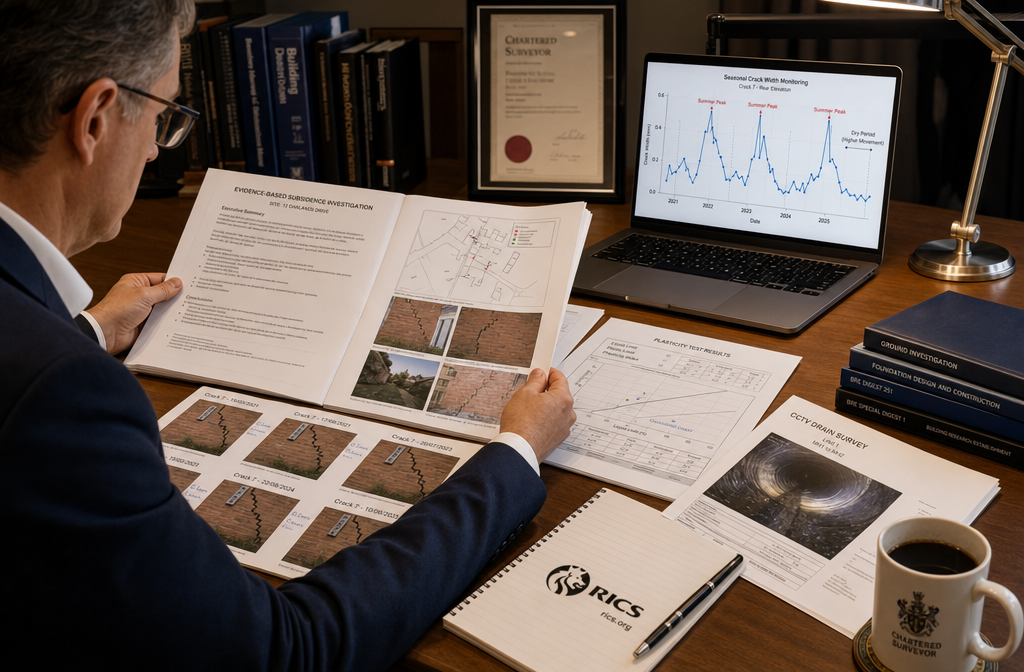
The most robust professional approach to complex subsidence cases is the differential diagnosis method — systematically testing each potential cause and recording how each is ruled in or out. This mirrors the approach used in clinical medicine and is increasingly expected in legal and insurance contexts [2][5].
Step-by-Step Investigation Sequence
Step 1: Confirm Soil Type and Moisture Regime
Commission trial pits or boreholes to determine foundation depth and soil type. Laboratory plasticity tests on clay samples establish whether the subsoil is genuinely shrinkable. Without this, any tree-related hypothesis is speculative [2].
Step 2: CCTV Drain Survey
A full CCTV inspection of all drainage within the zone of influence should be completed early. This is low-cost relative to geotechnical investigation and can quickly confirm or eliminate drainage as a contributing factor [5].
Step 3: Root Identification
Where tree involvement is suspected, root samples recovered from trial pits should be sent for laboratory identification to species level. This is a requirement under current good practice guidance, not an optional extra [1][8].
Step 4: Crack and Level Monitoring
Install precise crack monitors (tell-tales) and, where possible, precise level surveys. Monitor over a minimum of one seasonal cycle — ideally including a dry summer and a wet winter. Seasonal crack widening that correlates with dry periods strongly implicates tree-related desiccation; movement linked to rainfall events points toward drainage [2][5].
Step 5: Document the Evidence Chain
Every report should explicitly link observed patterns to probable causes. For example:
"Crack widths increased by 1.8mm between June and September 2026, correlating with the dry period recorded at the nearest weather station. A mature oak (Quercus robur) is located 6m to the south-west. Root samples recovered from Trial Pit 1 at 0.6m depth were identified as Quercus spp. Soil plasticity index: 42% (high shrinkability). Drainage CCTV: no defects identified. On the balance of available evidence, tree-related desiccation on shrinkable clay is the primary probable cause."
This level of specificity is what distinguishes a defensible professional report from one that will be challenged by insurers or loss adjusters.
What Standard Surveys Do and Don't Cover
It is important to be clear with clients about the scope of RICS Level 2 (HomeBuyer Report) and Level 3 (Building Survey) inspections. Both are largely visual and do not include root excavation, drainage testing, or geotechnical investigation [3]. Where cracks, distorted openings, or trees within the zone of influence are observed, surveyors are expected to:
- ✅ Flag the risk clearly and in plain language
- ✅ Avoid definitive diagnoses of subsidence vs. historic settlement
- ✅ Recommend further specialist investigations
For properties where active movement is suspected, a dedicated subsidence survey or structural survey goes significantly further than a standard Level 2 or Level 3 report. Understanding the difference between survey types is essential — a useful starting point is the HomeBuyer Report vs Building Survey guide.
Multi-Disciplinary Working: Who Does What
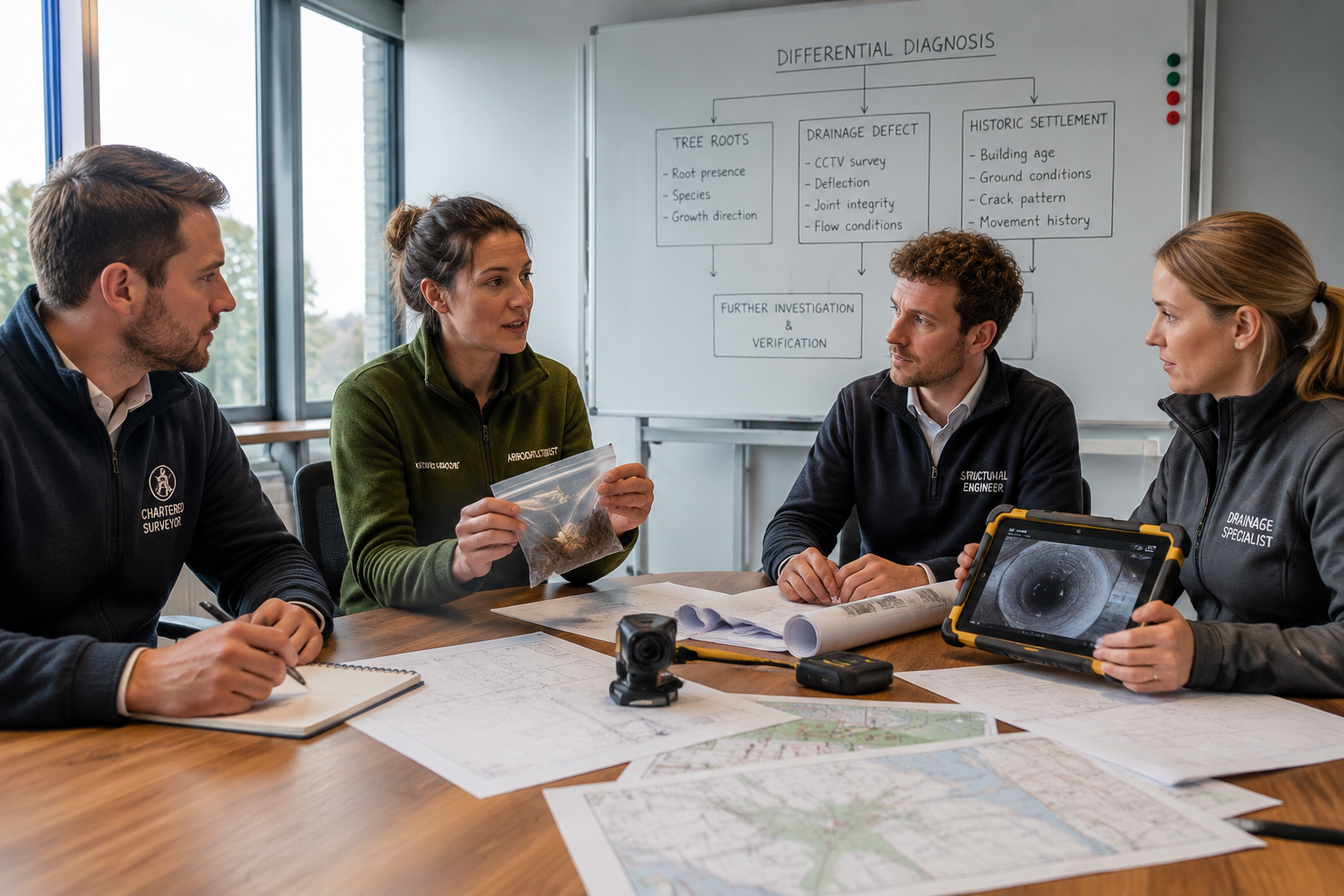
A recurring theme in current technical and legal guidance is that subsidence claims are inherently multi-disciplinary [2]. Surveyors are expected to act as coordinators and evidence-gatherers, not sole determiners of cause. The table below sets out the typical team and their respective roles:
| Specialist | Role in Subsidence Investigation |
|---|---|
| Chartered Surveyor | Initial inspection, crack documentation, report coordination, client communication |
| Structural Engineer | Foundation analysis, movement assessment, underpinning specification if needed |
| Arboriculturist | Tree condition, species identification, water demand assessment, management options |
| Drainage Specialist | CCTV survey, leak tracing, pipe condition assessment |
| Geotechnical Lab | Soil plasticity testing, moisture content analysis |
Surveyor reports should signpost these inputs clearly and state where the surveyor's own remit ends. This is not a sign of professional weakness — it is a sign of professional competence and appropriate risk management [2].
Where a claim may involve neighbouring properties or shared drainage infrastructure, the Party Wall Act may also be relevant, particularly if underpinning or excavation works are proposed. Surveyors working in London and the South East — areas with high concentrations of shrinkable clay and mature street trees — should be especially familiar with this intersection. Chartered surveyors in Surrey and chartered surveyors in West London regularly encounter exactly this combination of risk factors.
Remedial Strategy: Proportionality Is Non-Negotiable
One of the most common reasons surveyor reports are challenged by insurers and loss adjusters is jumping straight to underpinning or tree removal without demonstrating why lesser measures would be inadequate [5][2].
Current best practice sets out a clear hierarchy of remedial options:
🌿 Tree Management First
Where tree-related desiccation is the probable cause, phased crown reduction or pruning is the first-line response. This reduces the tree's water demand without the sudden soil moisture change that complete removal causes. Abrupt removal of a large tree can trigger heave — the soil swelling back as moisture returns — which can be as damaging as the original subsidence [5].
🔧 Drainage Repair Second
Where drainage defects are identified, repair, relining, or rerouting of affected pipes should be completed before any structural intervention. In many cases, this alone stabilises movement [5].
🏗️ Underpinning as Last Resort
Underpinning is expensive, disruptive, and not always necessary. It should only be specified after monitoring confirms ongoing active movement that cannot be arrested by tree management or drainage repair [5][2].
Where a claim may also involve damage to a neighbouring property, the party wall damage guidance provides useful context on liability and documentation requirements.
For cases that may proceed to litigation or formal dispute resolution, a properly structured expert witness report is often required. Surveyors should be aware that their standard survey report is not a substitute for a formal expert witness opinion.
Professional Responsibility: Language, Liability, and Client Communication
The language used in subsidence reports carries significant professional and legal weight. Online forums and consumer discussions consistently highlight how phrases like "some structural movement" or "trees within the influencing distance" cause confusion and anxiety when not properly explained [4][10].
Surveyors should follow these communication principles:
- Avoid ambiguous phrases without explanation — "movement noted" means nothing without context
- Clearly separate historic from active movement — use explicit language: "The crack patterns observed are consistent with historic, long-stabilised settlement and show no evidence of recent progression" or "Monitoring is required to determine whether movement is ongoing"
- State the limits of the inspection — remind clients that a visual survey cannot diagnose causation
- Give clear next steps — name the specific specialist to instruct (structural engineer, arboriculturist, drainage contractor) rather than vague references to "further investigation"
For surveyors handling complex cases, a specific defect report focused solely on the suspected subsidence issue — rather than a general building survey — may provide the most useful and defensible professional output.
Conclusion: Building a Stronger Evidence Trail in 2026
Knowing how surveyors should handle subsidence claims when trees, drainage, and historic movement are all possible causes ultimately comes down to one principle: evidence before opinion. The professional and legal landscape in 2026 is clear — causation must be proved on the balance of probabilities using a structured, multi-disciplinary evidence chain [1][2][9].
Actionable Next Steps for Surveyors ✅
- Adopt the differential diagnosis framework — test each cause systematically before drawing conclusions
- Commission early drainage CCTV — it is low-cost and can quickly eliminate one hypothesis
- Require root identification to species level — proximity alone is not causation
- Install crack monitors and allow at least one seasonal cycle before finalising conclusions
- Use precise, policy-aligned terminology — align with FOS definitions of subsidence, heave, settlement, and landslip
- Document proportionate remedies — show why tree management or drainage repair was considered before underpinning
- Clearly state the limits of your inspection — and name the specialists whose input is needed
Subsidence claims are among the most technically and legally complex matters a surveyor will encounter. The surveyors who navigate them most successfully are those who resist the temptation to provide a quick, confident answer — and instead build a careful, well-evidenced, professionally defensible report that genuinely serves their client and withstands scrutiny.
References
[1] Revised Guide To Risk Management Strategies For Tree Root Claims Published – https://charteredforesters.org/revised-guide-to-risk-management-strategies-for-tree-root-claims-published
[2] Tree Root Subsidence – https://rswlaw.co.uk/tree-root-subsidence/
[3] Do Surveyors Check Trees And Roots – https://surveymatch.co.uk/do-surveyors-check-trees-and-roots/
[4] Advice Required Structural Movement Vs Subsidence – https://www.reddit.com/r/HousingUK/comments/1rhw6h3/advice_required_structural_movement_vs_subsidence/
[5] Subsidence – https://www.totallandlordinsurance.co.uk/knowledge-centre/subsidence
[6] Subsidence Causes Warning Signs Solutions – https://www.allcottassociates.co.uk/blog/subsidence-causes-warning-signs-solutions/
[8] Tree Related Subsidence Damage – https://www.localsurveyorsdirect.co.uk/tree-related-subsidence-damage
[9] Subsidence Types Ground Movement – https://www.financial-ombudsman.org.uk/businesses/complaints-deal/insurance/home-buildings-insurance/subsidence-types-ground-movement
[10] Property Has Suffered Some Movement Trees Within The Influencing Distance Mortgage Surveyor Report – https://forums.landlordzone.co.uk/c/general-discussions/property-has-suffered-some-movement-trees-within-the-influencing-distance-mortgage-surveyor-report