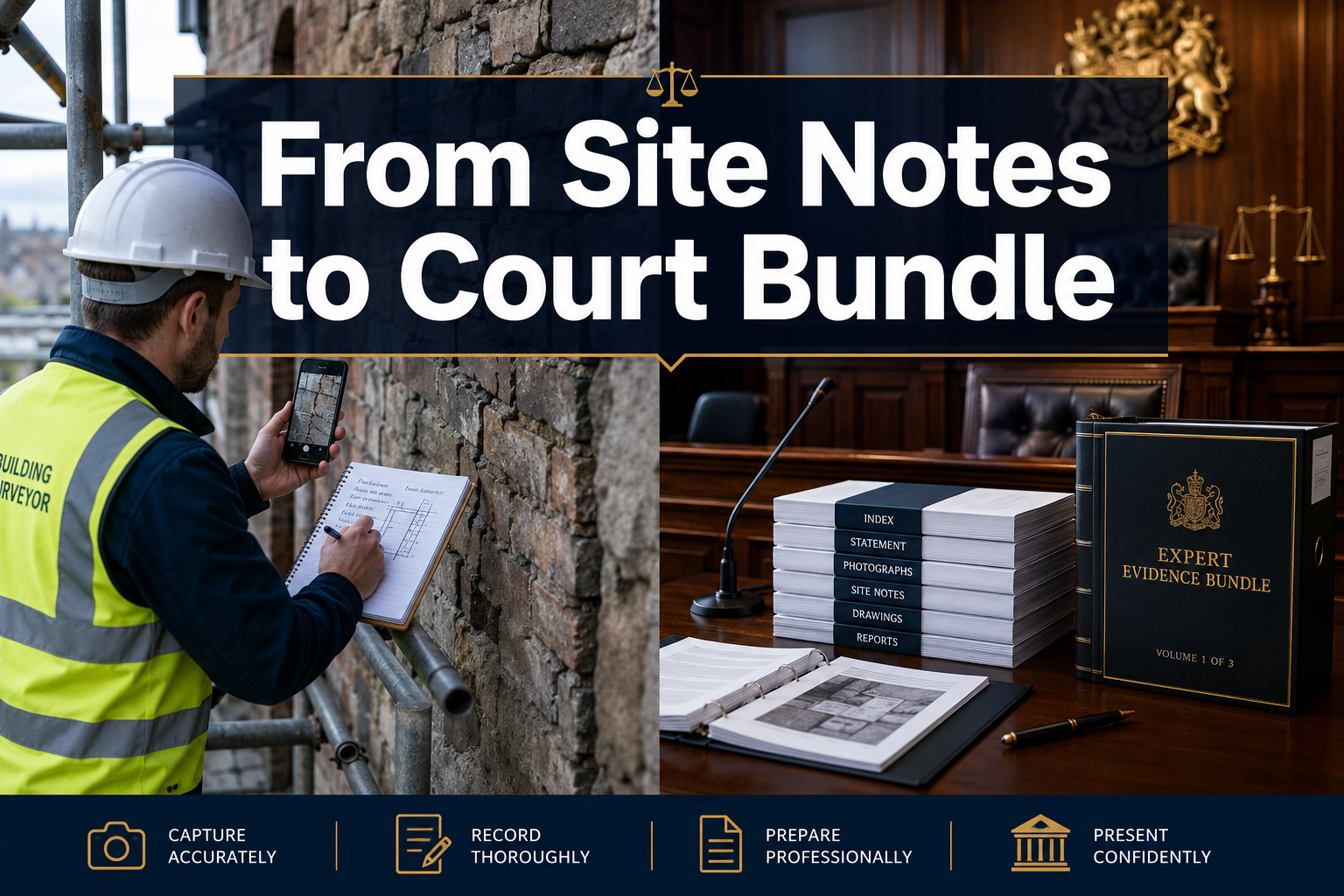

Only around 1 in 5 building dispute cases that reach litigation actually feature survey evidence that fully withstands cross-examination — meaning the majority of surveyors who attend court are working with records that were never designed to be tested [8]. The gap between a competent field inspection and a court-ready expert report is not a matter of expertise; it is almost always a matter of documentation discipline.
This article walks through the entire journey described in From Site Notes to Court Bundle: Turning Building Survey Records into Defensible Expert Witness Evidence — from the moment a surveyor picks up a pencil on site to the moment a judge opens the court bundle. Every stage matters.
Key Takeaways 📋
- Site records must be litigation-ready from day one — retroactively reconstructing evidence is a leading cause of expert reports being challenged or dismissed.
- CPR Part 35 compliance is non-negotiable — the surveyor's primary duty is to the court, not the instructing party [4].
- Photographs, moisture readings, sketches, and drone imagery all have specific best-practice standards that determine whether they will be admitted as reliable evidence.
- The RICS 5th edition guidance on surveyors acting as expert witnesses sets the professional benchmark for independence, impartiality, and scope [1].
- AI-generated analysis tools are reshaping how evidence is compiled, but they introduce new challenges around verification and admissibility [3].
Why Everyday Survey Records Become the Foundation of Expert Evidence
Most surveys are commissioned for transactional or advisory purposes — a homebuyer report or building survey to inform a purchase decision, a schedule of condition to protect a tenant at lease commencement, or a dilapidations survey to quantify end-of-lease liabilities. None of these are created with litigation in mind.
Yet disputes arise. A landlord claims the tenant caused structural damage. A buyer discovers defects that were allegedly present before exchange. A party wall excavation is blamed for cracking in a neighbouring property. Suddenly, those routine site records become the primary evidence in a legal claim.
"The quality of your evidence is fixed at the moment you leave the site. Everything after that is interpretation."
This is why the process of turning building survey records into defensible expert witness evidence must begin before the first photograph is taken — not after a solicitor's letter arrives.
The Legal Framework: CPR Part 35 and RICS Standards
Expert witness reports in England and Wales must comply with Civil Procedure Rules (CPR) Part 35. The core requirement is that the expert's duty is to the court, overriding any obligation to the instructing party [4]. This means:
- The report must be independent and unbiased
- It must clearly state the facts and assumptions on which opinions are based
- It must include a statement of truth signed by the expert
- The expert must only opine within their field of competence
The RICS 5th edition of Surveyors Acting as Expert Witnesses reinforces all of these principles, adding that evidence must be within the surveyor's verified area of expertise and must not be shaped by the commercial interests of the client [1]. For surveyors providing expert witness reports in London or elsewhere, these standards are the professional baseline — not a ceiling.
How to Create Site Records That Will Hold Up in Court
The transformation described in From Site Notes to Court Bundle: Turning Building Survey Records into Defensible Expert Witness Evidence starts with a simple question: Could another competent surveyor independently verify what I recorded here?
If the answer is no, the record is vulnerable.
📸 Photography: The Most Common Evidence — and the Most Commonly Challenged
Photographs are the backbone of almost every building dispute. Yet courts and opposing experts routinely challenge photographic evidence on the following grounds:
| Challenge | Prevention |
|---|---|
| No timestamp or geotag | Enable camera metadata; use GPS-enabled devices |
| No scale reference | Always include a scale rule or tape measure in frame |
| Poor lighting / unclear subject | Use supplementary flash; take multiple angles |
| No context shot | Always photograph wide, medium, and close-up |
| Unverifiable date of inspection | Use a dated site board or chalkboard in opening shots |
| Chain of custody unclear | Store originals in a locked, timestamped digital archive |
Every photograph should be numbered sequentially, referenced in the site notes, and stored in an unedited original format (RAW or high-resolution JPEG). Post-processing for brightness is acceptable; cropping or selective enhancement is not.
📝 Handwritten Site Notes: Still the Gold Standard
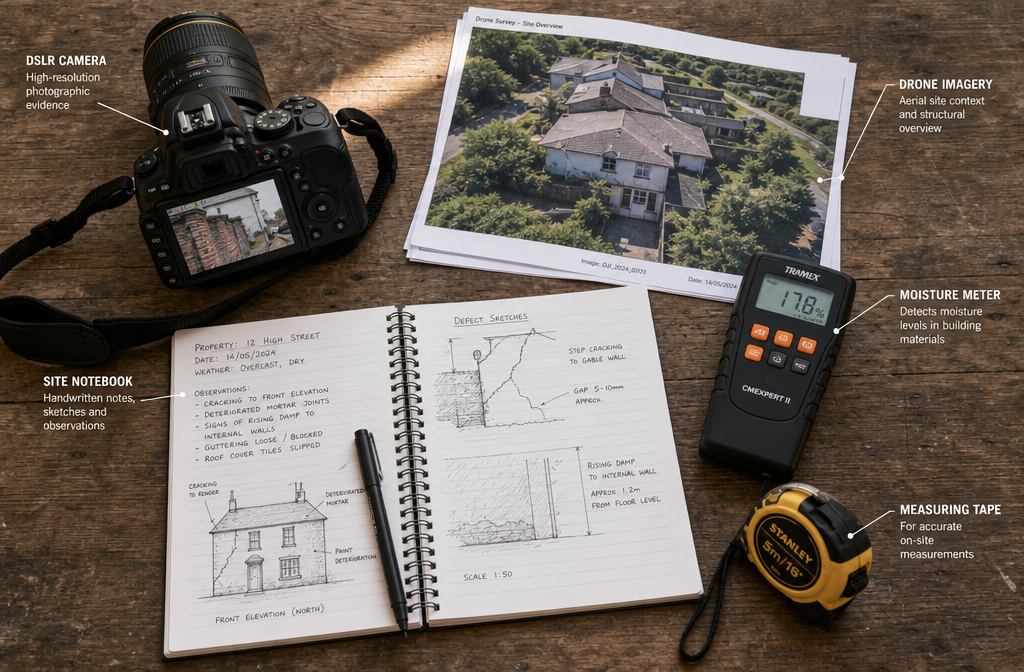
Despite digital tools, handwritten contemporaneous notes carry significant evidential weight because they are difficult to fabricate retrospectively. Best practice includes:
- Date, time, weather conditions, and names of those present at the top of every page
- Sequential page numbering with no blank pages left between entries
- Corrections made by single strikethrough — never obliterate an error
- Sketches with compass orientation, approximate scale, and key dimensions
- Signed and dated at the end of each site visit
Typed notes prepared after the fact must clearly state when they were compiled and that they are a transcription of contemporaneous records.
🌡️ Moisture Readings and Instrument Data
Quantitative readings — moisture content percentages, thermal imaging data, crack width measurements — are powerful because they are objective. However, they are only defensible if:
- The instrument type, model, and calibration date are recorded
- Readings are taken at consistent, documented locations (ideally mapped on a floor plan)
- Baseline and comparative readings are included where possible
- The limitations of the instrument are acknowledged (e.g., surface-only moisture meters vs. deep probes)
A case study highlighted by the Expert Institute illustrates the risk: an expert's inspection was questioned because tests were not conducted in compliance with the specific building code rules governing that type of assessment, fatally undermining the weight of the report [9].
🚁 Drone Imagery and Remote Sensing
Drone surveys are increasingly used for roof inspections, tall structures, and large commercial sites. For roof surveys in London and commercial building surveys, drone footage can provide evidence that is simply impossible to gather safely from ladders. To make drone evidence court-ready:
- CAA flight authorisation records must be retained
- GPS flight logs should be exported and stored
- Video and stills should be timestamped and linked to the site record
- Pilot competency credentials (GVC or equivalent) should be documented
- Annotations on stills must be clearly labelled as post-processing additions, not alterations to the original image
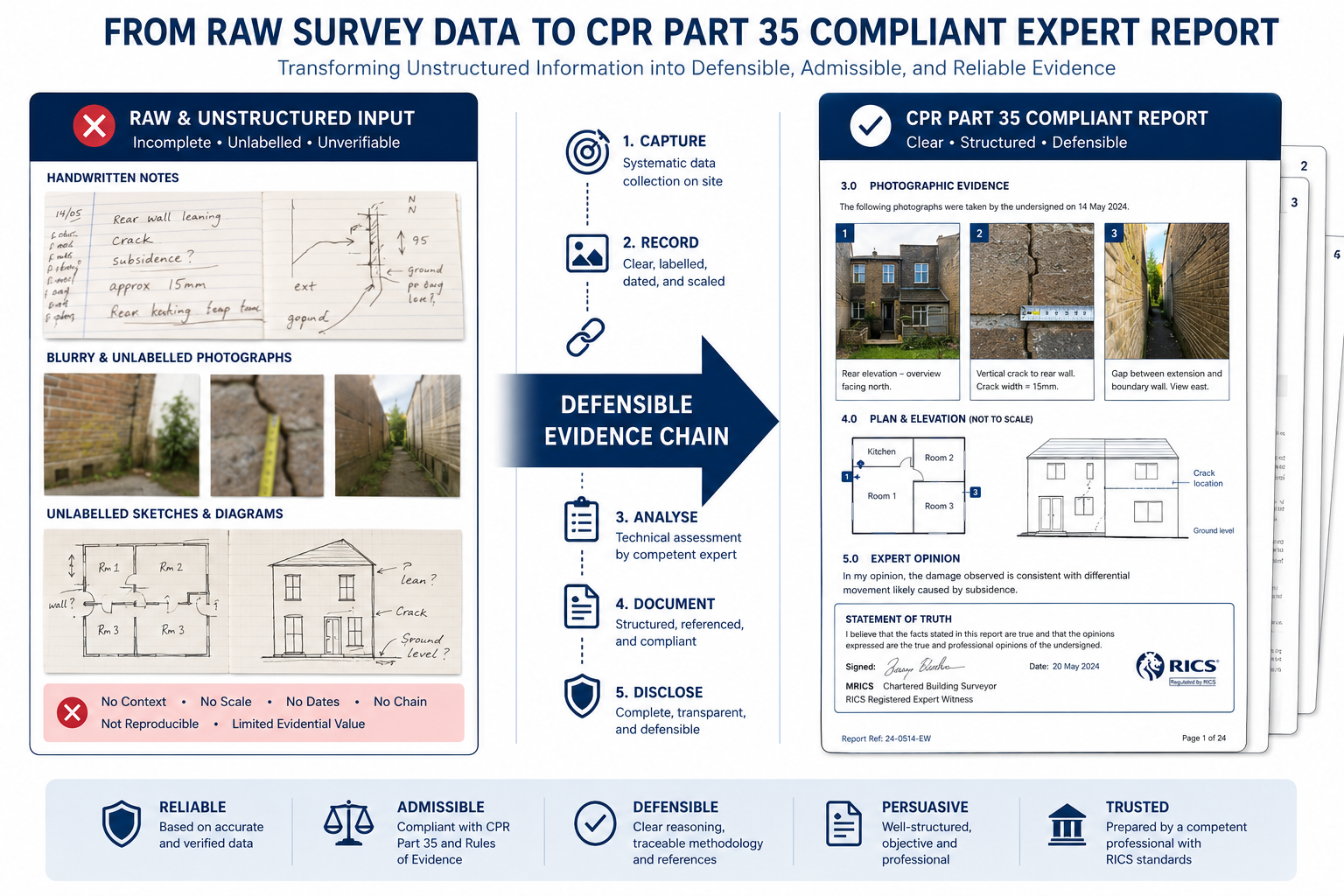
Structuring Records So They Translate Directly into a CPR-Compliant Report
The second half of From Site Notes to Court Bundle: Turning Building Survey Records into Defensible Expert Witness Evidence is about architecture — not the building kind, but the logical structure of an expert report that a court can follow.
A recent study underscored the increasing reliance on building survey evidence in construction-related disputes, specifically noting that inspection methodology and documentation practices are under greater judicial scrutiny than ever before [2]. Surveyors who structure their field records with the eventual report in mind will find the transition from site notes to court bundle significantly smoother.
The Expert Report Structure: A Practical Template
A CPR Part 35-compliant building surveyor expert report should follow this structure:
- Cover page — case reference, instructing party, date, expert's name and qualifications
- Statement of instructions — verbatim or summarised from the letter of instruction
- Summary of opinion — a brief, plain-English summary of conclusions (judges read this first)
- Qualifications and experience — relevant expertise only; do not over-claim
- Methodology — inspection dates, access granted, instruments used, limitations
- Factual background — property description, history, relevant documents reviewed
- Findings — referenced to numbered photographs and appendices
- Opinion — clearly separated from facts; stated with appropriate confidence levels
- Statement of truth — mandatory under CPR Part 35
- Appendices — photographs, plans, instrument data, relevant correspondence
Pull Quote: "An expert report is only as strong as the evidence chain that runs from the site visit to the final opinion. Break the chain anywhere, and the whole report is at risk."
Maintaining Independence Under Pressure
One of the most common pitfalls highlighted in construction dispute literature is the expert who — consciously or not — becomes an advocate for the instructing party [8]. CPR Part 35 is unambiguous: the expert's duty is to the court. RICS guidance reinforces this [1].
Practical safeguards include:
- Declining instructions where there is a prior relationship with the client that could compromise independence
- Documenting all communications with the instructing solicitor
- Flagging any attempts to influence the opinion in writing
- Preparing a joint statement with the opposing expert in good faith, identifying agreed and disputed points
For boundary surveys in London or party wall matters that escalate to dispute, the agreed surveyor or party wall surveyor may be called upon to provide evidence — and the same independence standards apply.
The Impact of AI Tools in 2026
The emergence of AI-generated analysis in valuation and building disputes has introduced new challenges for expert witnesses in 2026 [3]. AI tools can now assist with defect pattern recognition, thermal image analysis, and report drafting. However:
- AI-generated content must be disclosed to the court
- The expert must be able to verify and stand behind every AI-assisted finding
- Opposing experts will probe AI methodology — understanding the tool's limitations is essential
- Raw AI outputs should never appear in a court bundle without expert review and annotation
The expert remains personally responsible for every opinion in the report, regardless of the tools used to compile it.
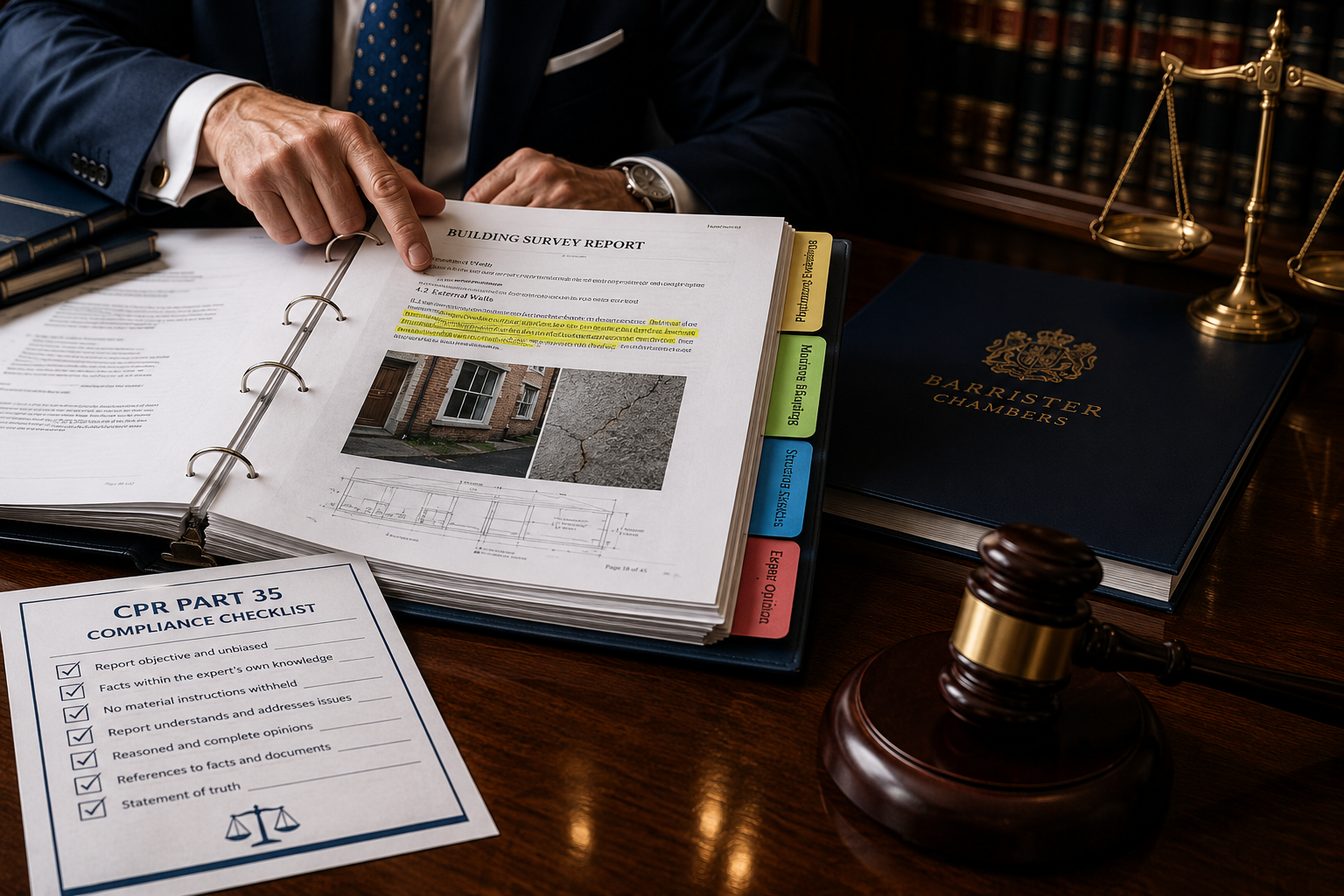
From Site Notes to Court Bundle: Assembling the Final Evidence Package
The court bundle is the physical or digital package of evidence presented to the tribunal. For a building dispute, this typically includes the expert report, supporting appendices, and any joint statements. Assembling this package correctly is the final stage of turning building survey records into defensible expert witness evidence.
Court Bundle Checklist ✅
- Expert report paginated and indexed
- All photographs numbered, dated, and cross-referenced in the report body
- Instrument calibration certificates included as appendices
- Site notes (originals or certified copies) included
- Drone flight logs and authorisation records included where applicable
- Joint statement of experts (if directions have been given)
- Statement of truth signed and dated
- CV/qualifications appendix included
- All documents in chronological order within each section
- Bundle indexed with tab references matching report citations
Common Reasons Expert Evidence is Challenged or Dismissed
Understanding failure modes is as important as following best practice. Courts and opposing counsel most frequently attack expert building evidence on these grounds:
- Scope creep — opining outside the surveyor's expertise [1]
- Lack of contemporaneous records — notes that appear to have been written after the fact
- Selective evidence — omitting findings that do not support the instructing party's case
- Methodology not explained — failing to describe how conclusions were reached
- Instrument data without calibration records [9]
- Photographs without metadata or scale references
- Failure to consider alternative explanations for defects
A structural survey that identifies cracking, for example, must consider all plausible causes — settlement, thermal movement, vibration, poor construction — and explain why one cause is more probable than others. Presenting only the evidence that supports one theory is a form of advocacy, not expertise.
Dilapidations and Schedule of Condition Evidence
Dilapidations disputes are among the most document-intensive in property law. A well-prepared schedule of dilapidations supported by a robust schedule of condition — ideally prepared at lease commencement — provides the evidential baseline against which end-of-lease claims are measured. When these documents are prepared with litigation in mind from the outset, the expert report at the dispute stage becomes significantly more straightforward to defend.
Conclusion: Actionable Next Steps for Surveyors in 2026
The journey from site notes to court bundle is not a transformation that happens at the end of a dispute — it is a discipline that must be embedded in every inspection from the first day. The principles of From Site Notes to Court Bundle: Turning Building Survey Records into Defensible Expert Witness Evidence are straightforward to implement but require consistent professional commitment.
Actionable steps to take now:
- Audit your current site recording templates — do they capture instrument model, calibration date, weather conditions, and sequential numbering?
- Implement a digital evidence management system that timestamps and locks original files on upload.
- Review the RICS 5th edition guidance on surveyors acting as expert witnesses and confirm your practice aligns with it [1].
- Establish a pre-inspection checklist that covers photography standards, measurement protocols, and note-taking discipline.
- Consider a mock cross-examination of your last expert report — identify where an opposing expert could find weaknesses.
- Disclose AI tool usage in any report where AI-assisted analysis has been used, and document your verification process [3].
- Engage specialist expert witness support early — waiting until litigation is imminent significantly limits what can be done with existing records.
For surveyors working across London and the South East, the standards are the same whether the instruction comes from a residential or commercial client. The discipline of defensible documentation is what separates a competent surveyor from a credible expert witness.
References
[1] Viewcompounddoc – https://consultations.rics.org/surveyorsasexpertwitness/viewCompoundDoc?docid=16248980&partid=16250356&pfv=y&utm_source=openai
[2] 2026.v7.i1.a – https://www.civilengineeringjournals.com/ijsse/archives/2026.v7.i1.A.50?utm_source=openai
[3] Building Surveyors As Expert Witnesses Evidence Standards For Construction Claims And Dilapidations In 2026 – https://wimbledonsurveyors.com/building-surveyors-as-expert-witnesses-evidence-standards-for-construction-claims-and-dilapidations-in-2026/?utm_source=openai
[4] Expert Witness Reports – https://www.bluecrown.co.uk/building-surveying-services/expert-witness-reports/?utm_source=openai
[8] The Perils Of Calling An Expert Witness – https://www.asce.org/publications-and-news/civil-engineering-source/civil-engineering-magazine/issues/magazine-issue/article/2021/11/the-perils-of-calling-an-expert-witness?utm_source=openai
[9] Building Code Expert Witnesss Inspection Questioned Over Building Code Rules – https://www.expertinstitute.com/resources/case-studies/building-code-expert-witnesss-inspection-questioned-over-building-code-rules/?utm_source=openai