

A single undetected structural defect in a buy-to-let property can cost a landlord anywhere between £10,000 and £50,000 in remedial works — yet the Level 3 Building Survey that would have flagged it costs, on average, just £656 [1][9]. For institutional landlords running high-volume acquisition pipelines in 2026, that arithmetic is not just compelling — it is the foundation of sound portfolio strategy.
Level 3 Surveys for Institutional Buy-to-Let: Prioritizing Risks in 2026 Professional Landlord Portfolios sits at the intersection of regulatory tightening, AI-driven inspection tools, and a rapidly professionalising rental market. Whether a portfolio spans five properties or fifty, the structured intelligence delivered by a full building survey is no longer optional — it is the baseline for defensible investment decisions.
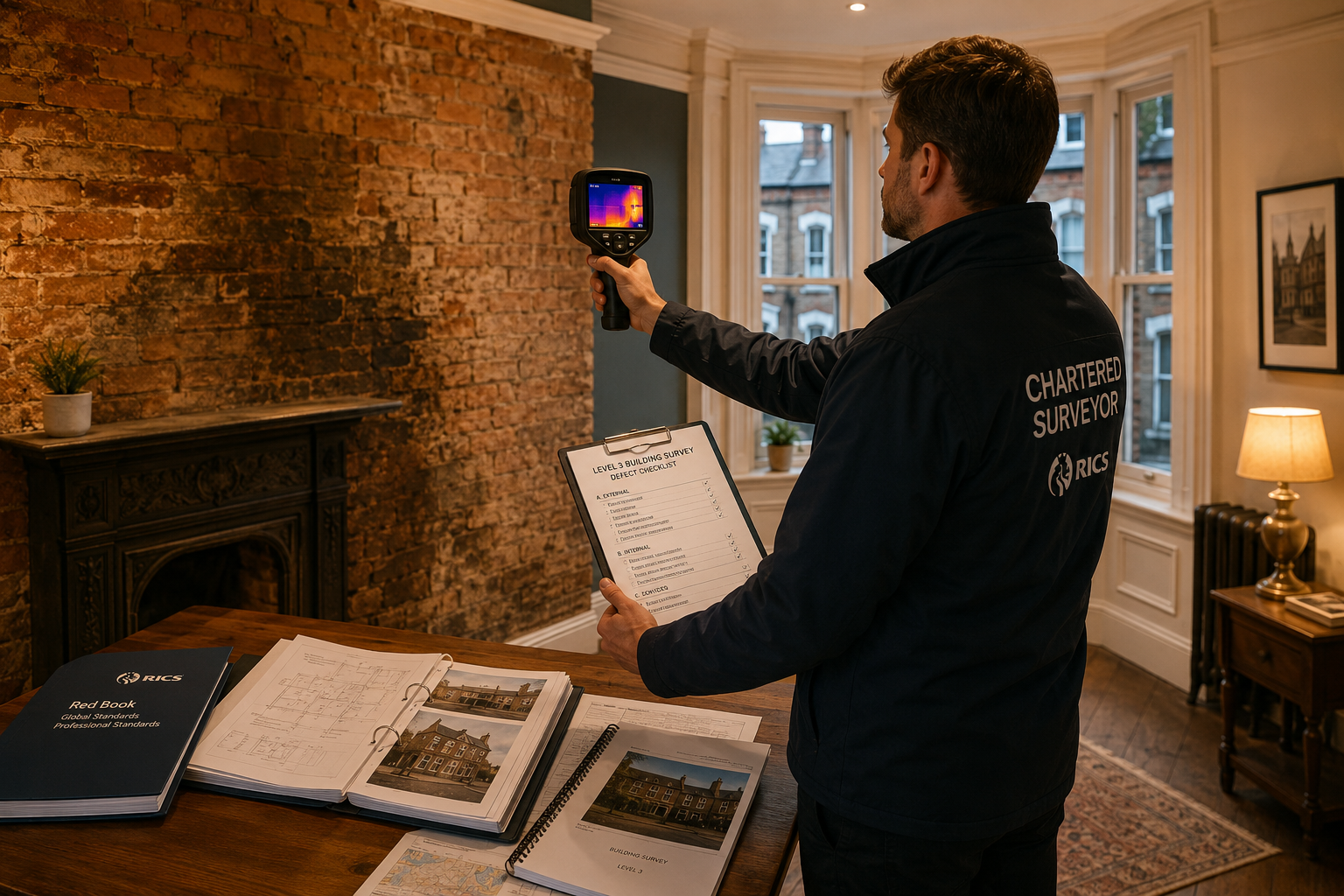
Key Takeaways 📋
- Level 3 Surveys are the gold standard for institutional landlords acquiring older, complex, or high-value buy-to-let properties in 2026.
- RICS strengthened its building survey standards in 2026, making comprehensive defect reporting a compliance expectation for professional portfolios [2].
- AI integration is now mandatory under RICS guidelines effective March 2026, changing how surveyors detect defects and report findings [3].
- The PRA defines portfolio landlords as those with four or more mortgaged buy-to-let properties, triggering enhanced underwriting and survey requirements [8].
- Compliance is a direct driver of rental yield — properties with unresolved structural or energy deficiencies face void periods, enforcement action, and reduced capital values [5].
Why 2026 Is the Pivotal Year for Professional Landlord Due Diligence
The buy-to-let sector has been moving steadily toward institutionalisation for several years, but 2026 marks the point at which that shift becomes structural rather than aspirational [4]. Smaller, accidental landlords are exiting the market under the weight of regulatory complexity, while professional portfolio operators — those managing assets with the rigour of a fund — are scaling up.
This professionalisation has a direct impact on survey standards. Institutional landlords are not buying a home to live in; they are acquiring income-generating assets that must perform reliably, comply with evolving legislation, and withstand lender scrutiny. That requires a fundamentally different approach to pre-acquisition due diligence than the Level 1 or Level 2 assessments that might satisfy a residential purchaser [6].
💡 Pull Quote: "In 2026, the question for institutional landlords is not whether to commission a Level 3 Survey — it is how to integrate survey findings systematically across an entire acquisition pipeline."
The Prudential Regulation Authority's definition of a portfolio landlord — four or more distinct mortgaged buy-to-let properties — carries enhanced underwriting requirements that lenders enforce rigorously [8]. Surveyors and mortgage underwriters increasingly expect Level 3 Building Surveys as part of the evidence base for complex or older stock. Failing to provide them can stall financing or trigger post-acquisition renegotiations.
What a Level 3 Survey Actually Covers: The Institutional Checklist
A Level 3 Building Survey (formerly called a Full Structural Survey) is the most thorough inspection available under the RICS Home Survey Standard. For institutional portfolios, it functions as a risk register for each individual asset. Understanding what it covers — and why each element matters to rental yield — is essential for professional landlords.
Core Inspection Areas
| Survey Element | Why It Matters for BTL Portfolios |
|---|---|
| Structural integrity | Foundation movement, subsidence, and wall cracking can make a property unmortgageable |
| Roof condition | Failing roofs are the most common cause of emergency repair spend in older stock |
| Damp and drainage | Damp-related defects trigger Housing Health and Safety Rating System (HHSRS) enforcement |
| Electrical systems | Non-compliant wiring creates legal liability and invalidates landlord insurance |
| Energy Performance | EPC ratings below 'E' (and soon 'C') render properties unlettable under proposed regulations |
| Windows and external fabric | Deteriorating external elements accelerate internal defect progression |
| Party walls and boundaries | Unresolved disputes create legal costs and can block planning applications |
For properties with complex roof structures or hard-to-access areas, a drone roof survey can complement the Level 3 inspection, providing high-resolution imagery of areas a surveyor cannot safely reach on foot.
Energy Efficiency: The Yield-Critical Factor in 2026
Energy performance has moved from a nice-to-have to a hard financial constraint. Proposed Minimum Energy Efficiency Standards (MEES) upgrades mean that properties with low EPC ratings face either significant capital expenditure or removal from the lettable portfolio. A Level 3 Survey identifies the specific fabric deficiencies — poor insulation, single glazing, inefficient heating systems — that drive poor energy ratings, allowing landlords to model upgrade costs before acquisition rather than after.
For portfolios acquiring Victorian or Edwardian terraces in areas like South West London or Surrey, where period stock dominates, energy efficiency defects are almost universal. Quantifying them upfront is the difference between a profitable acquisition and a capital trap.
Prioritizing Risks Across High-Volume Acquisition Pipelines
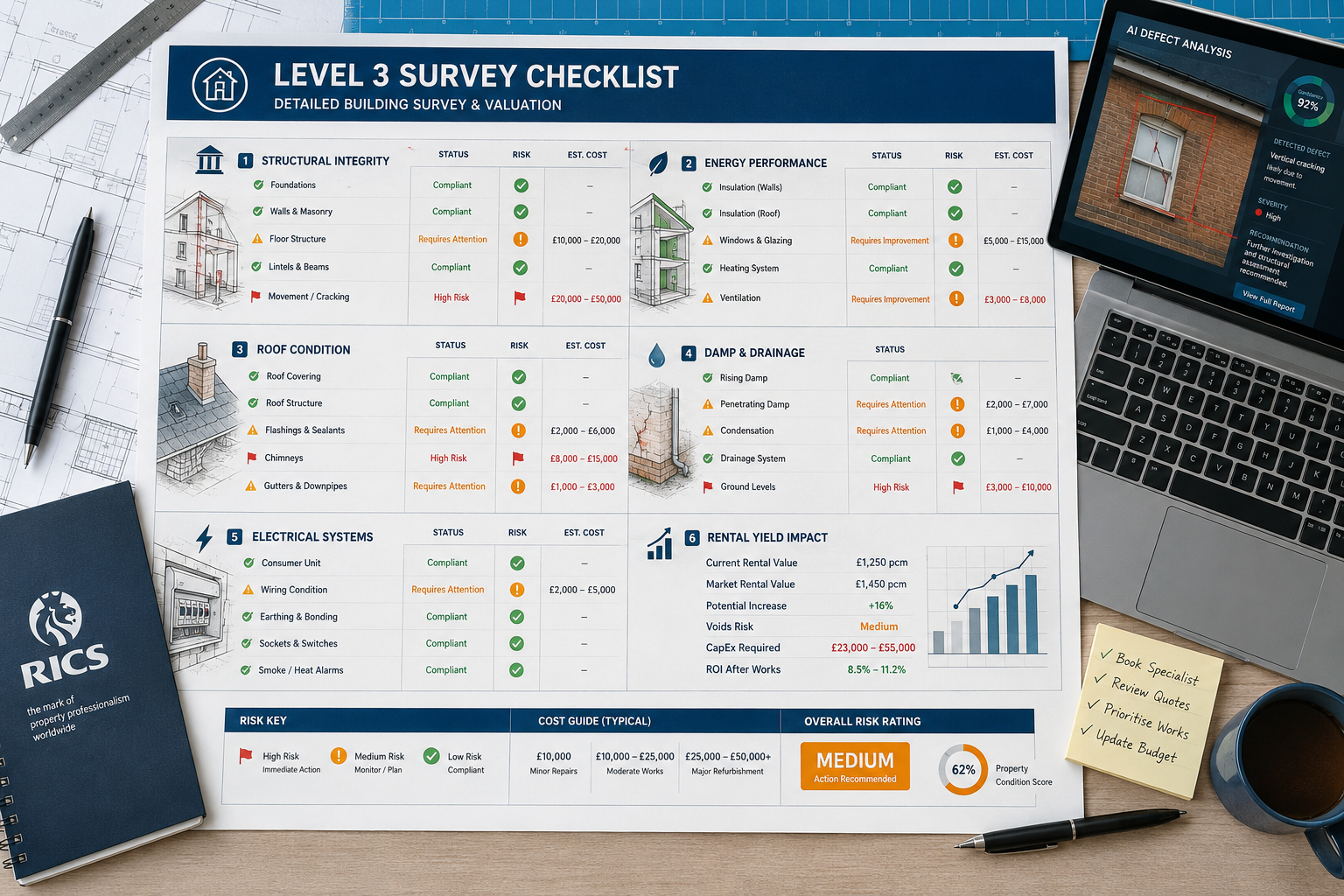
For institutional operators running multiple simultaneous acquisitions, the challenge is not just commissioning surveys — it is triaging findings systematically so that capital allocation decisions are made on comparable risk data. This is where Level 3 Surveys for Institutional Buy-to-Let: Prioritizing Risks in 2026 Professional Landlord Portfolios delivers its greatest strategic value.
The Risk Prioritisation Framework
Professional landlords should instruct surveyors to categorise defects using a standardised risk matrix that maps directly to financial impact:
🔴 Category 1 — Urgent Action Required
- Structural failure risks (subsidence, roof collapse risk)
- Immediate safety hazards (electrical, gas, fire escape)
- Legal non-compliance (HHSRS Category 1 hazards)
🟡 Category 2 — Short-Term Action (within 12 months)
- Significant damp penetration
- Roof covering deterioration
- Below-threshold EPC ratings requiring upgrade
🟢 Category 3 — Ongoing Maintenance
- Minor cosmetic defects
- Routine redecoration
- Planned replacement items (guttering, minor joinery)
This framework, when applied consistently across a portfolio, allows acquisition teams to compare properties on a like-for-like risk basis. A property with three Category 1 defects and a purchase price that does not reflect remediation costs should be renegotiated or walked away from — regardless of its headline yield.
Dilapidations and Schedule of Condition
For landlords acquiring tenanted properties or converting commercial premises, a dilapidation survey and a Schedule of Condition report are essential companion documents to the Level 3 Survey. They establish a baseline condition record that protects the landlord's legal position at lease end and supports insurance claims.
The Role of Structural Engineers
Complex defects identified in a Level 3 Survey — particularly those involving foundations, load-bearing walls, or historic alterations — will often require a specialist opinion. Engaging residential structural engineers to assess flagged issues provides the technical depth that a building survey alone cannot deliver, and gives institutional lenders the confidence they require for underwriting.
AI, RICS Compliance, and the New Survey Standard in 2026
The integration of artificial intelligence into building surveying practice is not a future trend — it is a current regulatory reality. Effective 9 March 2026, RICS-regulated firms must comply with the "Responsible Use of Artificial Intelligence in Surveying Practice" standard [3]. This has direct implications for how Level 3 Surveys are conducted, reported, and relied upon in institutional transactions.
What the RICS AI Standard Requires
Under the new standard, surveying firms must:
- Maintain a written AI system inventory documenting all AI tools used in survey work
- Operate a quarterly-reviewed risk register covering AI-related risks to accuracy and professional liability
- Ensure that AI-generated outputs are subject to human professional review before inclusion in reports
- Disclose AI tool usage to clients in survey documentation [3]
For institutional landlords, this matters because AI-assisted defect detection tools — thermal imaging analysis, drone imagery processing, and predictive maintenance modelling — can materially influence the findings of a Level 3 Survey. A surveyor who uses these tools without RICS compliance exposes both themselves and their client to liability.
💡 Pull Quote: "AI can enhance defect detection precision, but only when deployed within a compliant framework. Institutional landlords should verify their surveyor's AI governance before instruction."
When comparing survey types for different property categories, understanding the difference between a Homebuyer Report and a Building Survey helps acquisition teams allocate the right survey tier to each property — avoiding both over-spend on straightforward modern stock and under-investment on complex period buildings.
How AI Is Changing Defect Detection
AI-driven tools are improving the accuracy of Level 3 Surveys in several practical ways:
- Thermal imaging analysis identifies hidden damp, insulation gaps, and heat loss patterns invisible to the naked eye
- Drone survey processing automates the identification of roof defects across large areas
- Predictive modelling flags properties with defect profiles that correlate with higher future maintenance costs
- Natural language processing assists in generating standardised defect reports that are comparable across a portfolio [7]
For institutional landlords, the practical benefit is faster, more consistent survey outputs that support high-volume acquisition decisions without sacrificing analytical depth.
Building a Survey-Led Acquisition Strategy: Practical Steps for 2026

Level 3 Surveys for Institutional Buy-to-Let: Prioritizing Risks in 2026 Professional Landlord Portfolios is not simply about ticking a due diligence box — it is about building a repeatable, scalable acquisition process that protects yield and capital value simultaneously [5][6].
Step-by-Step Survey Integration for Portfolio Landlords
Step 1: Pre-Instruction Screening
Before commissioning a full Level 3 Survey, use desktop research (Land Registry data, EPC register, planning history) to screen out properties with obvious disqualifying issues. Reserve Level 3 instruction for properties that pass initial screening.
Step 2: Surveyor Selection and Brief
Select a RICS-regulated surveyor with demonstrable experience in the specific property type and location. Provide a clear brief that specifies:
- Portfolio context (number of properties, acquisition pace)
- Specific risk areas to prioritise (e.g., energy efficiency, structural)
- Required output format for integration into portfolio management systems
For acquisitions in specific regions, working with locally experienced surveyors — such as those covering West London or Surrey — ensures familiarity with local construction types, planning constraints, and common defect patterns.
Step 3: Survey Findings Integration
Map survey findings directly to acquisition financials:
| Defect Category | Action |
|---|---|
| Category 1 defects identified | Renegotiate price or withdraw |
| Category 2 defects costed | Adjust yield model; seek price reduction |
| Category 3 defects noted | Build into 5-year maintenance reserve |
| EPC below target rating | Model upgrade cost; assess feasibility |
Step 4: Post-Survey Legal and Structural Follow-Up
Where surveys identify boundary ambiguities or party wall issues, commission specialist reports. A structural survey or expert witness report may be required if findings are likely to be contested or form part of a legal dispute.
Step 5: Portfolio-Level Reporting
Aggregate survey findings across all acquisitions into a portfolio risk dashboard. Track defect categories, estimated remediation costs, and compliance status by property. This creates an auditable record for lenders, insurers, and regulatory bodies.
Cost-Benefit Reality Check 💰
| Survey Cost | Potential Defect Cost if Missed | ROI on Survey |
|---|---|---|
| £574–£894 (average £656) [1] | £10,000–£50,000 [9] | 15x–75x cost avoided |
| Level 3 for complex property | Structural remediation | Essential investment |
| Drone roof add-on | Emergency roof replacement | Preventative spend |
The numbers are unambiguous. For institutional landlords acquiring multiple properties per year, the aggregate risk avoided by systematic Level 3 Survey commissioning dwarfs the total survey spend many times over.
Conclusion: Survey Intelligence as a Competitive Advantage
The professionalisation of the buy-to-let sector in 2026 has created a clear dividing line between landlords who manage risk proactively and those who absorb it retrospectively [4]. Level 3 Surveys for Institutional Buy-to-Let: Prioritizing Risks in 2026 Professional Landlord Portfolios represents the most powerful tool available for crossing that line.
Actionable Next Steps for Professional Landlords
✅ Audit your current acquisition process — identify where survey commissioning sits and whether it is systematic or ad hoc.
✅ Establish a standard Level 3 Survey brief that all instructed surveyors follow, ensuring comparable outputs across your portfolio.
✅ Verify RICS AI compliance with any surveyor you instruct — ask directly whether they maintain an AI system inventory and risk register as required under the March 2026 standard [3].
✅ Build defect cost modelling into your yield calculations from day one — Category 1 and 2 defects should be priced into every offer.
✅ Commission specialist follow-up (structural engineers, dilapidation surveyors, drone roof inspections) wherever Level 3 findings indicate elevated risk.
✅ Create a portfolio-level risk register that aggregates survey findings, tracks remediation progress, and provides audit-ready documentation for lenders and regulators.
The institutional landlords who will outperform in 2026 and beyond are those who treat survey intelligence not as a transaction cost, but as a strategic asset. The data is there — the competitive advantage lies in acting on it systematically.
References
[1] Structural Survey Cost – https://www.comparemymove.com/guides/surveying/structural-survey-cost?utm_source=openai
[2] Building Survey Defect Reporting In Institutional Buy To Let Portfolios Rics Standards For Professional Landlord Due Diligence – https://manchestersurveyors.com/building-survey-defect-reporting-in-institutional-buy-to-let-portfolios-rics-standards-for-professional-landlord-due-diligence/?utm_source=openai
[3] Valuation Impacts Of Rics Ai Standards On Level 3 Building Surveys March 2026 Compliance Checklist – https://kingstonsurveyors.com/valuation-impacts-of-rics-ai-standards-on-level-3-building-surveys-march-2026-compliance-checklist/?utm_source=openai
[5] Growing Your Portfolio Why Compliance Is Critical In 2026 And Beyond – https://www.hunters.com/guides/branch/camberwell/growing-your-portfolio-why-compliance-is-critical-in-2026-and-beyond/?utm_source=openai
[6] Buy To Let Property Surveys Why Institutional Landlords Are Driving Demand For Professional Assessments In 2026 – https://wimbledonsurveyors.com/buy-to-let-property-surveys-why-institutional-landlords-are-driving-demand-for-professional-assessments-in-2026/?utm_source=openai
[7] 2026 Landlord Outlook Cautious Optimism Multifamily Strength And The New Housing Map – https://patternnexus.com/2026-landlord-outlook-cautious-optimism-multifamily-strength-and-the-new-housing-map?utm_source=openai
[8] Portfolio Landlord Mortgages Uk – https://letsafeuk.co.uk/guides/portfolio-landlord-mortgages-uk?utm_source=openai
[9] Is A Level 3 Survey Worth It Heres When To Choose One – https://lmsurveyors.co.uk/is-a-level-3-survey-worth-it-heres-when-to-choose-one/?utm_source=openai