
Over 40% of party wall disputes in London's premium residential sector escalate beyond initial surveyor negotiations — and in 2026, the financial stakes have never been higher. When a basement excavation beneath a Kensington townhouse or a rooftop extension in Hampstead triggers a deadlock between neighbours, the difference between a swift resolution and a costly legal battle often comes down to one critical decision: knowing exactly when and how to invoke third party mechanisms.
Third Party Mechanisms in Party Wall Deadlocks: RICS Best Practices for 2026 High-Value Residential Projects has become one of the most searched topics among property professionals this year — and for good reason. RICS launched a consultation in April 2026 on its draft 8th edition of "Party Wall Legislation and Procedure," introducing sharper protocols for third surveyor appointments, fee transparency, and dispute resolution in complex urban developments [1]. This article unpacks those protocols, explains the escalation pathway, and delivers fee recovery tactics tailored specifically to premium projects.
Key Takeaways 🔑
- The Third Surveyor is not a last resort — invoking this mechanism early in a genuine deadlock can save months and significant costs on high-value projects.
- RICS's draft 8th edition (2026) introduces clearer jurisdiction rules, updated documentation templates, and strengthened impartiality standards for all party wall surveyors [1].
- Fee recovery in premium developments requires proactive documentation from day one, including a robust party wall schedule of condition and transparent engagement terms.
- Surveyor impartiality is non-negotiable — awards challenged due to bias or jurisdictional overreach are a growing risk in 2026 [3].
- Arbitration and court referral remain available as escalation steps beyond the Third Surveyor, but carry significantly higher costs and timelines.
Understanding Party Wall Deadlocks in High-Value Residential Contexts
Before exploring third party mechanisms, it is worth defining what a genuine deadlock looks like in practice. A deadlock occurs when the two appointed party wall surveyors — one representing the building owner and one representing the adjoining owner — cannot reach agreement on the terms of a party wall award.
In standard residential projects, deadlocks are relatively rare. However, in high-value developments — think multi-storey basement digs, structural alterations to shared walls in Georgian terraces, or large-scale extensions in prime London postcodes — the complexity and financial exposure increase dramatically. Disputes frequently centre on:
- Scope of protective works and who bears the cost
- Access rights and working hours
- Compensation for disturbance or temporary loss of amenity
- Adequacy of the party wall schedule of condition as a baseline for damage claims
- Surveyor fees and who is responsible for payment
💡 "In premium urban developments, a single unresolved party wall dispute can delay a project by six to twelve months and cost the building owner tens of thousands of pounds in prolongation costs."
Understanding what a party wall dispute involves at a fundamental level is essential before any escalation strategy is deployed.
The Escalation Pathway: From Negotiation to Third Surveyor
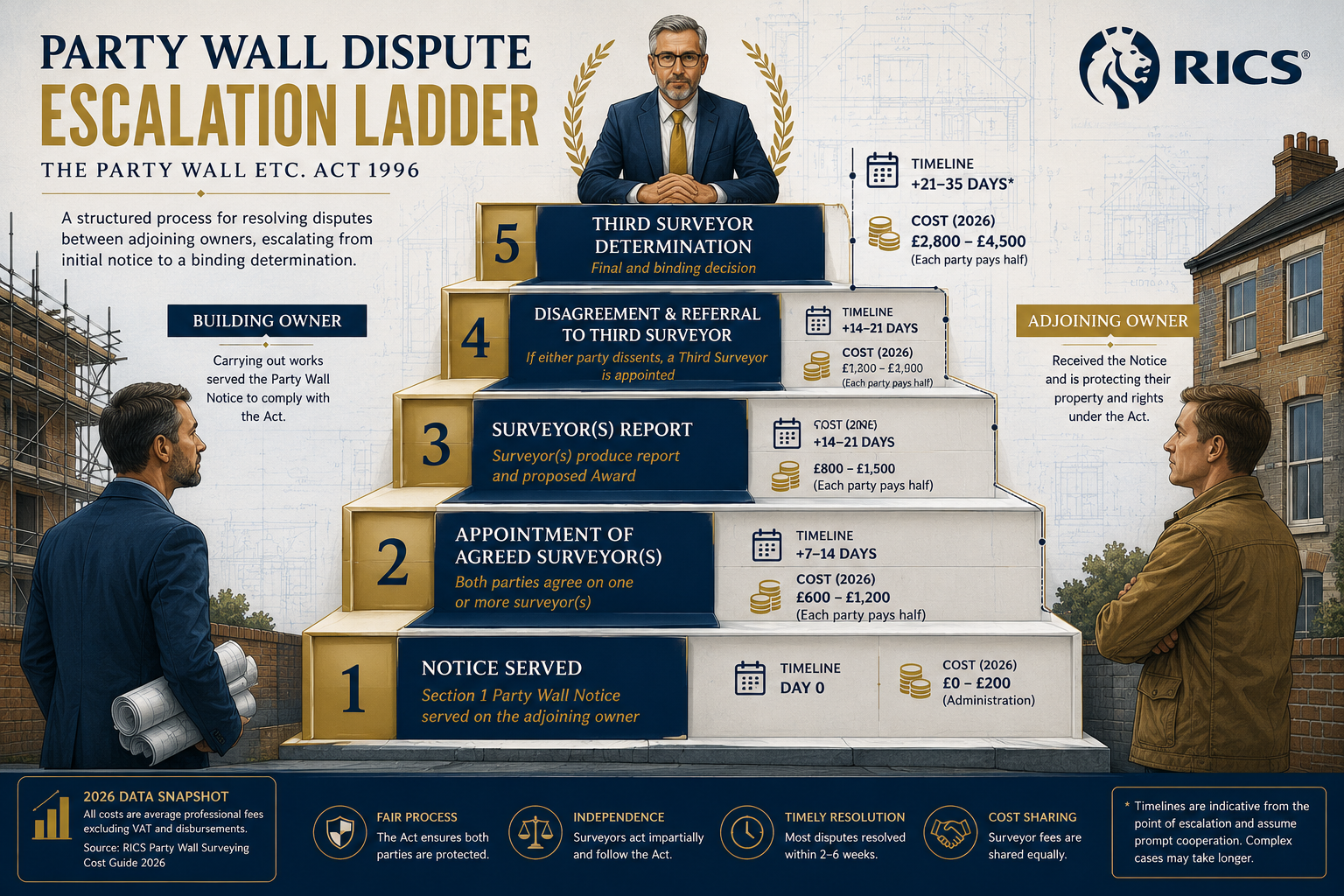
The Party Wall etc. Act 1996 creates a structured escalation pathway. Understanding each stage is critical for managing timelines and costs on premium projects.
Stage 1: Surveyor-to-Surveyor Negotiation
The first and preferred route. Both appointed surveyors exchange draft awards, negotiate terms, and attempt to reach a mutually acceptable position. On straightforward projects, this resolves most issues within two to six weeks.
Stage 2: Formal Deadlock Declaration
When negotiations break down irretrievably, either surveyor can formally declare a deadlock. This triggers the right — and in many cases the obligation — to refer the matter to the Third Surveyor.
Stage 3: Third Surveyor Appointment
Under Section 10 of the Party Wall etc. Act 1996, the two appointed surveyors must agree on a Third Surveyor at the outset of the process (not when the deadlock arises). The Third Surveyor acts as a quasi-judicial decision-maker, not a mediator. Their determination is binding on both parties.
Key point: Either surveyor — or either owner — can call upon the Third Surveyor. This is a statutory right that cannot be contracted away.
Stage 4: Arbitration or Court Referral
If a party wishes to challenge a Third Surveyor's award, the route is an appeal to the County Court within 14 days of the award being served. Arbitration is also available by agreement, though less commonly used in residential party wall matters.
| Stage | Typical Duration | Approximate Cost (Premium Projects) | Binding? |
|---|---|---|---|
| Surveyor Negotiation | 2–8 weeks | £2,000–£8,000 | No |
| Third Surveyor Determination | 4–12 weeks | £5,000–£20,000+ | Yes |
| County Court Appeal | 6–18 months | £15,000–£50,000+ | Yes |
| Arbitration (by agreement) | 3–9 months | £10,000–£30,000+ | Yes |
RICS Best Practices for 2026: The 8th Edition Changes That Matter
The RICS draft 8th edition guidance, currently in consultation with a closing date of 5 June 2026, represents the most significant update to party wall practice guidance in over a decade [4]. For professionals working on high-value residential projects, several changes are particularly relevant.
Clearer Third Surveyor Jurisdiction Protocols
One of the most persistent problems in party wall practice has been surveyors acting outside their proper jurisdiction — drafting awards that go beyond what the Act permits, or referring matters to the Third Surveyor prematurely. The draft 8th edition addresses this directly by providing explicit protocols on:
- When a matter is properly referable to the Third Surveyor
- What categories of dispute fall within the Third Surveyor's jurisdiction
- How the Third Surveyor should conduct their determination [2]
This matters enormously for high-value projects, where an award challenged on jurisdictional grounds can unravel months of work and expose the building owner to significant delay costs.
Strengthened Impartiality Standards
RICS continues to emphasise that party wall surveyors hold a statutory and personal appointment, independent of client instructions [3]. Their role is quasi-judicial. The 8th edition reinforces this by:
- Reminding surveyors that they must act impartially even when appointed by one party
- Clarifying that surveyors cannot simply "follow instructions" from the owner who appointed them
- Strengthening guidance on conflicts of interest and disclosure obligations
For adjoining owners in premium developments, this is significant. It means the building owner's surveyor is not simply an advocate — they are bound by the same impartiality standards as the adjoining owner's surveyor. Understanding your rights as a neighbour affected by works is covered in detail in our guide on what to do if your neighbour is carrying out party wall work.
Revised Documentation Templates
The draft 8th edition includes updated templates for:
- Letters of appointment — clearer scope of engagement
- Terms of engagement — including fee structures and billing practices
- Draft awards — standardised format to reduce ambiguity [1]
These revisions are particularly valuable for high-value projects where poorly drafted awards are a common source of post-completion disputes.
Enhanced Public Engagement Standards
A notable addition in the 2026 guidance is the introduction of standards for communicating with non-professional parties — i.e., the property owners themselves rather than their legal or surveying advisors [1]. In premium residential developments, adjoining owners are often sophisticated individuals with high expectations and legal resources. Clear, timely communication from the outset reduces the risk of escalation.
Third Party Mechanisms in Party Wall Deadlocks: Fee Recovery Tactics for Premium Urban Developments

Fee recovery is one of the most contentious aspects of Third Party Mechanisms in Party Wall Deadlocks: RICS Best Practices for 2026 High-Value Residential Projects. In high-value projects, surveyor fees can be substantial — and disputes over who pays what can themselves become a secondary source of conflict.
Who Pays the Surveyor's Fees?
Under the Party Wall etc. Act 1996, the general principle is that the building owner pays the reasonable fees of both appointed surveyors and the Third Surveyor (where invoked). However, this is not absolute. The Third Surveyor has discretion to apportion costs differently, particularly where:
- The adjoining owner has been unreasonable or obstructive
- The building owner has failed to comply with statutory requirements
- Either party has caused unnecessary delay or expense
Proactive Fee Protection Strategies
For building owners on premium projects, the following tactics reduce fee exposure:
- ✅ Agree fee caps or hourly rate ranges upfront in the letter of appointment
- ✅ Request itemised fee schedules from all surveyors at the outset
- ✅ Document all communications between surveyors to demonstrate reasonableness
- ✅ Commission a thorough party wall schedule of condition before works commence — this limits spurious damage claims that inflate overall costs
- ✅ Ensure the Third Surveyor's appointment is properly recorded at the beginning of the process, not after a deadlock arises
The RICS 8th edition's strengthened guidance on fee practices is a direct response to industry feedback about disproportionate fees in complex cases [2]. The draft guidance recommends that surveyors provide transparent, proportionate fee estimates and update clients when circumstances change materially.
The Agreed Surveyor Option
In some cases, both parties can agree to appoint a single agreed surveyor rather than two separate surveyors. This can significantly reduce costs on high-value projects where both parties have a shared interest in a swift, commercially sensible outcome. However, it is not appropriate where there is a genuine conflict of interest or where one party lacks confidence in the proposed surveyor's impartiality.
When to Appoint the Third Surveyor: Practical Decision Framework
Knowing when to invoke the Third Surveyor is as important as knowing how. Premature referral can antagonise the adjoining owner and increase costs. Delayed referral can allow a deadlock to calcify into an entrenched dispute.
Indicators That Third Surveyor Referral Is Appropriate 🔴
- Surveyors have exchanged three or more substantive draft awards without agreement
- One surveyor is refusing to engage or respond within reasonable timeframes
- A fundamental disagreement exists on a point of law or jurisdiction
- The project programme is being materially impacted by the delay
- Either party has threatened legal proceedings
Indicators That Further Negotiation Is Warranted 🟡
- The gap between the parties' positions is narrowing with each exchange
- The dispute concerns minor technical details rather than fundamental principles
- Both surveyors agree that further information (e.g., structural engineer's report) is needed
- A residential structural engineer's assessment is pending that may resolve the technical disagreement
The Referral Process in Practice
Either appointed surveyor (or either owner directly) serves a written request on the Third Surveyor, setting out the matters in dispute. The Third Surveyor then:
- Notifies all parties of the referral
- Invites written submissions from both appointed surveyors
- May request additional information or conduct a site inspection
- Issues a written determination, which constitutes a party wall award
The Third Surveyor's determination is binding unless appealed to the County Court within 14 days.
Third Party Mechanisms in Party Wall Deadlocks: Avoiding Common Pitfalls in 2026
Even with RICS's updated guidance, several pitfalls remain common in 2026 — particularly on high-value projects where the stakes are elevated and parties are more likely to challenge outcomes.
Pitfall 1: Failing to Agree the Third Surveyor Early
The Third Surveyor must be agreed and recorded at the start of the process, not when a deadlock arises. If the two appointed surveyors cannot agree on a Third Surveyor, either party can apply to the Appointing Officer (typically the relevant professional body) to make the appointment. This adds delay and cost — avoid it by addressing the Third Surveyor appointment in the initial letters of appointment.
Pitfall 2: Confusing the Third Surveyor's Role with Mediation
The Third Surveyor is not a mediator. They do not facilitate negotiation between the parties. They make a binding determination on the matters referred to them. Parties who approach the Third Surveyor expecting a collaborative process are often disappointed — and sometimes worse off.
Pitfall 3: Inadequate Schedule of Condition
On premium projects, a superficial schedule of condition is a significant risk. If damage to property occurs during works and the pre-works condition is not comprehensively documented, the building owner faces exposure to inflated claims. A detailed, photographic schedule — ideally prepared by an independent surveyor — is essential.
Pitfall 4: Ignoring the Legal Requirements for Party Walls
In the rush to commence premium development projects, building owners sometimes serve inadequate notices or fail to comply with the statutory process under the Party Wall Act. This can invalidate the entire process, expose the building owner to injunction proceedings, and — critically — remove the protection that the Act provides against common law nuisance claims.
Conclusion: Actionable Next Steps for 2026 High-Value Projects
Third Party Mechanisms in Party Wall Deadlocks: RICS Best Practices for 2026 High-Value Residential Projects is not a niche concern — it is a core competency for anyone involved in premium urban development. The RICS 8th edition consultation signals a profession actively raising its standards, and property owners and their advisors need to keep pace.
Actionable Next Steps ✅
- Appoint experienced, RICS-accredited surveyors from the outset — not as an afterthought when a dispute arises.
- Record the Third Surveyor appointment in the initial engagement documentation, before any deadlock develops.
- Commission a comprehensive schedule of condition before any works commence, to protect against inflated damage claims.
- Review fee arrangements proactively — agree hourly rate caps and billing protocols in writing.
- Stay informed on the RICS 8th edition — the guidance finalised after the June 2026 consultation will set the standard for party wall practice for years to come.
- Seek specialist advice early if a dispute is escalating — the cost of early professional intervention is almost always lower than the cost of a Third Surveyor determination or court appeal.
For property owners and developers navigating complex party wall matters in London and the surrounding areas, working with chartered surveyors in London who have deep expertise in the Party Wall Act is the single most effective risk mitigation strategy available in 2026.
References
[1] RICS Launches Consultation on Updated Party Wall Practice Guidance – https://www.rics.org/news-insights/rics-launches-consultation-on-updated-party-wall-practice-guidance
[2] RICS 8th Edition Party Wall Guidance 2026: Implementation Challenges and Surveyor Compliance Strategies – https://wimbledonsurveyors.com/rics-8th-edition-party-wall-guidance-2026-implementation-challenges-and-surveyor-compliance-strategies/
[3] Party Wall Surveyors Impartiality – https://ww3.rics.org/uk/en/journals/built-environment-journal/party-wall-surveyors-impartiality.html
[4] RICS 8th Edition Party Wall Guidance 2026: Consultation — What Changed and What It Means for London Property Owners – https://partywallsurveyorlondon.uk/blogs/rics-8th-edition-party-wall-guidance-2026-consultation-what-changed-and-what-it-means-for-london-property-owners/