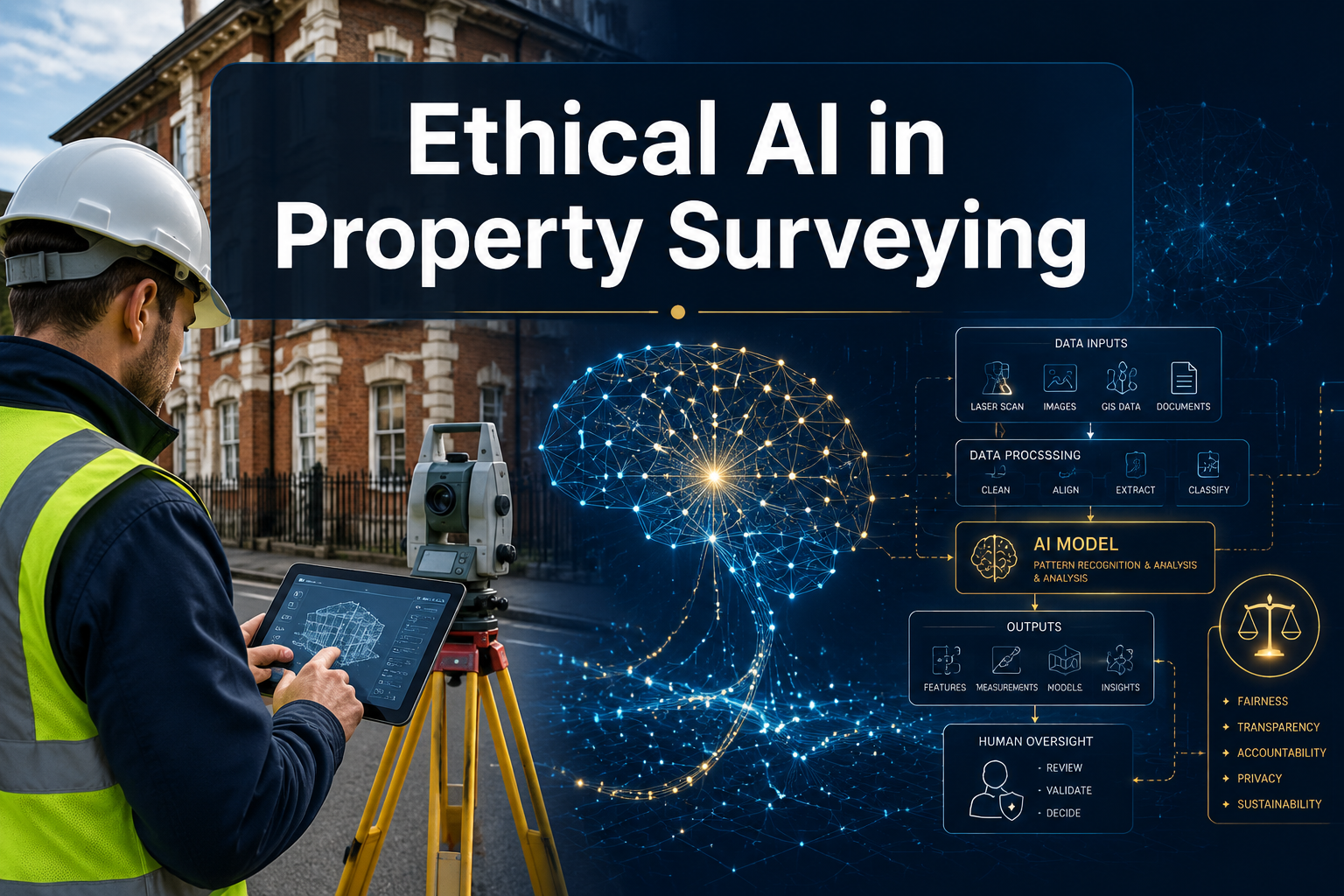

A single algorithmic error in a property valuation model can wipe thousands of pounds from an assessed value — or inflate it beyond market reality — before a human surveyor ever reviews the output. As AI systems now classify terrain features, flag structural risks, and generate automated valuation models at scale, the surveying profession faces a defining challenge: how to integrate these powerful tools without sacrificing the accuracy, fairness, and trust that clients depend on. The framework for ethical AI use in property surveying: guidelines for transparent algorithms and bias-free data has never been more urgent or more consequential.
Key Takeaways
- The Royal Institution of Chartered Surveyors (RICS) implemented its first global standard for responsible AI use in surveying on March 9, 2026, setting mandatory requirements for governance, transparency, and bias mitigation.
- Surveyors must maintain baseline AI literacy and apply professional judgment to all AI-generated outputs — they cannot delegate accountability to an algorithm.
- Bias in training data is one of the most serious risks in AI-assisted property assessment, with documented potential to produce discriminatory valuation outcomes.
- Firms are required to implement risk registers, data anonymization protocols, and clear client communication policies when deploying AI tools.
- Transparency is not optional: clients have a right to know when and how AI systems influence the advice and reports they receive.
Why Ethical AI Use in Property Surveying Matters More Than Ever
Property surveying has always been a profession built on trust. A client commissioning a structural survey or a commercial property valuation is placing significant financial decisions in a surveyor's hands. When AI enters that process — analyzing satellite imagery, processing comparable sales data, or generating condition reports — the stakes for accuracy and fairness multiply.
The pace of AI adoption in the sector has accelerated sharply. A RICS survey conducted in January 2026 found that while many surveyors recognize the productivity benefits of AI tools, there is strong professional consensus that ethical guidelines and human oversight are non-negotiable safeguards [6]. The concern is not theoretical. Automated valuation models trained on historical data can inherit the biases embedded in that data — including patterns shaped by decades of discriminatory lending and appraisal practices.
The Consumer Financial Protection Bureau (CFPB) has highlighted this risk directly, noting that algorithmic bias in home valuations can produce systematically unfair outcomes for certain demographic groups [9]. In the UK, where property values carry enormous legal and financial weight — from lease extensions to divorce property valuations — the consequences of biased AI outputs are deeply personal as well as financial.
"The question is not whether AI will reshape property surveying — it already has. The question is whether the profession will govern that reshaping with the rigor and ethics it demands."
The RICS Global Standard: A Landmark Framework for Responsible AI
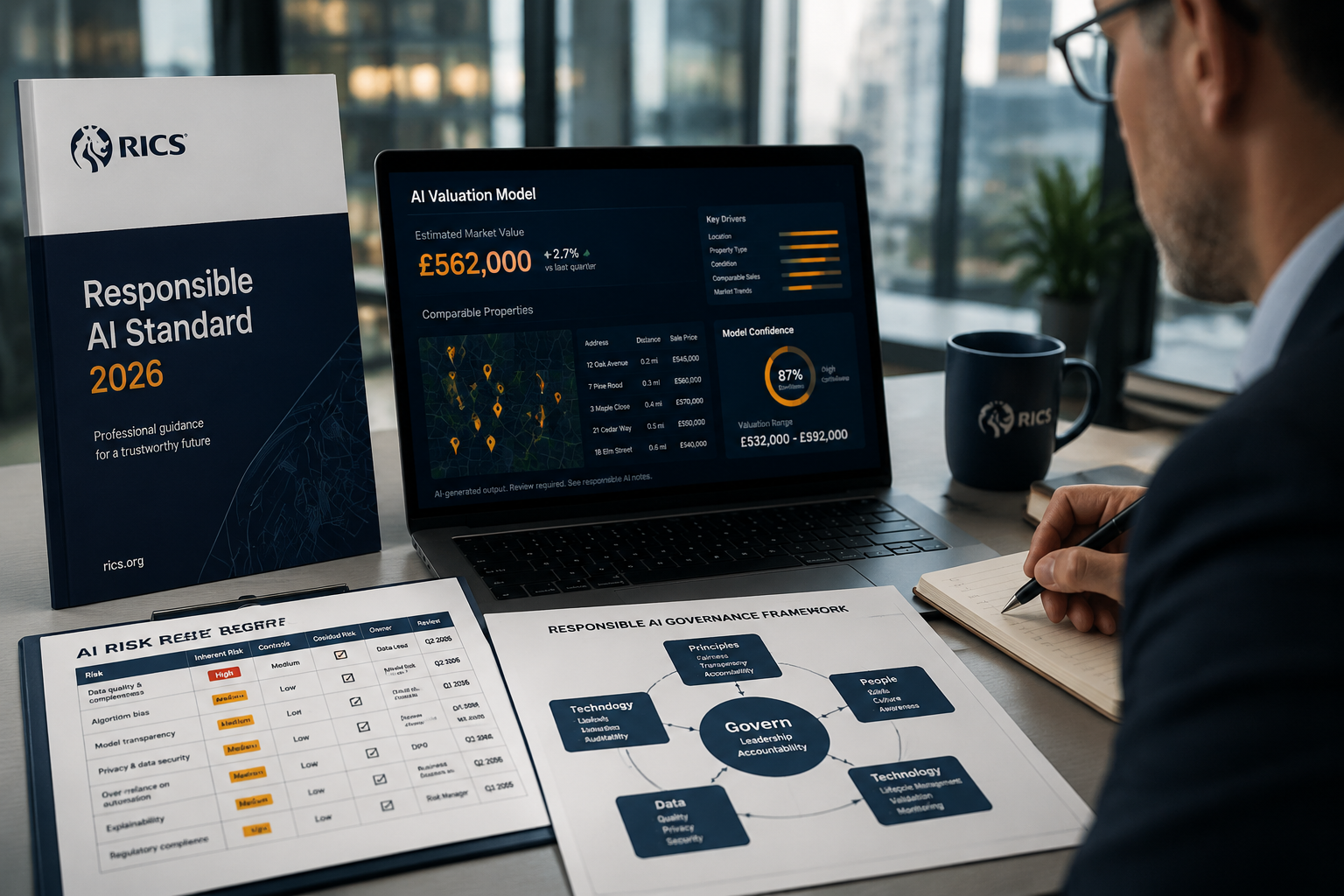
On March 9, 2026, RICS implemented its first-ever global professional standard for the responsible use of AI in surveying [1]. This is a watershed moment for the profession. The standard is not advisory guidance — it carries mandatory weight for RICS members and regulated firms worldwide.
Core Requirements of the RICS AI Standard
The standard establishes obligations across four interconnected areas:
| Requirement Area | Key Obligations |
|---|---|
| Data Governance | Clear policies on data sourcing, storage, and use; privacy protection through anonymization |
| AI System Governance | Due diligence on AI tools; risk registers documenting system limitations |
| Professional Competence | Baseline AI literacy for all members; ability to critically assess AI outputs |
| Client Communication | Transparent disclosure of AI use; explanation of risks and limitations |
Data governance sits at the foundation. Firms must prepare any data entered into an AI system in ways that protect client privacy — including anonymizing sensitive information before it is processed [4]. This is particularly relevant when AI tools handle personal data connected to probate valuations or shared ownership assessments.
AI system governance requires firms to maintain risk registers that document the specific AI tools in use, their known limitations, and the controls in place to manage those limitations [3]. This is not bureaucratic box-ticking — it is a structured mechanism for accountability.
Professional competence is perhaps the most significant shift. RICS now requires members to possess a baseline understanding of AI system types, their limitations, and the nature of algorithmic bias [2]. Surveyors who cannot critically evaluate an AI-generated output are not equipped to stand behind it professionally.
Client communication closes the loop. When AI systems influence the advice or reports a client receives, that client has a right to know — including an honest account of what the AI can and cannot reliably do [4].
Professional Judgment Cannot Be Outsourced
The RICS standard is unambiguous on one point: surveyors remain accountable for all work, regardless of whether AI tools contributed to it [3]. Professional skepticism — the habit of questioning outputs rather than accepting them at face value — is now a formal professional requirement, not merely good practice.
RICS has published case studies illustrating this principle in action. In building surveying contexts, AI-generated condition reports have flagged issues that required a surveyor's on-site judgment to correctly interpret. In other cases, AI tools missed context that an experienced professional would have caught immediately [5]. The lesson is consistent: AI augments professional expertise; it does not replace it.
Bias-Free Data: The Central Challenge in Ethical AI Property Assessment
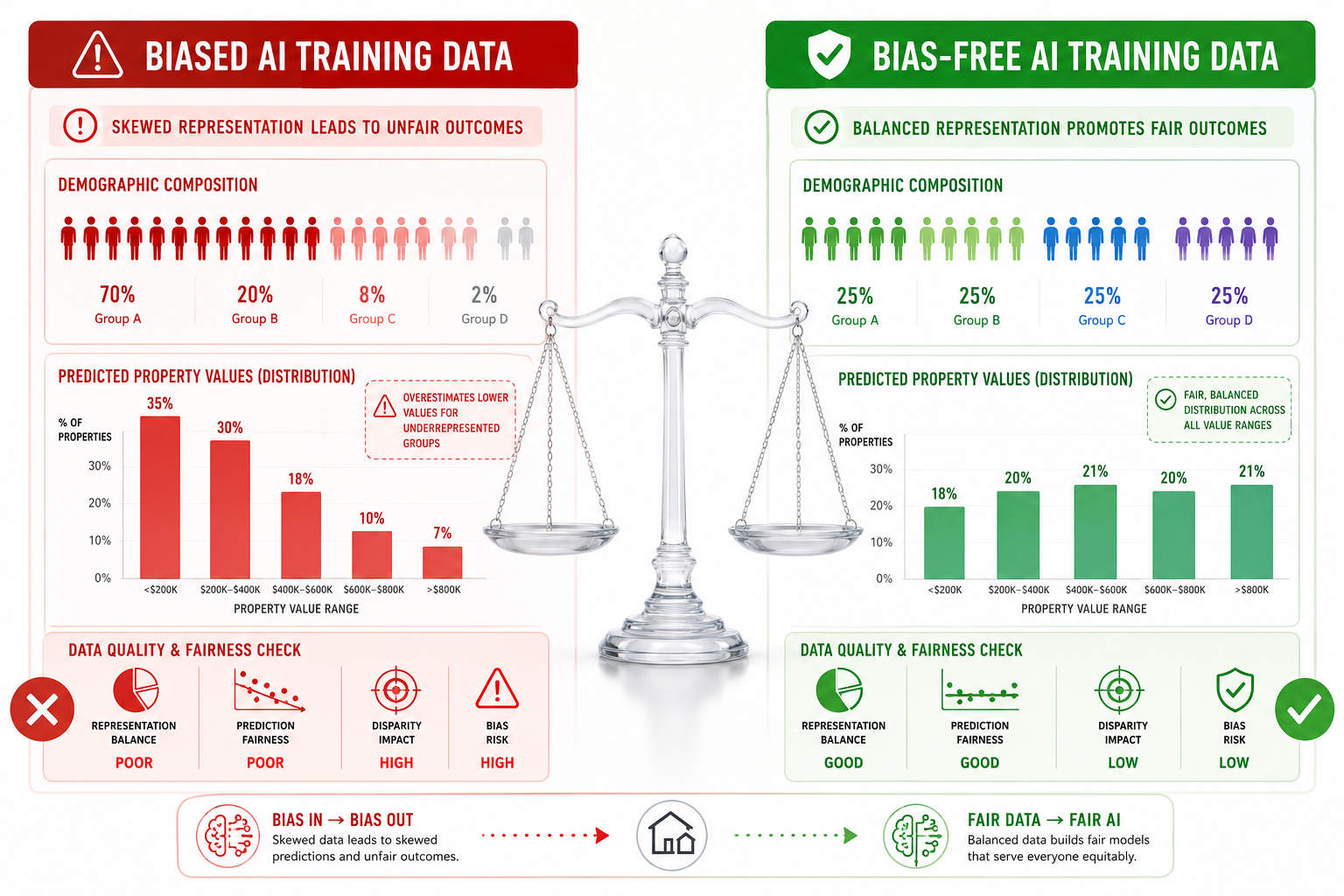
Bias in AI systems is not always obvious, and that is precisely what makes it dangerous. An algorithm trained on historical property transaction data will learn from that data — including any patterns of undervaluation, discriminatory lending, or geographic redlining embedded in it. The result can be an AI system that perpetuates historical inequity while appearing entirely objective.
Where Bias Enters Property AI Systems
Bias can enter at multiple points in the AI pipeline:
- Training data bias: Historical datasets that reflect past discriminatory practices in lending, appraisal, or planning decisions
- Feature selection bias: Choosing proxy variables (such as postcode or neighborhood characteristics) that correlate with protected characteristics
- Feedback loop bias: AI systems trained on their own previous outputs, amplifying existing errors over time
- Measurement bias: Inconsistent data collection standards across different geographic areas or property types
The National Institute of Standards and Technology (NIST) has published detailed guidance on identifying and managing these bias types in AI systems, providing a technical framework that complements the RICS professional standard [8]. The OECD's AI principles similarly emphasize transparency, explainability, and accountability as foundational requirements for trustworthy AI [7].
Practical Steps for Bias Mitigation in Surveying Contexts
Firms committed to ethical AI use in property surveying should implement the following measures:
Audit training datasets regularly. Before deploying any AI valuation or assessment tool, firms should scrutinize the data it was trained on. Who collected it? Over what time period? Does it represent the full diversity of property types and locations in the target area?
Test for disparate impact. Run AI outputs against known benchmarks and check whether the system produces systematically different results for comparable properties in different demographic contexts. This is especially important for tools used in retrospective property valuations where historical data dependency is high.
Document model limitations explicitly. Every AI tool used in a professional context should have a documented profile of its known limitations, the conditions under which it performs reliably, and the conditions under which human override is required.
Establish override protocols. Surveyors must have clear authority — and clear responsibility — to override AI outputs when professional judgment conflicts with algorithmic conclusions. This authority should be documented in firm governance policies.
Involve diverse review teams. Bias is easier to spot when the people reviewing AI outputs bring diverse professional and lived experience to the task.
Transparency in Practice: What Clients and Regulators Expect

Transparency is the thread that runs through every aspect of ethical AI use in property surveying: guidelines for transparent algorithms and bias-free data are only meaningful if they are visible — to clients, to regulators, and to the profession itself.
Client Disclosure Requirements
Under the RICS standard, firms must provide clients with clear information about how AI systems are used in their services [4]. This disclosure should cover:
- Which specific tasks involve AI assistance
- What type of AI system is being used and what it does
- The known limitations and potential risks of the AI tool
- How the surveyor's professional judgment interacts with AI outputs
- How client data is protected within the AI system
This level of transparency may feel unfamiliar to some firms, but it aligns with broader expectations already established in financial services and healthcare. Clients commissioning a valuation report or a commercial dilapidation survey deserve to understand the tools shaping the advice they receive.
Algorithm Transparency: Explainability as a Standard
One of the most technically challenging aspects of ethical AI deployment is explainability — the ability to describe, in plain terms, why an AI system reached a particular conclusion. Many high-performing AI models, particularly deep learning systems, operate as "black boxes" where the internal reasoning is not directly interpretable.
For property surveying, this creates a practical problem. If a surveyor cannot explain why an AI tool flagged a particular risk or assigned a particular value, they cannot defend that output professionally. The RICS standard implicitly addresses this by requiring surveyors to assess the reliability of AI outputs — which is impossible without some degree of explainability [2].
Firms should therefore prioritize AI tools that offer interpretable outputs over those that offer higher performance at the cost of transparency. A slightly less accurate model that a surveyor can explain and defend is professionally safer than a highly accurate model that operates as a black box.
Building a Governance Culture
Ethical AI use does not happen through policy documents alone. It requires a firm culture in which:
- Questions about AI outputs are encouraged, not discouraged
- Errors and near-misses involving AI tools are reported and reviewed
- Training on AI literacy is treated as a professional development priority
- Risk registers are living documents, updated as AI tools evolve
Firms working with RICS-registered valuers should ensure that AI governance responsibilities are clearly assigned — not left as a shared assumption that everyone and no one owns.
Implementing Ethical AI: A Practical Checklist for Surveying Firms
The following checklist translates the RICS standard and supporting frameworks into actionable steps for firms at any stage of AI adoption:
Before deploying any AI tool:
- Conduct due diligence on the tool's training data, methodology, and known limitations
- Establish a risk register entry for the tool, documenting governance controls
- Define clear criteria for when human override of AI outputs is required
- Prepare data anonymization protocols for any client data that will be processed
During AI-assisted work:
- Apply professional skepticism to all AI outputs before incorporating them into reports
- Document instances where AI outputs were modified or overridden, and why
- Ensure client disclosure requirements are met before delivering AI-influenced advice
Ongoing governance:
- Review and update risk registers as AI tools are updated or replaced
- Conduct periodic bias audits on AI tools used for valuation or assessment
- Provide regular AI literacy training to all professional staff
- Monitor regulatory developments from RICS, OECD, and national bodies
Conclusion
The integration of AI into property surveying is not a future scenario — it is the present reality of the profession in 2026. The ethical framework now exists to govern that integration responsibly. The RICS global standard on responsible AI use sets clear, mandatory requirements for data governance, transparency, bias mitigation, and professional accountability [1][3]. International bodies including NIST and the OECD have provided complementary technical and ethical frameworks [7][8]. The tools for compliant, responsible AI integration are available.
What remains is implementation. Surveying firms that treat the RICS standard as a compliance exercise will miss its deeper purpose: rebuilding and reinforcing the trust that clients place in professional advice. Those that embed ethical AI principles into their governance culture — auditing for bias, disclosing AI use clearly, maintaining professional judgment at every stage — will be better positioned to deliver reliable, defensible, and genuinely useful surveying services.
Actionable next steps for surveying professionals:
- Review your firm's current AI tool inventory against the RICS responsible AI standard requirements
- Establish or update your risk register to include all AI systems in use
- Develop a client disclosure template that meets RICS transparency requirements
- Schedule a bias audit for any AI valuation or assessment tools currently deployed
- Invest in AI literacy training for all professional staff, treating it as a core competency rather than an optional extra
The profession's credibility depends not on whether it uses AI, but on how well it governs that use.
References
[1] Rics First Ever Standard On Responsible Ai Use Now In Effect – https://www.rics.org/news-insights/rics-first-ever-standard-on-responsible-ai-use-now-in-effect?utm_source=openai
[2] Responsible Use Of Ai – https://www.rics.org/profession-standards/rics-standards-and-guidance/conduct-competence/responsible-use-of-ai?utm_source=openai
[3] Rics Launches Landmark Global Standard On Responsible Use Of Ai In Surveying – https://www.rics.org/news-insights/rics-launches-landmark-global-standard-on-responsible-use-of-ai-in-surveying?utm_source=openai
[4] Client Information Note – https://www.rics.org/profession-standards/rics-standards-and-guidance/conduct-competence/responsible-use-of-ai/client-information-note?utm_source=openai
[5] Ruai Case Studies 06 – https://www.rics.org/profession-standards/rics-standards-and-guidance/conduct-competence/responsible-use-of-ai/ruai-case-studies-06?utm_source=openai
[6] What Surveyors Think Ai – https://ww3.rics.org/uk/en/modus/technology-and-data/surveying-tools/what-surveyors-think-ai.html?utm_source=openai
[7] Ai Principles – https://www.oecd.org/en/topics/ai-principles.html?utm_source=openai
[8] Towards Standard Identifying And Managing Bias Artificial Intelligence – https://www.nist.gov/publications/towards-standard-identifying-and-managing-bias-artificial-intelligence?utm_source=openai
[9] Algorithms Artificial Intelligence Fairness In Home Appraisals – https://www.consumerfinance.gov/about-us/blog/algorithms-artificial-intelligence-fairness-in-home-appraisals/?utm_source=openai