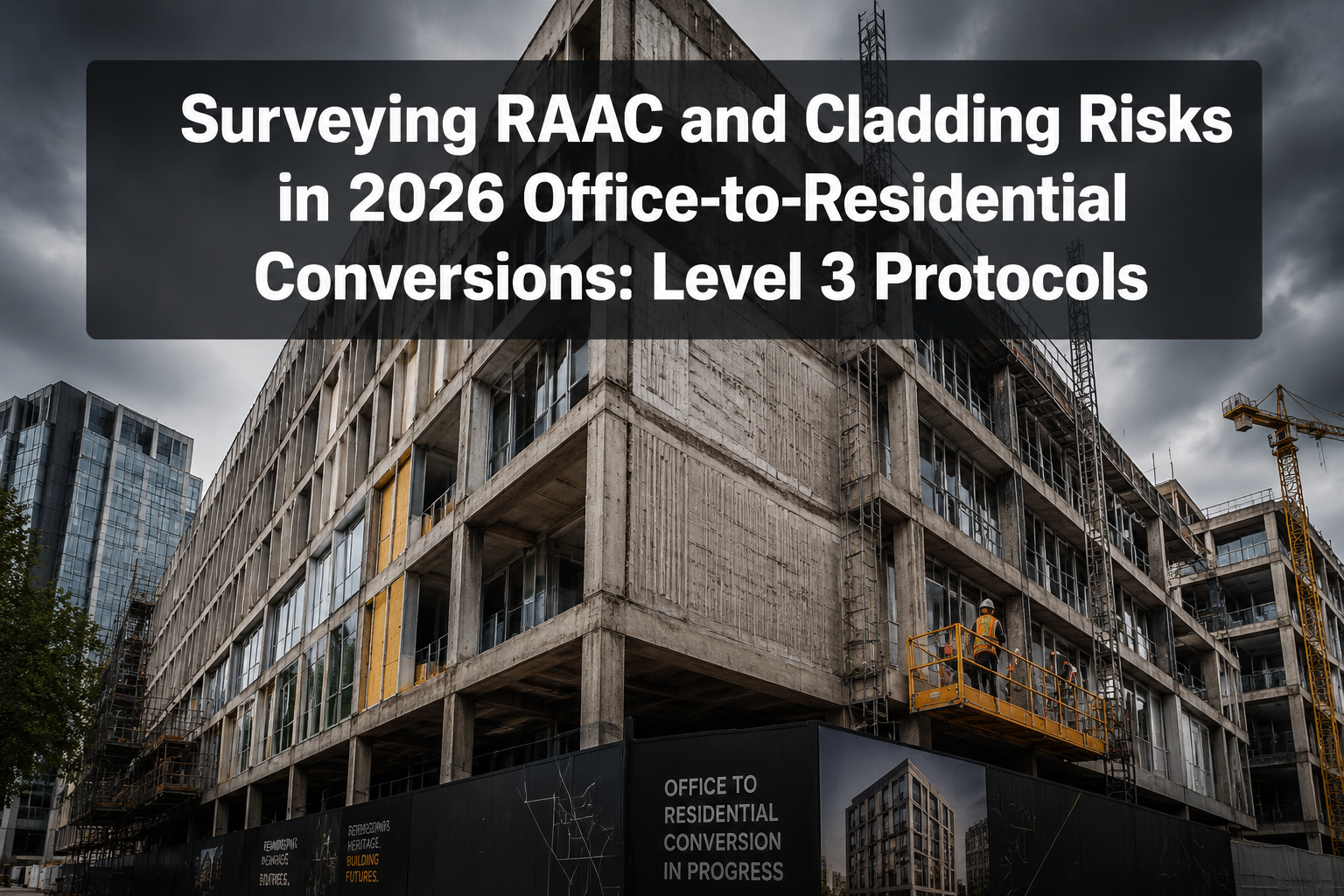

Fewer than one in ten mid-century office buildings converted to residential use in the UK has undergone a formal structural investigation for Reinforced Autoclaved Aerated Concrete (RAAC) before contracts exchange — a gap that is now colliding with tightening Building Safety Act gateway requirements and a wave of urban conversion schemes. Surveying RAAC and cladding risks in 2026 office-to-residential conversions through Level 3 protocols is no longer a discretionary best practice; it is rapidly becoming a condition of lender sign-off, insurer cover, and planning gateway approval for any building that falls within the critical construction window.
This guide sets out the technical and regulatory landscape for surveyors, developers, and investors navigating that challenge in 2026.
Key Takeaways
- Office buildings constructed or altered between the 1950s and early 1990s represent the primary RAAC risk cohort for conversion projects.
- Level 3 protocols require intrusive investigation — opening up finishes, drill-hole sampling, and load evaluation — well beyond a standard RICS Level 2 or Level 3 building survey.
- Cladding risk assessment must be integrated with RAAC investigation under a single Building Safety Act gateway compliance framework.
- Chartered structural engineers, not general practice surveyors alone, must sign off RAAC findings for lender and insurer acceptance.
- Identified RAAC and non-compliant cladding can reduce gross development value by 5–25%, depending on remediation scope and building height.
Why RAAC Is Central to 2026 Office Conversion Due Diligence
The office-to-residential conversion market has accelerated sharply since 2023, driven by persistently high urban housing demand and the relaxation of permitted development rights [6]. London alone has dozens of active schemes targeting 1960s–1980s office stock. The structural problem embedded in many of those buildings is RAAC: a lightweight, aerated concrete product that was widely used in flat and shallow-pitched roof panels, floor decks, and wall cladding from the 1950s through to the early 1990s [2].
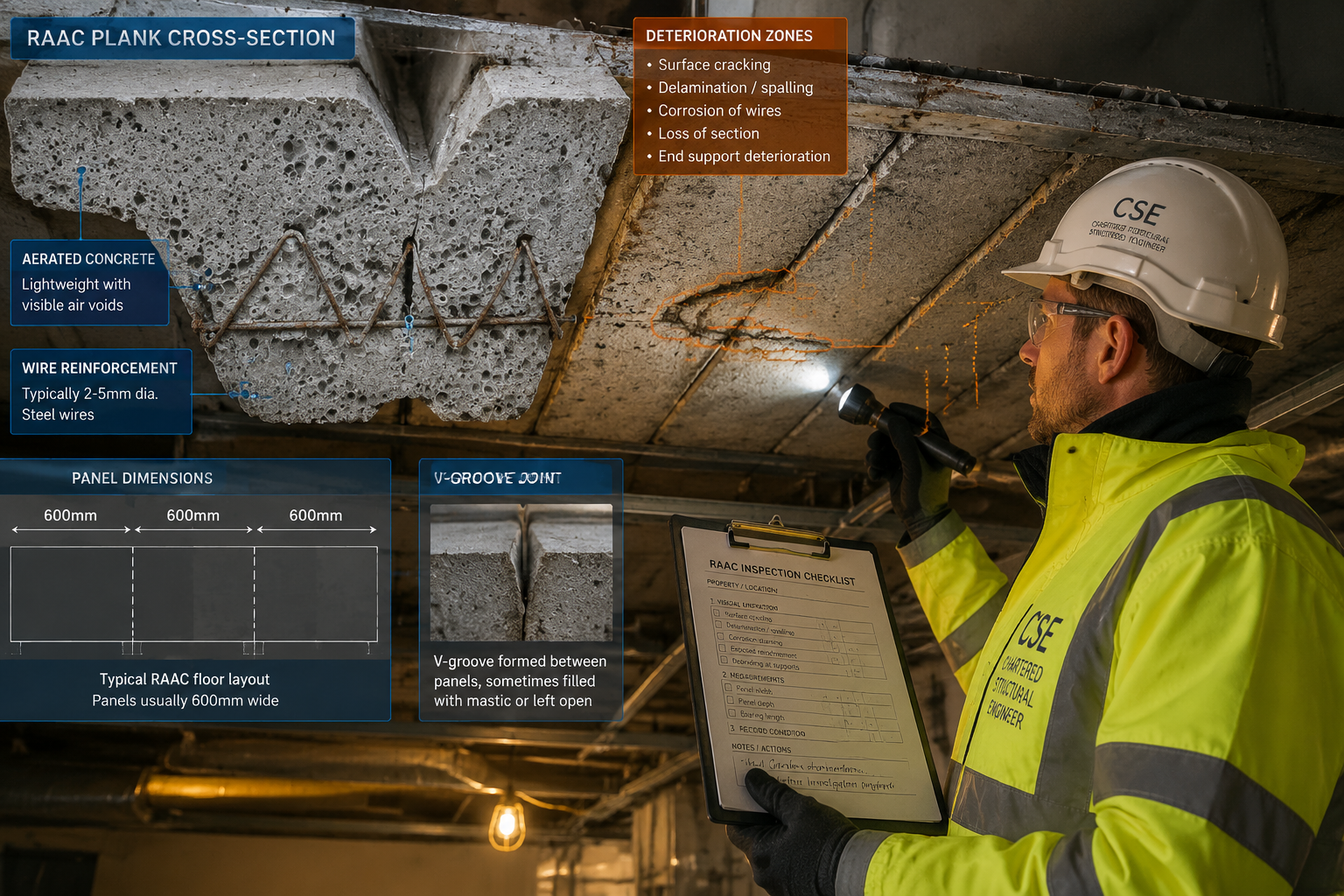
RAAC differs from conventional reinforced concrete in one critical respect. Its wire reinforcement is minimal and its cellular structure absorbs moisture readily. Once water penetrates, the reinforcement corrodes rapidly, the bond between concrete and steel fails, and panels can deflect or collapse with very little visible warning [4]. Zurich's risk management guidance notes that RAAC has been identified in buildings from as early as the 1930s, though typical use was concentrated in the 1950–1990s window [2] — precisely the construction era that dominates London's current conversion pipeline.
The Institution of Structural Engineers (IStructE) has confirmed that properly designed and maintained RAAC can remain structurally adequate, but that condition assessment must be carried out by a Chartered or Incorporated Structural Engineer [3]. This is not a task that can be delegated to a general building surveyor working from visual inspection alone. For developers and their advisers, the practical implication is clear: any office building of uncertain construction date or with flat-roof characteristics requires a formal RAAC screening before a change-of-use application is submitted.
RICS guidance also flags that where conversions to residential use have already taken place without adequate RAAC disclosure, there may be potential recourse under the Defective Premises Act — a liability risk that adds urgency to pre-acquisition due diligence on any building sold or let after conversion [4].
Level 3 RAAC Inspection Protocols: What the Investigation Actually Involves
Standard RICS Level 2 and Level 3 building surveys were not designed with RAAC in mind. The NHS Estates guidance on RAAC — one of the most detailed publicly available frameworks — sets out a structured three-stage approach that effectively defines what a specialist "Level 3" RAAC protocol looks like in practice [1].
Stage 1: Desktop Familiarisation and Initial Risk Profiling
The first stage involves gathering all available documentary evidence: original construction drawings, planning records, building control certificates, and any prior survey reports. The surveyor or engineer establishes whether the building falls within the 1950–1990s risk cohort and identifies the structural system used. Buildings with flat or shallow-pitched roofs, lightweight panel construction, or procurement records referencing suppliers such as Siporex, Durox, or Celcon are immediately elevated to higher-risk status [5].
At this stage, a preliminary risk profile is produced. If RAAC cannot be ruled out from desktop evidence alone, the investigation proceeds to Stage 2.
Stage 2: Visual Inspection and Risk-Based Prioritisation
Stage 2 requires physical access to roof voids, ceiling spaces, and structural zones. The inspector looks for the characteristic visual markers identified in DfE guidance [5]:
| Visual Indicator | Description |
|---|---|
| Panel width | Approximately 600 mm wide concrete units |
| Surface grooves | V-shaped grooves at regular 600 mm spacings |
| Colour and texture | Light grey or off-white, visibly porous surface |
| Supplier markings | Stamps or cast markings referencing RAAC manufacturers |
| Deflection | Visible sagging or mid-span deflection in panels |
Where these indicators are present, the inspector maps high-risk spaces — areas where RAAC panels carry imposed loads from partitions, mechanical plant, or floor-to-floor loadings that will change significantly under residential use [1]. This mapping is critical for conversion projects because the residential loading profile (heavier floor finishes, bathroom pods, partition walls) is materially different from the open-plan office loading the building was originally designed to carry.
Stage 3: Intrusive Investigation and Management Planning
This is the core of the Level 3 protocol. Where RAAC is suspected from visual inspection, the DfE guidance anticipates confirmation by lifting ceiling tiles or making 30–50 mm drill holes through finishes to expose the panel substrate [5]. The structural engineer then:
- Confirms the structural form and span of each suspect panel
- Records all historic interventions (patch repairs, additional fixings, applied loads)
- Evaluates the current load path and compares it against original design assumptions
- Assesses the degree of moisture ingress and reinforcement corrosion
- Produces a formal RAAC register listing every identified panel with condition ratings
Zurich's guidance is explicit that this register and an accompanying management plan must be produced by a chartered structural engineer and kept current [2]. For conversion projects, the management plan must also address the transition period during construction works, when panels may be subjected to additional temporary loads from scaffolding, materials storage, or demolition vibration.
For developers working with chartered surveyors in London, engaging a structural engineer at Stage 1 rather than waiting for a problem to emerge during construction is consistently the lower-cost outcome.
Integrating Cladding Risk Assessment with RAAC Surveys
RAAC and cladding are distinct hazards, but in mid-century office conversions they frequently occur together — and the Building Safety Act 2022 requires both to be addressed within a single gateway compliance framework before a higher-risk building can be occupied.
The Cladding Risk Landscape in 2026
The post-Grenfell regulatory environment has fundamentally changed how cladding is assessed in conversion projects. Under the Building Safety Act, buildings over 18 metres (or 7 storeys) are classified as higher-risk buildings (HRBs) and must pass through mandatory gateway stages before and after construction. Gateway 2 requires a building control approval application supported by a full fire safety case, which must address external wall construction and cladding materials [6].
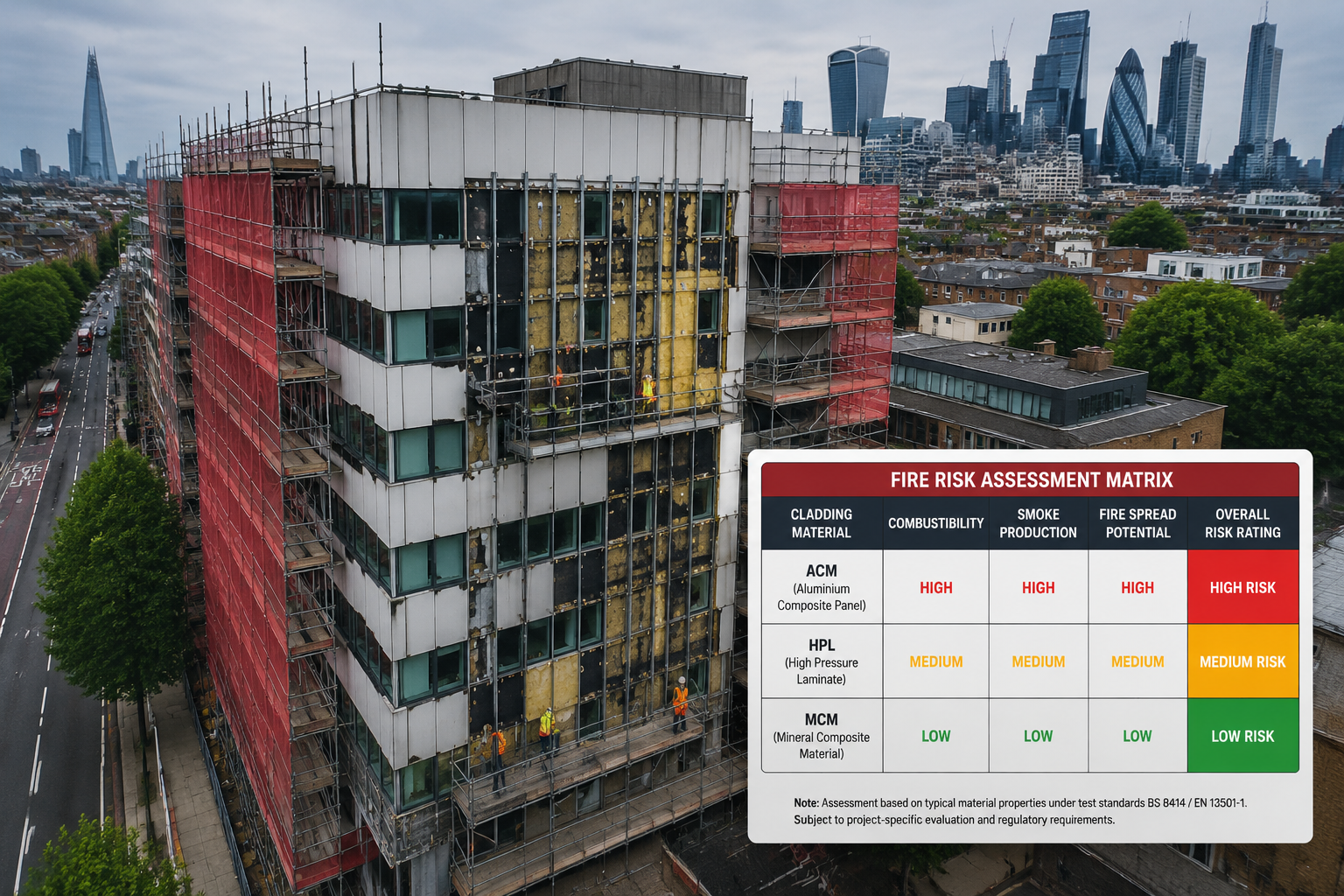
For office conversions, the cladding challenge is compounded by the fact that many 1970s and 1980s office buildings used Aluminium Composite Material (ACM) panels, High-Pressure Laminate (HPL) cladding, or Metal Composite Material (MCM) systems — all of which may contain combustible cores that do not meet current residential fire safety standards.
A cladding survey integrated with the RAAC investigation should:
- Identify all external wall system (EWS) components, including insulation type and thickness
- Confirm whether an EWS1 form has been completed or is required for mortgage purposes
- Assess fire performance against current Approved Document B requirements
- Identify any ACM or HPL panels and test or confirm core category (A1, A2, B, or C/D)
- Map any penetrations, fixings, or junctions that compromise fire compartmentation
The EWS1 process remains directly relevant to lender requirements in 2026. Buildings that cannot produce a satisfactory EWS1 form face significant mortgage market restrictions, directly affecting the viability of the residential conversion as a product for sale or rent.
For projects involving complex roof structures or external envelope systems, a drone roof survey can provide high-resolution imagery of panel conditions, fixings, and deterioration that would otherwise require costly scaffold access at an early stage of due diligence.
Combining RAAC and Cladding Findings in a Single Risk Report
Best practice in 2026 is to commission a single integrated structural and fire safety report that addresses both RAAC and cladding within one document. This approach serves three purposes:
- It satisfies Building Safety Act gateway requirements with a consolidated evidence base
- It provides lenders and insurers with a single point of reference for risk assessment
- It enables the developer to produce a coherent remediation cost plan that is not fragmented across separate specialist reports
A structural survey scoped specifically for office-to-residential conversion should include explicit sections on RAAC risk, cladding EWS assessment, and a combined remediation schedule with cost ranges.
Risk Valuation Adjustments for London Conversion Schemes
Identifying RAAC or non-compliant cladding does not automatically make a conversion project unviable. What it does is create a quantifiable risk that must be reflected in the acquisition price, the development appraisal, and the end-value assumptions.
How RAAC Affects Gross Development Value
The valuation impact of RAAC depends on three variables: the extent of affected panels, the remediation strategy, and the programme implications. The table below summarises typical adjustments observed in London conversion appraisals in 2026.
| RAAC Scenario | Remediation Approach | GDV Adjustment Range |
|---|---|---|
| Isolated panels, good condition | Monitor and manage in situ | -2% to -5% |
| Moderate spread, some deflection | Propping and selective replacement | -8% to -15% |
| Widespread, structurally critical | Full structural replacement | -15% to -25% |
| Unknown extent (no Level 3 survey) | Risk premium applied | -10% to -20% |
The final row is particularly important. Where a Level 3 RAAC survey has not been completed, lenders and institutional investors increasingly apply a precautionary risk premium to the gross development value rather than accepting an unquantified liability. Commissioning the survey is therefore not only a safety obligation but a direct value-protection measure.
Cladding Remediation Costs and Their Appraisal Impact
Cladding remediation costs for mid-rise office conversions in London typically range from £150 to £400 per square metre of external wall area, depending on the system being replaced and the access strategy. For a typical 1970s office block of 2,000 square metres of external wall area, this represents a potential remediation cost of £300,000 to £800,000 — a material line item in any development appraisal.
Where the building qualifies as an HRB under the Building Safety Act, developers should also factor in the cost of the Building Safety Regulator (BSR) gateway process itself, including the preparation of the safety case report and any required third-party review.
"The cost of a thorough Level 3 RAAC and cladding investigation at the due diligence stage is almost always a fraction of the cost of discovering the same issues after contracts have exchanged or construction has begun."
For projects requiring a formal commercial dilapidation survey as part of lease surrender prior to conversion, the dilapidations assessment should be coordinated with the RAAC and cladding investigation to avoid duplicating access costs and to ensure that structural defects are not misclassified as tenant dilapidations.
A schedule of dilapidations produced without awareness of underlying RAAC or cladding issues may significantly understate the true cost of bringing the building to a standard suitable for residential conversion.
Building Safety Act Gateway Alignment for Surveying RAAC and Cladding Risks in 2026 Office-to-Residential Conversions
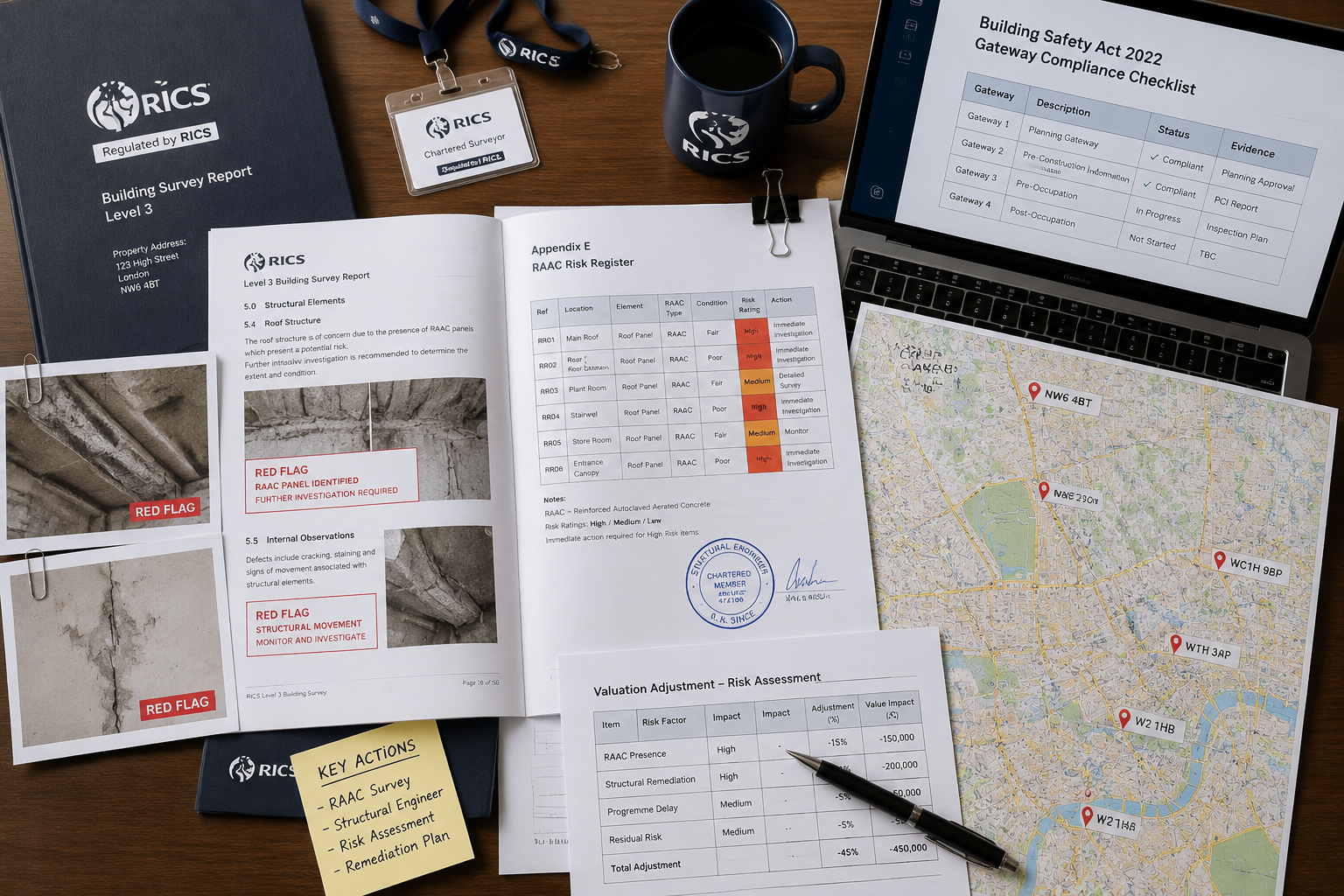
The Building Safety Act 2022 introduced a three-gateway system for higher-risk buildings that directly affects the sequencing of RAAC and cladding surveys in conversion projects.
Gateway 1 occurs at the planning application stage. The fire statement submitted at Gateway 1 must demonstrate that fire safety has been considered in the design. For conversions of buildings with suspected RAAC or legacy cladding, a preliminary structural and fire safety assessment should be available at this stage to inform the fire statement.
Gateway 2 occurs before construction begins. The full building control application must include detailed construction drawings and specifications. Any RAAC remediation strategy and cladding replacement specification must be finalised and submitted at this stage. Incomplete or unresolved RAAC findings at Gateway 2 will block commencement of works.
Gateway 3 occurs before occupation. The as-built documentation, including the golden thread of building information, must confirm that all RAAC and cladding works have been completed in accordance with the approved specification.
For developers working on schemes across multiple London boroughs, engaging chartered surveyors in West London or East London who are familiar with local Building Safety Regulator case management practices can materially reduce gateway processing times.
Practical Protocol Checklist for Level 3 RAAC and Cladding Surveys
The following checklist summarises the minimum scope for a Level 3 investigation aligned with Building Safety Act gateway requirements:
- Confirm building construction date and procurement records
- Review original structural drawings and any subsequent alterations
- Conduct visual inspection of all accessible structural zones for RAAC indicators
- Carry out intrusive confirmation (drill holes or ceiling lift) where RAAC is suspected
- Produce a RAAC register with panel-by-panel condition ratings
- Assess imposed loading changes under residential use
- Identify all external wall system components and insulation types
- Confirm ACM, HPL, or MCM panel presence and core category
- Produce an EWS1 form or confirm requirements for one
- Prepare an integrated remediation cost schedule
- Align all findings with Gateway 1, 2, and 3 documentation requirements
Conclusion
Surveying RAAC and cladding risks in 2026 office-to-residential conversions through Level 3 protocols is the defining due diligence challenge for anyone active in the UK's urban conversion market this year. The combination of an ageing office stock built during the peak RAAC era, tightening Building Safety Act gateway requirements, and heightened lender and insurer scrutiny means that incomplete or superficial surveys are no longer commercially acceptable.
Actionable next steps for developers and their advisers:
- Screen every target building against the 1950–1990s RAAC risk cohort before committing to heads of terms.
- Commission a chartered structural engineer to lead the Level 3 investigation — not a general practice surveyor working alone.
- Integrate cladding EWS assessment into the same investigation scope to avoid duplicated access costs and fragmented reporting.
- Quantify RAAC and cladding risk in the development appraisal using the valuation adjustment ranges appropriate to the identified scenario.
- Align all survey outputs with Building Safety Act Gateway 1, 2, and 3 documentation requirements from the outset.
- Engage experienced chartered surveyors in London who can coordinate structural, fire safety, and valuation workstreams within a single due diligence programme.
The cost of a thorough Level 3 investigation is predictable and bounded. The cost of discovering RAAC or non-compliant cladding after exchange, mid-construction, or at Gateway 2 is neither.
References
[1] Reinforced Autoclaved Aerated Concrete Estates Guidance A C01 – https://static1.squarespace.com/static/6139be6187fc606b90972c74/t/63d683baadd91d569a32cc7f/1675002815361/Reinforced_Autoclaved_Aerated_Concrete_Estates_Guidance-A-C01.pdf
[2] Risk Insight Managing Risks From Raac – https://www.zurich.co.uk/-/media/uk-zurich-municipal/docs/risk-management/risk_insight_managing_risks_from_raac.pdf
[3] Raac What Private Sector Agents Need To Know – https://www.propertymark.co.uk/resource/raac-what-private-sector-agents-need-to-know.html
[4] Raac Consumer Guide – https://www.rics.org/content/dam/ricsglobal/documents/consumer-guides/RAAC_consumer_guide.pdf
[5] Guide Dfe Xx Xx T X 9002 Reinforced Autoclaved Aerated Concrete Identification Guidance A C04 002 – https://assets.publishing.service.gov.uk/media/6628e519b0ace32985a7e5ad/GUIDE-DFE-XX-XX-T-X-9002-Reinforced_Autoclaved_Aerated_Concrete_Identification_Guidance-A-C04__002_.pdf
[6] 2025 Office Conversions – https://www.callan.com/blog/2025-office-conversions/