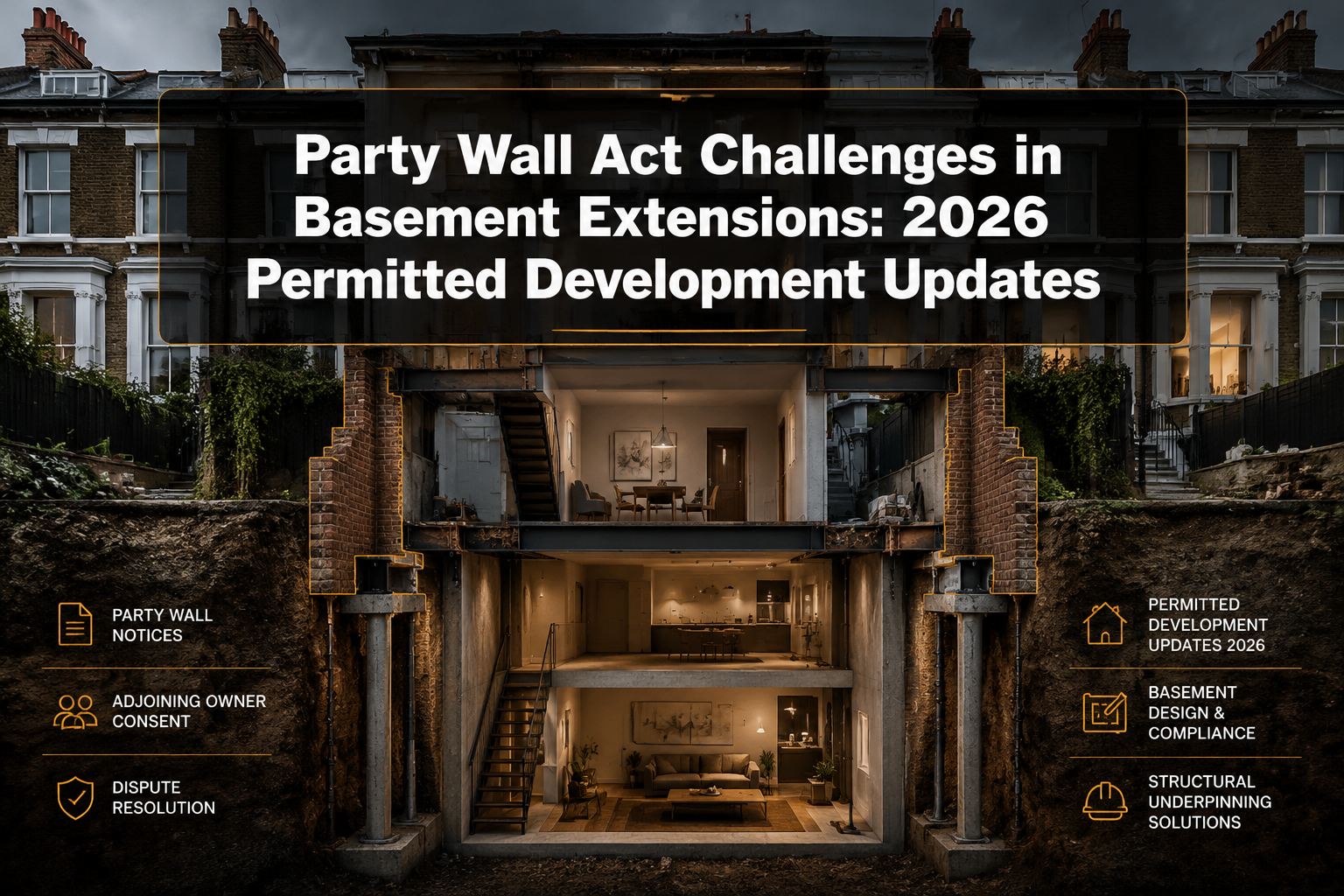

Basement extensions account for nearly 40% of all party wall disputes in urban areas — a figure that has climbed steadily as London and other high-density cities exhaust above-ground expansion options [1]. With expanded permitted development rights (PDR) now reshaping what homeowners can build without full planning consent, the legal obligations under the Party Wall etc. Act 1996 have never been more consequential. For urban homeowners planning a basement project in 2026, navigating Party Wall Act challenges in basement extensions requires precise surveying, disciplined notice procedures, and a clear understanding of the latest RICS-guided compliance standards.
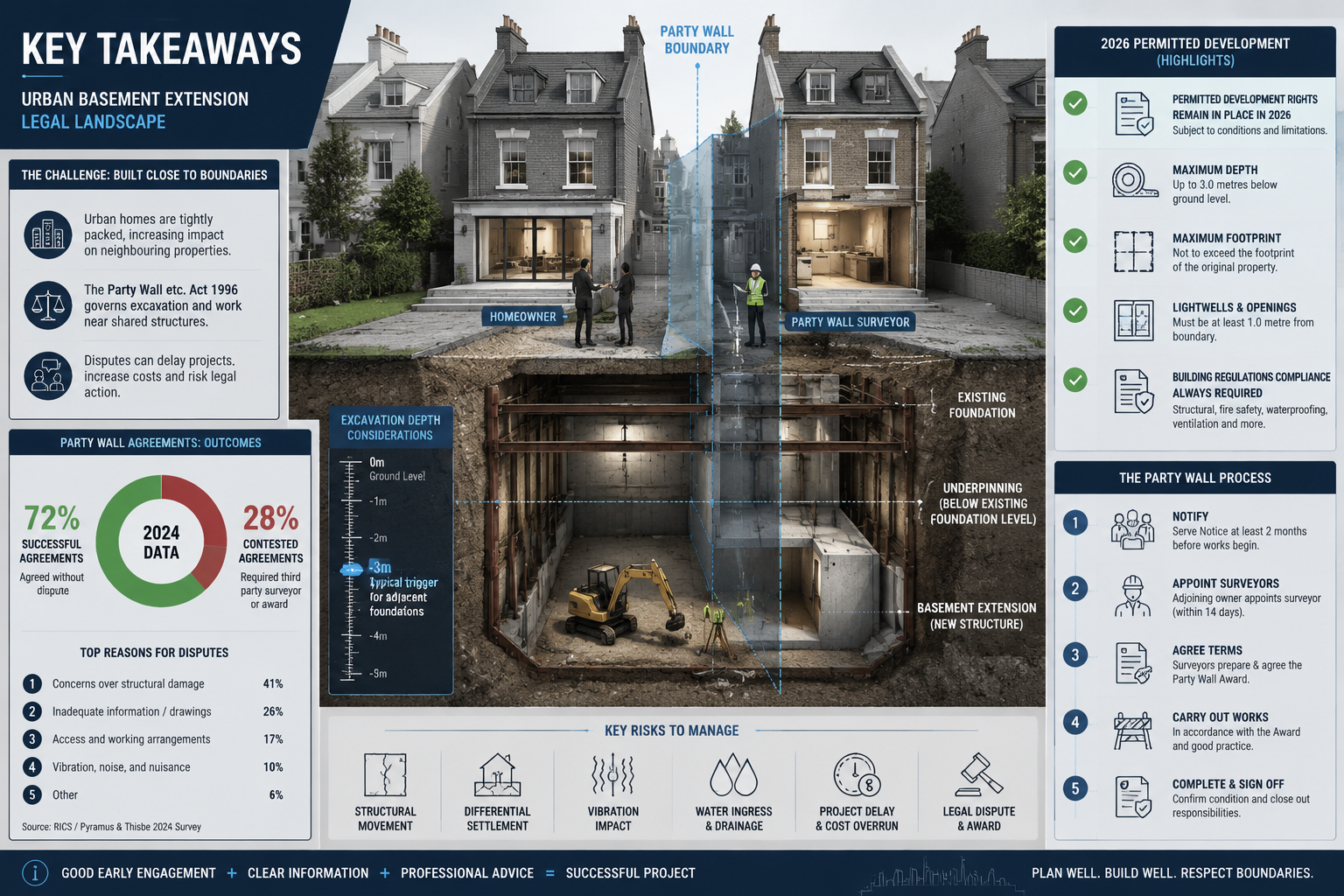
Key Takeaways
- Basement projects frequently trigger up to three separate notice types under the Party Wall etc. Act 1996, each with distinct legal timelines.
- Excavations within 3 metres or 6 metres of a neighbour's foundations (depending on depth) require a formal Notice of Adjacent Excavation.
- A formal Party Wall Award is mandatory for most terraced and semi-detached properties undertaking basement works.
- In April 2026, RICS launched a consultation on updating its Party Wall guidance to raise compliance standards beyond the legal minimum.
- Selecting a surveyor with verified basement conversion experience is critical — general party wall knowledge is often insufficient for these technically complex projects.
Why Basement Extensions Create Unique Party Wall Act Challenges
Most home renovation projects trigger one notice type. Basement extensions routinely trigger three. Under the Party Wall etc. Act 1996, a typical basement project may require serving a Section 1 notice (for new walls on the boundary), a Section 2 notice (for work on an existing party wall or structure), and a Section 6 notice (for excavations near neighbouring foundations) [2]. Missing any one of these exposes the building owner to injunctions, legal costs, and claims for damages.
This complexity is compounded by the physical nature of basement work. Unlike a loft conversion or rear extension, basement excavation disturbs the ground beneath and beside a neighbour's property. Ground movement, vibration from piling equipment, and changes in groundwater drainage can all affect adjacent structures — sometimes weeks or months after the work concludes [6].
For homeowners in terraced streets, which dominate inner London boroughs, the risks are heightened further. Properties share not just walls but often foundations laid in the Victorian era, designed to carry loads that modern basement conversions fundamentally alter. Understanding party wall matters from the outset is therefore not optional — it is the legal and practical foundation of any successful basement project.
The 2026 Permitted Development Context
Permitted development rights allow certain works to proceed without a full planning application. In 2026, updates to PDR have broadened the scope of what qualifies as permitted development for residential extensions in England [7]. However, a critical misconception persists: PDR approval does not exempt a project from the Party Wall etc. Act 1996. The two regimes operate independently.
A homeowner may lawfully proceed under PDR without planning permission, yet still face a mandatory obligation to serve party wall notices and obtain a Party Wall Award before breaking ground. Failing to recognise this distinction is one of the most common — and costly — errors seen in 2026 basement projects.
Notice Requirements, Excavation Rules, and the 3-Metre Threshold
The Three Notice Types Explained
The Party Wall etc. Act 1996 establishes clear notice obligations for basement works. Each notice type carries its own timeline, and all must be served before any physical work begins.
| Notice Type | Trigger | Minimum Notice Period |
|---|---|---|
| Section 1 | New wall at or astride the boundary | 1 month |
| Section 2 | Work on an existing party wall or structure | 2 months |
| Section 6 | Excavation within 3m or 6m of neighbour's foundations | 1 month |
Basement projects frequently engage all three simultaneously [2]. A homeowner who serves only a Section 6 notice while also underpinning a shared party wall has failed to comply with the Act in full.
For a detailed walkthrough of the excavation-specific obligations, the party wall excavation notice requirements set out by experienced surveyors provide a practical reference point.
Understanding the 3-Metre and 6-Metre Rules
The excavation proximity rules under Section 6 of the Act are precise and non-negotiable [3]:
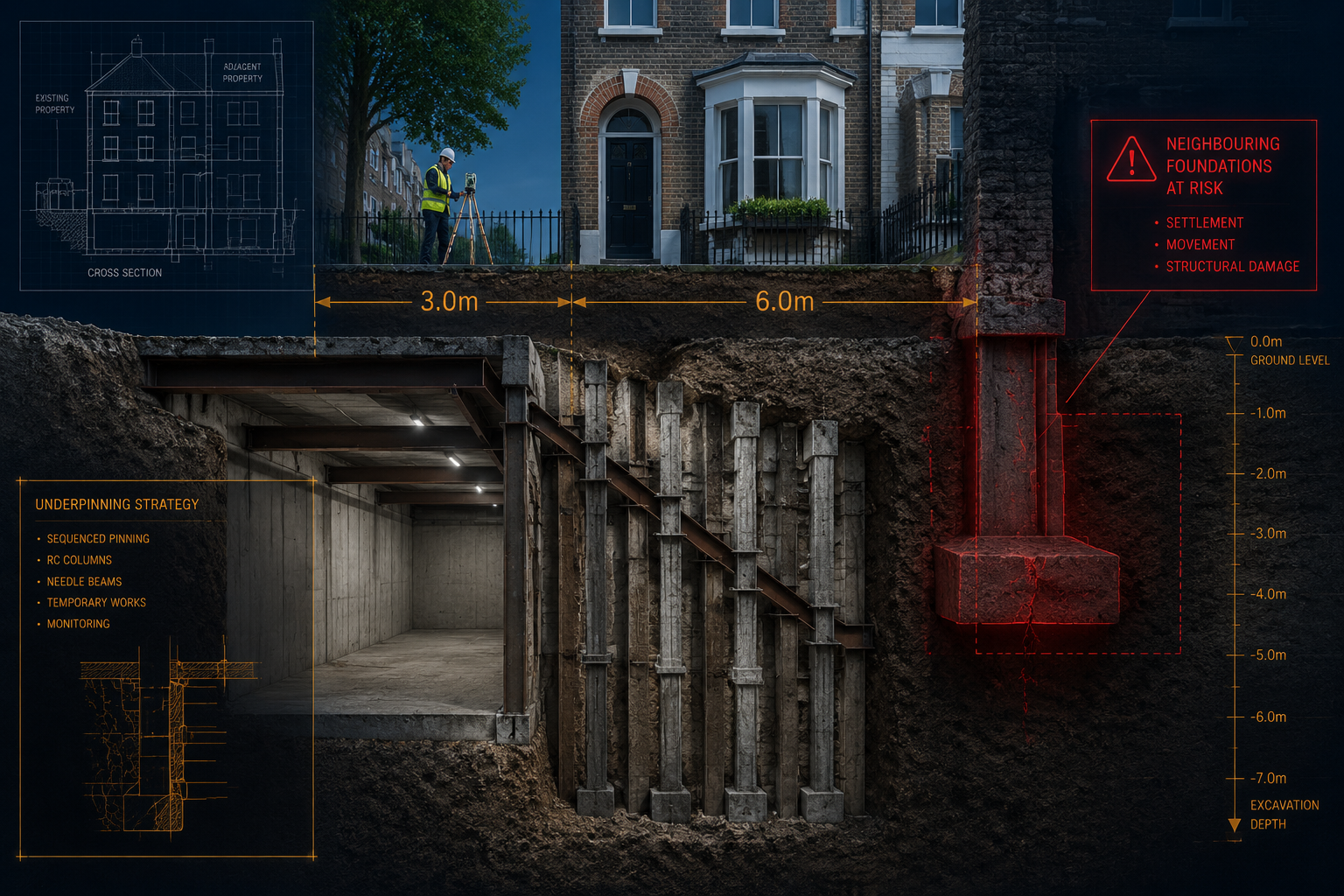
- 3-metre rule: If excavation is proposed within 3 metres of a neighbouring structure and the proposed depth is greater than the neighbour's existing foundations, a notice must be served.
- 6-metre rule: If excavation is within 6 metres of a neighbouring structure and would cut a 45-degree line drawn downward from the base of that structure's foundations, a notice is required.
These thresholds are not approximations. A surveyor must measure from the correct reference points, and the Party Wall Act 3-metre rule has specific technical interpretations that can vary depending on soil type, foundation depth, and the construction method proposed.
"Inaccurate underpinning that extends beyond property boundaries can lead to future claims. It is essential to define acceptable tolerances in the Party Wall Award and ensure contractors adhere to them." [5]
What Happens When Neighbours Dissent
Once a notice is served, the adjoining owner has 14 days to respond. If they consent in writing, work may proceed. If they dissent — or fail to respond — a dispute is deemed to have arisen, and surveyors must be appointed to produce a Party Wall Award [2].
The Award is a legally binding document that sets out:
- The scope and method of the proposed works
- Protective measures for the adjoining property
- Access rights for inspection
- A Schedule of Condition documenting the pre-works state of the neighbour's property
A properly prepared party wall schedule of condition is not merely procedural. It is the primary evidence used to assess whether any post-construction damage was caused by the basement works — making it one of the most important documents in the entire process.
Security for Expenses Under Section 12
Under Section 12 of the Party Wall etc. Act, an adjoining owner may request that the building owner deposit funds into an escrow account before works begin [5]. This security covers potential damages or the cost of completing protective works if the building owner defaults. In basement excavations — which carry elevated structural risk — this provision is increasingly exercised by adjoining owners and their surveyors.
Homeowners should budget for this possibility. Escrow deposits can range from a few thousand pounds to significantly more, depending on the scale of the excavation and the assessed risk to neighbouring structures.
RICS Protocols, Surveyor Selection, and 2026 Compliance Standards
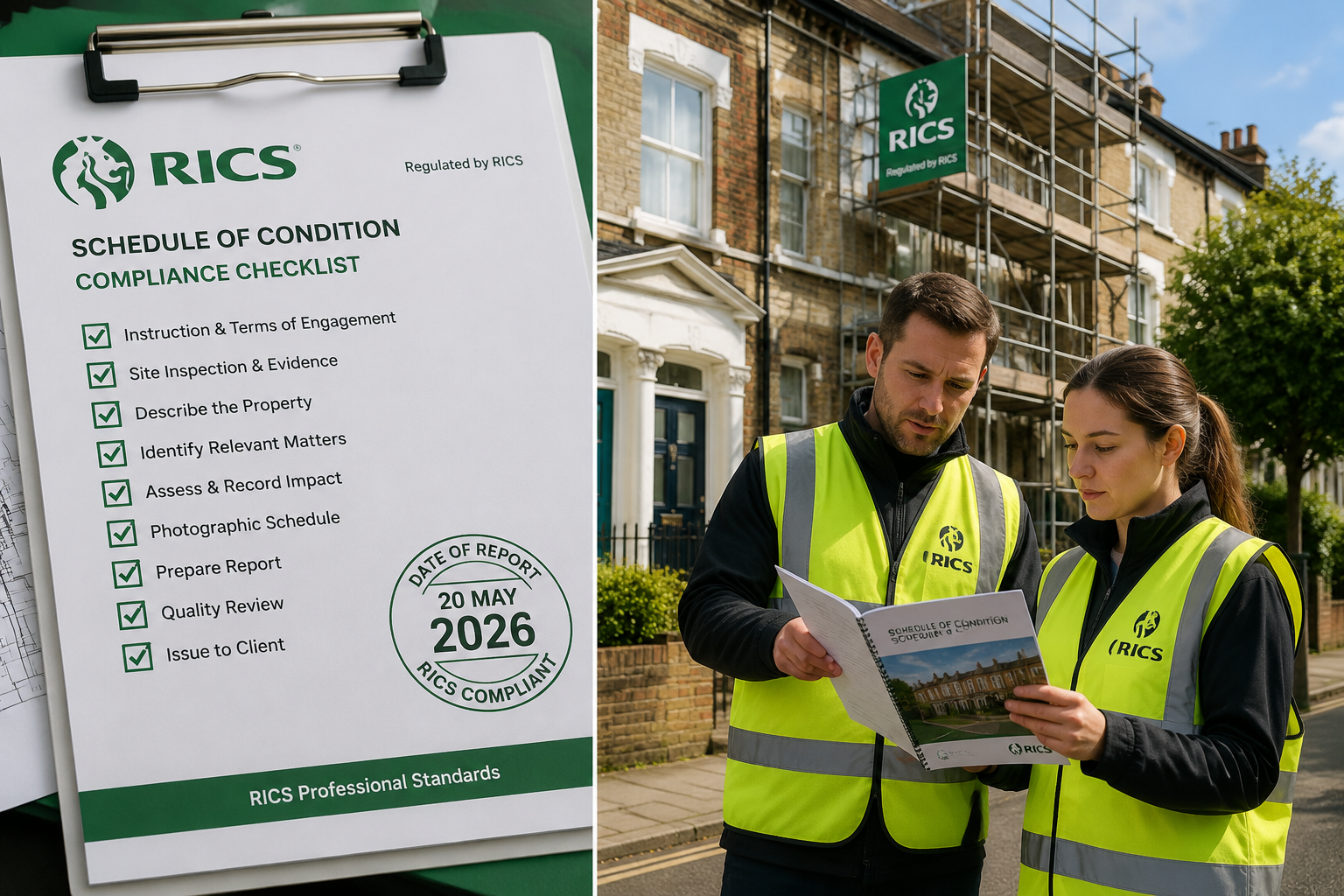
The April 2026 RICS Guidance Update
In April 2026, the Royal Institution of Chartered Surveyors launched a consultation on the 8th edition of its Party Wall Legislation and Procedure guidance [4]. The updated guidance is designed to raise compliance standards above the legal minimum set by the 1996 Act, with particular focus on:
- Clearer protocols for technically complex projects, including basement excavations
- Strengthened requirements for Temporary Works Design and Method Statements
- Greater emphasis on post-construction verification, including thermal compliance testing
On the thermal compliance point, new regulations now require that basement party wall work achieve U-values not exceeding 0.15 W/m²K, verified through post-construction testing [3]. This requirement intersects with Building Regulations Part L and adds a layer of compliance that surveyors and contractors must account for in the Award documentation.
Why Specialist Surveyor Experience Matters
Not all party wall surveyors are equally equipped to handle basement projects. General competence in party wall procedure is insufficient when a project involves:
- Deep excavation adjacent to Victorian or Edwardian foundations
- Complex underpinning sequences
- Temporary works that affect shared structural elements
- Ground anchors or sheet piling that cross the boundary
Selecting a surveyor with verified experience in basement conversions is critical [2]. When assessing candidates, homeowners should ask specifically about previous basement Awards they have prepared, their familiarity with Temporary Works Design approval processes, and their experience in high-density urban environments.
For homeowners in London, working with chartered surveyors in central London who specialise in dense urban residential projects provides a significant advantage. The structural and legal complexity of basement works in terraced streets demands local knowledge alongside technical expertise.
The Temporary Works Design Requirement
One of the most technically demanding aspects of basement construction is the design and execution of temporary works — shoring, propping, and retaining systems that protect both the building under construction and adjacent properties during excavation [5].
The Party Wall Award should reference an approved Temporary Works Design and Method Statement, prepared or reviewed by a qualified structural engineer. This document:
- Defines the sequence of excavation
- Specifies propping loads and monitoring requirements
- Establishes trigger levels for movement monitoring instruments
- Sets out contingency procedures if movement exceeds agreed thresholds
Without this documentation embedded in the Award, the adjoining owner has limited recourse if ground movement occurs during construction. For building owners, it also provides protection against spurious claims by demonstrating that all reasonable precautions were taken.
Building a RICS-Guided Compliance Checklist for High-Density Areas
For urban homeowners managing Party Wall Act challenges in basement extensions, a structured compliance checklist reduces the risk of procedural failures. The following framework reflects current RICS guidance and 2026 permitted development requirements:
Pre-Notice Stage
- Confirm whether PDR applies and obtain any required prior approval
- Commission a structural engineer to assess foundation depths of neighbouring properties
- Determine which of the three notice types apply
- Appoint an experienced party wall surveyor before serving any notice
Notice Stage
- Serve all applicable notices simultaneously where possible
- Allow statutory response periods to elapse before commencing work
- Document all notice service (recorded delivery or personal service with witness)
Award Stage
- Ensure the Award includes a detailed Schedule of Condition
- Confirm Temporary Works Design is referenced and approved
- Address Section 12 security requirements if raised by the adjoining owner
- Verify thermal compliance obligations are documented
Construction Stage
- Install movement monitoring instruments at agreed locations
- Provide regular monitoring reports to both surveyors
- Ensure contractors work strictly within the tolerances defined in the Award
- Document any deviations immediately and seek Award amendment if necessary
Post-Construction Stage
- Commission post-construction U-value testing for thermal compliance
- Conduct a joint inspection with the adjoining owner's surveyor
- Resolve any damage claims through the Award dispute resolution mechanism
For homeowners whose projects also involve shared chimney stacks or party wall insulation — common in full basement and ground-floor renovation schemes — additional notice obligations may apply. Reviewing party wall insulation requirements and understanding party wall shared chimneys obligations ensures that no notice type is overlooked.
Addressing Neighbour Concerns Proactively
One of the most effective ways to reduce dispute risk is early, transparent communication with adjoining owners before any formal notice is served. Sharing outline plans, explaining the construction methodology, and introducing the appointed surveyor can convert a potentially hostile neighbour into a cooperative one.
This approach does not waive any legal rights. Formal notices must still be served. But a neighbour who understands the project and trusts the process is far less likely to dissent or request maximum security under Section 12.
Homeowners who find themselves on the receiving end of a neighbour's basement project also have clear rights. Understanding what to do if a neighbour is carrying out party wall work on your boundary is equally important for protecting your property.
Conclusion
Party Wall Act challenges in basement extensions represent one of the most technically and legally demanding areas of residential construction in 2026. Expanded permitted development rights have made basement projects more accessible in planning terms, but they have not reduced — and in some cases have increased — the obligations under the Party Wall etc. Act 1996.
Actionable next steps for urban homeowners planning a basement extension in 2026:
- Appoint a party wall surveyor with verified basement conversion experience before any design work is finalised.
- Commission a structural engineer to assess neighbouring foundation depths and determine which notice types apply.
- Serve all required notices simultaneously, allowing statutory periods to run concurrently where possible.
- Ensure the Party Wall Award includes a Temporary Works Design reference, a Schedule of Condition, and thermal compliance obligations.
- Establish a movement monitoring programme and maintain records throughout the construction phase.
- Engage with adjoining owners early and transparently to reduce the likelihood of formal dissent.
The cost of getting this right is modest compared to the cost of an injunction, a damages claim, or a protracted dispute with a neighbour. With RICS raising compliance standards and local authorities increasingly scrutinising basement projects in high-density areas, the homeowners who succeed in 2026 will be those who treat party wall compliance not as a bureaucratic hurdle but as a core part of their project plan.
For comprehensive guidance on all aspects of party wall procedure, the party wall agreement process and the full range of party wall notices provide the legal framework within which every successful basement extension must operate.
References
[1] Avoiding Party Wall Disputes In Basement Extensions 2026 Notice Timelines And Protective Measures – https://partywallsurveyorlondon.uk/blogs/avoiding-party-wall-disputes-in-basement-extensions-2026-notice-timelines-and-protective-measures/?utm_source=openai
[2] How Recent Changes To The Party Wall Act Impact Current Home Extensions And Basement Projects – https://partywallsurveyorlondon.uk/blogs/how-recent-changes-to-the-party-wall-act-impact-current-home-extensions-and-basement-projects/?utm_source=openai
[3] Essential Party Wall Notices For Basement Extensions Under 2026 Permitted Development Rules – https://partywallsurveyorlondon.uk/blogs/essential-party-wall-notices-for-basement-extensions-under-2026-permitted-development-rules/?utm_source=openai
[4] Party Wall Surveys For Basement Conversions In 2026 Rics Protocols Amid Rising Urban Demand – https://princesurveyors.co.uk/blog/party-wall-surveys-for-basement-conversions-in-2026-rics-protocols-amid-rising-urban-demand/?utm_source=openai
[5] Basements – https://www.partywall.info/basements.html?utm_source=openai
[6] Party Wall Surveys Amid 2026 Construction Boom Handling Disputes In High Demand Uk Housing Markets – https://nottinghillsurveyors.com/blog/party-wall-surveys-amid-2026-construction-boom-handling-disputes-in-high-demand-uk-housing-markets?utm_source=openai
[7] Permitted Development 2026 – https://devisarchitecture.com/home-extensions/permitted-development-2026/?utm_source=openai