
The April 2026 RICS UK Residential Market Survey recorded a headline house price net balance of -34%, the sharpest monthly deterioration since the post-mini-budget correction of late 2022 — and surveyors working on active developer projects are now recalibrating every assumption they made at the start of the year. Geopolitical Volatility in April 2026 RICS Surveys: Party Wall Risk Adjustments for Developer Projects has become a live operational concern, not a theoretical one. When buyer demand collapses, timelines stretch, and construction costs spike simultaneously, the party wall process — often treated as administrative box-ticking — transforms into a critical risk management instrument [1].
Key Takeaways
- The April 2026 RICS survey recorded buyer demand at a net balance of -34% and agreed sales at -36%, creating prolonged project timelines that directly affect party wall risk exposure.
- Geopolitical instability, particularly the ongoing Middle East conflict, has driven oil price volatility and supply chain disruption, feeding through to higher borrowing costs and weakened developer confidence.
- Credit conditions deteriorated to -44% in Q1 2026, the weakest reading since Q3 2023, constraining the financial headroom developers need to absorb party wall complications.
- Developers must treat party wall agreements as dynamic risk documents rather than static legal formalities, updating schedules of condition and cost assumptions as market conditions shift.
- Regions showing the sharpest price declines — London, the South East, East Anglia, and the South West — require the most urgent party wall risk reassessment for projects currently in progress.
What the April 2026 RICS Data Actually Tells Developers
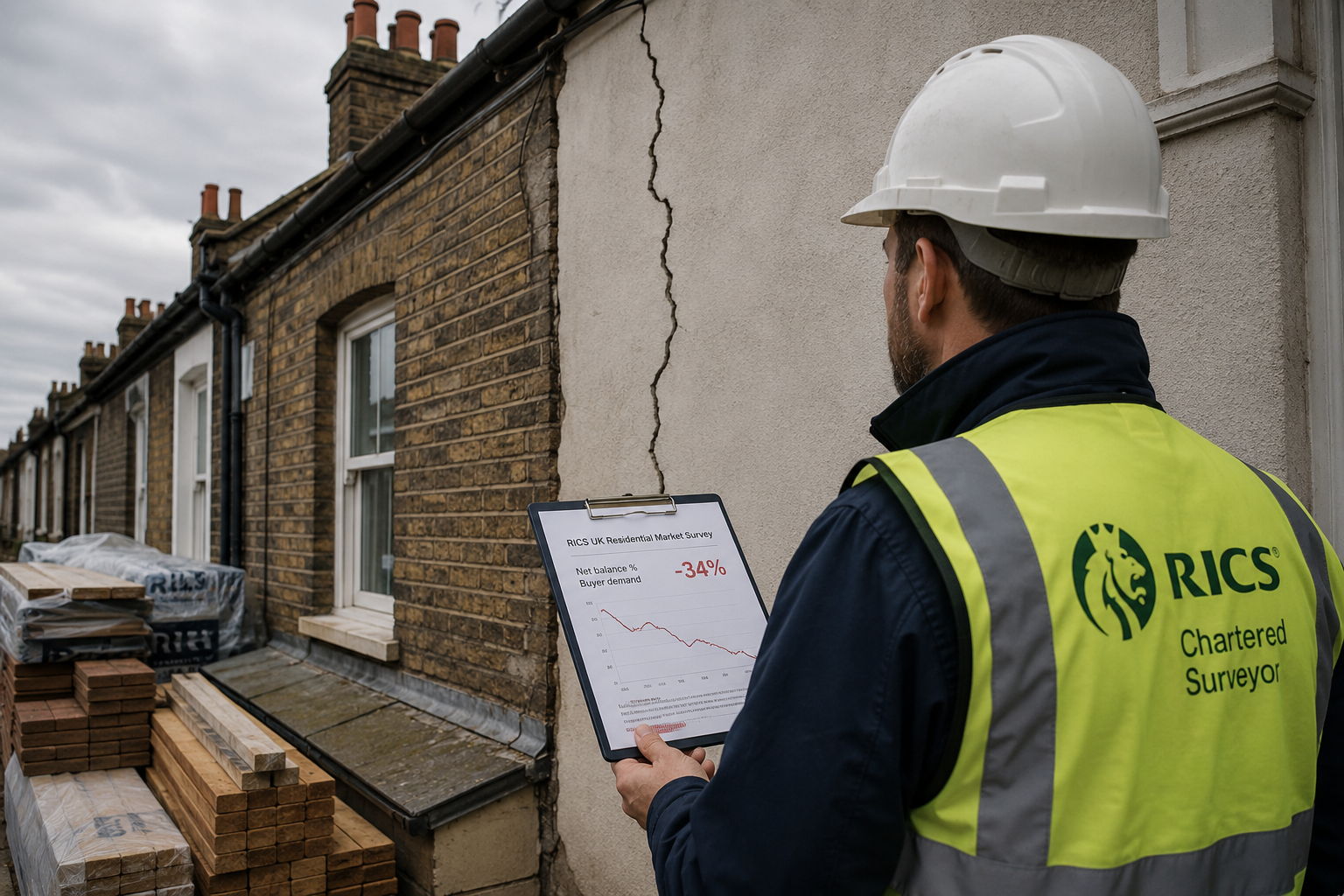
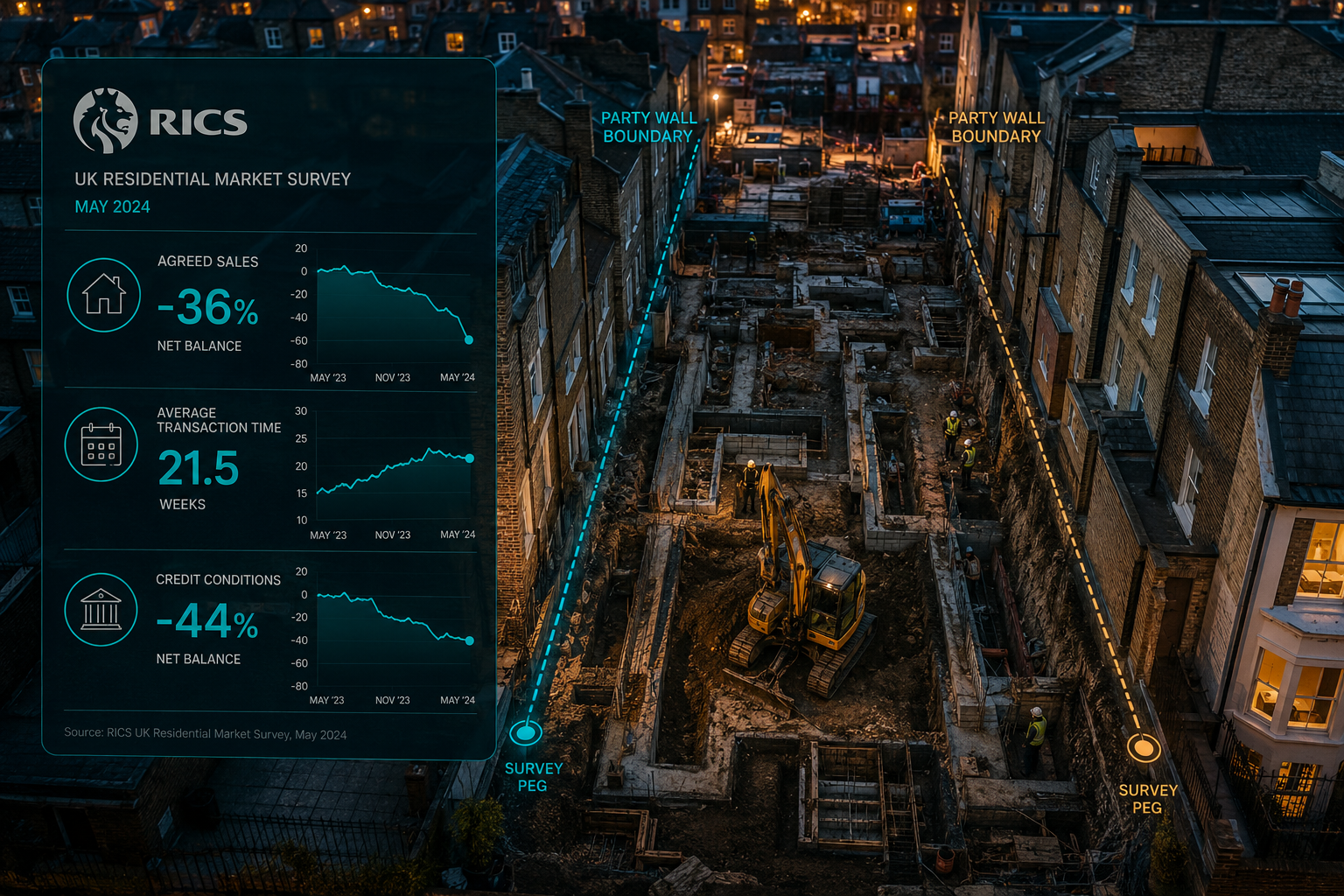
The April 2026 RICS survey data paints a consistent picture of a market under sustained external pressure. New buyer enquiries registered a net balance of -34%, a modest improvement from -40% in March but still firmly negative. Agreed sales sat at -36%, almost unchanged from -35% the previous month [1]. For developers, these are not abstract statistics — they represent real delays between project completion and revenue realisation.
Why does this matter for party wall risk? Because the longer a development project remains active on site, the longer the exposure window for party wall-related incidents, disputes, and liability claims. A project that was originally scheduled for a six-month build programme may now run to nine or ten months as financing conditions tighten and purchaser commitments become harder to secure.
The Geopolitical Transmission Mechanism
The connection between geopolitical events and party wall risk is indirect but measurable. The World Bank's April 2026 Commodity Markets Outlook confirmed that periods of elevated geopolitical risk are associated with nearly twice the oil price volatility compared to stable periods [5]. Higher oil prices feed directly into construction material costs — from bitumen-based products to polymer insulation and transportation fuel.
Tarrant Parsons, RICS Head of Market Research and Analysis, noted that higher mortgage rates and geopolitical uncertainty are weighing simultaneously on buyer demand and sales activity [1]. This dual pressure — reduced demand and increased costs — creates a financial squeeze that forces developers to extend timelines, defer completions, and in some cases, pause construction phases. Each of these decisions has direct implications for party wall management.
"When a developer pauses a construction phase mid-programme, the party wall surveyor's role shifts from procedural compliance to active damage monitoring and dispute prevention."
Credit conditions deteriorated sharply to -44% in Q1 2026, the weakest reading since Q3 2023 [4]. Developers relying on revolving credit facilities or development finance tied to LIBOR-linked rates are finding their cost of capital rising precisely when project revenues are being deferred. This financial compression is the underlying driver pushing party wall risk adjustments to the top of the project risk register.
How Geopolitical Volatility in April 2026 RICS Surveys Reshapes Party Wall Risk Assessments
Party wall risk does not exist in isolation from market conditions. When RICS data signals the kind of sustained deterioration seen in April 2026, experienced surveyors recognise that several specific risk categories require recalibration.
Extended Exposure Periods and Structural Monitoring
The average time from listing to completion rose to 21.5 weeks in May 2026, the longest recorded duration since 2017 [3]. For developers, this means that neighbouring properties remain exposed to construction vibration, ground movement, and structural interference for significantly longer than originally anticipated when the party wall notice was served.
A party wall agreement drafted on the assumption of a standard build programme may not adequately cover the monitoring obligations required for an extended programme. Surveyors should consider:
- Increasing the frequency of structural monitoring visits beyond what the original award specified
- Updating schedules of condition at programme milestones rather than relying solely on the pre-construction record
- Reviewing the scope of the party wall agreement to ensure it reflects the actual works being undertaken as designs evolve under cost pressure
Regional Risk Differentiation
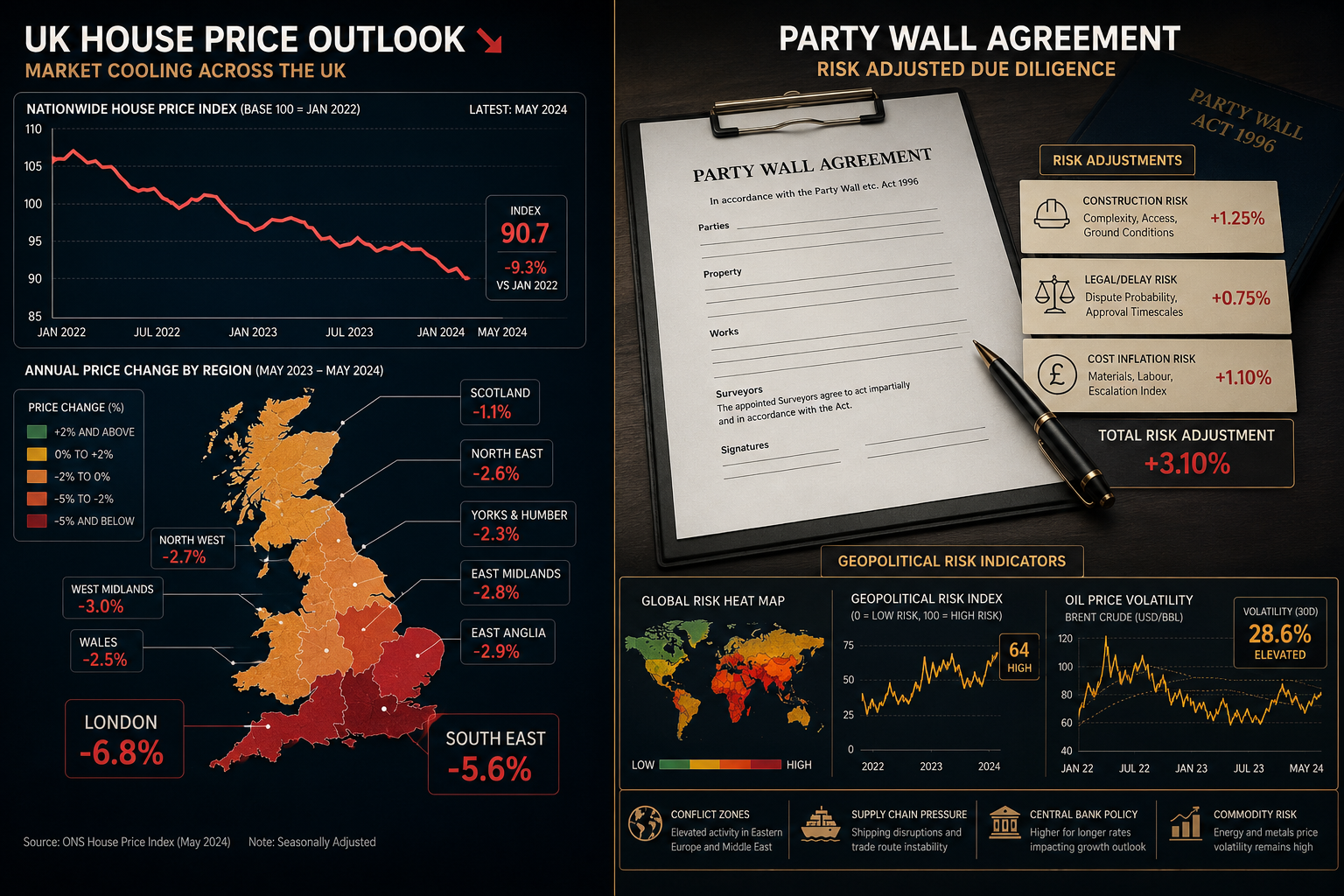
The April 2026 RICS survey highlighted stark regional divergence. Northern England, Scotland, and Northern Ireland recorded marginally positive house price readings, while London, the South East, East Anglia, and the South West experienced the sharpest declines [1]. This regional split has a direct bearing on party wall risk strategy.
| Region | House Price Trend (April 2026) | Developer Risk Level | Party Wall Priority |
|---|---|---|---|
| London | Significant decline | High | Critical |
| South East | Significant decline | High | Critical |
| East Anglia | Significant decline | High | Elevated |
| South West | Significant decline | Moderate-High | Elevated |
| Northern England | Marginally positive | Moderate | Standard |
| Scotland | Marginally positive | Moderate | Standard |
| Northern Ireland | Marginally positive | Moderate | Standard |
In declining markets, developers face greater pressure to cut costs. This sometimes leads to decisions — such as reducing the scope of underpinning, altering excavation depths, or substituting specified materials — that can increase the risk of damage to neighbouring property. A robust party wall framework acts as the primary safeguard against these risks becoming costly disputes.
Supply Chain Disruption and Material Substitution Risk
The Middle East conflict has contributed to higher oil prices and disrupted supply chains across the construction sector [1]. When specified materials become unavailable or prohibitively expensive, contractors substitute alternatives. These substitutions can alter the structural behaviour of works covered by the party wall award.
For example, if a developer originally specified a particular type of temporary propping system for excavation works near a boundary, and substitutes a lighter system due to supply constraints, the load distribution on the party wall may change materially. This is precisely the scenario where the party wall act 3 metre rule becomes critically important — excavation works within three metres of a neighbouring structure require careful re-evaluation whenever the method of work changes.
Practical Party Wall Risk Adjustments for Developer Projects in 2026
Understanding the risk landscape is necessary but insufficient. Developers and their appointed surveyors need concrete adjustments to their party wall procedures to navigate Geopolitical Volatility in April 2026 RICS Surveys: Party Wall Risk Adjustments for Developer Projects effectively.
Step 1: Reassess the Schedule of Condition
The schedule of condition report is the foundational document for any party wall dispute. In a market where projects are running longer than anticipated, a pre-construction schedule of condition recorded twelve months ago may no longer accurately reflect the current state of the neighbouring property. Independent deterioration — cracks from seasonal movement, damp ingress, or pre-existing structural issues — can be incorrectly attributed to construction works if the schedule of condition is not updated.
Recommended action: Commission an updated schedule of condition at the six-month mark for any project that has extended beyond its original programme, and again at twelve months if the project continues.
Step 2: Review Party Wall Surveyor Cost Assumptions
The financial model underpinning a development project typically includes a fixed allowance for party wall surveyor costs. In a normal market, this allowance is straightforward to estimate. In the current environment, three factors are inflating actual costs beyond original budgets:
- Extended monitoring periods requiring additional site visits
- Increased dispute frequency as neighbours become more alert to potential claims in a falling market
- Higher professional fees reflecting the increased complexity of geopolitically influenced projects
Developers should revisit their party wall cost provisions and model a scenario where costs run 25-40% above original estimates. In declining markets, neighbours are more likely to appoint their own surveyors and pursue compensation claims, increasing the likelihood of a three-surveyor scenario rather than an agreed surveyor arrangement.
Step 3: Serve Notices Early and Comprehensively
In a market where transaction timelines have stretched to 21.5 weeks [3], the temptation to delay serving party wall notices — to avoid triggering the statutory response period before works are ready to commence — can backfire significantly. If a project timeline slips, a notice served too late can result in works being undertaken without the legal protection of a party wall award.
The party wall notice should be served as early as practically possible, with the full scope of works described accurately. Where excavation works are involved, a separate party wall excavation notice should be served under Section 6 of the Party Wall etc. Act 1996 to cover works near foundations.
Step 4: Maintain Proactive Neighbour Communication
In a market where house prices are falling and neighbours are anxious about the value of their properties, construction works next door become a focal point for concern. Proactive communication — regular updates, clear points of contact, and prompt responses to queries — reduces the likelihood of disputes escalating to formal party wall disputes that require third-party resolution.
This is not merely a goodwill gesture. It is a risk management strategy. A neighbour who feels informed and respected is significantly less likely to appoint a surveyor and pursue a dispute than one who feels ignored.
Step 5: Engage Chartered Surveyors with Current Market Intelligence
The value of a chartered surveyor in London operating in the current environment lies not just in technical party wall expertise, but in their ability to contextualise risk within live market conditions. A surveyor who understands that credit conditions are at their weakest since Q3 2023 [4], that buyer demand is deeply negative, and that supply chains remain disrupted by geopolitical events, will produce a more accurate and defensible party wall award than one operating from a standard template.
The Rental Market Dimension and Its Effect on Developer Strategy
One consequence of the current sales market weakness is that developers are increasingly pivoting completed units toward the private rental sector rather than open market sale. The April 2026 RICS survey recorded tenant demand at a net balance of +14%, while landlord instructions remained negative at -17%, pointing to continued upward pressure on rents [1].
This strategic pivot has party wall implications. A development originally designed for owner-occupier sale, with a certain build quality specification and timeline, may be repurposed for rental. The change in end use does not alter the party wall obligations — the Act applies equally regardless of tenure — but it can affect the intensity and nature of ongoing works as developers adapt fit-out specifications.
Supply constraints are also a factor. New vendor instructions were broadly flat at -3% in April, while new appraisals weakened to -16% [1], suggesting that the pipeline of available properties for developers to acquire and redevelop may thin further in coming months. This makes the efficient management of current projects — including their party wall obligations — even more commercially important.
Conclusion
Geopolitical Volatility in April 2026 RICS Surveys: Party Wall Risk Adjustments for Developer Projects is not a niche compliance topic — it is a live financial risk that every developer with an active construction programme in the UK should be addressing now. The April 2026 RICS data confirms a market under sustained pressure: buyer demand at -34%, agreed sales at -36%, house prices falling fastest in London and the South East, and credit conditions at their weakest in nearly three years [1][4].
Actionable next steps for developers and their surveyors:
- Audit every active party wall agreement against the current project programme and identify where extended timelines have created gaps in monitoring obligations.
- Commission updated schedules of condition for projects that have run beyond six months from the original pre-construction survey.
- Revise party wall cost provisions upward by at least 25-40% to reflect the higher probability of disputes in a stressed market.
- Serve all outstanding party wall notices immediately, including excavation notices for any foundation or basement works near boundaries.
- Engage a chartered surveyor with demonstrable knowledge of current RICS survey data and geopolitical risk factors to ensure party wall awards reflect real-world conditions rather than pre-2026 assumptions.
The party wall framework exists precisely to protect all parties when construction stress is highest. In the current environment, that stress is considerable — and the developers who treat party wall risk management as a strategic priority, rather than an administrative obligation, will be best positioned to complete projects on time, within budget, and without costly disputes.
References
[1] UK Residential Survey April 2026 – https://www.rics.org/news-insights/uk-residential-survey-april-2026?utm_source=openai
[2] Party Wall Surveys For East Anglia's Lagging Recovery RICS Strategies To Mitigate Developer Risks In Slow Moving Markets – https://kingstonsurveyors.com/party-wall-surveys-for-east-anglias-lagging-recovery-rics-strategies-to-mitigate-developer-risks-in-slow-moving-markets/?utm_source=openai
[3] UK Residential Survey May 2026 – https://www.rics.org/news-insights/uk-residential-survey-may-2026?utm_source=openai
[4] Global Headwinds On UK Housing 2026 Valuation Adjustments For Geopolitical And Rate Risks Per RICS Insights – https://princesurveyors.co.uk/blog/global-headwinds-on-uk-housing-2026-valuation-adjustments-for-geopolitical-and-rate-risks-per-rics-insights/?utm_source=openai
[5] CMO April 2026 – https://thedocs.worldbank.org/en/doc/f3138644a1e8e2bb631399ae11d6c408-0050012026/original/CMO-April-2026.pdf?utm_source=openai