
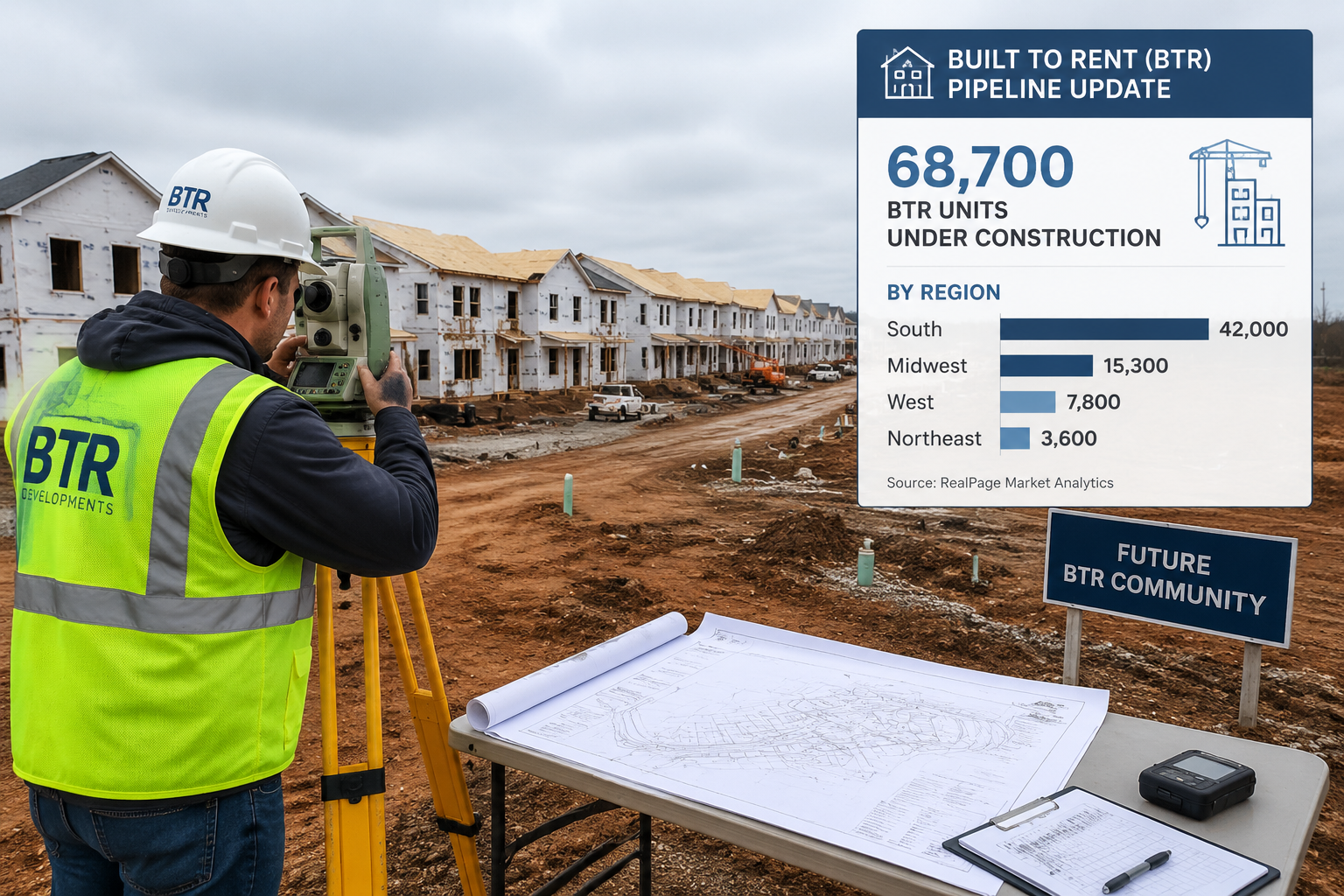
Approximately 68,700 build-to-rent (BTR) units were under construction across the United States as of early 2026, with the South alone accounting for nearly 42,000 of those units [1]. Across the Atlantic, single-family rental properties now represent 51% of all BTR investment in the UK over the 12 months leading into Q1 2026 [5]. These numbers tell a clear story: the BTR sector is not a passing trend but a structural shift in how housing is delivered and managed. For surveyors, developers, and investors navigating this landscape, understanding the full scope of surveying for build-to-rent developments: key considerations in the 2026 boom is no longer optional — it is a professional necessity.
This article examines the surveying strategies, regulatory requirements, and site assessment disciplines that underpin successful BTR projects in 2026, with direct reference to current pipeline data and market conditions.
Key Takeaways
- BTR pipeline data shows significant regional concentration, making precise site selection and topographic surveying critical before land acquisition.
- Boundary delineation errors and party wall oversights are among the most costly mistakes in large-scale BTR communities.
- Structural and roof surveys must be built into pre-development due diligence, not treated as afterthoughts.
- Regulatory compliance — particularly around dilapidations, schedules of condition, and rent review frameworks — directly affects long-term asset performance.
- Chartered surveyors with BTR-specific experience add measurable value at every stage from site appraisal to practical completion.
The 2026 BTR Pipeline: What the Data Means for Surveyors
The BTR construction pipeline peaked at roughly 122,000 units in early 2024 before contracting to approximately 61,700 to 63,000 units by Q1 2026 — a reduction of nearly 50% [2]. Sun Belt markets dominate what remains, with Phoenix at 7,300 units, Dallas at 3,700, and Atlanta at 3,500, together accounting for 82% of the active pipeline [2]. In the UK, Greystar's BTR footprint expanded from around 7,000 homes in 2022 to over 46,000 by mid-2026 [6], illustrating the rapid scaling that makes professional surveying oversight essential.
This consolidation has important implications. Over 200 developers hold active BTR projects, but only eight have pipelines exceeding 1,000 units each, and companies such as Empire Group and Taylor Morrison each exceed 2,000 units [3]. When projects reach this scale, even minor surveying errors compound quickly. A boundary discrepancy of a few metres across a 500-unit community can trigger planning disputes, delay infrastructure connections, and generate significant legal costs.
What this means in practice:
- Large-scale BTR sites require phased surveying programmes rather than single-point assessments.
- Topographic surveys must account for drainage, utilities, and access routes across the entire site, not just individual plots.
- Land banking strategies depend on accurate site appraisals conducted well before planning applications are submitted [7].
The pipeline contraction also signals that surviving projects are those backed by experienced operators who invest properly in pre-development due diligence. Surveyors who understand BTR-specific requirements — rather than applying standard residential survey protocols — are in high demand.
Site Selection and Topographic Assessment
Before a single foundation is poured, the site must be thoroughly understood. Topographic surveys establish the physical baseline for all subsequent design and engineering decisions. For BTR developments, which typically involve higher unit densities than traditional residential schemes, this baseline is especially important.
Key elements of a BTR topographic survey include:
| Survey Element | Why It Matters for BTR |
|---|---|
| Ground levels and gradients | Drainage design and road layout across large sites |
| Existing boundary positions | Avoids encroachment disputes with adjacent landowners |
| Underground utilities | Prevents costly diversions during construction |
| Tree positions and root zones | Affects foundation design and planning conditions |
| Flood risk zones | Informs insurance reinstatement values and lender requirements |
Working with chartered surveyors in London who have direct experience on large residential schemes ensures that topographic data is collected to the standard required by planning authorities and structural engineers alike.
Core Surveying Disciplines in Build-to-Rent Development
Surveying for build-to-rent developments: key considerations in the 2026 boom extends well beyond the initial land assessment. A BTR project moves through multiple stages — acquisition, design, construction, practical completion, and ongoing asset management — each requiring distinct surveying inputs.
Structural and Roof Surveys at Acquisition Stage
When a BTR developer acquires an existing site with buildings — a former industrial estate, a redundant office block, or a brownfield plot with legacy structures — structural surveys are essential before demolition or conversion decisions are made. Hidden defects in existing structures affect remediation costs, programme timelines, and ultimately the financial viability of the entire scheme.
A structural survey in London conducted at acquisition stage should assess:
- Foundation integrity and any evidence of subsidence
- Structural frame condition in existing buildings
- Presence of hazardous materials such as asbestos or Japanese knotweed
- Roof condition, particularly on any retained structures
For retained buildings being converted to BTR use, a dedicated roof survey is equally important. Roof defects are among the most common sources of post-completion disputes between developers and contractors, and identifying them early prevents costly claims during the defects liability period.
Party Wall Considerations in Dense BTR Communities
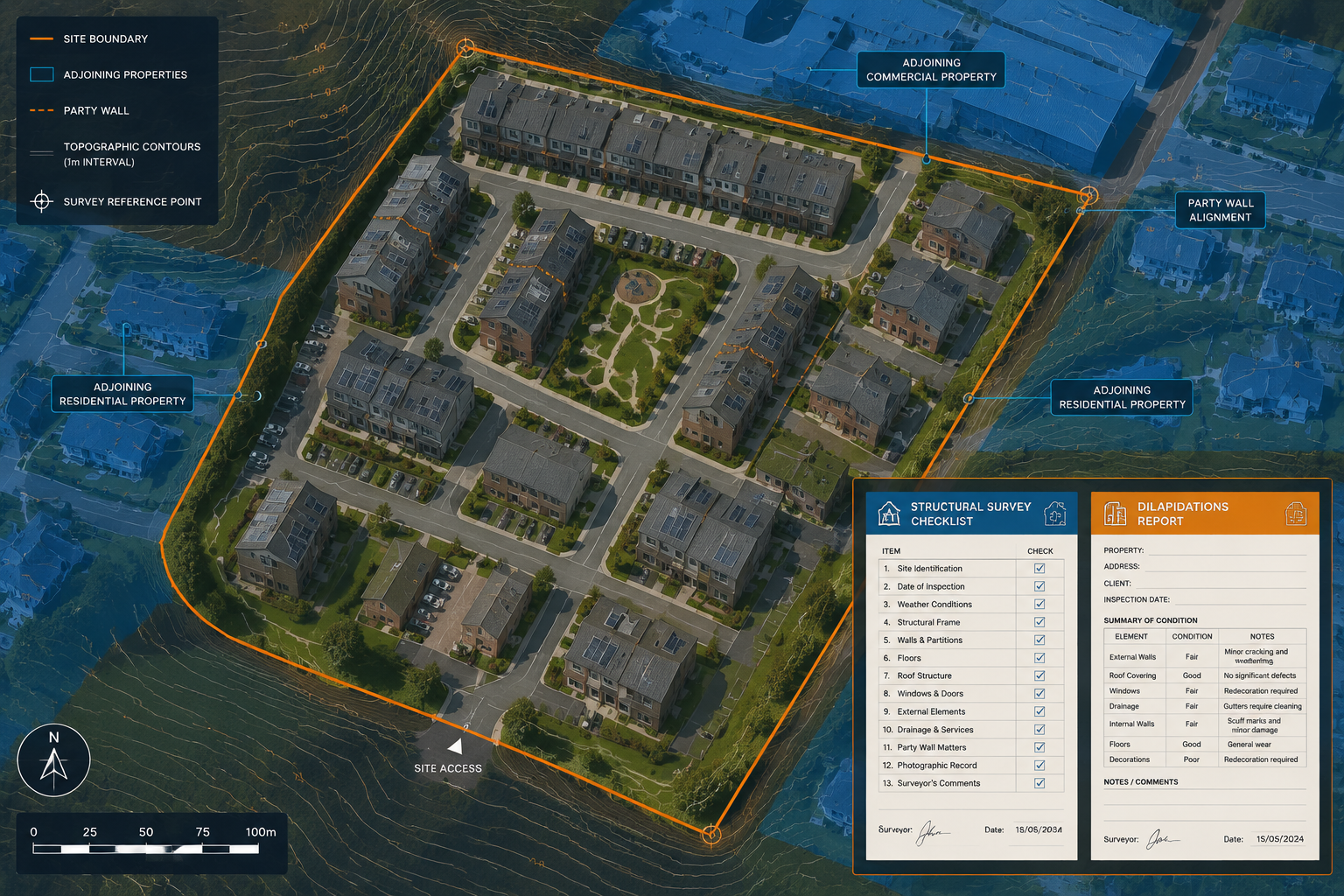
BTR developments in urban areas frequently involve construction adjacent to existing residential or commercial properties. The Party Wall etc. Act 1996 applies whenever works affect a shared wall, excavate near a neighbouring foundation, or build at or astride a boundary. In a BTR community of 200 or more units, the number of party wall notices required can be substantial.
Failing to serve the correct notices — or failing to appoint a surveyor when a neighbour dissents — exposes the developer to injunctions that can halt construction entirely. Understanding what a party wall dispute involves and how to prevent one is a core competency for any surveyor working on BTR schemes.
A party wall schedule of condition should be prepared for all neighbouring properties before groundworks begin. This document records the existing condition of adjacent structures and provides the evidential baseline if damage claims arise later. Given the scale of BTR developments and the vibration and ground movement associated with large-scale excavation, this protection is not merely procedural — it is financially critical.
Boundary Surveys and Dilapidations
Precise boundary delineation is one of the most technically demanding aspects of BTR surveying. In large communities, individual plot boundaries must align precisely with the overall site boundary, road layouts, and shared amenity areas. Errors in delineation can create title defects that affect the developer's ability to sell or refinance the completed asset.
A boundary survey in London for a BTR scheme should be conducted using GPS-referenced total station equipment and cross-referenced against Land Registry title plans and any historic conveyancing documents. Where title plans are ambiguous — which is common on large brownfield sites — a formal boundary determination may be required before planning is granted.
For BTR developers acquiring sites with existing tenancies or commercial leases, a commercial dilapidations survey may be necessary to assess the condition of outgoing occupiers' demises and calculate the cost of reinstatement before redevelopment begins.
"In large-scale BTR communities, precise surveying is crucial. Errors in boundary delineation or topographic assessments can lead to significant delays and increased costs." [7]
Regulatory Compliance and Asset Management Surveying
Surveying for build-to-rent developments: key considerations in the 2026 boom does not end at practical completion. The ongoing management of a BTR asset — particularly one held by an institutional investor with long-term income expectations — requires a structured approach to compliance surveying, rent review, and condition monitoring.

Snagging and Schedule of Condition at Practical Completion
When a BTR development reaches practical completion, a thorough snagging inspection identifies defects that the contractor must remedy before the developer accepts the building. In a 300-unit BTR community, snagging is not a simple walkthrough — it is a systematic, documented process that protects the developer's investment and the future residents' experience.
A professional snagging report for a BTR scheme should cover:
- Finish quality across all unit types and common areas
- Mechanical and electrical installations
- External works including landscaping, roads, and drainage
- Fire safety provisions and compartmentation
- Accessibility compliance
Alongside snagging, a schedule of condition report at handover creates a definitive record of the property's state at the point the developer takes possession. This document becomes the reference point for any future dilapidations claims at lease expiry, particularly relevant where commercial ground-floor units are included in the BTR scheme.
Rent Review and Valuation in a Shifting Market
BTR occupancy rates have remained relatively stable — single-family BTR occupancy stood at 94.9% as of late 2025 — but advertised rents declined by approximately 1% year-on-year, falling to around $2,180 per month in December 2025 [4]. This combination of stable occupancy but softening rents creates a nuanced environment for asset managers and their surveyors.
In the UK context, institutional BTR landlords typically hold assets on long-term leases with periodic rent review provisions. Engaging a surveyor experienced in rent review in London ensures that review clauses are exercised correctly, comparable evidence is properly assessed, and any disputes are resolved efficiently.
Accurate RICS-compliant valuations are also essential for refinancing, portfolio reporting, and regulatory compliance. BTR assets held by funds or REITs require regular Red Book valuations to satisfy lender covenants and investor reporting obligations.
Subsidence and Long-Term Structural Monitoring
BTR communities are long-term assets. Institutional investors typically hold them for 10 to 20 years or more. This holding period means that structural issues which might be tolerated in a short-term residential sale become significant liabilities in a managed rental portfolio.
Subsidence surveys in London and periodic structural inspections should be built into the asset management plan from day one. Sites in areas with shrinkable clay soils, proximity to tree roots, or legacy mining activity require more frequent monitoring. Early detection of movement prevents minor cracking from escalating into structural failure — and the associated insurance claims, tenant disruption, and reputational damage.
A schedule of dilapidations prepared at regular intervals throughout the asset's life allows the management team to plan maintenance expenditure accurately and avoid the accumulation of deferred repairs that erode asset value over time.
Choosing the Right Surveyor for a BTR Project
Not all surveyors have the experience or capacity to handle BTR developments at scale. The following criteria should guide the selection process:
RICS membership and BTR-specific experience
The surveyor should hold full RICS membership and be able to demonstrate experience on comparable BTR or large residential schemes. Generic residential survey experience is not sufficient for a 200-unit development.
Multi-discipline capability
BTR projects require input across topographic surveying, structural assessment, party wall matters, valuation, and dilapidations. A practice with multi-discipline capability reduces coordination risk and improves consistency of advice across the project lifecycle.
Local market knowledge
BTR viability is highly location-specific. A surveyor with strong knowledge of local planning policy, comparable rental evidence, and site-specific risks adds substantially more value than one unfamiliar with the area. Whether the development is in a major city or a regional growth corridor, local expertise matters.
Track record in regulatory compliance
BTR developers face a growing body of regulation covering fire safety, building standards, accessibility, and energy performance. Surveyors who stay current with legislative changes — including the Building Safety Act and evolving EPC requirements — protect their clients from compliance failures that can delay occupation or trigger enforcement action.
Conclusion
The 2026 BTR boom presents significant opportunities for developers, investors, and surveyors alike — but the scale and complexity of these projects demand a level of surveying rigour that goes well beyond standard residential practice. From topographic assessments and boundary surveys at acquisition through to party wall compliance, snagging, and long-term structural monitoring, every stage of a BTR development carries surveying obligations that directly affect financial outcomes.
Actionable next steps for developers and investors entering the BTR market in 2026:
- Commission a full topographic and boundary survey before submitting any planning application — do not rely on Land Registry title plans alone.
- Appoint a party wall surveyor at the earliest stage of design to identify all neighbouring properties that will require notices under the Party Wall etc. Act 1996.
- Build structural and roof surveys into the acquisition due diligence process for any site with existing buildings.
- Establish a snagging and schedule of condition protocol before practical completion to protect against contractor disputes.
- Engage a RICS-qualified surveyor with BTR experience for ongoing rent review, valuation, and dilapidations management throughout the asset holding period.
The pipeline data is clear: the BTR sector is consolidating around experienced operators who invest properly in professional services. Surveying is not a cost to be minimised — it is a risk management tool that protects one of the most capital-intensive asset classes in the modern property market.
References
[1] Btr Under Construction 2026 – https://www.realpage.com/analytics/btr-under-construction-2026/?utm_source=openai
[2] Real Estate Investing Platforms Build To Rent Properties – https://ark7.com/blog/learn/in-depth/real-estate-investing/real-estate-investing-platforms-build-to-rent-properties/?utm_source=openai
[3] Why Build To Rent Is Shaping The Housing Market In 2026 – https://www.matthews.com/insights/why-build-to-rent-is-shaping-the-housing-market-in-2026?utm_source=openai
[4] Yardi Matrix Research Reveals Stable Single Family Build To Rent Occupancy Amid Negative Rent Growth – https://www.yardi.com/news/press-releases/yardi-matrix-research-reveals-stable-single-family-build-to-rent-occupancy-amid-negative-rent-growth/?utm_source=openai
[5] Live And Kicking Lsh Build To Rent Report 2026 – https://www.lsh.ie/explore/research-and-views/research/2026/may/live-and-kicking—lsh-build-to-rent-report-2026?utm_source=openai
[7] Surveying Demands For Build To Rent Communities Navigating New Development Trends – https://www.canterburysurveyors.com/blog/surveying-demands-for-build-to-rent-communities-navigating-new-development-trends/?utm_source=openai