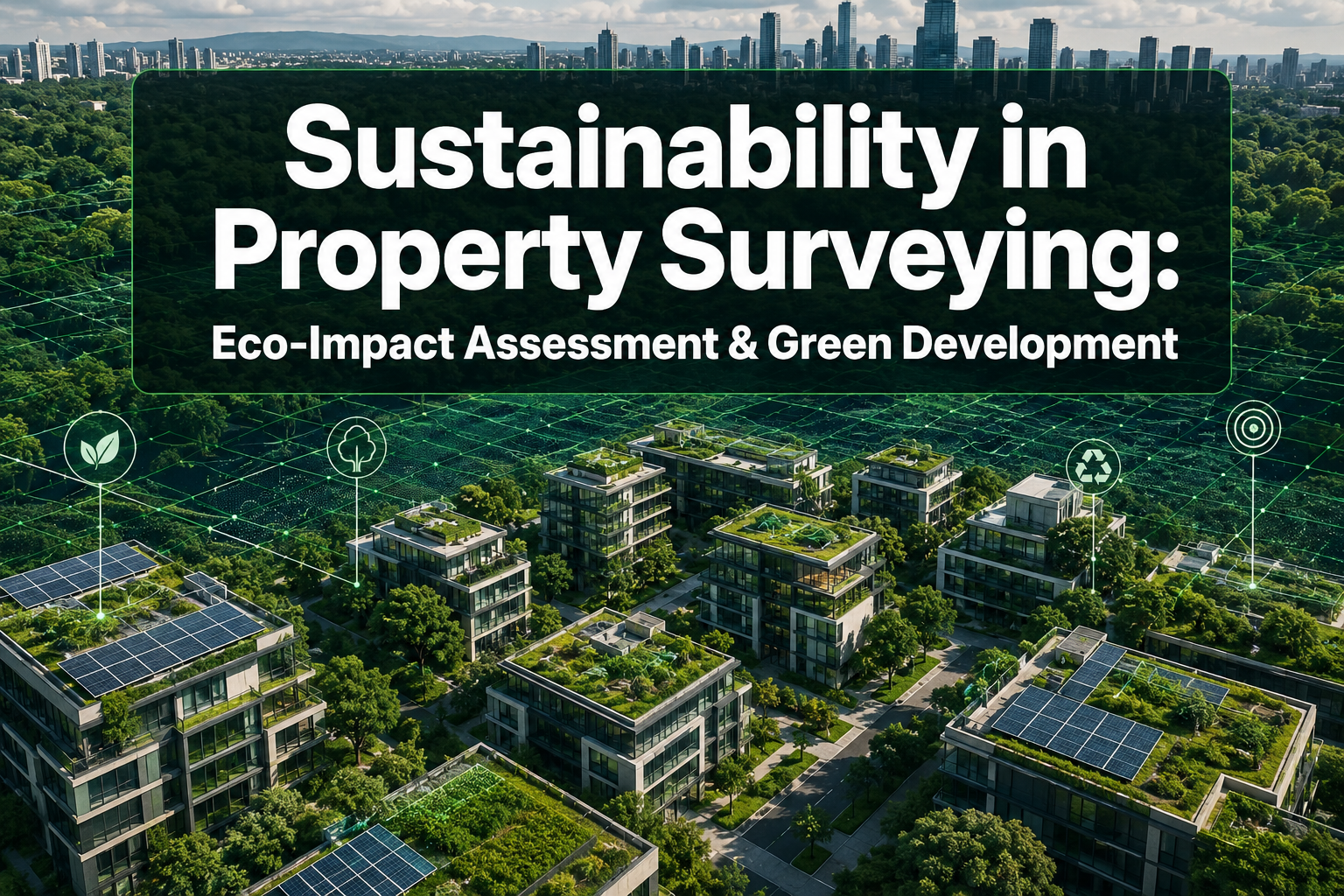

By June 2026, 87% of institutional investors representing $6.3 trillion in real estate assets now require third-party verified sustainability data before completing any acquisition — a figure that would have seemed extraordinary just five years ago [10]. That single statistic signals a fundamental shift in what property surveying means in practice. Sustainability in property surveying: tools for eco-impact assessment and green development are no longer optional add-ons for forward-thinking firms. They are regulatory requirements, investment prerequisites, and competitive differentiators rolled into one.

This article examines the specific technologies, standards, and methodologies that chartered surveyors are deploying in 2026 to meet stricter environmental rules, satisfy investor demand, and support genuinely greener development outcomes.
Key Takeaways
- RICS now mandates carbon footprint calculations and climate risk assessments for all commercial property surveys, effective mid-2026 [1].
- The 2026 ALTA Survey Standards require environmental constraints — including flood risk, brownfield status, and habitat proximity — as standard boundary survey components [4].
- Digital tools including drone surveys, thermal imaging, BIM integration, and AI-powered data platforms are central to modern eco-impact assessment.
- Investor pressure is accelerating adoption: 72% of institutional investors specifically request surveyor-certified energy performance metrics before transaction completion [10].
- Surveyors who build competency in green assessment tools will be better positioned for regulatory compliance, client retention, and career growth.
Why Sustainability Has Become Central to Property Surveying
The surveying profession has historically focused on physical condition, boundary accuracy, and market value. That scope has expanded dramatically. Climate legislation, net-zero commitments, and evolving RICS standards have repositioned the surveyor as a frontline assessor of environmental risk and ecological impact.
Three converging forces are driving this change:
- Regulatory tightening — RICS released its updated "Sustainability Practice for Surveyors" standard in June 2026, making carbon footprint calculations mandatory for all commercial property assessments and requiring specific measurement of embodied carbon in building materials during due diligence [1].
- Investor expectations — The GRESB MIPIM 2026 survey found that 72% of major investors specifically request surveyor-certified energy performance metrics before a transaction completes [10].
- Climate risk disclosure — A mandatory Climate Risk Assessment Module for all RICS-registered valuers took effect on July 1, 2026, requiring surveyors to evaluate physical climate risks — flood, heat stress, and coastal erosion — using Environment Agency flood maps updated within the last 90 days for all commercial valuations over £1 million [3].
"Sustainability is no longer a niche specialism within surveying — it is the baseline expectation for any professional operating in the commercial or residential market in 2026." — RICS Sustainability Practice Update, June 2026 [1]
For chartered surveyors across London and the South East, these changes mean that every site visit, every valuation report, and every condition assessment now carries an environmental dimension that must be documented, quantified, and disclosed.
Core Tools for Eco-Impact Assessment in Property Surveying
Remote Sensing and Drone Technology
Drone-based surveys have become one of the most powerful tools for ecological data capture. Beyond inspecting roof conditions and structural defects, modern drones equipped with multispectral and thermal sensors can map vegetation health, identify heat loss patterns, detect water ingress, and assess solar potential — all in a single flight.
A drone roof survey can now generate thermal imaging data that feeds directly into energy performance calculations, reducing the need for invasive access while producing richer datasets than traditional visual inspections. This is particularly valuable for large commercial buildings where full access is impractical and where energy efficiency data is required for EPC compliance.
Key capabilities of drone-based eco-assessment:
| Sensor Type | Environmental Data Captured | Surveying Application |
|---|---|---|
| Thermal infrared | Heat loss, insulation gaps | EPC assessment, retrofit planning |
| Multispectral | Vegetation health, land cover | Habitat proximity mapping |
| LiDAR | Topography, flood modelling | Climate resilience assessment |
| RGB high-resolution | Roof condition, solar panel status | Green development feasibility |
For standard roof surveys, integrating thermal imaging alongside visual inspection now provides a dual-purpose output: structural condition data and energy performance data in a single report.
Building Information Modelling and Embodied Carbon Calculation
Building Information Modelling (BIM) has evolved from a design coordination tool into a sustainability assessment platform. In 2026, BIM platforms integrated with carbon databases — such as the Inventory of Carbon and Energy (ICE) and RICS's own carbon data tools — allow surveyors to calculate embodied carbon in existing building materials during due diligence, as now required under the updated RICS standard [1].
Embodied carbon refers to the greenhouse gas emissions associated with the manufacture, transport, and installation of building materials. It is distinct from operational carbon (energy used to run a building) and is increasingly scrutinised as buildings become more energy-efficient in operation. Surveyors conducting commercial building assessments must now account for both.
For teams conducting commercial building surveys, BIM integration enables:
- Material quantity take-offs linked to carbon coefficients
- Whole-life carbon comparisons between refurbishment and demolition options
- BREEAM and LEED certification support documentation
- Retrofit feasibility modelling against net-zero targets
Environmental Risk Mapping Platforms
The 2026 ALTA Survey Standards, effective June 1, 2026, now require surveyors to document environmental constraints — including flood risk zones, brownfield status, and proximity to protected habitats — as standard components of boundary surveys [4]. This has accelerated adoption of GIS-based environmental risk mapping platforms.
Tools such as Groundsure, Landmark Information Group, and the Environment Agency's own digital mapping services allow surveyors to overlay multiple environmental datasets onto a single property footprint. The output is a composite risk profile that covers:
- Flood risk (fluvial, surface water, coastal, groundwater)
- Contaminated land (historical industrial use, landfill proximity)
- Ecological constraints (Sites of Special Scientific Interest, ancient woodland buffers)
- Air quality zones (Clean Air Zone designations)
- Ground stability (mining subsidence, shrink-swell clay)
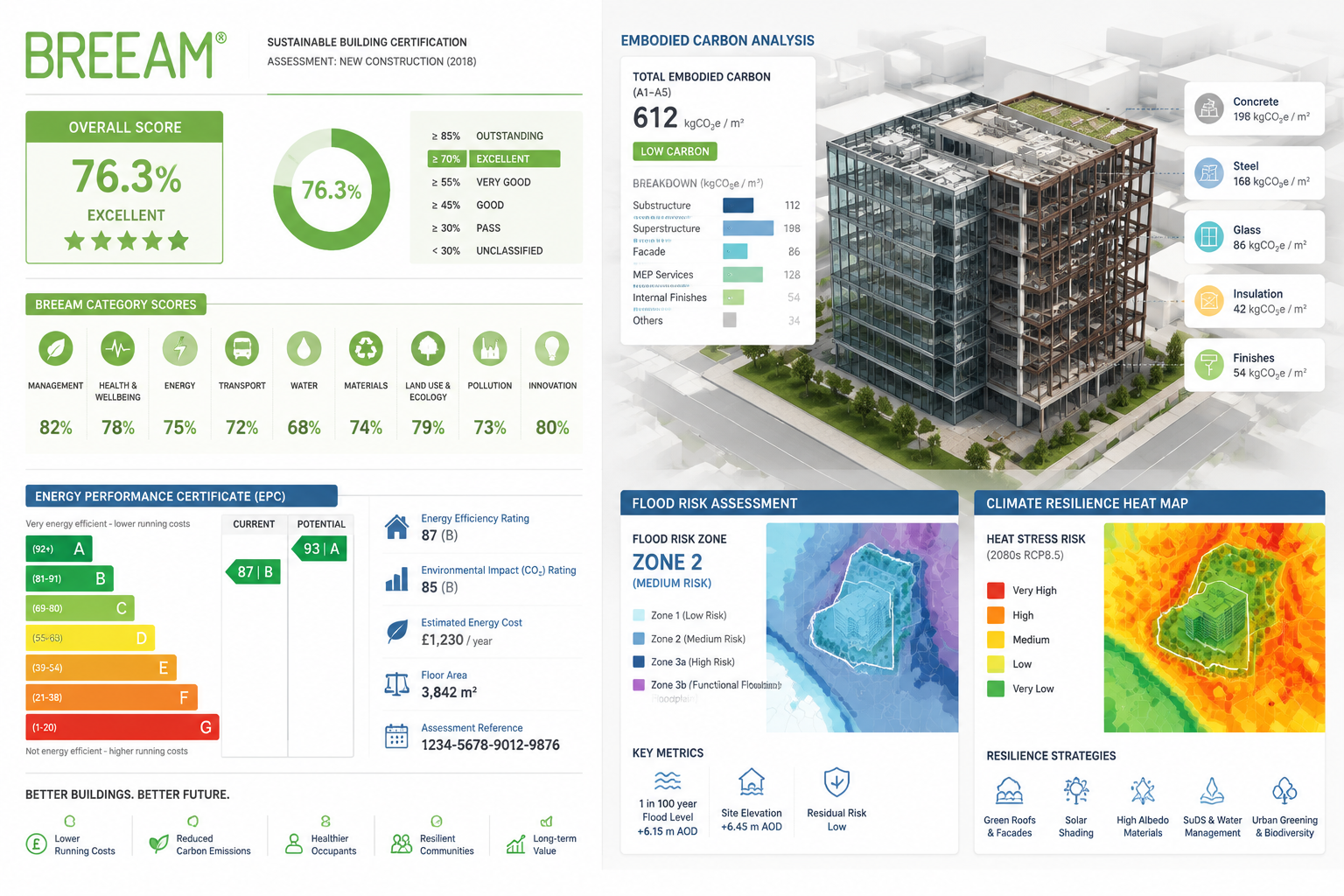
This data is not merely informational. Under the July 2026 RICS Climate Risk Assessment Module, surveyors must use Environment Agency flood maps updated within the last 90 days when preparing commercial valuations over £1 million [3]. Stale data is no longer acceptable. The requirement for current, verified environmental data is reshaping how surveyors source, store, and audit their mapping inputs.
Energy Performance and Green Rating Certification Tools
Energy Performance Certificates (EPCs) remain the most widely recognised sustainability metric in UK property transactions, but they are increasingly supplemented by more detailed green rating frameworks. BREEAM (Building Research Establishment Environmental Assessment Method) and NABERS UK (National Australian Built Environment Rating System, now operating in the UK) provide operational performance ratings that go beyond the modelled energy use captured in EPCs.
Surveyors supporting green development projects are now expected to be familiar with:
- BREEAM New Construction and In-Use ratings
- NABERS UK operational energy ratings for offices
- WELL Building Standard assessments (occupant health and wellbeing)
- Passivhaus certification criteria for residential development
A schedule of condition report prepared at the outset of a green retrofit project creates a verified baseline against which post-refurbishment performance can be measured — a practice increasingly requested by institutional landlords seeking to evidence sustainability improvements to investors.
Regulatory Compliance and the Surveyor's Evolving Role
RICS Mandatory Standards in 2026
The June 2026 RICS "Sustainability Practice for Surveyors" standard represents the most significant update to professional obligations in a generation [1]. Its core requirements include:
- Mandatory carbon footprint calculations for all commercial property assessments
- Embodied carbon measurement during material due diligence
- Climate risk reporting using current, verified data sources
- Sustainability competency as a requirement for CPD and professional development
These are not aspirational guidelines. They are enforceable standards. Surveyors who fail to meet them risk disciplinary action and, more practically, the loss of institutional clients who now audit their professional advisors' sustainability credentials as part of procurement processes [1].
The profession's response has been significant. Research published in early 2026 found that sustainable development practices are increasingly embedded in surveying curricula, with green assessment competencies now forming part of APC (Assessment of Professional Competence) pathways [2].
The Dilapidations Context
Sustainability obligations are also reshaping dilapidations practice. When a lease ends, the question of whether a tenant must reinstate alterations — or whether a landlord can require energy-efficiency upgrades as part of a dilapidations settlement — is becoming a live legal and surveying issue. Dilapidation surveys now increasingly incorporate energy performance baselines so that any deterioration in a building's environmental performance during a lease can be quantified and costed.
Similarly, snagging reports for new-build properties in 2026 routinely include checks against green specification requirements — verifying that insulation thicknesses, air permeability rates, and renewable energy installations match what was promised in planning consents and sales particulars.
Green Development Assessment: From Site Selection to Post-Occupancy
Pre-Development Ecological Assessment
Sustainability in property surveying: tools for eco-impact assessment and green development begin long before any planning application is submitted. Pre-development ecological surveys — Phase 1 Habitat Surveys, protected species assessments, and biodiversity net gain calculations — are now statutory requirements under the Environment Act 2021, with mandatory 10% biodiversity net gain having applied to most developments in England since February 2024.
Surveyors working on development sites must coordinate with ecologists and use spatial data platforms to demonstrate that proposed schemes will deliver measurable biodiversity improvements. The 2026 ALTA standards reinforce this by requiring habitat proximity mapping as a standard survey output [4].
Biodiversity net gain assessment steps:
- Baseline habitat mapping using drone imagery and field survey
- Habitat scoring using the DEFRA Biodiversity Metric 4.0
- Identification of habitat enhancement and creation opportunities
- Post-development monitoring plan with measurable KPIs
Climate Resilience and Adaptation Planning
Physical climate risk is now a core component of property valuation and development appraisal. Surveyors are expected to assess how a property or proposed development will perform under projected climate scenarios — not just current conditions.
Properties in high flood-risk zones are already experiencing measurable valuation discounts, and surveyors who cannot quantify climate risk exposure are failing their clients at the most fundamental level.
For residential structural engineers and surveyors working on retrofit and adaptation projects, this means specifying materials and design interventions that address future climate conditions: improved drainage, flood-resilient construction, heat-reflective roofing, and passive cooling strategies.
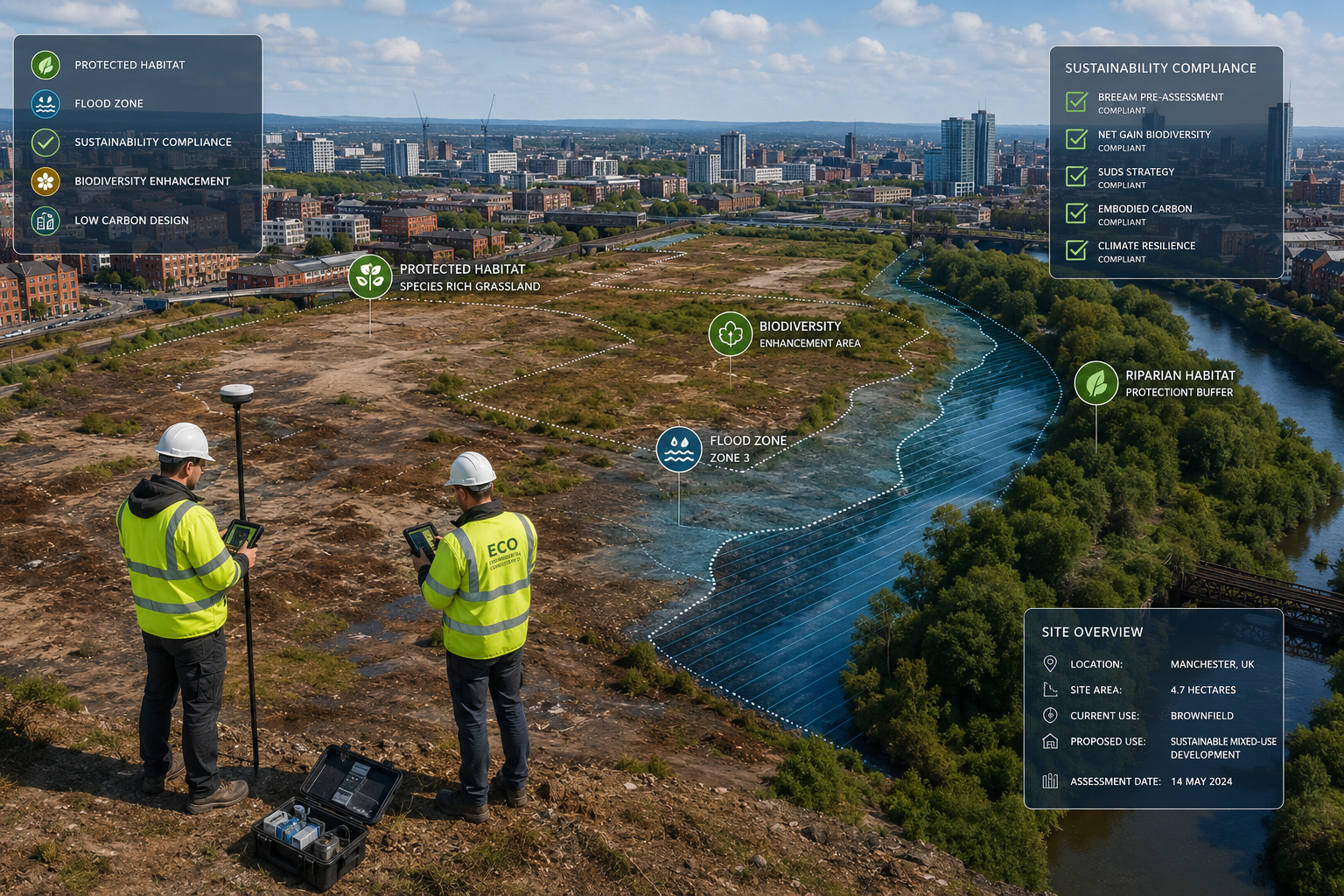
The RICS webinar series on adapting existing real estate assets to climate risk has highlighted that the majority of the UK's building stock will still be standing in 2050 — meaning retrofit, not new build, is where most climate adaptation work will occur [6]. Surveyors are therefore central to identifying which buildings can be economically retrofitted and which represent stranded asset risks.
Valuation and the Green Premium
Sustainability credentials are increasingly reflected in property values. Research consistently shows that buildings with higher EPC ratings, verified green certifications, and demonstrable low-carbon performance command rental and capital value premiums over comparable non-certified assets [8].
For surveyors preparing valuation reports, this means that sustainability data is no longer background context — it is a material input to the valuation itself. Comparable evidence must be analysed for energy performance, and adjustments must be made where the subject property's sustainability profile differs materially from comparables.
The RICS Red Book valuation standards already require valuers to consider all factors that would influence a hypothetical purchaser. In 2026, a sophisticated purchaser in the commercial market will almost certainly factor in EPC ratings, climate risk exposure, and green certification status. Failing to reflect these in a valuation is increasingly difficult to justify.
Building Surveyor Competency: Skills and Tools for 2026
The expansion of sustainability obligations demands new skills from surveyors at every level. The SCSI (Society of Chartered Surveyors Ireland) Sustainability Resource Guide identifies several core competency areas that are directly transferable to UK practice [5]:
- Carbon literacy — understanding operational and embodied carbon, carbon budgets, and net-zero pathways
- Climate risk assessment — using GIS and flood mapping tools to quantify physical risk
- Green rating systems — familiarity with BREEAM, EPC methodology, NABERS, and WELL
- Biodiversity and ecology — understanding habitat assessment frameworks and biodiversity net gain
- Sustainable procurement — advising on low-carbon materials and circular economy principles
Professional development in these areas is no longer optional. The updated RICS CPD requirements for 2026 include mandatory sustainability-related learning hours, and the profession is actively developing new qualifications in climate risk and green assessment [9].
Conclusion
Sustainability in property surveying: tools for eco-impact assessment and green development have moved from the margins to the mainstream of professional practice. The regulatory landscape of 2026 — shaped by updated RICS standards, mandatory climate risk modules, revised ALTA survey requirements, and investor-driven ESG expectations — demands that surveyors are equipped with both the technical tools and the professional knowledge to deliver credible, compliant, and commercially relevant sustainability assessments.
Actionable next steps for surveyors and property professionals:
- Audit your current toolkit. Identify gaps in your use of environmental risk mapping platforms, carbon calculation tools, and drone-based data capture.
- Review RICS CPD requirements. Ensure your continuing professional development includes the mandatory sustainability hours and covers the June 2026 standard updates [1].
- Integrate sustainability data into every report. Whether preparing a valuation, a condition survey, or a dilapidations assessment, sustainability metrics should be a standard section — not an afterthought.
- Engage with specialist ecologists and climate risk consultants. Surveyors do not need to be ecologists, but they do need to know when specialist input is required and how to integrate it into their assessments.
- Communicate the green premium to clients. Help clients understand that sustainability investment is reflected in asset values, rental demand, and transaction certainty.
The surveyors who will lead their firms through the next decade are those who treat eco-impact assessment not as a compliance burden but as a core professional service — one that protects clients, supports better development outcomes, and contributes to a built environment that is genuinely more resilient.
References
[1] Sustainability Practice For Surveyors June 2026 – https://www.rics.org/content/dam/ricsglobal/documents/standards/Sustainability-practice-for-surveyors_June-2026.pdf
[2] Vol10 Iss1 Pg5810 5822 202602 Pdf – https://rsisinternational.org/journals/ijriss/uploads/vol10-iss1-pg5810-5822-202602_pdf.pdf
[3] Jclemen Surveying Rics Construction Activity – https://www.linkedin.com/posts/jclemen_surveying-rics-construction-activity-7424059489093472256-JuHX
[4] 2026 Alta Survey Standard Changes – https://www.envdesigngroup.com/resources/2026-alta-survey-standard-changes/
[5] Surveyors Declare Sustainability Resource Guide Scsi – https://scsi.ie/wp-content/uploads/2023/05/Surveyors-Declare-Sustainability-Resource-Guide-SCSI.pdf
[6] Global Adapting Existing Real Estate Assets Climate Risk Retrofit Future Role Surveyors Webinar – https://www.rics.org/training-events/online-training/scheduled/global-adapting-existing-real-estate-assets-climate-risk-retrofit-future-role-surveyors-webinar
[7] Scsi Sustainable Development – https://www.aeebc.org/docs/SCSI_Sustainable_Development.pdf
[8] Sustainability For Surveyors – https://www.isurv.com/downloads/36/sustainability_for_surveyors
[9] Sustainability Net Zero And The Surveying Profession – https://www.jarsolutions.co.uk/blog/2025/11/sustainability-net-zero-and-the-surveying-profession-what-your-career-needs-to-know
[10] Sustainability Remains Central For Real Estate Investors Despite Esg Pushback Gresb Mipim Survey Finds – https://www.gresb.com/insights/sustainability-remains-central-for-real-estate-investors-despite-esg-pushback-gresb-mipim-survey-finds/