Fewer than eight weeks after becoming mandatory, the RICS global AI standard is already reshaping how surveyors defend their valuations in court. Since March 9, 2026, every RICS member and regulated firm worldwide must comply with the first-ever professional standard governing responsible AI use in surveying — and the implications for expert witness credibility are profound [1]. For building surveyors deploying AI-driven valuation tools in building surveys, the question is no longer whether to embrace automation, but whether they can withstand cross-examination when an algorithm underpins their figures.
This article examines how AI-driven valuation tools in building surveys intersect with RICS standards for 2026 expert witness credibility — covering automated defect detection, valuation adjustment methodologies, mandatory compliance obligations, and courtroom defence strategies that every practising surveyor needs to understand right now.
Key Takeaways 📋
- RICS made AI governance mandatory on March 9, 2026 — all members must comply or face disciplinary consequences.
- Named surveyor accountability is non-negotiable: a qualified professional must sign off on every AI-assisted output in writing.
- Written client disclosure of AI involvement is compulsory before any valuation service begins.
- Explainability on demand — surveyors must be able to articulate AI methodology, limitations, and risk management to courts and clients.
- Dip sampling protocols and risk registers are now standard practice for high-volume AI outputs used as evidence.
How AI Is Automating Defect Detection and Valuation Adjustments
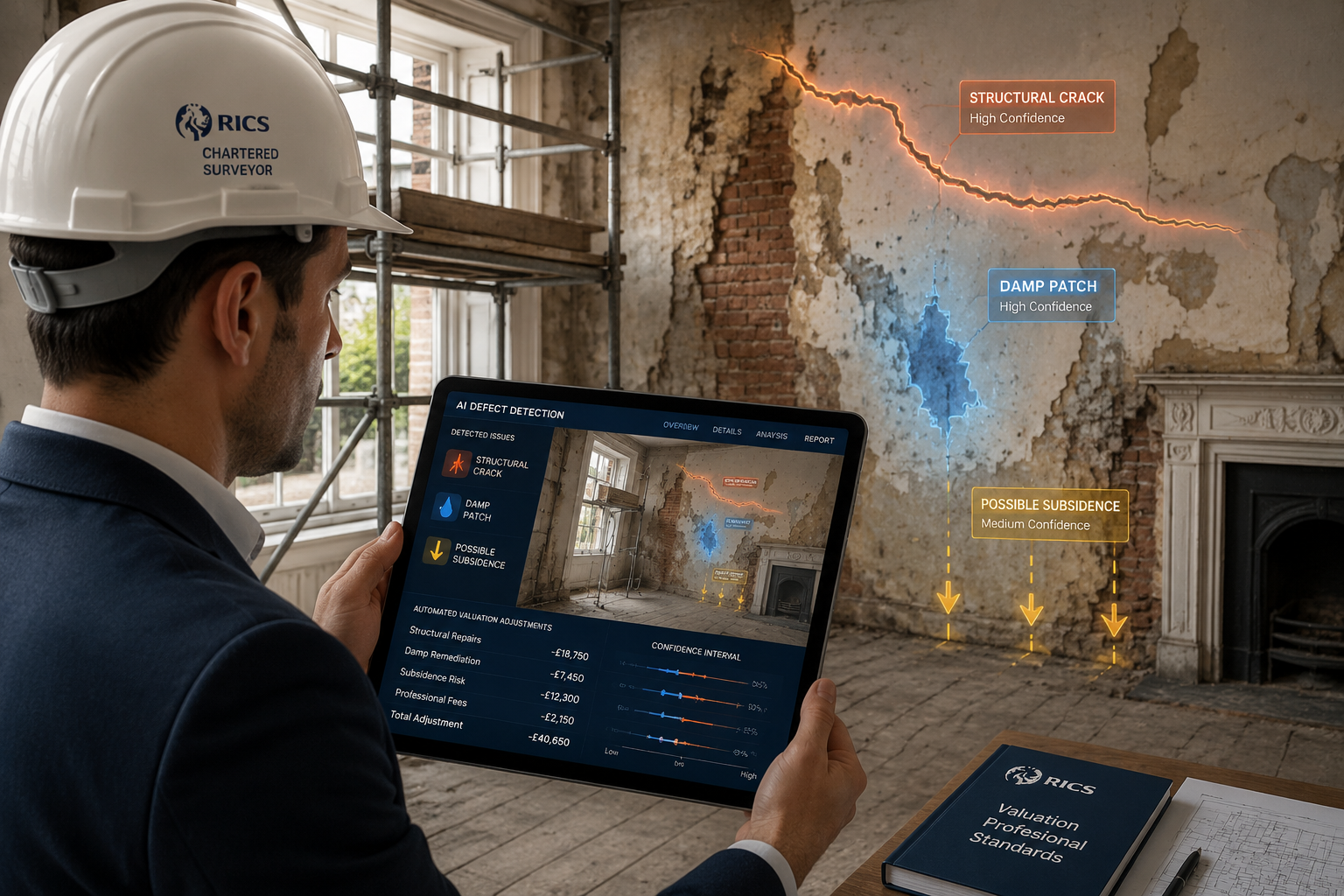
The integration of machine learning into building surveys has accelerated dramatically in 2026. Automated valuation models (AVMs), computer vision tools, and predictive analytics platforms can now scan thousands of comparable transactions, identify structural anomalies from drone or thermal imaging data, and generate valuation adjustments within seconds. For chartered surveyors in London and beyond, these tools offer genuine efficiency gains — but they also introduce new layers of professional risk.
Automated Defect Detection: What the Technology Actually Does
Modern AI defect detection systems use convolutional neural networks trained on millions of property images to flag:
- Structural cracking patterns — distinguishing settlement cracks from subsidence indicators
- Damp and moisture ingress — via thermal imaging analysis integrated with survey data
- Roof deterioration — detecting tile displacement, sagging rafters, and flashing failures
- Facade degradation — identifying spalling brickwork, failed pointing, and render delamination
These outputs feed directly into valuation adjustment engines that apply percentage deductions or additions based on defect severity scores. A specific defect report that once required hours of manual assessment can now be augmented with AI-generated condition ratings in minutes.
Valuation Adjustment Automation: The Opportunity and the Risk
"AI can process comparable evidence at a scale no human surveyor can match — but the model's blind spots become the expert witness's liability."
Automated valuation adjustment tools cross-reference defect severity scores against local market data, lease terms, and comparable sales to produce adjusted capital values. For complex instructions — such as commercial dilapidation surveys in London or insurance reinstatement valuations — AI can dramatically reduce turnaround time.
However, the risks are equally significant:
| Risk Category | Example Scenario | Expert Witness Exposure |
|---|---|---|
| Training data bias | Model trained on urban stock misapplies to rural properties | Valuation challenged as statistically unreliable |
| Failure mode opacity | AI flags false positive subsidence crack | Report overstates remediation costs |
| Market lag | Model uses stale comparable data | Adjusted value materially incorrect |
| Explainability gap | Surveyor cannot articulate algorithm logic | Cross-examination destroys credibility |
Understanding these failure modes is now a baseline professional requirement under the RICS standard — not optional knowledge [6].
RICS Standards for 2026 Expert Witness Credibility: The Mandatory Framework
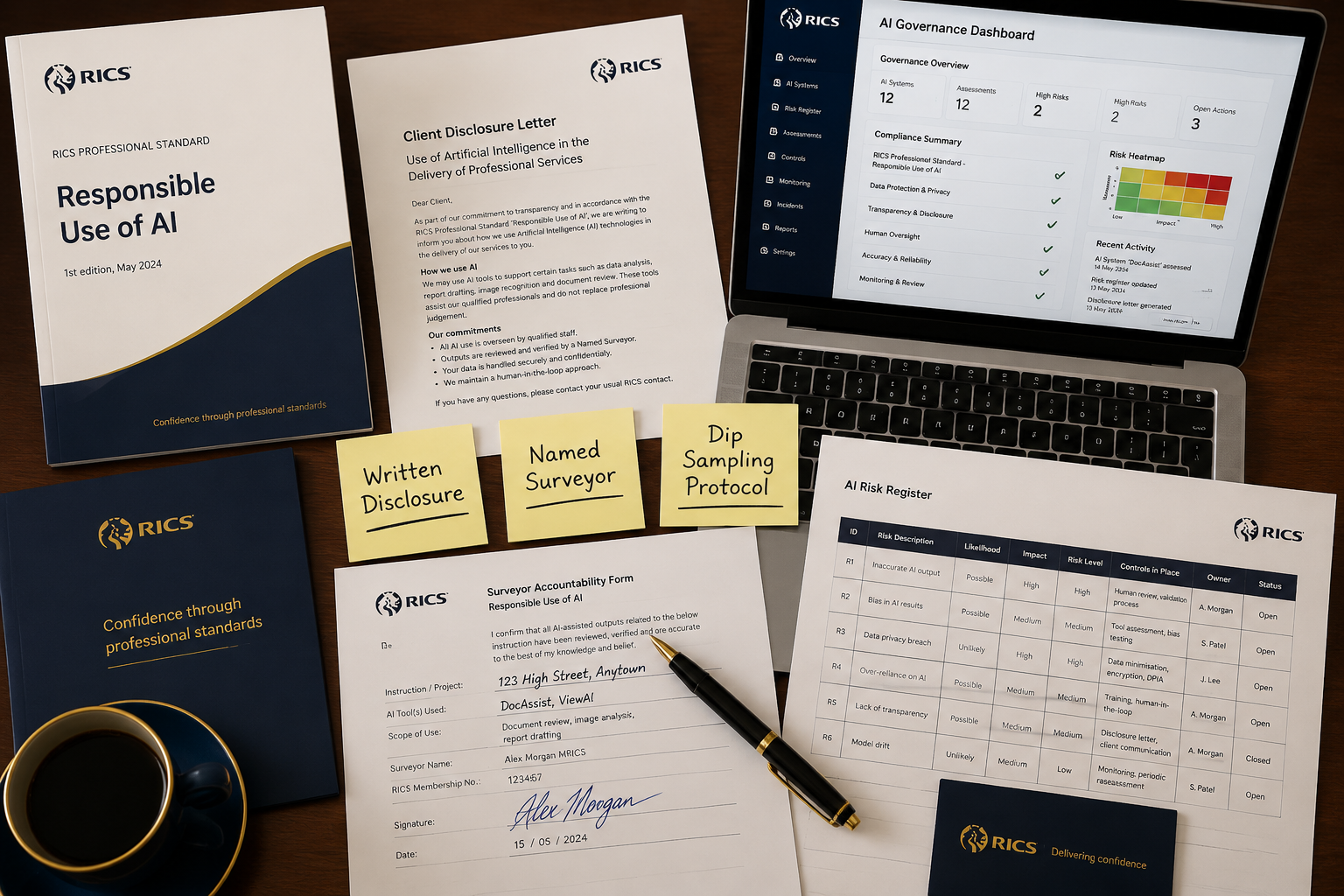
The RICS Responsible Use of AI professional standard — published September 10, 2025, and mandatory since March 9, 2026 — is the first such framework from any major built environment institution globally [6]. Its requirements directly affect how AI-driven valuation tools in building surveys are presented, documented, and defended in legal proceedings.
Core Obligations Every Expert Witness Must Meet
1. Named Surveyor Accountability
Every AI-assisted valuation output must be reviewed and signed off by a named, appropriately qualified surveyor who accepts full professional responsibility for its content [6]. Anonymous algorithmic outputs are not acceptable as expert evidence. The surveyor's professional judgement must be documented in writing — not implied.
2. Written Client Disclosure
Before deploying any AI tool in a valuation service, clients must receive written notification explaining:
- Which AI systems will be used
- How those systems will influence the output
- What options exist for redress or opting out [7]
In expert witness contexts, this disclosure obligation extends to all parties who may rely on the report. Failure to disclose AI involvement could be characterised as a material omission in legal proceedings.
3. Baseline AI Literacy
Surveyors using AI systems must demonstrate understanding of [6]:
- Different AI system types (machine learning, large language models, rule-based systems)
- Known failure modes and limitations
- Inherent bias risks from training data
- Data usage and privacy risks
This knowledge is now expected to be demonstrable under cross-examination. A surveyor who cannot explain how their AI tool works — or what its limitations are — faces a serious credibility problem in court.
4. Explainability on Demand
On request from any interested party, surveyors must provide written information covering [9]:
- The type of AI system used
- Its known limitations
- Due diligence conducted before use
- Risk management procedures applied
- The named surveyor's reliability assessment
This requirement effectively creates a mandatory audit trail for every AI-assisted valuation presented as evidence.
Risk Registers and Due Diligence Documentation
RICS-regulated firms must now maintain formal risk registers covering AI system governance, data use policies, and due diligence procedures [1]. Before procuring any third-party AI tool with material impact on service delivery — such as an automated valuation model used in RICS valuation reports in London — firms must document:
- ✅ Data quality assessments
- ✅ Stakeholder involvement records
- ✅ Sustainability and environmental impact assessments
- ✅ Legal compliance checks
- ✅ Consent and anonymisation protocols for private client data [9]
The Dip Sampling Protocol
For high-volume AI outputs — such as bulk residential valuations or portfolio assessments — RICS permits firms to scrutinise random samples at regular intervals rather than reviewing every single output [6]. This dip sampling methodology must be documented and defensible. In expert witness terms, the sampling frequency, selection methodology, and review findings must all be available for disclosure.
Defending AI-Assisted Reports in Court: Strategies for 2026

The spring 2026 legal landscape is already seeing challenges to AI-assisted valuations in dilapidations disputes, lease extension tribunals, and property litigation. Understanding how to defend AI-driven valuation tools in building surveys against automated model challenges is now a core competency for any surveyor acting as an expert witness.
Building a Defensible AI Methodology
Step 1: Document Everything Before the Instruction Begins
The moment an AI tool is selected for a valuation instruction, the documentation process must start. This includes:
- Tool selection rationale (why this AI system for this property type?)
- Data quality assessment for the specific instruction
- Known limitations relevant to the subject property
- The named surveyor's initial reliability assessment
For specialist valuations — such as Charities Act valuations or capital gains tax valuations — the AI tool's training data relevance to the specific asset class must be explicitly assessed and recorded.
Step 2: Apply Professional Scepticism to Every Output
The RICS standard is unambiguous: surveyors must not simply accept AI outputs at face value [6]. Professional scepticism requires:
- Comparing AI-generated comparable evidence against the surveyor's own market knowledge
- Identifying outputs that appear anomalous or inconsistent with local conditions
- Overriding AI recommendations where professional judgement demands it — and documenting why
"The AI is a tool, not the expert. Courts appoint the surveyor, not the algorithm."
Step 3: Prepare for Cross-Examination on AI Methodology
Barristers challenging AI-assisted valuations in 2026 are increasingly sophisticated. Surveyors should anticipate questions including:
- "What training data was this model built on, and how recent is it?"
- "What is the model's margin of error for this property type?"
- "Did you independently verify the comparable evidence the AI selected?"
- "What would the valuation be without the AI adjustment?"
- "Who at your firm reviewed the AI output, and what is their qualification?"
Preparation for these questions is not optional — it is now a professional standard requirement [9].
Step 4: Leverage the RICS Standard as a Credibility Asset
Paradoxically, full compliance with the RICS AI standard strengthens expert witness credibility rather than undermining it. A surveyor who can demonstrate:
- A completed risk register for the AI tool used
- Written client disclosure provided in advance
- Named surveyor sign-off with documented reliability assessment
- Dip sampling records where applicable
- Explainability documentation prepared for the instruction
…presents as a rigorous, accountable professional — precisely the qualities courts look for in expert witnesses.
Sector-Specific Considerations
Different valuation contexts carry different AI risk profiles:
Dilapidations and Schedule of Condition Work
AI tools that automate condition ratings for schedules of dilapidations must be validated against the specific lease terms and property age. Training data bias toward modern commercial stock can produce unreliable outputs for older industrial or retail premises.
Lease Extension and Enfranchisement Valuations
Lease extension valuations in London involve highly specific statutory assumptions under the Leasehold Reform Act. AI tools trained on general residential data may not adequately reflect the leasehold premium calculation methodology required by the First-tier Tribunal.
Retrospective Valuations
Retrospective property valuations require AI tools to accurately reconstruct historical market conditions. The risk of market lag in training data is particularly acute — and must be explicitly addressed in the expert witness report.
What to Expect Later in 2026
RICS has confirmed that dedicated sector-specific guidance — Artificial Intelligence in Real Estate Valuation (Global Practice Guidance 1st Edition) — was in public consultation during Q2 2026 and is expected to be published later this year [3]. This guidance will provide more granular standards for AI use specifically within valuation practice, likely tightening requirements around comparable evidence selection, automated adjustment methodologies, and disclosure in formal reports.
Surveyors should monitor RICS publications closely and ensure their AI governance frameworks are ready to incorporate these additional requirements as soon as they are released.
Data Governance: Protecting Client Confidentiality and Expert Credibility
Data governance is an often-overlooked dimension of AI-driven valuation tools in building surveys that carries direct implications for RICS standards and 2026 expert witness credibility.
The mandatory standard requires firms to implement [9]:
- Secure handling of all private and confidential client data
- Restricted access controls for data uploaded to AI systems
- Anonymisation procedures before data enters third-party AI platforms
- Documented consent for any private data used in AI processing
In expert witness terms, a failure in data governance — for example, uploading confidential client financial data to an AI tool without consent — could result in both regulatory sanction and the exclusion of the resulting valuation evidence from proceedings.
Environmental impact assessments are also now required for firms developing proprietary AI systems or deploying tools with material service delivery impact [6]. While this may seem peripheral to expert witness work, it reflects the broader accountability framework that courts will increasingly expect surveyors to demonstrate.
Conclusion: Actionable Steps for Surveyors in 2026
The mandatory RICS AI standard has fundamentally changed what it means to be a credible expert witness in property valuation disputes. AI-driven valuation tools in building surveys offer powerful capabilities — but they demand equally powerful governance frameworks to withstand legal scrutiny.
Immediate Actions for Practising Surveyors ✅
- Audit your current AI tools — compile a list of every AI system used in valuation work and assess each against the RICS standard's requirements.
- Create or update your risk register — document data governance policies, due diligence procedures, and AI system assessments for each tool.
- Implement written disclosure templates — prepare standardised client disclosure letters for all AI-assisted instructions before the next instruction arrives.
- Designate named surveyors — ensure every AI-assisted output has a qualified, named professional who accepts documented accountability.
- Train for cross-examination — conduct internal mock cross-examinations on AI methodology to identify knowledge gaps before they surface in court.
- Monitor RICS publications — the forthcoming AI in Real Estate Valuation guidance will add further requirements; build flexibility into governance frameworks now.
The surveyors who thrive as expert witnesses in 2026 and beyond will be those who treat the RICS AI standard not as a compliance burden, but as a professional differentiator — demonstrating to courts, clients, and counterparties that their AI-assisted valuations are rigorous, transparent, and fully accountable.
References
[1] RICS Launches Landmark Global Standard On Responsible Use Of AI In Surveying – https://www.rics.org/news-insights/rics-launches-landmark-global-standard-on-responsible-use-of-ai-in-surveying
[3] AI In Real Estate Valuation – https://www.rics.org/profession-standards/rics-standards-and-guidance/sector-standards/valuation-standards/ai-in-real-estate-valuation
[4] RICS AI Standards For Surveyors – https://goreport.com/rics-ai-standards-for-surveyors/
[5] Responsible Use Of AI – https://www.rics.org/profession-standards/rics-standards-and-guidance/conduct-competence/responsible-use-of-ai
[6] RICS Sets Standard For Surveyors Use Of AI – https://digitalconstructionplus.com/rics-sets-standard-for-surveyors-use-of-ai/
[7] RICS Launches Landmark Global AI Standard – https://www.fmj.co.uk/rics-launches-landmark-global-ai-standard/
[8] RICS Releases First Global Standard For Responsible Use Of AI In Surveying – https://www.gim-international.com/content/news/rics-releases-first-global-standard-for-responsible-use-of-ai-in-surveying
[9] RICS Sets The Standard Responsible AI Use Becomes Mandatory In Surveying – https://beale-law.com/article/rics-sets-the-standard-responsible-ai-use-becomes-mandatory-in-surveying/
Meta Title: AI Valuation Tools in Building Surveys: RICS 2026 Standards
Meta Description: Discover how RICS 2026 AI standards govern automated valuation tools in building surveys and what expert witnesses must do to defend reports in court.
Tags: AI valuation tools, RICS standards 2026, expert witness surveying, building surveys, automated valuation models, AI defect detection, RICS compliance, expert witness credibility, property valuation AI, surveying technology, responsible AI, dilapidations surveying