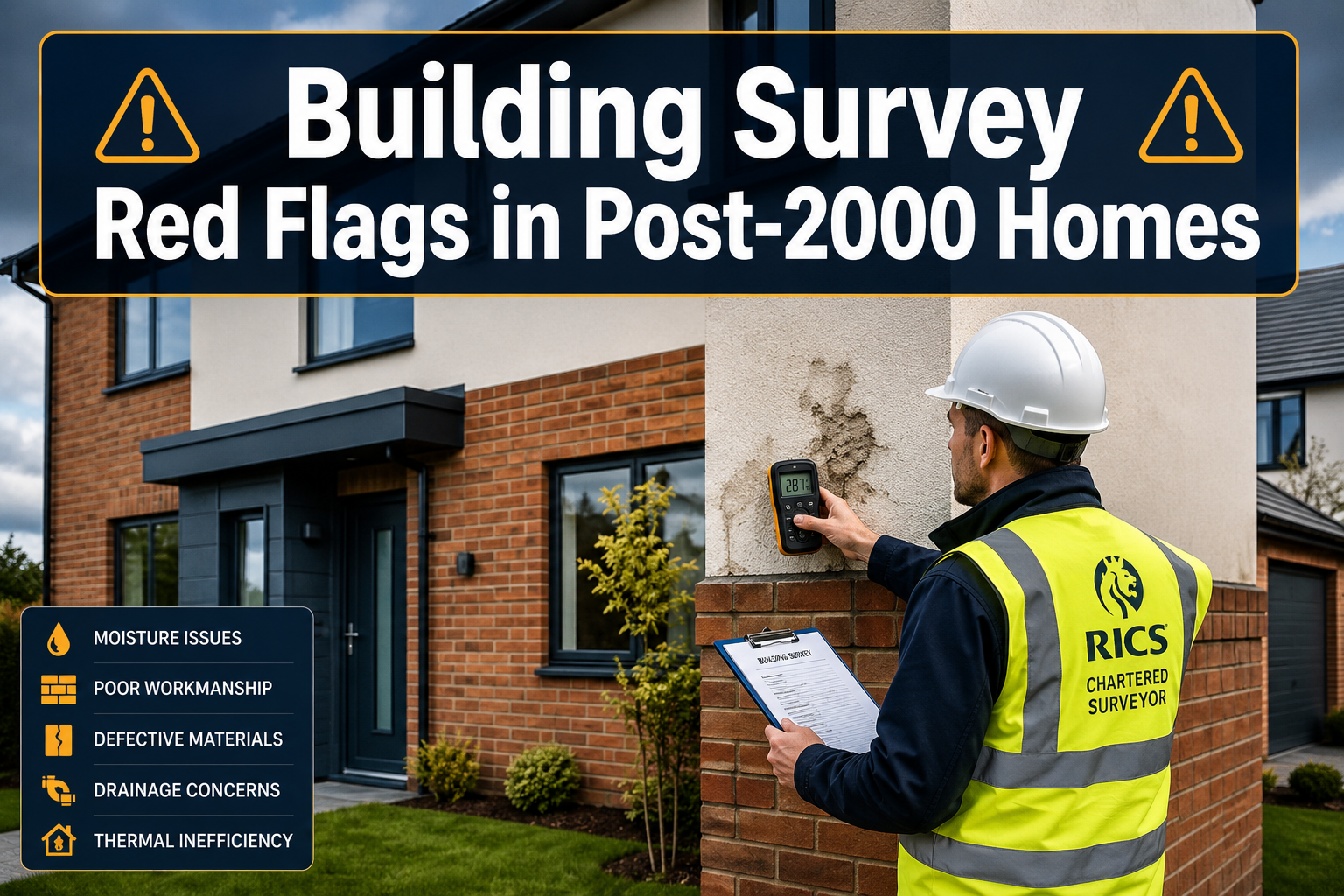

Fewer than one in five buyers of post-2000 steel-framed properties commission a survey capable of detecting hidden corrosion and fire safety failures — defects that can cost tens of thousands of pounds to fix [1]. That statistic alone dismantles one of the most persistent myths in residential property: that a newer home is a safer home.
Age is not a warranty. A house built in 2005 or 2015 can harbour drainage failures, structural movement, poorly executed extensions, and workmanship defects just as damaging as anything found in a Victorian terrace. Understanding the key building survey red flags in post-2000 homes — and why modern properties still need proper defect diagnosis — is essential for any buyer, investor, or lender operating in today's market.
Key Takeaways
- Post-2000 homes are not immune to serious structural, moisture, and workmanship defects.
- Steel-framed new-builds carry specific corrosion and fire risks that only a Level 3 Building Survey can reliably identify.
- Flat-roof extensions, drainage systems, and poorly detailed junctions are among the most common failure points surveyors find in modern properties.
- A RICS Level 3 Building Survey provides the depth of investigation needed to uncover hidden defects before exchange of contracts.
- Commissioning the right survey type is the single most effective step a buyer can take to protect their investment.
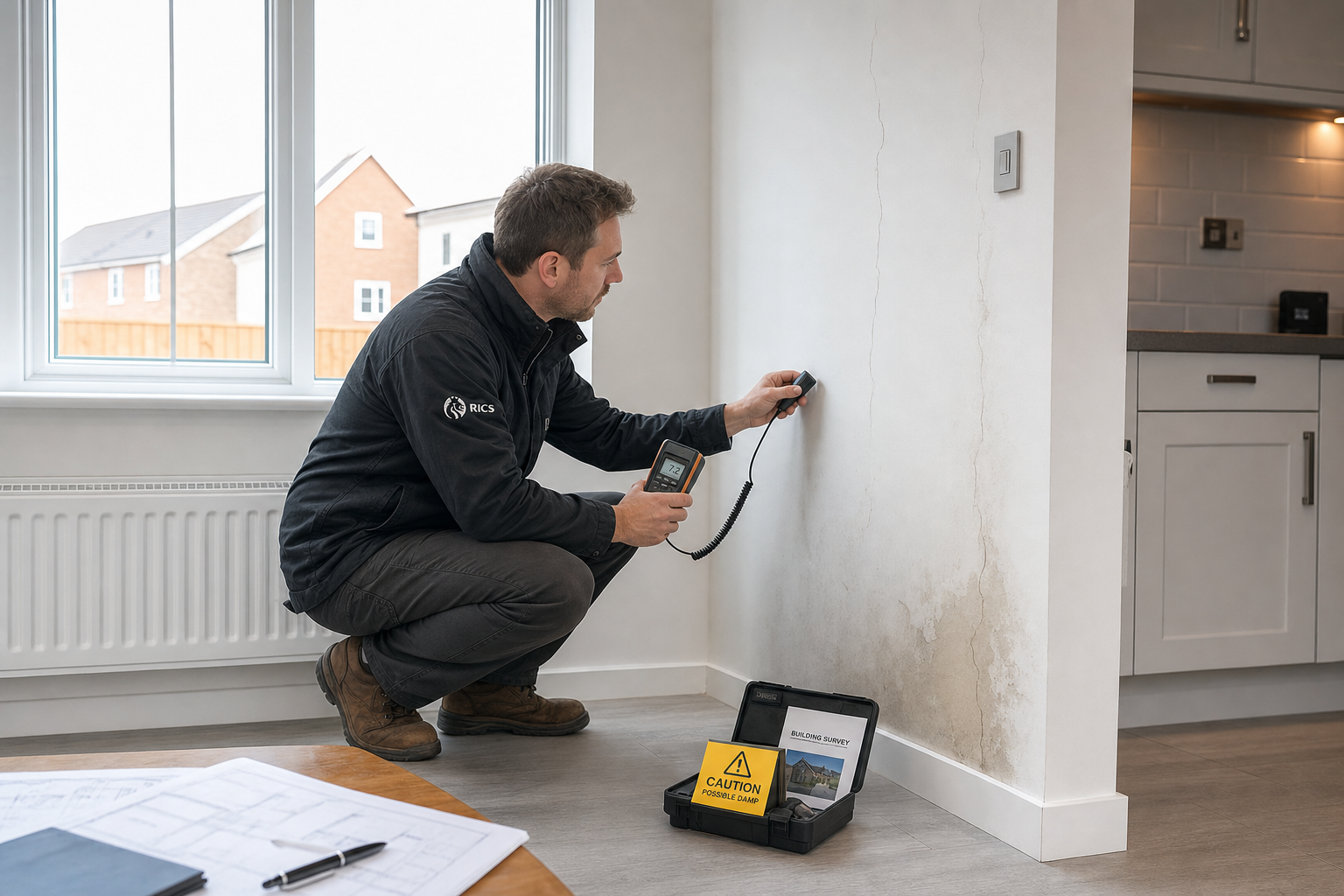
The Myth of the Low-Risk Modern Home
The assumption that newer properties are structurally sound and defect-free is understandable. Building regulations have tightened considerably since 2000, energy efficiency standards have improved, and construction materials have evolved. Yet surveyors across the UK consistently report that post-2000 homes generate a substantial share of their most complex defect findings.
Several factors explain this pattern.
Construction speed and volume pressure. The UK housing market has faced chronic undersupply for two decades. Developers working under commercial pressure to deliver units quickly sometimes allow quality control to slip. Workmanship defects — inadequately compacted fill beneath ground-floor slabs, poorly installed cavity wall ties, and badly detailed waterproofing at roof-to-wall junctions — are among the most frequently flagged issues in Level 3 Building Survey reports on homes built since 2000 [1].
New materials, new failure modes. Modern construction introduced materials and systems that were not widely used in earlier decades. Structural insulated panels (SIPs), light steel framing, and composite cladding systems each carry their own failure pathways. When these systems are incorrectly installed or inadequately maintained, the consequences can be severe and expensive.
Short NHBC warranty windows. Many buyers assume the National House Building Council (NHBC) Buildmark warranty provides comprehensive protection. In practice, the full structural warranty covers only the first ten years. A home built in 2014 is already outside that window in 2026. Once the warranty lapses, the buyer carries all risk — which is precisely why a thorough survey matters.
Understanding what survey you need for a post-2000 property is the first practical step. For the majority of modern homes, a RICS Level 3 Building Survey — formerly called a Full Structural Survey — provides the most comprehensive defect assessment available.
Top Building Survey Red Flags in Post-2000 Homes: Why Modern Properties Still Need Proper Defect Diagnosis
Structural Movement and Foundation Issues
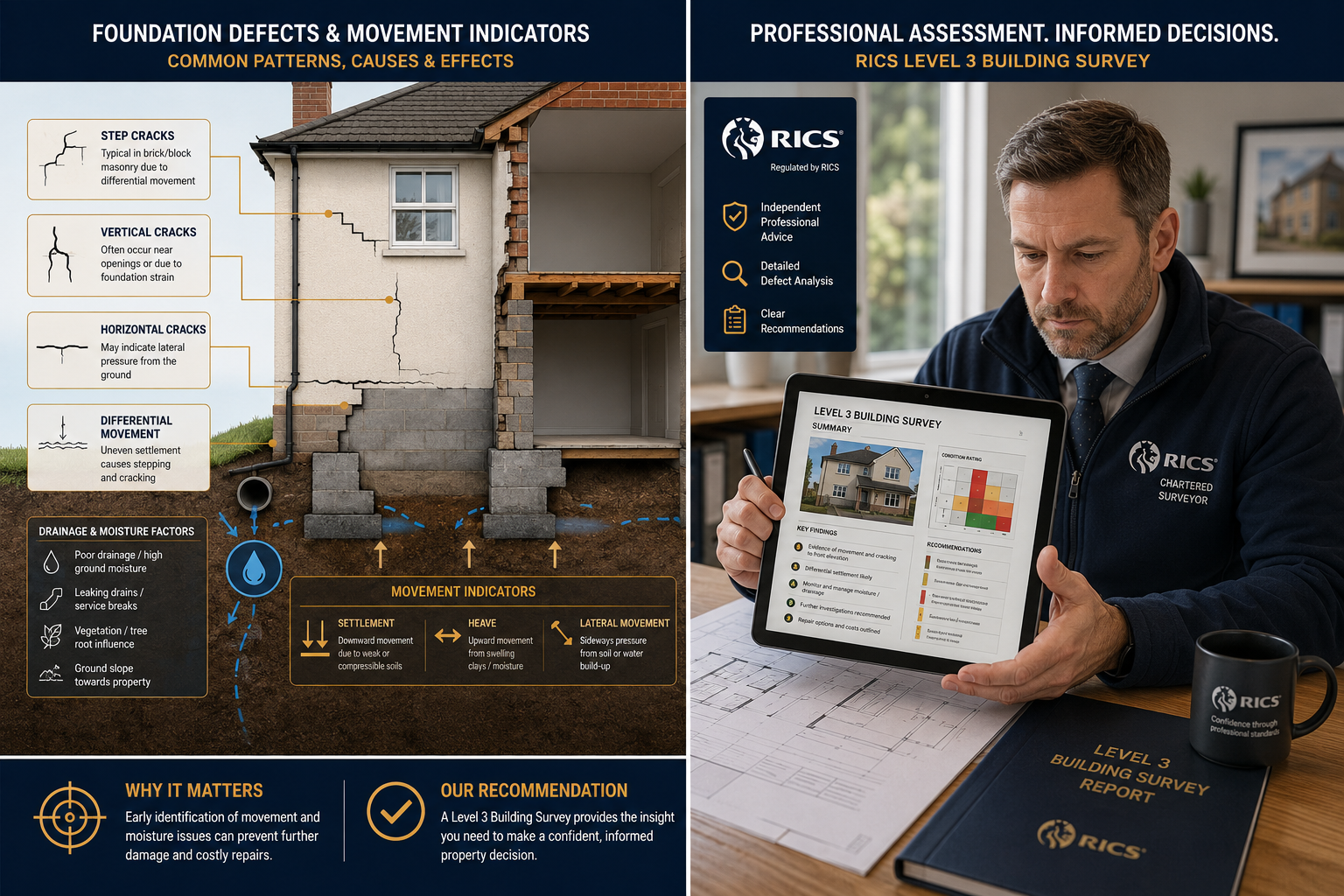
Foundation problems are not exclusive to old buildings. Modern homes built on shrinkable clay soils — common across large parts of London, Surrey, and the South East — remain vulnerable to subsidence and heave, particularly as climate change produces more extreme wet-dry cycles.
Common structural red flags include:
- Foundation cracks wider than 6mm (approximately 1/4 inch), especially diagonal cracks running from window and door corners [2]
- Sagging or uneven rooflines, which can indicate rafter spread or truss failure
- Doors and windows that bind or fail to close properly, suggesting differential movement in the frame
- Stepped cracking in blockwork at gable ends or party walls
Surveyors also look carefully at homes built on former industrial land or brownfield sites. Inadequate ground investigation before construction can leave a modern property sitting on poorly consolidated fill material, leading to progressive settlement that only becomes apparent years after completion.
Steel Frame Corrosion and Fire Safety Failures
This is one of the most serious and least understood risk categories in post-2000 residential property. Light steel frame (LSF) construction became increasingly common in the UK from the mid-1990s onward. When correctly detailed and built, steel-framed homes perform well. When moisture penetrates the structural envelope — through failed cladding, inadequate cavity barriers, or condensation within the wall build-up — the consequences can be severe.
Key risks include:
| Risk Category | Potential Consequence | Detection Method |
|---|---|---|
| Steel frame corrosion | Structural weakening, costly remediation | Intrusive investigation, moisture mapping |
| Missing or defective cavity barriers | Fire spread between floors and compartments | Opening-up works, thermal imaging |
| Combustible cladding systems | Fire safety failure | Visual inspection, material sampling |
| Inadequate fire stopping at penetrations | Rapid fire spread | Intrusive survey |
A June 2026 report confirmed that RICS recommends Level 3 Building Surveys for steel-framed post-2000 properties specifically because standard Level 2 Homebuyer Reports do not include the intrusive investigation necessary to identify these hidden defects [1]. The cost of remediating steel frame corrosion or retrofitting missing fire barriers can reach into the tens of thousands — far exceeding the cost of a thorough survey.
For buyers in London and the surrounding area, chartered surveyors in London with specific experience in modern construction defects are best placed to carry out this type of assessment.
Moisture, Water Ingress, and Drainage Failures
Water is the single most destructive force acting on any building, and modern homes are not exempt. Surveyors regularly find moisture-related defects in properties less than twenty years old, often tracing back to installation errors rather than material failure.
Warning signs that appear in building surveys include:
- Staining on ceilings and walls, particularly at external junctions [3]
- Musty odours in ground-floor rooms or below-ground spaces
- Warped or swollen skirting boards and door linings
- Efflorescence (white salt deposits) on external brickwork
- Evidence of mould growth in poorly ventilated spaces such as en-suite bathrooms
Drainage is a particular concern in post-2000 properties with extensions. Poorly designed or inadequately inspected drainage runs beneath extension slabs are a recurring finding. Blocked or displaced drains can cause soil saturation around foundations, accelerating movement and increasing the risk of damp penetration [5].
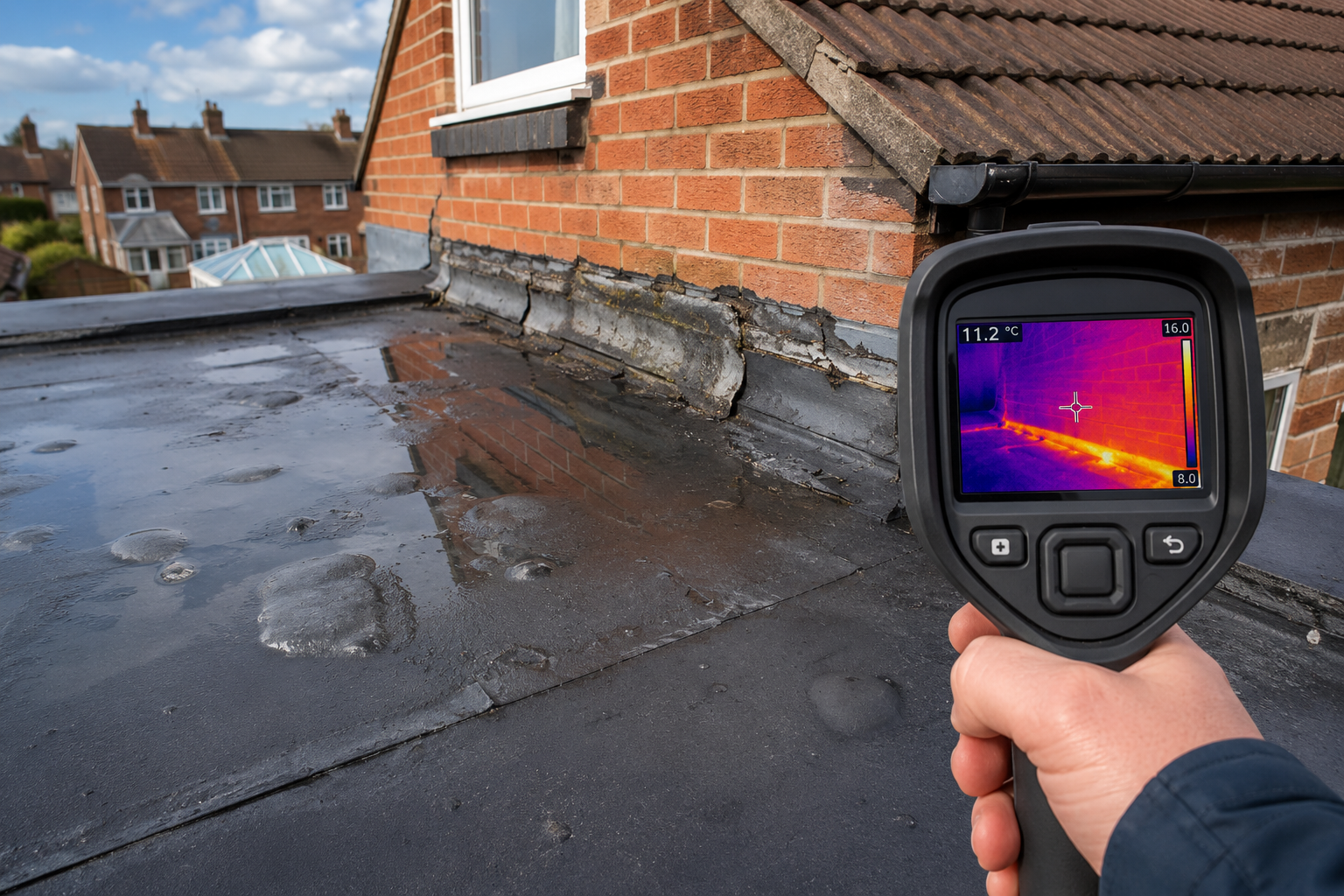
Flat-roof extensions — extremely common in post-2000 additions — deserve special attention. Flat roofs are inherently more vulnerable to water pooling, membrane failure, and inadequate upstand detailing than pitched roofs [6]. A professional roof survey can identify these issues before they become structural problems.
Workmanship Defects and Poorly Detailed Extensions
Extensions and alterations carried out on post-2000 homes represent one of the most productive areas of defect investigation. Many homeowners commission extensions or conversions using builders who work without adequate supervision or quality control. The result is a category of defect that is entirely preventable but surprisingly common.
Common Extension and Alteration Defects
Roof-to-wall junctions. The point where an extension roof meets the existing house wall is one of the most technically demanding details in domestic construction. Poorly installed lead flashings, missing cavity trays, and inadequate upstands are among the most common findings. Water that penetrates at this junction can track internally for considerable distances before becoming visible, causing concealed timber decay and plasterboard damage.
Structural openings. Extensions frequently require new structural openings in existing walls. Inadequately sized or poorly supported lintels above these openings can cause localised cracking and, in more serious cases, progressive structural movement.
Thermal bridging and condensation. Modern building regulations require careful detailing at junctions to prevent thermal bridging — areas of reduced insulation that allow heat loss and surface condensation. Extensions built without proper thermal continuity can develop persistent condensation and mould growth on internal surfaces, regardless of how new the construction is [6].
Permitted development and compliance. Not all extensions are built with planning permission or building regulations approval. A building survey should flag any additions that appear to lack the necessary consents, as these can create complications at resale and may require retrospective approval or even removal.
If alterations have affected shared walls, it is worth understanding the implications under party wall legislation. Guidance on damage to property in party wall situations can help buyers understand their position if a neighbour's works have contributed to defects.
Roofing Defects in Modern Properties
Even in newer constructions, roofing problems are a consistent finding in building surveys [4]. Specific issues include:
- Missing or slipped roof tiles creating entry points for water
- Inadequate ventilation in cold roof spaces, leading to interstitial condensation and timber decay
- Poorly installed or missing insulation at eaves level
- Defective or missing soaker flashings at abutments
- Flat roof membranes that have not been correctly bonded or sealed
A drone roof survey can provide detailed photographic evidence of roofing defects that are not visible from ground level, making it a valuable addition to a Level 3 survey on a post-2000 property with complex roof geometry.
Electrical and Mechanical Systems
Post-2000 homes should, in theory, have modern electrical installations. In practice, surveyors find a range of issues:
- Missing or incorrectly positioned Ground Fault Circuit Interrupter (GFCI) protection in kitchens, bathrooms, and external circuits [3]
- Consumer units that do not comply with current wiring regulations
- Unauthorised electrical work carried out without building regulations notification
- Inadequate bonding of metallic services
Heating and ventilation systems in modern homes also warrant scrutiny. Mechanical ventilation with heat recovery (MVHR) systems, increasingly common in well-insulated post-2000 homes, require regular maintenance and correct commissioning. Systems that have not been serviced can become a source of poor indoor air quality rather than an improvement.
Invasive Plants and Site-Specific Risks
Japanese knotweed and other invasive species are not limited to older properties. Any home built on or near previously disturbed ground can be affected. Knotweed rhizomes can penetrate concrete slabs and brickwork, causing structural damage and significantly complicating mortgage lending [6]. A building survey should note any evidence of invasive plant growth within or adjacent to the site boundary.
Choosing the Right Survey for a Post-2000 Property
The choice of survey type has a direct bearing on what defects are identified and what risks remain hidden.
A RICS Level 2 Homebuyer Report is a condition-based assessment that relies primarily on visual inspection. It is appropriate for conventional properties in reasonable condition, but it does not include intrusive investigation and will not identify concealed defects in wall cavities, beneath floor slabs, or within roof structures.
A RICS Level 3 Building Survey provides a far more detailed assessment. It includes:
- A thorough examination of all accessible elements
- Commentary on construction methods and materials
- Assessment of defects and their likely cause
- Recommendations for further specialist investigation where appropriate
- Guidance on maintenance and repair priorities
For post-2000 properties — particularly those with steel frames, flat-roof extensions, complex cladding systems, or a history of alterations — a Level 3 survey is the appropriate choice. The comparison between survey types is explored in detail in the guide to Homebuyer Report vs Building Survey.
Buyers in specific locations can access specialist surveying services. Those purchasing in Surrey can find chartered surveyors in Surrey with detailed knowledge of local ground conditions and construction types. Similarly, buyers in north London can benefit from the expertise of chartered surveyors in North London familiar with the area's specific building stock.
What a Building Survey Cannot Do
It is important to set realistic expectations. A building survey — even at Level 3 — is a non-intrusive visual inspection supplemented by limited investigation. It cannot guarantee that every defect will be identified. Hidden defects beneath floor finishes, within sealed wall cavities, or in inaccessible roof voids may only become apparent through specialist investigation or opening-up works.
Where a surveyor identifies a risk area but cannot fully assess it, they will typically recommend a specialist report — from a structural engineer, drainage contractor, or electrical inspector. Acting on these recommendations is an important part of the due diligence process.
Conclusion
The building survey red flags in post-2000 homes demonstrate clearly why modern properties still need proper defect diagnosis. Age alone offers no protection against structural movement, moisture ingress, workmanship failures, or the specific risks associated with modern construction systems such as light steel framing and flat-roof extensions.
Actionable next steps for buyers of post-2000 properties:
- Commission a RICS Level 3 Building Survey rather than a basic Level 2 Homebuyer Report, particularly for steel-framed homes, properties with extensions, or homes on brownfield land.
- Request a drone roof survey if the property has a flat roof, complex roof geometry, or extensions that are difficult to inspect from ground level.
- Act on specialist referrals — if the surveyor recommends a drainage CCTV survey, structural engineer's report, or electrical inspection, commission these before exchange.
- Check extension and alteration history through the local authority planning portal to confirm that consents and building regulations approvals are in place.
- Engage a chartered surveyor with local expertise who understands the ground conditions, construction types, and common defect patterns in the area where the property is located.
A thorough survey is not a cost — it is protection. The fee for a Level 3 Building Survey is a fraction of the potential remediation cost for a single undetected defect. In a market where buyers routinely spend hundreds of thousands of pounds on post-2000 homes, skipping proper defect diagnosis is a risk that simply does not need to be taken.
References
[1] Level 3 Building Surveys For Post 2000 Steel Frame Defects 2026 Rics Protocols For Corrosion And Fire Risks – https://kingstonsurveyors.com/level-3-building-surveys-for-post-2000-steel-frame-defects-2026-rics-protocols-for-corrosion-and-fire-risks/?utm_source=openai
[2] What To Look For When Buying A House – https://www.opendoor.com/articles/what-to-look-for-when-buying-a-house?utm_source=openai
[3] What Do Home Inspectors Look For – https://www.opendoor.com/articles/briefs/what-do-home-inspectors-look-for?utm_source=openai
[4] Red Flags On A House Survey – https://www.hamptons.co.uk/guides/buying/red-flags-on-a-house-survey?utm_source=openai
[5] Defect Risk Hotspots In 2026 Uk Housing Stock What Building Surveyors Are Finding Most Often – https://nottinghillsurveyors.com/blog/defect-risk-hotspots-in-2026-uk-housing-stock-what-building-surveyors-are-finding-most-often?utm_source=openai
[6] Red Flags On House Survey – https://www.comparemymove.com/guides/surveying/red-flags-on-house-survey?utm_source=openai