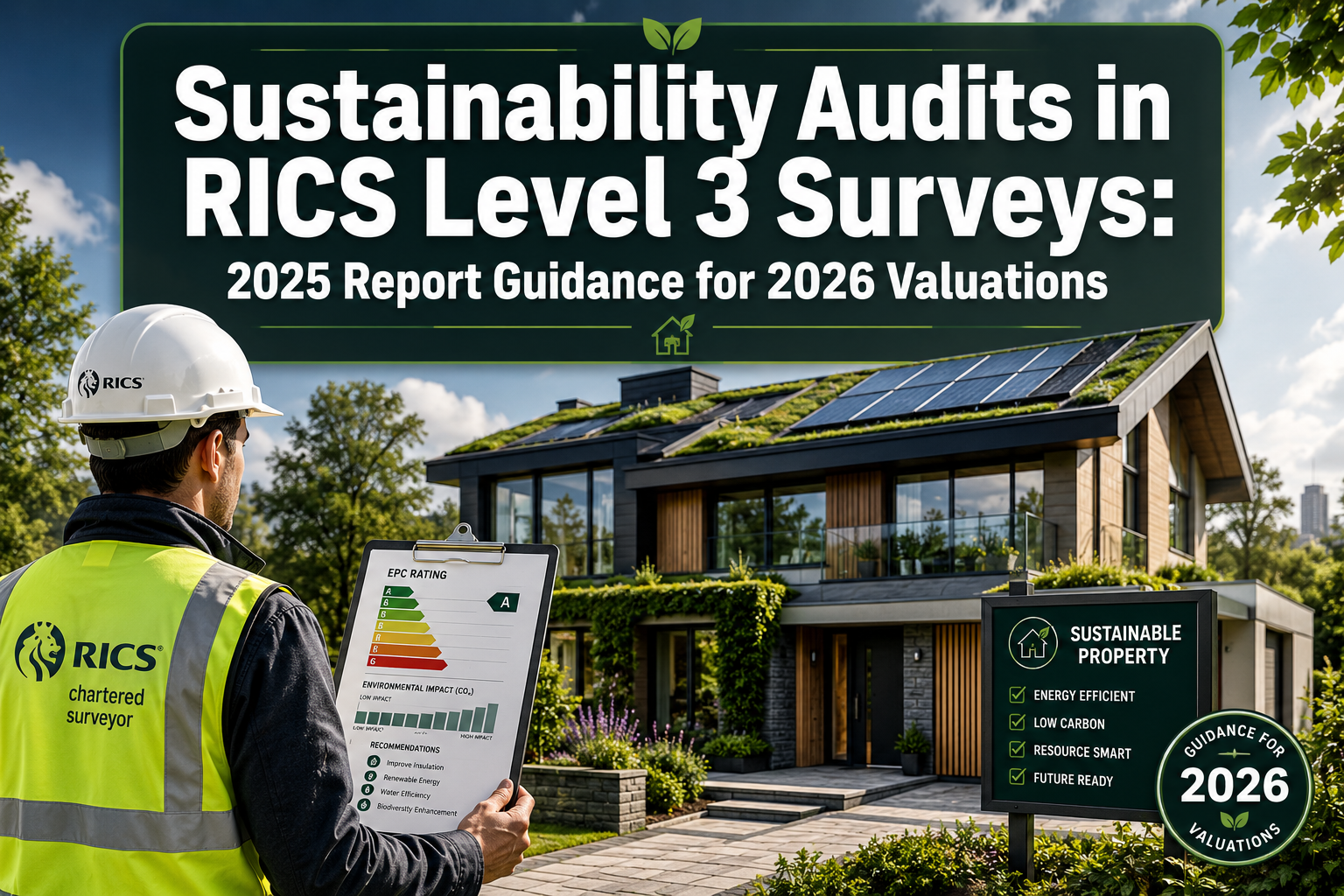

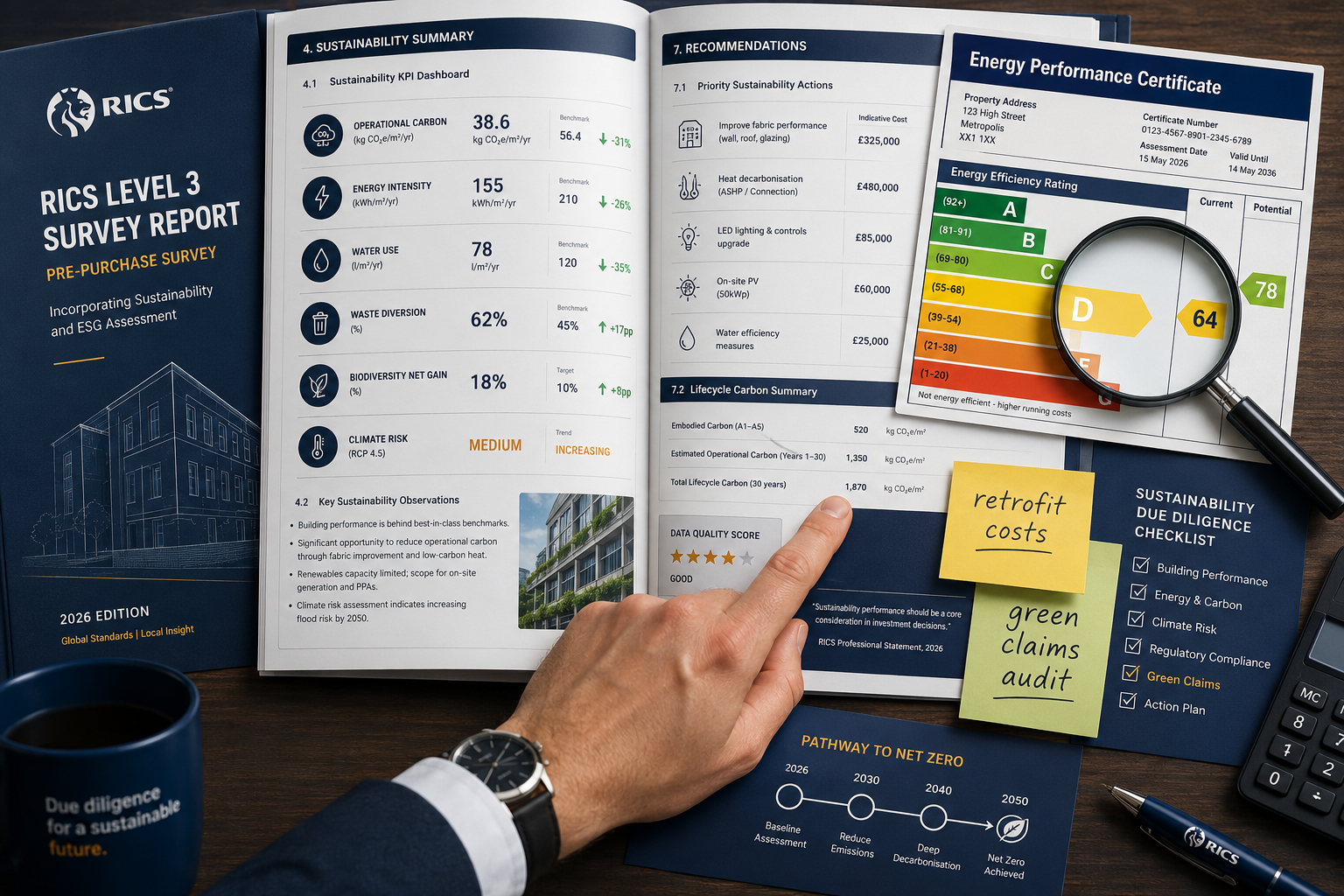
More than 60% of property professionals conduct carbon and resilience assessments infrequently or never — yet from April 2026, ESG factors became mandatory components of every RICS-compliant commercial property valuation [5]. For surveyors carrying out Level 3 Building Surveys, that gap between industry habit and regulatory expectation is no longer acceptable. Sustainability Audits in RICS Level 3 Surveys: Integrating 2025 Report Guidance for 2026 Valuations is now a live professional obligation, not a forward-looking aspiration. Eco-conscious buyers are asking harder questions, lenders are scrutinising Energy Performance Certificates more closely, and the RICS Sustainability Report 2025 has handed surveyors a clear framework for auditing green claims before contracts exchange.
Key Takeaways
- The RICS Sustainability Report 2025 identifies widespread under-performance in carbon assessments, making structured sustainability auditing within Level 3 surveys an urgent professional priority.
- From April 2026, ESG factors are mandatory valuation metrics under the updated RICS Red Book and International Valuation Standards, elevating green credentials from optional commentary to core valuation inputs.
- Level 3 surveys are the natural vehicle for auditing green claims because their scope — covering construction, condition, and defects in depth — maps directly onto the sustainability KPIs that valuers must now report.
- Retrofit cost modelling, EPC band verification, and carbon assessment must be integrated into survey methodology, not treated as add-on commentary.
- Surveyors should use the practical templates and proportionality principles in the fourth edition ESG standard to calibrate reporting depth to asset type and valuation risk.
Why Sustainability Audits Now Belong Inside Level 3 Surveys
A Level 3 Building Survey has always been the most thorough pre-purchase inspection available to residential and commercial buyers. It examines structural integrity, construction methods, materials, drainage, damp, and defects in granular detail. That same granularity makes it the ideal instrument for auditing the sustainability credentials that buyers, lenders, and valuers increasingly depend on.
The RICS Sustainability Report 2025 makes the professional gap visible: over 60% of surveying professionals perform inadequate carbon and resilience assessments [5]. This is not a marginal shortcoming. When a buyer pays a premium for a property marketed as low-carbon or energy-efficient, and the Level 3 survey fails to interrogate those claims, the professional advice delivered is incomplete.
Three forces are converging in 2026 to make this change non-negotiable:
- Regulatory mandate — RICS Red Book compliance now requires ESG integration in valuations effective April 2026 [1].
- Market demand — eco-conscious buyers routinely request EPC verification and retrofit cost estimates before making offers.
- Liability exposure — surveyors who fail to flag material sustainability risks face growing professional indemnity exposure as green claims become more common and more contested.
For surveyors working across London and the South East, where premium property prices amplify the financial impact of misstated energy performance, the stakes are especially high. Whether instructed on a Victorian terrace in South West London or a period conversion in North London, the methodology for integrating sustainability audit findings into survey reports must now be consistent and defensible.
The RICS 2025 Report Framework: What Surveyors Must Apply
The Fourth Edition ESG Standard and Its Practical Implications
In January 2026, RICS published the fourth edition of its global professional standard on ESG and sustainability in commercial property valuation [2]. This edition is not a theoretical update — it contains a consolidated list of ESG-related Key Performance Indicators (KPIs), jurisdiction-specific guidance for the UK, and practical direction on how capital and operational expenditure linked to sustainability factors should be reflected in valuation [1].
For Level 3 surveyors, the most actionable elements are:
| ESG Standard Element | Level 3 Survey Application |
|---|---|
| Consolidated ESG KPI list | Use as a checklist during physical inspection |
| UK jurisdiction guidance | Apply UK-specific EPC and MEES compliance thresholds |
| Cost assumption guidance | Model retrofit costs as a valuation adjustment |
| Proportionality principle | Scale audit depth to asset value and complexity |
| Distinction between valuation and strategic ESG advice | Clearly scope what the survey covers vs. specialist advice |
The proportionality principle is particularly important. The standard explicitly recognises that not every asset warrants the same depth of ESG analysis [1]. A modest residential property and a large commercial building require different levels of carbon assessment detail. Surveyors should document their proportionality reasoning within the survey report, referencing the asset type, EPC rating, age of construction, and known retrofit requirements.
Mandatory ESG Metrics: What Must Now Be Reported
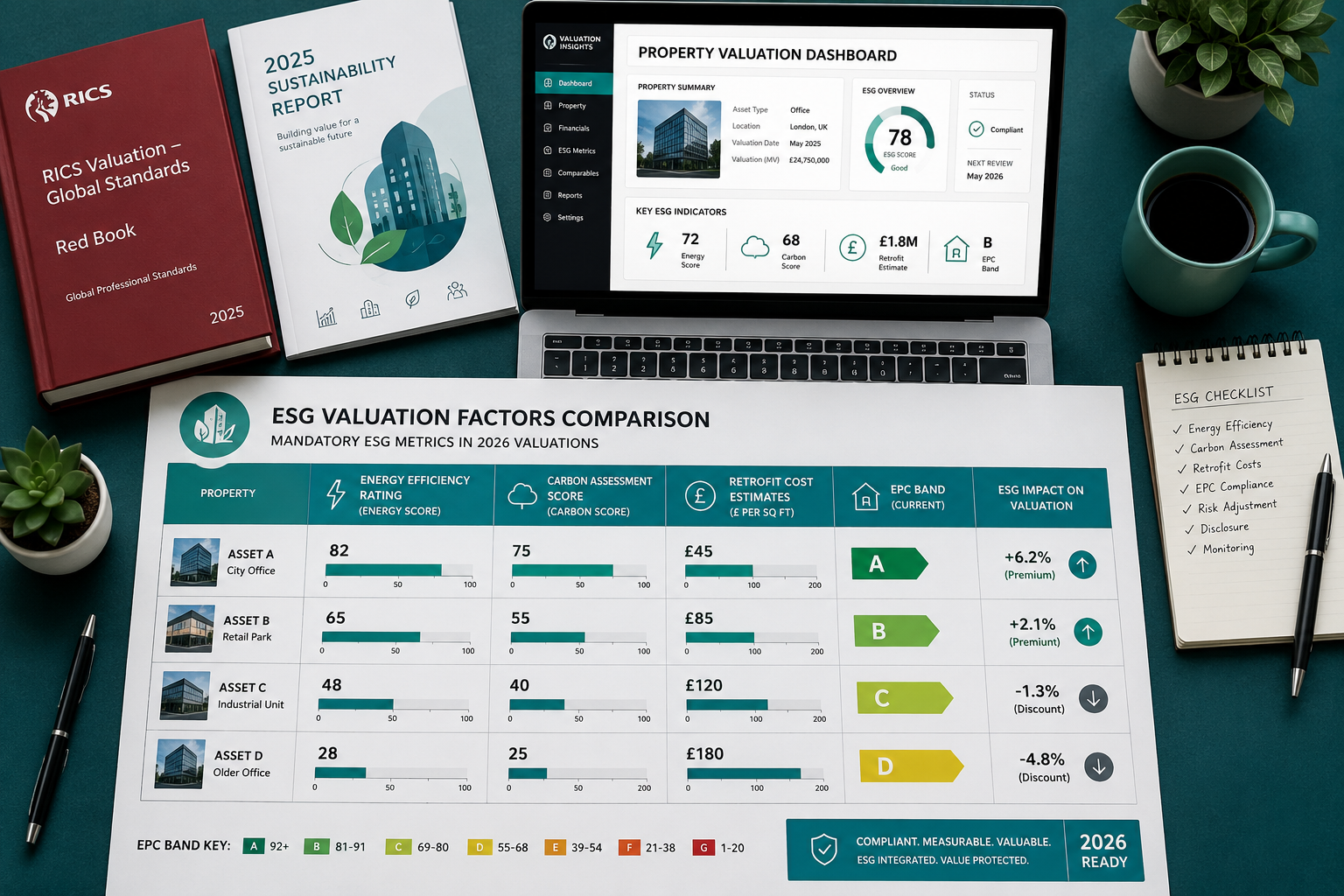
From April 2026, the following sustainability factors are no longer discretionary commentary — they are mandatory valuation inputs for commercial property and increasingly expected in residential Level 3 reports [6]:
- Energy Performance Certificate (EPC) band and rating — verified against the register, not simply accepted from marketing materials.
- Minimum Energy Efficiency Standards (MEES) compliance — particularly relevant for landlords and buy-to-let purchasers.
- Carbon assessment status — whether a formal assessment exists, its methodology, and its credibility.
- Retrofit cost estimates — capital expenditure required to improve EPC rating by one or more bands.
- Climate resilience factors — flood risk, overheating risk, and embodied carbon where material.
"ESG factors have moved from a discretionary consideration to a fundamental component of property value. Surveyors who treat sustainability as optional commentary are now out of step with professional standards."
The updated Red Book Global standards underpin this shift, aligning RICS requirements with International Valuation Standards [7]. Surveyors seeking a detailed understanding of how these standards interact with RICS valuation reports in London should review both documents alongside the fourth edition ESG standard.
Integrating 2025 Report Guidance for 2026 Valuations: Practical Templates for Surveyors
Auditing Green Claims: A Step-by-Step Methodology
Sustainability Audits in RICS Level 3 Surveys: Integrating 2025 Report Guidance for 2026 Valuations requires a structured approach that runs parallel to — and is integrated within — the standard Level 3 inspection methodology. The following framework draws directly on the RICS Sustainability Report 2025 and the fourth edition ESG standard.
Step 1: Pre-Inspection Data Gathering
Before attending site, surveyors should:
- Retrieve the current EPC from the national register and note the rating, expiry date, and recommended improvement measures.
- Review any green credentials cited in marketing materials (solar panels, heat pumps, MVHR systems, external wall insulation).
- Check flood risk mapping and Environment Agency data for climate resilience context.
- Note the property's construction date and likely construction type to anticipate thermal performance characteristics.
Step 2: On-Site Sustainability Audit
During the Level 3 inspection, surveyors should systematically assess:
- Fabric performance — wall, roof, and floor insulation; window glazing specification; air permeability indicators.
- Heating and hot water systems — fuel type, system age, efficiency rating, compatibility with low-carbon alternatives.
- Renewable energy installations — condition, age, and output documentation for solar PV, heat pumps, or other systems.
- Ventilation — natural and mechanical ventilation adequacy, damp and mould risk as a proxy for thermal performance failure.
- EPC consistency check — does the physical condition of the property align with the rated EPC band? Discrepancies should be flagged explicitly.
A specific defect report may be appropriate where a single sustainability-related element — such as a failed heat pump or deteriorating external wall insulation — requires focused analysis beyond the Level 3 scope. Surveyors can explore the role of specific defect reports in supplementing sustainability findings.
Step 3: Retrofit Cost Modelling
This is where the 2025 guidance adds the most practical value. The RICS ESG standard provides direction on how capital expenditure linked to ESG factors should be reflected in valuation [1]. For Level 3 surveyors, this translates into:
- Estimating the cost of recommended EPC improvement measures (as listed on the EPC itself).
- Providing a range of retrofit costs for upgrading the property to EPC Band C — the benchmark increasingly referenced in mortgage lending and government policy.
- Noting where specialist assessments (e.g., a full SAP calculation or a heat loss survey) would be required before retrofit costs can be confirmed.
The fourth edition ESG standard is clear that strategic ESG advice — such as recommending a specific retrofit pathway — is a separate service from valuation or survey [1]. Surveyors should scope their retrofit cost commentary accordingly, providing indicative ranges rather than prescriptive recommendations, and directing clients to specialist advisors where detailed retrofit planning is needed.
Step 4: Reporting and Disclosure
The survey report should include a dedicated sustainability section structured around the consolidated ESG KPI list from the fourth edition standard [2]. A practical template for this section includes:
| Reporting Category | Content Required |
|---|---|
| EPC Summary | Band, rating, expiry, verification status |
| MEES Compliance | Current compliance; risk of future non-compliance |
| Carbon Assessment | Existence, methodology, credibility rating |
| Retrofit Cost Estimate | Range in GBP; basis of estimate; limitations |
| Climate Resilience | Flood zone, overheating risk, coastal/subsidence factors |
| Green Claims Verification | Confirmation or challenge of marketed sustainability features |
| Recommended Further Actions | Specialist assessments required |
For commercial properties, the mandatory ESG reporting requirements from April 2026 apply directly to the valuation, and commercial building surveys in London must reflect this expanded scope. For residential Level 3 surveys, the same framework applies as best practice and increasingly as a client expectation.
Addressing the Carbon Assessment Gap
The RICS Sustainability Report 2025 identifies carbon calculations as uncommon practice, with over 60% of professionals conducting them infrequently or never [5]. For surveyors, this creates both a risk and an opportunity.
The risk: failing to flag the absence of a credible carbon assessment when a property is marketed as net zero or low-carbon exposes the surveyor to professional liability if the claim later proves unfounded.
The opportunity: surveyors who build carbon assessment literacy into their Level 3 methodology differentiate their service offering and provide genuinely higher-value advice to eco-conscious buyers.
At minimum, a Level 3 survey should:
- Note whether any formal carbon assessment exists for the property.
- Comment on the credibility of net zero or low-carbon claims based on physical inspection findings.
- Flag where carbon claims cannot be verified from available evidence and recommend specialist assessment.
This approach aligns with the RICS 'Sustainability Practice for Surveyors' guide published in June 2026, which emphasises a holistic understanding of sustainability across surveying disciplines [3][4].
Valuation Adjustments: Translating Audit Findings into Numbers
How Sustainability Audit Findings Affect 2026 Valuations
The mandatory integration of ESG factors into RICS valuations from April 2026 means that sustainability audit findings from Level 3 surveys must translate into quantifiable valuation adjustments [6]. This requires close coordination between the surveyor conducting the Level 3 inspection and the valuer preparing the formal valuation report.
Key adjustment mechanisms include:
- EPC-linked value adjustment — properties with EPC Band F or G face stranded asset risk under MEES regulations; this risk should be reflected in the valuation.
- Retrofit cost deduction — where the survey identifies material retrofit expenditure required to achieve minimum compliance or market-expected energy performance, this cost should inform the valuation.
- Green premium recognition — properties with verified high EPC ratings, renewable energy systems in good working order, and credible carbon assessments may command a premium that the valuer should be able to evidence and justify.
RICS registered valuers in London are now expected to demonstrate how ESG factors have been considered in every commercial valuation, and the audit findings from a Level 3 survey provide the evidential foundation for those adjustments.
For buyers seeking to understand the full cost implications of a property's sustainability profile before committing, understanding RICS valuation costs — including the additional scope required for ESG-integrated valuations — is an important early step.
The Distinction Between Survey Findings and Strategic ESG Advice
The fourth edition ESG standard draws a clear line between valuation and strategic ESG advice [1]. Surveyors should apply the same distinction in Level 3 reports:
- Within scope: Verifying EPC ratings, identifying physical defects that affect energy performance, estimating indicative retrofit costs, flagging unverified green claims.
- Outside scope (requiring separate instruction): Designing retrofit pathways, certifying carbon neutrality, providing investment-grade ESG due diligence, advising on green finance products.
This boundary protects surveyors from scope creep and ensures that clients understand when specialist sustainability consultants should be engaged alongside the Level 3 surveyor.
Where disputes arise over green claims — for example, in cases where a seller has misrepresented a property's energy performance — the Level 3 survey findings, if properly documented, can serve as critical evidence. Surveyors should be aware that their reports may be relied upon in formal dispute contexts, and the standards applicable to expert witness reports become relevant in those circumstances.

Conclusion
Sustainability Audits in RICS Level 3 Surveys: Integrating 2025 Report Guidance for 2026 Valuations is no longer an emerging trend — it is a current professional standard with regulatory teeth. The RICS Sustainability Report 2025 has documented the industry's carbon assessment deficit clearly [5], and the fourth edition ESG standard published in January 2026 has provided the practical framework to close it [2].
Actionable next steps for surveyors:
- Adopt the four-step sustainability audit methodology (pre-inspection data, on-site audit, retrofit cost modelling, structured reporting) as standard practice within all Level 3 instructions.
- Use the consolidated ESG KPI list from the fourth edition standard as a physical inspection checklist.
- Build a retrofit cost modelling template calibrated to common property types in the surveyor's operating area.
- Clearly scope the boundary between Level 3 sustainability findings and strategic ESG advice in every letter of engagement.
- Engage with the RICS 'Sustainability Practice for Surveyors' guide [3] and the updated Red Book [7] as mandatory continuing professional development.
- Coordinate with instructed valuers to ensure Level 3 audit findings are properly reflected in ESG-integrated valuations.
The eco-conscious buyer of 2026 is not asking whether sustainability matters — they are asking whether their surveyor can verify it. The answer must now be yes.
References
[1] Rics Publishes Updated Global Standard Esg Sustainability Commercial Property Valuation – https://www.rics.org/news-insights/rics-publishes-updated-global-standard-esg-sustainability-commercial-property-valuation?utm_source=openai
[2] Esg And Sustainability In Commercial Property Valuation – https://www.rics.org/profession-standards/rics-standards-and-guidance/sector-standards/valuation-standards/esg-and-sustainability-in-commercial-property-valuation?utm_source=openai
[3] Sustainability Practice For Surveyors – https://www.rics.org/news-insights/current-topics-campaigns/sustainability/sustainability-practice-for-surveyors?utm_source=openai
[4] Rics Launches New Global Sustainability Guide And Un Global Compact Report – https://specificationonline.co.uk/articles/2026-06-17/rics/rics-launches-new-global-sustainability-guide-and-un-global-compact-report?utm_source=openai
[5] Sustainability Report 2025.pdf. – https://www.rics.org/content/dam/ricsglobal/documents/reports/Sustainability-report-2025.pdf.?utm_source=openai
[6] Rics Sustainability Report 2025 In Expert Witness Valuations Auditing Net Zero Claims For 2026 Disputes – https://kingstonsurveyors.com/rics-sustainability-report-2025-in-expert-witness-valuations-auditing-net-zero-claims-for-2026-disputes/?utm_source=openai
[7] Red Book Global – https://www.rics.org/profession-standards/rics-standards-and-guidance/sector-standards/valuation-standards/red-book/red-book-global.html?utm_source=openai