

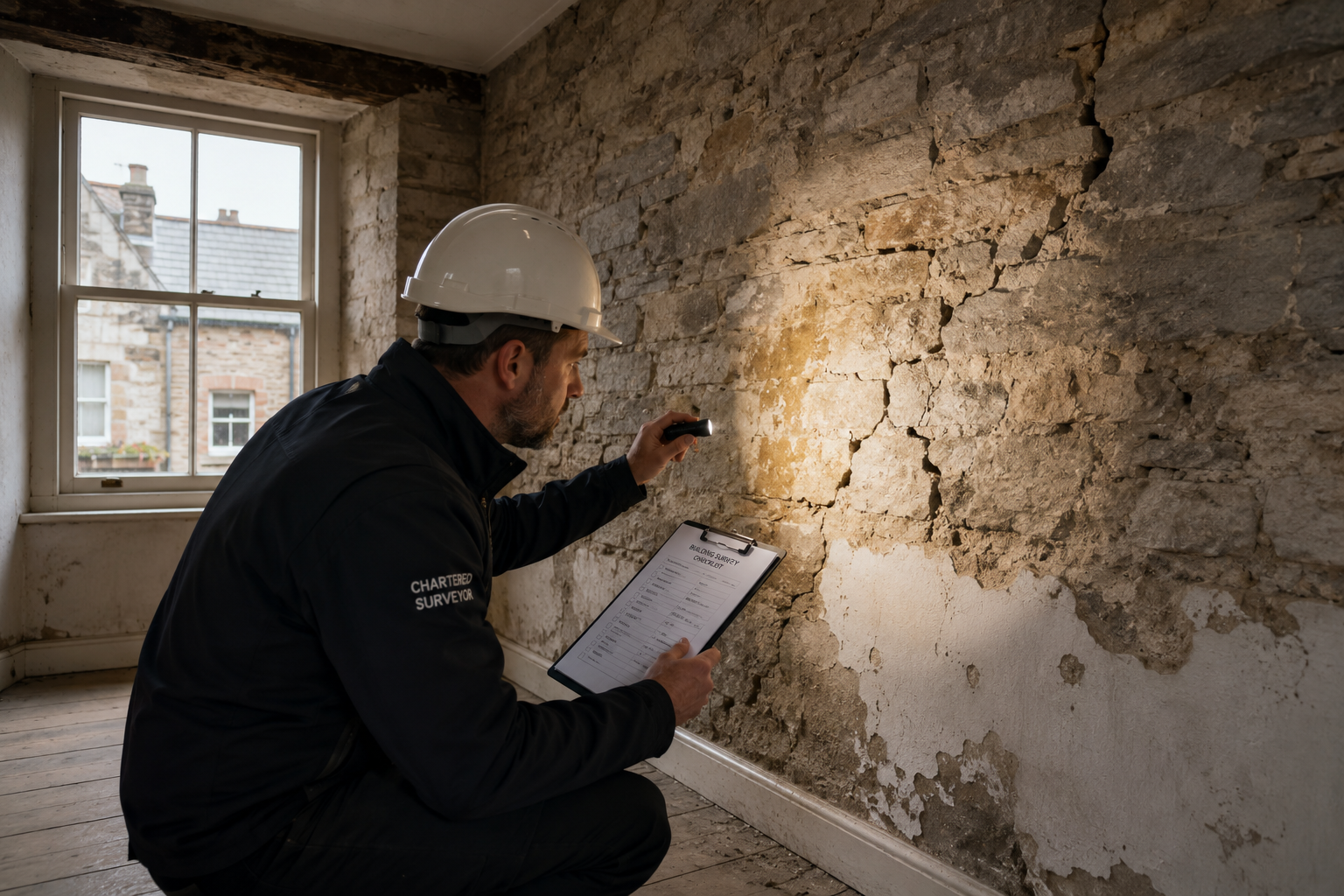
A property that looks sound on the surface can conceal repair costs that wipe out an entire year's anticipated growth before the buyer even collects the keys. In 2026's cautiously recovering UK housing market, where annual price growth has slowed to 1.7% and forecasts for many segments sit in the 2-5% range, the margin for error on an uninspected purchase is razor thin [1]. Building surveys for modest price growth properties: spotting value risks in a 2-5% UK market uptick is not simply a due-diligence exercise — it is the primary mechanism by which buyers, investors, and their advisers protect capital when the market offers little cushion for unpleasant surprises.
Key Takeaways
- In a 2-5% growth environment, a single undisclosed structural defect can eliminate an entire year's anticipated appreciation and trigger negative equity.
- Government data shows that 20% of UK dwellings would increase in market value if repairs were completed, with an average uplift of 2.9% [2].
- Properties with low EPC ratings (F or G) are trading at discounts of up to 20% compared to C-rated equivalents, making energy efficiency a critical survey focus [6].
- Flood risk, subsidence, and leasehold complications are the three structural risk categories most likely to suppress value in a modestly growing market.
- Survey findings are now a primary negotiation tool above the £375,000 price threshold, where buyer caution is measurably higher [9].
Why a 2-5% Growth Environment Demands Greater Survey Rigour
When prices were rising at 8-10% annually, buyers could absorb a £15,000 repair bill and still expect to break even within 12 months. That arithmetic no longer holds. UK house prices fell 0.6% in May 2026 alone, pulling average values to £278,024 and annual growth down to 1.7% from 3% the previous month, with two-year fixed mortgage rates averaging 5.68% [1]. The cost of borrowing has risen precisely as the growth buffer has shrunk.
In this context, building surveys for modest price growth properties: spotting value risks in a 2-5% UK market uptick shifts from optional comfort to financial necessity. A buyer purchasing at £350,000 with a projected 3% annual uplift stands to gain approximately £10,500 over the year. A missed damp-proofing issue, a failing flat roof, or a cracked lintel can cost £8,000-£20,000 to remediate — consuming the entire anticipated gain before a single mortgage payment is made.
The market is also structurally uneven. Flats have been underperforming houses significantly, driven by post-pandemic space preferences, escalating service charges, and leasehold complications [4]. New builds carry a 15-30% premium over comparable older stock, yet can lose 5-10% of their value relative to the local market within the first two years as the "newness" premium fades [3]. These dynamics mean that the property type, tenure, and location must each inform the survey scope, not just the age of the building.
The RICS Framework Underpinning 2026 Survey Standards
The Royal Institution of Chartered Surveyors updated its Red Book valuation standards effective January 2025, introducing reorganised frameworks specifically suited to stabilising markets. The updated standards place explicit emphasis on regional market monitoring and the integration of Environmental, Social, and Governance (ESG) factors into valuations [7]. For surveyors, this means that a Level 3 Building Survey in 2026 should not merely catalogue defects — it should contextualise each finding against current market conditions and quantify the likely impact on achievable sale price.
Working with chartered surveyors in London who operate under current RICS protocols ensures that survey outputs are calibrated to the market conditions buyers are actually navigating, not a generic checklist from a more buoyant period.
The High-Risk Defect Categories in a Modestly Growing Market
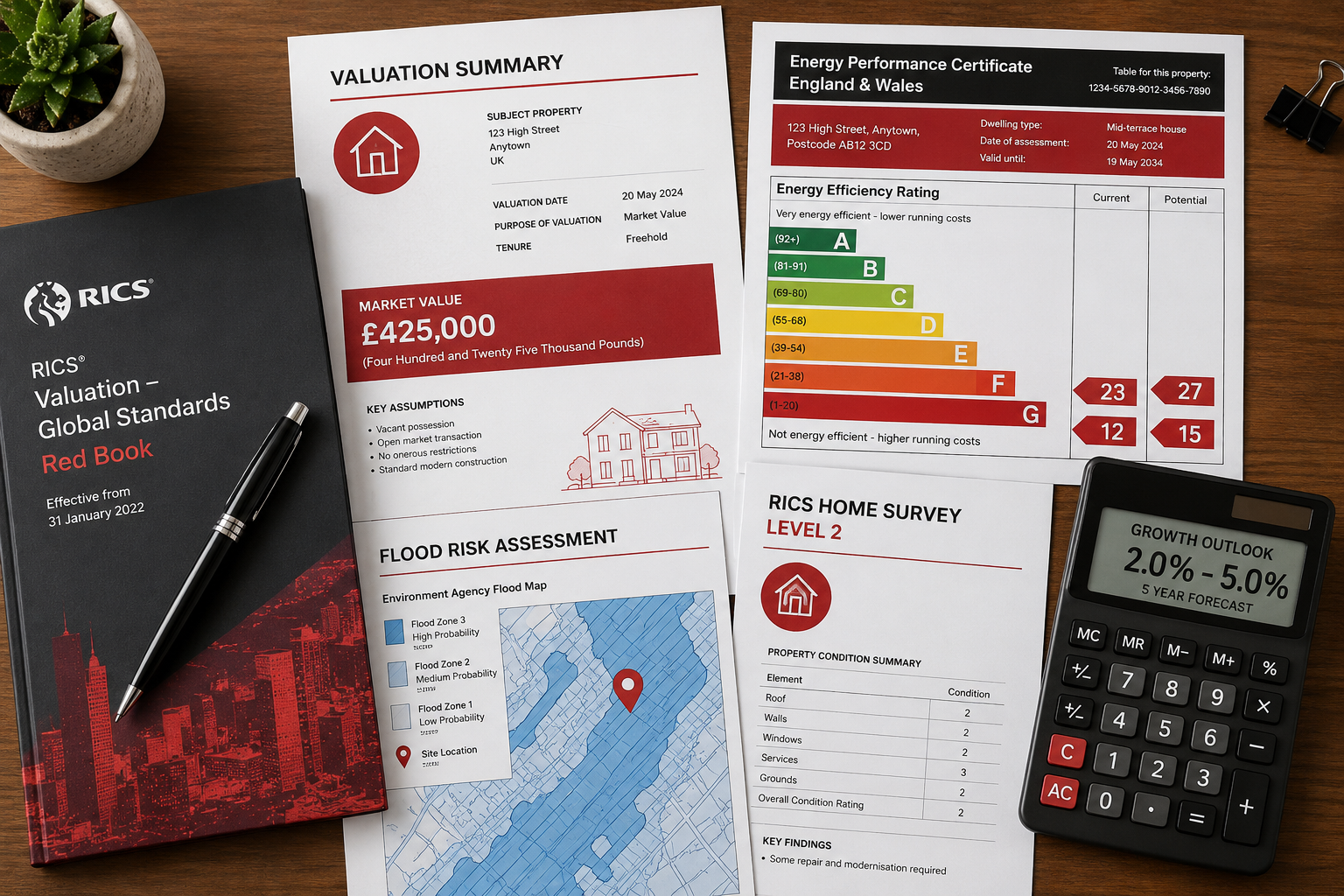
Understanding which defects carry the greatest value risk is essential for prioritising survey scope and negotiation strategy. The following categories represent the most consequential risk areas in the current market.
Structural Integrity and Subsidence
Subsidence remains the single most value-destructive defect a survey can uncover. Properties showing signs of differential settlement — staircase cracking, out-of-plumb door frames, or diagonal cracks emanating from window corners — require specialist investigation before any offer is confirmed. A subsidence survey in London can establish whether movement is historic and stable or active and progressive, a distinction that carries enormous implications for insurability and resale value.
In a 2-5% growth market, a property with confirmed active subsidence may be effectively unsaleable to mortgage-backed buyers without remediation. Even with a significant price reduction, the limited pool of cash buyers willing to take on the risk means that value erosion can be severe and prolonged.
Energy Performance and EPC Ratings
Properties rated F or G on the Energy Performance Certificate are now trading at discounts of up to 20% compared to equivalent C-rated homes in some UK regions, and this gap is widening [6]. With minimum EPC requirements for rental properties under continued legislative scrutiny, a low-rated property purchased as an investment carries both an immediate value discount and a future capital expenditure obligation for retrofitting.
A thorough building survey should assess:
- Insulation levels in roof, walls, and floors
- Boiler age and efficiency rating
- Window glazing specification
- Presence of cavity wall insulation or solid wall alternatives
- Potential for renewable energy integration
The cost of bringing a property from an F rating to a C can range from £10,000 to £35,000 depending on construction type. In a market offering 2-5% annual growth, this is not a cost that can be absorbed passively.
Flood Risk
Properties in the highest flood risk category can experience value discounts approaching 30% [5]. Crucially, flood risk is not always apparent from a physical inspection alone — it requires cross-referencing Environment Agency data, drainage records, and historical insurance claims. A comprehensive survey report should flag flood risk explicitly and recommend specialist environmental searches where the risk profile is elevated.
Beyond the immediate value impact, properties in high-risk flood zones face increasing difficulty securing affordable buildings insurance, which can make them unmortgageable in practice even if a lender is technically willing to proceed.
Roof Condition
Roof failure is among the most common and costly defects found in UK residential property. A full replacement on a typical semi-detached house can cost £8,000-£15,000, while a flat roof replacement on an extension may add a further £3,000-£6,000. A professional roof survey in London provides a detailed condition assessment that goes beyond what a standard mortgage valuation will capture, identifying issues such as failed flashings, deteriorating felt, blocked valley gutters, and inadequate ventilation.
Leasehold Complications
For flat purchasers specifically, leasehold tenure introduces a layer of value risk that a structural survey alone cannot address. Short leases (below 80 years) trigger the marriage value calculation in lease extension negotiations, significantly increasing the premium payable. Service charge disputes, major works notices, and ground rent escalation clauses can all suppress market value independently of the physical condition of the property.
Buyers considering leasehold properties should review the FAQ on lease extensions alongside their building survey to ensure that tenure risk is fully understood before exchange.
Building Surveys for Modest Price Growth Properties: Spotting Value Risks and Using Findings to Negotiate

Survey findings in a 2-5% growth market carry negotiating weight that they simply did not have during the frenzied conditions of 2020-2022. The market above £375,000 is now measurably price-sensitive, and buyers are actively using survey reports as structured negotiation tools [9]. The approach below sets out a protocol for translating survey findings into defensible price adjustments.
Quantifying Defect Costs Accurately
Vague references to "some damp" or "roof needs attention" are insufficient for negotiation purposes. A credible survey report should:
- Categorise defects by urgency (immediate action required / within 3 years / monitor)
- Provide indicative cost ranges for each category
- Distinguish between like-for-like repair and improvement-standard remediation
- Note any defects that may affect mortgage lender requirements
For complex structural issues, a structural survey in London or a report from residential structural engineers may be necessary to produce the level of cost certainty required for a negotiation to succeed.
The Repair-Value Uplift Calculation
Government data from 2024 confirms that 20% of UK dwellings would increase in market value if repairs were completed, with an average uplift of 2.9% [2]. In the private rented sector, this uplift rises to 3.8%. This means that buyers who negotiate a price reduction equivalent to repair costs are not simply recovering expenditure — they are acquiring latent value that the market will recognise once works are complete.
| Defect Category | Typical Repair Cost | Potential Value Uplift Post-Repair |
|---|---|---|
| Damp and penetrating water | £2,000-£8,000 | 1-2% of property value |
| Roof replacement | £8,000-£15,000 | 2-3% of property value |
| Structural crack investigation | £1,500-£5,000 | Insurability restored |
| EPC improvement (F to C) | £10,000-£35,000 | Up to 20% discount eliminated |
| Subsidence remediation | £15,000-£50,000 | Full market value restored |
Presenting Findings to Vendors
The most effective negotiation approach presents survey findings not as a list of complaints but as a costed schedule of works. A specific defect report can isolate a single high-priority issue — a failing chimney stack, a cracked party wall, a failing damp-proof course — and provide the focused documentation needed to support a targeted price reduction without reopening the entire transaction.
Vendors in a modest-growth market are generally more receptive to evidence-based price adjustments than to blanket renegotiation attempts. A well-structured survey report, supported by contractor quotes where necessary, gives both parties a rational basis for reaching agreement rather than abandoning the sale.
When to Walk Away
Not every defect is negotiable. The following scenarios typically warrant serious reconsideration of the purchase:
- Active, progressive subsidence with no clear remediation pathway
- Flood risk that renders the property uninsurable at standard rates
- Asbestos-containing materials in locations requiring full encapsulation or removal
- A lease below 70 years where the vendor is unwilling to extend prior to completion
- A new build with multiple latent defects suggesting systemic construction quality issues [8]
In a market offering 2-5% annual growth, the opportunity cost of proceeding with a fundamentally compromised property is high. The discipline to withdraw when the risk profile is unacceptable is itself a form of capital protection.
Practical Survey Protocols for the 2026 Market
Surveyors operating in the current environment should adapt their inspection protocols to reflect the specific risk profile of each property type. The following framework provides a starting point.
For period properties (pre-1919):
- Prioritise roof structure, chimney condition, and original timber elements
- Assess original drainage and any subsequent alterations
- Check for historic subsidence indicators and review insurance history
- Evaluate energy performance realistically against retrofit potential
For inter-war and post-war stock (1919-1980):
- Inspect for cavity wall insulation defects (wall tie corrosion, cold bridging)
- Assess concrete construction types (no-fines, Airey, Wimpey) for mortgageability
- Check flat roof extensions and garage roofs
- Review electrical installation age and compliance
For new builds:
- Focus on snagging-level defects that developers may not rectify post-completion
- Inspect drainage gradients, window seals, and insulation continuity
- Verify that structural warranties (NHBC Buildmark or equivalent) are in place
- Note that a new build premium of 15-30% will diminish within years [3], making defect-free condition at purchase critical
For commercial properties or mixed-use acquisitions, commercial building surveys in London follow a distinct protocol that incorporates tenant obligations, planned preventative maintenance schedules, and compliance with current building regulations.
Conclusion
Building surveys for modest price growth properties: spotting value risks in a 2-5% UK market uptick is not a passive exercise in documentation — it is an active risk management strategy that directly determines whether a property purchase delivers or destroys value in 2026's constrained market conditions.
The evidence is clear: undisclosed defects eliminate growth margins, EPC penalties are widening, flood risk discounts are material, and leasehold complications continue to suppress flat values. At the same time, government data confirms that repaired properties do recover value, and survey findings are now a legitimate and effective negotiation instrument in a market where vendors cannot rely on competing offers to override buyer concerns.
Actionable next steps for buyers and investors in 2026:
- Commission a Level 3 Building Survey (Full Structural Survey) for any property over 20 years old or showing visible signs of defect — not a mortgage valuation or a Level 2 Homebuyer Report.
- Request a specialist subsidence, roof, or specific defect report where the primary survey flags a high-risk area requiring further investigation.
- Cross-reference EPC ratings and flood risk data before instructing a survey, so the surveyor can focus inspection time on the highest-risk elements.
- Use the costed schedule of works from the survey report as the basis for a structured, evidence-based price renegotiation rather than a speculative reduction.
- For leasehold properties, review lease length and service charge history alongside the physical survey to ensure that tenure risk is fully priced in.
The cost of a professional building survey — typically £600-£1,500 for a residential property — is a fraction of the value at risk in a market where a single undiscovered defect can cost ten times that figure to remediate. In a 2-5% growth environment, that expenditure is not optional. It is the foundation of a sound purchase decision.
References
[1] Could House Prices Fall – https://moneyweek.com/investments/house-prices/could-house-prices-fall?utm_source=openai
[2] Market Value Survey 2024 Main Report – https://www.gov.uk/government/publications/market-value-survey-2024/market-value-survey-2024-main-report?utm_source=openai
[3] New Build Plot Premium Explained – https://www.propertypassport.uk/guides/new-build-plot-premium-explained?utm_source=openai
[4] The Flat Underperformance Problem Why Apartments Are Losing Value – https://propertydata.co.uk/resources/the-flat-underperformance-problem-why-apartments-are-losing-value?utm_source=openai
[5] Does Flood Risk Affect House Prices – https://www.unda.co.uk/news/does-flood-risk-affect-house-prices/?utm_source=openai
[6] Energy Efficiency Retrofits In Cautious 2026 Markets Valuation Impacts And Building Survey Protocols Under Rics Guidance – https://princesurveyors.co.uk/blog/energy-efficiency-retrofits-in-cautious-2026-markets-valuation-impacts-and-building-survey-protocols-under-rics-guidance/?utm_source=openai
[7] Valuation Techniques For Modest 2 5 Price Growth Properties Rics Tools For 2026 Stabilising Markets – https://wimbledonsurveyors.com/valuation-techniques-for-modest-2-5-price-growth-properties-rics-tools-for-2026-stabilising-markets/?utm_source=openai
[8] Building Survey Protocols For New Build Properties In 2026 Spotting Defects Amid 2 5 Price Growth Forecasts – https://nottinghillsurveyors.com/blog/building-survey-protocols-for-new-build-properties-in-2026-spotting-defects-amid-2-5-price-growth-forecasts?utm_source=openai
[9] Rics Uk Residential Market Survey Q1 2026 Valuation Strategies For Emerging Price Recovery Signals In Building Surveys – https://nottinghillsurveyors.com/blog/rics-uk-residential-market-survey-q1-2026-valuation-strategies-for-emerging-price-recovery-signals-in-building-surveys?utm_source=openai
[10] Why Are Rates Of Housebuilding Falling – https://www.jrf.org.uk/housing/why-are-rates-of-housebuilding-falling?utm_source=openai