

Nearly one in five post-2000 UK timber frame homes inspected at Level 3 in 2026 shows measurable moisture damage linked directly to failed or blocked weep holes — a defect pattern that barely registered in surveys a decade ago. As this construction method grew to represent a significant share of new-build housing across England, Scotland, and Wales, a generation of homes is now reaching the age at which concealed design flaws are surfacing with real financial consequences for buyers and owners.
Building Surveys for Timber Frame Defects in Post-2000 UK Housing: 2026 RICS Protocols for Rot and Weep Hole Failures sit at the intersection of evolving construction standards, updated RICS guidance, and an urgent need for buyers and surveyors to understand what a modern Level 3 inspection can — and cannot — reveal. This article sets out the current protocols, the most common defect triggers, and the valuation and remediation implications that follow.
Key Takeaways 📋
- Post-2000 timber frame homes are now showing rot and moisture damage linked to poorly designed or blocked weep holes — a pattern that 2026 RICS protocols specifically address.
- Level 3 Building Surveys are the minimum recommended survey type for timber frame properties; Level 2 surveys carry significant limitations for this construction method.
- Surveyors assess visually — they cannot strip cladding or probe concealed cavities, making specialist follow-up inspections critical when defects are suspected.
- Weep hole failures are not cosmetic; blocked drainage paths trap moisture in the cavity, accelerating wet rot in structural timber members and reducing property value.
- The RICS Home Survey Standard 2nd edition (April 2026) and the mandatory Residential Retrofit Standard both heighten surveyor obligations around concealed defects and moisture risk in modern construction.
Why Post-2000 Timber Frame Housing Presents Unique Survey Challenges
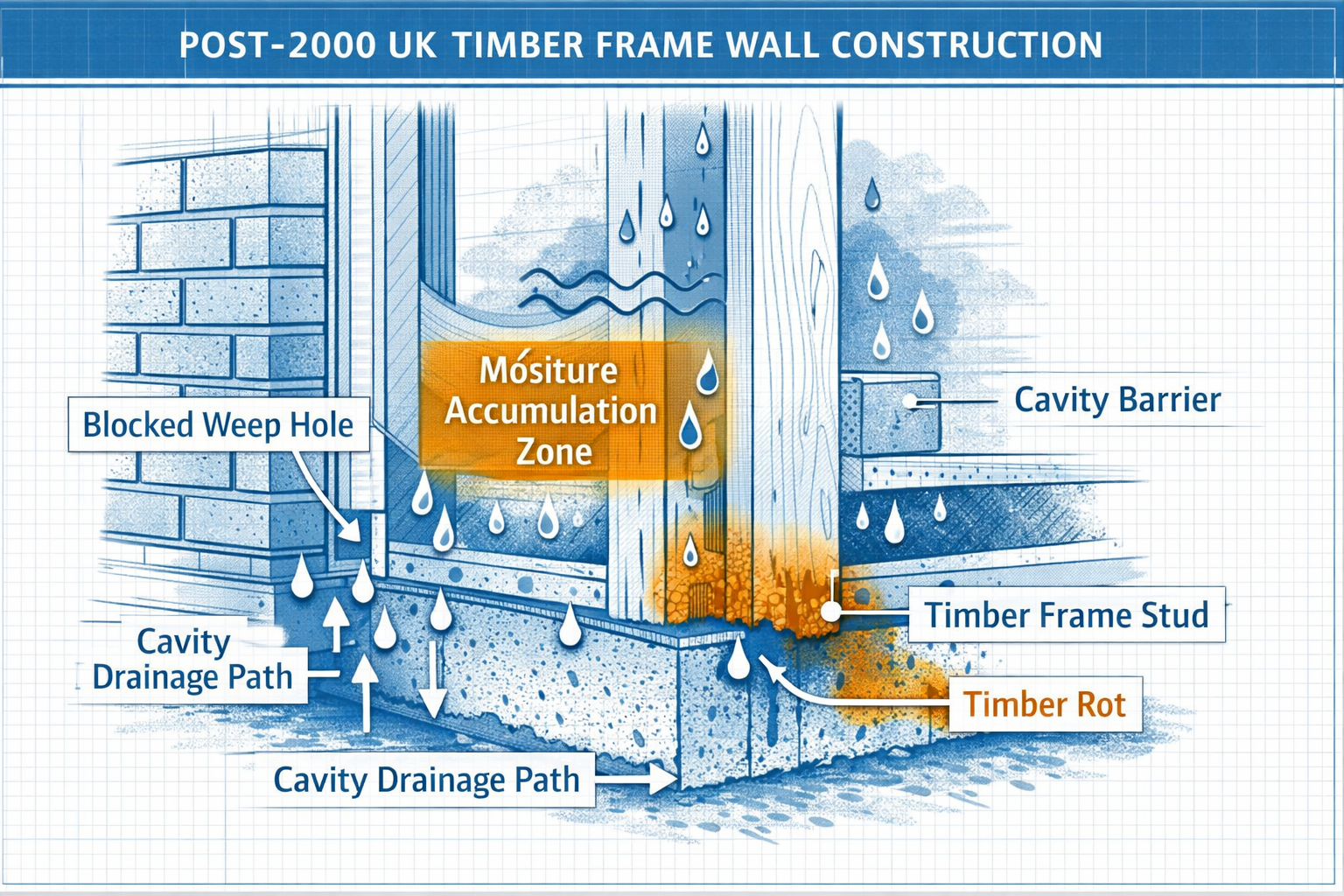
Timber frame construction surged in UK residential building from the late 1990s onward. Developers favoured it for speed of erection, thermal efficiency, and cost control. By the mid-2000s, it accounted for a substantial proportion of new private housing, particularly in Scotland and parts of the South East. Today, those homes are between 20 and 25 years old — old enough for early design and workmanship defects to manifest, but young enough that many buyers still assume they are purchasing a structurally sound modern home.
The core vulnerability lies in the cavity drainage system. In a properly constructed timber frame wall, a brick or render outer leaf sits in front of the structural timber frame, separated by an air cavity. Weep holes — small open perpendicular joints at the base of the outer leaf — allow any water that penetrates the cavity to drain freely. When these are blocked by mortar droppings during construction, sealed by subsequent pointing work, or simply omitted, water accumulates at the base of the cavity [3].
💧 Key risk: Trapped moisture at the base of the cavity contacts the timber sole plate and lower stud members. Given sustained moisture levels, wet rot can establish within 18–24 months in untreated or inadequately treated timber.
Government guidance on timber in construction identifies water ingress, humidity, and UV exposure as the primary risk factors affecting timber durability in modern builds [4]. The combination of impermeable modern membranes, reduced ventilation in energy-efficient designs, and blocked weep holes creates conditions that accelerate decay far faster than in traditionally built homes.
What Makes These Defects Hard to Detect
Several factors make weep hole failures and associated rot particularly challenging to identify during a standard building survey:
- Cladding conceals the cavity — surveyors cannot see behind brick or render without destructive investigation
- Early-stage rot produces no visible external signs — staining may only appear once decay is advanced
- Mortar blockages look like normal construction from the outside
- Modern render systems may completely obscure weep hole positions
- Internal finishes on the warm side of the frame hide moisture damage to inner faces of studs
Surveyors commenting on timber frames and cladding during Level 2 and Level 3 Building Surveys examine for rot, decay, movement, and structural concerns based on what is visibly accessible [1]. This is a critical limitation that buyers must understand before instructing a survey.
2026 RICS Protocols: What Building Surveys for Timber Frame Defects in Post-2000 UK Housing Now Require
The RICS Home Survey Standard 2nd edition, released in April 2026, represents the most significant update to residential survey protocols in several years [5]. Combined with the mandatory RICS Residential Retrofit Standard, it places heightened obligations on surveyors inspecting modern construction types, including timber frame homes.
Level 2 vs Level 3: Choosing the Right Survey
For any timber frame property, the choice of survey level is not a minor administrative decision — it has direct implications for what defects can be identified and reported.
| Survey Level | RICS Name | Timber Frame Coverage | Recommended? |
|---|---|---|---|
| Level 1 | Condition Report | Minimal — condition ratings only | ❌ Not suitable |
| Level 2 | HomeBuyer Report | Visual inspection, limited commentary | ⚠️ Limited |
| Level 3 | Building Survey | Full visual inspection, detailed defect reporting | ✅ Recommended |
A HomeBuyer Report vs Building Survey comparison makes clear that Level 3 is the appropriate choice for non-standard construction types, including timber frame. The additional cost — typically £800–£1,500 depending on property size and location — is modest against the potential remediation costs for undetected rot.
For buyers who have already exchanged or identified a specific concern, a Specific Defect Report can provide focused analysis of a suspected weep hole failure or moisture ingress issue.
The 2026 Level 3 Checklist for Timber Frame Properties
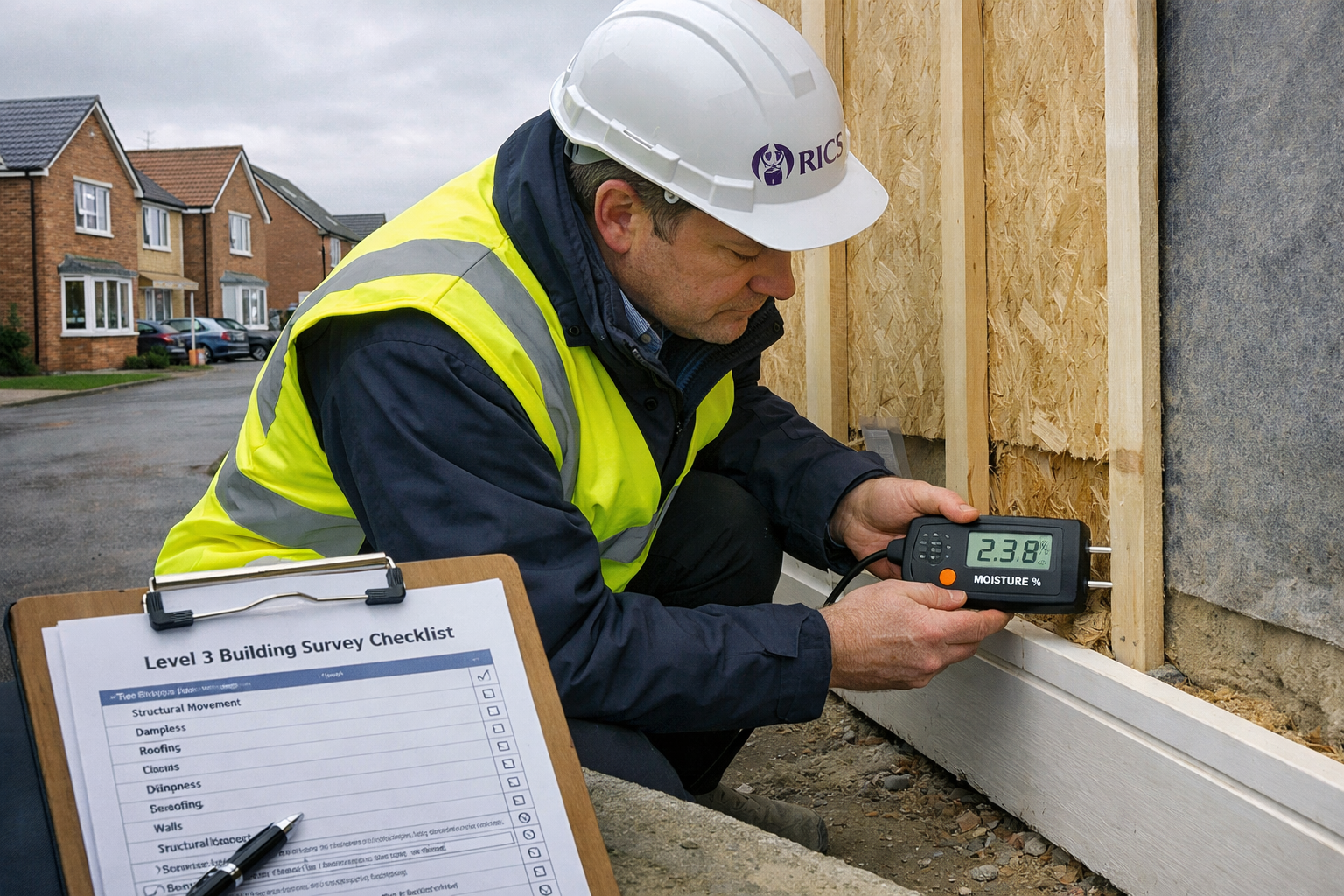
Under current RICS protocols, a Level 3 Building Survey of a post-2000 timber frame home should address the following elements:
External Envelope Assessment:
- ✅ Inspection of weep hole positions and visible blockages at DPC level
- ✅ Condition of mortar joints at base of outer leaf
- ✅ Evidence of staining, efflorescence, or tide marks on brickwork
- ✅ Condition of window and door reveals where frame meets cladding
- ✅ Visible condition of any exposed timber elements (fascias, soffits, bargeboards)
- ✅ Assessment of render condition where applicable
Moisture and Rot Indicators:
- ✅ Use of a calibrated moisture meter on accessible internal wall bases
- ✅ Inspection of ground floor perimeter internally for softness or staining
- ✅ Assessment of subfloor ventilation where applicable
- ✅ Identification of any visible fungal growth or timber discolouration
Specialist Referral Triggers:
- ✅ Recommendation for specialist timber survey where rot is suspected
- ✅ Recommendation for invasive investigation where moisture readings are elevated
- ✅ Flagging of cladding compliance concerns for fire safety engineer review
Surveyors are required to recommend specialist timber or fire safety inspections when suspected rot, infestation, or fire safety issues are identified — they cannot diagnose or verify concealed defects themselves [1]. This is not a limitation of surveyor competence; it is a defined professional boundary that protects both client and surveyor.
The Retrofit Standard's Impact on Concealed Defect Reporting
The mandatory RICS Residential Retrofit Standard requires surveyors to be alert to concealed property elements and deteriorated external components — such as mortar joints — that may not be immediately visible but affect structural integrity [3]. In practice, this means surveyors inspecting post-2000 timber frame homes in 2026 must:
- Explicitly note the construction type and its associated risk profile
- Record the presence or absence of visible weep holes
- Flag any mortar blockages as a significant defect rather than a minor maintenance item
- Recommend moisture testing of the cavity where access permits
The 2026 protocols place specific emphasis on identifying emerging defect patterns in post-2000 constructions, recognising that newer building methods present different failure modes than older housing stock [2]. A surveyor who treats a blocked weep hole as a cosmetic issue is not meeting the current standard.
Valuation Impacts, Remediation Costs, and Next Steps for Buyers
Understanding the defect is only half the picture. Buyers, sellers, and their advisers need to understand the financial implications before proceeding with a transaction.
How Rot and Weep Hole Failures Affect Property Valuation
When a Level 3 Building Survey identifies suspected or confirmed timber frame rot, the valuation impact depends on several factors:
- Extent of affected area — localised sole plate rot is far less costly than widespread stud damage
- Accessibility — rot behind render is more expensive to remediate than rot behind brick
- Structural significance — damage to load-bearing members triggers more serious concern
- Evidence of prior repair — undisclosed previous repairs can affect insurance and mortgage eligibility
A property with confirmed wet rot in the timber frame may face a valuation reduction of £15,000–£60,000 depending on scope, location, and the cost of remediation. Mortgage lenders may retain funds or decline lending entirely until remediation is complete and verified.
Working with chartered surveyors in London or the relevant regional area who understand post-2000 construction defects is essential for an accurate assessment.
Remediation Cost Ranges (2026 Estimates)
| Defect Scope | Typical Remediation Cost | Timeframe |
|---|---|---|
| Weep hole clearance only | £200–£800 | 1 day |
| Localised sole plate replacement | £3,000–£8,000 | 3–5 days |
| Single elevation stud replacement | £8,000–£20,000 | 1–2 weeks |
| Full perimeter frame remediation | £25,000–£60,000+ | 4–8 weeks |
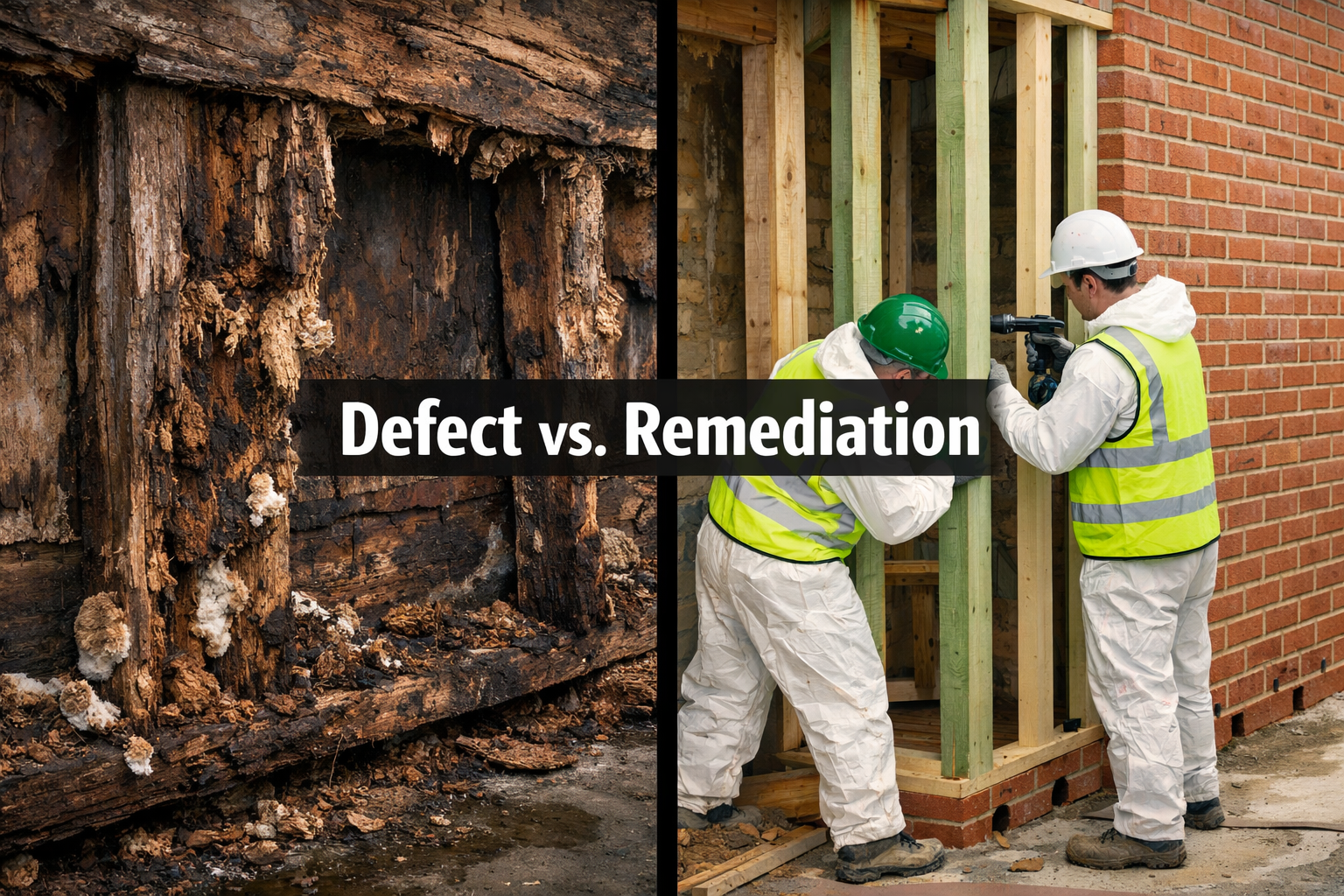
These figures assume brick outer leaf removal and reinstatement. Render systems may reduce access costs but increase complexity. All remediation should use pre-treated structural timber and must include correctly spaced, unobstructed weep holes in the reinstated outer leaf.
When to Commission a Structural Survey
Where a Level 3 Building Survey flags significant moisture readings or visible rot, the next step is typically a structural survey by a structural engineer or specialist timber contractor. This will involve:
- Targeted removal of cladding at affected areas
- Visual and probe assessment of timber members
- Moisture content measurement of structural elements
- Specification of remediation works with cost estimates
This report then forms the basis for price negotiation, retention of funds, or — in severe cases — withdrawal from the transaction.
Protecting Buyers: Practical Next Steps
For anyone purchasing a post-2000 timber frame property in 2026, the following steps represent best practice:
-
Always instruct a Level 3 Building Survey — not a Level 2 or basic condition report. If unsure which survey is needed, a guide to what survey you need can help clarify the decision.
-
Ask the surveyor explicitly whether the property is timber frame construction and request that weep holes and cavity drainage are specifically addressed in the report.
-
If the roof is complex or has multiple slopes, consider supplementing the survey with a drone roof survey to identify any additional moisture entry points at eaves and verges.
-
Review the survey report carefully for any moisture meter readings above 20% in timber elements — this is a threshold that typically triggers specialist referral.
-
Negotiate on the basis of specialist reports — do not accept a seller's assurance that "it's just a bit of damp." Weep hole failures are systemic, not incidental.
-
For new-build timber frame homes, a snagging report should be commissioned before legal completion to identify weep hole blockages and other construction defects while the developer is still obligated to remedy them.
A Note on Cladding Compliance
Surveyors can note the type and visible condition of cladding materials, but only certified fire safety engineers can verify compliance with building regulations [1]. On post-2000 timber frame homes with composite or non-traditional cladding, a separate fire safety assessment may be required — particularly for properties above 11 metres or those subject to EWS1 requirements. This is a separate process from the building survey and should not be conflated with it.
Conclusion: Acting on 2026 Survey Findings Before They Become Structural Crises
The convergence of ageing post-2000 timber frame stock, updated RICS protocols, and growing surveyor awareness of weep hole failure patterns means that 2026 is a pivotal year for buyers and owners of this construction type. The defects are real, the financial consequences are significant, and the survey tools to identify them — at least at a preliminary level — are now clearly defined.
Actionable next steps:
- 🔍 Commission a Level 3 Building Survey from a RICS-accredited surveyor with demonstrable experience in timber frame construction
- 📋 Request explicit commentary on weep hole condition, cavity drainage, and moisture meter readings in the survey brief
- 🏗️ Follow up suspected defects with a specialist timber survey and structural engineer's report before exchange
- 💷 Use remediation cost estimates as a basis for price renegotiation — do not proceed at full price where significant rot is identified
- 🆕 For new builds, ensure a snagging inspection captures weep hole provision before the developer's defects liability period expires
Building surveys for timber frame defects in post-2000 UK housing, conducted under 2026 RICS protocols for rot and weep hole failures, are not a bureaucratic exercise — they are the primary line of defence against purchasing a property with a hidden structural liability. The protocols exist precisely because these defects are common, consequential, and entirely preventable with the right professional advice at the right stage of a transaction.
References
[1] Do Surveyors Check Timber Frames Cladding 2025 – https://surveymatch.co.uk/do-surveyors-check-timber-frames-cladding-2025/
[2] Building Survey Checklists For Bungalow Purchases 2026 Rics Guidance On Structural Risks And Costs – https://nottinghillsurveyors.com/blog/building-survey-checklists-for-bungalow-purchases-2026-rics-guidance-on-structural-risks-and-costs
[3] The Proposed New Rics Residential Retrofit Standard – https://www.rpclegal.com/thinking/construction/the-proposed-new-rics-residential-retrofit-standard/
[4] Timber In Construction Roadmap 2025 – https://www.gov.uk/government/publications/timber-in-construction-roadmap-2025/timber-in-construction-roadmap-2025
[5] Home Survey Standard 2nd Edition April 2026 Update – https://www.rics.org/news-insights/home-survey-standard-2nd-edition-april-2026-update
[7] Adapting Building Surveys For 2026 Retrofit Projects Rics Guidance Post Quality In Retrofit Summit – https://nottinghillsurveyors.com/blog/adapting-building-surveys-for-2026-retrofit-projects-rics-guidance-post-quality-in-retrofit-summit





